Search

Showing posts with label 19th century legal history. Show all posts

15 October 2026

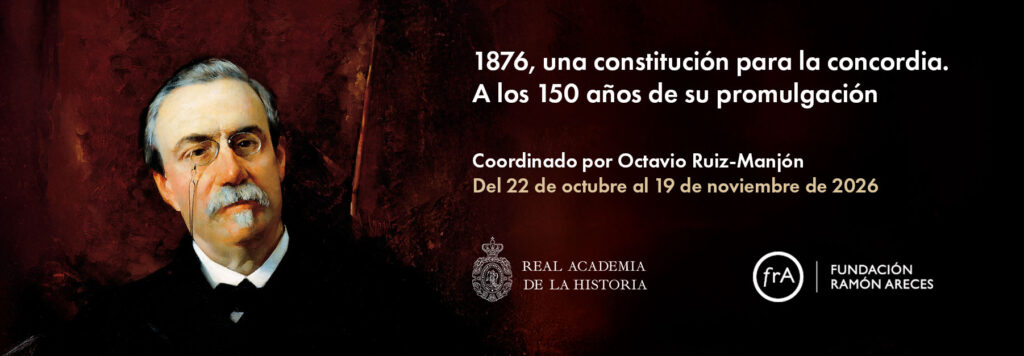
LECTURE: Octavio RUIZ-MANJÓN, "El planteamiento de la Restauración canovista" [Lecture Series 1876, une constitución para la concordia. A los 150 años de su promulgación, coord. Octavio RUIZ-MANJÓN] (Madrid: Real Academia de la Historia, 22 OCT 2026)


(image source: RAH)

Abstract:

El pasado 30 de junio se cumplieron 150 años de la firma de la Constitución de la Monarquía Española que estuvo plenamente vigente hasta 1923. Fue una ley en la que, bajo la influencia de Antonio Cánovas del Castillo, predominó la idea de inclusión de la mayor parte de las fuerzas políticas a partir de los principios de transigencia y de tolerancia, así como por la de flexibilidad en su desarrollo posterior. La prolongada vigencia del texto constitucional facilitó la afirmación de un consistente sistema de predominio civil y la consecución de un elevado nivel de libertades personales. En los días finales de 1874, la situación política española parecía agotada y la situación política internacional parecía apuntar hacia la consolidación de regímenes de autoridad. En Francia se ensayaba un cierto cesarismo militar después de las convulsiones revolucionarias de 1871, mientras que acababa de establecerse el Imperio alemán, de tono conservador. Todo parecía apuntar hacia regímenes de orden.

More information on all lectures in the series here. 


02 October 2026

BOOK REVIEW: Elisabetta FUSAR POLI, Law and art in the 19th century. Power in images, eds. Giovanni ROSSI and Pietro SCHIRÒ (Pisa: Pacini, 2024) (Comparative Legal History, XIV (2026), nr. 1 (June), pp. 158-161)

(image source: Taylor&Francis)

The book edited by Giovanni Rossi and Pietro Schirò (opening the 'Immagini, Diritto e Storia' series directed by Rossi himself) is a collaborative effort that owes its overall value first of all to its editors drawing on their long-standing academic background in the Law and Humanities field. Notably, they sought to explore the intertwining of law, power, and images in the nineteenth century, sparking a broad international debate through the conference (held in Verona, 19-21 October 2022) which gave rise to the book and nurtured its truly appreciable diversity of contents and perspectives. 

This plurality has been appropriately structured by the editors into four sections: ‘The Representation of Power', 'Revolutions, Laws, Art', 'The Force of Law and the Tyranny of Power’, and ‘Tangible Forms of Law'. Rossi's introduction ('A proposito di immagini e di diritto. Un percorso tra visual culture e storia legale', 9-31) helps clarify this inner structure and is, at the same time, an integral part of the volume, serving as both a 'map for sailors' and a toolbox for the reader: It is indeed a substantial introduction, which can also be considered partly programmatic. According to Rossi's introduction, the image (artistic or not) takes on an important heuristic value, as a vehicle, a medium of ideas, concepts, and values connected to law and power, if not also an essential part of an affirmative or negative narrative of power itself. The 'gamble' that animates the scientific and editorial project of the conference and book is that of 'guaranteeing depth and historical interpretation to an aspect as pervasive as it is often underestimated, such as that of the translation into images of the values and myths of law and power. In other words, the aim is 'laying bare the colossal operation of […]


To read the full review, please click here. Online access is free for members of the European Society for Comparative Legal History.


DOI: https://www.tandfonline.com/doi/full/10.1080/2049677X.2026.2671634

10 June 2026

BOOK: Anna O. LAW, Migration and the Origins of American Citizenship. African Americans, Native Americans, and Immigrants (Oxford: OUP, 2026), 304 p. ISBN 9780197660096, 19,99 GBP


(image source: OUP)

Abstract:

Since the late nineteenth century, the US federal government has enjoyed exclusive authority to decide whether someone has the ability to enter and stay in US territory. But freedom of movement was not guaranteed in the British colonies or early US. By contrast, voluntary migrants were met with strict laws and policies created by colonies and states, which denied free mobility and settlement in their territories to unwanted populations. Migration and the Origins of American Citizenship presents a story of constitutional development that traces the confluence of the logics of slavery and settler colonialism in early legal rulings and public policy about migration and citizenship. The book examines the division of labor between the national and state governments that endured for over a century, reasons why that arrangement changed in the late nineteenth century, and what the transformation meant for people subject to those regimes of control. Drawing into one study the migration policy histories of groups of people that are usually studied separately, and combining the methodologies of political science, history, and law, Anna O. Law reveals the unmistakable effects of slavery and Native American dispossession in modern US immigration policy.

Table of contents:

Introduction
1:Sifting Migrants
2:Belonging
3:Migration and Citizenship at the Founding
4:Regulating International Borders
5:Regulating Interstate Borders
6:Formal Citizenship Defined
7:Historical Antecedents and Legal Precedents

Epilogue: Continuity, Change, and Constitutional Memory

 On the author:

is the Herbert Kurz Chair in Constitutional Rights in the Department of Political Science at CUNY Brooklyn College. She completed her PhD in Government at the University of Texas at Austin. Her publications appear in political science, history, and law journals and investigate the interaction between law, legal institutions, and politics. Her first book, The Immigration Battle in American Courts (2010), examined the role of the federal judiciary in U.S. immigration. She teaches and researches in U.S. constitutional law, federal courts, U.S. immigration policy history, federalism, American Political Development, and race/ethnicity.

 Read more here.


24 March 2026

CONFERENCE: Le Code pénal belge. Regards historiques et comparatifs (XVIe-XXIe siècles) /The Belgian Penal Code. Historical and Comparative Perspectives (XVIth-XXIth centuries) (Brussels: Academy Palace, 18 MAY 2026)


To mark the entry into force of the new Belgian Penal Code, originally scheduled for 8 April but ultimately postponed until 1 September 2026, Jérôme de Brouwer, Professor at the Université libre de Bruxelles, François Pierrard, F.R.S.-FNRS Postdoctoral Researcher at UCLouvain, and Édouard Delrée, PhD student at the ULB, are organising a conference on 18 May entitled ‘Le Code pénal belge. Regards historiques et comparatifs (XVIe-XXIe siècles)’ / ‘The Belgian Penal Code. Historical and Comparative Perspectives (16th–21st centuries)’. The aim of this conference is to offer a historical and comparative perspective on Belgian criminal codification. It will seek to situate the gradual development of the concept of the Penal Code within the European and then colonial context, from the Spanish Netherlands to contemporary Belgium. The conference will take place on 18 May 2026, from 9am to 6pm, at the Palace of Academies, Rue Ducale 1, 1000 Brussels. Admission is free, but registration is compulsory (contact: pierrard.francois@uclouvain.be).

À l'occasion de l'entrée en vigueur du nouveau Code pénal belge initialement prévue le 8 avril mais finalement reportée au 1er septembre 2026, François Pierrard, chargé de recherches F.R.S.-FNRS à l'UCLouvain sous la direction de Wim Decock, organise avec Jérôme de Brouwer, professeur à l'Université libre de Bruxelles, un colloque intitulé "Le Code pénal belge. Regards historiques et comparatifs (XVIe-XXIe siècles)" / "The Belgian Penal Code. Historical and Comparative Perspectives (XVIth-XXIth centuries)". Ce colloque a pour but d'offrir une perspective historique et comparative à la codification pénale belge. Il s'agira de replacer l'élaboration progressive du concept de code pénal dans le contexte européen et puis colonial des Pays-Bas espagnols à la Belgique contemporaine. Le colloque se tiendra le 18 mai 2026, de 9h à 18h, au Palais des Académies, Rue Ducale 1, 1000 Bruxelles. L'entrée est libre, mais l'inscription est obligatoire (contact : pierrard.francois@uclouvain.be).


Le Code pénal belge. Regards historiques et comparatifs           (XVIe-XXIe siècles)

The Belgian Penal Code. Historical and Comparative Perspectives (XVIth-XXIth centuries)


Palais des Académies,

Rue Ducale 1, Bruxelles

18.05.2026

A)       L’élaboration du concept de code pénal                                                            The development of the concept of a criminal code

I)                    De l’uniformisation à la codification                                                                                          From standardisation to codification

Président de séance / Chairperson : Jean-Marc Hausman (UCLouvain, Katholieke Universiteit Leuven)

9:00 : Introduction

Jérôme de Brouwer (ULB), François Pierrard (FNRS, UCLouvain) et Édouard Delrée (ULB)

9:30 : Le plus difficile : définir le concept

Dirk Heirbaut (Universiteit Gent) 

10:00 : The myths of criminal law codes

Aniceto Masferrer (Universitat de València) 


Pause-café / Coffee break


II)                  La séparation du droit pénal substantiel et procédural                                                The separation of substantive and procedural criminal law

Président de séance / Chairperson : Wim Decock (UCLouvain, Université de Liège)


11:00 : Les premières tentatives de codification. Des Ordonnances criminelles de Philippe II au Règlement provisionnel pour la procédure criminelle de Joseph II (1570-1787)

François Pierrard (FNRS, UCLouvain) 

11:30 : From the old to the new criminal law. Innovative aspects of the codification of criminal law of Joseph II (1787) compared with the Constitutio Criminalis Theresiana                         Thomas Simon (Universität Wien) 

12:00 : L’expérience française de la codification pénale (1791-1810)

Liêm Tuttle (Université Panthéon-Sorbonne)

Buffet froid / Cold buffet

B)       Le changement de paradigme de la codification pénale                 The paradigm shift in criminal codification

I)                    Les aléas de l’élaboration d’un code national                                                                                                 The challenges of developing a national code  

Président de séance / Chairperson : Nicolas Simon (Académie royale de Belgique)


14:00 : à la recherche d’un code pénal pour le royaume des Pays-Bas (1815-1830). Une divergence entre le nord et le sud ?

Fred Stevens (Katholieke Universiteit Leuven)

14:30 : Observation, expérimentation : les sciences au service de la codification pénale en Belgique au 19e siècle

Jérôme de Brouwer (ULB) 

15:00 : Le Code pénal belge de 1867 lu par la doctrine française

Tanguy Le Marc’hadour (Université d’Artois) 

Pause-café / Coffee break


II)                  L’influence et le devenir du premier Code pénal belge                                 The The influence and future of the first Belgian Penal Code    

Présidente de séance / Chairperson : Marie-Aude Beernaert (UCLouvain)

16:00 : Du Code pénal de 1867 aux lois de défense sociale en Belgique. Deux logiques antagonistes et complémentaires pour lutter contre le crime                                                                Yves Cartuyvels (UCLouvain Saint-Louis Bruxelles) 

16:30 (sur Teams) :  L’influence du droit belge sur le Code pénal congolais de 1940 à nos jours                                                                                                                                                                           Pacifique Magadju (Université Catholique de Bukavu)

17:00 : Des codifications jumelles aux destins opposés : trajectoires croisées des codes pénaux et du Code d’instruction criminelle en Belgique de 1831 à nos jours                                            Édouard Delrée (ULB)

Conclusion


17:30 : D’un code à l’autre                                                                                                                                         Jérôme de Brouwer (ULB), François Pierrard (FNRS, UCLouvain) et Édouard Delrée (ULB)


Contact : pierrard.francois@uclouvain.be


Fonds de la recherche scientifique — Wikipédia


19 March 2026

BOOK: Nathaniel BOYD, Hegel and German Public Law [Europe's Legacy in the World, eds. Martti KOSKENNIEMI & Annabel BRETT] (London: Bloomsbury/Hart, 2026), 304 p. ISBN 9781350584204, 85 GBP


(image source: Bloomsbury)

Abstract:

Nathaniel Boyd's pathbreaking book argues that Hegel's political thought was shaped by German public law. This tradition of legal discourse, especially through its imperial tradition, was crucial to European modernity, influencing foundational philosophical concepts such as sovereignty, the state and the diverse legal systems that emerged from them. Hegel and German Public Law examines the impact of Johann Jacob Moser, Johann Stephan Pütter and Johann Christian von Majer on Hegel's intellectual development. It reveals how the collapse of the Holy Roman Empire informed his early speculative system and constitutional theory. In doing so, Boyd extends our understanding of Hegel's relation to European legal and political thought while offering an original interpretive framework for Hegel's absolute idealism and unfolding institutional theory of the state.

Table of contents:

Introduction
1. Imperial Public Law in Statu Cadentis Imperii: Johann Jacob Moser
2. The Empire as the Impersonal Nexus of the Composite State: Johann Stephan Pütter3. The Twilight of German Imperial Public Law: Johann Christian von Majer4. The Empire of Ethical Life: Georg Wilhelm Friedrich HegelConclusionBibliography

Index

Read more here. 


03 November 2025

BOOK: Michał GALEDEK and Anna TARNOWSKA, Shaping the Congress Kingdom of Poland (1815–1830). The Interconnectivity of Constitutional and Liberal Ideas in Europe after Napoleon [Legal History Library, eds. Dirk HEIRBAUT, Michelle MCKINLEY, Matthew C. MIROW & C.H. VAN REE; vol. 79] (Leiden/Boston: Martinus Nijhoff/Brill, 2025), ISBN 978-90-04-73992-5, € 191,18


(image source: Brill)


Abstract:
Should the dispute over the interpretation of the 1815 constitution of Congress Poland be considered a key factor that shaped Polish political liberalism, and if so, why? The authors of this volume explore this question against the backdrop of constitutional development in post-Napoleonic Europe. The aim of this book is to illustrate the mutual interdependence between political liberalism and constitutionalism after the Congress of Vienna and to examine how Western European constitutional and liberal ideas intermingled with traditional Polish aristocratic republicanism.

On the authors:

Michał Gałędek, Dr. iur. (2010), Dr. hab. iur. (2018), is Professor and Chair of the Department of Legal History at the University of Gdańsk, as well as Vice-President for Science of the Polish Society for Legal History. His most recent monograph is Ideology and Private Law: Polish Experiences in the Long 20th Century (Brill, 2025). Anna Tarnowska, Dr. iur (2007), Dr hab. iur. (2020), is Professor at the Nicolaus Copernicus University in Toruń's Department of the History of Legal and Political Thought and German Law, Chairwoman of the Legal-Economic Chapter of the Scientific Society in Toruń, and Vice-President of the Polish Society for Legal History. She has authored numerous books and articles on legal history and constitutionalism. 

Read more here: DOI 10.1163/9789004739925. 


23 October 2025

BOOK: Fernando CASTRILLO DÁVILA, Entre justicia, poder y política. La Suprema Corte en el régimen liberal mexicano, 1853-1882 (México: Tirant lo Blanch / Barra Mexicana de Abogados, 2025) pp. 384, ISBN: 9788410952102, $ 489.00 MXN


(Source: Tirant lo Blanch)

ABOUT THE BOOK 


La Constitución de 1857 establecía que, en ausencia del presidente de la república, el presidente de la Suprema Corte de Justicia debía asumir interinamente su cargo. Aunque esta disposición surgió como una fórmula excepcional para asegurar la continuidad del gobierno y prevenir disputas por el poder, desde 1858 hasta 1877, todos los presidentes del máximo tribunal, sin excepción, reclamaron en algún momento la titularidad del Ejecutivo. Con frecuencia, estas pretensiones políticas desataron conflictos que profundizaron la crisis que ya vivía el Estado a consecuencia de la imposición modernizadora de la Reforma liberal. El presente trabajo estudia estos conflictos por la presidencia a la luz de otro precepto fundamental en el arreglo de la judicatura federal, a saber, la elección popular de los magistrados, novedad democrática de la Constitución liberal. De esta manera, la obra explora las consecuencias que tuvo la convergencia de ambas disposiciones constitucionales, la alternativa que permitió corregir el problema en la década de 1880 y el difícil ejercicio de las atribuciones políticas de la Corte durante las décadas de consolidación del Estado liberal.


Series: Historia del Derecho en América Latina.


ABOUT THE AUTHOR 

Fernando Castrillo Dávila es doctor en Historia por el Colegio de México. Se ha dedicado al estudio del constitucionalismo y de las instituciones políticas mexicanas de la segunda mitad del siglo XIX y de principios del XX. Entre sus publicaciones recientes destaca su libro 'La guerra que nos hizo nación. La arqueología del nacionalismo liberal en México y Puebla, 1855-1872', publicado por la Secretaría de Cultura de Puebla en 2022. Ha sido docente en la Universidad Iberoamericana-Puebla y actualmente es investigador posdoctoral en el Instituto de Ciencias Sociales y Humanidades de la Benemérita Universidad Autónoma de Puebla.

More information with the publisher.