Search

Showing posts with label migration. Show all posts

10 June 2026

BOOK: Anna O. LAW, Migration and the Origins of American Citizenship. African Americans, Native Americans, and Immigrants (Oxford: OUP, 2026), 304 p. ISBN 9780197660096, 19,99 GBP


(image source: OUP)

Abstract:

Since the late nineteenth century, the US federal government has enjoyed exclusive authority to decide whether someone has the ability to enter and stay in US territory. But freedom of movement was not guaranteed in the British colonies or early US. By contrast, voluntary migrants were met with strict laws and policies created by colonies and states, which denied free mobility and settlement in their territories to unwanted populations. Migration and the Origins of American Citizenship presents a story of constitutional development that traces the confluence of the logics of slavery and settler colonialism in early legal rulings and public policy about migration and citizenship. The book examines the division of labor between the national and state governments that endured for over a century, reasons why that arrangement changed in the late nineteenth century, and what the transformation meant for people subject to those regimes of control. Drawing into one study the migration policy histories of groups of people that are usually studied separately, and combining the methodologies of political science, history, and law, Anna O. Law reveals the unmistakable effects of slavery and Native American dispossession in modern US immigration policy.

Table of contents:

Introduction
1:Sifting Migrants
2:Belonging
3:Migration and Citizenship at the Founding
4:Regulating International Borders
5:Regulating Interstate Borders
6:Formal Citizenship Defined
7:Historical Antecedents and Legal Precedents

Epilogue: Continuity, Change, and Constitutional Memory

 On the author:

is the Herbert Kurz Chair in Constitutional Rights in the Department of Political Science at CUNY Brooklyn College. She completed her PhD in Government at the University of Texas at Austin. Her publications appear in political science, history, and law journals and investigate the interaction between law, legal institutions, and politics. Her first book, The Immigration Battle in American Courts (2010), examined the role of the federal judiciary in U.S. immigration. She teaches and researches in U.S. constitutional law, federal courts, U.S. immigration policy history, federalism, American Political Development, and race/ethnicity.

 Read more here.


01 December 2025

SERIES: Émigrés européens - des récits oubliés/Auswandern! Deutsche Schicksale aus drei Jahrhunderten (arte.tv)


(image source: arte)

Arte devotes a series of three episodes to migration, including the legal aspects.

Abstract (French):

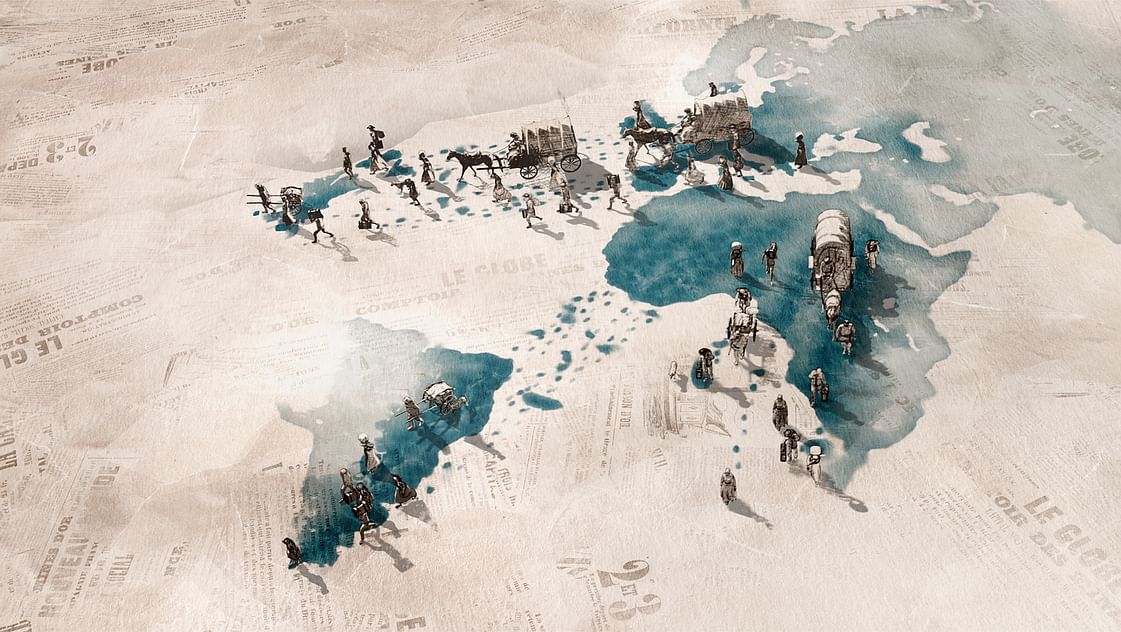
C’est l’histoire de l’une des plus grandes migrations européennes. Celle de gens fuyant la misère ou les persécutions et espérant une vie meilleure. Ils vont descendre les fleuves du Rhin et du Danube, du XVIIe siècle jusqu'au lendemain de la première guerre mondiale, et vont peupler des contrées en Amérique, dans l’Est de l’Europe, en Russie et sur le continent africain.

Abstract (German):

Deutsche Auswanderer haben – im Guten wie im Schlechten – die Welt geprägt. Was 1618, zu Beginn des 30-jährigen Krieges am Rhein begann, wird zur Geschichte einer Migration über drei Jahrhunderte und vier Kontinente. Millionen Deutschsprachige flohen vor Verfolgung, Hunger und Kälte, suchten in der Ferne ein besseres Leben – und wurden dabei oft zu Spielbällen im Machtkampf um neue Territorien. Eine Geschichte von Hoffnung, Flucht und Neuanfang.

Watch all episodes for free here


30 November 2023

BOOK: Cátia ANTUNES & Eric TAGLIACOZZO (eds.), Vol. I, Migration, 1400-1800 [The Cambridge History of Global Migrations, ed. Donna GARACCIA] (Cambridge: Cambridge University Press, 2023), 650 p. ISBN 9781108767095, 120 GBP

(image source: CUP)

Abstract:
Volume I documents the lives and experiences of everyday people through the lens of human movement and mobility from 1400–1800. Focusing on the most important typologies of pre-industrial global migrations, this volume reveals how these movements transformed global paths of mobility, the impacts of which we still see in societies today. Case studies include those that arose from the demand of free, forced and unfree labour, long and short distance trade, rural/urban displacement, religious mobility and the rise of the number of refugees worldwide. With thirty chapters from leading experts in the field, this authoritative volume is an essential and detailed study of how migration shaped the nature of global human interactions before the age of modern globalization.

Table of contents:

Introduction Cátia Antunes and Eric Tagliacozzo
Part I. Slavery/Forced Migration:
1. Slavery, captivity and mobilities in the early modern Mediterranean Guillaume Calafat and Mathieu Grenet
2. Africans on the move: the transatlantic slave trade Damian Alan Pargas
3. Debt, bondage and indentured labour in land and maritime empires Alessandro Stanzani
Part II. Long Distance Trade:
4. Long-distance trade, the Pacific Paul D'Arcy
5. Long-distance Japanese trade in the early modern era Adam Clulow
6. Long-distance trade and migration in Central Asia, 1500-1850 Magnus Marsden
Part III. Short Distance Trade:
7. Maritime migrations of the Eastern Mediterranean and the Black Sea Gelina Harlaftis and Katerina Galani
8. Mobility and migration around the Bay of Bengal David Ludden
9. Early modern Japan: a state with limited migration Robert Hellyer
Part IV. Migration by Land:
10. Indigenous mobility in the lowlands of South America Cristina Pompa
11. Chinese expansion in eighteenth-century central Eurasia Peter C. Perdue
12. Persianate peregrinations: elite migration in Eurasia, from the eleventh to nineteenth centuries James Pickett
Part V. Migration by Sea:
13. Western European long-distance movements Erik Odegard
14. Emigration, displacement, and forced migration in Indian Ocean Africa Jeremy Prestholdt
15. Migration by Sea in the Arabian Sea and the Persian Gulf, 1700–1800 Seema Alavi
Part VI. Rural/Urban Migrations:
16. Urban migration and gender diversity in Eurasia, 1600–1800 Manon van der Heijden
17. Urbanization and emigration in Coastal South China Steven Miles
18. Migration in Colonial Latin America Roberta Stumpf
Part VII. Labour Migration:
19. The globality of the Local – (Im)Mobilizing labor regimes under early capitalism and European colonial expansion Matthias van Rossum
20. Afro-India migrations and the Indianization of East Africa 5000 BCE to 1900 CE Nidhi Mahajan
21. Labour migration in Sub-Saharan Africa Before 1800 Filipa Ribeiro da Silva
Part VIII. Settler Migration:
22. North America: migrations and settlement (c. 1600 – c. 1800) Bertrand Van Ruymbeke
23. Turkish migrations in the Greater Turkic-Speaking World, 1450–1830 Suraiya Faroqhi
24. Dynamics of mobility and settlement in Africa: the horn of Africa, 13th – 19th Centuries Deresse Ayenachew Woldetsadik
Part IX. Religious Migrations:
25. Early modern diasporas Natalia Muchnik
26. Religious components of Southeast Asian migration Francis R. Bradley
27. Migrant clerics going East and West José Pedro Paiva
Part X. Refugees:
28. Refugees in Europe and the Atlantic World Geert H. Janssen
29. 'Mongol' and 'Manchu' and the great conquest enterprises of Eurasia, 1200–1800 Pamela Kyle Crossley

30. Refugees in Africa (1490–1820) Rémi Dewière. 

On the editors:

Cátia Atunes is Professor of History and Global Economic Networks at Leiden University. She has published, edited, and translated monographs and articles on the exploitation of early modern empires and the transition from colonialism to imperialism. She is co-editor, with Francisco Bethencourt, of Merchant Cultures: A Global Approach to Spaces, Representations and Worlds of Trade, 1500–1800 (2022).

Eric Tagliacozzo is John Stambaugh Professor of History at Cornell University. He is the director of the Comparative Muslim Societies Program at Cornell University. His book Secret Trades, Porous Borders: Smuggling and States Along a Southeast Asian Frontier, 1865–1915 (2005)won the Harry Benda Prize from the Association for Asian Studies (AAS).

Contributors:

Cátia Antunes, Eric Tagliacozzo, Guillaume Calafat, Mathieu Grenet, Damian Alan Pargas, Alessandro Stanzani, Paul D'Arcy, Adam Clulow, Magnus Marsden, Gelina Harlaftis, Katerina Galani, David Ludden, Robert Hellyer, Cristina Pompa, Peter C. Perdue, James Pickett, Erik Odegard, Jeremy Prestholdt, Seema Alavi, Manon van der Heijden, Steven Miles, Roberta Stumpf, Matthias van Rossum, Nidhi Mahajan, Filipa Ribeiro da Silva, Bertrand Van Ruymbeke, Suraiya Faroqhi, Deresse Ayenachew Woldetsadik, Natalia Muchnik, Francis R. Bradley, José Pedro Paiva, Geert H. Janssen, Pamela Kyle Crossley, Rémi Dewière 

Read more here: DOI 10.1017/9781108767095.

04 September 2023

BOOK: Kalyani RAMNATH, Boats in a Storm: Law, Migration, and Decolonization in South and Southeast Asia, 1942–1962 (Stanford, CA: Stanford University Press, 2023), 308 pp, ISBN 9781503632981, $90


(image courtesy: Stanford University Press) 

Book description: 
For more than century before World War II, traders, merchants, financiers, and laborers steadily moved between places on the Indian Ocean, trading goods, supplying credit, and seeking work. This all changed with the war and as India, Burma, Ceylon, and Malaya wrested independence from the British empire. Set against the tumult of the postwar period, Boats in a Storm centers on the legal struggles of migrants to retain their traditional rhythms and patterns of life, illustrating how they experienced citizenship and decolonization. Even as nascent citizenship regimes and divergent political trajectories of decolonization papered over migrations between South and Southeast Asia, migrants continued to recount cross-border histories in encounters with the law. These accounts, often obscured by national and international political developments, unsettle the notion that static national identities and loyalties had emerged, fully formed and unblemished by migrant pasts, in the aftermath of empires.
Drawing on archival materials from India, Sri Lanka, Myanmar, London, and Singapore, Kalyani Ramnath narrates how former migrants battled legal requirements to revive prewar circulations of credit, capital, and labor, in a postwar context of rising ethno-nationalisms that accused migrants of stealing jobs and hoarding land. Ultimately, Ramnath shows how decolonization was marked not only by shipwrecked empires and nation-states assembled and ordered from the debris of imperial collapse, but also by these forgotten stories of wartime displacements, their unintended consequences, and long afterlives.


Table of contents: 
Introduction: Boats in a Storm
1 1942
2 Banana Money
3 Partnership Deeds
4 Application Forms
5 Women Who Wait
6 Red Flags
7 1962
Conclusion: An Uneasy Calm

About the author: 
Kalyani Ramnath is Assistant Professor of History at University of Georgia.

More information can be found here

06 March 2023

SEMINAR: O sacerdote imigrante como desafio de governança durante o Brasil imperial: perspectivas do Conselho de Estado e da Santa Sé (Online). 10 March, 10:30


(Source: https://studiumiurisufmg.wordpress.com/)

On 10 March, 10:30 (Brasília time), Anna Clara Lehmann Martins will discuss about migrating priests in imperial Brazil, and how both the national government and the Holy See managed them. This event is promoted by the Brazilian Society of 19th century studies. Link: https://www.youtube.com/@SociedadedoOitocentos/streams

30 August 2021

BOOK: Philippe RYGIEL, L’ordre des circulations ? L’Institut de Droit international et la régulation des migrations (1870-1920) [Coll. « Histoire contemporaine »] (Paris: Éditions de la Sorbonne, 2021), ISBN 9791035106348


(image source: CNRS Histoire Sociale)

Description:
Le contrôle des migrations affectant le territoire d’un État est souvent conçu comme relevant de la seule compétence de celui-ci : tout passage de frontière, tout séjour d’un étranger, pourtant, mettent en contact plusieurs souverainetés et instaurent entre elles des échanges, des négociations, ou suscitent des conflits. Les fondateurs du droit international moderne, réunis à la fin du XIXe siècle par l’Institut de droit international, en étaient bien conscients. Fins observateurs du monde de leur temps, qu’ils entendaient ordonner selon le droit, ils consacrent alors aux implications des mobilités humaines des milliers de pages, et au meilleur moyen de les régler de nombreux débats, soucieux qu’ils étaient d’instaurer un ordre des circulations libéral, condition à leurs yeux de la prospérité de chacun et de la paix entre les nations occidentales. Ils entreprennent ainsi, non sans connaître de véritables succès, d’assurer un statut juridique aux étrangers résidant en Occident, de protéger les réfugiés de la vindicte des États, de dénoncer enfin les entraves trop manifestes à la liberté de circulation. Les guerres brutales que connut l’Europe, sa division en aires d’influence rivales, l’affaissement de la civilisation européenne consécutif à la Première Guerre mondiale ont fait tomber dans l’oubli ces travaux fondateurs autant que leurs réalisations effectives, dont beaucoup ne survécurent toutefois pas à l’effondrement du monde qui les avait vu naître. Ce livre retrace leur histoire et leurs combats, en un temps que marque à nouveau autant la nécessité d’un ordre mondial des mobilités humaines que l’apparente impossibilité de le faire advenir.

(read more here

(source: ESILHIL Blog)