Search

Showing posts with label Latin American Legal History. Show all posts

12 June 2026

BOOK: Thomas DUVE & Tamar HERZOG (eds.), Historia del Derecho de América Latina en Perspectiva Global [Historia del Derecho en América Latina, 1ª Edición] (México: Tirant lo Blanch, 2026), 680 p., ISBN 9788410959361

(image source: Tirant)

Abstract:

Este libro es el resultado de un esfuerzo colectivo de investigadores de América Latina, Europa y los Estados Unidos que se propusieron escribir una historia del Derecho centrada en las experiencias compartidas de las sociedades latinoamericanas a lo largo de un extenso período histórico, iniciado antes de la invasión europea del continente y que se prolonga hasta nuestros días. Su propósito era construir un relato capaz de identificar tendencias comunes, dar cuenta de las profundas transformaciones ocurridas a lo largo de este recorrido e integrar dichos procesos en una perspectiva más amplia. Esta historia «pan-latinoamericana», abordada desde una perspectiva global, muestra cómo América Latina se enfrentó a desafíos similares a los de otras regiones del mundo y cómo los debates surgidos en la región estuvieron con frecuencia vinculados a discusiones que tenían lugar en otros contextos. Los actores latinoamericanos contribuyeron activamente a estas discusiones y de ellas recibieron influencias, inspiración y nuevos marcos de reflexión.

Desde el punto de vista metodológico, los autores privilegian las preguntas sobre las respuestas, los procesos sobre los resultados y los contextos sobre las meras descripciones de soluciones jurídicas. La obra explora dónde, cómo y por qué se materializa el Derecho, quiénes son sus protagonistas y cuáles son los principales escenarios en los que actúa. Asimismo, pone de relieve los múltiples niveles en que opera el fenómeno jurídico y su profunda interrelación con los procesos sociales, políticos, culturales y económicos.

On the author:

Thomas Duve es director del Instituto Max Planck de Historia y Teoría del Derecho, y catedrático en la Facultad de Derecho de la Universidad Goethe de Fráncfort. Es especialista en historia del derecho y sus relaciones con la religión en los imperios ibérico.

Tamar Herzog ocupa la cátedra Monroe Gutman en la Universidad de Harvard. Su principal área de interés es la historia jurídica y social de la península ibérica y sus territorios de ultramar.

Table of contents:

Introducción       
Thomas Duve
Tamar Herzog
1. ¿En qué consiste la Historia del Derecho de América Latina en perspectiva global?
1.1. ¿Cómo se escribió y se escribe la Historia del Derecho de América Latina?        
Carlos Petit
1.2 ¿Qué es la Historia del Derecho y cómo se relaciona con otras Historias?       
Tamar Herzog
1.3. ¿Cómo se produce el Derecho?        
Thomas Duve
1.4. ¿Qué es la Historia del Derecho global y cómo puede llevarse a cabo?        
Mariana Dias Paes
2. ¿Cómo aproximarse al Derecho indígena?
2. ¿Cómo aproximarse al Derecho indígena?        
Caroline Cunill
3. ¿Cómo abordar el Derecho colonial?
3.1. Un Derecho civil para una sociedad religiosa        
Tamar Herzog
3.2. Normatividad religiosa para imperios coloniales        
Thomas Duve
3.3. La esfera doméstica        
Romina Zamora
4. Independencia(s): ¿Qué es un Derecho revolucionario?
4. Independencia(s): ¿Qué es un Derecho revolucionario?        
Tamar Herzog
5. ¿El advenimiento de los Estados? El siglo XIX
5.1. Constituciones        
José María Portillo
5.2. Codificaciones        
Agustín Parise
5.3. Contestaciones y exclusiones        
Monica Dantas
Roberto Saba
6. ¿La omnipresencia del Estado? El siglo XX
6.1. Hacia el Estado Administrativo        
Eduardo Zimmermann
6.2. Dictaduras       
Cristiano Paixão
6.3. Justicia transicional y derechos humanos        
Ruti Teitel
Valeria Vegh Weis
7. Más allá del Estado: ¿Puede sobrevivir el Derecho estatal en el siglo XXI?
7. Más allá del Estado: ¿Puede sobrevivir el Derecho estatal en el siglo XXI?        
Daniel Bonilla Maldonado

Find more on: Tirant

03 April 2026

BOOK REVIEW: Ignazio CASTELLUCCI on Law and diversity: European and Latin American Experiences from a legal historical perspective, vol. 1: fundamental questions, edited Peter Collin and Agustín Casagrande (Comparative Legal History, XIII (2025), nr. 2 (December), pp. 373-381)

(Image source: Taylor&Francis)

The book reviewed here is the first of four volumes derived from two conferences held in 2019 at the Max-Planck-Institut für Rechtsgeschichte und Rechtstheorie within the framework of a research project also titled Law and Diversity: European and Latin American Experiences from a Legal Historical Perspective. This volume, edited by Peter Collin and Agustín Casagrande, deals, according to its sub-title, with ‘Fundamental Questions’ of ‘Law and Diversity’ in historic and societal terms: the idea behind it is to assess how the different laws and legal environments researched deal(t) with the notion of ‘diversity’ and associated concepts – eg, those of ‘difference’, ‘discrimination’, ‘equality’ and ‘inequality’ – and which societal elements have been the focus of legally relevant ‘diversities’ in the various historic experiences analysed alongside the related express or implied diversified legal disciplines. Three further volumes are expected as part of the project’s research output, dealing in more detail with private, public and criminal law issues associated with the research project’s main theme.

To read the full review, please click here. Online access is free for members of the European Society for Comparative Legal History. For further information about the volume on our blog, please visit here

DOI: 10.1080/2049677X.2025.2580118


23 October 2025

BOOK: Fernando CASTRILLO DÁVILA, Entre justicia, poder y política. La Suprema Corte en el régimen liberal mexicano, 1853-1882 (México: Tirant lo Blanch / Barra Mexicana de Abogados, 2025) pp. 384, ISBN: 9788410952102, $ 489.00 MXN


(Source: Tirant lo Blanch)

ABOUT THE BOOK 


La Constitución de 1857 establecía que, en ausencia del presidente de la república, el presidente de la Suprema Corte de Justicia debía asumir interinamente su cargo. Aunque esta disposición surgió como una fórmula excepcional para asegurar la continuidad del gobierno y prevenir disputas por el poder, desde 1858 hasta 1877, todos los presidentes del máximo tribunal, sin excepción, reclamaron en algún momento la titularidad del Ejecutivo. Con frecuencia, estas pretensiones políticas desataron conflictos que profundizaron la crisis que ya vivía el Estado a consecuencia de la imposición modernizadora de la Reforma liberal. El presente trabajo estudia estos conflictos por la presidencia a la luz de otro precepto fundamental en el arreglo de la judicatura federal, a saber, la elección popular de los magistrados, novedad democrática de la Constitución liberal. De esta manera, la obra explora las consecuencias que tuvo la convergencia de ambas disposiciones constitucionales, la alternativa que permitió corregir el problema en la década de 1880 y el difícil ejercicio de las atribuciones políticas de la Corte durante las décadas de consolidación del Estado liberal.


Series: Historia del Derecho en América Latina.


ABOUT THE AUTHOR 

Fernando Castrillo Dávila es doctor en Historia por el Colegio de México. Se ha dedicado al estudio del constitucionalismo y de las instituciones políticas mexicanas de la segunda mitad del siglo XIX y de principios del XX. Entre sus publicaciones recientes destaca su libro 'La guerra que nos hizo nación. La arqueología del nacionalismo liberal en México y Puebla, 1855-1872', publicado por la Secretaría de Cultura de Puebla en 2022. Ha sido docente en la Universidad Iberoamericana-Puebla y actualmente es investigador posdoctoral en el Instituto de Ciencias Sociales y Humanidades de la Benemérita Universidad Autónoma de Puebla.

More information with the publisher.

22 September 2025

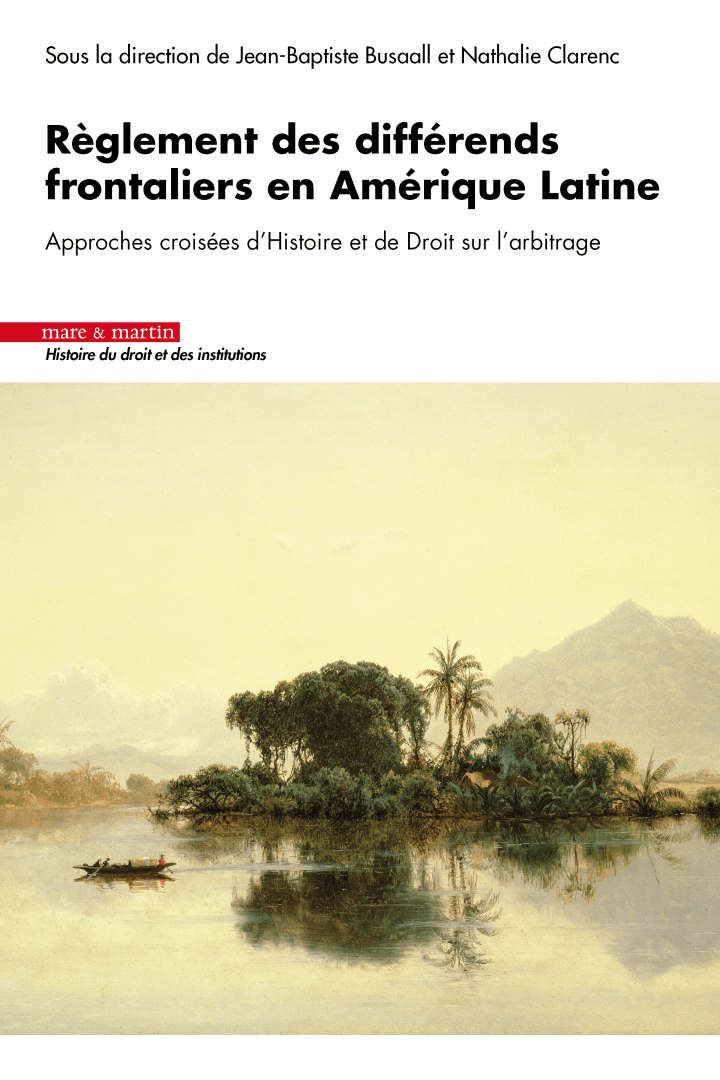
BOOK: Jean-Baptiste BUSAAL & Nathalie CLARENC (dir.), Règlement des différends frontaliers en Amérique Latine. Approches croisées d'Histoire et de Droit sur l'arbitrage [Histoire du droit et des institutions] (Paris: Mare & Martin, 2025), 212 p. ISBN 978-2-38600-061-4, € 27


(image source: Mare & Martin)

Abstract:
Aujourd’hui, le tracé des frontières litigieuses de l’Amérique latine se dessine à La Haye devant la Cour internationale de justice. Il occupe une grande partie de son activité judiciaire : 14 affaires furent introduites seulement depuis le début des années 2000. Mais la question est ancienne et la plupart des différends avaient déjà donné lieu à des procédures d’arbitrage entre le xixe et le début du xxe siècle. Cet ouvrage propose un recueil d’analyses de cas historiques et contemporains d’arbitrages de frontières dans l’espace des anciennes colonies ibériques de l’Époque moderne. L’approche est pluridisciplinaire, car elle allie histoire du droit et droit international. Les contributions des historiens du droit s’inscrivent dans le prolongement d’une historiographie récente qui a montré en quoi l’enjeu de l’intégrité territoriale est l’une des conséquences du double phénomène de construction institutionnelle des États et de la forge d’un discours national, voire nationaliste, au xixe siècle. Les auteurs internationalistes proposent une réflexion sur les modalités juridiques de règlement des disputes territoriales entre États, depuis les arbitrages du xixe siècle jusqu’aux procédures judiciaires du xxie siècle. L’analyse de cette évolution fournit des éclairages utiles sur le droit du contentieux international, et alimente la réflexion lancinante sur l’efficacité de la justice internationale : le règlement judiciaire pourra-t-il réussir là où les tentatives d’arbitrage ont échoué ?

On the editors:

Jean-Baptiste Busaall est Maître de conférences en histoire du droit à l’université Paris Cité. Nathalie Clarenc est Maître de conférences en droit public à l’université Paris Cité.

Read more here.

22 August 2025

BOOK REVIEW: Manuel BASTIAS SAAVEDRA on The Cambridge history of Latin American law in global perspective, edited by Thomas Duve and Tamar Herzog, and A companion to Latin American legal history, edited by Matthew C. Mirow and Victor Uribe-Uran (Comparative Legal History XIII (2025) nr. 1, June, pp. 112-122)

(Image source: Taylor&Francis)

There has been an increasing interest in the legal history of Latin America in recent decades. Largely restricted to law faculties and considered to be the domain of legal scholars until the late twentieth century, since the early 2000s legal history has steadily become an established research field in the context of a wider historiography concerned with questions of colonialism and empire, race and status, slavery and labour, Indigenous peoples, nation and state-building, among others.
Many parallel developments can arguably account for this. One longer-term development has been the influence that prominent legal historians, such as Paolo Grossi, Víctor Tau Anzoátegui, Michael Stolleis, António Manuel Hespanha, and Bartolomé Clavero, have had in rejuvenating the field, not only through their works but mainly through their students and adherents, who have come to occupy positions in both history and law departments and have driven the emergence of a new legal history in the Latin American context. Another somewhat parallel development was the interest that social and ethnohistorians – mostly in Latin America and the United States of America – were taking to the use of judicial archives and sources, promoting what has been alternatively called sociolegal history and history of justice. Finally, a more recent development worth mentioning was the appointment in 2009 of Thomas Duve as director of the Max-Planck-Institut für europäische Rechtsgeschichte, which gave one of the world’s leading legal historical institutions a global historical agenda with regional focus on Latin America and encouraged both scholarly output and networking in the field.
The publication in 2024 of the two edited volumes that are the subject of this review can be seen as confirmation of this trend. But it also marks an inflection point in the historiography of law in Latin America, since what had been developing through the discrete accumulation of research across two decades has now become a field that is engaging in critical self-reflection about its objectives, methods, aims, and its future.

To read the full review, please click here. Online access is free for members of the European Society for Comparative Legal History.
DOI: 10.1080/2049677X.2025.2500187


11 June 2025

BOOK: Santiago MUÑOZ-ARBELÁEZ, The New Kingdom of Granada. The Making and Unmaking of Spain’s Atlantic Empire (Durham (N.C.): Duke university Press, 2025), 328 p., USD 29,95


(image source: Duke)

Abstract:

The New Kingdom of Granada tells the history of the making and unmaking of empire in the diverse and decentralized Indigenous landscapes of the Northern Andes. Santiago Muñoz-Arbeláez examines the intricate and disputed processes that reshaped the peoples and landscapes of present-day Colombia into a kingdom within the global Spanish monarchy. Drawing on correspondence, visitation reports, judicial records, maps, textiles, and accounting and legal documents created by Europeans and Indigenous peoples, Muñoz-Arbeláez outlines the painstaking century-long effort between 1530 and 1630 to consolidate the kingdom. A diverse group of people that included Indigenous interpreters, scribes, and intellectuals spearheaded these projects, which eventually expanded colonial control outward from its base in the highland Andean plateaus down to the lowland river valleys. Meanwhile, autonomous Indigenous political projects constantly threatened imperial rule, as rebels often encircled the kingdom and seized the corridors that linked it to Spain. By foregrounding the kingdom’s difficult establishment and tenuous hold on power, Muñoz-Arbeláez challenges traditional understandings of imperial politics and the myriad ways Indigenous peoples participated in, disputed, and negotiated the establishment of colonial rule.

On the author:

Santiago Muñoz-Arbeláez is Assistant Professor of History at the University of Texas at Austin.

Table of contents:

A Note on Terminology  ix
Introduction. A Kingdom in the Mountains  1
Part I. Producing Indios  21
1. Labyrinths of Conquest  25
2. A Kingdom of Paper  47
3. The Fabric of Kingdom  77
Part II. Indigenous Freedom  107
4. Devouring the Empire  113
5. A Mestizo Cacique  143
6. An Indigenous Intellectual in King Philip’s Court  161
Part III. New Imperial Designs  191
7. Landscapes of Property  197
8. Imperial Alchemy  223
Epilogue  245
Acknowledgments  253
Notes  255
Bibliography  281

Index  307

 DOI 10.1215/9781478060802.

18 December 2024

BOOK: Juan JIMÉNEZ CASTILLO, La Monarquía Indiana de Carlos II en la encrujiada. La reconfiguración del poder virreinal en el Perú (1674-1689) [Avisos de Flandes, ed. Werner THOMAS; 21] (Leuven: Leuven University Press, 2024), 578 p. ISBN 9789462704084 [OPEN ACCESS]

(image source: Leuven University Press)

Abstract:

At the end of the 17th century, Spanish America was not yet in the throes of the crisis that would lead to the decadence of its Empire. This book unravels the causes and consequences of the political changes carried out by Carlos II in one of the most powerful kingdoms of his patrimony: Peru. This book shows, from a hitherto unexamined perspective, how Hispanic America was a forerunner in the reforms of the viceregal courts, which in turn reshaped the paradigm of government and interaction of the distant kingdoms. From then on, the Hispanic Monarchy shifted its interests towards America, in a reorganisation of its territories that led it not only to fight for its resilience, but also to strengthen its leading role in the international politics it had inherited from the Bourbon dynasty.

On the author:

Juan Jiménez Castillo is a postdoctoral researcher FWO at KU Leuven and a member of the Instituto Universitario “La Corte en Europa”. He holds a PhD in History from the Universidad Autónoma de Madrid, specialising in the study of the American viceregal courts during the reign of Carlos II.

Consult the book in open access here

22 November 2024

BOOK: Edward JONES CORREDERA, Odious Debt. Bankruptcy, International Law, and the Making of Latin America [The History and Theory of International Law, eds. Nehal BHUTA, Francesca IURLARO, Anthony PAGDEN & Benjamin STRAUMANN] (Oxford: OUP, 2024), 272 p. ISBN 9780192888280, GBP 100


(image source: OUP)

Abstract:

What are fallen tyrants owed? What makes debt illegitimate? And when is bankruptcy moral? Drawing on new archival sources, this book shows how Latin American nations have wrestled with the morality of indebtedness and insolvency since their foundation, and outlines how their history can shed new light on contemporary global dilemmas. With a focus on the early modern Spanish Empire and modern Mexico, Colombia, and Argentina, and based on archival research carried out across seven countries, Odious Debt studies 400 years of history and unearths overlooked congressional debates and understudied thinkers. The book shows how discussions on the morality of debt and default played a structuring role in the construction and codification of national constitutions, identities, and international legal norms in Latin America. This new history of the moral economy of the Hispanic World from the 1520s to the 1920s illuminates contemporary issues in international law and international relations. Latin American jurists developed a global critique of economics and international law that continues to generate pressing questions about debt, bankruptcy, reparations, and the pursuit of a moral global economy.

Table of contents:

Introduction
1:Origins of Odious Debt
2:Sancho Panza's Promised Land: Spain's Default on its American Debts
3:A History of Forgiveness: Moral Bankruptcy in Mexico
4:Fratricide and Redemption: Gran Colombia's Debt to Simón Bolívar
5:Armed Debtor: The Utility of Bankruptcy in Argentina
6:Sacred Debt and Just War: Moral Economy beyond International Law

Conclusion

Read more here


30 September 2024

BOOK: Evelin MARES CENTENO, La órbita del ejecutivo: las instituciones de gobierno en Guanajuato, 1824-1837 [Historia del Derecho en Amércia Latina] (México: Tirant lo Blanch/Instituto Mora, 2024), 324 p. ISBN 9788411974622


(image source: author)

Book abstract:

Esta obra analiza el funcionamiento de las instituciones de gobierno en el estado de Guanajuato durante la primera experiencia federal. A partir de la reconstrucción del aparato institucional que se implementó en el estado, se busca dar cuenta sobre la forma en que se delimitó la esfera de actuación del poder Ejecutivo. Mediante este estudio de caso, se busca conocer la manera en que se construyó uno de los poderes más cambiantes, las atribuciones que le fueron conferidas y los mecanismos que tenían sus agentes para ponerlo en marcha. En él se observa la pervivencia de la antigua causa de policía como sustento del ejercicio del gobierno y la práctica de sus instituciones.

On the author:

EVELIN MARES es Doctora en Historia Moderna y Contemporánea por el Instituto de Investigaciones Dr. José María Luis Mora. Su tesis de maestría recibió la Mención Honorífica en el XVII Premio Citibanamex Atanasio G. Saravia de Historia Regional Mexicana 2016-2017. Es miembro de ATARRAYA, Historia Política y Social Iberoamericana. Sus intereses giran en torno al funcionamiento de las instituciones de gobierno, y los procesos territoriales y constitucionales durante el siglo XIX. 

More information here

27 February 2024

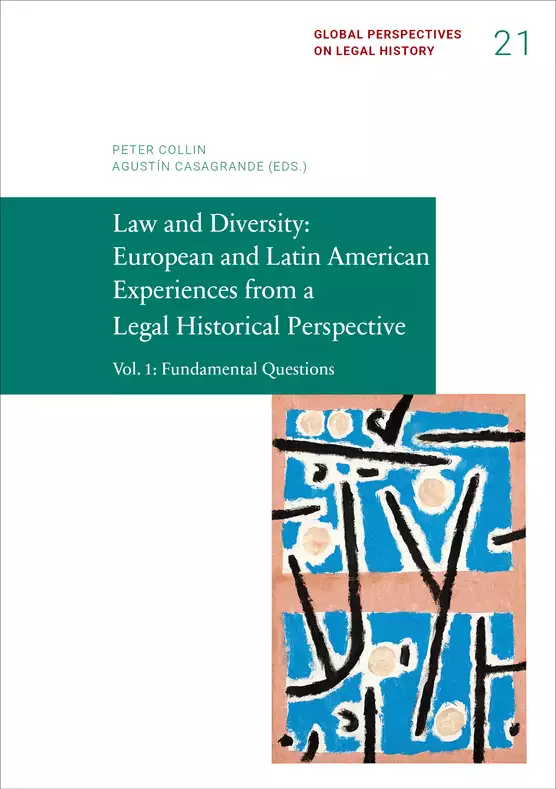
BOOK: Peter COLLIN, Agustín CASAGRANDE (eds.), Law and Diversity: European and Latin American Experiences from a Legal Historical Perspective. Vol. 1: Fundamental Questions (Frankfurt am Main: Max-Planck-Institut für Rechtsgeschichte und Rechtstheorie, 2023). ISBN: 9783944773407 [OPEN ACCESS]


ABOUT THE BOOK

Eine Grundfeste der Rechtssysteme der modernen Gesellschaft ist der Gleichheitsgrundsatz: Modernes Recht ist gleichheitsbasiert. Damit wird ein scharfer Trennungsstrich zum Recht der ständischen Gesellschaft mit ihren Sonderrechtsregimen für bestimmte Gruppen und Personen gezogen. Doch lässt sich diese strikte Gegenüberstellung nur dann durchhalten, wenn man lediglich auf die fundamentalen Postulate und die großen Kodifikationen mit ihren gleichheitsorientierten Systembildungen blickt? Auch die „Moderne“ ist sozial hoch ausdifferenziert und tradiert bzw. transformiert in einem nicht unerheblichen Maße „vormoderne“ Unterscheidungen. All dies bildet sich oft ab in Sonderrecht, das vom Staat oder den Gruppen selbst – wenn auch in diesem Fall oft nicht als Recht anerkannt – geschaffen wird.

Konstellationen normativ relevanter sozialer Differenz sollen mit dem Begriff „Diversität“ umschrieben werden. Das dabei zugrunde gelegte Diversitätsverständnis weist nur Teilüberschneidungen mit den Kategorien postmoderner Diversitätsdiskurse auf. Vielmehr wird die Grundfrage ins Zentrum gestellt: Welche sozialen Unterschiede sind in welchem Maße und in welcher Hinsicht relevant – oder, um es konkreter auf das Verhältnis von Recht und Diversität zu beziehen: Welche sozialen Unterschiede machen auch einen Unterschied für das Recht aus?

Eine erweiterte Perspektive auf dieses Problemfeld gewinnt man durch die vergleichende Betrachtung von europäischen und außereuropäischen Entwicklungen. Dabei erweist sich Lateinamerika als besonders wichtiges Untersuchungsfeld. Einerseits fand eine Translation europäischer Rechtstraditionen schon in kolonialer Zeit statt und nach der Unabhängigkeit war das lateinamerikanische Streben nach Modernität oft durch den Rückgriff auf europäische Rechtsideen und Regelungsmodelle geprägt. Andererseits blieb das Erbe der kolonialen Vergangenheit weiter prägend und die soziale Differenzierung, auf die das Recht reagieren musste, wies zu einem Gutteil andere Züge auf als in den europäischen Gesellschaften.

Damit sich der Ertrag des Zusammenführens europäischer und lateinamerikanischer Perspektiven nicht lediglich auf eine Aneinanderreihung verschiedener Beiträge beschränkt, wurde folgender Weg gewählt: Einem Hauptbeitrag, der sich auf die Entwicklung einer bestimmten nationalen Rechtsordnung bezieht, werden Kommentare aus anderen nationalen Rechtsordnungen zur Seite gestellt, die einerseits  ihre nationalen Entwicklung skizzieren und andererseits Bezug auf die Ausführungen des Hauptbeitrags nehmen, um so Unterschiede und Gemeinsamkeiten deutlich zu machen. Europäische und lateinamerikanische Autoren wechseln sich dabei ab. Der zeitliche Rahmen sind die letzten 200 Jahre.   

In Band 1 beschäftigen sich die Autoren mit Grundfragen von Recht und Diversität. Weitere Bände zum öffentlichen Recht, zum Privatrecht und zum Strafrecht werden folgen.


TABLE OF CONTENTS

  • Introduction


First Part: Thinking on Diversity and Law

Section I: National Traditions of Social Theoretical Contouring of Social Differences

  • Social Differentiation, Inequality, and Diversity in the Sociological Theory of Law – An Outline of the German Debate (Alfons Bora)
  • Comment: Law, Diversity and Sociological Imagination in Argentina (20th–21st Centuries) (Augustín Casagrande)

Section II: Traditions of Pluralistic Legal Thinking

  • Traditions of Pluralistic Legal Thought: The Example of Germany (Ralf Seinecke)
  • Comment: Monist or Pluralist Legal Tradition in 19th-Century Peru? (Armando Guvara Gil)
  • Comment: Pluralistic Legal Thought in Chile: A Critical Overview (Rodrigo Míguez Núñez)


Second Part: Tendencies

Section I: Diversity and Nation-building

  • National Identity through Diversity – Brazilian Nation Building Ideas and Theories, 1920–1948 (and their Aftermath) (Pedro Henrique Ribeiro)
  • Comment: The Tower of Babelgium. The Never-ending Belgian Nation-building (Bruno Debaenst)
  • Comment: The “cuestión foral”: Legal Diversity and Nation-building in Spain (Alfons Aragoneses)
  • Comment: Diversity and Nation Building in the Periphery: Some Thoughts from Argentina (Ezequiel Adamovsky)

Section II: Legal Lines of Development of Discrimination and Anti-Discrimination

  • Discrimination: On the Constitutional History of a Fundamental Concept – a Chilean Perspective (Fernando Muñoz)
  • Comment: The Different Meanings of Discrimination from a Czech Perspective (Barbara Havelková)

Section III: Anthropological Approaches

  • Juridification and the Indigenous Peoples in Brazil: The Ambivalence of a Complex Process (Orlando Villas Bôas Filho)
  • Comment: Racial Thinking and Ethnic Minorities in Latin America (Eduardo Zimmermann)
  • Comment: The Juridification of Indigenous Claims in Latin America: Obstacles and Challenges (Nancy Yáñez Fuenzalida)


Third Part: Legal Frameworks

Section I: The Constitutional Embedding of Differences

  • The Constitutional Embedding of Differences: Chile (1810–1980) (Manuel Bastias Saavedra)
  • Comment: The Constitutional Embedding of Differences, 1921–1997: The Polish Example (Agnieszka Bień-Kacała and Anna Tarnowska)

Section II: System and Codification – Exclusion or Inclusion of Special Law?

  • The Limits of Equality: Special Law in the Age of Legal Monism in Italy (19th–20th Centuries) (Massimo Meccarelli)
  • System and Codification – Exclusion or Inclusion of Special Law? A German Perspective (Carsten Fischer and Hans-Peter Haferkamp)
  • Comment: A French Perspective about the Limits of Equality in 19th–20th Centuries Law (Jean-Louis Halpérin)
  • Comment: Diversity, Codification and Political Representation: Comments from the Brazilian Perspective (Thiago Reis)

Section III: Autonomy

  • German Discourses on Autonomy from the Beginning of the 19th Century Until Today (Peter Collin)
  • Comment: Construction and De-construction of Legal Identity: Different Notions of Autonomy in Italian Legal Thought (19th–20th Centuries) (Michele Pifferi)
  • Comment: Autonomy, Subjectivity and Diversity: Genesis and Logic of a Juridical-political Concept in Argentina (19th–20th Centuries) (Agustín Casagrande)

Section IV: Legal Person and Legal Personality

  • Mask of Legal Subjectivity: Equality and Difference within Personal Regimes in Brazil (1824–1988) (Samuel Barbosa)
  • Comment: The Theory and Ethics of the Person in Law: The German Perspective (Stephan Kirste)
  • Comment: Legal Person and Legal Personality: A View from English Legal History (Victoria Barnes)

Section V: Linguistic Diversity and the Language of Law

  • Linguistic Diversity and the Language of State Law in Colombia, 1819–2019 (Gloria Patricia Lopera-Mesa)
  • Comment: Austria-Cisleithania – a Non-nation Multi-ethnic State and its Language Policy (Thomas Simon)
  • Comment: From Pragmatic Overtness to Legal Taxonomy of Equality. Ottoman-Turkish Perspectives on Colombian Linguistic Diversity and Law (Zülâl Muslu)
  • Comment: Linguistic and Cultural Diversity in the Legal Sphere: Insights from Late Imperial Russia (Stefan B. Kirmse)


Conclusion

  • Categories and Concepts, Themes, References, and Outlooks in the Conference Discussions on “Law and Diversity”. A Structured Summary (Leonard Wolckenhaar)


The publication can be found in open access here.

07 February 2024

BOOK: Nora E. JAFFARY, Historia del aborto en México (México: Tirant lo Blanch, 2023). ISBN: 9788411971768, pp. 164, $ 299.00 MXN

(Source: Tirant lo Blanch)


ABOUT THE BOOK 


Series:  Historia del Derecho en América Latina 


Todas las familias mexicanas esconden historias de embarazos imposibles y no deseados. Hubo mujeres que, legal o ilegalmente, los interrumpieron. Este libro pone en perspectiva histórica las experiencias de estas mujeres, sus comunidades y los contextos jurídicos en que vivieron, a través de un análisis de la historia del aborto en México desde el Virreinato hasta nuestros días. Se examinan las actitudes de la Iglesia Católica con respecto al aborto, las prácticas médicas utilizadas a lo largo del tiempo para interrumpir el embarazo, así como las relaciones entre estas actitudes y prácticas con las cambiantes construcciones de género. El enfoque central del libro, no obstante, recae sobre la cambiante regulación del aborto en la ley. Como demuestra esta obra, hasta finales del siglo XX, la discusión sobre la personalidad y los derechos del feto desempeñó un papel relativamente marginal para la ley, los jueces, la opinión pública e incluso la Iglesia Católica. En lugar de ello, durante gran parte de la historia de México, la regulación jurídica de esta práctica se orientó esencialmente por el imperativo de proteger el honor sexual de las mujeres y la reputación de sus familias. 


ABOUT THE AUTHOR 


NORA JAFFARY es Doctora en Historia por la Universidad de Columbia y profesora del Departamento de Historia de la Universidad Concordia en Montreal, Canadá. Entre sus obras destacan False Mystics: Deviant Orthodoxy in Colonial Mexico (Nebraksa, 2004) y Reproduction and Its Discontents in Mexico: Childbirth and Contraception from 1750 to 1905 (UNC Chapel Hill, 2016), que recibió el premio Wallace K. Ferguson de la Asociación Histórica Canadiense.

08 January 2024

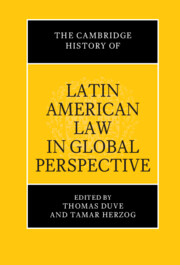
BOOK: Thomas DUVE & Tamar HERZOG (eds.), The Cambridge History of Latin American Law in Global Perspective (Cambridge: Cambridge University Press, 2024), ISBN 9781316518045 [OPEN ACCESS]


(image source: CUP)

Abstract:
Covering the precolonial period to the present, The Cambridge History of Latin American Law in Global Perspective provides a comprehensive overview of Latin American law, revealing the vast commonalities and differences within the continent as well as entanglements with countries around the world. Bringing together experts from across the Americas and Europe, this innovative treatment of Latin American law explains how law operated in different historical settings, introduces a wide variety of sources of legal knowledge, and focuses on law as a social practice. It sheds light on topics such as the history of indigenous peoples' laws, the significance of religion in law, Latin American independences, national constitutions and codifications, human rights, dictatorships, transitional justice and legal pluralism, and a broad panorama of key aspects of the history of statehood and law. This title is also available as Open Access on Cambridge Core.

On the editors:

Thomas Duve, Max Planck Institute for Legal History and Legal Theory, Frankfurt Thomas Duve is a director at the Max Planck Institute for Legal History and Legal Theory, and Professor of Comparative Legal History at Goethe University, Frankfurt. An expert in European and Latin American legal history, he specializes in the history of law and religion in a global perspective. Tamar Herzog, Harvard University, Massachusetts Tamar Herzog is the Monroe Gutman Professor of Latin American Affairs at Harvard University and an affiliated faculty member at the Harvard Law School. She is a legal historian of Spain, Portugal, and their overseas territories, having worked on colonial administration, penal justice, scribes, citizenship, land rights, and territorial conflicts. 

Table of contents:

Introduction Thomas Duve and Tamar Herzog
1. What is a legal history of Latin American law in a global perspective?
1.1 How was and is Latin American legal history written? Carlos Petit
1.2 What is a legal history and how does it relate to other histories? Tamar Herzog
1.3 How is law produced? Thomas Duve
1.4 What is global legal history and how can it be done? Mariana Dias Paes
2. How to approach indigenous law? Caroline Cunill
3. How to approach colonial law?
3.1 A civil law for a religious society Tamar Herzog
3.2 Religious normativity for colonial empires Thomas Duve
3.3 The domestic sphere Romina Zamora
4. Independence(s): what is a revolutionary law? Tamar Herzog
5. The coming of states? The nineteenth century
5.1 Constitutions José María Portillo
5.2 Codifications Agustín Parise
5.3 Contestations and exclusions Monica Dantas and Roberto Saba
6. The omnipresence of the state? The twentieth century
6.1 Towards the administrative state Eduardo Zimmermann
6.2 Dictatorships Cristiano Paixão
6.3 Transitional justice and human rights Ruti Teitel and Valeria Vegh Weis

7. Beyond the state – can state law survive in the twenty-first century? Daniel Bonilla Maldonado.

 Read more here. (this book is in open access)


27 November 2023

BOOK: Nicolás BERALDI, La construcción de un poder judicial en clave liberal y la persistencia de la dicotomía ciudad-campaña. Una historia de la justicia de Córdoba (1855-1883) [Historia del Derecho en América Latina] (Mexico: Tirant lo Blanch, 2023), ISBN 9788411692540, € 34,11


(image source: author)

Abstract:

El objetivo central de esta obra es revelar el modo en que se construyó el poder judicial en la provincia argentina de Córdoba en un “momento” considerado liberal, contrastando los diseños institucionales con los límites culturales y materiales que determinaban las posibilidades reales de su aplicación. La dicotomía a que hace referencia el título dividía a la provincia en dos espacios claramente diferenciables: por un lado el de la ciudad, donde se asentó el lenguaje constitucional y se instituyó una justicia de carácter letrado; por el otro, la campaña, un extenso y poco poblado territorio donde se mantenía vigente la justicia de carácter lego, como si se tratara de un espacio de excepción. De esta manera se habían preservado normativamente dos espacios totalmente diferenciados, los cuales exigían, según la mirada, respuestas y soluciones distintas. La presunta igualdad ante la ley resultaba una ilusión quimérica mientras dichas diferencias permanecieran. Así, el libro busca desandar los trayectos que se siguieron para disolver esa forma tradicional de entender la distribución del poder y la justicia, y de jerarquizar esos espacios y sus habitantes. Su persistencia a lo largo del período analizado muestra los límites que enfrentó la construcción jurídica del Estado nacional.

On the author:

NICOLÁS BERALDI es abogado y doctor en Derecho y Ciencias Sociales por la Facultad de Derecho de la Universidad Nacional de Córdoba. Es becario doctoral CONICET (ISHIR-CONICET-UNR), vinculado al laboratorio CEHISO y la línea estratégica Justicia y Gobierno. Ha publicado diversos artículos en revistas especializadas en Historia del Derecho, y ha sido docente de la materia Historia del Derecho Argentino en la Universidad Nacional de Córdoba y en la Universidad Siglo 21. En 2017 fue becado en el Max-Planck-Institut für Rechtsgeschichte und Rechtstheorie (MPILHLT). Sus líneas de investigación combinan la historia del derecho y la historia social de la justicia. 

Read more here.

16 October 2023

BOOK REVIEW: Javier FRANCISCO on Thomas DUVE & José Luis Egió, Rechtsgeschichte des frühneuzeitlichen Hispanoamerika (DeGruyter) (Sehepunkte XXIII (2023), nr. 10)

(image source: Sehepunkte)

Javier Franscisco (Historisches Seminar, Uni Freiburg) discussed a collective work edited on the legal history of Latin America (see earlier on this blog).

First paragraph:

Der hier vorzustellende Band ist in der Reihe methodica erschienen und richtet sich nach Angaben der Autoren an Studierende, Lehrende und Forschende. Diesen soll praktische wissenschaftliche Hilfe zum komplexen Thema der rechtlichen Aspekte in Spanisch-Amerika geboten werden; dies schließt einen umfangreichen Überblick zu Quellen, Hilfsmitteln, Forschungstraditionen, Forschungsliteratur, Methoden und den wichtigen Forschungsfragen ein. Vorneweg: Diese Hilfestellung ist Thomas Duve und José Luis Egío sehr gut gelungen. 

Read the full review here.

26 June 2023

BOOK: Paolo CAPPELLINI; Giovanni CAZZETTA (Orgs). Pluralismo giuridico. Itinerari contemporanei, atti dell'incontro di studi, Firenze, 20-21 ottobre 2022. (Milano, Giuffrè, 2023). ISBN 9788828853404 37,05€

(Source:https://www.quadernifiorentini.eu/biblioteca/134/)

Il volume raccoglie gli Atti dell’Incontro internazionale di studi tenutosi a Firenze nell’ottobre del 2022 in occasione dei cinquant’anni dalla fondazione dei Quaderni fiorentini e del Centro di studi per la storia del pensiero giuridico moderno. Calato com’è nei pilastri fondativi dell’ordine giuridico e nei suoi processi di trasformazione, il tema del Pluralismo giuridico incrocia perfettamente i caratteri qualificanti iscritti sin dalle origini nel progetto della Rivista e nelle attività del Centro, intitolato a Paolo Grossi proprio a partire dall’Incontro di ottobre. Il volume  organizza in tre sezioni – Paradigmi, Esperienze, Prospettive – il ricco e vivace confronto tra storici, filosofi del diritto e giuristi di diritto positivo, e contiene altresì gli interventi della Cerimonia di intitolazione a Paolo Grossi del Centro di studi.


Table of Contents

Itinerari contemporanei del pluralismo giuridico. Le ragioni di un Incontro (P. Cappellini, G. Cazzetta, B. Sordi, I. Stolzi)


Paradigmi

 TOMMASO GRECO, Il problema (della scienza) del diritto e le vie del pluralismo

MICHELE GRAZIADEI, Frontiere, legal transplants, comparazioni: le vie del diritto e l’incontro con il pluralismo

CARLA FARALLI, Pluralismo e teoria generale del diritto

FABIO DEI, Razionalità e relativismo nell’antropologia giuridica


Esperienze: il caso della colonizzazione portoghese

CRISTIANO PAIXA˜ O, Pluralismo in gioco: le dispute sulla democrazia costituzionale brasiliana

RICARDO SONTAG, Ordine domestico e ordine statale nel Brasile del XIX secolo: la disciplina degli schiavi

CRISTINA NOGUEIRA DA SILVA, Colonial Justice in Mozambique (1915-1954): Preserving and Changing Indigenous Customary Law

MASSIMO MECCARELLI, Pluralismo giuridico e spazio eccedente. Il laboratorio storiografico brasiliano visto dall’Europa


Prospettive

MASSIMO LUCIANI, La Costituzione e il pluralismo

ENZO CANNIZZARO, Consuetudine e pluralismo normativo nel diritto internazionale

THORSTEN KEISER, Pluralismo e diritto del lavoro

NICOLO` LIPARI, Gli approdi pluralistici del diritto civile


Cerimonia di intitolazione a Paolo Grossi del Centro di studi per la storia del pensiero giuridico moderno

PAOLO CAPPELLINI, Paolo Grossi: una dedica, una presenza

ALESSANDRA PETRUCCI, Saluto

GIUSEPPE BETORI, Saluto

SILVANA SCIARRA, Per Paolo Grossi

PIETRO COSTA, Paolo Grossi: il sapere come istituzione

24 April 2023

BOOK: Lorenzo SERAFINELLI. US Law Schools: una visione alternativa della formazione del giurista negli Stati Uniti (Milano, Giuffrè 2023). ISBN 9788828851349. 44,65€


(Source: https://shop.giuffre.it/024219165-u-s-law-schools)

Il volume analizza la legal education statunitense, offrendone una visione alternativa rispetto alle impostazioni tradizionali. L’opera si articola lungo precise chiavi di lettura strumentali a far emergere la perdurante conflittualità tra elitismo e democrazia insita nell’educazione giuridica negli U.S.A. Per far ciò, U.S. Law Schools assume un’ottica storico-comparatistica e ripercorre le principali fasi di sviluppo della formazione dei lawyer statunitensi, muovendo dalle origini nel XVIII secolo per giungere, da ultimo, agli eventi più recenti che hanno interessato le scuole di diritto americane nel XXI secolo.

Complessivamente, in ciascuna delle partizioni storiche, l’autore avanza una proposta metodologica che tenta di raccordare le evoluzioni occorse nell’educazione dei giuristi con gli assetti del diritto statunitense più in generale. Il tutto, dunque, per dimostrare come le prime influenzino le seconde e viceversa.

Si ritiene, infatti, che l’analisi della formazione del giurista risulti imprescindibile per ricostruire l’esperienza giuridica di una determinata società. E ciò sia perché il meccanismo poietico degli operatori del diritto fa scorgere i connotati fondamentali dell’esperienza indagata, sia in quanto esso costituisce il dispositivo attraverso cui il sapere giuridico viene tramandato di generazione in generazione.


Table of contents: https://shopdata.giuffre.it/media/Indice/INDICE_024219165.pdf 


14 April 2023

CONFERENCE: Law and Diversity - European and Latin American experiences from a legal historical perspective - Criminal law II; 3-4, 13-14 April


(Source: https://www.lhlt.mpg.de/events/34139/2373)

The tensions between equality and inequality as principles of justice and distribution, as well as between general and individual case justice, should be among the basic experiences of any normative order. The history of law bears witness to this - and of ever new attempts to soften these tensions through institutional arrangements and special protection regimes.

However, the social dimensions in which the tension between equality and inequality emerged and the legal solutions or attempts at solutions it produced varied from country to country. In the workshop and publication project "Law and Diversity - European and Latin American Experiences from a Legal Historical Perspective", contributions from various European and Latin American countries are intended to illustrate this diversity and at the same time facilitate comparison. After three previous workshops dealing with general questions, public law and private law, this workshop focuses on criminal law.


3 April 

13:30 Welcome and introduction Peter Collin / Manuel Bastias Saavedra / Massimo Meccarelli 

13:45 Codification and special law 

Main contribution Alejandro Agüero / Matias Rosso 

Comments Massimo Meccarelli Diego Nunes Martin P. Schennach 15:00 Coffee break 


15:30 Military criminal justice 

Main contribution Artur Barretto de Almeida Costa 

Comments Giacomo Pace Gravina Patrick Heinemann Beatriz Lopez Lorca 


16:45 Perpetrator Type Theory 

Main contribution Emilia Musumeci 

Comments Richard F. Wetzell Sabine Freitag Marcos Antonio Leon 

18:00 Dinner 

19:00 Transnational criminal law regimes on women trafficking and prostitution 

Main contribution Karl Härter 

Comments Christiana Schettini 


4 April 

13:30 Prison System 

Main contribution Jorge Nunez / Jose Daniel Cesano 

Comments Jean Charles Froment Mary Gibson 

14:30 Colonial criminal law 

Main contribution Olindo De Napoli 

Comments Elizabeth Kolsky 


13 April 

13:30 Welcome and introduction Peter Collin / Manuel Bastias Saavedra / Massimo Meccarelli 

13:45 Political crimes 

Main contribution Raquel Sirotti 

Comments Monica Stronati Camilo Plaza Armijo 

15:00 Coffee break 

15:30 Juvenile criminal law 

Main contribution Dominique Messineo Comments Jaime Couso Enikő Kovács-Szépvölgyi 

16:45 Abortion and criminal law 

Main contribution Julieta Di Corleto 

Comments Bárbara Madruga da Cunha Kamila Staudigl-Ciechowicz 

18:00 Dinner 

19:00 Beggars, vagrants, and the poor 

Main contribution Paulo Cruz Terra 

Comments Agustin Casagrande 


14 April 

13:30 Women and Criminal Law 

Main contribution Claudia Paiva Carvalho / Camilla de Magalhães Gomes 

Comments Monica Burman Lucia Nunovero Cisneros 

14:30 Homosexuality and criminal law 

Main contribution Thierry Delessert 

Comments Caroline Derry