Search

Showing posts with label history of constitutional law. Show all posts

07 July 2026

BOOK: Dieter GRIMM, Constitutional Effectiveness. The Case of Germany's Basic Law (London: Bloomsbury, 2026), 232 p. ISBN 9781509988891


(image source: Bloomsbury)

Abstract:

This book presents a unique account of the social and political impacts of the German Basic Law on the German Republic from 1949 to the present day. It considers the way in which the history of the Federal Republic of Germany has been decisively influenced by its Constitution, the Basic Law of 1949, and by the jurisprudence of the Federal Constitutional Court. The book argues that the historiography of the Federal Republic does little to reflect this influence. The Basic Law is mentioned and so occasionally rulings of the Federal Constitutional Court. But the reader does not get the impression that they were of specific importance in Germany before and after reunification. Legal scholars, on the other hand, are concerned about the legal consequences of the Basic Law, but do not analyse its impact in the real world. There is, thus, a gap between the two disciplines – one not being familiar with social reality, the other not familiar with the normativity of the law. The history of the effectiveness of the constitution falls into this gap. In this book, Dieter Grimm, himself a Justice of the Federal Constitutional Court from 1987 to 1999 and an expert on interdisciplinary research in law, history and political science, guides the reader through important developments and events that were determined or influenced by the constitution and its judicial interpretation.

Table of contents:

Preface
Preliminary Remark on the Selection of Historical Literature for Examination
1. Constitutional History and General History
2. Genesis and Content of the Basic Law3. The Beginnings of Constitutional Adjudication4. Constitutional Evolution Through Amendments5. Moves Towards a Total Revision of the Basic Law6. The Constitutional Question in the Reunification Process7. The Liberalisation of Society as a Question of Fundamental Rights8. Influence of the Constitution on the Media System9. The Social Democratic-Liberal Reforms under Scrutiny10. The Taming of the Party State11. Achieving Gender Equality12. The Basic Law in the Risk Society13. The Constitution in the East-West Approximation Process14. The Federal Republic as Member State of the European Union15. The Underestimated Constitutionalisation of PoliticsAppendix: The Significance of Law in the History of Society: A Query

 Read more here.


09 June 2026

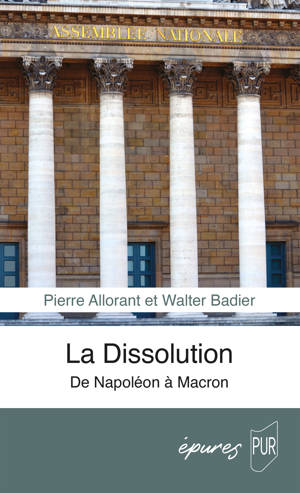
BOOK: Pierre ALLORANT & Walter BADIER, La Dissolution. De Napoléon à Macron [Épures, ed. Pierre-Henry FRAGNE] (Rennes: Presses universitaires de Rennes, 2026), 144 p. ISBN 9791041310647, € 10


Abstract:

La dissolution a souvent été présentée comme un outil nécessaire au contrôle des parlementaires, un instrument utile à la résolution des crises entre l’exécutif et le législatif, et une arme de dissuasion contre l’instabilité gouvernementale. La dissolution remet au peuple le soin de trancher le différend entre les pouvoirs. Porter un regard de longue durée sur cette histoire apparaît indispensable à la compréhension de la crise politique et institutionnelle que nous vivons aujourd’hui. Dispositif absent des constitutions révolutionnaires, la dissolution apparaît avec Bonaparte, mais n’est utilisée qu’avec les monarchies censitaires du premier XIXe siècle. Longtemps perçue comme incompatible avec la République parlementaire, la dissolution est écartée entre 1877 et 1955. La crise actuelle incite à repenser la Ve République, conçue par Michel Debré pour le général de Gaulle en 1958.

Read more on the publisher's website

13 May 2026

BOOK: Sandrine BAUME & David RAGAZZONI (eds.), Hans Kelsen on Constitutional Democracy Genesis, Theory, Legacies (Cambridge: CUP, 2026), ISBN 9781009230360 [OPEN ACCESS]


(image source: CUP)

Abstract:

This volume challenges conventional interpretations by demonstrating that Hans Kelsen was far from being a purely formalist thinker. Instead, it highlights his profound and enduring engagement with the threats facing constitutional democracies. The political and institutional upheavals of interwar Europe significantly influenced Kelsen's evolving vision of democracy, as this volume shows. His contributions to twentieth-century democratic theory include groundbreaking insights into multiparty systems, mechanisms of moderation, minority protections, and judicial review. Furthermore, Kelsen's reflections on the crises and collapses of democracies during the 1930s remain strikingly relevant, offering valuable perspectives on contemporary challenges such as polarisation and populism. This title is also available as Open Access on Cambridge Core.

Read the full book here: DOI 10.1017/9781009230360.

08 May 2026

NOTICE: PhD Defenses in Legal History [Association des Historiens des Facultés de Droit] (Paris/Nantes, APR/MAY 2026)


(image source: AssoHFD)

The Association des Historiens des Faculté de Droit reported the PhD Defenses of

  • Baptiste ROBAGLIA (Paris II Panthéon-Assas), Un humaniste au Palais : Étienne Pasquier (1529-1615), penseur d’un droit national (dir. Philippe COCATRE-ZILGIEN & Xavier PRÉVOST) (10 April 2026)
  • Ambre JARASSIER (Nantes Université), Les sénatus-consultes napoléoniens, entre constituer et légiférer (dir; Grégoire BIGOT) (5 May 2026)
More information on the jury composition can be found by clicking on the links above.

07 May 2026

BOOK: Samuel MOYN & Meredith TERRETTA (eds.), The Cambridge History of Rights, vol. V: The Twentieth and Twenty-First Centuries [The Cambridge History of Rights, eds. Nehal BHUTA, Anthony PAGDEN & Mira L. SIEGELBERG] (Cambridge: Cambridge University Press, 2026), €140,05


(image source: CUP)

Abstract:
The concept of a right, and the idea of human rights, were familiar abstractions on the brink of the twentieth century. But the history of political mobilization since shows that human rights had a transformative capacity in that century that no prior age had demonstrated. Through the twentieth century, human rights became institutionalized internationally in laws, movements, and organizations that transcended state-based citizenship and governance – which irrevocably changed the politics around them. Rights continued to evolve as the imperial world order transitioned to a postcolonial world of sovereign states as a primary form of political organization. Through twenty-six essays from experts around the world demonstrating how this period is historically distinctive, volume five of The Cambridge History of Rights is a comprehensive and authoritative reference for the history of rights in the twentieth and twenty-first centuries.

Table of contents:
General editor introduction Nehal Bhuta, Anthony Pagden and Mira L. Siegelberg Introduction Samuel Moyn and Meredith Terretta 1. Genealogies and human rights Ben Golder Part I. Rights, Politics and Mobilization Around the World: 2. Women's rights in international politics, 1900 –1967 Jean Quataert deceased 3. Rights and empire Miguel Bandeira Jerónimo and José Pedro Monteiro 4. Human rights and self-determination Umut Özsu 5. Rights and communism Ned Richardson-Little 6. Regional rights projects and decolonization in the twentieth century Anne-Isabelle Richard and Stella Krepp 7. Hierarchies of rights Barbara Keys 8. Human rights and cold war foreign policy Michael Cotey Morgan Part II. Forms and Fora of Rights Claiming: 9. Visions of human rights Adam Etinson and Jiewuh Song 10. On the critique of rights Jessica Whyte 11. Race, rights and the politics of petitioning Emma Stone Mackinnon 12. Transnational NGOs and human rights Jan Eckel 13. The 1993 world conference on human rights and the new rights ecosystem 14. Transitional justice, legal non-performatives and the sentiments of moving on Kamari Maxine Clarke Part III. Rights Causes and Their Evolution: 15. Rights without subjects: a history of children's human rights Linde Lindkvist 16. Development as the imperialism of 'free' trade: rights, liberalism and the engineering of African economies Alden Young and Tinashe Nyamunda 17. Economic and social human rights in the twentieth century Steven Jensen 18. Christianity, religious rights and decolonization Justin Reynolds 19. (Trans)gender identity and international human rights law Sandra Duffy 20. Resistance and insistence: making postcolonial indigenous rights Miranda Johnson 21. Health Sara Silverstein 22. Human rights and warfare Boyd van Dijk 23. The rights of artificial intelligence Jim Davies 24. Rights and environmental change Kerri Woods 25. Memorialisation, commemoration, and rights Bonny Ibhawoh 26. Empires of real estate: neoliberal legality and the right to housing Brenna Bhandar.


Read more here: DOI 10.1017/9781108938839.

06 May 2026

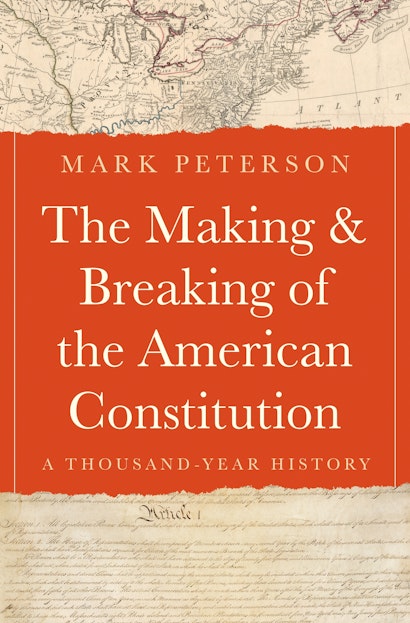
BOOK: Mark PETERSON, The Making and Breaking of the American Constitution: A Thousand-Year History (Princeton: Princeton University Press, 2026), 408 p. ISBN 9780691180014, 25 GBP


(image source: Princeton)

Abstract:
The American Revolution occurred at a time when Britain’s constitutional order failed to adapt to the extraordinary growth of its colonies. The framers designed an American constitution to succeed where Britain’s had faltered, planning for continuous population and territorial expansion that would eventually cross the continent. Yet by the end of the nineteenth century, it was already ill-suited for an increasingly urban, industrialized society, and the transformations of the twentieth century have pushed it to a breaking point. This book charts the history and aims of the American constitution from its origins in an agrarian past to the grave crisis we face today. Mark Peterson traces the American constitutional tradition to the control of land in medieval England, showing how the founders incorporated the aspirations of Magna Carta with the administrative principles of the Domesday Book, a meticulous survey and valuation of landed property commissioned by William the Conqueror. This framework encouraged the growth of democratic self-government in a young nation. It also institutionalized the colonization of territory and the expulsion of Indigenous peoples, establishing a legal blueprint for transforming tribal lands into revenue-yielding real estate for settlers. Peterson’s riveting narrative paints an arresting picture of a dynamic republic whose frame of government has changed enormously to meet the challenges of the modern age but whose written constitution has changed very little. Marking the 250th anniversary of American independence, The Making and Breaking of the American Constitution reveals how this widening disconnect threatens the very existence of our democracy. It calls for a constitution that sustains the ideals developed over the past thousand years while meeting the challenges of the future.

 On the author:

Mark Peterson is the Edmund S. Morgan Professor of History at Yale University. He is the author of The City-State of Boston: The Rise and Fall of an Atlantic Power, 1630–1865 (Princeton) and The Price of Redemption: The Spiritual Economy of Puritan New England.

Read more here

23 October 2025

BOOK: Fernando CASTRILLO DÁVILA, Entre justicia, poder y política. La Suprema Corte en el régimen liberal mexicano, 1853-1882 (México: Tirant lo Blanch / Barra Mexicana de Abogados, 2025) pp. 384, ISBN: 9788410952102, $ 489.00 MXN


(Source: Tirant lo Blanch)

ABOUT THE BOOK 


La Constitución de 1857 establecía que, en ausencia del presidente de la república, el presidente de la Suprema Corte de Justicia debía asumir interinamente su cargo. Aunque esta disposición surgió como una fórmula excepcional para asegurar la continuidad del gobierno y prevenir disputas por el poder, desde 1858 hasta 1877, todos los presidentes del máximo tribunal, sin excepción, reclamaron en algún momento la titularidad del Ejecutivo. Con frecuencia, estas pretensiones políticas desataron conflictos que profundizaron la crisis que ya vivía el Estado a consecuencia de la imposición modernizadora de la Reforma liberal. El presente trabajo estudia estos conflictos por la presidencia a la luz de otro precepto fundamental en el arreglo de la judicatura federal, a saber, la elección popular de los magistrados, novedad democrática de la Constitución liberal. De esta manera, la obra explora las consecuencias que tuvo la convergencia de ambas disposiciones constitucionales, la alternativa que permitió corregir el problema en la década de 1880 y el difícil ejercicio de las atribuciones políticas de la Corte durante las décadas de consolidación del Estado liberal.


Series: Historia del Derecho en América Latina.


ABOUT THE AUTHOR 

Fernando Castrillo Dávila es doctor en Historia por el Colegio de México. Se ha dedicado al estudio del constitucionalismo y de las instituciones políticas mexicanas de la segunda mitad del siglo XIX y de principios del XX. Entre sus publicaciones recientes destaca su libro 'La guerra que nos hizo nación. La arqueología del nacionalismo liberal en México y Puebla, 1855-1872', publicado por la Secretaría de Cultura de Puebla en 2022. Ha sido docente en la Universidad Iberoamericana-Puebla y actualmente es investigador posdoctoral en el Instituto de Ciencias Sociales y Humanidades de la Benemérita Universidad Autónoma de Puebla.

More information with the publisher.

20 August 2025

BOOK: Richard PRIMUS, The Oldest Constitutional Question. Enumeration and Federal Power (Cambridge (Mass.): Harvard University Press, 2025, 448 p. ISBN 9780674293595, € 45,95


(image source: Harvard)


Abstract:
A groundbreaking challenge to a core principle of constitutional law, arguing that congressional action is not limited by the legislative branch’s textually enumerated powers. Every law student learns that the federal government is constrained to act only according to its enumerated powers, meaning that Congress can do what the Constitution expressly authorizes it to and nothing more. Yet Richard Primus contends that this longstanding orthodoxy—allegedly required by the text of the Constitution, the Framers’ vision, and the logic of federalism—is fundamentally flawed.

On the author:

 Richard Primus is Theodore J. St. Antoine Collegiate Professor at the University of Michigan Law School. He clerked for Justice Ruth Bader Ginsburg at the US Supreme Court and is the author of The American Language of Rights.

(source: Legal History Blog

Read more here

09 July 2025

BOOK: Thomas KLEINLEIN (ed.), Weimar: une constitution mondiale? Contexte et réception de la constitution de 1919 (transl. Guy MONARD & Clothilde MELIN; preface Aurore GAILLET) (Paris: La Mémoire du Droit, 2024), € 64


(image source: MDD)

Abstract:

Ce volume est consacré au contexte international et à la réception internationale de la Constitution du Reich de Weimar. Des juristes, des politologues et des historiens procèdent à une mise en perspective internationale de la Constitution de 1919 et des discours qui s’y réfèrent. Leurs contributions mettent en évidence aussi bien les références transversales contemporaines que sa réception internationale sur l’axe historique longitudinal. Le contexte international de la Constitution de Weimar est examiné dans le sens d’une comparaison transversale. À quelles influences intellectuelles a­t­elle été soumise ? Quels modèles étrangers ont été utilisés, lesquels ont été sciemment rejetés ? L’histoire de la réception internationale de la Constitution de Weimar constitue un deuxième point fort. Quel a été son impact direct sur l’époque ? Où et quand « Weimar » a­t­il été un argument ? Quels enseignements ont été tirés ailleurs lors des débats constitutionnels ? Quels sont les effets à long terme qui se manifestent au niveau international dans les discours juridiques et intellectuels ?

Read more here

06 June 2025

CALL FOR PAPERS: The Other Declarations of 1776 (Antonin Scalia Law School/Institute for Judicial Engagement & Liberty and Law Center, 10 APR 2026) [DEADLINE 30 JUN 2025]


(image source: Legal History Blog)

Abstract:

We invite authors interested in exploring these and related topics to submit proposals for papers. We are looking for a journal where the papers will be published as a symposium. The number of papers published will depend on the quality of applications but the anticipation is to select approximately six. The writers are expected to attend the conference in person. Papers should be approximately 10,000 words and should address the history, meaning, and impact of state declarations of rights of 1776. We encourage this to include their impact on the later development of judicial review and constitutional government.

Topics:

A non-exclusive list of suggested topics include the following, but additional topics are welcome: 

  • How cognizant were the framers of the “Other Declarations” of any break their new declarations and constitutions represented from parliamentary supremacy?
  • When and how did the stirring words of an individual state’s declaration of rights come to be seen as a law that binds future legislatures?
  • Did the framers of the “Other Declarations” see themselves in the tradition of the Glorious Revolution and the Declaration of Rights of 1689, or as a different method for a different age?
  • Were “Other Declarations” an impetus for the development of judicial review in subsequent decades, or were later appeals to them in conjunction with judicial review a method of retrofitting history?
  • How did the “original meaning” of certain provisions in the “Other Declarations” influence later constitution writing and interpretation?
  • What was the relationship between the Declaration of Independence and the “Other Declarations”? 
  • More specifically, did Thomas Jefferson’s well-known cribbing of George Mason’s Virginia Declaration have a meaningful impact on subsequent constitutional history?
  • How does the legacy of the “Other Declarations” differ from the Declaration of Independence and/or the federal Bill of Rights?
  • Are there untold stories of contributions from the “Other Declarations” to later constitutional law—such as ancestors of the First and Fourth Amendments—that we should know about?
  • What thinkers actually had an impact on the “Other Declarations”—such as Locke, Pufendorf, Montesquieu, Rousseau, etc.—or were their ideas not relevant to the more practical concerns of revolution?

Practical:

Reasonable travel and hotel expenses will be provided for those selected to write and present papers. International travel will be considered on a case-by-case basis but cannot be guaranteed. An honorarium of $2,500 will also be provided to selected paper authors. 

More information here

(source: Legal History Blog


21 May 2025

BOOK: Vincent PETIT (dir.), La conjuration des hommes libres. Une histoire du serment politique (XVIII-XXIe siècle) [Histoire] (Rennes: Presses universitaires de Rennes, 2025), ISBN 9782753593459, € 18


Abstract:
L'histoire du serment politique en Occident est celle d'un long dévoiement. Ce rite habillé d'oripeaux antiques, médiévaux et religieux, avait été pensé comme l'instrument de la conjuration des hommes libres. Il sera devenu un des moyens de conjurer leur liberté. Alliance des hommes libres et égaux sous le regard de Dieu, il est progressivement encadré par les puissances politiques et ecclésiales, puis capté par l'État moderne à partir du XVIIe siècle. L'expérience révolutionnaire cherchera à redonner au serment son caractère démocratique et égalitaire, avant qu'au XIXe il ne devienne un rite de sujétion bureaucratique. Dans les régimes autoritaires et totalitaires, il exprime non seulement une fidélité politique mais il est la marque d'un biopouvoir par lequel l'individu abdique sa conscience et jusqu'à son propre corps dans le peuple, le parti, l'État, l'idéologie, le chef. C'est à une histoire politique enracinée dans les pratiques juridiques et les doctrines religieuses propres à l'Occident, et aujourd'hui négligée, que ce livre s'attache à donner une lecture originale et novatrice, puisqu'il s'agit de la première synthèse en français sur l'histoire du serment.

 Read more here.


19 May 2025

BOOK: Alexis FOURMONT, Châteaubriand. Les paradoxes du parlementarisme romantique [Le bien commun, dir. Adeline BALDACCHINO] (Paris: Michalon, 2025), 128 p. ISBN 978-2-347-00314-2, € 12


(image source: le bien commun)

Abstract:

La pensée constitutionnelle et politique de Chateaubriand (1768-1848), souvent négligée au profit de sa verve littéraire, témoigne d’une lucidité précoce sur le fonctionnement concret du système de gouvernement parlementaire, ses vices et vertus, les conditions de son bon fonctionnement. Partisan d’une monarchie tempérée par les moeurs, à même de susciter un climat propre à l’essor de ce qu’il appelle une « liberté raisonnable », il plaide sans cesse pour la parlementarisation des institutions : distinct du roi, le gouvernement doit être politiquement responsable face aux chambres et s’appuyer sur une majorité fixe. Instruit de l’expérience britannique, il a conçu très tôt l’intérêt d’une bipolarisation de la vie parlementaire. Déplorant l’inanité des oppositions de circonstances, il théorise la nécessité d’instiller des logiques collectives dans les travaux parlementaires. L’écrivain se révèle inséparable de l’homme politique, plusieurs fois ministre, ambassadeur et parlementaire. Au moment où la délibération parlementaire souffre d’une forme de déconsidération dans l’espace public, le détour par Chateaubriand est riche d’enseignements sur les vertus politiques et sociales du parlementarisme.

On the author:

maître de conférences en droit public de l’Université Paris 1 Panthéon-Sorbonne.

Read more here

12 May 2025

BLOG: Thomas ANDREU, "La théorie du "lit de justice" est-elle désuète ?" (Jus Politicum Blog, 8 MAY 2025)


(image source: JP Blog)

Abstract:

Doyen Vedel succeeded in striking the right balance to ease the tension between constitutional justice and democracy through the theory of the ‘ »lit de justice ». However, it has recently been pointed out that this solution « no longer seems sufficient » for some constitutionalists, who are campaigning for other, more radical methods that would ensure that the people or their representatives have the « dernier mot ». Yet it seems that such proposals are primarily the result of the fact that the theory of the « lit de justice » now seems obsolete.

On the author:

Par Thomas Andreu, Doctorant contractuel en droit public, Chaire internationale sur l’Europe Souveraine (CILES), Centre de Documentation et de Recherches Européennes (CDRE), Université de Pau et des Pays de l’Adour / Université de Luxembourg 

Read the full blog contribution here

16 April 2025

BOOK: David SOLDINI, Santi Romano (1875-1947). Tout pour l'État [Les Humanités du droit] (Paris: IRJS, 2024), 238 p. ISBN 9782850020650, € 22


(iamge source: LGDJ)

Abstract:
Santi Romano, l'auteur de L'ordre juridique, le livre de théorie du droit italien le plus traduit et commenté à l'étranger, est également le dernier président du Conseil d'Etat de la période fasciste et le seul nommé par Benito Mussolini. Alors que sa théorie a inspiré de nombreux auteurs se réclamant du pluralisme et critiquant l'étatisme, ses choix personnels révèlent au contraire un attachement viscéral à la nation, une pensée profondément conservatrice et un culte évident de l'autorité. Cette apparente contradiction constitue le point de départ de l'ouvrage ; l'approche biographique révèle la cohérence qui caractérise l'oeuvre pléthorique de Santi Romano mais aussi sa trajectoire idéologique et politique. Né en 1875, à Palerme, il est dans un premier temps proche des juristes libéraux de l'ère giolitienne, et en particulier de son maître, Vittorio Emanuele Orlando qui devient Président du Conseil durant la Première Guerre mondiale. Comme de nombreux libéraux, il soutient l'ascension de Benito Mussolini, auquel il restera fidèle jusqu'à la fin de la Seconde Guerre mondiale. Obsédé par l'Etat et sa nécessaire continuité, Santi Romano aura mis sa vie au service de cette cause, quitte à se compromettre avec un des régimes les plus sanguinaires du siècle. Sa vie témoigne des errances de nombreux libéraux et de serviteurs de l'Etat face à l'ascension du totalitarisme mais également de la manière dont le fascisme a poursuivi des objectifs compatibles avec l'idéologie étatiste de la fin du XIXe siècle et en particulier le renforcement du pouvoir exécutif contre le Parlement. Santi Romano décède en 1947, isolé, épuré de toutes les institutions prestigieuses dont il a fait partie, le Sénat, l'Université, le Conseil d'État et l'Académie des Lyncéens. Il ne bénéficie pas des lois d'amnistie. Son ancien maître, Vittorio Emanuele Orlando, qui s'était éloigné à temps du fascisme lui survit et devient, à 85 ans passés, président de la première séance de l'Assemblée constituante de 1946.

The book can be ordered with LGDJ


SYMPOSIUM: Constitutional Meaning in the Shadow of the Articles of Confederation (Philadephia: Brennan Center for Justice/National Constitution Center, 12 MAY 2025) [HYBRID]

(image source: Swogo)

Abstract:
The Roberts Court has increasingly relied on history to resolve some of the most important constitutional questions of our time. Embracing a form of interpretation called “originalism,” the Court’s conservative majority argues that the original public understanding of the Constitution is what really counts. But discerning the goals and assumptions of those who ratified the Constitution requires an understanding of the document they were replacing: the Articles of Confederation. Today, the Articles are ignored as a false start. That’s a mistake. The Constitution was an explicit attempt to form a union “more perfect” than that of the Articles of Confederation, and they provide vital context to the framers’ choices. Join us in Philadelphia on Monday, May 12, at 11 a.m. ET as historians, journalists, law professors, and political scientists explore how the nation’s first experiment in self-governance paved the way for the Constitution we have today. Participants will examine the legacy of the Articles of Confederation, the founding debates over federal power, and the lasting influence of these debates on modern-day constitutional interpretation.
Program:
11-11:15 a.m. | Introductory Remarks


Jeffrey Rosen, president and CEO, National Constitution Center
Michael Waldman, president and CEO, Brennan Center for Justice

11:15 a.m.–12:30 p.m. | Panel 1: The Articles of Confederation

Explore the origins of the Articles of Confederation—examining the political, practical, and ideological reasons behind the states' sovereignty—and how the “firm league of friendship” among the 13 states ultimately became unworkable.

Aditya Bamzai, Martha Lubin Karsh and Bruce A. Karsh Bicentennial Professor of Law, University of Virginia School of Law
Johann Neem, professor of history, Western Washington University
Farah Peterson, professor of law, University of Chicago Law School
Jack Rakove, Coe Professor of History and American Studies, professor of political science emeritus, Stanford University
Moderator: Alicia Bannon, director of the Brennan Center Judiciary Program

12:30–1:15 p.m. | Lunchtime Keynote

1:15–2:30 p.m. | Panel 2: Debating the Constitution 

Examine the reasons for the Constitution’s plan of government, how it was understood at the time, and how concerns over its failings were addressed through ideological debates at the Constitutional Convention.

Jay Cost, Gerald R. Ford Nonresident Senior Fellow, American Enterprise Institute
Jonathan Gienapp, associate professor of history, associate professor of law, Stanford University
Kermit Roosevelt, David Berger Professor for the Administration of Justice, University of Pennsylvania Carey Law School

2:45–4 p.m. | Panel 3: The War Over the Constitution’s Meaning

Explore governance under the new Constitution and the Articles’ long shadow, from the early republic to the post–New Deal modern era, and how competing narratives of the Constitution’s origin story evolved.

Ilya Somin, professor of law, Antonin Scalia Law School at George Mason University
Alan Trammell, associate professor of law, Washington and Lee University School of Law
Moderator: Wilfred U. Codrington III, Walter Floersheimer Professor of Constitutional Law, Benjamin N. Cardozo School of Law; fellow, Brennan Center

4–4:15 p.m. | Closing Reflections

Registration information: online - in-person.

(source: Legal History Blog)

11 February 2025

FELLOWSHIP: Brennan Center's Steven M. Polan Fellowship in Constitutional Law and History 2025-2026 (DEADLINE 15 FEB 2025)

(image source: Legal History Blog)

 Abstract:

The Brennan Center [for Justice] is inviting applications for the 2025-26 class of the Steven M. Polan Fellowship in Constitutional Law and History, a fellowship program aimed at enhancing public understanding and appreciation of the meaning and promise of the United States Constitution. The Fellowship is open to outstanding individuals from an array of professional backgrounds – including historians and other experts in constitutional law and history – working on projects to spur urgently needed debate over the proper understanding of our Constitution at this crucial moment, when new approaches to constitutional interpretation including originalism, incubated by the conservative legal movement over the past half century, have gained traction in the courts. These projects may include conducting legal and historical research, publishing original writing, crafting amicus briefs, organizing symposia and public events, spearheading public education projects, and other activities as appropriate.

Practical aspects:

Proposals are due by February 15, 2025. These nonresident, part-time fellowships will be one year in duration. Fellows will be awarded compensation in the form of a $40,000 stipend. The Fellowship is open both to experienced individuals with a proven track record of achievement and expertise and to people at earlier stages of their careers who demonstrate the potential to develop into leaders in their field. We’re looking for visionaries who are animated by the challenge of reclaiming our Constitution as an enduring plan of government suited to the needs of a changing country.

Read more here and here.

(source: Legal History Blog)

14 January 2025

BOOK: Catherine MARSHALL & Céline ROYNIER (dir.), Twenty-First Century Perspectives on the Scholarship of AV Dicey. The Enduring Legacy of a Victorian Constitutionalist (London: Bloomsbury, 2024), 400 p. ISBN 9781509975075, 135 GBP


(image source: Bloomsbury

Abstract:

This book reassesses AV Dicey's legacy in political and legal thought through the reflections of leading scholars who consider his importance not only in today's British constitutional and legal culture but also in other foreign constitutional cultures. Every student in law and in politics, every law faculty and most legal practitioners in the world are aware of who Albert Venn Dicey (1835–1922) was and what he wrote. Yet, this fame does not mean that Dicey's legacy is not controversial and debated in the present world. This book considers why Dicey's late Victorian constitutional and political thinking is still alive. In spite of all the transformations that have taken place in public law in the UK in the last hundred years, the book argues that Dicey managed to grasp and to crystallise something of the British political identity and culture. Hence the long-lasting fire-power of his constitutional and political thinking. The book also considers that there is something even more prescient in Dicey's writings, for the UK but also for countries that have adopted his understanding of the rule of law and/or of parliamentary government. Dicey identified one of the most fundamental political issues at stake: the nature of the relationship between public law and democracy. The book looks closely at the alliance between public law and democratic spirit. This alliance needs to be reassessed from a legal, historical and comparative perspective. This edited collection, gathering authors from different countries, from various legal systems and from diverse backgrounds, tackles this task.

Table of contents:

Introduction, Catherine Marshall (CY Cergy Paris University France) and Céline Roynier (CY Cergy Paris University, France)

Part 1: Dicey: Follower or Legal 'Disrupter'?
1. Bentham and Dicey, Michael Lobban (University of Oxford, UK)
2. Austinian Qualms: Dicey on Sovereignty, Gregory Bligh (Sciences Po Lyon, France)
3. Dicey and Bagehot: What is Left of the Nineteenth-Century Constitution in Twenty-First Century Britain? Adam Tomkins (University of Glasgow, UK)
4. Dicey's Letters to a Friend on Votes for WomenFrançoise Orazi (Lumière University Lyon 2, France)
5. AV Dicey on English Imperialism, Alex Middleton (University of Oxford, UK)

Part 2: Dicey Put to the Test
6. What is Left of Dicey's Constitution? Vernon Bogdanor (King's College, London, UK)
7. Dicey in the Miller 1 and Miller 2 Judgments, Aurélien Antoine (Jean Monnet University, France)
8. The Parliamentary Executive, Timothy Endicott (University of Oxford, UK)
9. What Dicey Forgot, NW Barber (University of Oxford, UK)

Part 3: Dicey Beyond Borders
10. Dicey's Theory of the British Constitution in the Light of the Home Rule Question, Thibault Guilluy (University of Lorraine, France)
11. Dicey in America: The Rule of (Administrative) Law, a Century Later, Michael Greve (George Mason University, USA)
12. Resolving Dicey's Contradictions? Rights, Freedoms and Parliamentary Sovereignty in Canada, Nicholas S Dickinson (University of Oxford, UK)
13. Dicey in Hong Kong, Richard Cullen (Monash University, Australia)

Part 4: Dicey vs Dicey
14. Between Traces and Aura, Dicey's Many Lives in Contemporary Public Law Scholarship, Marie Padilla (University of Bordeaux, France)
15. Dicey and the History of Liberalism, Alan S Kahan (University of Paris-Saclay, France)
16. Dicey's Influence on English Administrative Law, Nicolas Gabayet (Jean Monnet University, France)
17. No, Really, Dicey was not Diceyan, Iain McLean (University of Oxford, UK) and Scot Peterson (University of Oxford, UK)

Conclusion: The High Priest of Orthodox Constitutional Theory: AV Dicey Revisited, Mark D Walters (Queen's University, Canada)

Read more here


05 September 2024

BOOK: Jean QUATAERT & Laura WILDENTHAL (eds.), The Routledge History of Human Rights (London: Routledge, 2021), 690 p. ISBN 9781032089669, 43,99 GBP

(image source: Routledge)


Book abstract:

The Routledge History of Human Rights is an interdisciplinary collection that provides historical and global perspectives on a range of human rights themes of the past 150 years. The volume is made up of 34 original contributions. It opens with the emergence of a "new internationalism" in the mid-nineteenth century, examines the interwar, League of Nations, and the United Nations eras of human rights and decolonization, and ends with the serious challenges for rights norms, laws, institutions, and multilateral cooperation in the national security world after 9/11. These essays provide a big picture of the strategic, political, and changing nature of human rights work in the past and into the present day, and reveal the contingent nature of historical developments. Highlighting local, national, and non-Western voices and struggles, the volume contributes to overcoming Eurocentric biases that burden human rights histories and studies of international law. It analyzes regions and organizations that are often overlooked. The volume thus offers readers a new and broader perspective on the subject. International in coverage and containing cutting-edge interpretations, the volume provides an overview of major themes and suggestions for future research. This is the perfect book for those interested in social justice, grass roots activism, and international politics and society. 

Table of contents:

List of maps and images

List of contributors

Acknowledgements

1. Introduction: An Open-Ended and Contingent History of Human Rights

Jean H. Quataert and Lora Wildenthal

Part 1. The New Internationalism

2. John Anderson - Slave, Refugee, and Freedom Fighter: A Human Rights Campaign in the Age of Empire

Caroline Shaw

3. Investigating and Ameliorating Atrocities in the Nineteenth Century: International Commissions of Inquiry in the Balkans (1876-1880)

Benjamin E. Brockman-Hawe

4. Reclaiming Congo Reform for the History of Human Rights

Mairi S. MacDonald

5. The Red Cross and the Laws of War, 1863-1949: International Rights Activism before Human Rights

Kimberly Lowe

Part 2. The Interwar Era: The League of Nations

6. United in their Quest for Peace? Transnational Women Activists between the World Wars

Marie Sandell

7. The "Rights of Man" and Sex Equality: International Human Rights Discourses in the 1930s

Regula Ludi

Part 3. The Formative UN Era

A. UN Treaty Making

8. Social and Economic Rights: The Struggle for Equivalent Protection

Claire-Michelle Smyth

9. Islam and UN Human Rights Treaty Ratification in the Middle East: The Impact of International Law on Diplomacy

Rachel A. George

10. When the War Came: The Child Rights Convention and the Conflation of Human Rights and the Laws of War

Linde Lindkvist

B. Decolonization

11. "Why Then Call It the Declaration of Human Rights?" The Failures of Universal Human Rights in Colonial Africa’s Internationally Supervised Territories

Meredith Terretta

12. Decolonization, Development, and Identity: The Evolution of the Anticolonial Human Rights Critique, 1948-1978

Roland Burke

13. "When You are Weak, You Have to Stick to Principles": Botswana and Anti-Colonialism in Human Rights History

James Christian Kirby

C. Socialist and Capitalist Versions of Human Rights

14. The International Labour Organization (ILO) and the Gender of Economic Rights

Eileen Boris and Jill Jensen

15. Human Rights Movements and the Fall of the Berlin Wall: Explaining the Peaceful Revolution of 1989

Ned Richardson-Little

16. Human Rights in China: Resisting Orthodoxy

Pitman B. Potter

17. Continuity and Change in U.S. Human Rights Policy

Sarah B. Snyder

Part 4. After Formal Empire and the Cold War: How Human Rights are Practiced Around the Globe (1980s-2001)

18. The Universality of Human Rights: Early NGO Practices in the Arab World

Catherine Baylin Dureya

19. How Women Become Human: Chilean Contributions to Women’s Human Rights from Dictatorship to the 21st Century

Jadwiga E. Pieper Mooney

20. The Mothers of the Plaza de Mayo: From Dictatorship to Democracy

Jennifer Adair

21. Asma Jahangir: Personifying the Human Rights Debate in Pakistan

Afiya Shehrbano Zia

Part 5. The Universal Human Rights Pantheon in National Contexts

22. Freedom of Religion and the New Diversity: Case Studies from Canada

Lori G. Beaman

23. Indigenous Activism for Human Rights: A Case Study from Australia

Rachel Standfield and Lynette Russell

24. The International LGBT Rights Movement: An Introductory History

Laura A. Belmonte

25. Rights in Isolation: Lessons on Public Health and Human Rights from Leprosy and HIV in the Pacific Islands

Adam R Houston

Part 6. New Forms of Accountability in a National Security World (2001 to the Present)

26. Decentralization and Public-Private Diplomacy in the Business and Human Rights Field

Steven S. Nam

27. The Selectivity of Universal Jurisdiction: The History of Transnational Human Rights Prosecutions in Latin America and Spain

Ulrike Capdepón

28. Militarized Sexual Violence and Campaigns for Redress

Vera Mackie

29. Solidarity Rights and the Common Heritage of Humanity

Anca Claudia Prodan

30. Intellectual Property Law and Human Rights

Steven Wilf

31. Caged at the Border: Immigration Detention and the Denial of Human Rights to Asylum Seekers and Other Migrants

Stephanie J. Silverman and Petra Molnar

Part 7. The Transformative Impact of Human Rights on Knowledge

32. Archiving Human Rights in Latin America: Transitional Justice and Shifting Visions of Political Change

Michelle Carmody

33. Emotion in the History of Human Rights: A Case Study of the Canadian Museum for Human Rights

Christine Lavrence

34. From the Classroom to the Public: Engaging Students in Human Rights History

Jessica M. Frazier

A Bibliography on the History of Human Rights

Index

14 August 2024

JOURNAL: Journal of Constitutional History - Giornale di Storia Costituzionale XLVII (2024): Teaching constitutional history: a comparative and international overview / Insegnare la storia costituzionale: uno sguardo comparativo e internazionale (Macerata: EUM, ISBN 9878860568762) [OPEN ACCESS, print € 40]


Sommario / Contents:

Luigi Lacchè, Giuseppe MeccaTeaching constitutional history: at the crossroads of international experiences, disciplinary articulations, target audiences / Insegnare la storia costituzionale: all’incrocio di esperienze internazionali, articolazioni disciplinari, destinatari

FONDAMENTI
Marcel Morabito, Galaad DefontaineTeaching constitutional history in France: challenges and prospects/ Insegnare la storia costituzionale in Francia: problemi e prospettive

Ulrike MüßigTeaching Experiences of Constitutional History in a Comparative Perspective – Germany / Esperienze d’insegnamento della storia costituzionale in prospettiva comparata. La Germania  

Ignacio Fernández SarasolaL’insegnamento della storia costituzionale in Spagna: un’impresa incompiuta / The teaching of Constitutional History in Spain: an unfinished business
    
José DominguesDuzentos e cinquenta anos de ensino da história constitucional em Portugal (1772-2022) / Two hundred and fifty years of constitutional history teaching in Portugal (1772-2022)

Rocco GiuratoConstitutional History Teaching in Britain (19th-20th centuries) / L’insegnamento della storia costituzionale in Gran Bretagna (19-20° secolo)
    
Luigi Lacchè, Giuseppe MeccaConstitutional History Teaching in Italy: problems, challenges, opportunities / L’insegnamento della storia costituzionale in Italia: problemi, sfide, opportunità
    
Alain WijffelsTeaching Constitutional History in the Benelux Countries / L’insegnamento della storia costituzionale nei paesi del Benelux
    
Dag MichalsenTeaching Nordic Constitutionalism? How to understand the histories of the Nordic constitutions / Insegnare il costituzionalismo nordico? Come capire le storie delle costituzioni dei paesi nordici
    
Manuel GuţanTeaching Constitutional History in Contemporary Romania / L’insegnamento della storia costituzionale nella Romania contemporanea
    
Jack N. Rakove
Two Centuries and Counting: The Study of the United States Constitution / Due secoli e più: lo studio della Costituzione americana
    
Diego NunesTeaching Constitutional History in Brazil: an Experience in an Undergraduate Legal History Course Employing Active Teaching Methods /Insegnare la storia costituzionale in Brasile: un’esperienza in un corso universitario di storia del diritto impiegando metodologie participative
    
Cristiano Paixão, Raphael Peixoto De Paula MarquesTeaching constitutional history today: human rights, authoritarian legacies, and the role of the judiciary / Insegnare la storia costituzionale oggi: diritti umani, eredità autoritarie, e il ruolo della magistratura

RICERCHE
Stefano MarosticaSistemi elettorali e forme di governo. Il single transferable vote di Thomas Hare / Electoral systems and forms of government. Thomas Hare’s single transferable vote
    
Alessandra PetroneLaboulaye e il senso della storia/ Laboulaye and the sense of history

Romano Ferrari Zumbini25 luglio 1943: ma fu un colpo di Stato? / July 25, 1943: but was it a coup d’état?

LIBRIDO
Primo piano / In the foreground
Ulrike Müßig legge / reads Massimo Meccarelli, Paolo Palchetti, Carlo Sotis (Eds.), Die Schattenseite der Menschenrechte. Emanzipationsforderungen und Herrschaftslogik beim Schutz der Einzelperson
Francesca Gregori legge / reads Pietro Costa, Il progetto giuridico. Ricerche sulla giurisprudenza del liberalismo classico, a cura di Filippo Del Lucchese e Marco Fioravanti

Ventiquattro proposte di lettura / Twenty-four reading proposals

Read more here.