
(image source: Università degli studi di Bergamo)

The ESCLH aims to promote comparative legal history and seeks affiliation with individuals and organisations with complementary aims.
Dans le cadre d'une journée d'étude organisée par le Professeur Thérence Carvalho le jeudi 15 mai 2025 sur le thème "De l'esthétique de la nature à l'esthétique des droits de l'Homme au siècle des Lumières", le Professeur Michel Troper a prononcé une intervention intitulée "La nature dans la philosophie des droits de l'Homme et dans la théorie esthétique au siècle des Lumières". Cet exposé était précédé d'une présentation générale réalisée par le Professeur Thérence Carvalho. Problématique : Le XVIIIe siècle, période charnière dans l'émergence des droits subjectifs, voit se transformer les représentations du droit et de la nature. Cette journée d'études propose d'interroger, dans une approche interdisciplinaire (juridique, philosophique et historique), le passage d'une esthétique de la nature à une esthétique des droits de l'Homme. Comment les Lumières ont-elles repensé le lien entre nature et droits, entre beauté et norme ? Quels sont les fondements intellectuels et les implications politiques de cette évolution ?
(source: Youtube)

The European Court of Human Rights has released the 8 volumes of the official Travaux Préparatoires of the European Convention on Human Rights on the internet, with the kind cooperation of Brill/Martinus Nijhoff. This work originally appeared between 1975 and 1985.
Read the eight volumes here.

ABOUT THE BOOK:
Frieden ist nie selbstverständlich, er muss immer wieder gestiftet werden. So heißt es schon bei Immanuel Kant. Die internationalen Beziehungen der letzten beiden Jahrhunderte veranschaulichen dies besonders eindrücklich. Jost Dülffer forscht seit Jahrzehnten zur internationalen Friedenspolitik. Die hier versammelten Studien umreißen exemplarisch die Bemühungen um Frieden in unterschiedlichen Spannungsverhältnissen. Dazu gehören Machtpolitik und Völkerrecht, Menschenrechte und Friedensbewegungen, transnationale Organisationen und Vereinte Nationen, Friedensschlüsse und Umwelt. Darüber hinaus geht es um den wechselnden historiographischen Umgang in markanten Fallstudien. Dieser Band bündelt bislang teils unveröffentlichte Beiträge des bekannten Kölner Historikers aus den letzten 20 Jahren.
ABOUT THE AUTHOR:
Jost Dülffer ist emeritierter Professor für Neuere Geschichte am Historischen Seminar der Universität zu Köln mit dem Forschungsschwerpunkt Internationale Beziehungen.
Find more here.

How and why did the European Convention turn from a neglected legal tool into one of the most important human rights documents in legal practice? This book argues this remarkable development wasn't merely the result of a top-down movement initiated by the European Court, but of a far more dynamic process in which the national and European spheres engaged in constant co-creation. Focusing on the Netherlands and uncovering little known archival sources, it lays bare how the Convention was received over time throughout the entire Kingdom. In doing so, it incorporates insight into how European human rights were perceived in Europe and beyond. A much more varied story comes to light in which contingency and interaction take centre stage, and which uncovers the choices that continue to shape the character of the Convention as we know it today.
Table of contents:
- Introduction
- 1. 1945–1954 Constructing the moral basis for European integration
- 2. 1954–1962 The open beginning of the Convention
- 3. 1962–1968 From European rights to human rights
- 4:
- 1968–1979 European human rights in the age of activism
- 5. 1979–1989 The defining decade: How the Convention became 'mainstream'
- 6. 1989–2022 From permissive consensus to persistent critique
On the author:
Wiebe Hommes , Universiteit van Amsterdam
Read more here: DOI 10.1017/9781009676809.

Abstract:
When the European Convention on Human Rights was adopted, several states parties were major colonial powers forcefully engaged in retaining that position. This article aims to demonstrate the continued importance of this constellation for European human rights law. Using the convention’s travaux préparatoires as a starting point, it identifies civilizational hierarchies between Europe and other regions as foundational to the European project of human rights. The article then traces how the notion of ‘Europe’ has served as a conduit for these hierarchies to persist in less explicitly racialized form, using two examples: first, that of territorial and extraterritorial applicability and, second, the interpretation of the convention by the European Court of Human Rights based on the margin of appreciation and European consensus. Colonial continuities in the form of civilizational hierarchies, as this article thus aims to show, are not only relevant for specific topics like post-colonial migration but also continue to shape the project of European human rights as a whole.
Read more here: DOI 10.1093/ejil/chaf018.
Introducing the Anniversary Series (Robert Stendel)
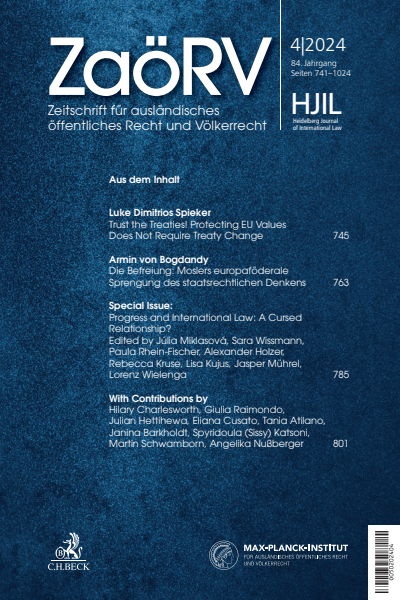
Die Befreiung: Moslers europaföderale Sprengung des staatsrechtlichen Denkens (Armin von Bogdandy)
Abstract:
1951 befreite Hermann Mosler das deutsche juristische Denken transnatio- naler Phänomene aus den Fesseln des staatsrechtlichen Denkens. Medium der Befreiung war die Zeitschrift für ausländisches öffentliches Recht und Völ- kerrecht, Anlass der Vertrag zur Gründung der Europäischen Gemeinschaft für Kohle und Stahl (EGKS). Konkret legte Mosler einen Weg frei, das Gemeinschaftsrecht jenseits des staatsrechtlichen Dualismus von Landesrecht und Völkerrecht als eine neue und neuartige Rechtsordnung zu denken, und zwar in föderalen und verfassungsrechtlichen Kategorien. Er zeigt, dass der politische Wille zu einer völkervertraglich verfassten Föderation souveräner Staaten kein juristisches Paradoxon ist, sondern vielmehr ein Weg in eine bessere Zukunft. Voraussetzung ist allerdings staatsrechtliche Dogmen zu sprengen. So geht es zunächst geht es um die Fesseln, veranschaulicht an Aufsätzen, mit denen Carl Bilfinger in der ZaöRV das juristische Denken in der ersten Sattelzeit zu orientieren suchte. In deren Gegenlicht gewinnt Mos- lers Befreiung klare Konturen. Abschließend wird untersucht, welchen Fes- seln Mosler nicht entkam.
Outside of this section:
Constructing Youth as Progress: Tracing Shared Efforts of the League of Nations and the United Nations (Julian Hettihewa)
Abstract:
A more comprehensive understanding of progress and international law can be obtained if youth is included in the analysis. While youth is gaining increasing prominence in international law, it continues to be neglected by international legal scholarship. This is especially problematic in the context of progress and international law as youth is constructed by international law as progress. This article presents a historical account of youth’s construction as progress, focusing on the efforts of the League of Nations (LoN) and the United Nations (UN) to educate youth in order to promote peace, to prevent another world war. This contribution highlights the continuity of historical patterns and identifies the function of youth as progress as an instrument to conceal power-differentials. Furthermore, this article reveals structural commonalities between interna- tional law and youth. Both embody the Messianic announcement of something universally and inherently good, albeit always postponed: progress.
Visions of International Law in the Nineteenth Century: The Experience of the French Intervention in Mexico (Tania Tilano)
Abstract:
This article explores how Mexican liberal republicans engaged creatively with international law to contest the French Intervention (1862–1867). Their novel vision of enforcing international law through domestic criminal law went beyond mere appropriation; it was a projection of the future. Mexican republicans envisioned international law as a tool to mitigate the asymmetries between European powers and postcolonial nation-states like Mexico. The article demonstrates how postcolonial actors effectively deployed international law, showcasing its potential to contest hegemony on multiple levels: as a language, as a strategy, as an instrument, and as a symbol.
Book reviews:
Issue DOI: 10.17104/0044-2348-2024-4 (open access)
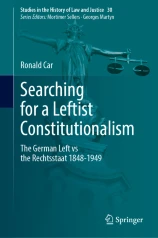
Is there a viable leftist constitutionalism that we can juxtapose with liberal constitutionalism, or is there really no alternative? If the left is considered an a priori enemy of the principle of the rule of law, the equal chance condition proves illusory. Accordingly, those asking for changes to social institutions will deem constitutionalism undemocratic. Hence, in our times of silent de-constitutionalization at the global level and rising populism and democratic backsliding at the national level, this book offers a valuable opportunity to reconsider one of the founding principles of liberal constitutionalism, the Rechtsstaat. It re-examines the controversies that accompanied the affirmation of the concept in a long-term perspective, from 1848 to the post-World War II constitutional debates. Since 1848 the German left has challenged the dominant liberal view of legitimacy, mainly by adopting Marx’s critique of the ideology of law and the state. Thus, the left has had to challenge not only the established order, but also the mainstream political and legal culture generated by the liberal discourse on rights. In search of constitutional viability, the left has oscillated between two tendencies. On the one hand, it has denounced the discourse on rights as an ideological smokescreen used by the ruling class to keep us from paying more attention to the actual level of democracy within the parties, the governmental bodies and in everyday social relations. On the other hand, the left has attempted to adjust its platform to the mainstream idea of constitutional legitimacy by devising its own sozialer Rechtsstaat. However, the break-even point has proven hard to find. If the acceptance of liberal principles was seen as less than wholehearted, leftist constitutional proposals aroused suspicions of a coverup for an unconstitutional rule (Unrechtsstaat). On the other hand, when the left has accepted liberal constitutional principles in full, its potential to challenge the social status quo has ultimately proven to be disappointing. The controversy culminated in a desperate and largely unknown attempt to devise a constitutional compromise between Liberalism and Socialism in East Berlin in the wake of the Cold War. Although doomed to fail and devoid of democratic credibility, the debates of the East German constitutional commission in 1948 offer important insights into a century of experiences, trials and errors in constitution-making seen from the leftist perspective.
Read more here: DOI 10.1007/978-3-031-62098-0.

Book abstract:
The Routledge History of Human Rights is an interdisciplinary collection that provides historical and global perspectives on a range of human rights themes of the past 150 years. The volume is made up of 34 original contributions. It opens with the emergence of a "new internationalism" in the mid-nineteenth century, examines the interwar, League of Nations, and the United Nations eras of human rights and decolonization, and ends with the serious challenges for rights norms, laws, institutions, and multilateral cooperation in the national security world after 9/11. These essays provide a big picture of the strategic, political, and changing nature of human rights work in the past and into the present day, and reveal the contingent nature of historical developments. Highlighting local, national, and non-Western voices and struggles, the volume contributes to overcoming Eurocentric biases that burden human rights histories and studies of international law. It analyzes regions and organizations that are often overlooked. The volume thus offers readers a new and broader perspective on the subject. International in coverage and containing cutting-edge interpretations, the volume provides an overview of major themes and suggestions for future research. This is the perfect book for those interested in social justice, grass roots activism, and international politics and society.
Table of contents:
List of maps and images
List of contributors
Acknowledgements
1. Introduction: An Open-Ended and Contingent History of Human Rights
Jean H. Quataert and Lora Wildenthal
Part 1. The New Internationalism
2. John Anderson - Slave, Refugee, and Freedom Fighter: A Human Rights Campaign in the Age of Empire
Caroline Shaw
3. Investigating and Ameliorating Atrocities in the Nineteenth Century: International Commissions of Inquiry in the Balkans (1876-1880)
Benjamin E. Brockman-Hawe
4. Reclaiming Congo Reform for the History of Human Rights
Mairi S. MacDonald
5. The Red Cross and the Laws of War, 1863-1949: International Rights Activism before Human Rights
Kimberly Lowe
Part 2. The Interwar Era: The League of Nations
6. United in their Quest for Peace? Transnational Women Activists between the World Wars
Marie Sandell
7. The "Rights of Man" and Sex Equality: International Human Rights Discourses in the 1930s
Regula Ludi
Part 3. The Formative UN Era
A. UN Treaty Making
8. Social and Economic Rights: The Struggle for Equivalent Protection
Claire-Michelle Smyth
9. Islam and UN Human Rights Treaty Ratification in the Middle East: The Impact of International Law on Diplomacy
Rachel A. George
10. When the War Came: The Child Rights Convention and the Conflation of Human Rights and the Laws of War
Linde Lindkvist
B. Decolonization
11. "Why Then Call It the Declaration of Human Rights?" The Failures of Universal Human Rights in Colonial Africa’s Internationally Supervised Territories
Meredith Terretta
12. Decolonization, Development, and Identity: The Evolution of the Anticolonial Human Rights Critique, 1948-1978
Roland Burke
13. "When You are Weak, You Have to Stick to Principles": Botswana and Anti-Colonialism in Human Rights History
James Christian Kirby
C. Socialist and Capitalist Versions of Human Rights
14. The International Labour Organization (ILO) and the Gender of Economic Rights
Eileen Boris and Jill Jensen
15. Human Rights Movements and the Fall of the Berlin Wall: Explaining the Peaceful Revolution of 1989
Ned Richardson-Little
16. Human Rights in China: Resisting Orthodoxy
Pitman B. Potter
17. Continuity and Change in U.S. Human Rights Policy
Sarah B. Snyder
Part 4. After Formal Empire and the Cold War: How Human Rights are Practiced Around the Globe (1980s-2001)
18. The Universality of Human Rights: Early NGO Practices in the Arab World
Catherine Baylin Dureya
19. How Women Become Human: Chilean Contributions to Women’s Human Rights from Dictatorship to the 21st Century
Jadwiga E. Pieper Mooney
20. The Mothers of the Plaza de Mayo: From Dictatorship to Democracy
Jennifer Adair
21. Asma Jahangir: Personifying the Human Rights Debate in Pakistan
Afiya Shehrbano Zia
Part 5. The Universal Human Rights Pantheon in National Contexts
22. Freedom of Religion and the New Diversity: Case Studies from Canada
Lori G. Beaman
23. Indigenous Activism for Human Rights: A Case Study from Australia
Rachel Standfield and Lynette Russell
24. The International LGBT Rights Movement: An Introductory History
Laura A. Belmonte
25. Rights in Isolation: Lessons on Public Health and Human Rights from Leprosy and HIV in the Pacific Islands
Adam R Houston
Part 6. New Forms of Accountability in a National Security World (2001 to the Present)
26. Decentralization and Public-Private Diplomacy in the Business and Human Rights Field
Steven S. Nam
27. The Selectivity of Universal Jurisdiction: The History of Transnational Human Rights Prosecutions in Latin America and Spain
Ulrike Capdepón
28. Militarized Sexual Violence and Campaigns for Redress
Vera Mackie
29. Solidarity Rights and the Common Heritage of Humanity
Anca Claudia Prodan
30. Intellectual Property Law and Human Rights
Steven Wilf
31. Caged at the Border: Immigration Detention and the Denial of Human Rights to Asylum Seekers and Other Migrants
Stephanie J. Silverman and Petra Molnar
Part 7. The Transformative Impact of Human Rights on Knowledge
32. Archiving Human Rights in Latin America: Transitional Justice and Shifting Visions of Political Change
Michelle Carmody
33. Emotion in the History of Human Rights: A Case Study of the Canadian Museum for Human Rights
Christine Lavrence
34. From the Classroom to the Public: Engaging Students in Human Rights History
Jessica M. Frazier
A Bibliography on the History of Human Rights
Index
The pivotal contributions of private international law to the conceptual emergence of international human rights law have been largely ignored. Using the idea of adjacent possibility as a theoretical metaphor, this article shows that conflict of laws analysis and technique enabled the articulation of human rights universalism. The nineteenth-century epistemic practice of private international law was a key arena where the claims of individuals were incrementally cast as being spatially independent from their state of nationality before rights universalism became mainstream. Conflict of laws was thus a vital combinatorial ingredient contributing to the dislocation of rights from territory that underwrites international human rights today.
International Lawyers as Hope Mongers: How Did We Come to Believe That Democracy Was Here to Stay? (Işıl Aral)
DOI 10.1163/15718050-bja10098
Abstract:
It is common these days to lament the recession of democracy around the world. The way scholars address the issue of democratic backsliding shows that there is a significant gap between the expectation about democracy’s anticipated course of development and the current state of affairs. This article argues that the expectation that democracy would consolidate over time was produced by the progress narrative of democratic governance discourses. Drawing on narratology, it conducts a discourse analysis to demonstrate that today’s dismay about the recession of democracy is due to an unwarranted expectation that was created by the progress narrative of democratic governance discourses. It focuses on the periodisation of history in the construction of these discourses and investigates how scholars used the Cold War – post-Cold War dichotomy to create a progress narrative.
The Twilight of the Law of the Fairs: Inventing International Cooperation on Bankruptcies in Early Modern Europe (Lyon, 1660–1710) (Benoît Saint-Cast)
DOI 10.1163/15718050-bja10094
Abstract:
Bankruptcy was a key institution in the development of markets in Europe. However, the territoriality of jurisdictions and legal systems made international insolvencies difficult to manage. In the middle of the seventeenth century, cities such as Lyon developed networks of cooperation by granting foreign merchants equal rights to local creditors on a reciprocal basis. However, courts were reluctant to give foreign authorities control over assets and creditors on their territory. The article examines how the Lyon commercial court changed its policy towards international insolvencies during the second half of the seventeenth century. Whereas equal treatment of foreign creditors was conditioned on the recognition of an extraterritorial jurisdiction in the medieval fairs system, it now depended on the reciprocity of the legal status granted to merchants abroad. This system of cooperation between equally sovereign courts prefigured in many ways the current situation of private international law in bankruptcy matters.
Book review
The Political Economy of International Commodity Cartels: An Economic History of the European Timber Trade in the 1930s , written by Elina Kuorelahti (Florenz Volkaert)
DOI 10.1163/15718050-bja10108
Read the full issue here.
ABOUT THE BOOK
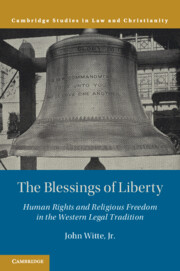
Leading legal scholar John Witte, Jr. explores the role religion played in the development of rights in the Western legal tradition and traces the complex interplay between human rights and religious freedom norms in modern domestic and international law. He examines how US courts are moving towards greater religious freedom, while recent decisions of the pan-European courts in Strasbourg and Luxembourg have harmed new religious minorities and threatened old religious traditions in Europe. Witte argues that the robust promotion and protection of religious freedom is the best way to protect many other fundamental rights today, even though religious freedom and other fundamental rights sometimes clash and need judicious balancing. He also responds to various modern critics who see human rights as a betrayal of Christianity and religious freedom as a betrayal of human rights.
ABOUT THE AUTHOR
John Witte, Jr. is Woodruff University Professor, McDonald Distinguished Professor, and Director of the Center for the Study of Law and Religion at Emory University. A world-class scholar of legal history, human rights, and law and religion, he has published 300 articles and forty books. Recent works include The Western Case for the Monogamy Over Polygamy (Cambridge, 2015), Christianity and Family Law (Cambridge, 2017), and Church, State, and Family (Cambridge, 2021).
TABLE OF CONTENTS
Introduction
1. Christian contributions to the development of rights and liberties in the Western legal tradition
2. Magna Cartas old and new: rights and liberties in the Anglo-American common law
3. Natural law and natural rights in the early Protestant tradition
4. 'A most mild and equitable establishment of religion': religious freedom in Massachusetts, 1780–1833
5. Historical foundations and enduring fundamentals of American religious freedom
6. Balancing the guarantees of no establishment and free exercise of religion in American education
7. Tax exemption of religious property: historical anomaly or valid constitutional practice? 8. Faith in Strasbourg? Religious freedom in the European Court of Human Rights
9. Meet the new boss of religious freedom: the new cases of the Court of Justice of the European Union
Concluding reflections: toward a Christian defense of human rights and religious freedom today
Index.
More information can be found here.
Lectures de… : La condition des sujets ennemis en France pendant la guerre (1916) et Cours radiodiffusé sur l’héritage (1938-1939) de René Cassin

(J. Broch éd., Académie des sciences morales et politiques, 2021),
Journée d’étude organisée le 1er juin par la SHFD et l’IRJS, Paris 1,
site de Port-Royal (1 rue de la Glacière), bâtiment Veil au 2ème étage, salle des séminaires
10 h
Sous la présidence d’Anne-Marie Leroyer, professeur de droit privé, université Paris 1 Panthéon-Sorbonne, directrice de l’Institut de Recherche Juridique de la Sorbonne.
Xavier Lagarde, professeur de droit privé, université Paris 1 Panthéon-Sorbonne, directeur de l’Institut d’Etudes à Distance de l’Ecole de Droit de la Sorbonne, Propos introductifs sur la diffusion des savoirs juridiques.
Michel Grimaldi, professeur émérite de droit privé, université Paris-Panthéon-Assas, Existe-t-il un droit à l’héritage ?
Christophe Vernières, professeur de droit privé, université Paris 1 Panthéon-Sorbonne, Les grands principes du droit successoral à travers le cours de René Cassin.
14 h
Sous la présidence de Nader Hakim, professeur d’histoire du droit, université de Bordeaux, secrétaire général de la Société pour l’histoire des Facultés de droit.
Muriel Ubeda-Saillard, professeur de droit public, université de Lille, La neutralisation des personnes perçues comme dangereuses par la communauté en guerre, préfiguration du droit pénal de l'ennemi.
Sarah Durelle-Marc, maître de conférences en droit public, institut catholique de Lille, La condition des sujets ennemis et les prémices d’un droit des minorités.
Michel Erpelding, chercheur en droit international et européen, université du Luxembourg, René Cassin, la condition des sujets ennemis et l’émergence du juge international comme garant des droits de l’individu.
Nikolas Karmis, doctorant en droit public, université Paris-Panthéon-Assas, « Comme un otage économique pour l’heure du règlement de compte avec nos ennemis » : la possibilité de saisie des biens des civils ennemis.
Et en présence de Julien Broch, maître de conférences en histoire du droit, université d’Aix-Marseille
More information here.
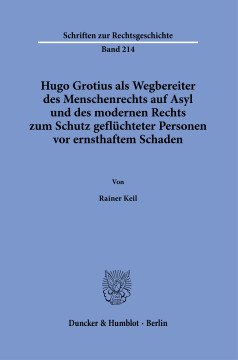
»Hugo Grotius as Author Paving the Way for the Human Right to Asylum and the Modern Law Protecting Forced Migrants Against Serious Harm«: This book presents results of research that contradict or go beyond claims of previous publications on Grotius and asylum: a comprehensive concept of asylum, the germ of individual rights, a new assessment of colonialist implications, connections with the reception of Sephardim, protection against political persecution, contributions to a human rights theory, relations between Grotius’s concepts and presently applicable features of law and with current discussions within philosophy of law.
On the author:
Rainer Keil studierte in Trier und Heidelberg Rechtswissenschaft und absolvierte den Juristischen Vorbereitungsdienst in Mannheim. Nach 2. jur. Staatsprüfung und Anwaltstätigkeit mit aufenthalts- und asylrechtlichem Schwerpunkt in Stuttgart betreute er ab Herbst 2000 als akad. Mit. die Anwaltsorientierte Juristenausbildung der Juristischen Fakultät Heidelberg, für deren Dekanatsgeschäftsführung er seit Frühjahr 2002 zuständig ist. Auf die Promotion zum Dr. iur. folgten Publikationen zu prozess-, aufenthalts- und asylrechtlichen, demokratietheoretischen, rechtsphilosophischen und ideengeschichtlichen Themen.
Read more here: DOI 10.3790/978-3-428-58898-5.
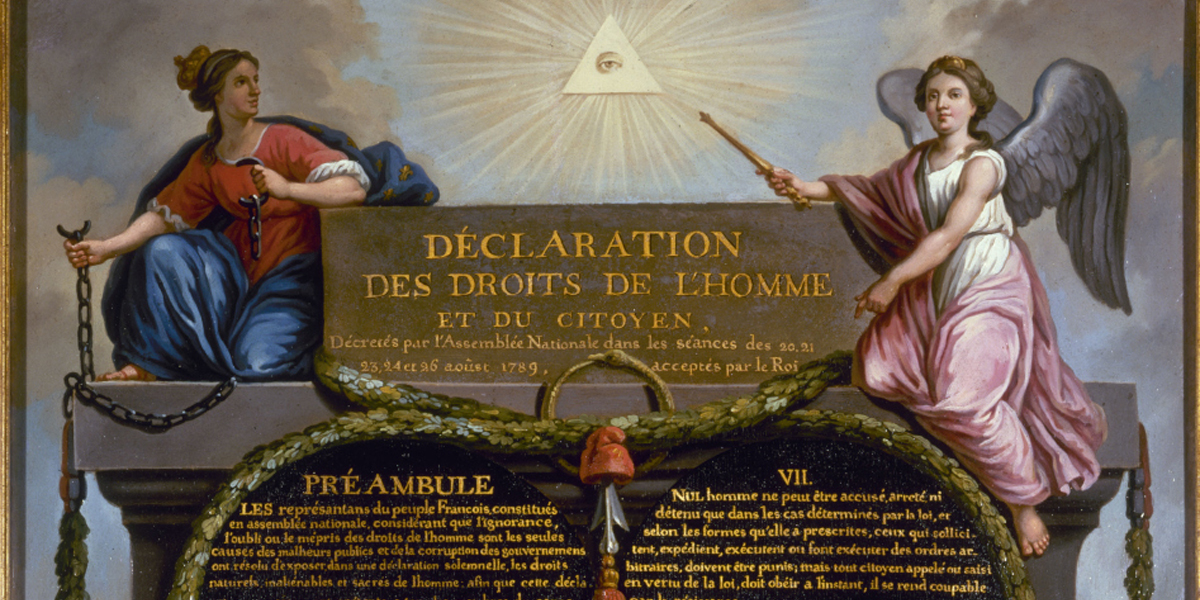
The Turin Humanities Programme and Fondazione1563 are pleased to invite postgraduate students and early career researchers to submit their applications to the Summer School “Enlightenment legacy: the rights of man in a global perspective”.
The Summer School intends to elucidate, from a global perspective, a fundamental – although often neglected – aspect of the legacy of the Enlightenment to better understand its enduring and controversial presence over time in the fields of politics, society, law, and economics.
Namely, the Summer School will focus on the political and constitutional language of the rights of man, seen as the most lasting legacy of the cultural revolution through which the Enlightenment changed the course of global history, acting as a “laboratory of modernity”.
The Summer School will engage with the Enlightenment’s transformation of the old moral concept of natural rights into the modern political language of the “rights of man” and the ambitious Enlightenment project of bringing about the constitutionalization of the rights of man as part of a modern politics of emancipation that began well ahead of the French Revolution.
Moreover, the Summer School will explore the controversial affirmation and metamorphoses of the Enlightenment’s culture of the rights of man in a global context throughout the Nineteenth and Twentieth centuries. By so doing, the Summer School aims at shedding light on the Enlightenment’s relevance to deal with issues raised by the contemporary evolutions of global constitutionalism and governance, that still require to be addressed.
The THP Summer School provides a forum for postgraduate students and early career researchers in the field of humanities and the social sciences (history, philosophy, law, economics, political science and international relations) to engage with the most up-to-date academic debates and global historiographical currents on the Enlightenment and its cultural, political and legal legacy.
We encourage applications from researchers with a strong interest in human rights/rights of man and woman/natural rights in an historical, global and interdisciplinary setting. In particular, but not limited to:
English will be the default language of the Summer School.
The Summer School programme includes keynote lectures of Professor Nicholas Cronk (Voltaire Foundation, University of Oxford), Professor Dan Edelstein (Stanford University), Professor Serena Ferente (University of Amsterdam), Professor Vincenzo Ferrone (University of Torino), Professor Franco Motta (University of Torino), Professor Céline Spector (Sorbonne Université), Giovanni Bietti (composer, pianist and musicologist), early career researchers’ presentations of original manuscripts/book projects, workshops and roundtable discussions.
To foster dialogue between senior and young scholars, the Summer School offers its participants a unique opportunity to contribute to the broader discussion on the human rights theme with their own ideas and to test their research.
Successful applicants will also have the chance to present their papers in panel sessions which will be followed by a Q&A led by a panel discussant.
The full call for application can be found here.

A propos de l'ouvrage :
Cette étude prend comme point de départ la lecture qui a été faite de l’article 5 de la Déclaration de 1789 à l’occasion de l’interdiction de la dissimulation du visage dans l’espace public. La première phrase de l’article 5, « La Loi n’a le droit de défendre que les actes nuisibles à la Société », avait alors été largement utilisée, à la fois par le Conseil d’État, dans son étude sur les possibilités d’interdiction du voile intégral, par le législateur, dans les différents rapports rendus publics et enfin, par le Conseil constitutionnel, dans la décision de conformité qu’il rendit lorsqu’il fut saisi du texte. Les « actes nuisibles à la société » ont alors été appréhendés comme le pendant des « exigences minimales et réciproques de la vie en société », expression dont on doit la paternité à la Haute juridiction administrative. C’est pourquoi, le travail entrepris ne s’est pas porté sur une lecture générale de l’article 5 de la Déclaration de 1789, mais il part du postulat que les actes nuisibles sont le négatif des exigences minimales et réciproques de la vie en société. Ce choix explique finalement l’expression retenue en guise de titre, qui ne correspond pas expressément à celle qui figure dans l’article 5.
A propos de l'auteur :
Valentin GAZAGNE-JAMMES est docteur en droit public de l’Université Toulouse 1 Capitole, qualifié aux fonctions de maître de conférences, enseignant-chercheur contractuel à l’Université de Bordeaux.


A propos de l'ouvrage :
Des deux côtés de la Manche, la France et l'Angleterre ont été pendant six siècles les créateurs d'une certaine idée de la liberté personnelle et politique. Jean de Salisbury, né en Angleterre, ami de Thomas Becket et évêque de Chartres, publie en 1159 son Policraticus, ouvrage de réflexion politique qui est l'un des premiers livres imprimés ; en 1576, Jean Bodin publie les Six livres de la République qui ont une grande influence sur John Locke; Montesquieu prolonge la pensée de Locke dans l'Esprit des lois en 1748 ; Sir William Blackstone, qui publie de 1765 à 1769 ses Commentaries on the laws of England, était un grand lecteur de Montesquieu. De Jean Bodin à Locke, de Locke à Montesquieu, de Montesquieu à Blackstone, quelle chaîne de réflexion sur la liberté des deux côtés de la Manche ! (...)
Le livre de Michael Tugendhat et Elisabeth de Montlaur Martin montre "l'influence réelle qu'eurent le droit anglais en France et le droit français en Angleterre pendant plus de six siècles". Cette large réflexion sur la liberté dans les deux pays entre 1159 et 1793 permet de mieux comprendre les ressorts de cette féconde interaction. Il donne accès, dans un volume dont les dimensions restent mesurées, à des clefs qui ouvrent des portes qu'il est aussi utile qu'agréable de franchir avec eux : elles donnent à voir l'importance des liens entre nos deux pays, leur rôle dans la construction de l'idéal européen de liberté, les promesses qui, au-delà des incertitudes du moment, en résultent pour l'avenir.
A propos des auteurs :
Michael Tugendhat est un ancien juge de la Hugh Court de 2003 à 2014. Il est également président de la société des juristes Franco-Britannique depuis 2011.
Elisabeth De Montlaur Martin
Table des matières :


ABOUT THE BOOK
Human rights prosecutions are the most prominent mechanisms that victims demand to obtain accountability. Dealing with a legacy of gross human rights violations presents opportunities to enhance the right to justice and promote a more equal application of criminal law, a fundamental condition for a more substantive democracy in societies. This book seeks to analyse the impact, advances, and difficulties of prosecuting perpetrators of mass atrocities at national and international levels. What role does criminal justice play in redressing victims’ wrongs, guaranteeing the non-repetition of mass atrocities, and attempting to overcome the damage caused by systematic human rights violations? This volume addresses critical issues in the field of human rights prosecution by drawing on the experiences of a variety of post-conflict and authoritarian countries covering three world regions. Contributing authors cover prosecutions in post-Nazi Germany, post-Communist Romania, and transnational legal complaints by victims of the Franco dictatorship, as well as domestic and third-country prosecutions for human rights violations in the pioneering South American countries of Argentina, Chile, Peru, and Uruguay, prosecutions in Darfur and Kenya, and the work of the International Criminal Court.
The Impact of Human Rights Prosecutions offers insights into the difficulties human rights trials face in different contexts and regions, and also illustrates the development of these legal procedures over time. The volume will be of interest to human rights scholars as well as legal practitioners, participants, justice system actors, and policy makers.
ABOUT THE EDITORS
Rosario Figari Layús is postdoctoral researcher in social sciences and lecturer at the Chair for Peace Studies at the Law Faculty at the Justus Liebig University of Giessen.
Ulrike Capdepón holds a PhD in political science and is a researcher and project coordinator at the Center for Cultural Inquiry (ZKF), University of Konstanz.
TABLE OF CONTENTS
Prologue- Aleida Assmann
Introduction: Do Human Rights Trials Make a Difference after Conflict, Dictatorship and State-Sponsored Violence? - Rosario Figari Layús and Ulrike Capdepón
Human Rights Trials without Human Rights Law: Prosecuting Nazi Crimes in Postwar Germany After Nuremberg - Annette Weinke
Courts as a Site to Tell the “Truth”: The Case of Former Prison Commander Alexandru Vişinescu - Kristine Avram
Seeking Justice for the Crimes of the Franco Dictatorship: The Politics of Victimhood in the “Argentine Legal Complaint” - Ulrike Capdepón
The Struggle of Victims for Human Rights Trials in Post-Dictatorship Chile - Boris Hau
The State Against the State: The Impact of Governmental Contradictions on Human Rights Trials and Victims in Argentina - Rosario Figari Layús
Operation Condor Trials Abroad: The Innovation and Domestic Constraints of Transnational Prosecution - Debbie Sharnak
Tensions Between Criminal Trials and the Sense of Justice in Post-Conflict Peru - Iris Jave
The International Criminal Court’s “Africa Problem” and Suppression of the “Justice Cascade” - Geoffrey Lugano
Conditions and Cultural Consequences of International Criminal Justice Intervention: The Case of Darfur - Joachim J. Savelsberg
The Effects of Seeking Justice on Behalf of the Victim: A Critical Analysis of Criminal Trials in the Kenyan Post-Election Violence Transitional Justice Process - Valeria Vegh Weis
Concluding Reflections: Towards the End of Impunity? The Scope and Impact of Human Rights Trials - Rosario Figari Layús and Ulrike Capdepón
Mor information with the publisher.


