Search

Showing posts with label philosophy of law. Show all posts

01 July 2026

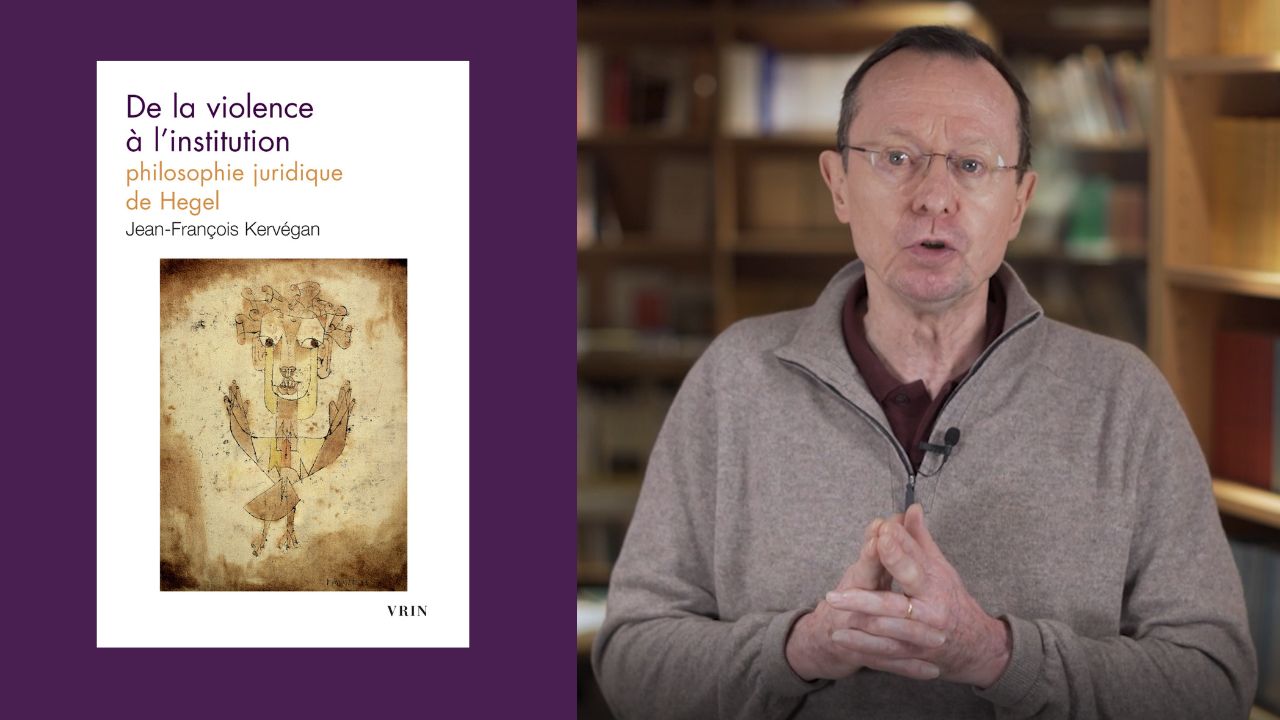
BOOK: Jean-François KERVÉGAN, De la violence à l'institution. Philosophie juridique de Hegel (Paris: Vrin, 2025), 196 p. ISBN 978-2-7116-3243-5, € 12


(image source: Vrin)

Abstract:
Le droit, c’est bien connu, a pour vocation de conjurer la violence aveugle en définissant les conditions de son usage légitime, autrement dit en l’institutionnalisant. De ce fait, il entretient avec elle un rapport ambigu : il la proscrit, mais il en est issu et, d’une certaine manière, la maintient en jeu. La philosophie juridique de Hegel, autrement dit sa théorie de « l’esprit objectif », prend la mesure de ce rapport complexe qu’illustrait déjà la tragédie antique. Ceci le conduit, dans le contexte de la société postrévolutionnaire, à élaborer une théorie des droits, pièce maîtresse d’une conception renouvelée de la justice et des institutions qui permet de penser l’État et la constitution non comme des configurations abstraites, mais comme des formes de vie. Cette attention portée aux marges des institutions juridiques confère à la pensée de Hegel une puissance critique dont se sont emparé les Jeunes hégéliens, au premier rang desquels Marx, puis, au XXe siècle, les différents courants de la théorie critique.

On the author:

Jean-François Kervégan est professeur émérite de philosophie à l’Université Paris 1 Panthéon-Sorbonne.

More information here

23 March 2026

LECTURE: Michel TROPER, "La nature dans la philosophie des droits de l'Homme" [Colloque De l'esthétique de la nature à l'esthétique des droits de l'Homme au siècle des Lumières, 15 MAY 2025] (Associationn des Historiens du Droit de l'Ouest) [YOUTUBE]


Abstract:
Dans le cadre d'une journée d'étude organisée par le Professeur Thérence Carvalho le jeudi 15 mai 2025 sur le thème "De l'esthétique de la nature à l'esthétique des droits de l'Homme au siècle des Lumières", le Professeur Michel Troper a prononcé une intervention intitulée "La nature dans la philosophie des droits de l'Homme et dans la théorie esthétique au siècle des Lumières". Cet exposé était précédé d'une présentation générale réalisée par le Professeur Thérence Carvalho. Problématique : Le XVIIIe siècle, période charnière dans l'émergence des droits subjectifs, voit se transformer les représentations du droit et de la nature. Cette journée d'études propose d'interroger, dans une approche interdisciplinaire (juridique, philosophique et historique), le passage d'une esthétique de la nature à une esthétique des droits de l'Homme. Comment les Lumières ont-elles repensé le lien entre nature et droits, entre beauté et norme ? Quels sont les fondements intellectuels et les implications politiques de cette évolution ?

(source: Youtube

19 March 2026

BOOK: Nathaniel BOYD, Hegel and German Public Law [Europe's Legacy in the World, eds. Martti KOSKENNIEMI & Annabel BRETT] (London: Bloomsbury/Hart, 2026), 304 p. ISBN 9781350584204, 85 GBP


(image source: Bloomsbury)

Abstract:

Nathaniel Boyd's pathbreaking book argues that Hegel's political thought was shaped by German public law. This tradition of legal discourse, especially through its imperial tradition, was crucial to European modernity, influencing foundational philosophical concepts such as sovereignty, the state and the diverse legal systems that emerged from them. Hegel and German Public Law examines the impact of Johann Jacob Moser, Johann Stephan Pütter and Johann Christian von Majer on Hegel's intellectual development. It reveals how the collapse of the Holy Roman Empire informed his early speculative system and constitutional theory. In doing so, Boyd extends our understanding of Hegel's relation to European legal and political thought while offering an original interpretive framework for Hegel's absolute idealism and unfolding institutional theory of the state.

Table of contents:

Introduction
1. Imperial Public Law in Statu Cadentis Imperii: Johann Jacob Moser
2. The Empire as the Impersonal Nexus of the Composite State: Johann Stephan Pütter3. The Twilight of German Imperial Public Law: Johann Christian von Majer4. The Empire of Ethical Life: Georg Wilhelm Friedrich HegelConclusionBibliography

Index

Read more here


13 October 2025

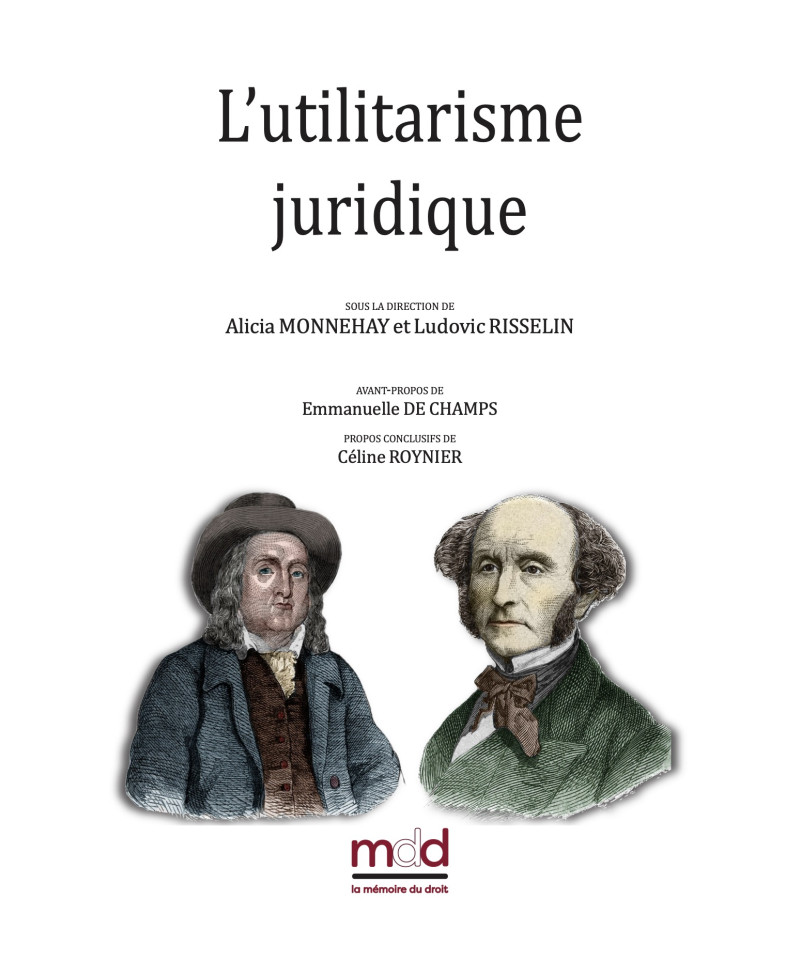
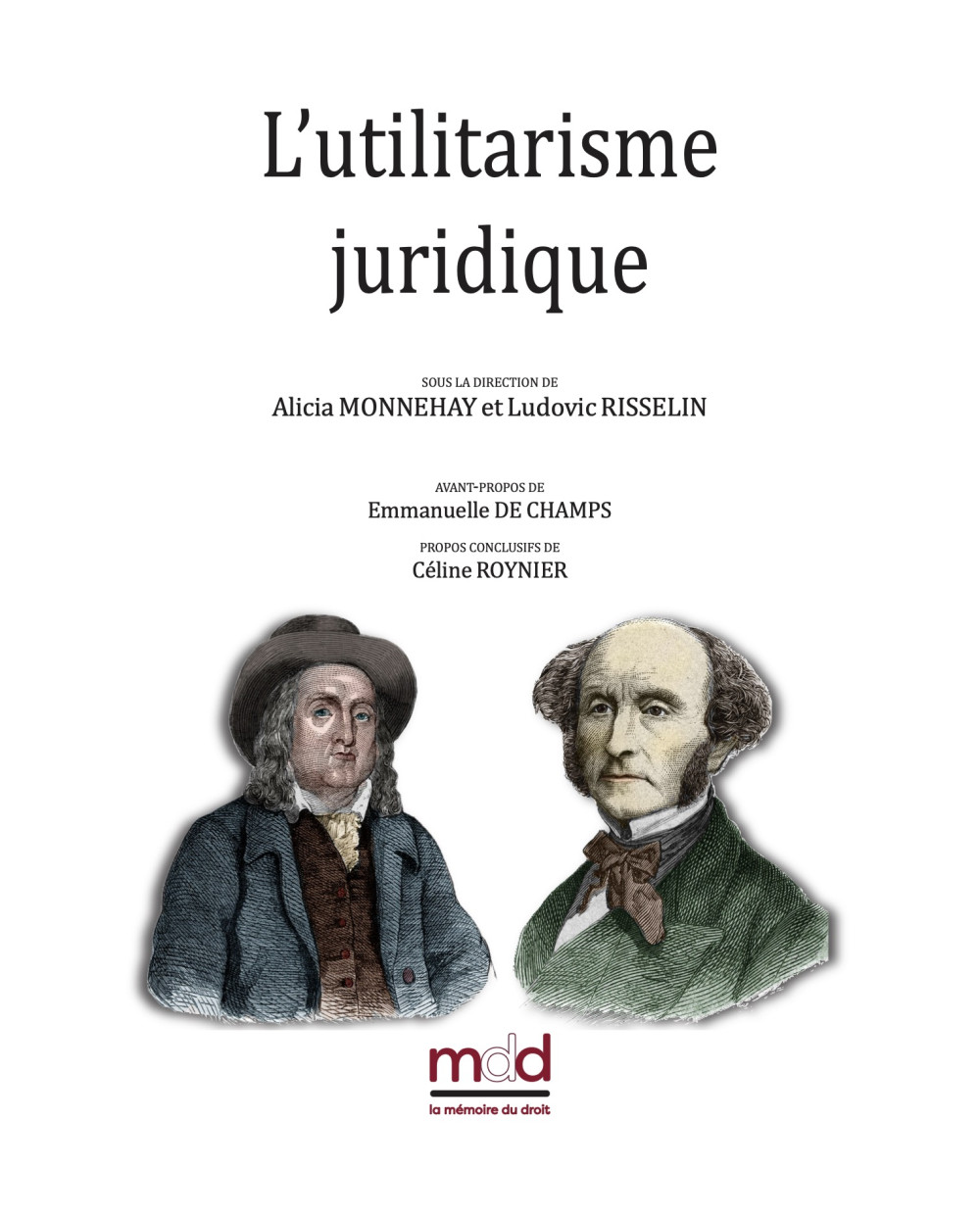
BOOK: Alicia MONNEHAY & Ludovic RISSELIN (dir.), L'utilitarisme juridique. Actes du colloque de la jeune recherche organisé le jeudi 7 septembre 2023 à CY Cergy Université (Paris: La Mémoire du Droit, 2025), 216 p.


(image source: MDD)

Abstract;

L’utilitarisme est cette philosophie morale qui érige l’utilité en principe. Enraciné dans la culture politique anglo-saxonne et trop souvent réduit à la théorie économique qui l’a favorablement accueilli, il entretient des relations privilégiées avec le droit. La philosophie utilitariste, en se prolongeant dans l’organisation sociale pour atteindre la félicité publique, innerve le système juridique. Un tel mouvement s’observe dans le droit français. À travers l’expression de « l’utilitarisme juridique », l’ouvrage porte l’ambition de retranscrire les actes du colloque, qui s’est tenu le 7 décembre 2023 à l’Université de Cergy Paris, au cours duquel les contributeurs ont intégré la question de l’utilité dans leur raisonnement. Une convergence de méthode s’est alors dessinée pour se saisir du droit positif et de ses évolutions. Qu’il s’agisse de déterminer le rapport de fondamentalité qu’entretiennent le droit et la morale ou de révéler l’instrumentalisation de l’utilité dans l’appréhension des conséquences des normes, l’utilitarisme offre une grille d’analyse pertinente. Les articles qui rythment la structure de l’ouvrage l’illustrent.

Read more here

14 July 2025

BOOK: Gabrio FORTI, Gaia DONATI, Claudia MAZZUCATO & Arianna VISCONTI (eds.), L'esercizio del 'giusto giudizio'. Dialoghi manzoniani sull'idea di responsabilità e i fondamenti della giustizia (Milano: Vita e Pensiero, 2025), 504 p. ISBN 9788834357873, € 34


(iamge source: Vita e Pensiero)

Abstract:

Che cosa rende ‘giusto’ l’esercizio del ‘giudizio’? Quanto, come e perché il ‘giudicare’ non si lascia ridurre al semplice ‘spiegare’? Queste le domande che si dischiudono non appena si mette a tema il ‘giudizio’, tanto più in un contesto socio-culturale, oltre che giuridico-istituzionale, nel quale si assiste, a tutti i livelli, a un ‘infuriare’ di giudizi ‘sommari’, il cui assordante rumore di fondo sembra renderci orfani di giudizi veri e, appunto, giusti. Le opere letterarie prese in considerazione in questo volume lasciano intravedere spiragli di risposta a tali secolari quesiti dell’umanità. La Storia della colonna infame, che è il luogo del giudizio e del giudizio sul giudizio, ma anche I promessi sposi, dove il giudizio è più squisitamente narrativo, pongono le basi per scandagliare, con Alessandro Manzoni, la dimensione etica della vita e il delicato equilibrio tra giudizio e comprensione. Un interrogativo che si ripropone nel dialogo con Leonardo Sciascia e Primo Levi, ma anche con molti altri autori e pensatori, attualizzato, ad esempio, nella serrata discussione critica con la tendenza, espressione di una crescente ‘ansia punitiva’, a mal sopportare i tempi e i vincoli di garanzia dello stesso procedimento penale, in favore del ben più rapido, ed emotivo, ‘giudizio mediatico’. Congiungendo competenze teoriche e sensibilità applicative, esperienze giuridiche e prospettive filosofiche, sociologiche, psicologiche e criminologiche, il volume incoraggia il lettore, tanto più quello interessato al livello di civiltà giuridica (e, dunque, di civiltà tout court) della società in cui vive, a dipanare l’intreccio tra responsabilità, giudizio, riparazione e pena, «tutte categorie che evocano situazioni di sofferenza». La risposta alla perturbante domanda «Ma come rispondere diversamente?» sta nel prendere sulle spalle un «pezzetto della croce della società», aprendosi a un’idea di giustizia come ascolto e attenzione.

Contributors:

Con i contributi di: Carla Bagnoli, Giuliano Balbi, Mauro Bertolotti, Giovanni Canzio, Lucia Castellano, Patrizia Catellani, Maurizio Catino, Adolfo Ceretti, Paola Corvi, Franca D’Agostini, Francesco D’Alessandro, Cristina de Maglie, Gaia Donati, Luciano Eusebi, Luigi Ferrarella, Gabriele Fornasari, Gabrio Forti, Pierantonio Frare, Loredana Garlati, Diletta Giuffrida, Fausto Giunta, Aldo Grasso, Natalino Irti, Claudia Mazzucato, Isabella Merzagora, Niccolò Nisivoccia, Carlo Enrico Paliero, Mauro Palma, Silvano Petrosino, Antonio Sichera, Francesco Viganò, Arianna Visconti.

On the editors:

L’Alta Scuola “Federico Stella” sulla Giustizia Penale (ASGP), istituita presso l’Università Cattolica del Sacro Cuore, rappresenta un unicum nel panorama culturale e professionale italiano. È un laboratorio di analisi e progettazione che si dedica alla ricerca di soluzioni regolative e applicative in tutti gli ambiti – giuridici, economici e sociali – connessi alla giustizia penale. Il suo metodo è il confronto serrato con l’‘immane concretezza’ dei problemi di oggi, reso esperto e consapevole grazie al dialogo costante tra docenti e ricercatori italiani e stranieri, nonché tra qualificate realtà istituzionali, professionali e imprenditoriali. Le iniziative didattiche e scientifiche dell’Alta Scuola, diretta da Gabrio Forti, hanno principalmente a oggetto, oltre all’esplorazione del rapporto tra diritto/giustizia e letteratura, i crimini d’impresa, le condizioni della compliance nelle organizzazioni complesse, la prevenzione della corruzione, la responsabilità in campo sanitario e il problema della gestione del rischio clinico, le misure patrimoniali di contrasto alla criminalità organizzata, le nuove frontiere della giustizia riparativa (restorative justice), la riforma dell’ordinamento penitenziario, la tutela del patrimonio culturale e dell’ambiente.

More information here


10 June 2025

BOOK: Sabina TORTORELLA (ed.), Alexandre Kojève et le droit. Justice, société et État à l’épreuve d’un nouvel ordre mondial [Bibliothèque de la pensée juridique, 23; eds. Olivier BEAUD & Jean-François KERVÉGAN] (Paris: Classiques Garnier, 2025), 228 p. ISBN 978-2-406-17865-1, € 32


(image source: Classiques Garnier)

Abstract:

L’Esquisse d’une phénoménologie du droit reste un ouvrage peu connu de la pensée d’Alexandre Kojève dont l’originalité sur des questions de théorie du droit, de philosophie et de théorie politique continue d’alimenter les débats contemporains.

More information here: DOI 10.48611/isbn.978-2-406-17867-5

21 September 2023

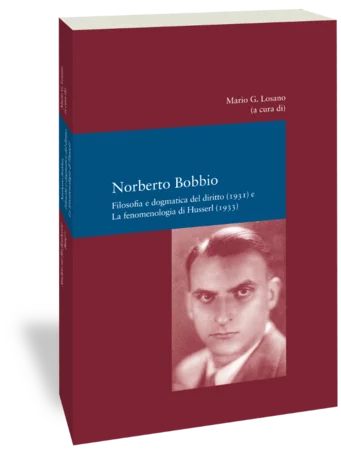
BOOK: Mario G. LOSANO (a cura di), Norberto Bobbio. Filosofia e dogmatica del diritto (1931) e La fenomenologia di Husserl (1933) [Studien zur Rechtstheorie; 1] (Frankfurt am Main: Klostermann, 2023), XII + 295 p. ISBN 978-3-465-04628-8


(image source: Klostermann)

Abstract:

Norberto Bobbio (1909–2004) was one of the most influential 20th-century legal philosophers of the Latin world, and he was considered the civil and secular conscience of Republican Italy. Early on in his intellectual development, he wrote and defended two dissertations while still in his early twenties. In 1931, he received a doctorate in legal philosophy for his thesis Philosophy and Legal Doctrine and another in 1933 in theoretical philosophy for Husserl’s Phenomenology, both from the University of Turin. This edition makes these previously unpublished texts available for the first time. His initial theoretical interest in Husserl quickly gave way to the pursuit of legal philosophy, which would remain the focus of his research: first in opposition to legal positivism and later, starting in 1949, his critical engagement with Hans Kelsen’s legal theory.

Read more here


26 June 2023

BOOK: Gianfrancesco ZANETTI, Mortimer SELLERS & Stephan KIRSTE (eds.), Handbook of the History of the Philosophy of Law and Social Philosophy [Studies in the History of Law and Justice, eds. Mortimer SELLERS & Georges MARTYN, vols. 22-24] (Heidelberg: Springer, 2023), 3 vol., ISBN 978-3-031-19544-0, € 211,99 per volume


(image source: Springer)

Abstract:

This Handbook discusses representative philosophers in the history of the philosophy of law and social philosophy, giving clear concise expert definitions and explanations of key personalities and their ideas. It provides an essential reference for experts and newcomers alike.

On the editors:
Gianfrancesco Zanetti taught Jurisprudence and Political Theory in the University of Bologna, University of Modena, Military Academy of Modena (course for the Carabinieri Cadets), Hunter College CUNY (New York), UC Berkeley. Mortimer Sellers is Regents Professor of the University System of Maryland. He is past President of the International Association for the Philosophy of Law and Social Philosophy (IVR). Stephan Kirste holds the Chair for the Philosophy of Law and Head of the Department for Legal Theory, International and European Law at the University of Salzburg, Professor Colaborador at Pontifícia Universidade Católica do Rio Grande do Sul (Brazil) and member of the Council of the German Speaking International Andrássy University, Budapest.
Read volume 1 and 2 here (DOI 10.1007/978-3-031-19542-6).

16 February 2023

JOURNAL: Special Issue "Les frontières du droit" (Cahiers Jean Moulin VIII (2022)) (OPEN ACCESS)


(image source: openedition)

Présentation du dossier « Frontières de la science du droit »
DOI 10.4000/cjm.1546

Enquêter sur les savoirs juridiques : controverses juridiques et traductions conceptuelles (Vincent Réveillère)
DOI 10.4000/cjm.1551
Abstract:

This contribution develops a methodological reflection on the way in which it is possible to investigate legal knowledge. Firstly, an inquiry into the surface of EU law is proposed: taking seriously the controversy before the judge and surrounding its rulings allow us to see its institutive dimension. Legal concepts are not mere tools, totally under control, used to achieve certain ends defined in other terms, outside the law. They are far more than that : they participate to the constitution of legal and social realities that they pretend to regulate. They enable and limit what participants of a language-game can do, and they can even influence what they may want to do. Secondly, this approach is used to study a conceptual translation that occurs in three rulings of the Court of justice of the European Union dealing with family name.


Rendre compte de l’activité scientifique : étude à partir de la Revue du droit public (1904-1913) (Guillaume Richard)
DOI 10.4000/cjm.1614
Abstract:

The Revue du droit public was created during the Third Republic to become the main French forum for the science of public law, in conjunction with its institutionalization in French law schools. The study of the bibliographic sections of the journal during the decade 1904-1913 offers a rich insight on the doctrinal construction of public law. The study is based on the actual practices of reading and selecting written material that was considered as belonging to the field of public law. It makes the science of public law appear as a flow that must be controlled and organized. The Revue du droit public thus constituted a « school of activity »: its functioning contributed to defining common scientific practices, without there necessarily being intellectual and doctrinal homogeneity among the contributors.

Dépasser les frontières disciplinaires dans la recherche en droit : une approche empirique (Albane Geslin)
DOI 10.4000/cjm.1671
Abstract:

It is conventional today to stress that legal research, particularly in France, is relatively isolated from other scientific fields. To know whether the facts corroborate this general feeling, I propose to measure the degree of openness of the legal field by using a quantitative and, more precisely, bibliometric analysis.

La répression judiciaire de l’activité et de la propagande communiste des années 1920 à la Libération : entre rupture et continuité de l’infraction politique en droit français (Jacques Duret)
DOI 10.4000/cjm.1721
Abstract:

After the Russian revolution of 1917, French society of the early 20’s is marked by the fear of a communism insurrection. This communist "threat" (Monier, 1998, p. 89 et seq.) quickly spreads within courts, where judges are in charge of repressing it. That being said, far from merely implementing the criminal strategy defined by the government against those accused, judges do not hesitate to play a significant part in having communist defendants be no longer considered as political criminals but as social criminals. This evolution of the concept of political offense raises many questions amongst authors, which will lead judges to adapt their approaches against such defendants. After the First World War, common law jurisdictions are hesitative with regards to the repression of first communist defendants. Subsequent governments are then looking for the ideal system with the assistance of the judges. Faced with the absence of exceptional jurisdictions and of a specific repressive law, judges will assimilate communist actions to anarchist activities, which have been punished for a long time through the "monstruous" laws. The French Supreme Court approves such judgements. Though deeply criticised by certain legal authors, this case law will last under the Vichy government, and will prove very useful for the fight of the État français against its natural enemies, the communists, in particular with respect to the setting-up of the sections spéciales. This also leads to question the position of French judges with respect to these defendants and its reasons.

L’étrange destin d’une institution « abandonnée » : les conseils d’arrondissement (Marie-Odile Nicoud)
DOI 10.4000/cjm.1791
Abstract:

As part of the territorial reorganization initiated under the Consulate, the law of 28 Pluviôse year VIII created the arrondissement, an intermediate administrative district between the department and the municipality, headed by a sub-prefect with whom sat a deliberative assembly, the arrondissement council. Although the arrondissement still exists today, its assembly disappeared after the law of 12 October 1940, which only suspended its sessions. If no text expressly suppressed the arrondissement councils, these assemblies, despite their limited activities concerned with local interests, were contested from the moment they were created, considered useless and insignificant, and ignored in the best cases. These assemblies disappeared with general indifference, because there was no room between the municipalities and the departments for an administrative district and not for a local authority with an elected assembly which could have challenge both the existence of thousands of municipalities and the authority of the departments, which continued to assert themselves as an essential collective body throughout the 19th and 20th centuries.

L’Instruction sur la procédure criminelle de 1791 : une autre présentation de la loi des 16-29 septembre 1791 sur la police de sûreté, la justice criminelle et l’établissement des jurés (François Moncassin)
DOI 10.4000/cjm.1866
Abstract:

Although historiography on the reform of criminal procedure by the Constituents has often focused on the law of 16-29 September 1791, it has not studied another text per se. This is the Instruction sur la procédure criminelle of 29 September 1791, which the deputies adopted to complete this law. This text is primarily technical in that it describes the criminal procedure regenerated by the Constituents. But beyond it lies a power issue. The adoption of this Instruction was intended to enable the National Constituent Assembly (1789-1791) to assert its authority over the judiciary. It also insists on the need to remove the police’s activities from the judiciary.

Croiser les vérités pour approcher le « chiffre noir de la criminalité » Le travail historique de la Commission indépendante sur les abus dans l’Église catholique (Thomas Boullu & Guillaume Richard)
DOI 10.4000/cjm.1984

Abstract:

Thomas Boullu a participé, en tant que membre du groupe de travail dirigé par Philippe Portier, aux travaux de la Commission indépendante sur les abus dans l’Église catholique (CIASE), présidée par Jean-Marc Sauvé, dont le rapport a conclu au caractère systémique des abus sexuels au sein de l’Église catholique. Il retrace dans cet entretien la méthode qui a été suivie par le groupe de travail sur l’histoire des prêtres abuseurs, les principaux résultats et le contexte dans lequel cette recherche a été menée.

Comptes rendus

  • Juan Manuel Hernandez Velez: Rafael Ramis Barceló, El nacimiento de la filosofía del derecho. De la Philosophia juris a la Rechtsphilosophie 
  • Florent Garnier:  Manon Altwegg-Boussac (sous la direction scientifique de), Introduire au droit. Regards critiques sur un enseignement 
Read the full issue in open access on openedition.

31 August 2022

JOURNAL: Grotiana XLIII (2022) [Grotian Moments, vol. 2]


(image source: Brill)


Grotian Moments, Vol. 2: Introduction (Tom Sparks & Mark Somos) (OPEN ACCESS)

International Environmental Law: of Sovereignty, Complexity, and Grotian Moments (Jutta Brunnée) (DOI 10.1163/18760759-43010002)
Abstract:

The Grotian Moment concept provides a lens through which to reflect on the enduring hold of state sovereignty on international environmental law. The article traces the development of the field’s customary rule framework and canvasses efforts to push its conceptual boundaries beyond the inter-state paradigm. Given their dominant role in the field, the article then provides a brief overview of treaty-based approaches to the development of international environmental law. It focuses on the global response to the climate emergency, as illustrative of how international environmental law has evolved in response to the challenges posed by complex crises. The article concludes by suggesting that international environmental law is unlikely to see a Grotian Moment at the level of customary international law, but that it does hold potential for the new thinking and new approaches that could produce a ‘quasi’ Grotian Moment.

Expanding Universe: Grotian Moments in the Practice of the UN Security Council (Inger Österdahl) (DOI 10.1163/18760759-43010003) (OPEN ACCESS)

Abstract:

This contribution explores Grotian Moments in the practice of the UN Security Council in three different but closely related subject areas. The three areas are, in turn, the way the Security Council interprets the concept of ‘threat to the peace’ or more generally ‘international peace and security’, the law-making by the Security Council, and the subjects – in the sense of legal or natural persons – that the Security Council chooses to address. It turns out that the interpretation by the Security Council of the UN Charter has been remarkably flexible, expanding the scope of action of the Council considerably. Whether its interpretation of the UN Charter also deserves to be labelled ‘Grotian’, however, is rather a matter of rhetoric than law.

Corruption in International Law: Illusions of a Grotian Moment (Simona Ross & Mark Somos)  (DOI 10.1163/18760759-43010004) (OPEN ACCESS)

Abstract:

Has there already been a Grotian Moment for corruption? If not, what would it take for new legal rules and doctrines on corruption to crystallise? This article seeks to answer these two questions by reviewing the relevant history of international legal scholarship, the current public international law framework for anticorruption, and recent developments in international legal practice. We conclude that a Grotian Moment may have been reached for a narrow concept of corruption, focused on petty corruption and bribery, with the proliferation of international anticorruption law following the Cold War. However, a Grotian Moment for a broadened understanding of corruption, based on other forms such as institutional, political, and grand corruption, ought to emerge to comprehensively address all forms of corruption. Given the range of challenges, including resistance from political elites and the indeterminacy of criminal liability, a Grotian Moment for a broadened concept of corruption remains improbable.

Data Surveillance Since the Snowden Revelations: A Grotian Moment in International Law? (Milan Tahraoui)

Abstract:

Mass data surveillance practices have received heightened attention in international law since the Snowden revelations of 2013. In this article, I examine whether that attention has given rise to a “Grotian moment” regarding the regulation of these activities under international law. At the outset, I answer that question in the negative and conclude that no general customary international law rules have emerged. Yet, that is not the end of the story. At a more fundamental and conceptual level, far reaching transformative process are underway in international law within the context of datafication. These concern new forms of power and/or control over data flows, and data surveillance practices are an inherent feature of that power. I contend that although there is no accelerated process of customary international law formation regarding data surveillance activities, it may be that a prolonged, epochal, Grotian moment is taking place. To that end, I argue that data surveillance must be understood as one manifestation of a broader constellation of shifts, through which ‘developments that profoundly impact the logic of territory or/and the “logic of capital” without signalling the arrival of a new international order’ are arguably in the making.

(Meta) Grotian Moment: International Organizations and the Rapid Formation of Customary International Law (Lorenzo Gasbarri) (DOI  10.1163/18760759-43010006)

Abstract:

In this paper, I first discuss the concept of ‘Grotian Moment’ in the context of the capacity of international organizations to contribute to the formation and identification of customary international law. Afterward, I apply three levels to discuss the time element of the formation of custom. At the micro-level of the institutional practice, the time required to form a customary norm may depend on whether each form of practice is directed to the institutional or to the international dimension. At the level of the organ, I reflect on the difference played by the presence or absence of member States in the institutional organ that adopts the practice relevant for custom formation. At the macro-level of the characteristics of the organization, I distinguish between so-called supranational and functional organizations. In general, I exclude the relevance of speaking in terms of a ‘Moment’ that produces a paradigm shift, and I stress the continuous change to which international law is subject.

Statehood: A Grotian Moment 2 (Milena Sterio) (DOI 10.1163/18760759-43010007) 

Abstract:

Grotian Moments are instances of accelerated formation of customary law, sparked by significant world events, such as wars, terrorism attacks, developments in technology, or natural catastrophes. This article will apply the Grotian Moment theory to the legal criteria of statehood, in an attempt to assess whether an evolution in specific elements of statehood has resulted in such paradigm-shifting Grotian Moments. In particular, this article will argue that the evolving political nature of our world order has contributed toward the need to re-conceptualize the legal theory of statehood. This article will thus posit that this constitutes a so-called Grotian Moment 2: a period of time when significant contestation of prevailing international legal norms and institutions occurs, and when novel thinking, norms and institutions attempt to replace elements of the old but may not succeed in doing so. This article posits that developments in the legal theory of statehood may be best described as Grotian Moment 2 although various historical and political developments have reshaped our contemporaneous conception of statehood, it may be argued that international law itself has neither contributed to the evolution of a new legal theory of statehood nor changed its own norms.

Grotian Moments in the Law of Self-Determination: Law, Rhetoric, and Reality (Tom Sparks) (DOI 10.1163/18760759-43010008)

Abstract:

Self-determination is one of international law’s most reviled and yet most important principles. The legal development of self-determination – or specific forms thereof – as a customary norm of international law has been shaped and spurred by key moments. These include the American and French declarations of 1776 and 1789, the conclusion of the UN Charter, and the General Assembly’s resolution 1514 (xv) in 1960. This article analyses whether, in characterising the effect of such moments, the label ‘Grotian’ moment adds meaningfully to the analysis. It concludes that the example of self-determination suggests that the ‘Grotian’ moment concept is not meaningfully illuminating; tending either to reduce to a slight of hand in favour of the so-called ‘Great Powers’, or alternatively to pathologise developments that would be amenable to standard forms of customary legal analysis.

Ancient Geographers and Modern Travelogues in the Early Seventeenth Century. The Difference between Hugo Grotius’s Bewys van den waren Godsdienst (1622) and De veritate religionis christianae (1627–40) (Silke-Petra Bergjan) (DOI 10.1163/18760759-43010009)

Abstract:

The Bewys van den waren Godsdienst and De veritate religionis Christianae originated against the background of Grotius’s familiarity with classical literature. To understand the innovative impact of these writings, the historical method applied must be considered. Grotius did not rely on authorities, but was compiling historical witnesses for the three religions. The availability and visibility of the witness reports are regularly referred to in the text. Thus, history and classical historians enter the picture. Interestingly, this cannot be separated from the debate about the methods to be used in geography, a matter that gains importance as the difference between Bewys and De veritate is nowhere as visible as in the geographical references. The generous sprinkling of place names from different continents contributes to the poem’s factual character. The place names in the Bewys derive from the Dutch sea trade and can be found in the travel reports of the time. This is elucidated by two examples: the island Waygat in the Artic, and the coast of Mina in the Gulf of Guinea. In De veritate, however, all such references are removed. In their stead appear examples from ancient topography, to be annotated in the 1640 edition with ample quotations from Pliny, Strabo, Josephus and others.

Hugo Grotius’s De iure belli ac pacis: a Report on the Worldwide Census of the First Edition (1625) (Edward Jones Corredera, Francesca Iurlarlo, Laura Muschel & Mark Somos) (DOI 10.1163/18760759-43010010)

Abstract:

This article provides new information on the publication history of the first edition of the text that, according to many scholars, laid the ground for the growth of international law: Hugo Grotius’s De iure belli ac pacis. Drawing on the preliminary findings of the Grotius Census Project at the Max Planck Institute for Comparative Public Law and International Law, funded by the German Research Foundation (Deutsche Forschungsgemeinschaft), the following pages shed light on the first three states of the typescript, the sources that Grotius had access to in France while drafting the book, and the early circulation of the 1625 edition, published by Nicolas Buon in Paris. The goal of this publication is to disseminate updated information on the printing history of this key text in the history of legal and political thought, and to invite readers to come forward with more information about the location of the remaining copies of the text, in order to advance our understanding of the rise of international law around the world.

Hugo Grotius’s De iure belli ac pacis: a Report on the Worldwide Census of the Second Edition (1626) (Edward Jones Corredera, Francesca Iurlarlo, Laura Muschel & Mark Somos) (DOI 10.1163/18760759-43010011)

Abstract:

The first edition of Hugo Grotius’s De iure belli ac pacis was published in Paris by Nicolas Buon in 1625. An unauthorised second edition appeared in Frankfurt a year later, from the reputable Wechel press. After Grotius made hundreds of changes to the first and second states of the first edition, and failed to convince the publisher Nicolas Buon of the merits of printing yet another edition of the book, the Wechels’s release of a new edition sought to capitalise on the high demand for the text, as copies had sold out in Central Europe by the summer of 1625. In this preliminary report on the 1626 edition, using online and card catalogues, we have located 59 surviving copies. We examined thirteen copies in person, and another three fully digitised copies online, and on the basis of this small sample we have been able to draw a number of conclusions. We hope that this research note on preliminary results will generate interest in this unduly neglected edition, and that readers will kindly bring further copies to our attention.

 Book reviews

Read more with Brill.

15 July 2022

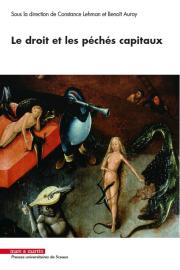
BOOK: Benoît AUROY & Constance LEHMAN (dir.), Le droit et les péchés capitaux [Collection des Presses Universitaires de Sceaux] (Paris: Mare & Martin, 2022), 224p. ISBN 9782849346228, €29


(image source: Mare & Martin)

Abstract:

Le 3 octobre 2019, le CERDI organisait sa première journée d’étude jeunes chercheurs. Le thème peut surprendre, tant droit canonique et droit séculier sont désormais bien distingués. Interdits religieux fondamentaux, les péchés capitaux reçoivent toutefois une traduction juridique : en certaines occasions, ils sont sanctionnés par le droit, telles la colère ou la luxure. À l’inverse, le droit enfreint parfois l’interdit religieux et tombe dans l’envie, la paresse ou autre. C’est cette ambivalence des rapports entre droit et péchés capitaux que la journée d’étude a cherché à mettre en lumière.

On the editor and contributors:

Benoît Auroy est membre du CERDI et docteur en droit privé et sciences criminelles. Constance Lehman est également membre du CERDI et doctorante en droit privé et sciences criminelles à l’université Paris-Saclay. Contributions de Clémentine Antoine, Loup Bommier, Cyrielle Chamot, Maxime Charité, Elias Chebaye, Eustache Da Allada, Benjamin Fiorini, Quentin Le Pluard, Quentin Ricardel, Gauthier Soufflard, Marine Virapin, Théo Vuarnet. 

(see publisher's website