Search

Showing posts with label Citizenship. Show all posts

14 July 2025

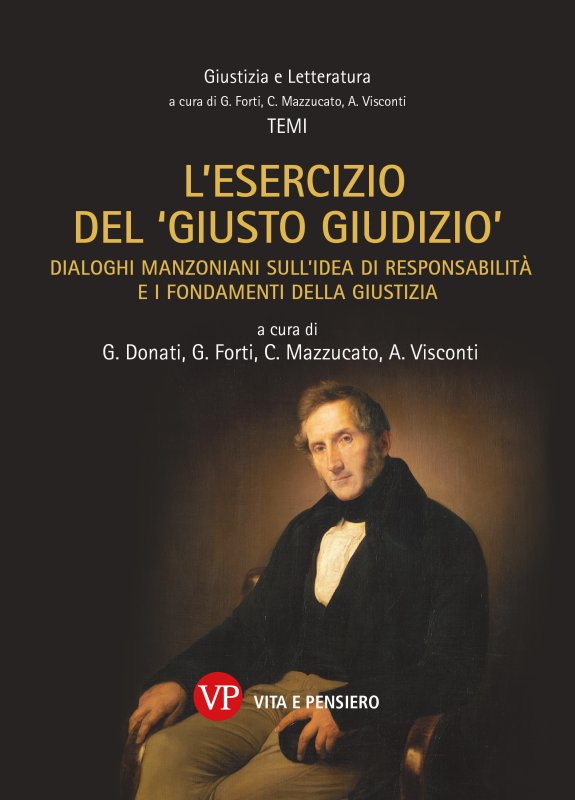
BOOK: Gabrio FORTI, Gaia DONATI, Claudia MAZZUCATO & Arianna VISCONTI (eds.), L'esercizio del 'giusto giudizio'. Dialoghi manzoniani sull'idea di responsabilità e i fondamenti della giustizia (Milano: Vita e Pensiero, 2025), 504 p. ISBN 9788834357873, € 34


(iamge source: Vita e Pensiero)

Abstract:

Che cosa rende ‘giusto’ l’esercizio del ‘giudizio’? Quanto, come e perché il ‘giudicare’ non si lascia ridurre al semplice ‘spiegare’? Queste le domande che si dischiudono non appena si mette a tema il ‘giudizio’, tanto più in un contesto socio-culturale, oltre che giuridico-istituzionale, nel quale si assiste, a tutti i livelli, a un ‘infuriare’ di giudizi ‘sommari’, il cui assordante rumore di fondo sembra renderci orfani di giudizi veri e, appunto, giusti. Le opere letterarie prese in considerazione in questo volume lasciano intravedere spiragli di risposta a tali secolari quesiti dell’umanità. La Storia della colonna infame, che è il luogo del giudizio e del giudizio sul giudizio, ma anche I promessi sposi, dove il giudizio è più squisitamente narrativo, pongono le basi per scandagliare, con Alessandro Manzoni, la dimensione etica della vita e il delicato equilibrio tra giudizio e comprensione. Un interrogativo che si ripropone nel dialogo con Leonardo Sciascia e Primo Levi, ma anche con molti altri autori e pensatori, attualizzato, ad esempio, nella serrata discussione critica con la tendenza, espressione di una crescente ‘ansia punitiva’, a mal sopportare i tempi e i vincoli di garanzia dello stesso procedimento penale, in favore del ben più rapido, ed emotivo, ‘giudizio mediatico’. Congiungendo competenze teoriche e sensibilità applicative, esperienze giuridiche e prospettive filosofiche, sociologiche, psicologiche e criminologiche, il volume incoraggia il lettore, tanto più quello interessato al livello di civiltà giuridica (e, dunque, di civiltà tout court) della società in cui vive, a dipanare l’intreccio tra responsabilità, giudizio, riparazione e pena, «tutte categorie che evocano situazioni di sofferenza». La risposta alla perturbante domanda «Ma come rispondere diversamente?» sta nel prendere sulle spalle un «pezzetto della croce della società», aprendosi a un’idea di giustizia come ascolto e attenzione.

Contributors:

Con i contributi di: Carla Bagnoli, Giuliano Balbi, Mauro Bertolotti, Giovanni Canzio, Lucia Castellano, Patrizia Catellani, Maurizio Catino, Adolfo Ceretti, Paola Corvi, Franca D’Agostini, Francesco D’Alessandro, Cristina de Maglie, Gaia Donati, Luciano Eusebi, Luigi Ferrarella, Gabriele Fornasari, Gabrio Forti, Pierantonio Frare, Loredana Garlati, Diletta Giuffrida, Fausto Giunta, Aldo Grasso, Natalino Irti, Claudia Mazzucato, Isabella Merzagora, Niccolò Nisivoccia, Carlo Enrico Paliero, Mauro Palma, Silvano Petrosino, Antonio Sichera, Francesco Viganò, Arianna Visconti.

On the editors:

L’Alta Scuola “Federico Stella” sulla Giustizia Penale (ASGP), istituita presso l’Università Cattolica del Sacro Cuore, rappresenta un unicum nel panorama culturale e professionale italiano. È un laboratorio di analisi e progettazione che si dedica alla ricerca di soluzioni regolative e applicative in tutti gli ambiti – giuridici, economici e sociali – connessi alla giustizia penale. Il suo metodo è il confronto serrato con l’‘immane concretezza’ dei problemi di oggi, reso esperto e consapevole grazie al dialogo costante tra docenti e ricercatori italiani e stranieri, nonché tra qualificate realtà istituzionali, professionali e imprenditoriali. Le iniziative didattiche e scientifiche dell’Alta Scuola, diretta da Gabrio Forti, hanno principalmente a oggetto, oltre all’esplorazione del rapporto tra diritto/giustizia e letteratura, i crimini d’impresa, le condizioni della compliance nelle organizzazioni complesse, la prevenzione della corruzione, la responsabilità in campo sanitario e il problema della gestione del rischio clinico, le misure patrimoniali di contrasto alla criminalità organizzata, le nuove frontiere della giustizia riparativa (restorative justice), la riforma dell’ordinamento penitenziario, la tutela del patrimonio culturale e dell’ambiente.

More information here


17 March 2025

BOOK: Massimo VALLERANI, Regimi di cittadinanza nell’Italia comunale (Rome: Viella, 2024). ISBN: 9791254696729

(Image source: Viella Editore)


About the book

Nelle città medievali abitare o nascere in un luogo non fanno diventare le persone dei cittadini e non garantiscono l’assegnazione di diritti civici in via definitiva. Diventare cittadini resta un lavoro faticoso, una condizione temporanea da mantenere con azioni ripetute nel tempo che mostrano la volontà di essere civis (abitare, pagare le tasse, militare nell’esercito, lavorare). In questa concezione dinamica e attiva di cittadinanza, non tutti avevano le stesse risorse. Tra Duecento e Quattrocento si affermano regimi diversi di cittadinanza, graduati secondo la possibilità o meno di partecipare alla vita politica. Questo libro ricostruisce la lenta trasformazione della civilitas da sistema di controllo dell’appartenenza a filtro selettivo di élites politiche riprodotte per via familiare. La divisione della cittadinanza in sfere di diritti differenziati aiuta a comprendere le complesse dinamiche di inclusione e di esclusione che ancora oggi caratterizzano il mondo contemporaneo.


About the author

Massimo Vallerani insegna storia medievale all’università di Torino. Ha studiato i sistemi politici e giudiziari di età comunale (Medieval public justice, 2012), e coordinato ricerche sui poteri eccettuativi nel basso medioevo (Sistemi di eccezione, 2009), le relazioni tra fiscalità e cittadinanza (Valore delle cose e valore delle persone, 2018) e in generale le forme di appartenenza alla città. Ha pubblicato il manuale Storia medievale, con Luigi Provero, nel 2022. È membro della direzione di «Quaderni storici» e direttore de «L’Indice dei libri del mese».


Table of contents

Introduzione

1. Classificazione. La definizione degli status di appartenenza

  1. Il sistema della classificazione: liste di inclusione e liste discriminanti
  2. Gradazioni di status e sistema documentario
  3. La divisione originaria. Cittadini e comitatini negli estimi
  4. La civilitas a Bologna: i registri del 1287 e la cittadinanza “per sentenza”

2. Valutazione. Il valore delle persone e il costo della cittadinanza

  1. Modelli di valutazione: fra auto-denuncia e valore imposto
  2. La costruzione del valore dei cives a Bologna: le carte di estimo del 1315
  3. Logica del valore o logica del prelievo?
  4. Gli estimi e il valore dei cives
  5. Appendice. Le carte di estimo dei Galluzzi

3. Esclusione. Instabilità delle condizioni di civis e stati diminuiti di cittadinanza

  1. L’esclusione politica: i bandi politici e le liste di sospetti
  2. Banditi a Bologna: censimento e gradi di esclusione (1277-1308)
  3. Gli evasori delle collette e la non protezione del comune
  4. Un caso di esclusione (parziale) di massa: i Malpaghi a Bologna nel 1309
  5. La criminalizzazione del debito e i suoi effetti
  6. Conclusioni
  7. Appendice. Consilia sull’evasione

4. Negoziazione. La contestazione dello status, tra testimonianze e libri

  1. La contestazione dello status economico
  2. Difendere l’identità civica: le prove di cittadinanza
  3. Contestare la categoria di nobilis e lambertazzo
  4. Un sistema autosufficiente: i libri come prova
  5. Appendice. Le Intentiones a difesa nei processi di cittadinanza

5. Selezione. La manipolazione degli status e i limiti alla partecipazione

  1. La modifica dello status come atto amministrativo: il “come se”
  2. La (ri)produzione degli status: l’estensione genealogica degli status nella prima metà del Trecento
  3. L’invenzione dell’origo: restringere e selezionare la cittadinanza
  4. L’articolazione artificiale della cittadinanza nel XV secolo: i privilegi di cittadinanza e la frammentazione delle forme di appartenenza

6. La moltiplicazione dei livelli di civilitas e la separazione fra appartenenza e partecipazione

  1. Nuove gerarchie di cives fra XIV e XV secolo
  2. Restringimento della partecipazione politica: dal criterio genealogico all’ereditarietà delle cariche
  3. Esiti moderni: dalla frammentazione dei livelli di cittadinanza alla ridefinizione delle gerarchie sociali
  4. L’impossibile ritorno al Comune: forme di uso politico dell’età comunale

Epilogo

Bibliografia

Indice dei nomi


More information can be found here.

03 June 2024

BOOK: Simona CERUTTI, Thomas GLESENER & Isabelle GRANDGAUD (dir.) La cité des choses. une nouvelle histoire de la citoyenneté (Toulouse: Anacharsis, 2024), 480 p. ISBN 9791027904723, € 30


(image source: AnacharsisAnacharsis)

Abstract:

À partir d’une pluralité d’enquêtes ancrées sur les deux rives de la Méditerranée, du XVIe siècle à nos jours, cet ouvrage entreprend de remettre en perspective l’histoire de la citoyenneté. Situant les « choses » au cœur de l’investigation – qu’il s’agisse d’une barque à Antibes, d’un coffre à Alger, d’un hôtel squatté à Turin, d’une mosquée à Tunis, de terres collectives à Naples, d’un mulet abandonné en Espagne –, il dévoile comment les prises en charge des biens distribuent les hiérarchies sociales et les statuts politiques. Ce livre révèle ainsi le pouvoir instituant des actions et des pratiques, par lesquelles les individus construisent leurs appartenances. Dès lors, La Cité des choses s’affranchit des seuls modèles politiques occidentaux pour mieux penser la citoyenneté comme un ensemble de droits forgés par des processus localisés échappant à tout déterminisme culturaliste : un enjeu d’une portée politique actuelle évidente.

See also this podcast on France Culture

More information with the publisherpublisher.

30 November 2023

BOOK: Henri-Pierre MOTTIRONI, Commerce et République en France au XVIIIe siècle ; quand l'entreprise inventa le citoyen (Lormont, Le Bord de l’eau, 2023), 180 p. ISBN 9782356879769, € 24


(image source: Le Bord de l'Eau)

Abstract:
À une époque où les firmes multinationales sont perçues comme une menace pour la démocratie et où nombreux sont ceux qui appellent à une réforme de leur gouvernance pour les rendre socialement et écologiquement responsables, revenir sur les liens entre le monde des affaires et l’émergence de la démocratie représentative moderne se révèle nécessaire. En dépit d’expressions et métaphores explicites comme l’idée d’un gouvernement « en trust » dans la pensée anglo-saxonne ou la métaphore du citoyen-actionnaire chez le grand constitutionnaliste de la Révolution française, Emmanuel Sieyès, l’historiographie politique et constitutionnelle a jusqu’alors trop souvent négligé ce lien. En croisant histoire des idées, études des transferts culturels et histoire du droit commercial et de l’entreprise, l’auteur comble cette lacune en mettant en lumière l’importance des idées et pratiques commerciales et financières dans la pensée politique des fondateurs de nos républiques modernes de la fin du XVIIe siècle à la Révolution française. Loin de l’opposition contemporaine entre démocratie et grande entreprise, cette étude montre que nos conceptions modernes du constitutionnalisme et du gouvernement représentatif doivent beaucoup à la gouvernance d’entreprise et au droit commercial du siècle des révolutions.

On the author:

Docteur en science politique de l’IEP de Paris et de l’Université de Lausanne, Henri-Pierre Mottironi est chercheur à l’Université de Neuchâtel à l’Institut d’histoire. Ses travaux croisent histoire de la pensée politique, de la gouvernance d’entreprise et du droit commercial, aux XVIIIe et XIXe siècles.

(source: Le Bord de l'Eau

22 November 2022

BOOK: Jessica M. MARGLIN, The Shamama Case: Contesting Citizenship across the Modern Mediterranean (Princeton, NJ: Princeton University Press, 2022), 384 pp., ISBN 9780691235875, £28


(image source: Princeton University Press)
Book description: 
In the winter of 1873, Nissim Shamama, a wealthy Jew from Tunisia, died suddenly in his palazzo in Livorno, Italy. His passing initiated a fierce lawsuit over his large estate. Before Shamama’s riches could be disbursed among his aspiring heirs, Italian courts had to decide which law to apply to his estate—a matter that depended on his nationality. Was he an Italian citizen? A subject of the Bey of Tunis? Had he become stateless? Or was his Jewishness also his nationality? Tracing a decade-long legal battle involving Jews, Muslims, and Christians from both sides of the Mediterranean, The Shamama Case offers a riveting history of citizenship across regional, cultural, and political borders.

On its face, the crux of the lawsuit seemed simple: To which state did Shamama belong when he died? But the case produced hundreds of pages in legal briefs and thousands of dollars in lawyers’ fees before the man’s estate could be distributed among his quarrelsome heirs. Jessica Marglin follows the unfolding of events, from Shamama’s rise to power in Tunis and his self-imposed exile in France, to his untimely death in Livorno and the clashing visions of nationality advanced during the lawsuit. Marglin brings to life a Dickensian array of individuals involved in the case: family members who hoped to inherit the estate; Tunisian government officials; an Algerian Jewish fixer; rabbis in Palestine, Tunisia, and Livorno; and some of Italy’s most famous legal minds.

Drawing from a wealth of correspondence, legal briefs, rabbinic opinions, and court rulings, The Shamama Case reimagines how we think about Jews, the Mediterranean, and belonging in the nineteenth century.

About the author: 

Jessica M. Marglin is associate professor of religion, history, and law and the Ruth Ziegler Early Career Chair in Jewish Studies at the University of Southern California. She is the author of Across Legal Lines.

More information can be found here.  


25 August 2022

JOURNAL: Jus Politicum, nº 27. Formes de la citoyenneté


Formes de la citoyenneté

Varia

Recensions

Mémoires

19 May 2021

BOOK: Lorenzo GAGLIARDI, David KREMER. Cittadinanza e nazione della stori europea. (Milano: Giuffrè, 2020). ISBN 9788828818458. 28 EUR.


(Source: https://shop.giuffre.it/024208942-cittadinanza-e-nazione-nella-storia-europea-citoyennete-et-nation-dans-l-histoire-europeenne.html)

Table of contents:

Cittadinanza e nazione. Un approccio storico, di Lorenzo Gagliardi e David Kremer
David Kremer (Université Paris Descartes) Leçons romaines à l’adresse des Européens. Brèves réflexions sur la civitas Romana et son héritage
Lorenzo Gagliardi (Università degli Studi di Milano) La nazione latina al tempo della Roma dei re
Loredana Cappelletti (Universität Wien) Lo « Stato » degli Italici al tempo della guerra sociale (91-88 a.C.)
Estela García Fernández (Universidad Complutense de Madrid) La condición latina como instrumento de integración de la población provincial
Chiara Corbo (Università degli Studi di Napoli Federico II) Constitutio Antoniniana: un’ulteriore chiave di lettura
Lorenzo Tanzini (Università degli Studi di Cagliari) Cittadinanza e appartenenza alla comunità nelle città italiane tra XIII e XIV secolo
Claire de Blois (Université Paris Descartes) L’évolution du lien entre « population » et « État » dans les dictionnaires de l’Ancien régime (1689-1789)
Thomas Branthôme (Université Paris Descartes) Le citoyen révolutionnaire
Jean-Baptiste Busaall (Université Paris Descartes) Le Citoyen espagnol de la Nation catholique dans la Constitution politique de la Monarchie espagnole de 1812 : sujet nouveau d’un ordre traditionnel
Guillaume Richard (Université Paris Descartes) Redéfinir la nation. L’application des lois sur les réparations pour dommages de guerre aux territoires intégrés après la Première Guerre mondiale (France, Italie)
Valerio Marotta (Università degli Studi di Pavia) Conclusioni


07 August 2020

CALL FOR PAPERS: Citizenship, Migration and Social Rights – Historical Experiences from the Eighteenth to the Twentieth Century (4-5 March 2021, Berlin) (DEADLINE: 15 September 2020)


(Source: Rework)

We learned of a call for papers for a workshop on “Citizenship, Migration and Social Rights – Historical Experiences from the Eighteenth to the Twentieth Century”. Here the call:

Call for Papers Workshop: Citizenship, Migration and Social Rights – Historical Experiences from the Eighteenth to the Twentieth Century Date: 4 – 5 March 2021 Location: Humboldt University Berlin, International Research Centre Work and Human Lifecycle in Global History (re:work), Georgenstr. 23, 10117 Berlin Organizers: Beate Althammer, DFG-Project “The Borders of the Welfare State: Migration, Social Rights and Expulsion (1850-1933)”, in cooperation with re:work Deadline for proposals: 15 September 2020 URL: https://rework.hu-berlin.de/borders-of-the-welfare-state-en.html

In current academic and political debates, the tensions between European conceptions of the welfare state and transnational migration are a heatedly discussed issue. How can promises of social security be kept in times of globalization? Is welfare only feasible in ‘closed’ nation states with tight border controls, or is migration, to the contrary, necessary for sustaining welfare systems? To what extent are social rights a privilege of national citizens, to what extent, and under what conditions, are they also due to foreign immigrants? Such questions have become an explosive and intensely scrutinized subject. Much less, however, is known about their historical dimensions. There exists by now a rich historiography on the origins of modern welfare policies; migration history is flourishing too; and in recent years, the history of citizenship has attracted increasing attention. Yet, these have largely remained three separate fields of research. Few works have studied in detail so far how European welfare states dealt with the challenges of migration in their formative phase, and what experiences, in turn, migrants have made with the social services of their host societies. The project “The Borders of the Welfare State: Migration, Social Rights and Expulsion (1850-1933)” is attempting to fill this gap. Taking as its starting point the frequently postulated, but probably too simplistic hypothesis that the status of aliens deteriorated inversely to the expansion of citizens’ rights with the emergence of modern national welfare states, it explores the interrelations of labour migration and social policies in the decades around 1900. The project compares national discourses and legal frameworks of various European countries, analyses concrete administrative practices at the local level, and looks at the beginnings of international agreements on the reciprocal treatment of citizens who moved across borders. The aim is to write a transnational European history of the negotiations over the social entitlements of migrants in the early days of modern welfare-state building. Despite its transnational approach, the scope of the project is necessarily limited, in geographical and temporal terms as well as in terms of the aspects of ‘welfare’ and ‘migration’ it is able to take into account. Therefore, the planned workshop wants to open up its horizon by bringing together researchers who are working on related topics. Invited are historians, but also scholars from neighbouring disciplines (sociology, political sciences, anthropology, etc.) with a research interest in the interrelationships of migration and social policies from the eighteenth century to the present. Although the focus of the workshop will be on the evolution of European migration and welfare regimes, papers that offer extraEuropean perspectives are very welcome too. And although the focus will be on the impact of migration on ‘modern’ social policies and vice versa, also early modern historians are addressed who can help us to understand continuities and changes during the transition to modernity. Possible approaches of papers that explore the interrelationships of migration and social policies include: - Theoretical reflections on long-term developments - Semantics of welfare, belonging and social rights - Comparisons between national migration and welfare regimes - Case studies on local constellations and experiences - Case studies on specific migrant groups or specific sectors of welfare provision - Case studies on periods of disruption, e.g. in the wake of wars or economic crises - Transnational studies on the cross-border coordination of migration and social policies The workshop is funded by the DFG (German Research Foundation) and will take place in Berlin from 4 to 5 March 2021 at the premises of re:work. The organizers will provide accommodation as well as (limited) reimbursement of travel expenses. Should travel restrictions or other impediments to on-site events due to the Covid-19 pandemic still be in force, we will consider switching to an, in parts, digital format. Presentations should not exceed 20 minutes. We plan to publish a selection of revised papers. Please send proposals comprising a title, an abstract of about 300 words and a short CV, to beate.althammer@hu-berlin.de by 15 September 2020.

More info on the website of the project.

10 January 2020

WORKSHOP PRESENTATIONS : Stanford Center for Law & History (Stanford, 27 Jan. to 9 Mar. 2020)

Source :  Stanford Law School
Stanford Center for Law and History announces four great legal history workshop presentations that will be taking place there. Coordinated by Professors Amalia Kessler and Robert Gordon.


Where :  Room 272 of the Law School's Crown Building, (Stanford, California).

When : on the following Mondays from 4:15 to 6:15 PM.

Programme:

January 27—Allison Powers, Assistant Professor of History, Texas Tech University: “The Specter of Compensation: Mexican Claims Against the United States, 1923-1941.”

February 10—Fahad Bishara, Assistant Professor of History, Assistant Professor of Arabian Peninsula and Gulf Studies, University of Virginia: "Rethinking the Bazaar: Law and the Documentary Infrastructures of Economic Life in the Indian Ocean."

February 24—Lauren Benton, Nelson O. Tyrone, Jr. Professor of History and Professor of Law, Vanderbilt University: “Law in Small Wars, circa 1750: Peacetime Violence and European Legal Regimes.”

March 9—Sam Erman, Professor of Law, University of Southern California Law: “Inventing the Rules of Blood and of Soil: Nineteenth-Century Origins of Birthright Citizenship.”  

More information and registration:  here

12 November 2019

BOOK: René KOEKKOEK, The Citizenship Experiment. Contesting the Limits of Civic Equality and Participation in the Age of Revolutions [Studies in the History of Political Thought, 15; ed. Annelien DE DIJN] (Leiden/Boston: Martinus Nijhoff/Brill, 2019), ISBN 978-90-04-22570-1, X + 294 p. € 99

(image source: Brill)

Abstract:
The Citizenship Experiment explores the fate of citizenship ideals in the Age of Revolutions. While in the early 1790s citizenship ideals in the Atlantic world converged, the twin shocks of the Haitian Revolution and the French Revolutionary Terror led the American, French, and Dutch publics to abandon the notion of a shared, Atlantic, revolutionary vision of citizenship. Instead, they forged conceptions of citizenship that were limited to national contexts, restricted categories of voters, and ‘advanced’ stages of civilization. Weaving together the convergence and divergence of an Atlantic revolutionary discourse, debates on citizenship, and the intellectual repercussions of the Terror and the Haitian Revolution, Koekkoek offers a fresh perspective on the revolutionary 1790s as a turning point in the history of citizenship.
More information with Brill.

13 August 2019

BOOK: Paul QUIGLEY, ed., The Civil War and the Transformation of American Citizenship (Baton Rouge, 2018). ISBN 9780807168639, $47.50


(Source: LSU Press)
Louisiana State University Press published a book last year that deals with the US civil war and American citizenship.

ABOUT THE BOOK

The meanings and practices of American citizenship were as contested during the Civil War era as they are today. By examining a variety of perspectives—from prominent lawmakers in Washington, D.C., to enslaved women, from black firemen in southern cities to Confederate émigrés in Latin America—The Civil War and the Transformation of American Citizenship offers a wide-ranging exploration of citizenship’s metamorphoses amid the extended crises of war and emancipation.

Americans in the antebellum era considered citizenship, at its most basic level, as a legal status acquired through birth or naturalization, and one that offered certain rights in exchange for specific obligations. Yet throughout the Civil War period, the boundaries and consequences of what it meant to be a citizen remained in flux. At the beginning of the war, Confederates relinquished their status as U.S. citizens, only to be mostly reabsorbed as full American citizens in its aftermath. The Reconstruction years also saw African American men acquire—at least in theory—the core rights of citizenship. As these changes swept across the nation, Americans debated the parameters of citizenship, the possibility of adopting or rejecting citizenship at will, and the relative importance of political privileges, economic opportunity, and cultural belonging. Ongoing inequities between races and genders, over the course of the Civil War and in the years that followed, further shaped these contentious debates.

The Civil War and the Transformation of American Citizenship reveals how war, Emancipation, and Reconstruction forced the country to rethink the concept of citizenship not only in legal and constitutional terms but also within the context of the lives of everyday Americans, from imprisoned Confederates to former slaves.

ABOUT THE AUTHOR

Paul Quigley is James I. Robertson, Jr., Associate Professor of Civil War Studies at Virginia Tech and the author of Shifting Grounds: Nationalism and the American South, 1848–1865.

More info here


24 April 2019

CONFERENCE: Citizenship in Classical Antiquity: Current Perspectives and Challenges (London, 1-3 July 2019)


(Source: UCL)

UCL (in cooperation with the Jagiellonian University) is organizing an international congress on citizenship in classical antiquity.

International conference

The Department of Greek and Latin, University College London, in co-operation with the Department of Classical Philology, Jagiellonian University in Kraków.

1-3 July 2019

University College London
What did citizenship mean in the ancient world, why was it important, and why should it matter to us today? Citizenship has been defined as 'both a set of practices cultural, symbolic and economic) and a bundle of rights and duties (civil, political and social) that define an individual's membership in a polity' (Isin & Wood 1999, Citizenship & Identity), and has existed in various forms since antiquity, holding complex resonances up to the present day. Depending on the socio-political context, a person's citizenship may be a matter of territorial belonging or blood descent; it may offer privileged or exclusive access to resources or participation in communal decision-making; it may provide a sense of group belonging that can be productive and rewarding, but such identification may also be open to discursive redefinitions and manipulation, primarily in public political debate. Citizenship may be connected to certain civic values, though how these are realised in practice may not always be simple. There are those for whom a society's emphasis on citizenship may cause serious problems, such as stateless persons and migrants.

The immediacy of issues surrounding the concept and practice of citizenship in the modern world calls for a re-investigation of the notion in its ancient contexts. Topics of discussions include but are not limited to:

- similarities and differences across Greek, Roman, Near-Eastern, or broader Mediterranean ideas of citizenship;
- insiders' and outsiders' perspectives in considering what citizenship entails (emic vs etic);
- the semantics and varying definitions of 'citizen' and 'citizenship';
- the self-presentation of citizens as a privileged social group;
- citizenship, social change, and social conflict;
- citizenship and the control of resources;
- interactions between citizenship and other (group) identities;
- creating and exploiting citizen identities in discourse;
- the importance and limits of legal definitions;
- civic training and education;
- political participation and majoritarianism;
- the topicality or inapplicability of classical paradigms.

This three-day conference is intended to promote discussion among scholars across different disciplines working on the theme of citizenship in classical antiquity in any capacity. It will include keynote lectures by Prof. Clifford Ando (Chicago), Prof. John Davies FBA, FSA (Liverpool), Prof. Engin Isin (QMUL), Dr Catherine Neveu (CNRS-EHESS), and Prof. Josiah Ober (Stanford), and will also include a public discussion event on the evening of Tuesday 2nd July.

We expect to be able to offer bursaries to assist graduate students in attending the conference.

For any enquires related to the Conference, please email: Jakub Filonik(jakub.filonik@uj.edu.pl) or Christine Plastow (christine.plastow@open.ac.uk)

The full program, as well as more information, can be found here

19 February 2019

BOOK: Will HANLEY: Identifying with Nationality. Europeans, Ottomans, and Egyptians in Alexandria (New York: Columbia University Press, 2017), 416 p. ISBN 9780231177627, GBP 50

(image source: Columbia UP)

Book abstract:
Nationality is the most important legal mechanism sorting and classifying the world's population today. An individual's place of birth or naturalization determines where he or she can and cannot be and what he or she can and cannot do. Although this system may appear universal, even natural, Will Hanley shows that it arose just a century ago. In Identifying with Nationality, he uses the Mediterranean city of Alexandria to develop a genealogy of the nation and the formation of the modern national subject. Alexandria in 1880 was an immigrant boomtown ruled by dozens of overlapping regimes. On its streets and in its police stations and courtrooms, people were identified by name, occupation, place of origin, sect, physical description, and other attributes. Yet by 1914, before nationalist calls for independence and decolonization had become widespread, nationality had become the defining category of identification, and nationality laws came to govern Alexandria's population. Identifying with Nationality traces the advent of modern citizenship to multinational, transimperial settings such as turn-of-the-century colonial Alexandria, where ordinary people abandoned old identifiers and grasped nationality as the best means to access the protections promised by expanding states. The result was a system that continues to define and divide people through status, mobility, and residency.
On the author:
Will Hanley is assistant professor of history at Florida State University.
More information with the publisher.

(source: Legal History Blog)

16 November 2018

CALL FOR PAPERS: XXVth Annual Forum of Young Legal Historians (Brussels: VUB/ULB/USL, 5-8 JUNE 2019); DEADLINE 15 JAN 2019

Identity, Citizenship and Legal History

XXVth Annual Forum of Young Legal Historians
Brussels, 5 – 8 June 2019

(image source: Wikimedia Commons)

Historically, the concept of citizenship encompassed three distinct, yet interconnected dimensions. The first and foremost dimension was of a legal nature: citizenship was a legal status which allowed one to act freely in accordance with the law and, when necessary, to claim its protection. In its second dimension citizenship presupposed one’s active participation in society’s political institutions. And last, though certainly not least, citizenship was closely linked to membership of a specific community that provided a distinct source of identity. All three dimensions were closely related to each other. This can perhaps be most aptly exemplified in the ancient boast of ‘Civis romanus sum!’, which encapsulated simultaneously a plea for legal rights, a republican sense of duty, and a distinctly Roman feeling of the imperial pride. Since the nineteenth century, these dimensions have been linked predominantly to the modern nation-state, a model which is nowadays increasingly challenged on the internal as well as the external level. Internally, many states are seen to be struggling with federalism, separatist movements, legacies of colonialism and right-wing identity politics. Externally, today’s governments are confronted with issues, such as climate change, demographic shifts, migration streams and a global and interdependent economic system, that require international cooperation or even supranational institutions.

The XXVth Annual Forum of the Young Legal Historians aims to shed light on these questions by looking at the legal history of the closely intertwined concepts of citizenship and legal history. Throughout history, citizenship and identity has been defined in different ways and at different levels. For instance, in antiquity the often smallish Greek poleis could hardly be compared to the expansive Roman Empire. Medieval life in Europe consisted of a feudal patchwork of kingdoms, principalities and free city-states, yet all were considered part of Christendom. Identity could also be determined by social class (e.g. aristocratic families) or by profession (e.g. the guilds). The nineteenth century saw the rise of nationalism and revolution, whilst at the same time European powers expanded their colonial empires. Despite these evolutions, it cannot be denied that there is also much continuity to be found. Although diversity and globalisation have reached an unprecedented scale and form today, these phenomena are not entirely new. Each era has had its international relations, its trades, wars, economic discrepancies, migrants and refugees.

There is, in short, enough reason to expect that we can learn from history. Such an endeavour necessitates a multidisciplinary approach since legal constructions can be fully appreciated only when combined with insights from the related fields of history, philosophy, political science and sociology. Therefore, the organizers welcome both traditional approaches in legal history and methodologically innovative research.

If you would like to present a paper during the conference, please send an application including an abstract of not more than 250 words and your CV to aylh2019@gmail.com before 15 January 2019. It is also possible to apply for a full panel. In that case, your proposal should also include, in addition to individual paper proposals, an abstract introducing the theme of the panel. Presentations have to be in English and should not exceed 20 minutes each. The conference fee will be € 100,- and does not include accommodation. Further information about the upcoming forum can be found at the website of the conference. Information about the Association of Young Legal Historians and the past Annual Forums is available at the AYLH-website.

We look forward to welcoming you to Brussels.

Wouter De Rycke (Vrije Universiteit Brussel, CORE)
Marco in ’t Veld (Vrije Universiteit Brussel, CORE)
Maxime Jottrand (Université libre de Bruxelles, CHDAJ)
Romain Landmeters (Université Saint-Louis Bruxelles, CRHiDI)
Stephanie Plasschaert (Vrije Universiteit Brussel, CORE)
This conference received the generous support of the Committee for Legal History of the Royal Flemish Academy of Belgium for Science and the Arts.


25 January 2016

SEMINAR: “Il funzionamento del corpo cittadino: spazi politici della cittadinanza e livelli di partecipazione" (Rome, February 3 2016)


WHAT Il funzionamento del corpo cittadino: spazi politici della cittadinanza e livelli di partecipazionemeeting of the Interdisciplinary Seminar on Citizenship "Cittadinanze e strategie di potere tra Medio Evo ed Età Moderna", organized by Sara Menzinger, Giuliano Milani and Massimo Vallerani

WHEN February 3 2016, 15:00

WHERE Roma Tre University, Law Faculty, Via Ostiense 159-161, room 278, second floor

program


15.00 
Giacomo Todeschini (University of Trieste): 

‘Intentio’ e ‘dominium’ come caratteri di cittadinanza: sulla complessità della rappresentazione dell’estraneo fra medioevo e modernità 

Lorenzo Tanzini (University of Cagliari): 

Il fantasma della rappresentanza: sorteggio e rotazione delle cariche nelle città comunali (secc. XIII-XIV)

roundtable coordinated by: 
Paolo Napoli (Cenj, École des Hautes Études en Sciences Sociales) and Michele Spanò (University of Turin)

03 November 2015

SEMINAR: "Dinamiche di esclusione e inclusione nel corpo cittadino" (Rome, November 6 2015)


WHAT Dinamiche di esclusione e inclusione nel corpo cittadino, meeting of the Interdisciplinary Seminar on Citizenship "Cittadinanze e strategie di potere tra Medio Evo ed Età Moderna", organized by Sara Menzinger, Giuliano Milani and Massimo Vallerani

WHEN November 6 2015, 9:30 am

WHERE Roma Tre University, Law Faculty, Via Ostiense 159-161, room 278, second floor

21 May 2015

SEMINAR: "Citizenship and Power Strategies between Middle Ages and Early Modernity" (Rome, June 19 2015)


WHAT  meeting of the seminar Cittadinanze e strategie di potere tra Medio Evo ed Età Moderna, organized by Sara Menzinger, Giuliano Milani and Massimo Vallerani in the framework of the PIMIC Project Power and Institutions in Medieval Islam and Christendom (http://www.pimic-itn.eu)  

WHEN June 19 2015, 9:30 

WHERE Roma Tre University, Law Department, 2nd Floor, Room 278, Via Ostiense 161-163, Rome.


01 June 2014

SEMINAR: "Citizenship and Power Strategies between Middle Ages and Early Modernity" (Rome, 4 June 2014)


WHAT: Indian Residential Schools.Settler colonialism e cittadinanza13th meeting of the seminar Cittadinanze e strategie di potere tra Medio Evo ed Età Moderna, organized by Sara Menzinger, Giuliano Milani and Massimo Vallerani in the framework of the PIMIC Project "Power and Institutions in Medieval Islam and Christendom" (http://www.pimic-itn.eu)  
WHERE: Roma Tre University, Law Department, 2nd Floor, Room 278, Via Ostiense 161-163, Rome.
WHEN: 4 June 2014, 3:00 pm

Speakers:
Prof. Michele Spanò, International University college, Turin
Prof. Giorgio Resta, University of Bari

06 May 2014

SEMINAR: Citizenship and Power Strategies between Middle Ages and Early Modernity (Rome,12 May 2014)

What: Eterointegrazione e percorsi di cittadinanza nel tardoantico12th meeting of the seminar Cittadinanze e strategie di potere tra Medio Evo ed Età Moderna, organized by Sara Menzinger, Giuliano Milani and Massimo Vallerani in the framework of the PIMIC Project "Power and Institutions in Medieval Islam and Christendom" (http://www.pimic-itn.eu)  
Where: Roma Tre University, Law Department, 2nd Floor, Room 278, Via Ostiense 161-163, Rome.
When: 12 May 2014, 3:00 pm

Speakers
Prof. Giovanna Mancini, University of Teramo
Prof. Luca Loschiavo, University of Teramo/Roma Tre University