Search

Showing posts with label legal history. Show all posts

14 September 2026

SEMINAR: Launch of the Research Centre for Legal History (Maynooth: Maynooth University School of Law and Criminology, 16 SEP 2026)

(image source: Wikimedia Commons)


Program:

10am 

Registration

10:10 

Introductory remarks by the Chief Justice of Ireland, Donal O’Donnell

10:30-11:50

David Doyle, Maynooth University, ‘Revolting that police officers and Irishmen have to be employed in detecting such crimes': Sexual Offences against Young Boys, 1923-35’

Lynsey Black, Maynooth University, ‘Constructing Evil – The Trial of Mamie Cadden’

12:00-13:20

Sarah Hamill, Trinity College Dublin, ‘Rent Control in the 1970s and the origins of Blake v Attorney General’

Niamh Howlin, University College Dublin, ‘Legal History as a Tool for Righting Historic Wrongs?’

12:30-14:15 Lunch

14:15-15:45

Norma Dawson, Queen’s University Belfast, ‘Lord Talbot de Malahide (1805-1883) and the first treasure trove bill in the common law world’

Heikki Pihlajamäki, University of Helsinki, ‘Writing national legal histories: why and how?’

15:45-16:00 Concluding remarks

(source: Legal History Blog) 

01 September 2026

PROGRAMME: Past Privacy Today: Negotiating Boundaries – Navigating Challenges (Copenhagen: Centre for Privacy Studies, 3-4 SEP 2026)


(image source: KU)

Abstract:

Needs for privacy emerge when boundaries are negotiated between individuals, communities, and societies. In such encounters, the large-scale structures of public space are challenged by the small-scale needs, desires, and wishes of individuals and smaller social groups.

  • How do such social dynamics play out across different contexts across the globe, both in the past and present?
  • How do changes in institutional structures influence privacy, and the other way around?
  • What forms of privacy were safeguarded or suppressed?
  • Who has been entitled to privacy, and under what circumstances? 
  • How does privacy relate to other concepts such as intimacy, secrecy, confidentiality, and anonymity?
  • And how should we as historians and contemporary privacy scholars navigate the boundaries between them?

This conference aims to address these and similar questions through thematic panels, inviting speakers and audience for interdisciplinary explorations. Building upon the insights produced at the Centre for Privacy Studies (2017-2027), it is our goal that these discussions will spark a flourishing stream of new scholarship in the field of privacy studies.

Program:

Day 1 (3 September 2026)


09:00: Registration and Welcome Coffee


09:15-09:35: Introduction

Paolo Astorri (Centre for Privacy Studies/Lund University)


09:35-11:45: Panel 1 - Urban Space: Privacy inside and outside the city: spaces, social patterns, and institutional settings


09:35-09:55: Urban Space – a paradoxical cradle of privacy

Johannes Ljungberg (Linköping University/Centre for Privacy Studies)


09:55-10:15: Affordances, transgressions, risks: privacy and gender in 18th-century urban green spaces

Antonia Weiß (Amsterdam University)


10:15-10:35: Marriage, sex and family life in the 18th century Dutch oversea empire

Sophie Rose (Universität Tübingen)


10:35-10:50: Break


10:50-11:45: Round table and shared discussion moderated by Viktor Wretström (Centre for Privacy Studies)


11:45-13:00: Break 


13:00-15:10: Panel 2 - Home: Privacy in the Early Modern Home: Cases from Europe, Greenland and Formosa (present-day Taiwan)


13:00-13:10: Introduction

Natalie Patricia Körner (Centre for Privacy Studies/Royal Danish Academy— Architecture, Design, Conservation)


13:10-13:30: The Making of Privacy at Home in Europe, 1500-2000

Raffaella Sarti (University of Urbino)


13:30-13:50: Drawing the Curtain: Negotiating Privacy in the Kalaallit Communal House. 

Asta Mønsted (University of Copenhagen)


13:50-14:10: Approaching Privacy through Darkness in Sirayan Houses during Dutch Colonisation. 

Hui-Yi Yang (Centre for Privacy Studies/Royal Danish Academy— Architecture, Design, Conservation)


14:10-14:20: Break


14:20-15:10: Round table and shared discussion moderated by Natalie Patricia Körner (Centre for Privacy Studies/Royal Danish Academy— Architecture, Design, Conservation)


15:10-15:40: Coffee & Cake


15:40-17:50: Panel 3 - Belief: Cosmologies of Privacy and the Privacy of Cosmologies


15:40-15:50: Introduction

Bastian Felter Vaucanson (Centre for Privacy Studies)


15:50-16:10: Responsible Freedom: Privacy in Native American Twinship Culture [online presentation]

Barbara Alice Mann (University of Toledo)


16:10-16:30: When the World is your Village. Reconceptualising Indigeneity and Privacy through a Global Biography

Martha Fredriks (Protestantse Theologische Universiteit, Utrecht)


16:30-16:50: Privacy as Perseverance. Sámi Ritual Traditions in Early Modern Central Sweden in a Time of Forced Homogenization. 

Jonas Monié (Lund University)


16:50-17:00: Break


17:00-17:50: Round table and shared discussion moderated by Karen Lauterbach (Centre for African Studies, University of Copenhagen)


Day 2 (4 September 2026)


09:15: Registration and Welcome Coffee


09:30-11:45: Panel 4 - Health: Privacy and Health: Sharing and Protecting Knowledge in Systems of Care


9.30-9.40: Introduction

Natacha Klein Käfer (Centre for Privacy Studies/Lund University)


9:40-10:00: Datasociality in Precision Medicine 

Mette Svendsen (University of Copenhagen) 


10:00-10:20: Privacy and Hospital in the Medieval and Early Modern Periods

Gisela Drossbach (Universität Augsburg)


10:20-10:40: Privacy and Health: Past-Present Perspectives

Natacha Klein Käfer (Centre for Privacy Studies/Lund University)


10:40-10:50: Break


10:50-11:45: Round table and shared discussion moderated by Angana Moitra (Centre for Privacy Studies/Lund University)


11:45-12:30: Break


12:30-15:00: Panel 5 - Law: Anonymity Before Encryption: Concealing Identities in Early Modern Transactions 


12:30-12:40: Introduction

Paolo Astorri (Centre for Privacy Studies/Lund University)


12:40-13:00: Private, but Not Personal: Rethinking Privacy in Medieval Law 

Guido Rossi (University of Palermo)


13:00-13:20: Anonymity and Silent Financiers in Sixteenth-Century Commercial Partnership 

Luisa Brunori (CNRS Paris)


13:20-13:40:  The Merchant’s Silence: Secrecy and Norms of Conduct in Early Modern Mercantile Literature 

Stefania Gialdroni (University of Padua)


13:40-14:00: An Identity to Hide? Noble Merchants in the Early Modern Era: A Legal Survey

Giovanni Chiodi (University of Milano Bicocca)


14:00-14:10: Break


14:10-15:00: Round table and shared discussion moderated by José María Martín Humanes (Centre for Privacy Studies)


15:00-16:00: Closing session

15:00-15:30: Concluding Remarks by Mette Birkedal Bruun (Director, Centre for Privacy Studies)

15:30-16:00: Plenary Discussion 

16:15-17:30: Reception (Centre for Privacy Studies)

Read more here.

Programme may be subject to smaller changes


31 August 2026

SOURCES: Sandrine JAUNEAU, Droit d'Ancien Régime [CORPUS - Recueil virtuel de sources historiques] (Versailles: Centre de recherche du Château de Versailles, 2026)


(image source: château versailles-recherche)

The Research Centre of the Château de Versailles published an online inventory of sources on the law of the Ancien Régime, compiled by Sandrine Jauneau.

Read more here.

28 August 2026

JOURNAL: Pro Memorie. Bijdragen tot de Rechtsgeschiedenis der Nederlanden XXVIII (2026), nr. 1

(image source: AUP)

Redactioneel (Bram Van Hofstraeten & Paul Brood)
DOI 10.5117/PM2026.1.001.REDA

De zaak Hendrick Schilt. De methodes van uitsluiting van de WIC in Nederlands-Brazilië met betrekking tot haar eigen ambtenaren, 1630-1654 (Florian Herrendorf)
DOI 10.5117/PM2026.1.002.HERR
Abstract:
As trust is essential for maintaining successful commercial relations, groups of traders relied on methods of exclusion to ensure that everyone carried out their agreed tasks. The Dutch West India Company (WIC), being a heterogeneous commercial organisation, therefore, could not function properly without employing formal methods of exclusion, both internally and in the territories it governed, of which taking recourse to courts was the most important. However, historians have failed to include the WIC in current debates on the principal-agent problem in early modern trade. As such, we know very little about the actual functioning of the judicial system in its overseas territories in general, and in its most important colony, Dutch Brazil, in particular. This article tries to address this problem by using a case study focused on a lawsuit against several Company officials to investigate the workings of the legal system of Dutch Brazil.

De civiele rechtspraak van de schepenbank van Thorn. De zaak Christina Halermans versus Dirk Brouns (1685-1688) (Bram Van Hofstraeten)
DOI 10.5117/PM2026.1.003.HOFS
Abstract:

This study examines the civil jurisdiction of the bench of aldermen of Thorn in the early modern period, focusing on its procedural practices, social accessibility, and the influence of learned legal traditions. Contrary to the notion of a general ‘Great Litigation Decline’ in eighteenth-century Europe, Thorn experienced a relatively low but steady rate of civil litigation, with a notable peak in the late seventeenth century. During the eighteenth century the court increasingly relied upon external impartial legal scholars in order to formulate a verdict which may have contributed to a reduced confidence in the local justice system. A detailed case study of Christina Halermans vs. Dirk Brouns (1685–1688) illustrates the court’s procedural complexity, the tactical – and not always equally careful – use of legal citations, and the increasing influence of legal arguments rooted in Roman law and the ius commune. This shift reflects a growing disjunction between local customary law and the academic legal discourse dominating civil litigation, which may have discouraged litigants from turning to the local court. The study suggests that the court’s procedural stagnation during the eighteenth century was less due to internal disorganization and more to the inability of local magistrates to navigate increasingly sophisticated legal reasoning. In addition, the study demonstrates that lawyers (instead of judges) played a crucial role in the reception of Roman law in early modern Europe.

Les immunités des ecclésiastiques ont leurs bornes Een moordende theologant en de vorstelijke rechtsbedeling in de Oostenrijkse Nederlanden (1749-1750) (Dirk Leyder)
DOI 10.5117/PM2026.1.004.LEYD
Abstract:

In december 1749, Martin van Meir, a 23-year-old theologian, commits two gruesome murders in the archiepiscopal seminary of Mechelen. The president of that institution decides to immediately cover up the case. The Privy Council, however, quickly uncovers the murders and obliges the Fiscal Office of the Great Council of the Netherlands in Mechelen to pursue both the murderer and his superior. The legal experts of the central government consider that the clerical immunities used as a defense by some, do not apply to either culprit. Written interventions by the archbishop of Mechelen, Thomas Philippe d’Alsace, in aid of his president (and to a lesser extent, of his homicidal student), put the regalists in Brussels on their heels, but do seem to affect the governor and the empress. Maria-Theresia eventually lets the case rest. But henceforth discussions about the immunity of clergymen will rather be settled in favor of the State.


Hunebedden en het Romeinse recht Over de privaatrechtelijke status van hunebedden en het Romeinse recht in Drenthe (Jelle Jansen)
DOI 10.5117/PM2026.1.005.JANS
Abstract:

The article begins with a sometimes fiery debate on the status of dolmens (Dutch: hunebedden), found mainly in the Dutch province of Drenthe. Lucas Oldenhuis Gratama, a.o. a lawyer, a legal historian and a member of House of parliament, stated that these dolmens were state property. With the introduction of civil codes in the Netherlands goods without an owner became stat-property and dolmens did not have an owner in the pre-codified era since they were nullius according to Roman law and not privately owned under Germanic law. Oldenhuis’ thesis was met with heavy criticism, it was generally assumed that the dolmens were part of private ownership of the land. The debate is nonetheless interesting since it raises questions on the role of Roman law in Drenthe. Scholars inspired by the anti Roman-law Groningen professor of Natural Law Van der Marck around 1800 again and again stated that Roman law played no role in rural Drenthe. This idea was already met with heavy criticism in Van der Marcks days. An examination of Drenthe’s laws as written down during the 17th and 18th century shows that Roman law played a substantial role in Drenthe’s private law, as it did in the surrounding provinces.

Action de la loi. Juridische draagpenningen in de kledijvoorschriften van de Franse Revolutie (Alexis Vejdani)
DOI 10.5117/PM2026.1.006.VEJD
Abstract:

A lasting legacy of the French Revolution and its legal reforms in France (and by extension in the various territories it occupied during this period) is the clothing prescribed for the magistrates and lawyers to be worn in court. Under the old regime the sovereign was the source of the law, therefore his magistrates wore regal robes when in session. The revolutionaries, having firmly denied this principle, designated the general will of the people as the sole source of law and therefore found inspiration with the representatives of third estate to clothe the members of the new judiciary. Along with their sombre black robes came revolutionary insignia like the cockades, ribbons in the three colours of the nation and above all medals in various forms, bearing legends such as La Loi and Action de la loi to signify the triumph of law over the tyranny of men.

Buiten de koninklijke hand? De taaldimensie van de Belgisch-Nederlandse codificatie-opdracht (1816-1830) (Robin Navez)
DOI 10.5117/PM2026.1.007.NAVE
Abstract:

The Belgian-Dutch civil code was the principle legislative project that occupied parliamentarians during the common years of Belgium and Netherlands. Since the union of these territories in 1815, the codification project had to deal with the coexistence of two main languages and the consequences of this new bilingual dimension for the drafting of the civil code to come. After a first unsuccessful attempt, a code was finally prepared by the Parliament between 1821 and 1826 under a commission led by the Belgian judge Nicolaï. A bilingual civil code was eventually promulgated in July 1830, but due to the Belgian secession, the code was considered too ‘Belgian’ and criticized for its similarity to the French one. Focussing on the issue of the drafting in two main languages, this contribution investigates the methodology used by the commission and its consequences on the project, including regarding the political issues.

Book reviews

  •  Surinaamse rechtspraak in vogelvlucht, 1651-2024 R. Abhelakh, onder eindredactie van A. Kuipers, 155 Jaar. Gedenkboek Hof van Justitie Suriname. Hof van Justitie, Paramaribo, 2024. 279 pagina’s. ISBN 978-99914-7-568-4. In Nederland verkrijgbaar in de webwinkel van Sampreshan, €49. (Peter van den Berg)
Read the full issue here.


17 August 2026

CONFERENCE: Alcool et droit: perspectives historiques [Institut d'Histoire du Droit/Faculté de droit de l'Université de Ljubljana] (Poitiers: 26 AUG 2026)

(image source: UNJF)

Program:

8h45 : Accueil des participants

9h00 : Mot d’accueil
Mme Marianne Faure-Abbad, doyenne de la Faculté de droit et des sciences sociales

9h15 : Si acetum pro vino veneat … eadem prope οὐσία est : la distinction entre l’erreur sur la substance et l’erreur sur la qualité dans la casuistique romaine
Vid Žepič, Université de Ljubljana

9h45 : Dispositions relatives aux vignobles, aux vignes et au vin dans les sources médiévales en territoire slovène – quelles histoires nous racontent-elles ?
Marko Kambič, Université de Ljubljana

10h15 : Discussion et pause

10h45 : Les boissons alcoolisées dans le Traité de la Police de Nicolas de La Mare
Elise Frêlon-Martelly, Université de Poitiers

11h15 : Ius montium in vineis en langue juridique slovène pré- et post- XVIe siècle : forgeant les règles générales entre mos iudicorum et lex scripta
Katja Škrubej, Université de Ljubljana

11h45 : Discussion


12h00 : Déjeuner


14h30 : L’alcool dans les provinces d’Ancien Régime : produit et instrument de spécificités culturelles
Donatien Le Barbier de Blignières, Université de Poitiers

15h00 : Libre Lenart : la caricature du paysan ivre et la réforme agraire dans l'Empire d'Autriche
Svit Komel, Université de Ljubljana

15h30 : Une mauvaise idée : le monopole des alcools indigènes en Indochine
Eric Gojosso, Université de Poitiers

16h00 : Discussion et pause

16h30 : Certains aspects juridiques de la viticulture sur le territoire de l’actuelle Slovénie
Janez Kranjc, Université de Ljubljana

17h00 : Une décision apparemment de salubrité publique : l’interdiction de l’absinthe par la loi du 16 mars 1915
Didier Veillon, Université de Poitiers

17h30 : Discussion

18h00 : Fin du colloque


More information here.

13 July 2026

JOURNAL: Clio@Themis, No. 30 (2026), “Le(s) temps de la justice (XVe–XXe siècle)” [OPEN ACCESS]

(image: The clock of the Palais de Justice, Paris, c. 1890. Photograph by Hippolyte Blancard. Source: Paris Musées / Musée Carnavalet (CC0)

The French legal history journal Clio@Themis has published its latest issue, devoted to “Le(s) temps de la justice (XVe–XXe siècle)”.


Contents/Articles:

Alice Bonzom, Simon Castanié, Nicolas Picard, Benoît Saint-Cast and Verónica Vallejo Flores
Introduction


Bernard Dauven
L’usage du temps par les justiciables à la fin du Moyen Âge. Les délais des compositions pour homicide dans les Pays-Bas bourguignons (sources, méthode et difficultés critiques)


Dylan Beccaria
Temps procédural et usages de la justice au XVIIe siècle. Étude de la vérification des lettres de grâce par les juridictions provençales


Louis Georges

De jour et de nuit : le Châtelet de Paris, une justice temporalisée ? Mesure, réformes, et pratiques du temps horaire dans les procédures criminelles parisiennes (XVIIe–XVIIIe siècles)


Fanny Lalande
Graffitis des prisons d’État de Crest et de Beauregard : mise en récit du temps de l’emprisonnement chez les prisonniers pour religion au XVIIIe siècle


Fabien Salducci
Célérité judiciaire et refonte du modèle de justice de proximité : l’exemple tropézien (1773–1803)


Federico Del Giudice
Del procedimiento sumario a los tribunales laborales. El tiempo de la justicia en los conflictos de trabajo en la Argentina en la primera mitad del siglo XX


Fabien Lostec
Les temps de la justice : un enjeu central de l’épuration en France à la Libération


Varia


Éric Seizelet
Les coutumiers japonais de la première moitié de l’ère Meiji et la codification du droit civil


Frédéric Blasi
La fabrique française du droit d’auteur et le rapport Reda, étude d’une controverse

The full issue is available in open access here: https://journals.openedition.org/cliothemis/6543

09 July 2026

BOOK: Xavier PRÉVOST, Rafael RAMIS BARCELÒ, Luigi Alberto SANCHI (eds.), Qu’est-ce que l’humanisme juridique? - Che cos’è l’umanesimo giuridico? - ¿Qué es el humanismo jurídico? (Madrid: Dykinson, 2026). ISBN: 979-13-7047-310-5, 202 p. [OPEN ACCESS]


(Source: uc3m)

Abstract:

El presente libro tiene como objetivo responder a una pregunta fundamental: ¿Qué es el humanismo jurídico? Tras la introducción de Xavier Prévost y Luigi Alberto Sanchi, se recogen las reflexiones de Patrick Arabeyre, Mario Ascheri, Diego Quaglioni, Italo Birocchi, Wouter Druwé y Rafael Ramis Barceló, quienes abordan las cuestiones esenciales desde una amplia perspectiva europea. A continuación, se presentan, como estudios de caso, dos traducciones al francés —realizadas por Philippe Cocatre Zilgien y Théo Crea— de obras de dos célebres humanistas: François Douaren y Eguiner Baron. The present book seeks to answer a fundamental question: What is legal humanism? Following the introduction by Xavier Prévost and Luigi Alberto Sanchi, the volume brings together contributions by Patrick Arabeyre, Mario Ascheri, Diego Quaglioni, Italo Birocchi, Wouter Druwé and Rafael Ramis Barceló, who address the essential issues from a broad European perspective. The book then offers, as case studies, two French translations—prepared by Philippe Cocatre Zilgien and Théo Crea—of works by two renowned humanists: François Douaren and Eguiner Baron.

Table of contents:

Introduction / Xavier Prévost, Luigi Alberto Sanchi (pp. 9-18). -- De quoi le bartolisme est-il le nom? / Patrick Arabeyre (pp. 19-40). -- Umanesimo giuridico e crisi del diritto comune / Mario Ascheri (pp. 41-50). -- Umanesimo giuridico e senso della tradizione / Diego Quaglioni, Saxum Sysyphi (pp. 51-62). -- Il problema della definizione dell’umanesimo giuridico: uno specchio per lo storico del diritto / Italo Birocchi (pp. 63-82). -- L’humanisme juridique dans le contexte des Pays-Bas méridionaux / Wouter Druwé (pp. 83-98). -- El humanismo jurídico: definición, etapas y categorías para su estudio / Rafael Ramis-Barceló (pp. 99-134). -- François Douaren, De docendi discendique iuris ratione (1544) : proposition de traduction / Philippe Cocatre-Zilgien (pp. 135-194). -- La préface De ratione docendi discendique iuris civilis, ad iuventutem écrite par Eguiner Baron / Théo Crea (pp. 195-202)

More information and open access PDF available here. 

08 July 2026

NEW RESOURCE AND COMMUNITY INVITATION: Oxford Bibliographies in Legal History

 
(image: Chained books in Duke Humfrey’s Library, Bodleian Library, Oxford. Photo: Philip Opher. Source: History of the Bodleian illustrated brochure, p. 8).

Oxford University Press has launched Oxford Bibliographies in Legal History, a new online resource edited by Gautham Rao.


The project aims to provide scholars and students with authoritative guides to the central themes, methods, and literature of legal history. According to Oxford University Press, the field of legal history now encompasses not only courts, lawyers, and doctrine, but also institutions, governance, power relations, social and family relations, identities, ideology, and the lived experiences of social, religious, and cultural minorities.


Oxford Bibliographies in Legal History forms part of the broader Oxford Bibliographies platform, a curated collection of research guides that is continuously updated by a community of scholars and researchers. The Legal History module is intended to offer accessible introductions, selected bibliographies, and guidance on both classic and recent scholarship in the field.


Oxford University Press also invites members of the wider academic community to become involved in the project. Authors, scholars, librarians, and students are encouraged to contribute, provide insights and recommendations, or contact the editorial team with questions and suggestions.


The Editorial Board is headed by Gautham Rao as Editor-in-Chief. The Area Editors are Alison L. Lefkovitz (Rutgers), Keramet Reiter (University of California Irvine), Mattias Åhrén (Lund University), Teri McMurty-Chubb (University of Illinois Chicago), and Tamar Herzog (Harvard University).


Those interested in contributing or contacting the editorial team may write to: LegalHistory.OxBib@oup.com


More information is available on Oxford Academic.

07 July 2026

SYMPOSIUM: Privacy before Privacy Law: Law and Humanities in Dialogue for a Digital Age (Copenhagen: Faculty of Theology/Centre for Privacy Studies, 25-26 JUN 2026)


A symposium was held at Copenhagen University on 25 and 26 June. 

Day 1: Thursday 25th June

Location: Centre for Privacy Studies, University of Copenhagen, South Campus, Karen Blixens Plads, 16, 2300 København S, Room: 6B.1.62

8.30 – 9.00

REGISTRATION AND WELCOME COFFEE

Centre for Privacy Studies


9.00 – 9.30

OPENING REMARKS


Introducing the Centre for Privacy Studies

Mette Birkedal Bruun, University of Copenhagen


Introducing the Symposium 

Paolo Astorri & Patrick O’Callaghan


9.30 – 11.00

SESSION I — PRIVACY IN MEDIEVAL AND REINASSANCE IMAGINATIONS

Chair: Bastian Felter Vaucanson, University of Copenhagen

Privacy as a Condition of Cognitive Liberty in Petrarch’s Writings  

Patrick O’Callaghan, University College Cork

The Private Autonomous Mind: Female Strategies of Inward Agency in Shakespeare’s Roman tale The Rape of Lucrece

Anni Haahr Henriksen, Kaberghus, Copenhagen

The Violation of Privacy in Renaissance Texts: A Prefiguration of Modern Challenges

Daniela Carpi, University of Verona (Online))


Coffee Break

11.00 – 11.15


11.15 -12.30

SESSION II — PRIVACY AND THE REFORMATIONS

Chair: Søren Frank Jensen, University of Copenhagen


The Space of Interiority and its Regulation in Thomas Bartholin’s Orationes

Lars Cyril Nørgaard, University of Copenhagen

Privacy in Anglo-American Law: From the Reformation to the Enlightenment

Peter Winn, University of Washington


Lunch

12.30 – 13.30


13.30 – 14.45

SESSION III — PRIVACY BETWEEN JURISDICTION AND CORRESPONDANCE

Chair: Ulrike Müssig, University of Passau


Arcana and Curiositas: Ahasver Fritsch and the Boundaries of Knowledge in Early Modern Germany

Paolo Astorri, University of Copenhagen

‘His Dearest Property’: Private Papers and Secrets in 18th Century Common Law

TT Arvind, University of York


Coffee Break

14.45 – 15.15


15.15 -16.00


08.15-09.00

(CDT)

SESSION IV — TEMPORAL CROSSINGS: PRIVACY IN TRANSITION

Chair: Johannes Ljungberg, University of Linköping

Lockean Liberalism, Religious Liberty, and the Foundations of Intellectual Privacy

Marc J. Blitz, Oklahoma City University (Online)


16.00 -16.45

CONCLUDING DAY 1

Group Discussion


Wine Reception

Centre for Privacy Studies

17.00 – 18.00

Day 2: 26th June

Location: Centre for Privacy Studies, University of Copenhagen, South Campus, Karen Blixens Plads, 16, 2300 København S, Room: 6B.1.62

8.30 – 9.00

ARRIVALS AND WELCOME COFFEE


09.00 – 10.15

SESSION V — PRIVACY AND THE NINETEENTH-CENTURY IMAGINATION

Chair: Lars Cyril Nørgaard, University of Copenhagen


Privacy Spaces in Dutch Nineteenth-Century Society: From Sara Burgerhart to Major Frans

Bert-Jaap Koops, Tilburg University


Reserve and Revelation: Modern Conceptions of Privacy in the Novels of Jane Austen

Róisín á Costello, Trinity College Dublin


Coffee Break

10.15 – 10.45


10.45 – 12.00

SESSION VI: PRIVACY, PERSONALITY, AND MODERN LAW

Chair: Patrick O’ Callaghan, University College Cork

The Rise of the Right to Private Life: Between Civil Liability and Droit D’Auteur

Giovanni Chiodi, University of Milan Bicocca (Online)


Dignity Reconsidered: An Analysis of its Inviolability’s Instrumentalization Ulrike Müssig, University of Passau


Lunch

12.00 – 13.0


13.00 – 15.45

SESSION VII: TAKING STOCK

Chair: Natalie P. Koerner, University of Copenhagen


Privacy and Utopian Thinking

Bart Van Der Sloot, Tilburg University

Privacy Between Past and Present

Tamar Herzog, Harvard University

General Discussion

Moderated By Paolo Astorri & Patrick O’Callaghan


Guided Excursion

Regensen Kollegium and Trinitatis Kirke

Store Kannikestræde, 2 Copenhagen

16.00 – 17.30

For more information, contact dr. Paolo Astorri.

23 June 2026

VACANCY: Assistant or Assistant Professor [Department of History of State and Law] (Brno: Masaryk University, DEADLINE 1 JUL 2026)

(image source: THE)

Masaryk University (Brno/Brünn, Czech Republic) is hiring a fulltime assistant or assistant professor (3 years) from 1 September 2026 on. The job description contains inter alia "teaching on courses primarily focused on legal history within accredited degree programmes and lifelong learning programmes, including the development of study programmes".

More information here.

20 May 2026

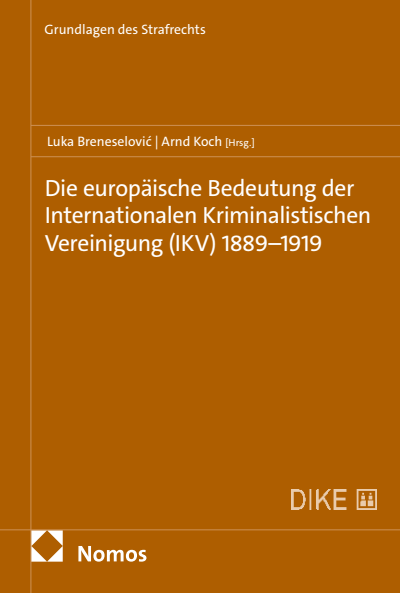
BOOK: Luka BRENESELOVIC and Arnd KOCH (eds.), Die europäische Bedeutung der Internationalen Kriminalistischen Vereinigung (IKV) 1889–1919 [Grundlagen des Strafrechts; 16] (Baden-Baden: Nomos Verlag, 2026), 336 p. ISBN 978-3-7560-0794-3


(image source: InLibra)

Abstract:
Die Internationale kriminalistische Vereinigung war eine international erfolgreiche Vereinsgründung der Belle Époque. Initiiert von Franz v. Liszt, Adolphe Prins und G. A. van Hamel legte sie ihrer Tätigkeit die Prämisse zugrunde, dass Verbrechen und Strafe „ebenso sehr vom soziologischen wie vom juristischen Standpunkte aus ins Auge gefasst werden müssen“ (Art. 1, Satzung von 1889). Auf dieser Basis erhob die IKV kriminalpolitische Forderungen, die bis heute das moderne Bild des Strafrechts maßgeblich prägen. Der Band widmet sich aus einer vergleichenden Perspektive der Tätigkeit und legislatorischen Wirksamkeit der nationalen Landesgruppen der IKV und leistet so einen wichtigen Beitrag zur europäischen Geschichte des Strafrechts.

Contributors:

Mit Beiträgen von Prof. Dr. Attila Barna | Dr. Luka Breneselović, LL.M. | Prof. Dr. Yves Cartuyvels | Prof. Dr. Dr. h.c. Cyrille Fijnaut | Prof. Dr. José Franco-Chasán | Prof. Dr. Sabine Freitag | Dr. Urs Germann | Prof. Dr. Jørn Jacobsen | Mag. Dr. Nina Kaiser | Prof. Dr. Sylvia Kesper-Biermann | Prof. Dr. Arnd Koch | Prof. Dr. Dr. Michael Kubiciel | Prof. Dr. Dunja Milotić | Prof. Dr. Martin Sunnqvist | Dr. Richard Wetzell

Read more here: 10.5771/9783748915515. 

18 May 2026

PRIZE: Bader-Preis to legal historian Svit KOMEL (Ljubljana) (Vienna: Austrian Academy of Sciences)


(image source: ÖAW)


Abstract:

Der Bader-Preis für die Geschichte der Wissenschaft und Technik geht in diesem Jahr an Svit Komel von der Universität Ljubljana. Ausgezeichnet wird seine Dissertationsschrift „Rule and measure. A history of juridical practices in the age of surveys“, in der er die Abschaffung von Grundlasten und kollektiven Landnutzungsrechten in der Habsburgermonarchie zwischen 1853 und 1895 untersucht. Komel zeigt, wie die Grundentlastung, also die Auflösung gemeinschaftlicher Rechte von Bauern an Wäldern und Weiden, nicht nur ein agrarpolitischer Einschnitt war, sondern Ausdruck einer tiefgreifenden Veränderung im Verhältnis zwischen Staat, Wissenschaft und lokaler Gesellschaft. Im Zentrum seiner Analyse steht das Konzept der Vermessung: Kommissare wurden in alle Winkel der Monarchie entsandt, um Gewohnheitsrechte zu erfassen und neu zu kategorisieren – ein Prozess, der auf das Wissen der bäuerlichen Bevölkerung zwingend angewiesen war.

More information at the ÖAW. 

30 April 2026

BOOK: Violet SOEN, Wouter DRUWÉ, Wim FRANCOIS & Ralph DECONINCK (eds.), Innovationes Lovanienses: Arts, Law and Theology at the University of Louvain (1425–1797) [Lectio; 18] (Turnhout: Brepols, 2026)


(image source: TRN)

Abstract:

Throughout the first centuries of its existence, the University of Louvain functioned as a crossroads for the transmission of texts, ideas, and even images from Antiquity, across the Middle Ages, and through the Renaissance. From its foundational bulls between 1425 and 1432, the university was established as a prototypical studium generale, drawing inspiration from earlier institutions in Paris and Cologne and adopting elements from contemporary universities like Rostock and Geneva. Situated at the heart of Europe, the University of Louvain quickly became a pivotal center for the reception and dissemination of both ancient and contemporary knowledge across the continent, and later, the Habsburg Empire. This volume examines how teachers and students examined old and innovative ideas across various constituent bodies of the university, including the Faculty of Arts or the College of the Three Tongues, or neighboring institutions, like the Jesuit College. Contributions span the Faculties of Law, adopting insights on the newly promulgated Tridentine decrees or novel moral economies, to the Faculty of Theology, a hotbed of the controversies surrounding grace, free will, and salvation in post-Tridentine Catholicism. Of the many scholars that were active in Louvain, special attention is devoted to the philologist Petrus Nannius, the theologians Michael Baius and Jacobus Janssonius, the lawyers Petrus Peckius and Johannes Wamesius, and the Jesuits Robertus Bellarminus and Leonardus Lessius, along with the lectures they gave at the Louvain house of their Order.

Table of contents: 

Introduction
Innovationes Lovanienses: What Is New about the ‘Old’ University of Louvain (1425–1797)? (Violet Soen)
Part I. The Faculty of Arts and the Collegium Trilingue
The Old and the New: Scholastic Elements in the Works of Petrus Nannius (1496–1557), Professor of the Collegium Trilingue in the First Half of the Sixteenth Century (Aline Smeesters)
Diagrammatic Innovations in Louvain Logic Notebooks (Seventeenth-Eighteenth Centuries) (Lorenz Demey)
Part II. The Faculties of Canon and Civil Law
The Role of Legal Practice in Louvain’s Legal Education (c. 1550–1650) (Wouter Druwé)
What Makes a Legal Commentary? Louvain Professors on Liber extra and Liber sextus (Sixteenth-Eighteenth Centuries) (Piotr Alexandrowicz)
Teaching Canon Law after Trent: Mapping Juridical Sources in the Lectures of Petrus Peckius (1529–1589) (Ana Luiza Ferreira Gomes Silva)
When the Sun Stopped Setting: Louvain Lawyers and Theologians on Issues of Monopolies and Competition (1500–1670) (Wout Vandermeulen)
Part III. The Faculty of Theology and the Jesuit College
Knowledge of Nature and Scripture at the Threshold of Modernity: Michael Baius’s (1513–1589) Louvain Lecture on Romans 1 (Jarrik Van Der Biest)
The Internal Act of Faith in the Commentaries on the Summa theologiae Produced in Sixteenth- and Seventeenth-century Louvain (with a Comparison with Previous Iberian Commentators) (Lidia Lanza)
The Jesuit College and Knowledge Transmission: Robert Bellarmine’s Lectiones Lovanienses (1570–1576) and the Spanish Scholastic Legal-Economic Thought (Shiri Roelofs)
Ex nudo Dei beneplacito: On Concord and Discord between Luis de Molina’s Concordia (1588) and Leonardus Lessius’ De gratia efficaci (1610) (C. J. (Niels) de Bruijn)
Vision, Love, and Joy: The Louvain Jesuit Leonard Lessius (1554–1623) on Beatitude (Patrícia Calvário)
Index

(source: Theology Research News)