Search

Showing posts with label intellectual history. Show all posts

30 April 2026

BOOK: Violet SOEN, Wouter DRUWÉ, Wim FRANCOIS & Ralph DECONINCK (eds.), Innovationes Lovanienses: Arts, Law and Theology at the University of Louvain (1425–1797) [Lectio; 18] (Turnhout: Brepols, 2026)


(image source: TRN)

Abstract:

Throughout the first centuries of its existence, the University of Louvain functioned as a crossroads for the transmission of texts, ideas, and even images from Antiquity, across the Middle Ages, and through the Renaissance. From its foundational bulls between 1425 and 1432, the university was established as a prototypical studium generale, drawing inspiration from earlier institutions in Paris and Cologne and adopting elements from contemporary universities like Rostock and Geneva. Situated at the heart of Europe, the University of Louvain quickly became a pivotal center for the reception and dissemination of both ancient and contemporary knowledge across the continent, and later, the Habsburg Empire. This volume examines how teachers and students examined old and innovative ideas across various constituent bodies of the university, including the Faculty of Arts or the College of the Three Tongues, or neighboring institutions, like the Jesuit College. Contributions span the Faculties of Law, adopting insights on the newly promulgated Tridentine decrees or novel moral economies, to the Faculty of Theology, a hotbed of the controversies surrounding grace, free will, and salvation in post-Tridentine Catholicism. Of the many scholars that were active in Louvain, special attention is devoted to the philologist Petrus Nannius, the theologians Michael Baius and Jacobus Janssonius, the lawyers Petrus Peckius and Johannes Wamesius, and the Jesuits Robertus Bellarminus and Leonardus Lessius, along with the lectures they gave at the Louvain house of their Order.

Table of contents: 

Introduction
Innovationes Lovanienses: What Is New about the ‘Old’ University of Louvain (1425–1797)? (Violet Soen)
Part I. The Faculty of Arts and the Collegium Trilingue
The Old and the New: Scholastic Elements in the Works of Petrus Nannius (1496–1557), Professor of the Collegium Trilingue in the First Half of the Sixteenth Century (Aline Smeesters)
Diagrammatic Innovations in Louvain Logic Notebooks (Seventeenth-Eighteenth Centuries) (Lorenz Demey)
Part II. The Faculties of Canon and Civil Law
The Role of Legal Practice in Louvain’s Legal Education (c. 1550–1650) (Wouter Druwé)
What Makes a Legal Commentary? Louvain Professors on Liber extra and Liber sextus (Sixteenth-Eighteenth Centuries) (Piotr Alexandrowicz)
Teaching Canon Law after Trent: Mapping Juridical Sources in the Lectures of Petrus Peckius (1529–1589) (Ana Luiza Ferreira Gomes Silva)
When the Sun Stopped Setting: Louvain Lawyers and Theologians on Issues of Monopolies and Competition (1500–1670) (Wout Vandermeulen)
Part III. The Faculty of Theology and the Jesuit College
Knowledge of Nature and Scripture at the Threshold of Modernity: Michael Baius’s (1513–1589) Louvain Lecture on Romans 1 (Jarrik Van Der Biest)
The Internal Act of Faith in the Commentaries on the Summa theologiae Produced in Sixteenth- and Seventeenth-century Louvain (with a Comparison with Previous Iberian Commentators) (Lidia Lanza)
The Jesuit College and Knowledge Transmission: Robert Bellarmine’s Lectiones Lovanienses (1570–1576) and the Spanish Scholastic Legal-Economic Thought (Shiri Roelofs)
Ex nudo Dei beneplacito: On Concord and Discord between Luis de Molina’s Concordia (1588) and Leonardus Lessius’ De gratia efficaci (1610) (C. J. (Niels) de Bruijn)
Vision, Love, and Joy: The Louvain Jesuit Leonard Lessius (1554–1623) on Beatitude (Patrícia Calvário)
Index

(source: Theology Research News)

17 February 2026

BOOK: Walter PAULY & Martin OTTO (Hrsg.), Recht, Staat und Geschichte bei Michael Stolleis. Wissenschaftsgeschichte des öffentlichen Rechts in Deutschland (Baden-Baden: Nomos Verlag, 2025), 403 p. ISBN 9783756016822, €119


(image source: Nomos)

Abstract:

Michael Stolleis (1941–2021) ist der Historiograph des deutschen öffentlichen Rechts. Seine Forschungen erstrecken sich von den Anfängen des ius publicum in der Frühen Neuzeit bis zum europäisch gerahmten öffentlichen Recht nach der Wiedervereinigung. Schwerpunkte bilden dabei das Natur- und Völkerrecht, das Staatsrecht der Aufklärung, die Policeywissenschaft, das „lange 19. Jahrhundert“ samt Konstitutionalismus und aufkommendem Interventionsstaat, die Weimarer und insbesondere die nationalsozialistische Rechts- und Herrschaftsordnung. Sein monumentales Werk analysiert jene Massen an Literatur, die den normativen Grundlagen von Organisation, Kompetenzen und Grenzen hoheitlicher Gewalt seit Entstehung moderner Staatlichkeit gelten.

 Contributors:

Patrick Bahners | Wolfgang Burgdorf | Frieder Günther | Hans-Christof Kraus | Naoko Matsumoto | Reinhard Mehring | Ulrich Muhlack | Volker Neumann | Jana Osterkamp | Martin Otto | Walter Pauly | Adrian Schmidt-Recla | Margrit Seckelmann | Achim Seifert | Dorothea Steffen | Annette Weinke

 Read more here.

08 December 2025

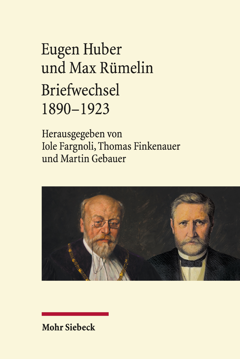
BOOK: Eugen Huber und Max Rümelin Briefwechsel 1890-1923 (ed. Iole FAGNOLI, Thomas FINKENAUER & Martin GEBAUER, with Jutta SCHUMACHER) (Tübingen: Mohr Siebeck, 2026), 817 p. ISBN 978-3-16-164866-3, € 99


(image source: Mohr Siebeck)

Abstract:
Der Briefwechsel zwischen Eugen Huber und Max von Rümelin gibt Einblicke in den juristischen Methodendiskurs am Ausgang des 19. und zu Beginn des 20. Jahrhunderts. Er verbindet den privaten Austausch unter Freunden mit der Kodifikationsgeschichte Deutschlands und der Schweiz in vergleichender Perspektive.

On the editors:

Iole Fargnoli ist Ordentliche Professorin für Römisches Recht an der Universität Bern und an der Università degli Studi di Milano (Italien); seit 2025 Direktorin des 'Istituto di italiano giuridico' an der Universität Bern. https://orcid.org/0000000300765604 Thomas Finkenauer ist Inhaber des Lehrstuhls für Bürgerliches Recht, Römisches Recht und Europäisches Privatrecht an der Universität Tübingen. https://orcid.org/0009000611029222 Martin Gebauer ist Inhaber des Lehrstuhls für Bürgerliches Recht, Internationales Privatrecht und Rechtsvergleichung an der Universität Tübingen und im Nebenamt Richter am Oberlandesgericht Stuttgart. https://orcid.org/0000000324428047 Jutta Schumacher ist promovierte Sprachwissenschaftlerin mit Schwerpunkt auf Texteditionen. 

Read more here

16 July 2025

BOOK: Hugo TOUSSAINT, Penser le droit constitutionnel: Pellegrino Rossi (1787-1848) [Droit public - Bibliothèque des Thèses] (Paris: Mare & Martin, 2025), 592 p. ISBN 9782386000980, € 54

(image source: Mare & Martin)


Abstract:

Premier titulaire de la chaire de droit constitutionnel de la Faculté de droit à Paris, Pellegrino Rossi (1787-1848) demeure aujourd’hui encore une figure méconnue. Doyen de la Faculté, pair de France, académicien puis ministre du Pape Pie IX, le constitutionnaliste est une figure incontournable de la doctrine juridique du XIXe siècle. L’ouvrage se propose de mettre au jour les outils épistémologiques avec lesquels Pellegrino Rossi construit sa pensée constitutionnelle et politique. À travers l’étude des notions de personne humaine, de société et d’État, l’ouvrage démontre le ralliement de Rossi à l’éclectisme philosophiquede son temps en soulignant ses diverses inspirations comme l’historicisme et l’organicisme allemands ainsi que l’utilitarisme anglais. L’ouvrage reconstitue également le logique juridique mais également politique de la pensée de Pellegrino Rossi. En ce sens, est mis au jour le but politique de la pensée constitutionnelle de Rossi entièrement tournée vers la promotion de l’unité nationale. Enfin, l’étude se propose d’interroger la figure - communément répandue - d’un Pellegrino Rossi « libéral ». En effet, sa vision inégalitaire de la société politique, sa conception capacitaire du gouvernement représentatif ainsi que sa virulente critique de l’égalité des conditions décrite par Tocqueville dans la Démocratie en Amérique interrogent de plus en plus sa stature de « penseur libéral ».

Read more here

17 June 2025

SYMPOSIUM: An Intellectual History of Legal History (INTELLEX). Figures, Methods and Moments of the Institutionalisation of Legal History in 1500-1900 Europe (Bayreuth: Universität Bayreuth/Institut für Fränkische Landesgeschichte der Universitäten Bamberg und Bayreuth, 12-13 JUN 2025)


Abstract:

This symposium is funded by a Junior Fellowship grant from the University of Bayreuth Centre of International Excellence “Alexander von Humboldt” [https://www.humboldt-centre.uni-bayreuth.de/en/index.html]. It will bring together scholars working on legal history or any aspects related to the teaching of legal disciplines in a historical context, contributing to the intellectual history of this field. While the conference focuses on identifying the intellectual contexts in which legal history developed, it also considers social aspects, as ideas do not exist independently of people.

Program:

 1. The Use of History in the Theory and Practice of Law: Codification, Concepts, and Origins

2. Theology, Medicine, History, and Legal Studies: Early Modern Knowledge Paradigms

3. Actors of Exchange: Influential Legal Historians and the Legacy of Their Concepts

4. The History of Teaching Legal History: Temporality and Spatiality in Academia

Keynote Speakers:

  • Heikki Pihlajamäki, University of Helsinki: How legal histories are written: codification, modernization and taxonomy of law
  • Sören Koch, University of Bergen: Changing perspectives on the sources of and reasons for legal historical research – A Scandinavian case study

More information here.

(source: Legal History Blog)

29 May 2025

BOOK: Martine Julia VAN ITTERSUM, The Working Papers of Hugo Grotius. Transmission, Dispersal, and Loss, 1604-1864 [Brill's Studies in Intellectual History, eds. Han VAN RULER, 343] (Leiden/Boston: Brill, 2025), ISBN 978-90-04-53600-5, € 242,74


(image source: Brill)

On the author:

Martine Julia van Ittersum, Ph.D. (2002), is Senior Lecturer in History at the University of Dundee (UK). She has published widely on book history, Dutch history, and the history of Western imperialism and colonialism, including Profit and Principle (Brill, 2006).
Table of contents:
Acknowledgements
List of Maps and Figures

Introduction: Hugo Grotius and the Microsociologies of Archives
 1 Early Modern Scholars and Textual Production and Loss
 2 The Role of Material Wealth in Preserving Personal Archives and Libraries
 3 The Materiality of Texts and the Microsociologies of Archives
 4 The Life and Times of Hugo Grotius
 5 The Fate of Grotius’ Working Papers

Knowledge Production and Records Management in Early Modern Europe: The Case of Hugo Grotius (1583–1645)
 1 Grotius’ Working Methods as a Lawyer and Government Official
 2 Is There a Start Date for Grotius’ Personal Archive?
 3 Where Did Grotius Keep His Books and Papers?
 4 The Working Methods of an Early Modern Scholar
 5 Access to Printed and Manuscript Materials
 6 How Grotius Involved His Relatives and Remonstrant Friends in Knowledge Production
 7 Circulating Manuscripts in the Republic of Letters
 8 The Role of Grotius’ Relatives and Remonstrant Friends in Printed Publication
 9 Conclusion

Confiscated Manuscripts and Books
What Happened to Grotius’ Personal Library and Archive Following His Arrest on Charges of High Treason in August 1618?
 1 What Is Known Already About the Confiscation of Grotius’ Books and Working Papers in the Period 1618–1620?
 2 Did Grotius’ Relatives Squirrel Away Sensitive Materials Following His Arrest in August 1618?
 3 To Which Books and Manuscripts Did Grotius Have Access in Captivity?
 4 How Jan De Groot Recovered Some of His Son’s Books and Papers in Summer 1621
 5 What Happened to Grotius’ Confiscated Papers?
 6 What Happened to Grotius’ Confiscated Books?
 7 Conclusion

Creating a (Definitive) Corpus of Writings: How Grotius’ Employer, Relatives, and Remonstrant Friends Shaped His Intellectual Legacy (1645–1679)
 1 Grotius’ Intellectual Legacy as a Family Project
 2 What Happened to the Book Collection Sold to Christina of Sweden?
 3 Manuscript Hunters in Paris, London, and the Low Countries
 4 Pieter De Groot’s Stewardship of His Father’s Working Papers (1653–1660)
 5 Grotius’ Intellectual Legacy in the Era of the ‘True Freedom’ and Beyond (1660–1678)
 6 What Happened to the Working Papers Inherited by the Descendants of Willem De Groot?
 7 Conclusion

Preserving and Editing Grotius’ Manuscripts for the Sake of Family Honor and the Remonstrant Cause (1679–1747)
 1 Publishing, Advertising and Deconstructing Epistolae Quotquot Reperiri Potuerunt
 2 A Remonstrant Hero: How Jean Le Clerc Shaped Grotius’ Intellectual Legacy
 3 Circulating Manuscripts in the Republic of Letters in the Eighteenth Century
 4 Writing and Publishing an Authoritative Biography of Hugo Grotius
 5 Memorialization through Physical Artifacts
 6 The Cornets De Groot Family in Bergen op Zoom
 7 Conclusion

Confronting Grotius’ Legacy in an Age of Revolution: The Cornets De Groot Family in Rotterdam (1748–1798)
 1 The Cornets De Groot Family as Beneficiaries of the Stadtholders’ Patronage
 2 The Establishment of a Grotius Memorial in the New Church in Delft
 3 A Patriot Revolution in Rotterdam
 4 The Patriot Politics of Paulus Gevers
 5 Hugo Grotius and Pieter De Groot as Patriot Icons
 6 Jan Cornets De Groot’s Efforts to Overturn the Patriot Revolution in Rotterdam
 7 Papers, Portraits, and Memorabilia Passed Down the Generations
 8 Status Symbols: Ancestral Portraits and Grotius Memorabilia
 9 An Inventory of the Papers of Hugo Grotius and Pieter De Groot (April 1778)

Constructing a Conservative National Hero in Response to Patriot Radicalism (1787–1815)
 1 Grotius as the Embodiment of Republican Virtue
 2 The Rediscovery of the Parallelon Rerumpublicarum and the Making of a Dutch National Hero
 3 What Can the Visser Collection Tell Us about the Transmission and Dispersal of Grotius’ Working Papers?
 4 How Jacobus Scheltema Rearranged Grotius’ Working Papers and Marked Up the 1778 Inventory

End of the Lineage: How Hugo Cornets De Groot Disposed of His Grotiana (1802–1864)
 1 A Visit from Lieutenant-General A.W.H. Nolthenius De Man in March 1832
 2 An Epistolary Exchange between Johan Pieter Cornets De Groot Van Kraaijenburg and Distant Relatives in Cuyck and Nijmegen
 3 Why Did Hugo Cornets De Groot Become Estranged from His Relatives?
 4 The Death of a Lonely Bachelor in Cuyck in February 1864
 5 How Jean Baptiste Regouin Rearranged the Working Papers of Hugo Grotius and Pieter De Groot, and Then Sold These to a Tobacco Merchant

Preparing for the Auction of the Working Papers of Hugo Grotius and Pieter De Groot, Mostly Behind the Scenes (February–November 1864)
 1 Christiaan Snelleman, Rotterdam Merchant and Remonstrant
 2 A List of Grotiana Compiled by the Remonstrant Minister C.P. Tiele
 3 How P.A. Tiele Put Together an Auction Catalogue, and Divided Up Manuscript Volumes into Multiple Lots
 4 The Auctioneer Martinus Nijhoff
 5 How Frederik Muller Did Business with the Nederlandsche Handel-Maatschappij

10 The 1864 Auction of the Working Papers of Hugo Grotius and Pieter De Groot, and What Happened Next
 1 How Nijhoff Conducted the Auction and Presented Its Outcome to the Public
 2 The Story Behind the Swedish Government’s Acquisition of Grotiana
 3 What Happened to Lots 1–42?
 4 The Bid and Strike Prices of Lots 43–99, and the Potential and Actual Buyers
 5 The 1864 Auction in Comparative Context
 6 What Explains the Dutch Government’s Total Lack of Involvement?
 7 How Johan Pieter Cornets De Groot Van Kraaijenburg (Re)Assembled a Collection of Family Papers

11 Conclusion

Appendix 1: The 1778 Inventory of the Working Papers of Hugo Grotius and Pieter De Groot, With Notes by Jacobus Scheltema
Appendix 2: Jacobus Scheltema’s Rearrangement of the Papers of Hugo Grotius and Pieter De Groot (May 1803)
Appendix 3: “Short Description of the Contents of the Enclosed Books, Volumes of Letters, Parchments with Seals Attached to Them, etc., Left by Hugo Grotius”
Appendix 4: A List of Grotiana Compiled by C.P. Tiele, at the Request of Christiaan Snelleman (August 1864)
Appendix 5: The Auction of the Working Papers of Hugo Grotius and Pieter De Groot: Bid Prices, Strike Prices, and Horse Trading Behind the Scenes (November 1804)
Appendix 6: The Auction Proceeds: The Final Receipt Sent to Christiaan Snelleman by Martinus Nijhoff
Appendix 7: Grotius’ Working Papers as Rearranged by P.A. Tiele
Appendix 8: Inheriting Ancestral Portraits and Papers: A Genealogical Chart
Bibliography
Indices
Read more here: DOI 10.1163/9789004536029.

23 January 2025

BOOK: Moritz MIHATSCH & Michael MULLIGAN (eds.), Shifting Sovereignties. A Global History of a Concept in Practice (Berlin: DeGruyter Oldenbourg, 2025), ISBN 9783111447117, €129

(image source: DeGruyter Oldenbourg

Abstract:

Shifting Sovereignties explores practical manifestations of sovereignty from antiquity to the Anthropocene. Taking a global-history perspective and centring Africa, the Middle East, and Asia, it destabilises overly neat theoretical notions of the concept. Shifting Sovereignties shows that, in practice, sovereignty is far from absolute, perpetual, indivisible, or supreme; rather it is fuzzy, compromised, fragmented, and layered. From these observations, the authors derive a historical conceptualisation which makes change and contingency core aspects of the understanding of sovereignty. Rather than understanding sovereignty as a characteristic of individual states, Mihatsch and Mulligan propose the notion of “sovereignty regimes”: frameworks of legitimation enforced through mutual recognition. These regimes are created and managed by more or less institutionalised structures which embody what the authors call “system sovereignty.” Sovereignty regimes and system sovereignty are, like sovereignty itself, continuously changing and contingent. This process of change forms the core of the book. Shifting Sovereignties thus contributes a practical, historical perspective on a concept which is foundational in political science, international relations, and international law.

On the editors:

Moritz A. Mihatsch, University of Cambridge, UK; Michael R. Mulligan, Euro University of Bahrain.

Read more here

30 June 2023

BOOK: Natasha WHEATLEY, The Life and Death of States: Central Europe and the Transformation of Modern Sovereignty (Princeton, NJ: Princeton University Press, 2023), 424 pp, ISBN 9780691244075, $45

(image courtesy: Princeton University Press) 

Book description: 
Sprawled across the heartlands of Europe, the Habsburg Empire resisted all the standard theories of singular sovereignty. The 1848 revolutions sparked decades of heady constitutional experimentation that pushed the very concept of “the state” to its limits. This intricate multinational polity became a hothouse for public law and legal philosophy and spawned ideas that still shape our understanding of the sovereign state today. The Life and Death of States traces the history of sovereignty over one hundred tumultuous years, explaining how a regime of nation-states theoretically equal under international law emerged from the ashes of a dynastic empire.

Natasha Wheatley shows how a new sort of experimentation began when the First World War brought the Habsburg Empire crashing down: the making of new states. Habsburg lands then became a laboratory for postimperial sovereignty and a new international order, and the results would echo through global debates about decolonization for decades to come. Wheatley explores how the Central European experience opens a unique perspective on a pivotal legal fiction—the supposed juridical immortality of states.

A sweeping work of intellectual history, The Life and Death of States offers a penetrating and original analysis of the relationship between sovereignty and time, illustrating how the many deaths and precarious lives of the region’s states expose the tension between the law’s need for continuity and history’s volatility.
Table of contents: 
Introduction
Chapter 1: Constitution as Archive: Drafting the Empire, 1848-1860s
Chapter 2: The Secret Science of Dual Sovereignty: 1867 and After
Chapter 3: Fictional States: Lands and Nations
Chapter 4: Pure Theory: Jellinek and Kelsen Reinvent Legal Philosophy
Chapter 5: What is a New State? 1919 in the History of the Austro-Hungarian Empire
Chapter 6: State Birth at the Frontier of Knowledge: Reimagining International Law from Postimperial Vienna
Chapter 7: Sovereignty in Sequence: Law, Time, and Decolonization 
Conclusion: The Temporal Life of States

About the author: 
Natasha Wheatley is assistant professor of history at Princeton University. She is the coeditor of Remaking Central Europe: The League of Nations and the Former Habsburg Lands and Power and Time: Temporalities in Conflict and the Making of History. Her writing has appeared in Past & Present and the London Review of Books.
More information can be found here

21 June 2023

JOURNAL: Les juristes dans la République des lettres (eds. Géraldine CAZALS, Stéphan GEONGET, Violaine GIACOMOTTO-CHARRA & Xavier PRÉVOST) (Clio@Thémis 24 (2023)) [OPEN ACCESS]


(image source: openedition)

« Pro communi utilitate » : où sont les juristes dans la République des lettres ? (Géraldine Cazals,Stéphan Geonget, Violaine Giacomotto-Charra et Xavier Prévost)
DOI 10.4000/cliothemis.3506

La bataille de Guillaume Budé, princeps de la République des Lettres, contre la barbarie des gens de justice (Shingo Akimoto)
DOI 10.4000/cliothemis.3195
Abstract:
This article focuses on the battle that Guillaume Budé waged against the barbarity of the magistrates of the French sovereign court, who, despising the study of letters and prone to the pursuit of gain, relied solely on the Bartolist science of law. I argue that, at the court of Francis I, Budé, already recognised as princeps of the Republic of Letters, assumed the political role of “advocate of the Philologists’ nation” and proposed, based on his idea of encyclopaedia, the ideal of the orator-philosopher able to achieve justice.

La faute de Narcisse et la leçon du droit : la philautie selon André Alciat, entre allégorie et discours juridique (Thomas Penguilly)
DOI 10.4000/cliothemis.3119
Abstract:
The jurist and humanist Andrea Alciato went down in history as the creator of the literary genre of the emblem, bound to a great fortune in the Renaissance and in the Classical period. However, his poetic work, put at the service of his conception of the teaching of law, also reflects the views of its author in the legal field. Indeed, in his emblem Philautia (1546), Alciato offers a true manifesto in favor of legal humanism through a very personal reading of the myth of Narcissus, dismissing back-to-back his opponents, jurists as well as philologists.

Prendre exemple sur le droit ? La formation du raisonnement politique dans le prologue des Discours de Machiavel (Laurent Gerbier)
DOI 10.4000/cliothemis.3260
Abstract:

The prologue to the Discourses on the First Decade of Livy defines the methodological conditions of political science using a specific analogy between law, medicine and politics. The aim here is to examine this analogy by trying to understand its stakes and origins. By relating it to the disputa delle arti, which has opposed medicine and law since the 14th century, as well as relating it to the emergence of legal humanism, which seeks to apply the scholarly methods of philology to law, the article aims to explain the meaning of this analogy and to show that the political science that Machiavelli intends to found is in fact a science of crises.

A Matter of Jurisdiction: “Guelfs” and “Ghibellines” in the French Wars of Religion (George Hoffmann)
DOI 10.4000/cliothemis.3150
Abstract:
Gallicans like Montaigne construed the confessional struggle as a problem of jurisdiction between the Crown and the Pope. When he quipped “to the Ghibelline I was a Guelph, to the Guelph a Ghibelline”, he was thus not intimating that he appeared “Protestant” to the Catholic side and “Catholic” to the Protestant one. Instead, he used these terms in their historical sense, designating a division between citramontane supporters of the king and ultramontane supporters of the pope. Between anti-tolerant and anti-pacifist Leaguers and tolerant-pacifist Politiques lay a third option, that of anti-tolerant but pacifist Gallicans.

Les juristes en épistoliers - Étude de la correspondance passive de Joseph-Juste Scaliger (1540-1609) (Xavier Prévost)
DOI 10.4000/cliothemis.3296
Abstract:
The study of two hundred and eighty-three letters addressed to Joseph-Juste Scaliger shows the extent of the humanist’s legal network and the active contribution of forty-nine jurists to the Republic of Letters. This encyclopedic contribution is based on philology as a central knowledge, in line with Scaliger’s interests. As for law, its place – without being negligible – remains peripheral in this correspondence, while varying according to the regularity of the legal practice of each letter writer.

Portrait du jurisconsulte en épistolier « particulier ». À propos de quelques développements sur le droit romain dans les Lettres (1619) d’Étienne Pasquier (XIX, 12 à XIX, 14) (Benoît Autiquet)
DOI 10.4000/cliothemis.3320
Abstract:
This article deals with three texts that Étienne Pasquier devoted to Roman law in the second edition of his collection of Lettres (1619), one to the authority of jurisconsults, the other two to the origins of the “légitime”. We propose to read in these little explored texts a redefinition of the authority of the jurisconsult, in French law as well as in Roman law, starting from the initial refusal of the idea that the jurist’s "opinions" have the force of law. In contrast to this idea, a figure embodied by the author himself appears : a "private" jurisconsult, who has all the more authority as he relates without personal ambition to the public good.

Étienne Pasquier, un avocat à l’éloquence herculéenne dans la République des Lettres (Baptiste Robaglia) 
DOI 10.4000/cliothemis.3379
Abstract:
This article deals with the identification of Étienne Pasquier with the civilizing eloquence of the Gallic Hercules. In the troubled context of the 16th century, the jurist-humanist identified himself with this eloquence that he implemented with the aim of participating in the civilization undertaken by the Republic of Letters. Pasquier thus took care to disseminate his knowledge, but also to civilize royal acts by confronting them with an ideal of justice. Behind this double meaning of eloquence then emerges the features of the Gallic hero described by Lucien de Samosate.

Jérôme Bignon (1589-1656), un juriste érudit et dévot dans la République des lettres à l’âge  confessionnel (Jean-Benoît Poulle)
DOI  10.4000/cliothemis.3410
Abstract:
Advocate General in the Parliament of Paris, Jérôme Bignon is remembered in history both as one of the great names of parliamentary eloquence, and as a highly respected scholar of the Republic of Letters for his erudition. With the help of his Vie published in 1747 by the Abbé Pérau, this article tries to better identify the links between the legal culture of a high-ranking officer, his public career, and his scholarly research, in which religious controversies occupy a central part. This also leads us to take into consideration the very great place he gives to Catholic devotion.

Varia:
What is a good book? Epistemic virtues and the role of originality in Brazilian public law scholarship (1820s - 1889) (Arthur Barrêtto de Almeida Costa)
DOI 10.4000/cliothemis.3460
Abstract:
Which virtues and vices 19th century Brazilian public opinion used to evaluate legal books and scholars? The paper analyzed the texts published in Brazilian newspapers commenting on books of public law, which are called “evaluation literature”, to answer this question. Major virtues were: utility, clarity, method, moderation; minor ones were: originality, experience, abnegation etc. This chart of values can be derived from the objectives of Brazilian legal scholarship of the time: not an academic discipline defined by research, but a technical discourse aimed at professional instruction and public intervention.

Read all articles here


28 March 2023

BOOK: Matthijs LOK, Europe Against Revolution. Conservatism, Enlightenment, and the Making of the Past (Oxford, OUP, 2023), 384 p. ISBN 9780198872139, 100 GBP

(image source: OUP)
 

Book presentation:

Contemporary Europe seems to be divided between progressive cosmopolitans sympathetic to the European Union and the ideals of the Enlightenment, and counter-enlightened conservative nationalists extolling the virtues of homelands threatened by globalised elites and mass migration. This study seeks to uncover the roots of historically informed ideas of Europe, while at the same time underlining the fundamental differences between the writings of the older counter-revolutionary Europeanists and their self-appointed successors and detractors in the twenty-first century. In the decades around 1800, the era of the French Revolution, counter-revolutionary authors from all over Europe defended European civilisation against the onslaught of nationalist revolutionaries, bent on the destruction of the existing order, or so they believed. In opposition to the new revolutionary world of universal and abstract principles, the counter-revolutionary publicists proclaimed the concept of a gradually developing European society and political order, founded on a set of historical and - ultimately divine - institutions that had guaranteed Europe's unique freedom, moderation, diversity, and progress since the fall of the Roman Empire. These counter-revolutionary Europeanists drew on the cosmopolitan Enlightenment and simultaneously criticized its alleged revolutionary legacy. Throughout the nineteenth and twentieth centuries, these ideas of European history and civilisation were rediscovered and adapted to new political contexts, shaping in manifold ways our contested idea of European history and memory until today.

On the author:

Matthijs Lok studied European history at the Universities of Liverpool, Leiden, and Yale, followed by a brief career as a policy advisor. In 2009 he took his PhD at the History Department of the University of Amsterdam. In 2011 Lok received tenure as an universitair docent and in 2015 he became senior university lecturer. Lok was appointed a senior fellow of the Netherlands Institute for Advanced Study NIAS (2019-20) and held visiting positions at the Lichtenberg Kolleg & Moritz Stern Institut Göttingen, Germany (2021-22) and the KU Leuven, Belgium (2022). 

Read more here

27 March 2023

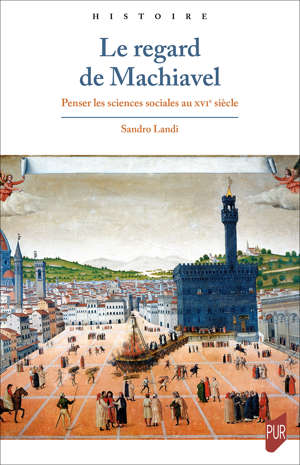
BOOK: Landi SAURO, Le regard de Machiavel. Penser les sciences sociales au XVIe siècle [Histoire] (Rennes: Presses universitaires de Rennes, 2021), 238 p. ISBN 9782753582156, € 24


(image source: PUR)

Book abstract:

Le regard que Machiavel porte sur la réalité lui permet de voir des choses que ses contemporains ne voient pas, comme la nature des comportements collectifs, le caractère mental des liens politiques et religieux ou l'importance de l'opinion dans le gouvernement des États. Le fil conducteur de cette « biographie cognitive » est l'enquête de Machiavel : sa manière d'identifier et de construire dans le temps des objets de recherche. Il ne s'agit plus de questionner Machiavel sur son identité politique ou religieuse mais de comprendre comment, en interprétant la réalité, il contribue à l'émergence d'une connaissance spécifiquement consacrée à l'homme en société.

On the author:

Landi Sauro, spécialiste de l'Italie moderne, est professeur à l'université Bordeaux-Montaigne. Il a notamment publié aux PUR Naissance de l'opinion publique dans l'Italie moderne. Sagesse du peuple et savoir de gouvernement de Machiavel aux Lumières. 

Read more here

10 January 2023

BOOK: Adeel HUSSAIN, Law and Muslim Political Thought in Late Colonial North India (Oxford: Oxford University Press, 2022), 248 pp., ISBN 9780192859778, £65


(image courtesy: Oxford University Press)

Book description: 
During the 1930s, much of the world was in severe economic and political crisis. This upheaval ushered in new ways of thinking about social and political systems. In some cases, these new ideas transformed states and empires alike. Particularly in Europe, these transformations are well-chronicled in scholarship. In academic writings on India, however, Muslim political and legal thought has gone relatively unnoticed during this eventful decade. This book fills this gap by mapping the evolution of Muslim political and legal thought from roughly 1927 to 1940. By looking at landmark court cases in tandem with the political and legal ideas of Muhammad Iqbal and Muhammad Ali Jinnah, Pakistan's founding fathers, this book highlights the more concealed ways in which Indian Muslims began to acquire a political outlook with distinctly separatist aspirations. What makes this period worthy of a separate study is that the legal antagonism between religious communities in the 1930s foreshadowed political conflicts that arose in the run-up to independence in 1947. The presented cases and thinkers reflect the possibilities and limitations of Muslim political thought in colonial India.
Table of contents: 
1.:Introduction
2.:In Search of Vulnerabilities Lost
3.:Shahidganj and the Burden of Time
4.:Jinnah: A Thinker of Existential Survival
5.:Iqbal and Combative Constitutionalism
6.:Conclusion
About the author: 
Adeel Hussain is an Assistant Professor of Legal and Political Theory at Leiden University, The Netherlands, and a Senior Research Associate at the Max Planck Institute for Comparative Public Law and International Law in Heidelberg, Germany. Before joining Leiden University, Adeel clerked at the Court of Appeals in Frankfurt, worked for an international law firm, and advised the Government of Afghanistan on constitutional and administrative reform. His research focuses on jurisprudence, comparative constitutional law, international law, and the global history of legal and political thought, with an emphasis on South Asia and Europe. This is his first monograph.
More information can be found here

17 August 2020

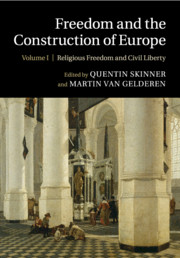
BOOK: Quentin SKINNER & Martin VAN GELDEREN (eds) Freedom and the Construction of Europe - Volume 1. Religious Freedom and Civil Liberty (Cambridge: CUP, 2020), ISBN 9781108817776, 24,99 GBP

(image source: CUP)

Abstract:
Freedom, today perceived simply as a human right, was a continually contested idea in the early modern period. In Freedom and the Construction of Europe an international group of scholars explore the richness, diversity and complexity of thinking about freedom in the shaping of modernity. Volume 1 examines debates about religious and constitutional liberties, as well as exploring the tensions between free will and divine omnipotence across a continent of proliferating religious denominations. Debates about freedom have been fundamental to the construction of modern Europe, but represent a part of our intellectual heritage that is rarely examined in depth. These volumes provide materials for thinking in fresh ways not merely about the concept of freedom, but how it has come to be understood in our own time.

Read more here


23 July 2020

CALL FOR PAPERS: Global Inequality – An Intellectual History (Aarhus, 10-11 June 2021) (DEADLINE: 31 August 2020)


We learned of a call for papers for a symposium on the intellectual history of global inequality since 1945. Here the call:

This two-day symposium is designed to investigate the global intellectual history of inequality. It will do so through a double global lens: How have intellectuals from around the world thought about inequality in the world? The aim of the symposium is to contribute with a new transnational intellectual history of inequality in different geographical and cultural contexts. The symposium will investigate links, differences and similarities between different intellectual traditions, as well as the circulation of inequality concepts and knowledge across countries. It aspires to facilitate a unique transcultural and multi-linguistic knowledge about inequality concepts, contributing to the fields of global conceptual and intellectual history. The symposium will aim at a special journal issue on the global intellectual history of inequality, exploring relationships between geographical anchoring (place) and thinking on inequality in history. We are delighted that the journal Global Intellectual History has kindly agreed to be the host of this special issue. Critics of global intellectual history have rightfully pointed out that few connections are actually truly global (planetary), but can much more adequately be described as transnational or transcultural (or ‘transcolonial’ or ‘transimperial’) connections. Taking this criticism into account, we are interested both in learning more about the intellectual histories of inequality in non-western countries, including in non-English, indigenous languages. Secondly, we are interested in learning more about intellectual and conceptual histories of transnational connections between various parts of the world, such as North-South and South-South connections and intellectual biographies of key thinkers on inequality whose histories are linked to several countries and continents. How did intellectuals across the globe address inequalities in a post-world war II age of ‘development’, promises of universal human rights, new data on inequalities, and of the crucial historical dynamics of the Cold War and decolonization?

The full call for papers can be found here

01 July 2020

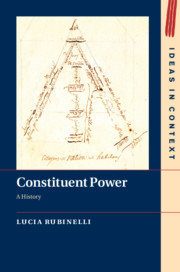
BOOK: Lucia RUBINELLI, Constituent Power: A History (Cambridge: Cambridge University Press, 2020). ISBN 9781108485432, USD 99.99


(Source: CUP)

Cambridge University Press has published a history of constituent power.

ABOUT THE BOOK

From the French Revolution onwards, constituent power has been a key concept for thinking about the principle of popular power, and how it should be realised through the state and its institutions. Tracing the history of constituent power across five key moments - the French Revolution, nineteenth-century French politics, the Weimar Republic, post-WWII constitutionalism, and political philosophy in the 1960s - Lucia Rubinelli reconstructs and examines the history of the principle. She argues that, at any given time, constituent power offered an alternative understanding of the power of the people to those offered by ideas of sovereignty. Constituent Power: A History also examines how, in turn, these competing understandings of popular power resulted in different institutional structures and reflects on why contemporary political thought is so prone to conflating constituent power with sovereignty.

ABOUT THE AUTHOR

Lucia Rubinelli, University of Cambridge
Lucia Rubinelli is Junior Research Fellow in the History of Political Thought at Robinson College, University of Cambridge.

TABLE OF CONTENTS

Introduction
1. Sieyès and the French Revolution
2. Constitutional Politics in Nineteenth-Century France
3. The Weimar Republic
4. Constitutional politics in post-World War II Europe
5. Arendt and the French Revolution
Conclusion
Bibliography
Index.

More info here

03 June 2020

BOOK: Bruno LEIPOLD, Karma NABULSI, and Stuart WHITE, eds., Radical Republicanism - Recovering the Tradition’s Popular Heritage (Oxford: Oxford University Press, 2020). ISBN 9780198796725, £65.00


(Source: OUP)

OUP is publishing a new book on Republicanism.

ABOUT THE BOOK

Republicanism is a powerful resource for emancipatory struggles against domination. Its commitment to popular sovereignty subverts justifications of authority, locating power in the hands of the citizenry who hold the capacity to create, transform, and maintain their political institutions. Republicanism's conception of freedom rejects social, political, and economic structures subordinating citizens to any uncontrolled power - from capitalism and wage-labour to patriarchy and imperialism. It views any such domination as inimical to republican freedom. Moreover, it combines a revolutionary commitment to overturning despotic and tyrannical regimes with the creation of political and economic institutions that realise the sovereignty of all citizens, institutions that are resilient to threats of oligarchical control. This volume is dedicated to retrieving and developing this radical potential, challenging the more conventional moderate conceptions of republicanism. It brings together scholars at the forefront of tracing this radical heritage of the republican tradition, and developing arguments, texts, and practices into a critical and emancipatory body of political and social thought. The volume spans historical discussions of the English Levellers, French and Ottoman revolutionaries, and American abolitionists and trade unionists; explorations of the radical republican aspects of the thought of Machiavelli, Marx, and Rousseau; and theoretical examinations of social domination and popular constitutionalism. It will appeal to political theorists, historians of political thought, and political activists interested in how republicanism provides a robust and successful radical transformation to existing social and political orders.

ABOUT THE EDITORS

Edited by Bruno Leipold, Fellow in Political Theory, London School of Economics, Karma Nabulsi, Fellow and Tutor in Politics, St Edmund Hall, University of Oxford, and Stuart White, Fellow and Tutor in Politics, Associate Professor of Politics, Jesus College, University of Oxford

Bruno Leipold is a Fellow in Political Theory at the London School of Economics and Political Science. He completed his DPhil at the University of Oxford and has held postdoctoral positions at the European University Institute and the Justitia Amplificata Centre for Advanced Studies at the Goethe University of Frankfurt and the Free University of Berlin.

Karma Nabulsi is Fellow and Tutor in Politics at St Edmund Hall, University of Oxford. She writes and lectures on 18th and 19th century republicanism, revolutions, and democracy, as well as on Palestine, especially Palestinian refugees.

Stuart White is Fellow in Politics at Jesus College, Oxford, having formerly taught in the Department of Political Science, M.I.T. His research is focused on democracy, republican values, and the economy, with related interests in both social policy and the political process. He is the author of The Civic Minimum (2003). He blogs occasionally at openDemocracy.

TABLE OF CONTENTS

Introduction: Radical Republicanism and Popular Sovereignty, Bruno Leipold, Karma Nabulsi, and Stuart White
I. DOMINATION: SOCIAL AND STRUCTURAL
1: From Neorepublicanism to Critical Republicanism, Dorothea Gãdeke
2: A Radical Revolution in Thought: Frederick Douglass on the Slave's Perspective on Republican Freedom, Alan Coffee
II. POPULAR CONSTITUTIONALISM
3: Republicanism, Virtuous and Corrupt: Social Conflict, Political Leadership and Constitutional Reform in Machiavelli's Florentine Histories, John P. McCormick
4: Citizens' Assemblies and Republican Democracy, Stuart White
III. MOVEMENT AND RESISTANCE
5: Popular Resistance and the Idea of Rights, Guy Aitchison
6: Two Traditions of Radical Democracy from the 1830 Revolution, Karma Nabulsi
IV. SOCIALISM AND LABOUR
7: Solidarity and Civic Virtue: Labour Republicanism and the Politics of Emancipation in Nineteenth Century America, Alex Gourevitch
8: Marx's Social Republic: Radical Republicanism and the Political Institutions of Socialism, Bruno Leipold
V. HISTORIAL TRAJECTORIES
9: The Intellectual Origins of Turkish Radical Republicanism, Banu Turnaoglu
10: The Utopian Imagination: Radical Republican Traditions in France, from the Enlightenment to the French Communists, Sudhir Hazareesingh

More info here

29 November 2019

BOOK: George PRIEST, The Rise of Law and Economics - An Intellectual History (London: Routledge, 2019). ISBN 9780367339388, £39.99


(Source: Routledge)

Routledge is publishing a new intellectual history of law and economics.

ABOUT THE BOOK

This is a history - though, intentionally, a brief history - of the rise of law and economics as a field of thought in the US college and law school academy, though the field has expanded to Europe and South America and will expand further as other legal systems develop.

This book explains the origins of the field and the sources of its growth during its formative period. It describes the intellectual roots of the field, and the field’s relationship to the understanding of the role of the legal system in directing the functioning of the economy. It describes the effect of the Great Depression and the expansion of governmental power on advancing the functional approach. The book then addresses the work of Aaron Director, during the late 1950s, on focusing economic analysis as a means of understanding the effects of the legal and regulatory system on the allocation of resources in the society. Then it turns to the subsequent intellectual founders of the field—Ronald Coase, Guido Calabresi and Richard Posner—and attempts to explain the significance of their work. It also discusses the efforts of Robert Bork and Henry Manne toward the influence of law and economics on public policy. The book ends with the founding of the American Law & Economics Association in 1991.

This is an essential companion of law and economics texts for undergraduate law and economic students and, especially, as a general supplement to first year casebooks for law school students.

ABOUT THE AUTHOR

George L. Priest is the Edward J. Phelps Professor of Law and Economics at Yale Law School.

TABLE OF CONTENTS

1. Introduction 2. The Early Development of the Functional Approach to Law 3. The Problems of the Depression and the Broader Acceptance of the Functional Approach to Law 4. The Birth of Modern Law and Economics as a Discipline 5. The Revolutionary Expansion of Law and Economics: Ronald H. Coase 6. Calabresi and the Economic Framework of The Costs of Accidents 7. Law and Economics Made Dominant: Richard A. Posner and Economic Analysis of Law 8. Coase, Calabresi, and Posner Compared 9. The Influence of Law and Economics on Regulation and Antitrust Law 10. Henry Manne and the Popular Expansion of Law and Economics 11. Epilogue: The John M. Olin Foundation and the Founding of the American Law & Economics Association

More information here

12 November 2019

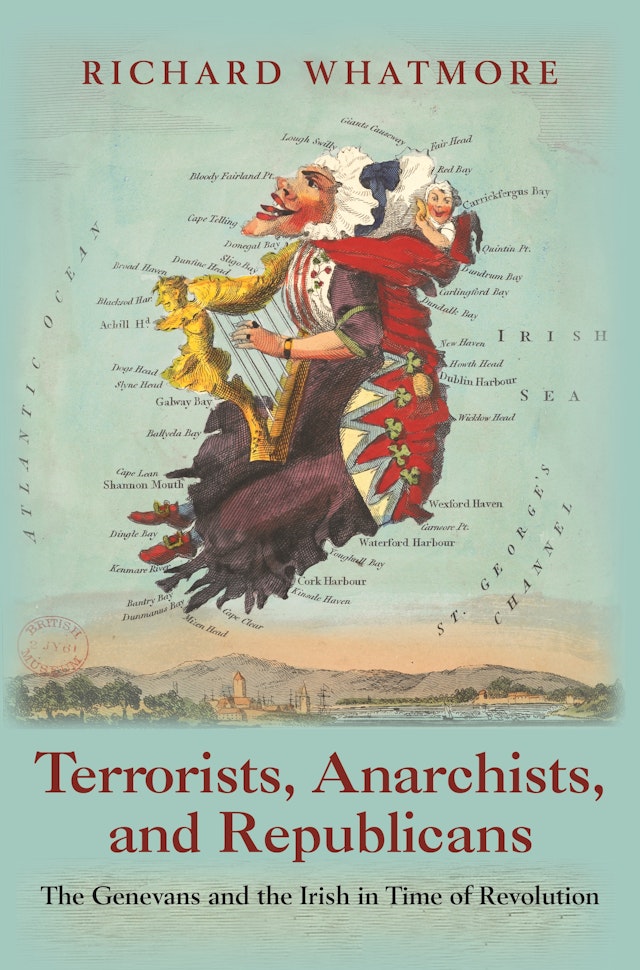
BOOK: RIchard WHATMORE, Terrorists, Anarchists, and Republicans: The Genevans and the Irish in Time of Revolution (Princeton: Princeton UP, 2019), 512 p. ISBN 9780691168777, 39,95 USD

(image source: Princeton UP)

Book abstract:
In 1798, members of the United Irishmen were massacred by the British amid the crumbling walls of a half-built town near Waterford in Ireland. Many of the Irish were republicans inspired by the French Revolution, and the site of their demise was known as Genevan Barracks. The Barracks were the remnants of an experimental community called New Geneva, a settlement of Calvinist republican rebels who fled the continent in 1782. The British believed that the rectitude and industriousness of these imported revolutionaries would have a positive effect on the Irish populace. The experiment was abandoned, however, after the Calvinists demanded greater independence and more state money for their project. Terrorists, Anarchists, and Republicans tells the story of a utopian city inspired by a spirit of liberty and republican values being turned into a place where republicans who had fought for liberty were extinguished by the might of empire. Richard Whatmore brings to life a violent age in which powerful states like Britain and France intervened in the affairs of smaller, weaker countries, justifying their actions on the grounds that they were stopping anarchists and terrorists from destroying society, religion and government. The Genevans and the Irish rebels, in turn, saw themselves as advocates of republican virtue, willing to sacrifice themselves for liberty, rights and the public good. Terrorists, Anarchists, and Republicans shows how the massacre at Genevan Barracks marked an end to the old Europe of diverse political forms, and the ascendancy of powerful states seeking empire and markets—in many respects the end of enlightenment itself.
On the author:
Richard Whatmore is professor of modern history and codirector of the Institute of Intellectual History at the University of St Andrews. He is the author of What Is Intellectual History?, Against War and Empire, and Republicanism and the French Revolution.
(source: Princeton UP)

10 September 2019

CALL FOR PAPERS: International Society for Intellectual History – Change and Exchange (Florence, 27-29 May 2020) (DEADLINE: 15 November 2019)


(Source: ISIH)

We learned of a call for papers for a conference organized by the International Society for Intellectual History. Here the call:

Keynotes: Giancarlo Casale (EUI), Emmanuelle de Champs (Cergy-Pontoise), Laszlò Kontler (CEU), Glenda Sluga (Sydney and EUI)

The suddenness of many recent changes has led to a widespread feeling of bewilderment and led many to retreat into what are seen as safe places and idealised pasts, rejection of difference and increasingly violent and intolerant social exchange. At the same time, the evidence of climate change is making people increasingly aware of the need to rethink our way of life. It therefore seems an appropriate moment to look at how change has been understood and conceptualised in the past, how changes in ways of thinking, concepts and paradigms have come about, the strength of resistance to change, and the role of exchange – intellectual and material – in this process. Change and Exchange proposes to explore historical, philosophical, cultural, material, social, environmental and scientific change, the varieties of social, intellectual, material, economic, etc. exchange and the interactions between the two. It will also look at change and exchange in the field of Intellectual History itself.

Call for Papers

The International Society for Intellectual History (ISIH) invites proposals for papers and panels. Papers (20 mins, followed by 10 mins of discussion), relating to the theme of change and exchange in intellectual history at large, can concentrate on any period, region, tradition or discipline, including the arts, humanities and sciences, 1450 to present. As well as individual papers, we welcome proposals for panels of up to three papers and a commentator. The range of subjects of investigation is extremely broad, and may include, but is not limited to:

  • thinking about change in intellectual history: epistemological breaks, paradigm change and intellectual traditions;
  • interdisciplinarity in intellectual history
  • debates on social, political, economic, scientific, technological, climate, etc. change;
  • writing the history of change; changes of scale in historical understanding
  • interactions between political, social, economic, technological, scientific and intellectual change;
  • promoting and resisting change;
  • informal and institutional exchanges between cultures and their role in bringing about change;
  • sociability and intellectual, scientific, commercial, institutional etc. networks;
  • the theory, practice, history and role of translation.
Proposals for papers and panels are due by 15 November 2019 and must be submitted through the Conference Submission Form.

Sponsor: Department of History and Civilisation, European University Institute.

For general inquiries, please email Francesca.Parenti@eui.eu.

Conference Committee: Ann Thomson, Thomas Ashby, Elisavet Papalexopoulou, Francesca Parent

More information here