Search

Showing posts with label university history. Show all posts

07 July 2026

BOOKS: Violet SOEN, Wouter DRUWÉ, Wim FRANCOIS & Ralph DECONINCK (eds.), Innovationes Lovanienses: Arts, Law and Theology at the University of Louvain (1425–1797) and Students, Scholars and Their Books at the University of Louvain (1425–1797) [Lectio, ed. Pieter D'HOINE/Studium Lovaniense, ed. Violet SOEN] (Turnhout: Brepols, 2026) [OPEN ACCESS]


(image source: Brepols)

Two open access volumes on the University of Leuven/Louvain in the late Middle Ages and Early Modern Age have been published recently.

Innovationes Lovanienses: Arts, Law and Theology at the University of Louvain (1425–1797) (eds. Violet Soen, Wouter Druwé, Wim François & Ralph Deconinck)
DOI 10.1484/M.LECTIO-EB.5.145524
Abstract:

Throughout the first centuries of its existence, the University of Louvain functioned as a crossroads for the transmission of texts, ideas, and even images from Antiquity, across the Middle Ages, and through the Renaissance. From its foundational bulls between 1425 and 1432, the university was established as a prototypical studium generale, drawing inspiration from earlier institutions in Paris and Cologne and adopting elements from contemporary universities like Rostock and Geneva. Situated at the heart of Europe, the University of Louvain quickly became a pivotal center for the reception and dissemination of both ancient and contemporary knowledge across the continent, and later, the Habsburg Empire. This volume examines how teachers and students examined old and innovative ideas across various constituent bodies of the university, including the Faculty of Arts or the College of the Three Tongues, or neighboring institutions, like the Jesuit College. Contributions span the Faculties of Law, adopting insights on the newly promulgated Tridentine decrees or novel moral economies, to the Faculty of Theology, a hotbed of the controversies surrounding grace, free will, and salvation in post-Tridentine Catholicism. Of the many scholars that were active in Louvain, special attention is devoted to the philologist Petrus Nannius, the theologians Michael Baius and Jacobus Janssonius, the lawyers Petrus Peckius and Johannes Wamesius, and the Jesuits Robertus Bellarminus and Leonardus Lessius, along with the lectures they gave at the Louvain house of their Order.

Chapters

  • Innovationes Lovanienses. What Is New about the ‘Old’ University of Louvain (1425–1797)? (Violet Soen)
  • The Old and the New. Scholastic Elements in the Works of Petrus Nannius (1496–1557), Professor of the Collegium Trilingue in the First Half of the Sixteenth Century (Aline Smeesters)
  • Diagrammatic Innovations in Louvain Logic Notebooks (Seventeenth-Eighteenth Centuries) (Lorenz Demey)
  • The Role of Legal Practice in Louvain’s Legal Education (c. 1550–1650) (Wouter Druwé)
  • What Makes a Legal Commentary? . Louvain Professors on Liber Extra and Liber Sextus (Sixteenth-Eighteenth Centuries) (Piotr Alexandrowicz)
  • Teaching Canon Law after Trent. Mapping Juridical Sources in the Lectures of Petrus Peckius (1529–1589) (Ana Luiza Ferreira Gomes Silva)
  • When the Sun Stopped Setting. Louvain Lawyers & Theologians on Issues of Monopolies and Competition (1500–1670) (Wout Vandermeulen)
  • Knowledge of Nature and Scripture at the Threshold of Modernity. Michael Baius’s (1513–1589) Louvain Lecture on Romans 1 (Jarrik Van Der Biest)
  • The Internal Act of Faith in the Commentaries on the Summa theologiae. Produced in Sixteenth- and Seventeenth-century Louvain (with a Comparison with Previous Iberian Commentators) (Lidia Lanza)
  • The Jesuit College and Knowledge Transmission: Robert Bellarmine’s Lectiones Louanienses (1570–1576) and the Spanish Scholastic Legal-Economic Thought (Shiri Roelofs)
  • Ex nudo Dei beneplacito. On Concord and Discord between Luis de Molina’s Concordia (1588) and Leonardus Lessius’s De gratia efficaci (1610) (C.J. (Niels) De Bruijn)
  • Vision, Love, and Joy. The Louvain Jesuit Leonard Lessius (1554–1623) on Beatitude (Patrícia Calvário)

Students, Scholars and Their Books at the University of Louvain (1425–1797) (eds. Violet Soen, Wouter Druwé, Wim François & Ralph Deconinck)
DOI 10.1484/M.LECTIO-EB.5.145522
Abstract:

Integrating prosopographical, cartographical, and book-historical data, this collective volume on the first University of Louvain (1425–1797) contributes to ongoing interdisciplinary inquiries into the intellectual productions of students, scholars, and printers in the Early Modern era. The ten contributions examine the state of the art at the University of Louvain, whose output was supported by the vibrant printing presses of the Low Countries and the continual mobility of its scholars across continental Europe. The essays first unravel the transregional circuits of Louvain’s students, scholars, and printers, built upon their geographical mobility throughout Europe. The second part explores how early modern students at Louvain created their study materials by compiling lecture notes, rearranging the contents, and binding them into codices, often adorned with drawings or printed engravings – a practice that remained prevalent until the eighteenth century. Further contributions trace the introduction of the handpress to the city of Louvain, which, beginning in 1473, brought new opportunities for producing textbooks for broader markets, as typography and physical features transformed handbook production. Louvain’s publication network was especially dense in the sixteenth century, and publication rates remained high through the eighteenth century. This volume offers new insights into the hybrid world of oral teaching, handwritten note-taking, and printed textbook production by students, scholars, and printers at one of Europe’s intellectual crossroads.

Chapters

  • From Magister Dixit to STUDIUM.AI. New Perspectives on Students, Scholars and Their Books at the University of Louvain (1425–1797) (Violet Soen)
  • Louvain Scholars on the Move. Networks and Mobility Patterns at the Early University of Louvain. An Analysis of Academic Mobility (1425–1797) (David de la Croix & Maria Vitale)
  • From Transregional Recruitment to Self-reproduction. Building a Teaching Staff at the University of Louvain in Its First Two Decades (1425–1443) (Christiaan Engberts)
  • Who’s Who in STUDIUM.AI. New Linked Data about Students, Scholars and Printers at the Early Modern University of Louvain (1425–1797) (Violet Soen Yann Ryan)
  • The Louvain Lecture Halls during Theological Controversy. The Benedictine Student Stephanus Puelincx and His Notes on the Lectures of Jacobus Janssonius (c. 1607) (Linde Van den Eede)
  • In the University Classroom. Seventeenth-century Notebooks of Arts Students at the Universities of Louvain and Leiden (1651–1700) (An Smets)
  • Drawing Practices as Learning and Recreational Processes in Louvain Student Notebooks (Seventeenth–Eighteenth Centuries) (Gwendoline de Mûelenaere)
  • Honesti et probi adolescentes. Pardon Letters and Student Violence at the Early Modern University of Louvain (Sixteenth–Seventeenth Centuries) (Gert Gielis, Luke Giraudet & Quintin Verreycken)
  • The Importance of Typography in Knowledge Transfer. The Materiality of Louvain Printed Philosophy Textbooks (1474–1562) (Dieter Cammaerts)
  • Shedding (More) Light on Sixteenth-century Mapping Practices. Pieter Pourbus’s Application of Gemma Frisius’s Triangulation Methods (Jan Trachet & Hendrik Hameeuw)
  • Integrating Library and Prosopographical Data in the Early Modern Publication Network of the University of Louvain (1501–1797) (Rossana Scebba & Margherita Fantoli)
Both books can be read in open access with Brepols


11 May 2026

BOOK: Christiaan ENGBERTS, Decentering Leuven University. A Transnational History (Leuven: Leuven University Press, 2026), 328 p. ISBN 9789462705081 [OPEN ACCESS]


(image source: Leuven University Press)

Abstract:

First longue durée transnational history of a university, surveying its cross-border ties and offering a new model for writing university history. Since its foundation in 1425, Leuven University has always been a transnational institution. Decentering Leuven University explores how this transnational character has shaped the university across six centuries, with cross-border ties emerging as a recurring theme throughout its history from the Middle Ages to the present day. However, these ties are more than just a recurring theme: they provide an innovative approach to writing university history. Taking the myriad cross-border ties as a methodological starting point makes it possible to view the history of the university from a new perspective. The rich variety of these ties highlights the complexity and diversity within the university. The author discusses, among other things, Leuven’s role as a center of European humanism in the 15th century, the significance of its Irish and Dutch mission colleges during the Counter-Reformation, the university’s more recent involvement in the Belgian colonial project, and the emergence of research institutes as hubs of transnational collaboration in the 20th century. Emphasizing these transnational ties leads to two forms of decentering the university’s history: it underscores the university’s embeddedness in a variety of cross-border networks, and it highlights the role of individual scholars, students, colleges, and research institutes in creating and maintaining these ties.

Table of contents: 

Introduction
Universities, jubilees, and transnational ties
Introduction
The first university jubilees
Writing university history
Histories of Leuven University
The university in a transnational landscape
Leuven University from 1425 to 2025

Chapter 1
The transnational character of the early university
Introduction
Medieval universities before 1500
University, religion, and politics
The foundation of Leuven University
The recruitment of professors
Determining the geographical background of the early staff
The geographical background of professors in church law
The geographical background of professors in civil law
The geographical background of professors in medicine
The geographical background of professors in theology
The geographical background of professors in the arts
Determining the educational background of the early staff
The educational background of professors in church law
The educational background of professors in civil law
The educational background of professors in medicine
The educational background of professors in theology
The educational background of professors in the arts
A life after Leuven?
Conclusion: becoming self-sufficient
 Chapter 2
Humanist entanglements
Introduction
Vives and Erasmus: Leuven’s early humanist luminaries
The networks of Vives and Erasmus
Humanism in Leuven before 1517
The foundation of the Collegium Trilingue
The (trans)national teaching staff of the Trilingue
A typical humanist: the research-minded traveler Campensis
A typical humanist: the printing endeavors of Rutgerus Rescius
A typical humanist: Petrus Nannius’s correspondence network
European students at the Trilingue
Trilingue students in Europe: the linguist Clenardus
Trilingue students in Europe: the diplomat Busbequius
Trilingue students in Europe: the anatomist Vesalius
An example worth following
Conclusion: a merging of university and humanist networks

Chapter 3
On the frontlines of faith
Introduction
Counter-Reformation and higher education in the seventeenth century
Leuven and the Irish college network
Irish history from Leuven
Irish Catholicism in Leuven
The precarious position of Catholicism in the northern Low Countries
Jesuits vs. Dutch secular clergy
Jesuits and the Leuven Augustinian tradition
Jesuits and Jansenists
St. Anthony’s, Pulcheria, and Alticollense
Toward the founding of an American College
The accomplishments of the American College
Leuven as an example of Catholicism and scholarship
Latin America in Leuven
Over four centuries of mission colleges

Chapter 4
Collections as transnational spaces
Leuven’s first central library
Catholic patristics and ecumenical medicine?
Collections, teaching, and research in the nineteenth century
The university collections in the mid-nineteenth century
The roots of the botanical garden
The botanical garden’s transnational branches
The birth of the zoological collection
Van Beneden’s transnational paleontological networks
The genesis of the Biblical Museum
A network of scholarly clergymen
The destruction of the library
International collaboration toward a new library
Reassembling the lost collection
The construction of a brand-new library
University collections and transnational networks

Chapter 5
The colonial involvement of Leuven University
Universities and colonialism
The first colonial programs at Belgian universities
A Catholic colonial student movement
Collecting the colony
After the First World War
First steps into the colony
The early expansion of FOMULAC: 1926-1931
The rapid expansion of FOMULAC: 1931-1945
Agricultural education in the Congo
Toward a university: University Centre Lovanium
The founding of a full university: Lovanium Kimwenza
Lovanium and Leuven University after Congolese independence
Leuven and Congo: a retrospective

Chapter 6
Research institutes as transnational hubs
The rise of research institutes
The Higher Institute of Philosophy
The laboratory for experimental psychology
The founding of the Husserl Archives
The growth of the Husserl Archives
Penicillin and the prelude to the Rega Institute
Polio vaccines and the founding of the Rega Institute
Developing viral treatments at the Rega Institute
Bananas come to Belgium
Banana research, conservation, and distribution in Leuven
The KU Leuven Institutes of the twenty-first century
Conclusion: research institutes between 1938 and 2025

Epilogue
Uniqueness and typicality
Change and continuity
Recent transnational developments
The merits and promise of transnational university histories
Notes

On the author:

Christiaan Engberts studied philosophy and history at Leiden University. Until recently he was affiliated with the Research Group Cultural History since 1750 at KU Leuven.

Read more here: DOI  10.11116/9789461667274.

04 March 2026

BOOK: Hannes LUDYGA, Dan ARADOVSKY, Simon DÖRRENBÄCHER (eds.), Rechtswissenschaften an der Saar [Schriften zur Rechtsgeschichte; 230] (Berlin: Duncker & Humblot, 2025), 422 p., ISBN 978-3-428-19554-1

 Cover: Rechtswissenschaften an der Saar

 
ABOUT THE BOOK:
 
Der Band beleuchtet die Geschichte der Rechtswissenschaften an der Universität des Saarlandes im 20. und 21. Jahrhundert – nicht als reine Institutionengeschichte, sondern durch biografische Zugänge. In einem einleitenden Teil wird die Entwicklung der Fakultät in historischen Schlaglichtern nachgezeichnet. Es folgen 64 Kurzbiographien verstorbener Juristen mit Bezug zum Saarland, die ihr Wirken in Saarbrücken geprägt haben. Ergänzt wird der Band durch Erinnerungsbeiträge ehemaliger Fakultätsmitglieder und zeitgeschichtliche Gesprächsnotizen. Entstanden ist eine multiperspektivische Dokumentation, die nicht nur juristische Karrieren abbildet, sondern auch politische und gesellschaftliche Kontexte sichtbar macht. Der Band versteht sich als Beitrag zur europäischen Rechts- und Wissenschaftsgeschichte ebenso wie zur Landesgeschichte des Saarlandes.
 
TABLE OF CONTENT:
 
Erster Teil: Schlaglichter

Hannes Ludyga

Anfänge der Rechtswissenschaften an der Saar

Simon Dörrenbächer
Die Rechtswissenschaftliche Fakultät und der Nationalsozialismus. Zu Kontinuitäten und Zäsuren in den Anfangsjahren der Rechtswissenschaftlichen Fakultät am Beispiel ausgewählter Professoren und Lehrbeauftragter

Dan Aradovsky
Von Revolutionären und dem Dornröschen an der Saar. Die Juristische Fakultät 1968

Wolfgang Müller
Arthur Kaufmanns Wirken an der Universität des Saarlandes

Florian Friedrichs
Die Professoren der Römischen Rechtsgeschichte an der Rechtswissenschaftlichen Fakultät der Universität des Saarlandes

Tiziana Chiusi
Römisches Recht als allgemeine Zivilrechtstheorie. Der Romanist Günther Jahr

Thomas Giegerich und Marc Bungenberg
Das Europa–Institut. 70 Jahre wissenschaftliche Begleiterin des europäischen Integrationsprozesses als »Krone und Symbol« der Universität des Saarlandes

Simon Dörrenbächer und Caroline Schümann–Cohen
Das Centre Juridique Franco–Allemand (CJFA)

Johanna Rubly
Das Institut für Europäisches Recht

Stefan Hessel
Das Institut für Rechtsinformatik

Zweiter Teil: Rechtswissenschaftler
Bernhard Aubin (1913–2005) – Christian Autexier (1944–2011) – Peter Gottfried Bähr (1936–2020) – Alessandro Baratta (1933–2002) – Fritz Wilhelm Brecher (1915–2003) – Rudolf Bruns (1910–1979) – Joachim Burmeister (1939–1999) – Guillaume Cardascia (1914–2006) – Léontin-Jean Constantinesco (1913–1981) – Franz-Josef Degenhardt (1931–2011) – Hans Ficker (1897–1968) – Wilfried Fiedler (1940–2023) – Hans-Ernst Folz (1933 –2016) – Paul Gaudemet (1914–1998) – Wilhelm Geck (1923–1987) – Paul Gieseke (1888–1967) – Joseph Goergen (1904–1995) – Winfried Hassemer (1940– 2014) – Wilhelm Haubrichs (1911–1982) – Friedrich von der Heydte (1907–1994) – Ulrich Huber (1936–2023) – Heinz Hübner (1914–2006) – Georges Hubrecht (1895–1984) – Uwe Hüffer (1939–2012) – Jean Imbert (1919–1999) – Günther Jahr (1923– 2007) – Arthur Kaufmann (1923–2001) – Gerhard Kielwein (1922 –2011) – Wolfgang Knies (1934–2019) – Peter Krause (1936–2023) – Detlef Krauß (1934–2010) – Heinrich Lange (1900–1977) – Arnold Liebisch (1896–1958) – François Luchaire (1919–2009) – Gerhard Lüke (1927–2014) – Werner Maihofer (1918–2009) – Werner Meng (1948–2016) – Ernst-Joachim Mestmäcker (1926–2024) – Egon Müller (1938–2022) – Heinz Müller–Dietz (1931–2022) – Hans-Werner Osthoff (1911–2006) – Lothar Philipps (1934–2014) – Filippo Ranieri (1944–2020) – Franz Schäfer (1879–1958) – Hartmut Schiedermair (1936–2020) – Jürgen Schmidt (1941–2024) – Roman Schnur (1927–1996) – Rudolf Schranil (1885–1957) – Dietrich Schultz (1928–1984) – Ernst Seelig (1895–1955) – Felix Senn (1879–1968) – Torsten Stein (1944–2024) – Ulrich Stock (1896–1974) – Hans Taschner (1933 –2023) – Werner Thieme (1923–2016) – Pierre Voirin (1895–1972) – Heinz Wagner (1926–2023) – Wilhelm Wegener (1911–2004) – Herbert Wehrhahn (1910–1986) – Uwe Wesel (1933–2023) – Josef Wolany (1907–1993) – Hans F. Zacher (1928–2015) – Albrecht Zeuner (1924–2021)

Dritter Teil: Reminiszenzen

Manfred Dauster

1974–1981. Eine Zeitreise in den Fachbereich Rechtswissenschaft der Universität des Saarlandes

Jean Imbert
»Erinnerungen an Saarbrücken – die ersten Schritte der Rechtswissenschaftlichen Fakultät«. Ein Schriftstück verfasst von Jean Imbert, verwahrt von Wolfgang Müller, ergänzt um eine Einleitung sowie eine Übersetzung mit Anmerkungen von Florian Friedrichs

Vierter Teil: Biographische Gesprächsnotizen
Biografische Gesprächsnotizen wichtiger Fakultätsmitglieder – Gesprächsnotizen Prof. Dr. Dr. Michel Fromont (12. 5. 1993) – Gesprächsnotizen Prof. Dr. Wilhelm Wegener (8. 7. 1993) – Gesprächsnotizen Prof. Dr. Hans Zacher (19. 12. 1994) – Gesprächsnotizen Prof. Dr. Dr. h.c. mult. Arthur Kaufmann (1. 3. 1995)
 
Find more here.


27 November 2025

BOOK: Nicolas BELL-ROMERO, The University of Cambridge in the Age of Atlantic Slavery (Cambridge: CUP, 2025), ISBN 9781009652544, 35 GBP [OPEN ACCESS]


(image source: CUP)

Abstract:

In this powerful history of the University of Cambridge, Nicolas Bell-Romero considers the nature and extent of Britain's connections to enslavement. His research moves beyond traditional approaches which focus on direct and indirect economic ties to enslavement or on the slave trading hubs of Liverpool and Bristol. From the beginnings of North American colonisation to the end of the American Civil War, the story of Cambridge reveals the vast spectrum of interconnections that university students, alumni, fellows, professors, and benefactors had to Britain's Atlantic slave empire - in dining halls, debating chambers, scientific societies or lobby groups. Following the stories of these middling and elite men as they became influential agents around the empire, Bell-Romero uncovers the extent to which the problem of slavery was an inextricable feature of social, economic, cultural, and intellectual life. This title is also available as open access on Cambridge Core.

On the author:

Nicolas Bell-Romero , Tulane University, Louisiana 

Read the book here: DOI 10.1017/9781009652582.

16 July 2025

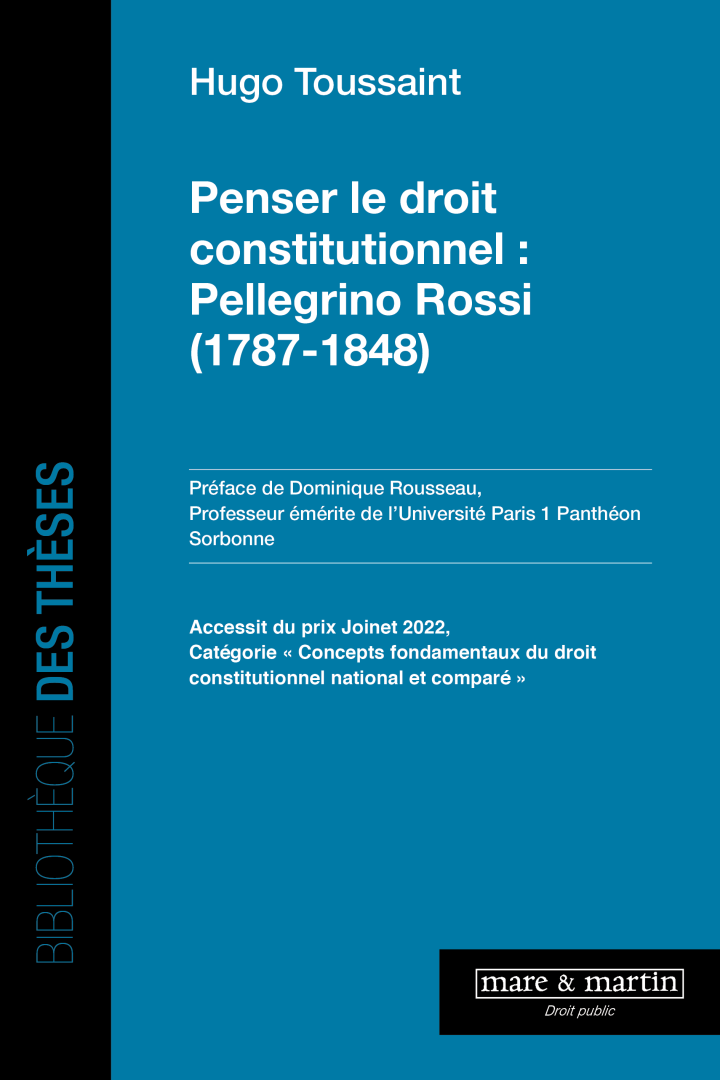
BOOK: Hugo TOUSSAINT, Penser le droit constitutionnel: Pellegrino Rossi (1787-1848) [Droit public - Bibliothèque des Thèses] (Paris: Mare & Martin, 2025), 592 p. ISBN 9782386000980, € 54

(image source: Mare & Martin)


Abstract:

Premier titulaire de la chaire de droit constitutionnel de la Faculté de droit à Paris, Pellegrino Rossi (1787-1848) demeure aujourd’hui encore une figure méconnue. Doyen de la Faculté, pair de France, académicien puis ministre du Pape Pie IX, le constitutionnaliste est une figure incontournable de la doctrine juridique du XIXe siècle. L’ouvrage se propose de mettre au jour les outils épistémologiques avec lesquels Pellegrino Rossi construit sa pensée constitutionnelle et politique. À travers l’étude des notions de personne humaine, de société et d’État, l’ouvrage démontre le ralliement de Rossi à l’éclectisme philosophiquede son temps en soulignant ses diverses inspirations comme l’historicisme et l’organicisme allemands ainsi que l’utilitarisme anglais. L’ouvrage reconstitue également le logique juridique mais également politique de la pensée de Pellegrino Rossi. En ce sens, est mis au jour le but politique de la pensée constitutionnelle de Rossi entièrement tournée vers la promotion de l’unité nationale. Enfin, l’étude se propose d’interroger la figure - communément répandue - d’un Pellegrino Rossi « libéral ». En effet, sa vision inégalitaire de la société politique, sa conception capacitaire du gouvernement représentatif ainsi que sa virulente critique de l’égalité des conditions décrite par Tocqueville dans la Démocratie en Amérique interrogent de plus en plus sa stature de « penseur libéral ».

Read more here

10 March 2025

BOOK: Michael MILO, Julie FRASER, Brianne MCGONIGLE LEYH, E.G.D. VAN DONGEN (eds.), Sol Iustitiae Setting ? The Utrecht Law School and its Relation to Slavery (Den Haag: Boom Juridisch, 2025), 230 p. ISBN 9789462129726 , € 52


(image source: Boom)

Abstract:

Slavery was legal, in conformity with the law in force in the former colonies of the Kingdom of the Netherlands, until abolition on July 1, 1863. Seldom is it shown more clearly that the law as it stands may indeed be unjust and utterly abject. The consequences work their way through, which does not surprise at all. Precisely the academic institution that has law and justice as its domain, the law faculty, should be concerned with this past and with its relationship to the institution of slavery. How did the Utrecht law faculty, its professors, students and alumni relate to slavery? A dozen students and four supervisors researched aspects of this relationship. This book reports on that bewildering past and present.

On the editors and authors:

The editors and authors are associated with the Utrecht University Law School as professors and students. 

Read more here

12 December 2023

CONFERENCE: LECTIO XII Conference 2023 - Innovationes Lovanienses (Leuven: KULeuven, 6-8 DEC 2023)


(image source: KULeuven)

Abstract:

Between 1425 and 1432, Louvain was founded as a rather prototypical medieval studium generale, modeled after similar institutions for higher education in Paris and Cologne, and vested with charters copied from contemporary foundations such as Rostock and Geneva. At this crossroads of Europe, the University of Louvain would soon function as a distinctive nucleus for receiving and transferring ancient and modern ideas and teachings. Until the abolition of the university in 1797, scholars, students, and artists in Louvain innovated and refashioned the results of antique scholarship and schooling, both in teaching and writing, while also engaging in the renewal of the Catholic faith and discipline as a reaction to the Protestant Reformation. In this conference, the Louvain crossroads of ideas, texts, images, and teaching practices will be situated in the European and worldwide 'web of knowledge' by offering transregional as well as global perspectives.

Keynotes:

Susanna Berger University of Southern California - Wouter Druwé KU Leuven - Lidia Lanza University of Lisbon - Jacob Schmutz ​​​​UCLouvain

 Program here, list of abstracts here.

07 December 2023

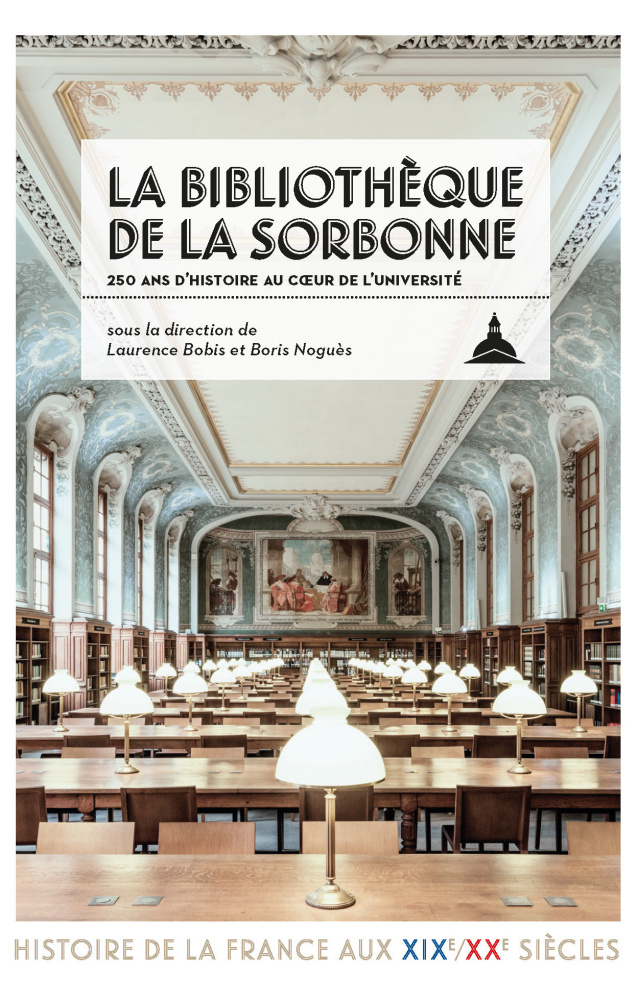
BOOK: Laurence BOBIS & Boris NOGUÈS (dir.), La bibliothèque de la Sorbonne. 250 ans d'histoire au coeur de l'université (Paris: Éditions de la Sorbonne, 2022), 440 p. ISBN 9791035106218, € 25


(image source: Editions de la Sorbonne)

Abstract:

Héritière de la bibliothèque de l'université de Paris ouverte en 1770, la bibliothèque de la Sorbonne est l’une de ces institutions anciennes et bien vivantes où, au fil du temps, se sont superposées des fonctions et des appropriations très diverses. Elle est d’abord, depuis plus de deux siècles, un outil de travail au service des étudiants et des professeurs des universités parisiennes. Mais, avec ses collections anciennes, sa position centrale au XIXe siècle dans l’université française, la monumentalité de sa salle de lecture, ou bien sa place dans la mémoire des cohortes d’étudiants qui l’ont fréquentée, elle est aussi devenue un objet patrimonial. De cette histoire particulièrement riche et complexe, le présent livre entend rendre compte à travers une série d’entrées qui permettront au lecteur de revisiter quelques moments charnières, des projets fondateurs de 1765 à ceux de 2013. La trentaine de contributeurs qui ont participé à l’entreprise se sont également attachés à illustrer la vie des collections, évoquant les richesses conservées, les dons ou le prêt aux lecteurs, le travail des bibliothécaires, certaines figures marquantes, ou encore les relations fluctuantes avec les institutions voisines, partenaires ou rivales. La manière dont l’établissement a été perçu, dans et hors les murs, offre enfin une diversité de points de vue qui met en valeur la vie au long cours et la singularité d’un établissement exceptionnel.

Contributors:

Jacqueline Artier, Jean-Claude Baillat, Marion Bernard-Schweitzer, Laurence Bobis, Arnaud Desvignes, Isabelle Diry-Löns, Sylvie Fayet-Scribe, Lucie Fléjou, Anne-Sophie Gallo, Valérie Grignoux, Anaëlle Guérin, François Haas, Georges Haddad, Claude Jolly, Ismaël Jude-Fercak, Amélia Laurenceau, Éléonore Marantz, Philippe Marcerou, Magali Mattern, Sylvie Meslet-Struyve, Victor Meunier, Laure Murat, Boris Noguès, Cécile Obligi, Géraldine Péoc’h, Vivi Perraky, Marie-Thérèse Petiot, Martine Poulain, Emanuele Romanini, Élodie Rousset, Emmanuelle Sordet, Marie-Brunette Spire-Uran et Pierre Verschueren

 Read more here.