Search

Showing posts with label Slavery. Show all posts

09 September 2026

VACANCY: Research Group Leader "Economies of Strong Asymmetrical Dependencies" (Bonn: Center for Dependency and Slavery Studies, DEADLINE 15 SEP 2026))


(image source: Wikimedia Commons)

Description:

The Bonn Center for Dependency and Slavery Studies (BCDSS) is looking to fill the following position with effect from 1 January 2027, on a fixed-term contract until 31 December 2032: Research Group Leader for the Research Area B: Economies of SAD

"Economies of SAD" - Research Group Leader

The BCDSS, a German Research Council-funded “Cluster of Excellence”, offers excellent opportunities for inter-disciplinary and comparative research of different forms of Strong Asymmetrical Dependencies (SADs) across time periods and world regions. During its first phase (2019–2025), the BCDSS successfully developed the concept of SAD as a comprehensive analytical framework to understand how power imbalances have been shaped in the past, and continue to influence, societies around the world today.

In its second funding phase (2026–2032), the BCDSS will investigate the underlying causes and mechanisms that contribute to the persistence of SADs across historical and contemporary contexts. We aim to anchor Historically Informed Dependency Studies (HIDS) as a key interdisciplinary field in the humanities, encouraging scholars across the humanities and social sciences to systematically integrate the analysis of SADs into the study of social, economic, and cultural phenomena.

Our research focuses on five Research Areas:
- Transitions and Transformations of SADs,
- Economies of SADs,
- Power – Violence – Trauma,
- Cultural Heritage – Transitional Justice – Memory Cultures,
- Alternative Archives and Life Writing.

The successful candidate will lead a Research Group in the BCDSS’ Research Area B “Economies of SAD”, design and conduct independent projects on the history of dependency that closely relate to Research Area B’s re- search goals. Topics can be of a wide variety – from micro studies to wide scale approaches, in any historical period or geographical region. A Research Group at the BCDSS is an independent research unit led by an early- career researcher to pursue an original research agenda while supervising a small team of researchers. The successful candidate will recruit two doctoral researchers for the research group and collaborate closely with colleagues from the BCDSS, in particular the cluster professor for Economic Anthropology. Furthermore, the successful candidate will be part of the interdisciplinary and international research community.

Your responsibilities:
- Developing the research profile of the Research Group on the relationship between coercive exclusion, economic behaviour, and the broader social, cultural, and normative contexts in which they are embedded from a historical perspective,
- Recruiting and supervising two doctoral researchers,
- Providing academic leadership and strategic development of the Research Group,
- Conducting an independent research project leading to a second monograph or equivalent work,
- Developing innovative theoretical and methodological approaches to analyse SAD contextualizing their economic entanglements,
- Organizing and contributing to international workshops, seminars, and conferences,
- Building national and international research networks.

We offer:
- The opportunity to establish and lead an independent Research Group, including the recruitment and supervision of two doctoral researchers,
- Membership in the interdisciplinary and international research environment of the Bonn Center for - Dependency and Slavery Studies (BCDSS),
- An open, collaborative, and innovative research culture that encourages interdisciplinary exchange,
Mentoring by two senior professors and comprehensive opportunities for professional and leadership development,
- Excellent institutional support for independent research, career development, families, and equal opportunities,
- Many options available for university sports,
- Excellent access by public transport thanks to Bonn’s central location as well as the opportunity to take advantage of low-cost parking,
- Flexible working hours and the ability to work from home,
- Remuneration in accordance with TV-L pay grade 14.

Your profile:
- At least three years of postdoctoral experience and an excellent academic track record in one or more of the following fields: History, Archaeology, Law, Theology,
- Publications relevant to the BCDSS research agenda in general and Research Area B in particular,
- Native or near-native proficiency in English,
- A strong interest in advancing research on HIDS from a comparative and interdisciplinary perspective,
- Demonstrated ability to develop innovative research questions and engage with methodological and epistemological challenges
- Experience in collaborative and interdisciplinary research.

Your application needs to include:
- Cover letter stating your motivation to work at the BCDSS (max. 1800 characters including spaces),
- Curriculum Vitae,
- A copy of your PhD certificate,
- An outline of the proposed Research Group (max. 10.000 characters including spaces). Please include information on:
Key research questions and hypotheses,
originality of the proposed project vis-à-vis existing scholarship and key publications in the field (with bibliography),
alignment of the project with the BCDSS’ research goals in general,
relevance of the project to Research Area B in particular and, if applicable, cross-connections to other Research Areas; concise ideas for two PhD projects,
- The name and contact of two referees (position, professional address, and e-mail).

Diversity and equal opportunity
The University of Bonn promotes an open, respectful, and non-discriminatory academic culture and is actively committed to equal opportunity and family friendliness. We aim to eliminate structural disadvantages and to strengthen diversity in research, teaching, and administration. Therefore, we welcome all applications, regardless of ethnic or social background, gender, sexual orientation, religion or belief, disability, or age.

Applications from women and people with a documented severe disability (or equivalent status) will be given preferential consideration in accordance with the State Equality Act (LGG) NRW and Social Code (SGB) IX.

Kontakt

Jeannine Bischoff
dependency@uni-bonn.de

(source: H/Soz/Kult)

28 August 2026

BOOK REVIEW: Rosa CONGOST, From masters of slaves to lords of lands: the transformation of ownership in the western world, by James Q. Whitman [Cambridge: Cambrdige University Press, 2025] (Comparative Legal History, XIV (2026), nr. 1 (June), pp. 131-136)

 (image source: Taylor&Francis)

The book I review here is one that cannot fail to impress any reader interested in the historical evolution of property rights. This will be the case whether you are interested in the legal discourse around the concept of property, or in the real and material interests that may lie behind the discourse. In this review, I will emphasise the aspects of the book I find most interesting, while pointing out some questions that came to mind during my reading. I will highlight not only the most obvious findings, but also the possibilities the book offers for starting a dialogue with historians who, like me, are working on similar topics, albeit from different angles and perspectives. 


This dialogue is facilitated by the author's ability to link the multiple references and quotations he provides from classic works, with which we are all familiar, with research from a wide variety of specialised fields. This is evident from the outset. Hence, Blackstone's statement that starts the introduction: ‘[t]here is nothing which so generally strikes the imagination, and engages the affections of mankind as the right of property, which allows the author to present his book as being about 'legal imagination’; an imagination, he immediately clarifies, that is expressed through the 'idioms of power' (10), a concept taken from Orlando Patterson's book Slavery and Social Death.' James Whitman shares one of the central theses of this book, which is the idea that the modern conception of property has its origins in a slave society. This is an idea that in itself already establishes a dialogue with the modern period, especially in a country such as the United States, which had to wait until the second half of the nineteenth century for the definitive triumph of the 'free-soil doctrines' and the 'disappearance of lawful slavery'. This reference locates us in the contemporary Common Law legal tradition where we are reminded that the success of the 'castle doctrine' and the homestead exemption proves the strong identification of property with land, an idea that is widespread throughout the Western world. To this effect, dialogue between scholars of different legal traditions is guaranteed from the outset because 'the West, as I [the book's author] will speak of it in this book, is the West of the Roman legal tradition' (14). In the last part of this review, I will emphasise the need for this dialogue […] 

To read the full review, please click here. Online access is free for members of the European Society for Comparative Legal History.  

DOI: https://www.tandfonline.com/doi/full/10.1080/2049677X.2026.2671610

18 June 2026

BOOK: Daniel ALLEMANN, Empires of Slavery: Rights and Power in the Early Modern Iberian World [Max Planck Studies in Global Legal History of the Iberian Worlds, ed. Thomas DUVE; 7] (Leiden/Boston: Martinus Nijhoff/Brill, 2026), [OPEN ACCESS]


(image source: Brill)

Abstract:
Enslavement was central to the early modern Iberian empires. No one at the time seriously questioned its legality, yet widespread reports of violent practices of captivity and human trafficking contrasted sharply with the Christian ideal of charity. This volume explores how Spanish and Portuguese theologians, jurists, and missionaries grappled with this moral dilemma. These thinkers developed ideological tools to protect the souls of those who appeared to be in a state of mortal damnation. Slavery prompted Iberian intellectuals to rethink the boundaries between property and person, law and religion, and household and commonwealth. By reconstructing these debates, this volume offers a new narrative about the relationship between individual rights and political power in the early modern Iberian world.

On the author:

Daniel Allemann, Ph.D. (2020), University of Cambridge, is Scientific Collaborator at the University of Geneva. A historian of the late medieval and early modern periods, he studies how intellectual traditions shaped ideas of empire, rights, and religion. He co-edited Conceptions of Space in Intellectual History (2018). 

Read more here: DOI  10.1163/9789004760592.


01 June 2026

CONFERENCE: L’antiesclavagisme : un idéal cosmopolite ? (1730-1830) (Paris: Collège de France, 18-19 JUN 2026)


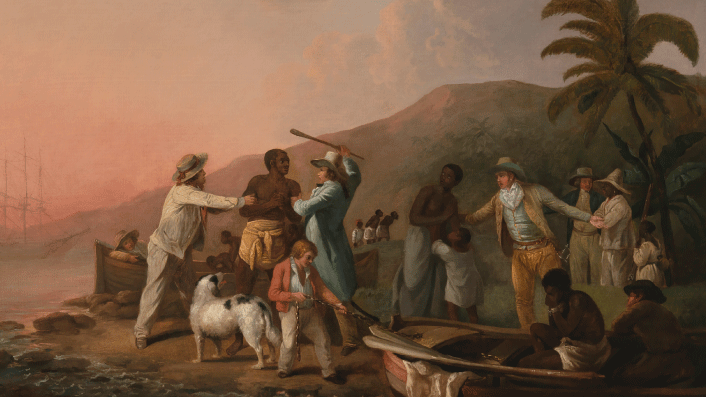
(image source: Georges Morland, Slave Trade (Execrable Human Traffick, or The Affectionate Slaves) c. 1788. Collection of the Smithsonian National Museum of African American History and Culture. Domaine public/Initiative Europe/Sorbonne)


Abstract:

liée à la mondialisation des échanges commerciaux et à l’expansion des empires coloniaux, la diffusion de l’esclavage colonial a contribué à remettre en question la pertinence du cadre national dans les débats politiques. Qu’il s’agisse de la révolution haïtienne ou de l’appel au boycott des produits coloniaux, la plupart des événements et des décisions politiques étaient pensés en fonction de leurs répercussions à l’échelle mondiale. Longtemps centrée sur le cas britannique, l’historiographie s’est progressivement ouverte à la dimension transnationale de la lutte contre l’esclavage colonial. Aujourd’hui, l’antiesclavagisme apparaît comme un mouvement d’ampleur mondiale, qui s’est diffusé non seulement en Europe et aux États-Unis, mais aussi dans les Caraïbes, en Amérique latine et en Afrique. La conscience et la dimension mondiale du combat contre l’esclavage sont-elles liées à la défense d’un idéal cosmopolite ? La question se pose d’autant plus que l’esclavage colonial et la traite, qui atteignent un point culminant à la fin du XVIIIe siècle, incarnent plus que tout autre phénomène les contradictions de l’expansion de l’horizon du monde. En effet, la domination et l’exploitation d’une partie de l’humanité par une autre semblent rendre impossible l’émergence d’une communauté mondiale, morale et politique, enracinée dans l’idée d’une commune humanité, qui est au coeur de l’idéal cosmopolite. Le colloque international, qui se tiendra les jeudi 18 et vendredi 19 juin 2026 (respectivement à la Bibliothèque nationale de France, site Richelieu, et au Collège de France), poursuit trois objectifs principaux. Il s’agira, premièrement, d’évaluer la place et les enjeux de la mobilisation de l’idéal cosmopolite dans les débats sur l’esclavage colonial. Deuxièmement, il conviendra d’analyser les contradictions internes de l’antiesclavagisme, entre la revendication de l’égale dignité de tous les êtres humains et une approche différenciée des processus d’émancipation, fondée sur une vision hiérarchisée du monde. Enfin, nous montrerons comment l’étude de la diversité des mouvements antiesclavagistes à travers le monde permet de défendre une approche plurielle du cosmopolitisme, qui rompt avec son identification exclusive à la tradition philosophique occidentale.


Speakers:

ACKERMANN-KOENIGS Mathilde, Bielefeld University | EHESS | IHA Paris BESSONE Magali, Université Paris I Panthéon Sorbonne CABOT Andy, Université Polytechnique Hauts de France – Valenciennes DARRIULAT Gabriel, Collège de France | Bibliothèque nationale de France FERRADOU Matthieu, Université Paris Nanterre HOQUET Thierry, Université Paris Nanterre PITTS Jennifer, Université de Chicago RENARD Nils, Université Paris I Panthéon Sorbonne ROSSI Benedetta, University College de Londres SPIELER Miranda, The American University of Paris TUCCILLO Alessandro, Université de Turin VIDAL Cécile, EHESS 

See here for further details

15 May 2026

SEMINAR: Cécile VIDAL, "L’argument du suicide dans le débat sur l’abolition de la traite et de l’esclavage en Grande-Bretagne et en France au XVIIIe siècle" (Paris: Sorbonne Université, 15 MAY 2026)


(image source: Sorbonne Université)

Cécile Vidal will intervene in the seminar hosted by the "Pôle Europe des Lumières" at Sorbonne Université on Wednesday 27 May at 17:30.

Title:

L’argument du suicide dans le débat sur l’abolition de la traite et de l’esclavage en Grande-Bretagne et en France au XVIIIe siècle.

More information here.

12 May 2026

BOOK: Bianca PREMO, La Ilustración a juicio. Litigantes y colonialismo en el imperio español [Historia del Derecho en América Latina, 1ª Edición] (México: Tirant lo Blanch, 2026), 514 p., ISBN 9788491198727

(image source: Tirant)

Abstract:
Este libro examina cómo las ideas ilustradas se pusieron a prueba en el mundo cotidiano de la justicia iberoamericana entre las personas esclavizadas e indígenas, y entre las mujeres del siglo XVIII. Se centra en los tribunales civiles, tanto en América como en España, como espacios clave de debate sobre los derechos naturales, la expansión de la esfera secular, el historicismo y la libertad.  El libro enseña cómo leer el archivo judicial para sacar a la luz las ideas de personas no letradas, y redibuja la geografía de la modernidad para replantear el origen de nociones habitualmente atribuidas a Europa del Norte.  Al entablar un diálogo con la historia del derecho, la historia intelectual y la historia social, subraya cómo la práctica legal transformó filosofías abstractas en herramientas prácticas. En conjunto, ofrece una reinterpretación poderosa de la Ilustración como un fenómeno forjado en el derecho colonial.
On the author:
Bianca Premo es Profesora Distinguida Universitaria de Historia en la Florida International University, en Miami, Estados Unidos.
Table of contents:

Introducción ¿Por qué es Ilustración?       

Ilustración sin el siglo XVIII        

Escritura, historia y escritura de la historia del Imperio español       

La república de los iletrados        

Una definición        

Verificable y refutable: Un panorama del libro       

Método comparativo        

Regiones       

Periodo de tiempo        

Casos y litigantes         

PARTE I: LIMONES Y LIMONADA: DEMANDAR EN EL IMPERIO ESPAÑOL

1. Agentes y poderes. Litigantes y escritores en los tribunales        

Poderes: Papel y protocolo        

Agentes: autoría y opciones de los litigantes        

“Dios no paga”        

Conclusión         

2. Derecho y Ley: Ilustración jurídica en la filosofía y las políticas      

El árbol de limones: Ilustración jurídica ecléctica        

Limones: Derecho moderno temprano en el Imperio español        

El árbol: Pensamiento jurídico de la ilustración        

Jurisprudencia colonial        

Bravo de Lagunas y la jurisdicción secular        

Bravo de Lagunas y la esclavitud        

Leyes sobre leyes        

“Desembarazados y libres”: Leyes sobre eficiencia judicial        

Jueces de bronce        

El crecimiento de la jurisdicción secular   

Agentes y poderes revisados        

Conclusión         

3. Números y valores: Conteo de casos en el imperio español        

Números        

Conteo de casos        

Conteo de causas        

Valores        

La cultura orientada a la justicia de los Montes de Toledo        

Umbrales y puertas: Las demandas de los subordinados coloniales 

Conclusión        

PARTE II: LUCES A PARTIR DE LITIGANTES 

4. Pleitos y demandas. Conflictos conyugales en tribunales civiles    

Justicia        

Derechos        

Una breve historia sobre los alimentos     

Secularización e individualidad: Jurisdicción y disputas maritales      

Derechos naturales y otras fuentes de derecho        

Los casos civiles de las mujeres como Ilustración        

Conclusión         

5. Ayer y hoy. Estatus y costumbres indígenas        

Ayer            

Armonía y justicia        

La lengua de la ley: Disputas legales en lengua zapoteca        

Hoy                

El mérito o la nueva ciencia del estatus    

Costumbre hoy        

Casos civiles indígenas como Ilustración   

Conclusión         

6. Ser y devenir: Libertad y demandas de esclavos        

El comienzo de la libertad: Periodización e historiografía        

Fines de las demandas por esclavitud       

Jurisprudencia        

Los esclavos en los tribunales eclesiásticos y civiles        

Del amparo a los papeles        

Autoconservación y sevicia        

La personalidad jurídica de los esclavos   

“La libertad que requieran los juicios”       

La etapa de libertad         

Conclusión: Los litigios de esclavos como Ilustración        

Conclusión. ¿Por qué no Ilustración?

Find more on: Tirant.

04 May 2026

BOOK: Bastiaan D. VAN DER VELDEN, The Legal Framework of Slavery in the Dutch Republic and Its Colonies (London: Routledge, 2026), 622 p. ISBN 9781003706755[OPEN ACCESS]


Abstract:

This open-access monograph addresses in a comparative way one of the central questions in legal history: how did law structure and condition the lives of enslaved people in the Dutch Republic between 1579 and 1794? By exploring Roman-Dutch law and its transregional applications, the study foregrounds the normative framework that sustained systems of unfreedom across metropolitan and colonial settings.

The book investigates the influence of Roman law on slavery in the Dutch Republic and in territories administered by the Dutch West India Company, the Society of Suriname, and the Dutch East India Company. 

Methodologically, the study draws on the Bellagio-Harvard Guidelines on the Legal Parameters of Slavery to construct a systematic analytical framework. These Guidelines serve as an instrument for identifying the legal powers constitutive of slavery and the private-law mechanisms through which they could be exercised and enforced. On this basis, the book develops a structured questionnaire to facilitate an interregional comparison, enabling an in-depth analysis of similarities and divergences across the four jurisdictions under consideration: Curacao, the Netherlands, Suriname, and The Cape.

The project thus constitutes a form of internal, or more precisely interregional, comparative legal history. By tracing how Roman law functioned as both a foundational and adaptable source within distinct local configurations, the study illuminates the dynamic interplay between learned law and local legislation. In doing so, it contributes to broader debates on legal pluralism, imperial governance, and the juridical construction of slavery in the early modern world.

Read the whole book for free here: DOI 10.4324/9781003706755.


13 January 2026

BOOK: Joseph Samuel HARPHAM, The Intellectual Origins of American Slavery. English Ideas in the Early Modern Atlantic World (Cambridge (Mass.): Harvard UP, 2025), ISBN9780674278370


(image source: Harvard UP)

Abstract:

A landmark account of the origins of American slavery, revealing how ancient Roman ideas were used to defend the establishment of a slave empire in the English Atlantic world. The period from 1550 to 1700 was critical in the development of slavery across the English Atlantic world. During this time, English discourse about slavery revolved around one central question: How could free persons be made into slaves? John Samuel Harpham shows that English authors found answers to this question in a tradition of ideas that stretched back to the ancient world, where they were most powerfully expressed in Roman law. These ideas, in turn, became the basis for the earliest defenses of American slavery.

On the author:

John Samuel Harpham is Assistant Professor of Classics and Letters and Wick Cary Professor in the Institute for the American Constitutional Heritage at the University of Oklahoma. 

Read more here


27 November 2025

BOOK: Nicolas BELL-ROMERO, The University of Cambridge in the Age of Atlantic Slavery (Cambridge: CUP, 2025), ISBN 9781009652544, 35 GBP [OPEN ACCESS]


(image source: CUP)

Abstract:

In this powerful history of the University of Cambridge, Nicolas Bell-Romero considers the nature and extent of Britain's connections to enslavement. His research moves beyond traditional approaches which focus on direct and indirect economic ties to enslavement or on the slave trading hubs of Liverpool and Bristol. From the beginnings of North American colonisation to the end of the American Civil War, the story of Cambridge reveals the vast spectrum of interconnections that university students, alumni, fellows, professors, and benefactors had to Britain's Atlantic slave empire - in dining halls, debating chambers, scientific societies or lobby groups. Following the stories of these middling and elite men as they became influential agents around the empire, Bell-Romero uncovers the extent to which the problem of slavery was an inextricable feature of social, economic, cultural, and intellectual life. This title is also available as open access on Cambridge Core.

On the author:

Nicolas Bell-Romero , Tulane University, Louisiana 

Read the book here: DOI 10.1017/9781009652582.

22 May 2025

ADVANCE ARTICLE: Stan PANNIER, "Habsburg in Havana. Outsider Participation in the Spanish Empire: the Slaving Licence of Romberg & Consors of Ghent, 1780–90", Itinerario [OPEN ACCESS]


(image source: itinerario)

Abstract:

The history of European overseas expansion has traditionally been studied from a national perspective. However, the rise of Atlantic history, global history, and a revitalized maritime history has prompted scholars to question the rigidity of Early Modern borders assumed by these conventional national or imperial frameworks. In parallel, researchers have contested the state-centric viewpoint by advocating for an actor-focused approach to Atlantic System history, emphasizing the role of private merchants and their informal, international networks. These approaches have uncovered the involvement of entrepreneurs belonging to polities without a formal empire in the colonial ventures of other nations. This paper examines one such trans-imperial enterprise: Romberg & Consors, a firm operating from the Austrian Netherlands. During and after the American War of Independence (1775–83), Romberg & Consors leveraged evolving Spanish attitudes toward the slave trade and the establishment of neutral trade to organize slave trade expeditions to Cuba. By closely analyzing the operations of this Imperial firm, this study illuminates a decisive phase in Spanish imperial history while contributing to the often-overlooked Atlantic history of the Habsburg Monarchy and the Austrian Netherlands.

DOI 10.1017/S0165115325000026

25 March 2025

BOOK: Lindsay O'NEILL, The Two Princes of Mpfumo. An Early Eighteenth-Century Journey into and out of Slavery [The Early Modern Americas; ed. Peter C. MACALL] (Philadelphia: University of Pennsylvania Press, 2025), 200 p. ISBN 9781512827200, 39,95 USD


(image source: Penn U Press)

Abstract:

A fascinating account of two eighteenth-century princes from East Africa, their travels, and their encounters with the British Empire and slavery In 1716 two princes from Mpfumo—what is today Maputo, the capital of Mozambique—boarded a ship licensed by the East India Company bound for England. Instead, their perfidious captain sold them into slavery in Jamaica. After two years of pleading their case, the princes—known in the historical record as Prince James and Prince John—convinced a lawyer to purchase them, free them, and travel with them to London. The lawyer perished when a hurricane wrecked their ship, but the princes survived and arrived in England in 1720. Even though the East India Company had initially thought that the princes might assist in their aspirations to develop a trade for gold in East Africa and for enslaved labor in Madagascar, its interest waned. The princes would need to look elsewhere to return home. It was at this point that members of the Royal African Company and the Society for Promoting Christian Knowledge took up their cause, in the hope that profit and perhaps Christian souls would follow. John would make it home, but tragically, James would end his own life just before the ship sailed for Africa. In The Two Princes of Mpfumo, Lindsay O’Neill brings to life individuals caught up in the eighteenth-century slave trade. O’Neill also shows how the princes’ experiences reflect the fragmented, chaotic, and often deadly realities of the early British empire. A fascinating and deeply researched historical narrative, The Two Princes of Mpfumo blurs the boundaries between the Atlantic and Indian ocean worlds; reveals the intertwined networks, powerful individuals, and unstable knowledge that guided British attempts at imperial expansion; and illuminates the power of African polities, which decided who lived and who died on their coasts.

On the author:

Lindsay O’Neill is Associate Professor (Teaching) of History at the University of Southern California and author of The Opened Letter: Networking in the Early Modern British World, also available from the University of Pennsylvania Press. 

Read more here

10 March 2025

BOOK: Michael MILO, Julie FRASER, Brianne MCGONIGLE LEYH, E.G.D. VAN DONGEN (eds.), Sol Iustitiae Setting ? The Utrecht Law School and its Relation to Slavery (Den Haag: Boom Juridisch, 2025), 230 p. ISBN 9789462129726 , € 52


(image source: Boom)

Abstract:

Slavery was legal, in conformity with the law in force in the former colonies of the Kingdom of the Netherlands, until abolition on July 1, 1863. Seldom is it shown more clearly that the law as it stands may indeed be unjust and utterly abject. The consequences work their way through, which does not surprise at all. Precisely the academic institution that has law and justice as its domain, the law faculty, should be concerned with this past and with its relationship to the institution of slavery. How did the Utrecht law faculty, its professors, students and alumni relate to slavery? A dozen students and four supervisors researched aspects of this relationship. This book reports on that bewildering past and present.

On the editors and authors:

The editors and authors are associated with the Utrecht University Law School as professors and students. 

Read more here

06 March 2025

BOOK: James Q. WHITMAN, From Masters of Slaves to Lords of Lands. The Transformation of Ownership in the Western World [Studies in Legal History, eds. Lisa FORD, Thomas MCSWEENEY & Reuel SCHILLER] (Cambridge: Cambridge University Press, 2025), ISBN 9781009497534, 35 GBP


(image source: CUP)

Abstract:

Today we think of land as the paradigmatic example of property, while in the past, the paradigmatic example was often a slave. In this seminal work, James Q. Whitman asserts that there is no natural form of ownership. Whitman dives deep into the long Western history of this transformation in the legal imagination – the transformation from the ownership of humans and other living creatures to the ownership of land. This change extended over many centuries, coming to fruition only on the threshold of the modern era. It brought with it profound changes, not only in the way we understand ownership but also in the way we understand the state. Its most dramatic consequence arrived in the nineteenth century, with the final disappearance of the lawful private ownership of humans, which had been taken for granted for thousands of years.

On the author:

James Q. Whitman is a professor at Yale Law School. He is the author of numerous books and articles, including Hitler's American Model (2018), The Verdict of Battle (2012), The Origins of Reasonable Doubt (2008) and Harsh Justice (2003) and the recipient of many awards.

Read the book online: DOI 10.1017/9781009497541.

11 July 2024

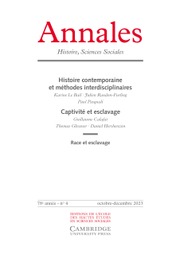
JOURNAL: Annales. Histoire, Sciences Sociales LXXVII (2023), nr. 4 (Dec)


(image source: Cambridge Core)

The journal Annales. Histoire, Sciences Sociales published several issues of interest to legal historians

Articles
Enfermement et graffiti Des palimpsestes de prison aux archives murales (note critique) (Guillaume Calafat)
DOI  10.1017/ahss.2024.4
Abstract:
In the early 2000s, restoration work on the building that housed Palermo’s Inquisition prisons during the early modern period revealed an impressive series of graffiti and prompted their historical study. In Del Santo Uffizio in Sicilia e delle sue carceri, Giovanna Fiume offers a rich synthesis of the individual and collaborative work she has devoted to these “mural archives” of the Palermo court. Bringing together the procedural and material history of incarceration, she succeeds in identifying the possible authors of the inscriptions and drawings that line the cell walls. In so doing, she sheds light on the trajectories of prisoners and their experiences of imprisonment, often passed over in silence by legal sources. These graffiti thus offer a new layer of documentation that broadens our understanding of the Inquisition’s judicial, penal, and carceral systems. More broadly, Fiume’s work is part of a flourishing strand of recent research dedicated to prisons and graffiti, at the confluence of literary studies, anthropology, and art history, which is interested in both the patrimonial and scholarly dimensions of these graphic marks and their aesthetic and ethnographic aspects. In offering a brief overview of the field, this review article aims to suggest some methodological and historiographical avenues for documenting social and intellectual life inside prisons.

« Dans les rues, on ne voit que des musulmans ! » Esclavage délié et appartenance urbaine en Méditerranée espagnole aux XVIIe et XVIIIe siècles (Thomas Glesener & Daniel Hershenzon) 
DOI 10.1017/ahss.2024.3
Abstract:

In 1717, an anonymous petition to the King of Spain expressed concern about the excessive number of Muslims living in Cartagena (Murcia). This complaint prompted the Council of Castile to launch a survey of the Muslim population with the aim of clarifying their status. In addition to galley slaves, the inquiry focused in particular on libertinos, a little-known category of slaves who lived and worked freely in the city but were heavily indebted to their masters because of the sums owed for their ransom. This article reconstructs the condition of these unbound slaves, who lived apart from their masters’ households, and the tensions this provoked between competing systems of norms. On the one hand, the right of slaves to work to finance their own redemption, and that of their masters to live off the rents imposed on them, were deeply rooted in local custom. On the other, rising insecurity along the coast prompted local authorities and the Crown to restrict these overlapping rights by forcing masters to keep their slaves at home. At stake in this conflict between different slavery regimes, the one based on local law and the other on royal jurisdiction, were slaves’ access to the labor market and their right to free residency and the protections afforded by contract law. Finally, by placing the inquiry itself at the heart of the study, the article investigates the meaning of a procedure that was less a demographic enumeration of slaves than a redistribution of rights to the city among its Muslim inhabitants.

 Book reviews

  • Sinclair Bell et Teresa Ramsby (dir.) Free at Last! The Impact of Freed Slaves on the Roman Empire Londres, Bristol Classical Press, 2012, 212 p. (by Marianne Beraud)
    DOI 10.1017/ahss.2024.5
  • Craig Perry et al. (dir.) The Cambridge World History of Slavery, vol. 2, AD 500-AD 1420, Cambridge, Cambridge University Press, 2021, 708 p. (by Jean-Claude Hoquet)
    DOI 10.1017/ahss.2024.6
  • Hannah Barker That Most Precious Merchandise: The Mediterranean Trade in Black Sea Slaves, 1260-1500 Philadelphie, University of Pennsylvania Press, 2019, 328 p. (by Jean-Claude Hoquet)
    DOI 10.1017/ahss.2024.7
  • Meredith Martin et Gillian Weiss Le Roi-Soleil en mer. Art maritime et galériens dans la France de Louis XIV, Paris, Éd. de l’EHESS, trad. par É. Trogrlic, 2022, 403 p. (by M'hamed Oualdi)
    DOI 10.1017/ahss.2024.8
  • Fabienne P. Guillén et Roser Salicrú i Lluch Ser y vivir esclavo. Identidad, aculturación y agency (mundos mediterráneos y atlánticos, siglos XIII-XVIII), Madrid, Casa de Velázquez, 2021, 290 p. (by José Antonio Martínez Torres)
    DOI 10.1017/ahss.2024.9
  • Jean-Frédéric Schaub et Silvia Sebastiani Race et histoire dans les sociétés occidentales, XVe-XVIIIe siècle, Paris, Albin Michel, 2021, 504 p. (by Domitille de Gavriloff)
    DOI 10.1017/ahss.2024.10
  • Daniel Nemser Infrastructures of Race: Concentration and Biopolitics in Colonial Mexico Austin, University of Texas Press, 2017, 221 p. (by Guillaume Gaudin)
    DOI 10.1017/ahss.2024.11
  • Jennifer L. Palmer Intimate Bonds: Family and Slavery in the French Atlantic Philadelphie, University of Pennsylvania Press, 2016, 280 p. (by Olivier Caudron)
    DOI 10.1017/ahss.2024.13
  • Christine Walker Jamaica Ladies: Female Slaveholders and the Creation of Britain’s Atlantic Empire Williamsburg/Chapel Hill, Omohundro Institute of Early American History and Culture/University of North Carolina Press, 2020, 317 p. (by Cécile Vidal)
    DOI 10.1017/ahss.2024.15
  • Manuel Covo Entrepôt of Revolutions: Saint-Domingue, Commercial Sovereignty, and the French-American Alliance New York, Oxford University Press, 2022, XI + 304 p. (by Éric Roulet)
    DOI 10.1017/ahss.2024.16
  • Hebe Mattos Les couleurs du silence. Esclavage et liberté dans le Brésil du XIXe siècle trad. par A. Fléchet, Paris/Aubervilliers, Khartala/CIRESC, [1995] 2019, 359 p. (by Aurélia Michel) DOI 10.1017/ahss.2024.21
  • Tyler Stovall White Freedom: The Racial History of an Idea Princeton, Princeton University Press, 2021, 436 p. (by Jean-Luc Bonniol)
    DOI 10.1017/ahss.2024.22
Read the issue on Cambridge Core.


14 May 2024

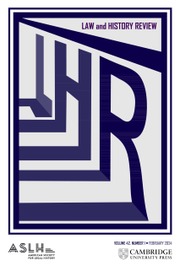
JOURNAL: Special issue African Legal Abolitions, Law and History Review XLII (2024), n. 1 (Feb)


(image source: Cambridge Core)

The Abolition of Slavery in Africa's Legal Histories (Benedetta Rossi) [OPEN ACCESS]
DOI 10.1017/S0738248023000585
Abstract:
This introduction contextualizes the special issue's articles in the broader continental dynamics. It discusses the Eurocentric bias of the historiography and suggests that the view that Europe was responsible for the legal abolition of slavery in Africa should be nuanced and qualified. Some independent African polities abolished slavery before Europe's colonial occupation. Nowhere did European abolitionists encounter a tabula rasa: African polities had complex jurisdictions, oral or written, which formed the normative background against which slavery's abolition should be studied. To do so, however, it is misleading to imagine abolitionism as a unitary movement spreading globally out of Europe. What happened differed from context to context. Normative systems varied, and so did abolition's legal processes. This introduction examines the dynamics that led to the introduction and implementation of anti-slavery laws in African legal systems. It recenters the analysis of the legal abolition of slavery in Africa around particular African actors, concepts, strategies, and procedures.

Ahmad Bey's 1846 Istiftāʾ: Its Dual Legislative Framework and Religio-Political Context (Ismael Musah Montana)
DOI 10.1017/S0738248023000573
On April 26, 1846, Ahmad Bey signed a historic emancipation decree making the Regency of Tunis the first in the modern Islamic world to formally abolish the longstanding institution of slavery. While the decree marked the first of such unprecedented measures, attracting a barrage of compliments from anti-slavery societies around the globe, it conflicted with the local notions of enslaving practices and thus prompted an earnest process of legitimation for the formal abolition of slavery before the Majlis al Shari (Sharia Council for Judicial Ordinance), without which abolition would have remained culturally and politically contentious. The paper will assess the socio-cultural context and the plural Islamic legal framework that informed both Ahmad Bey's argument favoring abolition and the divergent responses and attitudes of the religious establishment toward the abolition decree.

The Sultans of Zanzibar and the Abolition of Slavery in East Africa The Sultans of Zanzibar and the Abolition of Slavery in East Africa (Michelle Liebst) [OPEN ACCESS]
DOI 10.1017/S0738248023000561
Abstract:

In 1890, Sultan Ali of Zanzibar declared in writing that “we wish by every means to stop the slave trade.” Statements like these, in addition to the actual passing of anti-slavery legislation, call into question the generally accepted scholarly understanding that the sultans of Zanzibar only agreed to pass and enforce anti-slavery legislation because they were under duress from European, mainly British, powers, who negotiated favorable political and economic benefits in return for (gradual) abolition. A close analysis of the sources tells a more complicated story of both collaboration and conflict between the Zanzibari sultans, their subjects, and the British agents. Moreover, each sultan had distinctive political and religious beliefs, as well as individual personal experiences and outlooks. This paper explores the anti-slavery legislation passed under three sultans of Zanzibar: Barghash bin Said (1870–1888) who prohibited the transport of slaves by sea in 1873, Ali bin Said (1890–1893) who passed the Slave Trade Prohibition Decree of 1890, and Hamoud bin Mohammed (1896–1902) who passed the Abolition Decree of 1897. By analyzing draft treaties and correspondence before and after the passing of legislation, this paper argues that the sultans and their advisors were not devoid of ideological interest in ending slavery; and that British agents and explorers in the region were too hastily hailed as abolitionists.

Exploring African Abolitionism: Fante Perspectives on Domestic Slavery in the Nineteenth-Century Gold Coast (Michael Ehis Odijie) [OPEN ACCESS]
DOI 10.1017/S0738248023000548
Abstract:

This article draws on a variety of primary sources to first illustrate the rise of African abolitionism in the Fante region in the mid-nineteenth century and then situate local abolitionists in the context of colonial legal abolition in the Gold Coast. When the British abolished slavery in 1874, various Fante groups had been developing local anti-slavery views and strategies closely connected to the evolution of a Fante ethnic identity fashioned against the “barbaric” Asante. Tensions arose between the Fante intelligentsia, which spearheaded local abolitionism, and British colonial elites. The article examines the rise of local abolitionism among the coastal Fante through specific ideas, individuals, and events, and discusses subsequent dynamics in the “first age” (1874–1900) of colonial abolitionism in the Gold Coast. It shows that the 1874 abolition was opposed by members of the Fante anti-slavery movement not—as has been argued—because Fante intellectuals were pro-slavery or opposed to the idea of abolition, but because they held different visions of emancipation and were critical of British abolition laws that, unlike in the West Indies, did not compensate slaveowners.

Exploring African Abolitionism: Fante Perspectives on Domestic Slavery in the Nineteenth-Century Gold Coast (Michael Ehis Odijie)
DOI 10.1017/S0738248023000548
Abstract:

This article draws on a variety of primary sources to first illustrate the rise of African abolitionism in the Fante region in the mid-nineteenth century and then situate local abolitionists in the context of colonial legal abolition in the Gold Coast. When the British abolished slavery in 1874, various Fante groups had been developing local anti-slavery views and strategies closely connected to the evolution of a Fante ethnic identity fashioned against the “barbaric” Asante. Tensions arose between the Fante intelligentsia, which spearheaded local abolitionism, and British colonial elites. The article examines the rise of local abolitionism among the coastal Fante through specific ideas, individuals, and events, and discusses subsequent dynamics in the “first age” (1874–1900) of colonial abolitionism in the Gold Coast. It shows that the 1874 abolition was opposed by members of the Fante anti-slavery movement not—as has been argued—because Fante intellectuals were pro-slavery or opposed to the idea of abolition, but because they held different visions of emancipation and were critical of British abolition laws that, unlike in the West Indies, did not compensate slaveowners.

Abolitionist Decrees in Ethiopia: The Evolution of Anti-Slavery Legal Strategies from Menilek to Haile Selassie, 1889–1942 (Takele Merid & Alexander Meckelburg)
DOI 10.1017/S073824802300055X
Abstract:

Slavery and the slave trade were fundamental institutions in Ethiopian history. Their abolition was a protracted process that involved developing, debating, passing, and applying multiple anti-slavery and anti-slave trade edicts and decrees under successive rulers. While slavery existed in various societies that were later integrated in the Abyssinian empire since the second half of the nineteenth century and took different forms based on different legal traditions, this article focuses specifically on the Christian kingdom and its successor empire. It analyzes changes and continuities in legal approaches to slavery and its suppression through consecutive Ethiopian governments starting with a discussion of slavery's regulation in the ancient Christian law code, the Fetha nagast (“The Law of the Kings”). The article then considers how successive Christian emperors developed anti-slavery policies in response to both local and global dynamics.

In Pursuit of Freedom: Oaths, Slave Agency, and the Abolition of Slavery in Western Tanzania, 1905–1930 (Salvatory S. Nyanto, Felicitas M. Becker) [OPEN ACCESS[
DOI 10.1017/S0738248023000615
Abstract:

This article examines ways in which slaves and missionaries used public declarations before witnesses to carve out a distinctive space of legal proceedings in pursuit of emancipation in western Tanzania. This way of pursuing emancipation shows slaves deploying their intellectual creativity and cultural knowledge to shape the German and British colonial legal systems. Interviews provide evidence that these public declarations drew on long-standing practices of oathing in western Tanzanian societies, while administrative sources indicate that oaths had been used in Islamic legal practice. Both mission and administrative sources show that these public declarations became a fairly routine means to facilitate slave emancipation between about 1907 and the 1920s. They were seen as legitimate by both (ex)owners and (ex)slaves, and were welcomed by officials as they mitigated tensions between owners and slaves, and between slave owners and missions. This legal practice was not codified in either the gradualist German-era laws on slavery or the more proactive abolitionist laws enacted by the British. It was a bottom-up innovation, developed in a context in which effective emancipation depended on drawn-out struggles and negotiations over personal autonomy and malleable social norms.

Read the full issue on Cambridge Core


12 December 2023

BOOK: Jeannine BISCHOFF, Stephan CONERMANN & Marion GYMNICH (eds.), Naming, Defining, Phrasing Strong Asymmetrical Dependencies. A Textual Approach [Dependency & Slavery Studies, eds. Jeannine BISCHOFF & Stephan CONERMANN vol. 8] (Berlin: DeGruyter, 2023), OPEN ACCESS


(image source: DeGruyter)

Abstract:

An examination of the terms used in specific historical contexts to refer to those people in a society who can be categorized as being in a position of ‘strong asymmetrical dependency’ (including slavery) provides insights into the social categories and distinctions that informed asymmetrical social interactions. In a similar vein, an analysis of historical narratives that either justify or challenge dependency is conducive to revealing how dependency may be embedded in (historical) discourses and ways of thinking. The eleven contributions in the volume approach these issues from various disciplinary vantage points, including theology, global history, Ottoman history, literary studies, and legal history. The authors address a wide range of different textual sources and historical contexts – from medieval Scandinavia and the Fatimid Empire to the history of abolition in Martinique and human rights violations in contemporary society. While the authors contribute innovative insights to ongoing discussions within their disciplines, the articles were also written with a view to the endeavor of furthering Dependency Studies as a transdisciplinary approach to the study of human societies past and present.

On the editors:

Jeannine Bischoff, Stephan Conermann and Marion Gymnich, University of Bonn, Germany.

Read the whole volume in open access: DOI 10.1515/9783111210544.