Search

Showing posts with label Property. Show all posts

03 July 2026

JOURNAL: Special Issue Quand la propriété prive. Concentration, conflictualités, alternatives (eds. Maud YAÏCHE, Benjamin CASTELLANI & Charles DELPORTE) (Regards croisés sur l'économie XXXVII (2025), nr. 2)


(image source: CAIRN)

Éditorial. Pourquoi penser et repenser la propriété ? (Maud Yaïche, Benjamin Castelanelli & Charles Delporte)
DOI 10.3917/rce.037.0007

First paragraph:

Entre 1897 et 1903, la politique coloniale dite du « grand cantonnement » opérée en Nouvelle-Calédonie scella une dépossession d’ampleur : les Kanak, populations autochtones de l’île, furent contraint·es de se replier au sein de moins d’un huitième de la Grande Terre [1]. Les terres spoliées furent alors réaffectées aux ancien·nes bagnard·es venu·es de métropole ou d’Algérie, dans le cadre d’un projet colonial visant à implanter une économie capitaliste sur la société traditionnelle. La perte fut double. Matérielle, d’abord, puisqu’elle impliqua la réduction brutale des espaces cultivables au détriment des Kanak. Symbolique et politique, ensuite, car l’imposition d’un régime foncier occidental, fondé sur la propriété privée, remplaça un régime collectif de la terre partagée au sein d’une tribu. Le droit coutumier Kanak s’opposait alors à une conception individualisée, exclusive et hiérarchisée de la propriété diffusée par l’État colonial. Cette histoire de la dépossession des Kanak est à l’origine des inégalités qui structurent encore aujourd’hui le territoire puisque ces dernier·ères représentent près de 40 % de la population [2], mais détiennent moins de 20 % des surfaces agricoles. Cette inégale répartition du foncier se double d’une inégalité de revenus, de patrimoine et d’accès aux ressources, dans un territoire où les Kanak connaissent un taux de pauvreté de 33 %, contre 9 % pour les autres Calédonien·nes [3].

La propriété privée, institution matricielle de nos sociétés capitalistes

L’idéologie propriétaire et sa contestation : une approche historique (Yannick Bosc)
DOI 10.3917/rce.037.0019
Abstract:

The idea of exclusive property, as enshrined in the Civil Code of 1804, was not self-evident: it was the outcome of a long and conflictual process that culminated during the French Revolution. Contrary to a naturalized view of property as an individual and absolute right, this article traces the diversity of property forms in use before the nineteenth century and the debates surrounding their legitimacy, their social function, and their regulation. It shows that the republican principle was, for the popular movement and the Montagnards, incompatible with the unlimited freedom of the property owner, which was deemed an infringement on the right to existence. Through an analysis of several revolutionary controversies, the article highlights how property lay at the heart of a political struggle between collective emancipation and economic domination. Finally, by acknowledging the contemporary resurgence of shared property practices, it invites us to rethink property as a social relation and a common good, rather than a relationship between an individual and a thing.

La propriété privée comme idéologie politique (Éric Fabri)
DOI 10.3917/rce.037.0030
Abstract:

Private property is one of those seemingly self-evident conceptual foundations of Western societies, so deeply embedded that its historical and contingent character is often forgotten. Yet it represents only one of many possible ways of relating to things. If it has come to appear “natural”, it is largely because the propertarian ideology has, since the dawn of modernity, operated to justify its existence. This article examines the specificity of private property and the history of this distinctly modern right, before turning to three of the main argumentative justifications for private property. Such an examination brings to light its fundamentally political dimension and provides the basis for a critical perspective on it.

De la nature au marché : les chemins heurtés de propriété dans la pensée économique (Arnaud Orain, Simon Brigode, Benjamin Castelanelli & Charles Delporte)
DOI 10.3917/rce.037.0040
Abstract:

This interview with Arnaud Orain highlights that, although property and its foundations occupy a central place in social organization, it was only late in the history of mainstream economic thought that it came to be framed within a genuine theoretical framework. In the eighteenth century, two conceptions stood in opposition: one grounded in the idea of absolute natural right (the Physiocrats), and another based on shared customary rights. The nineteenth century sanctified absolute private property without, however, analyzing it as a true economic object. It was only in the twentieth century, with the economic theory of property rights (the Chicago school) and later the Bloomington school (notably represented by Elinor Ostrom), that property became a workable theoretical framework, particularly in relation to ecological challenges and debt crises.

Entreprise, propriété et pouvoir (Jean-Philippe Robé)
DOI  10.3917/rce.037.0059
Abstract:

Private property plays a central role in structuring the firm. It determines who holds power within the firm. When the firm prospers and concentrates significant amounts of property rights, it is the source of corporate power. Finally, the notion of private property leads to significant conflicts over who holds power over the firm and how it should be exercised.

La surenchère des brevets d’invention comme signe du nouveau capitalisme intellectuel (Christian Bessy)
DOI 10.3917/rce.037.0069
Abstract:

Criticism of the intellectual property system has failed to halt the growth in the number of patents, which now apply to objects that were previously considered inappropriate. The text begins by outlining the factors behind this unbelievable extension, focusing on the role played by legal intermediaries in this field. Secondly, it characterizes the emergence of a new intellectual capitalism based on the asymmetry of legal resources. In conclusion, we link the rise of this regime of intangible capital accumulation to new forms of wealth expropriation.

 « C’est à moi ! » : les premières socialisations à la propriété chez les jeunes enfants (Sophie Levrard)
DOI 10.3917/rce.037.0080
Abstract:

This article examines the early forms of socialization to private property among young children, drawing on ethnographic observations in preschool and elementary school settings. By analyzing linguistic and interactional practices surrounding the appropriation of spaces and objects, it highlights the early learning of social norms governed by power relations. This socialization to property, situated at the crossroads of the political and the pedagogical, shapes differentiated perceptions of ownership from childhood onward.

L’utilisation de droits de propriété pour la mise en œuvre de politiques d’atténuation des changements climatiques (Alain Karsenty)
DOI 10.3917/rce.037.0091
Abstract:

Greenhouse gas emission allowances constitute property rights, in the legal sense of the right to undertake certain actions within a regulated framework, insofar as they are emission permits issued in limited quantity by a regulator. They therefore differ from carbon credits originating from projects and intended for the voluntary carbon market, which are primarily communication tools for companies seeking to align themselves with “carbon neutrality,” even though they can also serve as vehicles for speculation, like any other financial asset. Carbon credits only become property rights when a regulator authorizes their use for offsetting emissions within a cap-and-trade system. The question of ownership of carbon credits—particularly in the forestry sector—has become a political issue in several developing countries, which are seeking to obtain a greater share of the revenues from the sale of these assets generated by private projects.

La concentration de la propriété privée: explications et conséquences 

De la « pierre » au « papier » : quand l’immobilier devient un actif financier (Marine Duros)
DOI 10.3917/rce.037.0104
Abstract:

The article analyzes the financialization of real estate, characterized by the transformation of real estate into a "financial asset" managed by specialized companies: real estate investment funds. In France, this process, which began about thirty years ago, is based on a complex institutional framework – a set of regulations, organizational forms, and professional standards. The article demonstrates how this transformation of property ownership has led to real estate development increasingly disconnected from residents’ needs, notably resulting in an overproduction of office space at the expense of housing.

La propriété immobilière, un privilège ? Fiscalité et marché au cœur des inégalités (Rémi Lei)
DOI 10.3917/rce.037.0116
Abstract:

Housing ownership is becoming increasingly concentrated within the French population. While transitioning to homeownership represents the first step in accumulating wealth, accessing homeownership is becoming increasingly difficult. Both housing and rent values have been increasing steadily since 2000, driving up the transition cost and reducing the savings rate of renters. Financial assistance from family has become an important channel for transitioning to homeownership, leading to stability in tenure status between generations. The fiscal system is unable to mitigate this concentration. On the one hand, the property tax is regressive because the tax base was assessed in 1970. On the other hand, the tax scheme for intergenerational transmissions offers opportunities for the wealthiest individuals, who have higher levels of financial literacy and access to advice, to reduce tax burdens. Hence, the current tax system appears inefficient in mitigating the concentration of housing ownership.

Comment la propriété occupante nourrit les inégalités (Fanny Bugeja-Bloch)
DOI  10.3917/rce.037.0125
Abstract:

Access to real estate homeownership is shaped by institutional factors. Owner-occupied housing is reserved for households with stable and sufficient income. As a result, young people, single-earner or inactive households, and single-parent families are effectively excluded from it.

Du rêve de la propriété privée à la précarité résidentielle. Le cas du camping résidentiel en France (Gaspard Lion)
DOI 10.3917/rce.037.0135
Abstract:

This article examines the development of residential camping as a form of homeownership for a segment of the French working classes. While presented as a step up in the housing trajectory and a way to recover some of the attributes of single-family homes, it in fact confines residents to a form of “semi-ownership” that is legally fragile, economically depreciated, and socially stigmatized. Through this lens, the article highlights both the ambivalence of contemporary homeownership and the growing wealth inequalities that structure French society.

Marx et Proudhon : deux penseurs socialistes face à la propriété privée (Antoine Favier & Camille Lemonde)
DOI  10.3917/rce.037.0147
Abstract:

Marx and Proudhon, two socialist authors acknowledged Europe-wide, allocated a large part of their writings to the criticism of private property and of it bourgeoise justification. This article aims to explain the basis of those criticisms and the difference between both thinkers.

Défendre la cause des propriétaires : le cas des expulsions locatives (Camille François, Marius Besnier & Arnaud Niedbalec)
DOI 10.3917/rce.037.0155
Abstract:

In this interview, which expands on ideas developed in his book (François, 2023), Camille François discusses the recent rise in rental evictions in France. He highlights how changes within the state have contributed to this increase. By looking at how and why the actors involved in eviction procedures come to align themselves with the interests of landlords, he shows that the crisis of capital reproduction caused by unpaid rents is ultimately managed by the state through the use of coercion and force.

De la propriété à l’appropriation sociale des animaux : une perspective féministe matérialiste (Joséphine Guichard)
DOI 10.3917/rce.037.0166
Abstract:

This article proposes a materialist feminist analysis of the social appropriation of animals, going beyond their mere classification as legal properties. The appropriation of animals concerns their bodies, conceived as reservoirs of labour, energy and reproduction. The right of ownership over animals thus functions as an extension of the mechanisms of social appropriation of animals, considered to be appropriable “by nature”. The analysis distinguishes between individual and collective forms of appropriation and identifies the various agents involved in this dynamic of appropriation.

Comment les droits de propriété contribuent-ils aux inégalités ? Le pouvoir du codage juridique (Katharina Pistor, Benjamin Castelanelli, Charles Delporte et Maud Yaïche)
DOI 10.3917/rce.037.0196
Abstract:

Katharina Pistor explains how capital is not a natural category but a legal construct, made possible through the “coding” of assets by law. This legal coding is largely endorsed by private actors and often reinforces inequalities, limits accountability, and bypasses democratic processes. The state plays a key role by granting authority and enforcement to private arrangements. Rethinking property rights and their legal foundations is essential to restore democratic legitimacy and social equity.

Penser des alternatives au modèle de propriété privée exclusive

De la gestion efficace et durable des communs (Élise Olivier & Luca Cocco
DOI 10.3917/rce.037.0210
Abstract:

This text examines the different economic conceptualizations of common goods over time. These goods have long been considered uninteresting or even problematic for society, following Garret Hardin’s theory of the "tragedy of the commons". However, more recent empirical and multidisciplinary work shows that another conception can be established, emphasizing that an effective and sustainable management of the commons is possible.

De l’usage coutumier à la reconnaissance juridique : penser la propriété chez les amérindiens Navajos (Marine Bobin)
DOI 10.3917/rce.037.0216
Abstract:

The Navajo do not consider land to be alienable private property, but rather a space for collective use, transmitted and recognised by the community. The article highlights the role of the concept of private property as an instrument of colonial enterprise. It also shows how Navajo jurisprudence subsequently established a coherent set of customary rules based on usage, lineage and community recognition.

L’institution des communs à l’épreuve du système juridique contemporain (Claire Annereau)
DOI 10.3917/rce.037.0226
Abstract:

The law seems inhospitable to the institution of the commons. On the one hand, these practices of community-based resource management run counter to the modern property relation, which shapes our link to goods, and the summa divisio between private law and public law, which structures our legal system. In the search for a legal space conducive to the commons, this article sets out the various paths opened by French legal doctrine for grasping and setting the practices of the commons in law.

Les Scop : une forme alternative de propriété du capital et un rééquilibrage du pouvoir économique ? (Anne Catherine Wagner)
DOI 10.3917/rce.037.0235
Abstract:

French worker cooperatives, or Scop (Sociétés coopératives et participatives), embody an alternative model of ownership grounded in use, collective control, and worker participation. Unlike conventional capitalist firms, ownership is non-speculative, locally anchored, and democratically managed. By subordinating capital to labor, Scop promote equitable profit-sharing and a strong collective ethos.

La propriété sociale, une utopie réalisée ? Penser la protection sociale avec Robert Castel (Arhur Jatteau)
DOI 10.3917/rce.037.0245
Abstract:

Until the 18th century, in a predominantly rural France, community-based solidarities existed, which the Industrial Revolution would shatter. A working class emerged, precarious and exposed to life’s uncertainties. Gradually, workers secured a set of social rights to protect themselves: this is what Robert Castel calls social property. However, since the 1980’s, mass unemployment, precariousness, and neoliberal policies have weakened this system. The realized utopia of social property remains alive, yet constantly under threat.

Des communs pour, des communs contre le capital (Maud Simonet, Charles Delporte & Maud Yaïche)
DOI  10.3917/rce.037.0256
Abstract:

In this interview, Maud Simonet examines the complex relationships between certain “commons” or collective goods and the logics of commodification characteristic of contemporary capitalism. Drawing on the sociology of associative labor, she shows how spaces praised for their inclusivity and lack of financial interest can nonetheless resemble the economic organization of private enterprises and the social relations they involve. Based on extensive fieldwork, whether regarding the lawsuit of Huffington Post bloggers or volunteer engagement during the 2024 Paris Olympic Games, and in dialogue with other studies such as those on the digital economy, she argues that the “commons” should not be considered inherently separate from capitalist organization, but rather as embedded in a relationship of “entanglement” and “hybridization” with it. At the same time, this analysis does not imply a systematic co-optation of the commons by capitalism; it highlights that the commons can also unfold within the framework of collective struggles.

Read the full issue here.  

26 January 2026

JOURNAL: Dieter GOSEWINKEL, Oliver LEPSIUS, Peter OESTMANN (eds.), Eigentum als Herrschaftsressource. Tagung der Vereinigung für Verfassungsgeschichte in den Franckeschen Stiftungen (Halle) vom 22.–24. Februar 2022 [Beihefte zu "Der Staat"; 28] (Berlin: Duncker & Humblot, 2025), 292 p., ISBN 978-3-428-19212-0

Cover: Eigentum als Herrschaftsressource

ABOUT THE JOURNAL:
 
Das Beiheft dokumentiert eine Tagung der Vereinigung für Verfassungsgeschichte. Eigentum als Herrschaftsressource scheint auf den ersten Blick einen zivilrechtlichen und einen öffentlichrechtlichen Aspekt zu verknüpfen. Aber in der Tat stützten sich frühmittelalterliche Könige auf eigene Ländereien und Domänen, um ihre Macht zu finanzieren und damit zu festigen. Später erschien dominium als Inbegriff von Herrschaft und Eigentum zugleich, sehr handfest auch in der Geschichte des Kolonialismus. Erst das 19. Jahrhundert versuchte, Amt und Privatperson wieder zu trennen. Bis in die Zeitgeschichte mit ihren neuen Nationalstaaten, totalitären Regimen, der Daseinsvorsorge und dem geistigen Eigentum erstreckt sich die thematische Spannweite der Beiträge. Die Plenumsdiskussionen sind umfassend dokumentiert und zeigen, wie Rechtshistoriker, Öffentlichrechtler und Archivare über eine Grundfrage der Verfassungsgeschichte epochenübergreifend ins Gespräch kommen. 
 
OVERVIEW OF CONTRIBUTIONS:
 
David Bachrach
Allodium und Eigentum im frühen Mittelalter. Die Basis der königlichen Macht?

Stefan Hammer
Eigentum, Vertrag und politische Herrschaft im Vernunftrecht

Benedikt Stuchtey
Mit John Locke argumentieren. Eigentumsfragen als Herrschaftsressource in der Geschichte des Kolonialismus

Reinhard Mußgnug
Das Eigentum des Monarchen im Wandel der Verfassungen

Dirk van Laak
Experimentierfelder des Gemeinwohls? Infrastrukturen und die Logik des Eigentums

Margrit Seckelmann
Die Internationalisierung »geistiger Eigentumsrechte«

Marju Luts-Sootak und Karin Visnapuu
Eigentum im Nationalstaat und Sozialismus – der Fall Estland als unabhängige Republik 1918−1940 und unter der Sowjetherrschaft

Thorsten Keiser
Eigentum als Herrschaftsressource in totalitären Regimen

Simon Kempny
Die Konstruktion des Eigentumsrechts durch Gesetzgebung
 
Find more here. 

19 September 2025

BOOK REVIEW: Joshua GETZLER, on The making of modern property: reinventing Roman law in Europe and its peripheries 1789–1950 by Anna di Robilant (Comparative Legal History, XIII (2025), nr. 1, June, pp. 138-145)

(Image source: Taylor&Francis)


In this ambitious monograph Anna di Robilant describes how European jurists of the eighteenth and nineteenth centuries drew from the doctrines of Roman classical law and ius commune traditions in order to craft a new ‘Romanist-bourgeois’ form of property. She shows how a succession of gifted scholars steeped in Roman legal tradition produced a concept of property as dominium or absolute command, designed to secure the widest possible control of resources by individual owners. The hallmark of this dominium was the power to assign and dispose of assets as expressions of subjective right grounded in the free will of the autonomous owner. This juridical project of Romanist-bourgeois property joined to an ideological inheritance drawn from idealist philosophy (Kant, Hegel) and political economy (Smith, the Physiocrats), according to which a person’s interests were best expressed by choice of conduct in relation to external things and persons, yielding property and obligations as the basic legal building blocks of society. Each of these streams of liberal thought – the legal, the philosophical, and the economic – emphasized the benign operation and interaction of the wills of autonomous actors who could, within the guidance of a modernised legal order, constitute a cooperative society based on voluntary relations between equals. On di Robilant’s account, Romanist-bourgeois property as individualised dominium was not only projected as a positive contribution to freedom in a well-ordered society; it was also an act of creative destruction, aiming to clear away illiberal obstacles left over from the past. Romanist-bourgeois property would dissolve or displace the older feudal forms of holding that were associated with hierarchy, inequality, domination, and inefficiency, and permit the forces of capital and labour to interact with utmost freedom and rationality. Like modern economic analysts of the law today, Roman-bourgeois theory appealed to a lofty sense of autonomy, allied to a yen for efficiency and prosperity.


To read the full review, please click here. Online access is free for members of the European Society for Comparative Legal History. 

DOI: 10.1080/2049677X.2025.2500208


06 March 2025

BOOK: James Q. WHITMAN, From Masters of Slaves to Lords of Lands. The Transformation of Ownership in the Western World [Studies in Legal History, eds. Lisa FORD, Thomas MCSWEENEY & Reuel SCHILLER] (Cambridge: Cambridge University Press, 2025), ISBN 9781009497534, 35 GBP


(image source: CUP)

Abstract:

Today we think of land as the paradigmatic example of property, while in the past, the paradigmatic example was often a slave. In this seminal work, James Q. Whitman asserts that there is no natural form of ownership. Whitman dives deep into the long Western history of this transformation in the legal imagination – the transformation from the ownership of humans and other living creatures to the ownership of land. This change extended over many centuries, coming to fruition only on the threshold of the modern era. It brought with it profound changes, not only in the way we understand ownership but also in the way we understand the state. Its most dramatic consequence arrived in the nineteenth century, with the final disappearance of the lawful private ownership of humans, which had been taken for granted for thousands of years.

On the author:

James Q. Whitman is a professor at Yale Law School. He is the author of numerous books and articles, including Hitler's American Model (2018), The Verdict of Battle (2012), The Origins of Reasonable Doubt (2008) and Harsh Justice (2003) and the recipient of many awards.

Read the book online: DOI 10.1017/9781009497541.

13 January 2025

BOOK: Felix Andreas KIEFNER, Besitz als relatives Eigentum? - Geschichte und Dogmatik des Besitzschutzes als Relativschutz im common law und im civil law [Studien zum ausländischen und internationalen Privatrecht; 531] (Tübingen: Mohr Siebeck, 2024), 372 p., ISBN 978-3-16-163872-5

 Cover von 'undefined'
ABOUT THE BOOK:
 
In der Tradition des civil law betont man unter Verweis auf den possessorischen Besitzschutz regelmäßig, dass Eigentum und Besitz grundverschieden seien. Nach common law hingegenerwirbt jeder Besitzer zum Zeitpunkt der Besitzerlangung zugleich ein relatives Eigentum, welches gegen alle »schlechter berechtigten« Dritten wirkt und entsprechenden Rechtsschutz vermittelt. Finder, Diebe, Grundstücksbesetzer, Mieter, gescheiterte redliche Erwerber - sie alle sind relative Eigentümer. Doch auch im römischen und römisch-gemeinen Recht existierte für bestimmte Besitzertypen die Vorstellung eines relativen Eigentums, wovon sich in heutigen kontinentaleuropäischen Rechtsordnungen aber nur noch minimale Spuren finden. Wie hat sich die Vorstellung des Besitzes als relatives Eigentum in den Traditionen des common law und des civil law entwickelt? Welche Wertungen und Funktionen lagen und liegen ihr zugrunde? In welchen Fallgruppen des Besitzes kann sie überzeugen? Felix Kiefner untersucht diese Fragen in historisch-vergleichender Perspektive am Beispiel des englischen und des deutschen Rechts.
 
TABLE OF CONTENTS:
 
Einführung
Teil 1: England und die Tradition des
common law
Kapitel 1: Grundlagen
Kapitel 2: Besitzschutz im heutigen englischen Recht
Kapitel 3: Historische Grundlagen des Besitzschutzes im englischen Recht
Kapitel 4: Wertungen des Besitzschutzes im heutigen englischen Recht
Teil 2: Deutschland und die Tradition des civil law
Kapitel 5: Grundlagen
Kapitel 6: Der petitorische Besitzschutz (§ 1007 BGB)
Kapitel 7: Besitzschutz im Übrigen
Teil 3: Essenz und vergleichende Schlussbetrachtung
Kapitel 8: Dogmatische Ergebnisse
Kapitel 9: Modelle zur Erklärung des Relativschutzes
Kapitel 10: Überzeugungskraft des Relativschutzes – Fallgruppen und Wertungen
 
Find more here.

04 November 2024

BOOK: Julian SCHWARZE, Westeigentum in der DDR [Jenaer Schriften zum DDR Recht; 2] (Köln: Böhlau, 2024), 388 p., ISBN 978-3-412-52990-1


ABOUT THE BOOK:

Die Gründung der DDR zerriss nicht nur zahllose Familien, in hunderttausenden Fällen trennte sie auch Grundstücke auf unabsehbare Zeit von ihren Eigentümern. Insbesondere das Vermögen von Republikflüchtlingen, Ausreisenden, BRD-Bürgern und Ausländern befand sich für die Eigentümer durch die deutsche Teilung unerreichbar jenseits des „Eisernen Vorhangs“. In der DDR wurde dieses Westeigentum Gegenstand einer streng geheimen staatlichen Enteignungsmaschinerie. Unbemerkt von der Öffentlichkeit wurden unzählige Vermögenswerte westlicher Eigentümer systematisch erfasst, überschuldet und anschließend in Volkseigentum überführt. Auf der Grundlage umfangreicher Archivbestände schildert Julian Schwarze den Umgang mit dem Westvermögen in der DDR von 1949 bis 1990. Die Darstellung verortet das Westvermögen in einem Spannungsfeld zwischen Ideologie, Politik und Recht. Hierdurch wird deutlich, dass das Westvermögen schon in der DDR längst nicht nur ein juristisches Problem war. Erstmalig liegt damit eine umfassende Untersuchung jener Vermögensschädigungen vor, deren Rückabwicklung unter dem Schlagwort der offenen Vermögensfragen zu den umstrittensten Fragen der Wiedervereinigung zählte.  

ABOUT THE AUTHOR:

Julian Schwarze ist derzeit Rechtsreferendar am Landgericht Heidelberg. Nach seinem Studium der Rechtswissenschaft in Heidelberg, Lille (Frankreich) und Leipzig promovierte er an der Universität Jena im Bereich der DDR-Rechtsgeschichte. 
 
Read more here.

16 May 2024

ARTICLE: Nancy BERTOLDI, "Property and international relations: lessons from Locke on anarchy and sovereignty" (International Theory) [OPEN ACCESS]


(image source: Cambridge Core)

Abstract:

Property has a ubiquitous presence in international practice, but its implications for theorizing world order are not adequately explored. I remedy this by showing how property constitutes the core concepts of anarchy and sovereignty in international relations (IR) as overlapping spaces of right-based governance. I develop my account of a property-based world order in relation to the work of John Locke. Locke is generally overlooked as a core IR thinker, with the unfortunate consequence that anarchy and sovereignty are conceptualized as polar opposites under the enduring shadow of Hobbes. Even prominent critics of Hobbesian anarchy rely on Hobbesian notions of sovereignty, resulting in minimalist conceptions of international society and international ethics. To counter these Hobbesian legacies, I turn to Locke's limited, plural, and fluid accounts of anarchy and sovereignty and show how they are grounded in a normative notion of property that mutually constitutes them. This provides an alternative to the Hobbesian absolutist conceptions of anarchy and sovereignty that many IR theorists still operate with. The result is a distinctly normative vision for IR that condemns the twin evils of conquest and tyranny.

Read the article here: DOI 10.1017/S175297192300012X.

14 December 2022

BOOK: Andrea G. MCDOWELL, We the Miners: Self-Government in the California Gold Rush (Cambridge, MA: Harvard University Press, 2022), 336 pp., ISBN 9780674248113, $39.95


(image source: Harvard University Press)
Book description: 

Gold Rush California was a frontier on steroids: 1,500 miles from the nearest state, it had a constantly fluctuating population and no formal government. A hundred thousand single men came to the new territory from every corner of the nation with the sole aim of striking it rich and then returning home. The circumstances were ripe for chaos, but as Andrea McDowell shows, this new frontier was not nearly as wild as one would presume. Miners turned out to be experts at self-government, bringing about a flowering of American-style democracy—with all its promises and deficiencies.
The Americans in California organized and ran meetings with an efficiency and attention to detail that amazed foreign observers. Hundreds of strangers met to adopt mining codes, decide claim disputes, run large-scale mining projects, and resist the dominance of companies financed by outside capital. Most notably, they held criminal trials on their own authority. But, mirroring the societies back east from which they came, frontiersmen drew the boundaries of their legal regime in racial terms. The ruling majority expelled foreign miners from the diggings and allowed their countrymen to massacre the local Native Americans. And as the new state of California consolidated, miners refused to surrender their self-endowed authority to make rules and execute criminals, presaging the don’t-tread-on-me attitudes of much of the contemporary American west.
In We the Miners, Gold Rush California offers a well-documented test case of democratic self-government, illustrating how frontiersmen used meetings and the rules of parliamentary procedure to take the place of the state.

Table of contents: 
  • Introduction
  • 1. Before Property
  • 2. Powerless Judges and Discharged Soldiers
  • 3. Indian Miners
  • 4. The Mining Codes
  • 5. Resolving Disputes
  • 6. Cooperation and Conflict with Mining Companies
  • 7. Lynch Trials and Frontier Criminal Law
  • 8. Trial by Judge Lynch
  • 9. Whipping, Branding, and Hanging
  • 10. The End of the Hangtown Oak
  • 11. Massacring Indians and Ejecting Spanish Speakers
  • 12. Outside Capital and the End of the Gold Rush
  • Conclusion
  • Notes
  • Acknowledgments
  • Index

About the author: 
Andrea G. McDowell is a historian and Professor of Law at Seton Hall Law School. A Guggenheim Foundation Fellow, she has also taught at the University of Leiden, Johns Hopkins University, and the University of Pennsylvania Law School. Before turning to law, McDowell was an Egyptologist and authored three books on the ancient Egyptian workers who built the tombs in the Valley of the Kings.
More information can be found here. 

18 July 2022

PODCAST: Arnaud-Dominique HOUTE, XIXe siècle : la propriété et le vol (France Culture: Concordance des temps, 9 JUL 2022)


(Image source: France Culture)

Jean-Noël Jeanneney interviewed Arnaud-Dominique Houte on crime, property and theft in 19thC France. 

Abstract:

Chacun se souvient de la formule fameuse de Proudhon : « La propriété, c’est le vol ». Des humoristes ont souvent joué à la parodier : « L’énergie, c’est la paresse », « le courage, c’est l’effroi », « la beauté, c’est la laideur », et ainsi de suite. Mais on aurait bien tort de s’en tenir à cette ironie. Non pas tellement parce que Proudhon lui-même s’est employé à apporter bien des nuances à son propos abrupt que parce que celui-ci rappelle une évidence, à savoir que la propriété et le vol sont liés l’une à l’autre comme l’avers et le revers d’une médaille.  Ce vol que le code pénal, au début du XIXe siècle, définissait, en son article 311, comme « la soustraction frauduleuse de la chose d’autrui » - la chose possédée par autrui. Et c’est bien ce qu’explicitent le titre du beau livre sur lequel nous allons fonder cette émission, La propriété défendue, et son sous-titre, La société française à l’épreuve du vol.
Listen to the podcast here. 

01 July 2019

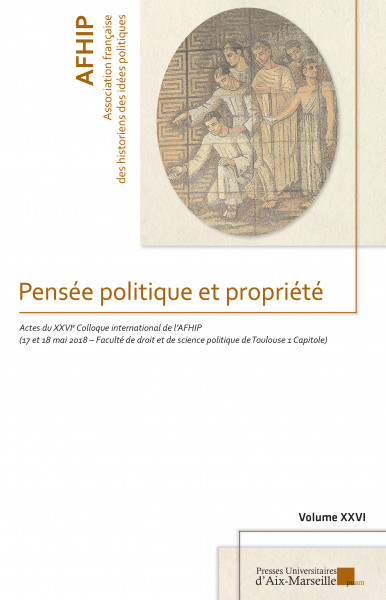
BOOK: Pensée politique et propriété - Actes du Colloque international de l’AFHIP (17 et 18 mai 2018 – Faculté de droit et de science politique de Toulouse 1 Capitole) [Association française des historiens des idées politiques , Vol. XXVI] (Aix-en-Provence/Marseille: PUAM, 2019), 424 p., ISBN 978-2-7314-1136-2, € 36

(image source: univ-droit)


Book abstract:
Dès la pensée grecque, la propriété devient un thème de réflexion jusqu’à devenir la clé d’un projet utopique avec Platon. À l’époque moderne, la propriété demeure un objet de la pensée politique et juridique (les deux n’étant jamais disjoints sur ce sujet) du courant du droit naturel moderne qui débute avec l’École de Salamanque, Les penseurs qui n’appartiennent pas à ce courant, de Hobbes à Rousseau, s’appuient sur un contrat social qui garantit à chaque individu des droits sur les choses, traitent également de façon fondamentale la question de la propriété. Les Lumières, à la suite de Locke, conjuguent propriété et liberté et les physiocrates érigent le citoyen propriétaire en seul titulaire des droits politiques. Quant aux rédacteurs du Code civil, influencés par la philosophie sensualiste, ils font de la propriété « l’âme universelle de la législation ». Depuis la Révolution française et la DDHC, repris par les textes internationaux et la constitution de 1958, la propriété est l’un des « piliers » du droit. Mais sans doute parce que ce concept clé qui a maturé, au long des siècles, désigne une situation fondée en droit, elle n’a pas manqué de susciter la question de sa légitimité. Siècle d’or de la propriété, le XIXe siècle connaît des théories visant soit à son abolition radicale (cf. Proudhon) soit à sa collectivisation chez les penseurs socialistes ou communistes (cf. Cabet, Fourier, Marx et Engels). Quant aux juristes, ils ont toujours cherché à distinguer les choses qui étaient objet de propriété communautaire, gérées par l’État, et les choses susceptibles d’appropriation privée dont l’individu ne peut être privé (hormis par l’expropriation). Somme toute, la propriété, par ses conséquences politiques (et économiques), par son importance sociale, ne peut jamais être ignorée par le pouvoir. Dès lors, il semble opportun de l’envisager dans une perspective d’histoire des idées politiques.
More information with the publisher.

05 July 2018

JOB: Postdoctoral position in real estate science (Lund University, DEADLINE 1 SEP 2018)

(image source: Lund University)

Lund University was founded in 1666 and is repeatedly ranked among the world’s top 100 universities. The University has 40 000 students and 7 400 staff based in Lund, Helsingborg and Malmö. We are united in our efforts to understand, explain and improve our world and the human condition.

LTH forms the Faculty of Engineering at Lund University, with approximately 9 000 students. The research carried out at LTH is of a high international standard and we are continuously developing our teaching methods and adapting our courses to current needs.

The division of Real Estate Science at Lund University invites applicants for a post-doctoral position, 2 years fully funded. Real Estate science is a multi-disciplinary research area and the applicant is expected to hold a Ph. D. in Real Estate Science or related discipline including but not limited to: Economics (with a real estate, urban-, or regional research profile), Economic Geography, Geography, Law (real estate law), Sociology or Urban planning.
The recruitment of a post-doctoral researcher is part of a long-term strategy to build a research platform with a wide focus on land use. Research topics include but are not limited to housing markets, locational choice of firms and households, land regulations, or physical planning for a sustainable society.
Subject
Real Estate Science
Work duties
The main duties involved in a post-doctoral position is to conduct research, independently and/or together with other researchers within the division and/or together with other researchers at other academic institutions and universities. Teaching and advising students may also be included in the position but at a maximum of 20% of the working hours. The position also includes the opportunity for three weeks of training in higher education teaching and learning.
The position allows the successful candidate to conduct research on topics of their own choosing (that is within the subject Real Estate Science). The application should therefore include a research plan stating the applicant’s planned research topics for the position.
Qualification requirements
Appointment to a post-doctoral position requires that the applicant has a PhD, or an international degree deemed equivalent to a PhD, within the subject of the position or any related field described above, completed no more than three years before the last date for applications. Under special circumstances, the doctoral degree can have been completed earlier.
Additional requirements:
  • Very good oral and written proficiency in English.
Assessment criteria and other qualifications
This is a career development position primarily focused on research. The position is intended as an initial step in a career, and the assessment of the applicants will primarily be based on their research qualifications and potential as researchers.
Particular emphasis will be placed on research skills within the subject.
For appointments to a post-doctoral position, the following shall form the assessment criteria:
  • A good ability to develop and conduct high quality research.
  • Teaching skills.
Consideration will also be given to good collaborative skills, drive and independence, and how the applicant’s experience and skills complement and strengthen ongoing research within the department, and how they stand to contribute to its future development.
Terms of employment
This is a full-time, fixed-term employment of a maximum of 2 years. The period of employment is determined in accordance with the agreement “Avtal om tidsbegränsad anställning som postdoktor” (“Agreement on fixed-term employment as a post-doctoral fellow”) between Lund University, SACO-S, OFR/S and SEKO, dated 4 September 2008.
Instructions on how to apply
Applications shall be written in English. Please draw up the application in accordance with LTH’s Academic qualifications portfolio – see link below. Upload the application as PDF-files in the recruitment system. Read more:
http://www.lth.se/index.php?id=71223
In addition to the documents requested by the LTH Academic qualification portfolio the application should include a research plan stating what research the candidate wants to pursue during the duration of the position. The research plan should be no more than 2 pages long.


[a Ph.D. (or LL.D. or equivalent) in the history of real estate law also matches the requirements]

(read further here)

15 December 2016

BOOK: Rafe BLAUFARB, The Great Demarcation. The French Revolution and the Invention of Modern Property. Oxford: Oxford UP, 2016, 304 p. ISBN 9780199778799, £47,99

(image source: OUP)

Professor Rafe Blaufarb (Florida State University) published a new work on the history of property and the French Revolution's impact.

Book abstract:

The Great Demarcation explores how the French Revolution transformed the system of property-holding that had existed in France before 1789, thus creating the framework for modern definitions of property and political forms. This book examines the Revolution not from an economic or social perspective, but through the lens of the laws and institutions of property. The Revolution's dramatic legal restructuring aimed at two fundamental goals: removing formal public power from the sphere of private property, and excising property rights from the realm of the new sovereign, the nation. The revolutionaries accomplished these two aims by abolishing privately-owned forms of public power—such as jurisdictional lordship and venal public office—and by dismantling the Crown domain to construct a purely sovereign State.

These efforts brought about a Great Demarcation: a radical distinction between property and power from which flowed critical distinctions between the political and the social, state and society, sovereignty and ownership, the public and private. These distinctions destroyed the conceptual basis of the Old Regime, laid the foundation of France's new constitutional order, and crystallized modern ways of thinking about polities and societies. This, Blaufarb claims, was the Revolution's fundamental act, the stake in the Old Regime's heart, and the basis of all of its other reforms.

Tracing how the French Revolution sought to remake the country's legal and institutional reality, The Great Demarcation shows how the revolutionary transformation of Old Regime property helped to inaugurate political modernity.
 Table of contents:
Acknowledgments
Note on the Use of French Technical Vocabulary
Introduction
Chapter 1 Talking Property before 1789
Chapter 2 Loyseau's Legacy: The Night of August 4th and the First Abolition of Feudalism
Chapter 3 The Death and Rebirth of the Direct Domain: The Second Feudal Abolition
Chapter 4 The Invention of the National Domain
Chapter 5 Emptying the Domain: The Problem of Engagements
Chapter 6 When the Nation Became a Lord: Feudal Dues as Biens Nationaux
Epilogue
Glossary
Notes
Bibliography
Index
On the author:
Rafe Blaufarb is the Ben Weider Eminent Scholar Chair and Director of the Institute on Napoleon and the French Revolution at Florida State University. He is the author of The French Army, 1750-1820: Careers, Talent, Merit, Bonapartists in the Borderlands: French Refugees and Exiles on the Gulf Coast, 1815-1835, and Inhuman TraffickThe International Struggle against the Transatlantic Slave Trade: A Graphic History, among other titles.
More information with Oxford University Press.

29 March 2015

BOOK: "Advocates for the Oppressed: Hispanos, Indians, Genízaros, and Their Land in New Mexico", by Malcolm Ebright


all information here
Struggles over land and water have determined much of New Mexico’s long history. The outcome of such disputes, especially in colonial times, often depended on which party had a strong advocate to argue a case before a local tribunal or on appeal. This book is partly about the advocates who represented the parties to these disputes, but it is most of all about the Hispanos, Indians, and Genízaros (Hispanicized nomadic Indians) themselves and the land they lived on and fought for. 
Having written about Hispano land grants and Pueblo Indian grants separately, Malcolm Ebright now brings these narratives together for the first time, reconnecting them and resurrecting lost histories. He emphasizes the success that advocates for Indians, Genízaros, and Hispanos have had in achieving justice for marginalized people through the return of lost lands and by reestablishing the right to use those lands for traditional purposes. 

07 January 2015

BOOK: "Property in East Central Europe: Notions, Institutions, and Practices of Landownership in the Twentieth Century", edited by Hannes Siegrist and Dietmar Müller

Property in East Central Europe: Notions, Institutions, and Practices of Landownership in the Twentieth Century, edited by Hannes Siegrist (University of Leipzig) and Dietmar Müller (University of Leipzig)

All information here

Property is a complex phenomenon comprising cultural, social, and legal rules. During the twentieth century, property rights in land suffered massive interference in Central and Eastern Europe. The promise of universal and formally equal rights of land ownership, ensuring predictability of social processes and individual autonomy, was largely not fulfilled. The national appropriation of property in the interwar period and the communist era represent an onerous legacy for the postcommunist (re)construction of a liberal-individualist property regime. However, as the scholars in this collection show, after the demise of communism in Eastern Europe property is again a major factor in shaping individual identity and in providing the political order and culture with a foundational institution. This volume analyzes both historical and contemporary forms of land ownership in Poland, Romania, and Yugoslavia in a multidisciplinary framework including economic history, legal and political studies, and social anthropology.

Table of Contents:

13 November 2014

CONFERENCE & CFP: "Old and New Worlds: The Global Challenges of Rural History,” (Lisbon, 28-30 January 2016)


WHAT: Old and New Worlds: The Global Challenges of Rural History, Conference and Call for Panels 

WHERE:  ISCTE- University Institute of Lisbon, Lisbon, Portugal

WHEN: 28-30 January 2016

all information here


Over the last 500 years, the inter-relations between civilisations and cultures across the globe have had multiple effects on agriculture, property, natural resources and rural societies. They brought about the circulation of people, plants, animals and diseases; transfers of techniques, knowledge, institutions and legal norms; changes in diet habits, land uses and landscapes; extensive appropriation and expropriation of property rights; and changes in produce and factor markets (land, capital, labour) at a global scale.
Research on these topics has been attracting scholars with a variety of backgrounds, from environmental to cultural history, from social to legal history, from economic history to the history of science, among others.
The concern to open up and globalise the research in rural history, both historically and historiographically, draws the guideline for this international conference. It is intended to be a forum where to present new findings and new perspectives on any aspect of those global dynamics, and where to discuss the major theoretical, methodological and historiographical challenges now facing rural history.
This call for panels (open to scholars of all nationalities, disciplinary areas and historical periods) has been extended until 25 November 2014.  See the full CFP and more info on the conference website.  The conference email is lisbon2016rh@gmail.com.

07 November 2014

SEMINAR: The Next Meeting of the Edinburgh Roman Law Group (Edinburgh, 3 December 2014)


WHAT: Property: An Essay in Fan Fiction, meeting of the Edinburgh Roman Law Group

WHERE: MacCormick Seminar Lorimer Room, Old College, Edinburgh

WHEN: 3 December 2014, 5:30 pm

all information here

Speaker

James Lee (Dickson Poon School of Law, KCL)

The speaker has provided the following blurb:
“This paper draws upon Roman and contemporary debates about the scope and applicability of property rights in certain instances to consider the extent to which ‘property’ is used in an instrumental and fictive way. It argues that, properly understood, property rights are not essentially fictional, but that their misapplication is potentially harmful to the coherence of the law.”

26 October 2014

ARTICLE: "Liberalism and Property in Colombia: Property as a Right and Property as a Social Function", by Daniel Bonilla


Liberalism and Property in Colombia: Property as a Right and Property as a Social Function, by Daniel Bonilla, Universidad de los Andes School of Law,  appeared in the Fordham Law Review, 80 (2011): 1135-70.  

 Download the article here

Abstract

Liberalism has determined the structure of the property law regime in Colombia. A genealogical analysis of the legal forms of the recent past that define and regulate property provides evidence of three key periods in the creation and consolidation of the right to property in the country. These three moments revolve around different forms of interpreting and balancing three fundamental values in the liberal canon: autonomy, equality, and solidarity.