Search

Showing posts with label Revolution. Show all posts

03 March 2026

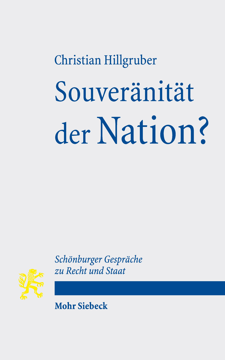
BOOK: Christian HILLGRUBER, Souveränität oder Nation? Die politische und rechtliche Schlüsselfrage der Revolution von 1848/49 oder: Der lange deutsche Weg zur Anerkennung der Volkssouveränität [Schönburger Gespräche zu Recht und Staat] (Tübingen: Mohr Siebeck, 2025), 55 p., ISBN 978-3-16-164892-2

 Cover von 'undefined'

 
ABOUT THE BOOK:
 
Die deutsche Revolution von 1848/49 war verfassungsrechtlich wie politisch vom Ringen um die verfassunggebende Gewalt geprägt. Das von der Frankfurter Nationalversammlung reklamierte Prinzip der Volkssouveränität forderte das überkommene monarchische Prinzip heraus. In der Folge stand dem vom Paulskirchenparlament geltend gemachten Alleinentscheidungsrecht über eine neue gesamtdeutsche Verfassung das von den monarchischen Regierungen der Einzelstaaten verfochtene Mitentscheidungsrecht gegenüber, das auf eine Vereinbarungslösung drängte. In dieser Auseinandersetzung konnte sich der Grundsatz der Volkssouveränität gegen die überlegenen Kräfte der Beharrung noch nicht durchsetzen. Erst die mit der Novemberrevolution 1918 errungene verfassunggebende Gewalt des deutschen Volkes schuf die Basis der Weimarer Reichsverfassung. Sie bildet auch die Legitimationsgrundlage des Grundgesetzes.
 
TABLE OF CONTENT:
 
I. Einleitung
II. Die Spaltung der nationalen Verfassungsbewegung in Liberale und Demokraten
III. Die Spannungen zwischen Demokraten und Liberalen in der Heidelberger Versammlung und die unterschiedliche Haltung gegenüber dem Bundestag
IV. Die Perspektive einer Verständigungslösung
V. Die Debatten im Vorparlament
VI. Der „kühne Griff" nach der politischen Macht im Namen der Volkssouveränität
VII. Der tiefere Grunddissens: Ganze oder geteilte Souveränität?
VIII. Das Ende aller Hoffnungen: Weder Republik noch konstitutionelle Monarchie
IX. Nachspiel: Von Frankfurt über Erfurt nach Berlin/Versailles
X. Weimar: Das Reich, das sind wir.
XI. Bonn: Das Grundgesetz als Ausprägung des Prinzips der Volkssouveränität
 
ABOUT THE AUTHOR:
 
Christian Hillgruber Geboren 1963; Studium der Rechtswissenschaft an der Universität zu Köln; 1988 Erste Juristische Staatsprüfung; 1991 Promotion (Köln); 1997 Habilitation (Köln); Professur an den Universitäten Heidelberg und Erlangen-Nürnberg; Inhaber eines Lehrstuhls für Öffentliches Recht an der Universität Bonn und Direktor des dortigen Instituts für Kirchenrecht.
 
Find more here.  
 

16 July 2025

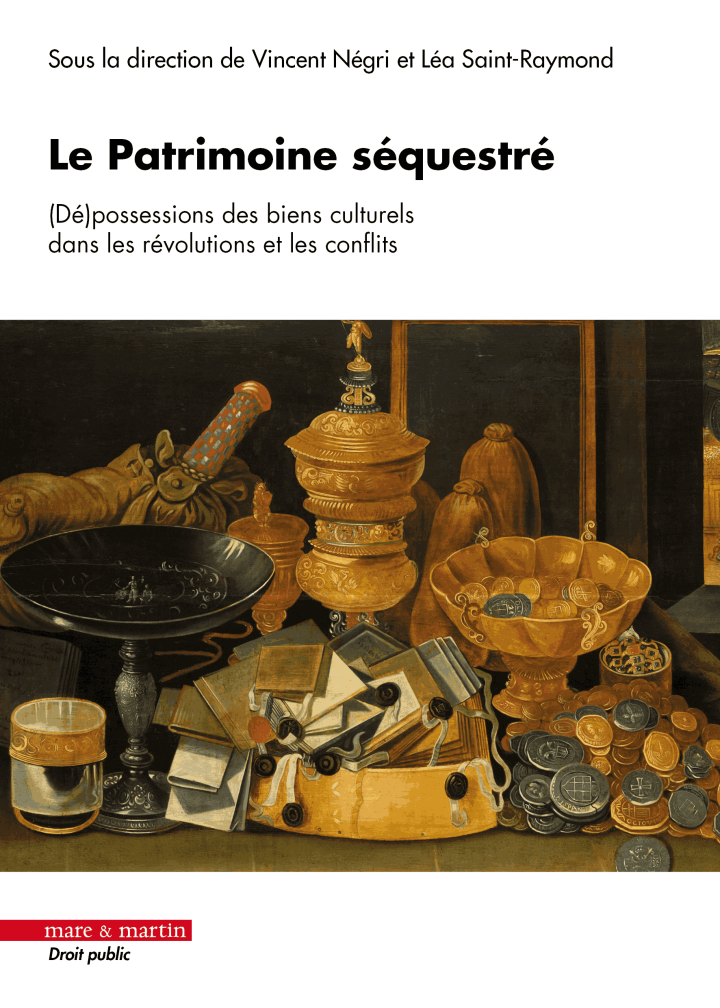
BOOK: Vincent NÉGRI & Léa SAINT-RAYMOND (dir.), Le Patrimoine séquestré. (Dé)possessions des biens culturels dans les révolutions et les conflits [Droit public] (Paris: Mare & Martin, 2025), 300 p. ISBN 978-2-84934-734-8, €26


Abstract:

La guerre en Ukraine a redonné une malheureuse actualité aux séquestres de biens culturels. Encore peu étudiée – contrairement aux « saisies », aux « confiscations » et aux « spoliations » – la notion de « séquestre » mérite d’être interrogée et replacée dans un temps long. Telle est l’ambition de cet ouvrage, mobilisant les apports croisés de l’histoire, de l’histoire de l’art, du droit, des sciences politiques, de l’économie et de la sociologie. Lors des conflits, les séquestres de biens culturels sont motivés par une certaine conception de « l’intérêt général » et relèvent d’intentions et d’opportunités politiques, que cet ouvrage met également en lumière.

 Read more here.

18 March 2021

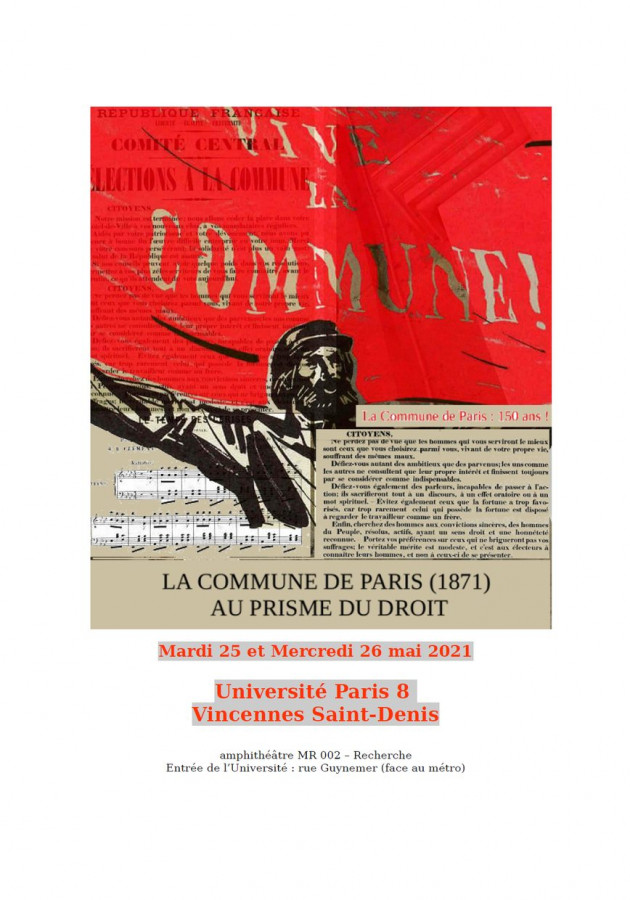
COLLOQUIUM: La commune de Paris (1871) au prisme du droit (Vincennes: Université Paris 8, 25-26 MAY 2021)

(image source: univ-droit)

Programme:

9h30 Allocutions de bienvenue…
Président(e) Université Paris 8
Pierre-Olivier Chaumet, doyen de l'UFR Droit
Alexandre Lunel, co-directeur du Centre de recherches juridiques de Paris 8 (CRJP8)


I. Prémisses politiques et juridiques de la Commune de Paris (1871)

10h - Présidence : Danielle Tartakowsky (présidente univ. Paris 8 2012- 2016)


4 septembre 1870, la proclamation de la République
Maxime Tourbe, PR (droit) Paris 8

Autour du 4 septembre 1870. L'Empire, la République et le Peuple
Benoît Habert, MCF (droit) Paris 8


Du franc-tireur à l’insurgé : étude stasiologique sur différents paradigmes de transgression de la loi
Ninon Grangé, MCF HDR (philosophie) Paris 8


II. Contextes et expériences communalistes (mars- ­mai 1871)


Présidence : Marc Pelletier, co-directeur du Centre de recherches juridiques de Paris 8 (CRJP8)


- Institutions et administrations

La quintessence de l’état d’exception. L’état de siège politique pendant la Commune
François Saint-Bonnet, PR (droit) Paris 2

La province et l’expérience communale
Pierre-Olivier Chaumet, MCF HDR  (droit)  Paris  8


Présidence : François Saint-Bonnet, PR (droit) Paris 2


- Justice et procès

Procès d'hommes et procès de femmes sous la Commune de Paris : l'émancipation des femmes
Catherine Puigelier, PR (droit)  Paris 8

La justice pénale sous la Commune : par le peuple, et pour le peuple
Benjamin Fiorini, MCF  (droit)  Paris  8


14h - Présidence : Pierre-Olivier Chaumet (Doyen de l’UFR droit)


- Culture et musique

Le Conservatoire de Paris pendant la Commune : itinéraires d’une utopie à travers l’oeuvre et la réflexion de Francisco Salvador-Daniel
Jules Cavalié (Conservatoire National Supérieur de Musique et de Danse de Paris)


Les évènements de la butte au 'temps des cerises' par J.-B. Clément
Laurent Delprat, MCF associé (droit)  Paris  8


Mercredi 26 mai 2021


9h30 - Présidence : Francine Demichel, présidente univ. Paris 8 1987- 1991


- Convictions et explications

La Commune dans la pensée de Proudhon. La pensée de Proudhon dans la Commune
Anne-Sophie Chambost, PR (droit) Science-Po Lyon

Une pensée administrative communaliste laïque
Geneviève Koubi, PR (droit), Paris 8


III. Reliquats et reliques de la Commune de Paris de 1871


Présidence : Geneviève Koubi, PR (droit), Paris 8


 - L’ordre  public

Surveillance          et répression des subversifs
Bertrand Warusfel, PR (droit) Paris 8

Les communards en prison
Catherine Delplanque, chargée d’études Paris 10


14h - Présidence : un membre de l'association les « Amies et les Amis de la Commune »


- Les idées politiques

Marx et la lutte des classes en France
Jean Laingui, MCF (droit) Paris 8

La Commune entre anarchisme, néo-jacobinisme et socialisme : divisions et doctrines sur une définition de la République sociale
Hugo Rousselle, ATER (droit) Paris 8


Discussion générale


Synthèse

L'héritage de la Commune en ces débuts du XXIe siècle
Francine Demichel


16h30 - Fin

(source and more information: univ-droit)

29 January 2021

BOOK: Kathryn GREENMAN, Anne ORFORD, Anna SAUNDERS & Ntina TZOUVALA (Eds.), Revolutions in International Law - The Legacies of 1917 (Cambridge: CUP, 2021). ISBN 9781108495035, 95.00 GBP


(Source: CUP)

CUP is publishing a new book on the legacies of the 1917 revolution in international law.

ABOUT THE BOOK

In 1917, the October Revolution and the adoption of the revolutionary Mexican Constitution shook the foundations of the international order in profound, unprecedented and lasting ways. These events posed fundamental challenges to international law, unsettling foundational concepts of property, statehood and non-intervention, and indeed the very nature of law itself. This collection asks what we might learn about international law from analysing how its various sub-fields have remembered, forgotten, imagined, incorporated, rejected or sought to manage the revolutions of 1917. It shows that those revolutions had wide-ranging repercussions for the development of laws relating to the use of force, intervention, human rights, investment, alien protection and state responsibility, and for the global economy subsequently enabled by international law and overseen by international institutions. The varied legacies of 1917 play an ongoing role in shaping political struggle in the form of international law.

ABOUT THE EDITORS

Kathryn GreenmanUniversity of Technology, Sydney
Kathryn Greenman is Lecturer in the Faculty of Law, University of Technology, Sydney.

Anne OrfordUniversity of Melbourne
Anne Orford is Redmond Barry Distinguished Professor and Michael D. Kirby Chair of International Law at Melbourne Law School. Her publications include Reading Humanitarian Intervention (2003), International Authority and the Responsibility to Protect (2011), and Pensée Critique et Pratique du Droit International (2020).

Anna SaundersHarvard Law School, Massachusetts
Anna Saunders is Frank Knox Memorial Fellow at Harvard Law School and a former Teaching Fellow at Melbourne Law School.

Ntina TzouvalaAustralian National University, Canberra
Ntina Tzouvala is a Senior Lecturer at the College of Law, Australian National University. She is the author of Capitalism as Civilisation: A History of International Law (2020).


TABLE OF CONTENTS

1. International law and revolution:

1917 and beyond Kathryn Greenman, Anne Orford, Ntina Tzouvala and Anna Saunders

Part I. Imperialism:

2. Looking eastwards: the Bolshevik theory of imperialism and international law Ntina Tzouvala and Robert Knox

3. Lenin at Nuremberg: anti-imperialism and the juridification of crimes against humanity Amanda Alexander

Part II. Institutions and Orders:

4. Excluding revolutionary states: Mexico, Russia and the League of Nations Alison Duxbury

5. Law, class struggle and nervous breakdowns Mai Taha

6. Microcosm: Soviet constitutional internationality Scott Newton

7. Law and socialist revolution: early Soviet legal theory and practice Owen Taylor

Part III. Intervention:

8. Intervention: sketches from the scenes of the Mexican and Russian Revolutions Dino Kritsiotis

9. Mexican revolutionary constituencies and the Latin American critique of US intervention Juan Pablo Scarfi

10. Mexican post-revolutionary foreign policy and the Spanish Civil War: legal struggles over intervention at the League of Nations Fabia Fernandes Carvalho Veçoso

Part IV. Investment:

11. 1917: property, revolution and rejection in international law Kate Miles

12. 1917 and its implications for the law of expropriation Daria Davitti

13. Contestations over legal authority: the Lena Goldfields Arbitration 1930 Andrea Leiter

14. The Mexican Revolution: alien protection and international economic order Kathryn Greenman

Part V. Rights:

15. 'Animated by the European spirit': European human rights as counterrevolutionary legality Anna Saunders

16. Human Rights, revolution and the 'good society': the Soviet Union and the Universal Declaration of Human Rights Jessica Whyte.


More info here

24 September 2019

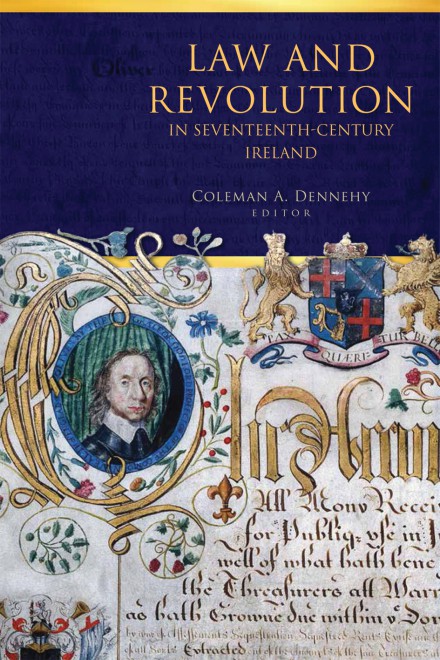
BOOK: Coleman A. DENNEHY, Law and Revolution in Seventeenth-Century Ireland (Dublin: Four Courts Press, 2019). ISBN 978-1-84682-813-3, €49.50


Four Courts Press is publishing a book on law and revolution in 17th century Ireland.

ABOUT THE BOOK

In October 1641, violence erupted in mid-Ulster that spread throughout the whole kingdom and lasted for more than a decade. The war was neither unpredictable nor was it out of step with the rest of the Stuart kingdoms, or indeed Europe generally. As with all wars, particularly the multi-national and multi-denominational, the Irish wars of the 1640s and 1650s had many complex and interrelated causes. Law, the legal system and the legal community played a vital role in the origins and the development of the conflict in Ireland that took it from a dependent kingdom to becoming part of a republican commonwealth. Lawyers also played a fundamental part in the return of the legal and political ‘normality’ in the 1660s. This collection of essays considers how the law was part of this process and to what extent it was shaped by the revolutionary developments of the period. These essays arise from a conference held in 2014 in the House of Lords at the Bank of Ireland, Dublin, under the auspices of the Irish Legal History Society.

Contributors: Andrew Carpenter, Stephen Carroll, John Cunningham, Coleman A. Dennehy, Neil Johnston, Colum Kenny, Neasa Malone, Aran McArdle, Bríd McGrath, Jess Velona, Philip Walsh and Jennifer Wells.

ABOUT THE EDITOR

Coleman A. Dennehy is a Humanities Institute (University College Dublin) research associate and a former IRC Marie Skłodowska-Curie fellow, having taught at University College London and University of Vienna. In addition to many articles and chapters, he published an edited collection, Restoration Ireland (London, 2008) and also a monograph The Irish parliament, 1613–89 (Manchester, forthcoming).

More info here

01 May 2019

RESEARCH GUIDE: The Cahiers de Doléance of the French Revolution (Bibliothèque nationale de France)

(image source: hypotheses.org)

The Bibliothèque nationale de France has opened an online research guide page on hypothèses.org concerning the Cahiers de doléance of the French Revolution. The recent "gilets jaunes"-agitation was countered by President Macron with a national debate, where local government collected citizens sorrows and complaints, referring to the canonical moment of 1789.

First paragraph:
Vous recherchez des cahiers de doléances de 1789 ? Des explications simples sur leur rédaction ? Des analyses plus poussées de leur contenu ? Le blog L’Histoire à la BnF vous livre quelques résultats trouvés en ligne … N’hésitez pas à nous signaler tout oubli, toute piste complémentaire, etc.
More information on histoireBnF.hypotheses.

29 May 2018

JOURNAL: Legal History in French History (June 2018)

(image source: Oxford Journals)

French History (Oxford Journals) published two articles of interest to legal historians in its latest issue:


  • ‘The law must never be a game for fair and upright men in a Republic’: revolutionary justice in Lyon 1792–3' (Julie Patricia Johnson);  https://doi.org/10.1093/fh/cry010
    Abstract: This article examines escalating civil conflict expressed through new judicial processes in Lyon in 1792–3. National legislation in 1791 had promised a significant new focus on judicial rights of the citizen. One of the central changes was the election of a juge de paix (justice of the peace) in each canton to deliver swift justice in smaller civil and criminal cases and an investigative role in more serious prosecutions heard in the higher courts. Initially, both electors and early incumbents of the position embraced these changes enthusiastically but the magistrates of Lyon soon divided over social and political issues. The transition to a more democratic system of justice exposed deep disagreement about how to advance revolutionary change and led to fears and conflict that contributed significantly to a deteriorating political situation and ultimately to the bloody repression of Lyon.
  • 'Creating and resisting the Terror: the Paris Revolutionary Tribunal, March–June 1793' (Alex Fairfax-Cholmeley): https://doi.org/10.1093/fh/cry008
    Abstract: The Paris Revolutionary Tribunal was a key institution of the Terror during the French Revolution, as evidenced by the show trials of Jacques-Pierre Brissot and Georges Danton. However, the early history of this central cog in the machinery of revolutionary justice merits renewed study. This article combines analysis of the National Convention debates that led to the Tribunal’s creation with the court’s subsequent caseload and daily practices during its first two months in operation. I argue that the Convention surrendered the initiative to other actors, allowing them to influence the record of the new court. These included both the institution’s personnel (e.g. Antoine Fouquier-Tinville, the public prosecutor) and the suspects they were investigating as potential counter-revolutionaries. Defence activity was widespread and influential, and this meant that the developing system of revolutionary justice actually encouraged a culture of resistance to repression, even as it contributed to France’s slide into the Terror.
More information with Oxford Journals.

21 November 2017

BOOK: Raphael CAHEN, Friedrich Gentz 1764–1832. Penseur post-Lumières et acteur du nouvel ordre européen [Pariser Historische Studien, vol. 106] (Oldenburg: De Gruyter, 2017), 524 p. ISBN 978-3-11-045534-2. 54,94 EUR

(Image source: De Gruyter)

Book abstract:
This extraordinarily rich study of Friedrich Gentz, an important figure in post-enlightenment European history, amplifies and corrects the conventional image of Gentz as "Europe’s Secretary." Using new sources from the Herterich Gentz Collection in Cologne and from archives throughout Europe, the author describes Friedrich Gentz’s networks around the world along with the diversity and visionary nature of Gentz’s oeuvre and thinking.
Cette étude sur Friedrich Gentz, l’une des personnalités les plus brillantes de l’histoire européenne, reconsidère l’image conventionnelle du »secrétaire de l’Europe«. Basée sur un grand nombre de sources inédites de la collection Herterich à Cologne et d’archives européennes, elle met en lumière les réseaux internationaux de Friedrich Gentz ainsi que les nuances, les contradictions et les continuités de son œuvre et de sa pensée.
On the author:
Dr. Raphael Cahen is a Marie Curie Pegasus Incoming Fellow at the Research Group Contextual Research in Law (CORE) at the Vrije Universiteit Brussel (VUB)
More information with the publisher.

15 December 2016

BOOK: Rafe BLAUFARB, The Great Demarcation. The French Revolution and the Invention of Modern Property. Oxford: Oxford UP, 2016, 304 p. ISBN 9780199778799, £47,99

(image source: OUP)

Professor Rafe Blaufarb (Florida State University) published a new work on the history of property and the French Revolution's impact.

Book abstract:

The Great Demarcation explores how the French Revolution transformed the system of property-holding that had existed in France before 1789, thus creating the framework for modern definitions of property and political forms. This book examines the Revolution not from an economic or social perspective, but through the lens of the laws and institutions of property. The Revolution's dramatic legal restructuring aimed at two fundamental goals: removing formal public power from the sphere of private property, and excising property rights from the realm of the new sovereign, the nation. The revolutionaries accomplished these two aims by abolishing privately-owned forms of public power—such as jurisdictional lordship and venal public office—and by dismantling the Crown domain to construct a purely sovereign State.

These efforts brought about a Great Demarcation: a radical distinction between property and power from which flowed critical distinctions between the political and the social, state and society, sovereignty and ownership, the public and private. These distinctions destroyed the conceptual basis of the Old Regime, laid the foundation of France's new constitutional order, and crystallized modern ways of thinking about polities and societies. This, Blaufarb claims, was the Revolution's fundamental act, the stake in the Old Regime's heart, and the basis of all of its other reforms.

Tracing how the French Revolution sought to remake the country's legal and institutional reality, The Great Demarcation shows how the revolutionary transformation of Old Regime property helped to inaugurate political modernity.
 Table of contents:
Acknowledgments
Note on the Use of French Technical Vocabulary
Introduction
Chapter 1 Talking Property before 1789
Chapter 2 Loyseau's Legacy: The Night of August 4th and the First Abolition of Feudalism
Chapter 3 The Death and Rebirth of the Direct Domain: The Second Feudal Abolition
Chapter 4 The Invention of the National Domain
Chapter 5 Emptying the Domain: The Problem of Engagements
Chapter 6 When the Nation Became a Lord: Feudal Dues as Biens Nationaux
Epilogue
Glossary
Notes
Bibliography
Index
On the author:
Rafe Blaufarb is the Ben Weider Eminent Scholar Chair and Director of the Institute on Napoleon and the French Revolution at Florida State University. He is the author of The French Army, 1750-1820: Careers, Talent, Merit, Bonapartists in the Borderlands: French Refugees and Exiles on the Gulf Coast, 1815-1835, and Inhuman TraffickThe International Struggle against the Transatlantic Slave Trade: A Graphic History, among other titles.
More information with Oxford University Press.

17 May 2016

LECTURE: Herve Leuwers (Lille-III) on his Robespierre (Paris: Fayard, 2014, 472 p. ISBN 9782213671567, € 25)

(image source: Fayard)

Prof. Hervé Leuwers (Lille-III) will give a talk in Brussels on 2 June on Robespierre, un juriste en politique, his biography of the seminal French lawyer and politician of the Revolution.

He will act as the guest of Standen en Landen/Anciens Pays et Assemblées d'États. More information on their website.


RSVP by 26 May 2016 on standenenlanden@gmail.com.

19 March 2014

SEMINAR: "La révolution et l’exception : exception à la règle et exception dans la règle" (Paris, 20 March 2014)


What: Séminaires Norma, séminaire du sous-projet Connaître la Loi sous l’Ancien Régime (CLAR) sur « La révolution et l’exception: exception à la règle et exception dans la règle »

Where: 105, bd. Raspail, Paris (6e), salle 1

When: 20 March 2014, 5:00-7:00 pm

All information here
 

 Speakers: 
Yann-Arzel Durelle-Marc, Maître de Conférences en Histoire du droit, Université de Franche Comté