Search

Showing posts with label art and law. Show all posts

20 February 2026

SEMINAR: Patrick ARABEYRE, "Le droit par l’image : l’exemple d’un manuscrit enluminé bolonais de la fin du XIIIᵉ siècle" [Les trésors de Richelieu] (Paris: BnF Richelieu, 17 MAR 2026)


(image: BnF Richelieu; source: BnF)

Abstract:

Centre majeur de l’enseignement du droit au Moyen Âge, la ville de Bologne se caractérise par la production de manuscrits juridiques. La BnF en possède une collection de premier plan, ce qui a été bien souligné par des travaux récents. Un exemplaire du Digeste Infortiatum glosé par Accurse, auteur de la Magna glossa, constitue un fleuron de ce corpus. Cette intervention soulignera la transposition du langage juridique en langage figuratif dans les manuscrits de droit romain enluminés du XIIIe au XVe siècle dans la cité universitaire.

On the seminar cycle:

La Bibliothèque nationale de France, l’Institut national d’histoire de l’art et l’École nationale des chartes - PSL organisent la 14e édition du cycle « Trésors de Richelieu », où conservateurs, chargés de collections, historiens de l’art, du spectacle, de la musique, de la littérature et spécialistes des textes partagent leurs savoirs avec un plus large public. À chaque conférence, des œuvres d’art, des manuscrits, des costumes ou des partitions musicales sortent exceptionnellement des magasins de la BnF, de l’INHA et de l’ENC, pour être présentés en direct à l’aide d’une caméra, qui en reproduit les plus infimes détails sur le grand écran de l’auditorium Jacqueline Lichtenstein. 

On the speaker:

Archiviste paléographe (prom. 1987), il a été adjoint au directeur des Archives départementales de la Côte-d’Or, puis chargé de recherche au CNRS auprès du Centre Georges-Chevrier de l’Université de Bourgogne. Il est titulaire d’un doctorat en droit et d’une habilitation à diriger des recherches en droit. Il a été élu en 2007 professeur à l'École nationale des chartes. Sa thèse d’École nationale des chartes a porté sur les écrits politiques de l’archevêque de Toulouse Bernard de Rosier (1400-1475), sa thèse de doctorat sur l’œuvre politique du canoniste toulousain Guillaume Benoît (1455-1516) – publiée sous le titre Les idées politiques à Toulouse à la veille de la Réforme en 2003 – et son habilitation sur l’historiographie, les idées politiques et l’enseignement du droit en France aux xive-xvie siècle. Il est rattaché à l’École doctorale conjointe de l’École nationale des chartes - PSL et de l’Université Paris Sorbonne. Il a été directeur du Centre Jean-Mabillon. À partir des Archives personnelles de Gabriel Le Bras (données à l’EHESS et déposées aux Archives Nationales) et des Archives du CNRS, une petite équipe associant l’ENS, l’ENC (Katia Weidenfeld et Patrick Arabeyre) et l’EHESS, se propose d’analyser les documents de ces fonds et d’organiser en 2018 une journée d’études, avec le concours de la Société d'histoire religieuse de la France. Lancement en 2018 du Séminaire "Humanisme juridique" avec l'IHD de Paris II.

On the speaker:

Archiviste paléographe (prom. 2010) et docteur en histoire de l’art, Sabine Maffre est l’auteure d’une thèse portant sur l’iconographie de Caïn et Abel en France au Moyen Âge soutenue à l’Université de Poitiers en 2023 sous la direction de Cécile Voyer. Conservatrice des bibliothèques, elle a été responsable pendant cinq ans de la bibliothèque Carnegie, bibliothèque patrimoniale à Reims. Depuis 2018, elle est chargée de collections pour la période xiiie siècle-xive siècle au service médiéval du département des Manuscrits de la Bibliothèque nationale de France. Sa thèse d’École (2010) porte sur L’iconographie de Caïn et Abel en France du xie siècle au début du xvie siècle.

 On the speaker:

Viviana Persi Chartiste. Thèse La réglementation du marché et le contrôle du commerce à Paris et à Rome, fin XVIIe-début XVIIIe siècle

Practical information:

Galerie Colbert, 2, rue Vivienne, Paris 2e (auditorium Jacqueline Lichtenstein); 18:15-19:30


 (source: PSL-ENC)


09 December 2025

VIDEO: Alain PAPAUX, "Droit et peinture : la cause animale, de l’escargot (del Cossa) à l’hermine (da Vinci)" (Collège de France, 14 NOV 2025)

(Video source: Youtube)

Abstract:

Alain Papaux est invité par l'assemblée du Collège de France sur proposition de la Pr Samantha Besson. La conférence se tiendra dans le cadre d'une convention signée avec l'Université de Lausanne.

10 October 2025

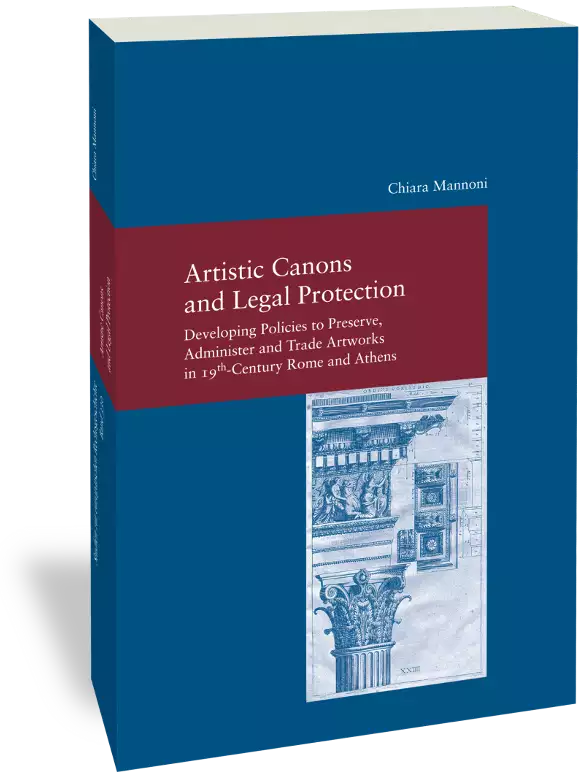
BOOK REVIEW: Mateusz BIECZYŃSKI on Artistic canons and legal protection: developing policies to preserve, administer and trade artworks in 19th-century Rome and Athens by Chiara Mannoni (Comparative Legal History, XIII (2025), nr. 1 (June), pp. 164-169)

(Image source: Taylor&Francis)


Chiara Mannoni’s Artistic Canons and Legal Protection: Developing Policies to Preserve, Administer and Trade Artworks in 19th-Century Rome and Athens offers an exploration of the interplay between law, culture, and art during a transformative historical period. Focusing on two pivotal European cities, Rome and Athens, Mannoni argues that nineteenth-century legal frameworks were not merely reactive to the burgeoning art market but actively shaped the artistic canonsFootnote1 they aimed to safeguard. Her analysis bridges legal and art history, providing a fresh perspective on how laws influenced both the preservation of national heritage and the circulation of art within an evolving international market.

The book consists of an introduction, three chapters, and a conclusion. Each chapter presents a different aspect of the trade in antiquities and the legal restrictions imposed upon it, following a chronological order. The first chapter focuses on protective legislation, with particular emphasis on the significance of the Chirografo Chiaramonti (1802), an Act that introduced early preventive measures to regulate the export of antiquities and established the groundwork for cultural heritage protection in the Papal States, and the Edict Pacca (1834), which expanded these protections by introducing stricter controls on the removal and sale of cultural artifacts, emphasising the public interest in preserving Rome’s historical legacy. Both were designed to safeguard the cultural heritage of Rome. Similarly, the Gesetz of 1834 for Greece marked an important milestone in codifying legal protections for antiquities, aiming to prevent the widespread looting and unauthorised export of Greece’s rich archaeological heritage. Chapter two examines administrative chronicles, detailing the practical application of these legal measures within the Papal States, Athens, and the Greek provinces. Finally, in the third chapter, the author moves on to analyse the practices surrounding the trade of ancient artworks in both territorial contexts, discussing their influence on the shaping of the European art market and aesthetic preferences.


To read the full review, please click here. Online access is free for members of the European Society for Comparative Legal History. For further information about the volume on our blog, please visit here.
DOI: 10.1080/2049677X.2025.2500219

16 July 2025

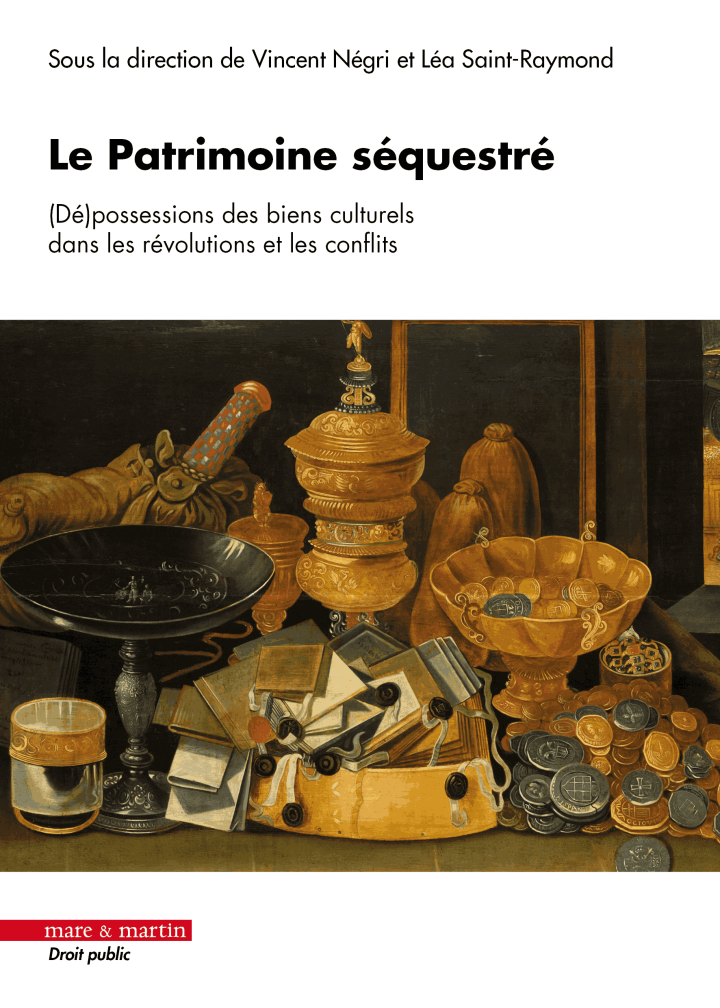
BOOK: Vincent NÉGRI & Léa SAINT-RAYMOND (dir.), Le Patrimoine séquestré. (Dé)possessions des biens culturels dans les révolutions et les conflits [Droit public] (Paris: Mare & Martin, 2025), 300 p. ISBN 978-2-84934-734-8, €26


Abstract:

La guerre en Ukraine a redonné une malheureuse actualité aux séquestres de biens culturels. Encore peu étudiée – contrairement aux « saisies », aux « confiscations » et aux « spoliations » – la notion de « séquestre » mérite d’être interrogée et replacée dans un temps long. Telle est l’ambition de cet ouvrage, mobilisant les apports croisés de l’histoire, de l’histoire de l’art, du droit, des sciences politiques, de l’économie et de la sociologie. Lors des conflits, les séquestres de biens culturels sont motivés par une certaine conception de « l’intérêt général » et relèvent d’intentions et d’opportunités politiques, que cet ouvrage met également en lumière.

 Read more here.

15 January 2024

JOURNAL: LawArt. Rivista di Diritto, Arte, Storia IV (2023) [OPEN ACCESS]

(Image source: Giappichelli editore)


APERTURE/OVERTURES

PERCORSI/ITINERARIES: Entanglements nel diritto dell’arte: beni, patrimonio e circolazione / Entanglements in Art Law: Goods, Heritage, and Circulation 

DIALOGHI/COLLOQUIA

RIFRAZIONI. A PROPOSITO DI LAWART/REFRACTIONS. ABOUT LAWART

CROCEVIA/CROSSOVER


More information can be found here.

25 October 2023

CONFERENCE: I mille volti del processo: bagliori giuridici nello specchio della letteratura e delle arti (Verona: Università degli Studi di Verona, 27 OCT 2023) [ONLINE]


Incontro di studio e di presentazione del volume L’arte di giudicare. Percorsi ed esperienze tra letteratura e diritto, a cura di G. Rossi, D. Velo Dalbrenta, C. Pedrazza Gorlero, Napoli, ESI, 2022


PRESIEDE E MODERA: Paolo Cappellini (Università di Firenze)

INTRODUCE: Giovanni Rossi (Università di Verona) | La vita del diritto nel prisma della letteratura e dell’arte

INTERVENGONO: 

  • Orlando Roselli (Università di Firenze) | L’arte di giudicare e l’inconsapevole giuridico
  • Floriana Colao (Università di Siena) | Il giudice attraverso lo specchio. Riflessioni su “L’arte di giudicare”
  • Francesco Sidoti (Università de L’Aquila) | Rumori e ragioni nel processo


More information and the online registration form can be found here.


19 September 2023

BOOK: Chiara MANNONI, Artistic Canons and Legal Protection. Developing Policies to Preserve, Administer and Trade Artworks in 19th-Century Rome and Athens (Frankfurt am Main: Klostermann, 2023). ISBN 978-3-465-04547-2


ABOUT THE BOOK

The edicts on the antiquities and artworks issued in the Papal States and Greece in the early 19th century constitute the first comprehensive legislation for the protection of heritage in Europe. In this volume, such laws are analysed from a cultural, juridical and art-historical perspective in order to understand how both legal and artistic scholarship affected the guardianship of artefacts, fluctuations in the art market and the establishment of innovative systems for heritage administration in Rome and Athens. The analysis of the origins of these laws, discussed in comparison to earlier edicts (5th–18th century), and of their cultural consequences also sheds light on the development of new definitions of “art”, “artwork” or “monument”, which have become fundamental to contemporary approaches to heritage protection in Europe.


More information can be found here.

11 September 2023

CFP: 'Art in Times of War and Peace: Legacies of Early Modern Loot and Repair' - Bibliotheca Hertziana (Rome, 8-10 May 2024)[DEADLINE 15 DEC 2023]

(Source: BiblHertz)

Art in Times of War and Peace: Legacies of Early Modern Loot and Repair

  • START: May 8, 2024 09:00 AM (Local Time Germany)
  • END: May 10, 2024 06:00 PM
  • SPEAKER: Conference
  • LOCATION: Villino Stroganoff, Via Gregoriana 22, RM 00187 Rome. In person and online
  • CONTACT: john.rattray@biblhertz.it

A category of objects that exists entirely as a function of violence, the term ‘loot’ describes a relationship of possession, if not more specifically of dispossession. Neither an historically nor materially specific typology of artifacts, loot is instead primarily a legal category that cuts across place and time. And while it is also not an art-historical classification, it is one with which the discipline of art history must constantly contend, given its repercussions for what is accessible, where, and in what condition.

This international, interdisciplinary conference will address the ways in which conflict and its resolution have historically moved, modified, and reclassified art objects in the long early modern period.

Our call for papers is currently open. We invite contributions on the material, ethical, legal, political, and narrative implications of the claiming and reclaiming of objects in times of war and peace, as well as the ongoing resonance of these issues today, particularly for institutions that are their present-day repositories. The deadline for submissions is December 15, 2023.

Confirmed Keynote Speakers: Ananda Cohen-Aponte (Cornell University) and Erin Thompson (CUNY).

26 June 2023

CLOSING PLENARY SESSION: Dialogues of Art, History and Law: 'Legal Iconography Issues in Byzantine Art' - 30th June 2023 [online, registration required]

(Source: IEM)

The closing plenary session of the 2nd Cycle of Webinars “Dialogues of Art, History and Law”, dedicated to the theme "Legal Iconography Issues in Byzantine Art", will take place on June 30, at 4:30 pm, via Zoom.
 
The cycle is organized by the Institute of Medieval Studies (IEM- NOVA/FCSH), together with the IUS ILLUMINATUM research team and in partnership with the Portuguese Heraldry Institute (IPH), the Capitular Library of Verona and the Capitular Library of Vercelli. 

This initiative, organized by a scientific and organizational committee composed of members of the IUS ILLUMINATUM research team, coordinated by researcher Maria Alessandra Bilotta, PI of the team, aims to establish a fruitful dialogue between different scientific disciplines, namely History of Art, History and History of Law, necessary for the study of illuminated legal manuscripts and documents.

This initiative also aims to facilitate synergies between different areas of knowledge and to disseminate the results of research to a wider audience, always maintaining scientific rigor, in order to promote the importance of an interdisciplinary approach in the study of manuscripts and medieval legal documents, drawing attention to the importance of conserving that heritage.

To participate (free but compulsory registration): maria.bilotta@fcsh.unl.pt

12 December 2022

JOURNAL: LawArt - Rivista di Diritto, Arte, Storia - Journal of Law, Art and History - 3 (2022) [open access]


EDITORIALE/EDITORIALAPERTURE/OVERTURESPERCORSI/ITINERARIES
Il 'visual turn' negli studi giuridici / Visual Turn in Legal Studies
DIALOGHI/COLLOQUIAFocus – Sebald and the Law
A Discussion around C. Angier, Speak, Silence. In Search of W.G. Sebald, London, Bloomsbury Publishing, 2021
Esperienze / Case StudiesRecensioni / Book ReviewsPDF della rivista

08 November 2022

CONFERENCE: International conference Law and Art in the 19th Century: Power in Images (Verona and ONLINE, 19-21 October 2022)


The conference "Law and Art in the 19th Century: Power in Images" (CfP here) investigates the ways in which, during the nineteenth century, the substantial change in the structural characteristics of the legal phenomenon, and the emergence of an alternative legal experience, corresponded to the replacement - or re-semantization - of the symbols and images traditionally expressed in the law, so that they were more suitable to convey the new concept of the juridical in society.

***

Giovedì 10 novembre DIPARTIMENTO DI SCIENZE GIURIDICHE

Saluti Istituzionali e Introduzione ai lavori

  • 14:30 Giovanni ROSSI (Università di Verona): A proposito di immagini e diritto


La rappresentazione del potere -  Presiede Giovanni ROSSI (Università di Verona)

  • 15.00: Boris BERNABÉ (Université Paris-Saclay): “Napoléon dans son cabinet de travail” (Jacques-Louis David, 1812): le possible Code civil
  • 15.30: Mario RIBERI (Università di Torino): Lo strano caso di un quadro scomparso. “Gli ultimi istanti di Lepeletier” di Jacques-Louis David
  • 16.00: Vincenzo TOSCANO (Università di Milano): Celebrare il potere, celebrare la gloria. Diritto e arte in due opere di Jean Baptiste Mauzaisse

16.30: Discussione e pausa

  • 17.00: Renato Sedano ONOFRI (Humboldt-Universität zu Berlin): The Code civil’s embossment at Napoleon’s sepulcher in the Église des Invalides. The ‘presence’ of law and statute beyond legal hermeneutic
  • 17.30: Pietro SCHIRÒ (Università di Verona): L’immagine di una imperatrice. La rappresentazione di Maria Luigia d’Asburgo: tra diritti e potere

18.00: Discussione


Venerdì 11 novembre SOCIETÀ LETTERARIA DI VERONA 

Rivoluzioni, leggi e arti - Presiede Giacomo PACE GRAVINA (Università di Messina) 

  • 9.00: Cecilia PEDRAZZA GORLERO (Università di Verona): Demoni della Rivoluzione: Maria Antonietta di Francia fra immagine storica e immaginario artistico 
  • 9.30: Sara PARINI (Università di Milano): “Le Gazetier cuirassé, ou anecdotes scandaleuses de la cour de France”. Quadri convincenti di un mondo in evoluzione sul finire dell’Ancien Régime
  • 10.00: Tania Ixchel ATILANO (Humboldt-Universität zu Berlin): The Execution of Emperor Maximilian by Édouard Manet. Intervention, Sovereignty and the Laws of War 

10.30: Discussione e pausa 

  • 11.00: Mattia RUZZARIN (Università di Verona): Storia, identità e indipendenza della Nazione Polacca attraverso i dipinti di Jan Matejko 
  • 11.30: Emőd VERESS (University of Miskolc): “Interrogation”: law, justice, morality in the last decades of the 19th century in Hungary 

12.00: Discussione 


Venerdì 11 novembre DIPARTIMENTO DI SCIENZE GIURIDICHE 

La forza del diritto e la tirannia del potere - Presiede Boris BERNABÉ (Université Paris-Saclay) 

  • 15.00: Giacomo PACE GRAVINA (Università di Messina): Il giurista: percezioni visive 
  • 15.30: Anthony CRESTINI (Université de La Rochelle): La Caricature de Louis XIV en costume de sacre (par William Thackeray): une démythification des pouvoirs traditionnels au XIXe siècle 
  • 16.00: Alessandro LALLI (Università di Ferrara): ‘Ungentlemanly Art’ e potere: le vignette satiriche come strumento di diffusione della cultura antitrust tra Otto e Novecento 

16.30 Discussione e pausa 

  • 17.00: Marco FIORAVANTI (Università di Roma Tor Vergata): “Le nègre blanc”. Diritto, schiavitù e razza in Francia attraverso una litografia inedita di Honoré Daumier 
  • 17.30: Olufunmilayo B. AREWA (Temple University, Philadelphia): Law, (Il)legality, and Justice: Colonial Hangover and Art 
  • 18.00: Magalie FLORES-LONJOU (Université de La Rochelle) - Nicolas THIRION (Université de Liège): “L’affaire Dreyfus” de Georges Méliès (1899): une dénonciation en images tous azimuts 

18.30: Discussione


Sabato 12 novembre DIPARTIMENTO DI SCIENZE GIURIDICHE 

Forme tangibili del diritto - Presiede Cecilia PEDRAZZA GORLERO (Università di Verona)

  • 9.00: Zoltán József FAZAKAS (Károli Gáspár Reformed University): The laying of the foundation stone of the Chain Bridge and the foundation of modern Hungarian civil law 
  • 9.30: Martin SUNNQVIST (Lunds Universitet): The Eye of the Law and the Scales of Justice: Law and Art in the Scania and Blekinge Court of Appeal 1821-1917 
  • 10.00: Faustino MARTÍNEZ MARTÍNEZ (Universidad Complutense de Madrid): La decoración del tribunal supremo en el siglo XX. ¿Algo más que imágenes? 

10.30: Discussione e pausa 

  • 11.00: Ulrike MÜßIG (Universität Passau): The Iconography of the Royal Constitutional Oath. Communicating the Decisive Moment of Monarchical Sovereignty 
  • 11.30: Claire WROBEL (Université Paris-Panthéon-Assas): The arts of indirect legislation: symbolism, allegory and theatricality in the writings of Jeremy Bentham (1748-1832) 

12.00: Discussione e chiusura dei lavori


More information can be found here.

13 June 2022

CfP REMINDER: International conference Law and Art in the 19th Century: Power in Images (Verona, 19-21 October 2022), DEADLINE: 30 JUNE 2022

(Image source: Wikipedia)


The Coronation of Napoleon by Jacques-Louis David; the courthouse of the Court of Cassation in Rome; the statues of Justice or Liberty; the caricatures by the painter Honoré Daumier: these are just a few examples of the artistic representation of law, power, justice and rights in the 19th century. Sometimes faithful reproductions of the legal values produced at the time, sometimes exaltation, transfiguration or denunciation of certain aspects of the legal system. 

Art, like law, is a human factor that is sometimes able to assert itself from below, from the society that produces it; at other times it comes from above, in tune with the designs of those who hold political power and who use art to put forward a certain image of power, as well as to disseminate a precise idea of the juridical.

The importance of artistic images and, more specifically, of the iconographic representation of key themes and concepts of law in their various legal contexts, requires no lengthy demonstration. The evocative capacity and symbolic potential released by images has often been used in Western history to effectively  express, and at the same time to reinforce, key ideas from the legal world through the strength and immediacy of an iconic message, so as to obtain the broadest possible understanding and adherence in the community of reference for the model of legal organisation in force at any given moment.

The research team set up to further study the project Images, Law and Power in the Modern Age, within the framework of the Excellence Project of the Department of Legal Sciences of the University of Verona (2018-2022), is organising a conference on the theme of the artistic representation of law in the 19th century, from the French Revolution to the early twentieth century.

The purpose is to investigate the ways in which, during the nineteenth century, the substantial change in the structural characteristics of the legal phenomenon, and the emergence of an alternative legal experience, corresponded to the replacement - or re-semantization - of the symbols and images traditionally expressed in the law, so that they were more suitable to convey the new concept of the juridical in society.

By studying the painting, sculpture and architecture of a particular epoch, it is possible to understand and delve into the legal reality, observing law in its complexity, as well as its ability to reside within society and give it order and structure. In this sense, the nineteenth century is a complex century, which begins with the French Revolution and the great break with the social and legal order of the Ancien Régime, and with the simultaneous establishment of a new socio-political order, marked by the affirmation of bourgeois society. The century ends with the emergence of a plural and complex society, marked by the advent of positivism, Darwinism and an unprecedented technological and industrial order.

The cultural, political and economic changes are intertwined - in a play of reciprocal influences - with the legal and institutional ones, and are also expressed in an extensive and coherent iconographic system, either new or repurposed, which not only serves to describe the new order but also aims to make it empathetically present to the minds and hearts of those who confront it.

These were sometimes the result of a specific cultural policy expressed on an iconographic level with reference to the world of law, and sometimes the result of a series of progressive ‘adjustments’ of the iconic baggage of the past to the new situation of modernity. Art follows the movement of history and the needs of society. Taking up the simple forms of the past in neoclassicism, it at the same time felt the urgency to describe the new, perceiving a cultural and social restlessness capable of evolving rapidly at the turn of the century. Architecture, with its harmonious neoclassical geometric forms, clashed with the utilitarian architecture desired by governments and required by the prevailing era of industrialisation. Painting initially followed revolutionary suggestions, then adapted to the magniloquent exaltation of Napoleon's exploits and the monarchies during the Restoration period, before becoming a denunciation of social injustice in satirical caricatures in tandem with the rise of Impressionism and Realism. Partially different movements followed in sculpture, which asserted itself in the 19th century as a monumental representation of political power in statues of monarchs and emperors, but also as an exaltation of the rights of freedom to be made present and visible in the urban spaces of the new cities.

The subjects connected with the theme of the conference are therefore multiple and concern the connection of the varied artistic world with law and thus with political power, justice, legislative power and the fundamental rights of the individual. It is also possible to question the influence of the legal phenomenon on art, exploring the relations between artists and jurists, as well as painters and rulers; or again, to analyse artistic works that oppose a given legal and political system, denouncing the abuses of power or the injustice of laws. 

From this point of view, the historical reconstruction of this evolution is essential to grasp its deep implications as well as to highlight caesuras and continuities with respect to previous legal experience. The contributions of the history of art, architecture, and culture in general can lead to a deeper and more conscious reading of the legal phenomenon, one which takes into account its irreducible specificity but also its vital connection with contemporary cultural and artistic manifestations.

The conference, therefore, aims to analyse the theme of the artistic representation of law in the 19th century via a multidisciplinary and comparative approach, stimulating discussion and dialogue among the participants, so as to ensure the historical profundity and depth of interpretation of an topic pervasive but underestimated, that of the translation into images of the values and 'myths' of law and power. It will thus be possible, starting from the notion of the changes experienced by society and, therefore also by its law in the 19th century, to lay bare first of all the operation of the ideological configuration of the rule of law and bourgeois society, which certainly benefit significantly from recourse to images capable of constructing a shared ideal and which is also disseminated through artistic images.

The conference organisers invite all interested scholars to participate in the call by sending the title and abstract (minimum 300 words - maximum 500 words) of the proposed paper and also indicating name, surname and university of affiliation, together with a curriculum vitae (of no more than four pages).

In addition, the organisers are also accepting proposals for panels, consisting of three speakers and a chair and possibly a discussant; in this case, a title and an abstract of the panel (minimum 300 and maximum 500 words) are required in addition to the abstracts of the individual papers and the curriculum vitae of each speaker, chair and discussant.


The conference will be held in Italian, French and English, so proposals can be submitted in any of these languages. Applications must be sent by 30 June 2022 to: immagini.diritto@ateneo.univr.it


Proposals will be accepted by 31 July 2022.

The conference will take place in Verona in October 2022, potentially in person, although we are also considering online transmission of the event (candidates who know already that they will not be able to travel to Italy are requested to indicate this, and to specify the time zone of their country).

The organisers will bear the cost of accommodation and meals for the conference participants.

The conference papers will be published following successful peer review. A prerequisite for participation in the conference is the delivery of the text ready for publication (maximum limit: 60,000 characters including spaces and notes) on the date of the conference, in one of the languages used for the work.


  • For any further communication or information: immagini.diritto@ateneo.univr.it
  • The Chairman of the Scientific Committee: Prof. Giovanni Rossi: giovanni.rossi@univr.it;
  • The person in charge of the organisation: Dr Pietro Schirò: pietro.schiro@univr.it.  


More information can be found here.


13 May 2022

CONFERENCE: Notai tra ars e arte. Mediazione, committenza e produzione tra Medioevo ed Età Moderna (27 may 2022, Milan - ONLINE)

(Image source: Project LIMEN)
 

Nell’ambito del progetto LIMEN - Linguaggi della mediazione notarile secoli XII-XVI, Marta Luigina Mangini (Dipartimento di Studi storici), Alessandra Bassani (Dipartimento di Diritto pubblico italiano e sovranazionale), Fabio Scirea (Dipartimento di Beni culturali) ed Elisabetta Fusar Poli (Università degli Studi di Brescia) organizzano il convegno di studio dal titolo Notai tra ars e arte. Mediazione, committenza e produzione tra Medioevo ed Età Moderna che si svolgerà il 27 maggio 2022, in presenza presso l'Università degli Studi di Milano, via Festa del Perdono 3, aula 304, e in sincrono presso l’aula virtuale Zoom.

L’incontro è parte dell’offerta formativa per l’anno 2021-2022 del Dottorato di ricerca in Studi Storici dell’Università degli Studi di Milano.

Per ricevere il link a Zoom è necessario iscriversi a questo link (https://forms.office.com/r/TVDkS4X3pg) entro il 25 maggio alle h. 23.45.  


PROGRAMMA

10.00 Marta Luigina Mangini (Università degli Studi di Milano) - Introduzione ai lavori

10.15 Presiede Stefania Buganza (Università Cattolica del Sacro Cuore)

  • Fabio Scirea (Università degli Studi di Milano) - I notai piacentini e l'arte del disegno
  • Federica Gennari (Centro Culturale Italo-Tedesco di Piacenza - CoolTour) - Armi e amori nei disegni dei registri notarili dell'Archivio di Stato di Piacenza (XIV-XV sec.)
  • Matteo Ferrari (École Pratique des Hautes Études -Laboratoire SAPRAT) - Notariato e sapere araldico: un problema aperto
  • Lorenzo Colombo (Università Cattolica del Sacro Cuore) - La committenza del collegio notarile nel Duomo di Milano: l’altare di San Giovanni Evangelista
  • Carlo Cairati (Università Cattolica del Sacro Cuore) - I notai milanesi tra XV e XVI secolo: nobili e committenti?

12.45 Discussione e pausa

14.30 Presiede Alessandra Bassani (Università degli Studi di Milano)

  • Roberta Braccia (Università degli Studi di Genova) - Committenza artistica e organizzazione del lavoro a Genova tra medioevo ed età moderna: i modelli contrattuali
  • Elisabetta Fusar Poli (Università degli Studi di Brescia) e Enrico Valseriati (Fondazione Bruno Kessler - Istituto Storico-Germanico di Trento) - Artefici, committenti, cronisti: profili ‘irregolari’ nel notariato bresciano della prima età moderna
  • Claudia Passarella (Università degli Studi di Padova) - Collegi notarili e opere d’arte nella terraferma veneta: i casi di Verona, Vicenza e Padova XV-XVIII secolo
  • Paola Casali (notaio in Milano) - Il ruolo del notaio tra diritto vigente e circolazione del patrimonio storico-artistico

16.30 Discussione e conclusioni


More information can be found here


06 May 2022

CONFERENCE: Internationale rechtshistorische dagen // Journées internationales d’histoire du droit et des institutions (Middelburg, 28 May 2022)


Les journées internationales d’histoire du droit et des institutions 2022 auront lieu à Middelbourg (Middelburg), 28 mai 2022 et seront consacrées au thème de L’Art et le Droit. Vous pouvez trouver le programme ci-dessous. 

De internationale dagen 2022 van de Société d’histoire du droit et des institutions des pays flamands, picards et wallons zullen op 28 mei 2022 in Middelburg plaatsvinden. Het thema is : « l’Art et le Droit (“Kunst en Recht”). Hieronder vindt u het programma terug. 


***

MIDDELBOURG, le 28 mai 2022
« L’Art et le Droit »


09:15   Emese VON BÓNÉ (Erasmus Universiteit Rotterdam, Présidente de la Société d'histoire du droit et des institutions des pays flamands, picards et wallons) : Accueil et Introduction aux journées internationales d'histoire du droit et des institutions

09:30-10:30 Tanguy Le Marchadour

  • Catherine LECOMTE (Versailles), Le Droit dans les Peintures de la Galerie des Glaces a Versailles
  • Jules FOURNEL (Université Paris Nanterre), Quelques observations sur les possibilités d'une analyse méta-théorique et artistique de la pensée juridique.
  • Ronan BRETEL (Paris II), L'art et les enchères: métonymie et hypermétropie du droit français du marché de l'art - Perspectives historiques
  • Francois-Xavier GERVASONI (Besançon), Le Procès, mise en scène du tragique

10:30-10:45 Discussion

10:45-11:00 Café

11:00-12:00 Paul Nѐve

  • Amber GARDEYN (Gent), Nazi looted art in Belgium: an archival study into the Belgian practice in the postwar era
  • Stefano CATTELAN (VUB Bruxelles), Art, Law and Sea Power in the Early Modern Age
  • Tim LUBBERS (Leyde), Art for the Court: A new interpretation of Gerard de Lairesse’s paintings for the Court of Appeal of Holland (1688-1689)
  • Louise TESTOT-FERRY (Toulouse 1 Capitole), Le souci de l’image ou la réception allégorique des symboles de la Justice. Le legs antique dans les attributs vu au travers de dessins et gravures du XVIe au XVIIIe siècle

12:00-12:15 Discussion

12:15-13:00 Jeroen Chorus

  • Niels FIEREMANS (Gent), The Last Judgement of Portinari. Litigation Strategies in the Case of the Burgundian Galleys
  • Paulien WYMEERSCH (Gent), The Advocate and Death: Rubens’ drawing after Holbein’s woodcut
  • Marco in ‘t VELD (VUB Bruxelles), The Art of Rhetoric in Mercantile Customary Law

13:00-13:15 Discussion

13:15   Assiette froide composée (sur place) – pour les personnes préalablement inscrites

14:15-15:45 Georges Martyn

  • Fred STEVENS (Leuven), De galeislaven van Antwerpen (1880) van Hendrik Shaefels: getuigen van een realiteit?   
  • Jan DE PUTTER, Van den Vos Reynaerde, Straf en Verzoening

15:45-15:00 Discussion

15:00 Emese VON BÓNÉ (Présidente de la Société), Conclusions et clôture des Journées internationales d'histoire du droit et des institutions

Suivies de l’Assemblée générale de la Société et Visite au musée de Zélande.


Further information can be found here.


01 April 2022

CALL FOR PAPERS: International conference Law and Art in the 19th Century: Power in Images (Verona, 19-21 October 2022), DEADLINE: 30 JUNE 2022


(Image source: Wikipedia)


The Coronation of Napoleon by Jacques-Louis David; the courthouse of the Court of Cassation in Rome; the statues of Justice or Liberty; the caricatures by the painter Honoré Daumier: these are just a few examples of the artistic representation of law, power, justice and rights in the 19th century. Sometimes faithful reproductions of the legal values produced at the time, sometimes exaltation, transfiguration or denunciation of certain aspects of the legal system. 

Art, like law, is a human factor that is sometimes able to assert itself from below, from the society that produces it; at other times it comes from above, in tune with the designs of those who hold political power and who use art to put forward a certain image of power, as well as to disseminate a precise idea of the juridical.

The importance of artistic images and, more specifically, of the iconographic representation of key themes and concepts of law in their various legal contexts, requires no lengthy demonstration. The evocative capacity and symbolic potential released by images has often been used in Western history to effectively  express, and at the same time to reinforce, key ideas from the legal world through the strength and immediacy of an iconic message, so as to obtain the broadest possible understanding and adherence in the community of reference for the model of legal organisation in force at any given moment.

The research team set up to further study the project Images, Law and Power in the Modern Age, within the framework of the Excellence Project of the Department of Legal Sciences of the University of Verona (2018-2022), is organising a conference on the theme of the artistic representation of law in the 19th century, from the French Revolution to the early twentieth century.

The purpose is to investigate the ways in which, during the nineteenth century, the substantial change in the structural characteristics of the legal phenomenon, and the emergence of an alternative legal experience, corresponded to the replacement - or re-semantization - of the symbols and images traditionally expressed in the law, so that they were more suitable to convey the new concept of the juridical in society.

By studying the painting, sculpture and architecture of a particular epoch, it is possible to understand and delve into the legal reality, observing law in its complexity, as well as its ability to reside within society and give it order and structure. In this sense, the nineteenth century is a complex century, which begins with the French Revolution and the great break with the social and legal order of the Ancien Régime, and with the simultaneous establishment of a new socio-political order, marked by the affirmation of bourgeois society. The century ends with the emergence of a plural and complex society, marked by the advent of positivism, Darwinism and an unprecedented technological and industrial order.

The cultural, political and economic changes are intertwined - in a play of reciprocal influences - with the legal and institutional ones, and are also expressed in an extensive and coherent iconographic system, either new or repurposed, which not only serves to describe the new order but also aims to make it empathetically present to the minds and hearts of those who confront it.

These were sometimes the result of a specific cultural policy expressed on an iconographic level with reference to the world of law, and sometimes the result of a series of progressive ‘adjustments’ of the iconic baggage of the past to the new situation of modernity. Art follows the movement of history and the needs of society. Taking up the simple forms of the past in neoclassicism, it at the same time felt the urgency to describe the new, perceiving a cultural and social restlessness capable of evolving rapidly at the turn of the century. Architecture, with its harmonious neoclassical geometric forms, clashed with the utilitarian architecture desired by governments and required by the prevailing era of industrialisation. Painting initially followed revolutionary suggestions, then adapted to the magniloquent exaltation of Napoleon's exploits and the monarchies during the Restoration period, before becoming a denunciation of social injustice in satirical caricatures in tandem with the rise of Impressionism and Realism. Partially different movements followed in sculpture, which asserted itself in the 19th century as a monumental representation of political power in statues of monarchs and emperors, but also as an exaltation of the rights of freedom to be made present and visible in the urban spaces of the new cities.

The subjects connected with the theme of the conference are therefore multiple and concern the connection of the varied artistic world with law and thus with political power, justice, legislative power and the fundamental rights of the individual. It is also possible to question the influence of the legal phenomenon on art, exploring the relations between artists and jurists, as well as painters and rulers; or again, to analyse artistic works that oppose a given legal and political system, denouncing the abuses of power or the injustice of laws. 

From this point of view, the historical reconstruction of this evolution is essential to grasp its deep implications as well as to highlight caesuras and continuities with respect to previous legal experience. The contributions of the history of art, architecture, and culture in general can lead to a deeper and more conscious reading of the legal phenomenon, one which takes into account its irreducible specificity but also its vital connection with contemporary cultural and artistic manifestations.

The conference, therefore, aims to analyse the theme of the artistic representation of law in the 19th century via a multidisciplinary and comparative approach, stimulating discussion and dialogue among the participants, so as to ensure the historical profundity and depth of interpretation of an topic pervasive but underestimated, that of the translation into images of the values and 'myths' of law and power. It will thus be possible, starting from the notion of the changes experienced by society and, therefore also by its law in the 19th century, to lay bare first of all the operation of the ideological configuration of the rule of law and bourgeois society, which certainly benefit significantly from recourse to images capable of constructing a shared ideal and which is also disseminated through artistic images.

The conference organisers invite all interested scholars to participate in the call by sending the title and abstract (minimum 300 words - maximum 500 words) of the proposed paper and also indicating name, surname and university of affiliation, together with a curriculum vitae (of no more than four pages).

In addition, the organisers are also accepting proposals for panels, consisting of three speakers and a chair and possibly a discussant; in this case, a title and an abstract of the panel (minimum 300 and maximum 500 words) are required in addition to the abstracts of the individual papers and the curriculum vitae of each speaker, chair and discussant.


The conference will be held in Italian, French and English, so proposals can be submitted in any of these languages. Applications must be sent by 30 June 2022 to: immagini.diritto@ateneo.univr.it


Proposals will be accepted by 31 July 2022.

The conference will take place in Verona in October 2022, potentially in person, although we are also considering online transmission of the event (candidates who know already that they will not be able to travel to Italy are requested to indicate this, and to specify the time zone of their country).

The organisers will bear the cost of accommodation and meals for the conference participants.

The conference papers will be published following successful peer review. A prerequisite for participation in the conference is the delivery of the text ready for publication (maximum limit: 60,000 characters including spaces and notes) on the date of the conference, in one of the languages used for the work.


  • For any further communication or information: immagini.diritto@ateneo.univr.it
  • The Chairman of the Scientific Committee: Prof. Giovanni Rossi: giovanni.rossi@univr.it;
  • The person in charge of the organisation: Dr Pietro Schirò: pietro.schiro@univr.it.  


More information can be found here.
16 February 2022

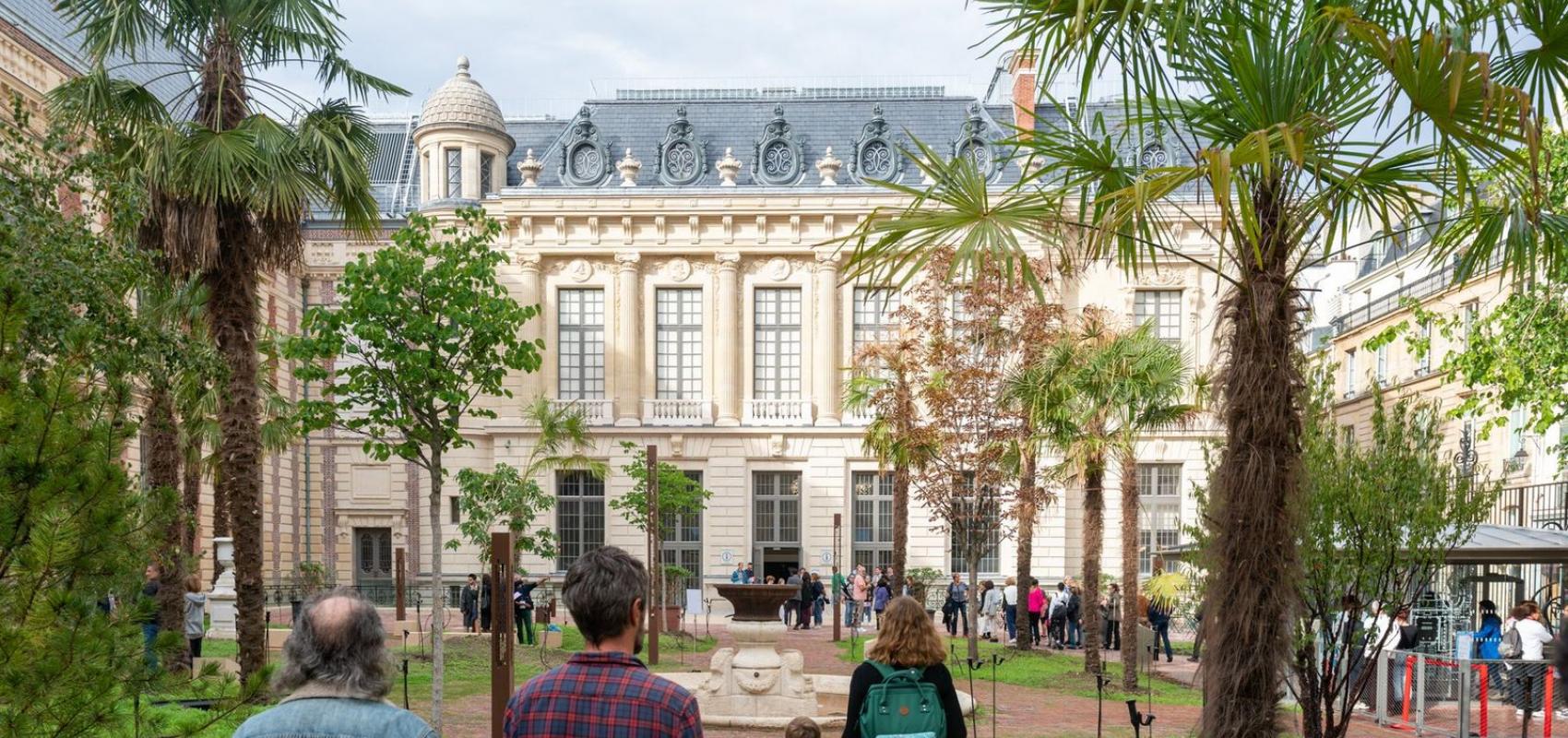
JOURNAL: Special Issue "Le patrimoine de la Justice" (In Situ. Revue des patrimoines 46 (2022))


(image source: in Situ)

(read more on openedition.org)