Search

Showing posts with label Administering Justice. Show all posts

28 February 2025

SEMINAR: Justices de chanoines (1200-1500) (Aubervilliers: Campus Condorcet, 21 MAR 2025 h. 14-17) [ONLINE]


La table-ronde des Fasti ecclesiæ gallicanæ est consacrée cette année aux justices des chanoines (xiie-xve siècle). L’histoire des justices ecclésiastiques à la fin du Moyen Âge, qu’il s’agisse des officialités épiscopales et métropolitaines, des justices seigneuriales d’Église ou encore des justices monastiques et canoniales, a connu des renouvellements importants ces dernières décennies. La table-ronde entend éclairer les spécificités des justices des chapitres cathédraux, nées des justices épiscopales, en examinant, à travers plusieurs études de cas, leur fonctionnement et leur place au sein de la pluralité des justices urbaines.


Programme:

  • Élisabeth Lusset (CNRS – LaMOP) – Introduction
  • Thomas Lacomme (Université Jean Moulin Lyon 3 – CIHAM) – Le chapitre cathédral troyen et l’exemption de la juridiction épiscopale (xiie-xve siècle)
  • Monique Maillard-Luypaert (chercheuse associée à l’université Saint-Louis, Bruxelles) – Crime et châtiment au chapitre cathédral de Cambrai. L’affaire du chanoine Jean Reginaldi (1443-1449) : un cas exemplaire ?
  • Véronique Beaulande-Barraud et Lucas Flandre (Université Grenoble-Alpes) – Le procès d’un prêtre voleur en 1479 : l’exercice de la juridiction capitulaire sur l’Hôtel-Dieu de Reims

La table-ronde pourra être suivie en présentiel ou à distance.


Inscription préalable : fasti-journees(at)services.cnrs.fr

More information can be found here.

10 November 2023

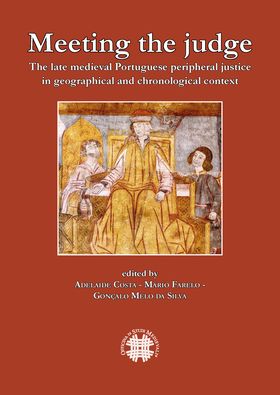
BOOK: Adelaïde COSTA, Mario FARELO, Gonçalvo MELO DA SILVA (eds.), Meeting the judge. The late medieval Portuguese peripheral justice in geographical and chronological context (Palerme: Officina di Studi Medievali, 2023). ISBN: 9788864851433


ABOUT THE BOOK

This book is the final result of a project entitled Meet the judge. Justice and communities in a transitional period (Portugal, 1481-1580). It aimed to answer one question: analyze how the sporadic nomination of royal judges operating with local governments in the Middle Ages evolved into systematic and permanent institutions of erudite officials in the main Portuguese cities and towns of the Modern Age? The presented texts go beyond this, by contributing to better understand the process of expansion of the Portuguese Crown’s peripheral judicial apparatus (in number and complexity), which entailed an irreversible loss of autonomy for the communities. The book has ten chapters providing: (I) state of the art and problematization on this subject; (II) an organogram of central and local judicial instances; (III) the Crown’s use of peripheral magistrates; (IV) the intense legislative activity involved in defining the competences of royal judicial agents, which prevailed from the 14th to the 16th centuries. Although concentrated mainly in Portugal, there are four texts that focus on other territories. Two texts about Castilian judicial norms and agents in the Late Middle Ages have been included, enabling a comparison to be made of the institutional experiences of the two neighboring kingdoms. Two other contributions focus on vestiges of medieval local justice organization and royal control in North Africa and in the Orient. The authors resorted to different types of sources and methodologies, from case study analysis to the observation of groups of officers using a prosopographic method. The book provides in the end a glossary of the offices, institutions and rules of central, peripheral and local justice in medieval Portugal and Castile, as well as seven maps on the topics studied.


More information can be found here.

25 October 2023

CONFERENCE: I mille volti del processo: bagliori giuridici nello specchio della letteratura e delle arti (Verona: Università degli Studi di Verona, 27 OCT 2023) [ONLINE]


Incontro di studio e di presentazione del volume L’arte di giudicare. Percorsi ed esperienze tra letteratura e diritto, a cura di G. Rossi, D. Velo Dalbrenta, C. Pedrazza Gorlero, Napoli, ESI, 2022


PRESIEDE E MODERA: Paolo Cappellini (Università di Firenze)

INTRODUCE: Giovanni Rossi (Università di Verona) | La vita del diritto nel prisma della letteratura e dell’arte

INTERVENGONO: 

  • Orlando Roselli (Università di Firenze) | L’arte di giudicare e l’inconsapevole giuridico
  • Floriana Colao (Università di Siena) | Il giudice attraverso lo specchio. Riflessioni su “L’arte di giudicare”
  • Francesco Sidoti (Università de L’Aquila) | Rumori e ragioni nel processo


More information and the online registration form can be found here.


17 February 2022

CALL FOR PAPERS: Mobiliser son réseau ou sa parentèle pour obtenir justice : les jeux de pouvoir dans les pratiques judiciaires au Moyen Âge et à l’époque moderne en France et en Europe (deadline 1 March 2022; Université Bordeaux Montaigne)


Journée d’étude, Université Bordeaux Montaigne, jeudi 10 novembre 2022: Mobiliser son réseau ou sa parentèle pour obtenir justice : les jeux de pouvoir dans les pratiques judiciaires au Moyen Âge et à l’époque moderne en France et en Europe 

Les études historiques sur les pratiques judiciaires ont mis en évidence, à contre-pied de la vision d’une institution judiciaire implacable, la relative autonomie des justiciables, capables d’élaborer des stratégies judiciaires. Sous l’Ancien Régime, les choix effectués par les justiciables – tous groupes sociaux confondus – prouvent leur capacité à adapter leurs stratégies en fonction des normes juridiques, et révèlent une certaine appropriation de la culture judiciaire. Cependant, les stratégies judiciaires ont principalement été interrogées, jusqu’à présent, du point de vue des normes et des représentations culturelles, tandis que l’influence des sociabilités sur les choix des justiciables n’a guère donné lieu à des études globales ou approfondies.

Cette journée d’étude vise à analyser les stratégies de mobilisation d’un réseau ou d’une parentèle pour obtenir justice au Moyen Âge et à l’époque moderne. Elle a pour ambition de mettre en lumière, si possible, les jeux de pouvoir dans les pratiques judiciaires, à partir de sources révélant la capacité des acteurs de la scène judiciaire – magistrats comme justiciables – d’utiliser leurs relations sociales pour influencer ou interférer dans les procédures.

Afin de comprendre l’influence et le rôle de la parentèle et des sociabilités dans les stratégies judiciaires, on pourra s’intéresser aussi bien aux réseaux de ceux qui détenaient le pouvoir judiciaire qu’aux réseaux des justiciables, qu’il s’agisse d’individus ou d’associations de personnes, telles que les communautés religieuses, les collèges, les corporations. On veillera à se concentrer sur l’emprise judiciaire de ces réseaux à l’occasion d’un ou plusieurs procès, en prenant soin d’analyser leurs interférences sur la procédure. On cherchera à savoir si celles-ci opéraient de manière informelle, ou directement dans la rédaction des pièces de procédure, des jugements, arrêts, sentences ou décisions d’arbitrage.


Modalités pratiques

Les propositions de communication (max. 300 mots), accompagnées d’une courte bio-bibliographie, sont à envoyer avant le 1er mars 2022 à l’adresse suivante : aude_loriaud@hotmail.com


Organisateurs

  • Martine Charageat, maître de conférences en Histoire médiévale, Ausonius, Université Bordeaux Montaigne (martine.charageat@u-bordeaux-montaigne.fr)
  • Aude Loriaud, docteure en Histoire moderne, CEMMC, Université Bordeaux Montaigne (aude_loriaud@hotmail.com)
  • Éric Suire, maître de conférences habilité à diriger des recherches en Histoire moderne, CEMMC, Université Bordeaux Montaigne (eric.suire@u-bordeaux-montaigne.fr)

Comité scientifique

  • Beaulande-Barraud Véronique, Professeur d’Histoire médiévale à l’Université Grenoble Alpes
  • Garnot Benoît, Professeur d’Histoire moderne à l’Université Bourgogne Franche-Comté
  • Le Mao Caroline, Maîtresse de conférences habilitée à diriger des recherches en Histoire moderne, Université Bordeaux Montaigne

Vous trouverez ici l’appel à communication

01 October 2021

CONFERENCE: Images of Justice (Orléans, 11-12 October 2021)

(image source: Le Studium)


We learned of a conference about judicial images and imaginary.


Conference description

In the last three decades, beginning in 1994 with a major work by Robert Jacob, there has been a renascence of writing of images of Justice, judicial iconography and courthouse architecture.

In 2016 and 2018, following two major exhibitions held in Bruges and Mechelen to which I contributed, I was able to weave a more reflective understanding of what happens when a viewer encounters an embodied image of justice, whether this artifact is a painting, a sculpture, or an object, trapped into a meaningful  judicial ritual (eg. shaming practices, "amende honorable", executions in effigy).

These investigations were born out of a fruitful dialogue between curators, legal professionals and researchers. An image of justice is no longer imagined as an immobile artwork, or an opportunity for religious or historical narrative out of its primary judicial context but as an imaging process involving several functions (didactic, persuasive, mnemonic, deontological roles). In Europe, most of our contemporary courthouses are symbolically silent. A reflective evaluation of the functions of judicial images in the "longue durée" is a useful ally to revive the foundational principles of fair trial and due process.

Bringing together researchers and legal professionals, as well as curators and heritage specialists, this event also wishes to connect participants to the ways in which a figure of Christian Judgment has been constantly reinvented throughout the centuries. The idea is to look at artworks 'in situ' from a legal and societal perspective, explaining their key role as symbols.


Convenors

  • Dr Valérie Hayaert, LE STUDIUM / Marie Skłodowska-Curie Research Fellow; from Käte Hamburger Kolleg "Law as Culture", University of Bonn - DE and in residence at Centre for Advanced Studies in the Renaissance (CESR)  / CNRS, University of Tours - FR
  • Hélène Jagot, Director of the Museum of Fine Arts in Tours - FR
  • Christophe Regnard, President of the Tours Courthouse - FR

***

Monday 11th october 2021
 Last Judgment (salle d'Assises du Tribunal Judiciaire de Tours)
Chairman - Antoine Garapon (Sciences-Po Paris)

08.30 Welcome of the participants

09.00 Official opening by Sophie Gabillet (General Secretary of LE STUDIUM) & Christophe Regnard (President of the Tours Courthouse)

09.45 Valérie Hayaert - Regards sur le décor allégorique de la salle

10.00 Georges-Elia Sarfati (Professeur d'université (linguistique) et professeur d'études bibliques à l'Institut universitaire Elie Wiesel (Paris)) - Significations et portée de l'expression "le jour de Yahwé" dans la Bible hébraïque

10.45. Robert Jacob (directeur de recherche au CNRS et professeur d’histoire du droit à l’Université de Liège)


Chairman - Olivier Beaud (Paris II, Assas)

13.45 Christophe Bouton (Professeur de Philosophie à l’Université Bordeaux III-Montaigne) - Le tribunal de l'histoire - Le thème du jugement dernier dans les philosophies de l'histoire

14.30 Frédéric Gros (Professeur de pensée politique à l’IEP de Paris, Sciences-Po et chercheur au CEVIPOF) 

15.30 Noëlle Herrenchmidt (journaliste reporter) : « 45 années de dessins d’audience aux côtés d’Antoine Garapon »

16.15 Antoine Garapon 

17.30 Tribute to Antoine Garapon at the Basilique Saint-Martin (visit of the crypt and tribute on the square in front of the basilica: capacity of 60 to 70 people..

Sacha Philip (Émile Cohl school, Lyon) will sketch the speakers during the debates and will make an illustrated report of the day, in the tradition of courtroom drawings. The illustrations will be produced and filmed during the day, with occasional projections on a large screen.


Tuesday 12th october 2021
Judicial iconography and symbolism from Middle Ages to the Modern era (salle Olivier Debré du Palais des beaux-arts de Tours)
Chairman - Robert Jacob (CNRS, Université de Liège)

08.30 Welcome of the participants

09.00 Offiicial opening by the director, Hélène Jagot, and the curator, Elsa Gomez (medieval and Renaissance paintings)

09.15 Valérie Hayaert - Deux tableautins (tavolette) encadrant le rituel d'exécution à Bologne (vers 1350) conservés au Musée des Beaux-Arts de Tours: l'image narcotique-salvifique dans le rite judiciaire.

10.00 Carolin Behrmann (Université de Berlin)

11.00 Dominic-Alain Boariu (Université de Fribourg, Suisse) - Autour du procès de Giuseppe Fieschi (1835) et son exécution ; Respondent: Raphaël Cahen (POLEN, Orléans) 

11.45 Pierre Henri Biger & Samuel Devisme: La Justice sur un éventail : une allégorie critique de la politique judiciaire de Louis XIV ?


Chairman : Harold Epineuse (Institut des Hautes Études sur la Justice)

13.45 Manuela Bragagnolo (Max Planck Institute for Legal History and Legal Theory, Francfort)  - Physiognomy and Law at the Early Modern Period ; Respondent: Concetta Pennuto (CESR, Tours)

14.45 Adrien Pitor & Nicolas Lyon-Caen - Assister à la scène judiciaire. Le public dans le Palais de Paris au XVIIIe siècle

15.15 Xavier Rousseaux (Université de Louvain) « La spectacularité des peines dans les Pays-Bas (rituels de pèlerinage ou de pardon, amendes honorables, ex-votos) au 15e-17e siècles. »

16.00 Stéphane Moure (MCF à la faculté de Droit de Tours) -  « La nouvelle architecture judiciaire. Remarques sur un langage symbolique. »

16.45 Jean-Paul Jean (Président de chambre honoraire à la Cour de cassation et secrétaire général de l’AHJUCAF (Cours de cassation du réseau francophone) - « Le N’Kisi Kongo comme symbole de justice ».


Detailed information can be found at the following page

03 December 2020

BOOK : J.John SACKAR, Lord Devlin (Hart Publishing, 2020)


(Source : bloomsburyprofessional.com)   

 The author, Justice John Sackar is a judge at the Supreme Court of New South Wales.

ABOUT THE BOOK : Lord Devlin was a leading lawyer of his generation. Moreover, he was one of the most recognised figures in the judiciary, thanks to his role in the John Bodkin Adams trial and the Nyasaland Commission of Inquiry. It is hard then to believe that he retired as a Law Lord at a mere 58 years of age. This important book looks at the life, influences and impact of this most important judicial figure. Starting with his earliest days as a schoolboy before moving on to his later years, the author draws a compelling picture of a complex, brilliant man who would shape not just the law but society more generally in post-war Britain.

 TABLE OF CONTENTS :

1. Ab Ovo
2. God's House
3. The Early Years in the Law
4. A Relentless Workload
5. The Celebrity
6. Friends Across the Atlantic
7. Up a Notch
8. Darkest Africa
9. The Return to Normality?
10. Appellate Life
11. Not Quite the Wilderness
12. New Challenges and the Enemy Within
13. Revenge 

08 April 2019

BOOK: Ulrike MÜSSIG, Reason and Fairness. Constituting Justice in Europe, from Medieval Canon Law to ECHR [Legal History Library, vol. 27] (Leiden/Boston: Martinus Nijhoff/Brill, 2019), 176 EUR (29 MAY 2019)

(image source: Brill)

Book abstract:
Throughout Europe, the exercise of justice rests on judicial independence by impartiality. In Reason and Fairness Ulrike Müßig reveals the combination of ordinary judicial competences with procedural rationality, together with the complementarity of procedural and substantive justice, as the foundation for the ‘rule of law’ in court constitution, far earlier than the advent of liberal constitutionalism. The ECHR fair trial guarantee reads as the historically-grown consensus of the functional judicial independence. Both before historical and contemporary courts, justice is done and seen to be done by means of judgements, whose legal requirements combine the equation of ‘fair’ and ‘legal’ with that of ‘legal’ and ‘rational.’ This legal determinability of the judge’s fair attitude amounts to the specific (rational) European idea of justice.
On the author:
 Ulrike Müßig, Prof. Dr., Dipl. Legal Studies (Cantab.), is Professor of European Legal History (Passau) and Advanced Grantee of the ERC (ReConFort). She has published widely on constitutional and court history, most recently Decisive Constitutional Normativity (Springer 2018).
More information with Brill.

13 November 2014

BOOK: "Protocols of Justice: The Pinkas of the Metz Rabbinic Court, 1771-1789", by Jay R. Berkovitz


Jay R. Berkovitz, University of Massachusetts, Protocols of Justice: The Pinkas of the Metz Rabbinic Court, 1771-1789,  Brill Academic Publishers

all information here

Presented here to the public for the first time, the Pinkas of the Metz Beit Din is the official register of civil cases that came before the Metz rabbinic court in the two decades prior to the French Revolution. Brimming with details of commercial transactions, inheritance disputes, women's roles in economic life, and the interplay between French law and Jewish law, the Metz Pinkas offers remarkable evidence of the engagement of Jews with the surrounding society and culture. The two volumes of Protocols of Justice comprise the complete text of the Metz Pinkas Beit Din, which is fully annotated by the author, and a thorough analysis of its significance for history and law at the threshold of modernity.

05 November 2014

ARTICLE: "The Politics of Early Justice, Lower Court Federal Judicial Selection 1789-1861", by Michael J. Gerhardt and Michael Ashley Stein (2014)


Michael J. Gerhardt (University of North Carolina at Chapel Hill School of Law)  and Michael Ashley Stein  (William & Mary Law School) on "The Politics of Early Justice, Lower Court Federal Judicial Selection 1789-1861", forthcoming on the Iowa Law Review

Here the abstract:


Almost every commentary on the history of the selection of federal judges presumes that there was some prior golden era in which national political leaders focused primarily on the merit of individual nominees and were not unduly swayed by partisan politics or ideology. Numerous constitutional scholars — and national leaders — have therefore roundly criticized the modern day judicial selection process, citing unprecedented delays and a low percentage of approval of federal court nominees as evidence that the system has broken down. They have argued that the ways in which senators, as well as presidents, have handled lower court nominations in the modern era have deviated from how the nation’s first chief executives and the first few Senates handled such nominations. Yet, there is one glaring omission in almost all commentaries on disputes over judicial selection over the past few decades — the absence of any substantiation of an earlier, so-called golden era, in which there actually was general deference within the Senate to presidents’ nominations to federal district and appellate judgeships. Even the classic work on federal judicial selection by the late Kermit Hall begins its analysis of federal judicial selection in 1825, disregarding nearly forty years of prior practices in the field and reinforcing the received but unsubstantiated assumptions about how judicial nominations to lower courts fared beforehand.


20 October 2014

BOOK: "Studies in the History of Law and Justice" (vol. 3, 2015)


Studies in the History of Law and Justice
Volume 3 : The Great Council of Malines in the 18th century, by An Verscuren

now available on the SpringerLink website

This work studies the Great Council of Malines as an institution. It analyzes the Council’s internal organization and staff policy, its position within the broader society of the Austrian Netherlands, the volume and nature of litigation at the Council, and its final years and ultimate demise in the late 18th and early 19th century. By means of this institutional study, this volume provides insight into the role played by the Great Council in the process of state-building in the 18th century Austrian Netherlands. While superior courts were once considered to be the prime agencies of change in the Early Modern Period, tools par excellence for the sovereigns’ striving towards centralization and superiority, their position in the 18th century has so far been barely touched upon. This work focuses specifically on the 18th century supreme court of the Austrian Netherlands, and provides a broad overview with attention to other aspects of the tribunal's functioning and to its role in 18th century attempts at state formation.