Search

Showing posts with label 20th century legal history. Show all posts

15 June 2026

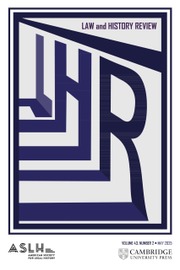
ADVANCE ARTICLE: Maya MARK, "Civil Disobedience in Defense of Democracy: Menachem Begin’s Struggle Against Emergency Laws in Israel, 1948–1954" (Law and History Review) [OPEN ACCESS]

(image source: CUP)

 Abstract:

This study uncovers a previously overlooked chapter in the historiography of civil disobedience: Menachem Begin’s resistance to Israeli emergency legislation between 1948 and 1954, which he argued undermined foundational democratic principles. It presents the first scholarly analysis of Begin’s resistance, contending that it constitutes a clear instance of civil disobedience, embodying its core tenets. At the heart of this historical case study lies a paradigmatic question: how can laws that erode foundational—yet abstract—democratic principles, such as the separation of powers, be effectively resisted, and can such resistance be accommodated within traditional frameworks of civil disobedience? Begin’s struggle brings these questions into sharp relief, illuminating longstanding critiques of the framework’s overly restrictive boundaries and underscoring the tension between theoretical frameworks and political reality. More broadly, the article engages central debates at the intersection of law, politics, and democratic thought. By examining the democratic convictions of a prominent right-wing leader, it contributes to historical scholarship on the role of conservative and right-wing movements in shaping democratic ideologies, while also providing a historical reference point for subsequent ideological transformations and radicalization processes within these movements. Finally, by illuminating the complexities inherent in opposing laws that erode core-yet abstract-democratic principles, this study resonates with contemporary debates on democratic backsliding, offering a historical lens through which civil disobedience has served as a principled response to such challenges.

Read more here: DOI 10.1017/S0738248026101539

10 June 2026

BOOK: Anna O. LAW, Migration and the Origins of American Citizenship. African Americans, Native Americans, and Immigrants (Oxford: OUP, 2026), 304 p. ISBN 9780197660096, 19,99 GBP


(image source: OUP)

Abstract:

Since the late nineteenth century, the US federal government has enjoyed exclusive authority to decide whether someone has the ability to enter and stay in US territory. But freedom of movement was not guaranteed in the British colonies or early US. By contrast, voluntary migrants were met with strict laws and policies created by colonies and states, which denied free mobility and settlement in their territories to unwanted populations. Migration and the Origins of American Citizenship presents a story of constitutional development that traces the confluence of the logics of slavery and settler colonialism in early legal rulings and public policy about migration and citizenship. The book examines the division of labor between the national and state governments that endured for over a century, reasons why that arrangement changed in the late nineteenth century, and what the transformation meant for people subject to those regimes of control. Drawing into one study the migration policy histories of groups of people that are usually studied separately, and combining the methodologies of political science, history, and law, Anna O. Law reveals the unmistakable effects of slavery and Native American dispossession in modern US immigration policy.

Table of contents:

Introduction
1:Sifting Migrants
2:Belonging
3:Migration and Citizenship at the Founding
4:Regulating International Borders
5:Regulating Interstate Borders
6:Formal Citizenship Defined
7:Historical Antecedents and Legal Precedents

Epilogue: Continuity, Change, and Constitutional Memory

 On the author:

is the Herbert Kurz Chair in Constitutional Rights in the Department of Political Science at CUNY Brooklyn College. She completed her PhD in Government at the University of Texas at Austin. Her publications appear in political science, history, and law journals and investigate the interaction between law, legal institutions, and politics. Her first book, The Immigration Battle in American Courts (2010), examined the role of the federal judiciary in U.S. immigration. She teaches and researches in U.S. constitutional law, federal courts, U.S. immigration policy history, federalism, American Political Development, and race/ethnicity.

 Read more here.


13 May 2026

BOOK: Sandrine BAUME & David RAGAZZONI (eds.), Hans Kelsen on Constitutional Democracy Genesis, Theory, Legacies (Cambridge: CUP, 2026), ISBN 9781009230360 [OPEN ACCESS]


(image source: CUP)

Abstract:

This volume challenges conventional interpretations by demonstrating that Hans Kelsen was far from being a purely formalist thinker. Instead, it highlights his profound and enduring engagement with the threats facing constitutional democracies. The political and institutional upheavals of interwar Europe significantly influenced Kelsen's evolving vision of democracy, as this volume shows. His contributions to twentieth-century democratic theory include groundbreaking insights into multiparty systems, mechanisms of moderation, minority protections, and judicial review. Furthermore, Kelsen's reflections on the crises and collapses of democracies during the 1930s remain strikingly relevant, offering valuable perspectives on contemporary challenges such as polarisation and populism. This title is also available as Open Access on Cambridge Core.

Read the full book here: DOI 10.1017/9781009230360.

24 March 2026

CONFERENCE: Le Code pénal belge. Regards historiques et comparatifs (XVIe-XXIe siècles) /The Belgian Penal Code. Historical and Comparative Perspectives (XVIth-XXIth centuries) (Brussels: Academy Palace, 18 MAY 2026)


To mark the entry into force of the new Belgian Penal Code, originally scheduled for 8 April but ultimately postponed until 1 September 2026, Jérôme de Brouwer, Professor at the Université libre de Bruxelles, François Pierrard, F.R.S.-FNRS Postdoctoral Researcher at UCLouvain, and Édouard Delrée, PhD student at the ULB, are organising a conference on 18 May entitled ‘Le Code pénal belge. Regards historiques et comparatifs (XVIe-XXIe siècles)’ / ‘The Belgian Penal Code. Historical and Comparative Perspectives (16th–21st centuries)’. The aim of this conference is to offer a historical and comparative perspective on Belgian criminal codification. It will seek to situate the gradual development of the concept of the Penal Code within the European and then colonial context, from the Spanish Netherlands to contemporary Belgium. The conference will take place on 18 May 2026, from 9am to 6pm, at the Palace of Academies, Rue Ducale 1, 1000 Brussels. Admission is free, but registration is compulsory (contact: pierrard.francois@uclouvain.be).

À l'occasion de l'entrée en vigueur du nouveau Code pénal belge initialement prévue le 8 avril mais finalement reportée au 1er septembre 2026, François Pierrard, chargé de recherches F.R.S.-FNRS à l'UCLouvain sous la direction de Wim Decock, organise avec Jérôme de Brouwer, professeur à l'Université libre de Bruxelles, un colloque intitulé "Le Code pénal belge. Regards historiques et comparatifs (XVIe-XXIe siècles)" / "The Belgian Penal Code. Historical and Comparative Perspectives (XVIth-XXIth centuries)". Ce colloque a pour but d'offrir une perspective historique et comparative à la codification pénale belge. Il s'agira de replacer l'élaboration progressive du concept de code pénal dans le contexte européen et puis colonial des Pays-Bas espagnols à la Belgique contemporaine. Le colloque se tiendra le 18 mai 2026, de 9h à 18h, au Palais des Académies, Rue Ducale 1, 1000 Bruxelles. L'entrée est libre, mais l'inscription est obligatoire (contact : pierrard.francois@uclouvain.be).


Le Code pénal belge. Regards historiques et comparatifs           (XVIe-XXIe siècles)

The Belgian Penal Code. Historical and Comparative Perspectives (XVIth-XXIth centuries)


Palais des Académies,

Rue Ducale 1, Bruxelles

18.05.2026

A)       L’élaboration du concept de code pénal                                                            The development of the concept of a criminal code

I)                    De l’uniformisation à la codification                                                                                          From standardisation to codification

Président de séance / Chairperson : Jean-Marc Hausman (UCLouvain, Katholieke Universiteit Leuven)

9:00 : Introduction

Jérôme de Brouwer (ULB), François Pierrard (FNRS, UCLouvain) et Édouard Delrée (ULB)

9:30 : Le plus difficile : définir le concept

Dirk Heirbaut (Universiteit Gent) 

10:00 : The myths of criminal law codes

Aniceto Masferrer (Universitat de València) 


Pause-café / Coffee break


II)                  La séparation du droit pénal substantiel et procédural                                                The separation of substantive and procedural criminal law

Président de séance / Chairperson : Wim Decock (UCLouvain, Université de Liège)


11:00 : Les premières tentatives de codification. Des Ordonnances criminelles de Philippe II au Règlement provisionnel pour la procédure criminelle de Joseph II (1570-1787)

François Pierrard (FNRS, UCLouvain) 

11:30 : From the old to the new criminal law. Innovative aspects of the codification of criminal law of Joseph II (1787) compared with the Constitutio Criminalis Theresiana                         Thomas Simon (Universität Wien) 

12:00 : L’expérience française de la codification pénale (1791-1810)

Liêm Tuttle (Université Panthéon-Sorbonne)

Buffet froid / Cold buffet

B)       Le changement de paradigme de la codification pénale                 The paradigm shift in criminal codification

I)                    Les aléas de l’élaboration d’un code national                                                                                                 The challenges of developing a national code  

Président de séance / Chairperson : Nicolas Simon (Académie royale de Belgique)


14:00 : à la recherche d’un code pénal pour le royaume des Pays-Bas (1815-1830). Une divergence entre le nord et le sud ?

Fred Stevens (Katholieke Universiteit Leuven)

14:30 : Observation, expérimentation : les sciences au service de la codification pénale en Belgique au 19e siècle

Jérôme de Brouwer (ULB) 

15:00 : Le Code pénal belge de 1867 lu par la doctrine française

Tanguy Le Marc’hadour (Université d’Artois) 

Pause-café / Coffee break


II)                  L’influence et le devenir du premier Code pénal belge                                 The The influence and future of the first Belgian Penal Code    

Présidente de séance / Chairperson : Marie-Aude Beernaert (UCLouvain)

16:00 : Du Code pénal de 1867 aux lois de défense sociale en Belgique. Deux logiques antagonistes et complémentaires pour lutter contre le crime                                                                Yves Cartuyvels (UCLouvain Saint-Louis Bruxelles) 

16:30 (sur Teams) :  L’influence du droit belge sur le Code pénal congolais de 1940 à nos jours                                                                                                                                                                           Pacifique Magadju (Université Catholique de Bukavu)

17:00 : Des codifications jumelles aux destins opposés : trajectoires croisées des codes pénaux et du Code d’instruction criminelle en Belgique de 1831 à nos jours                                            Édouard Delrée (ULB)

Conclusion


17:30 : D’un code à l’autre                                                                                                                                         Jérôme de Brouwer (ULB), François Pierrard (FNRS, UCLouvain) et Édouard Delrée (ULB)


Contact : pierrard.francois@uclouvain.be


Fonds de la recherche scientifique — Wikipédia


23 March 2026

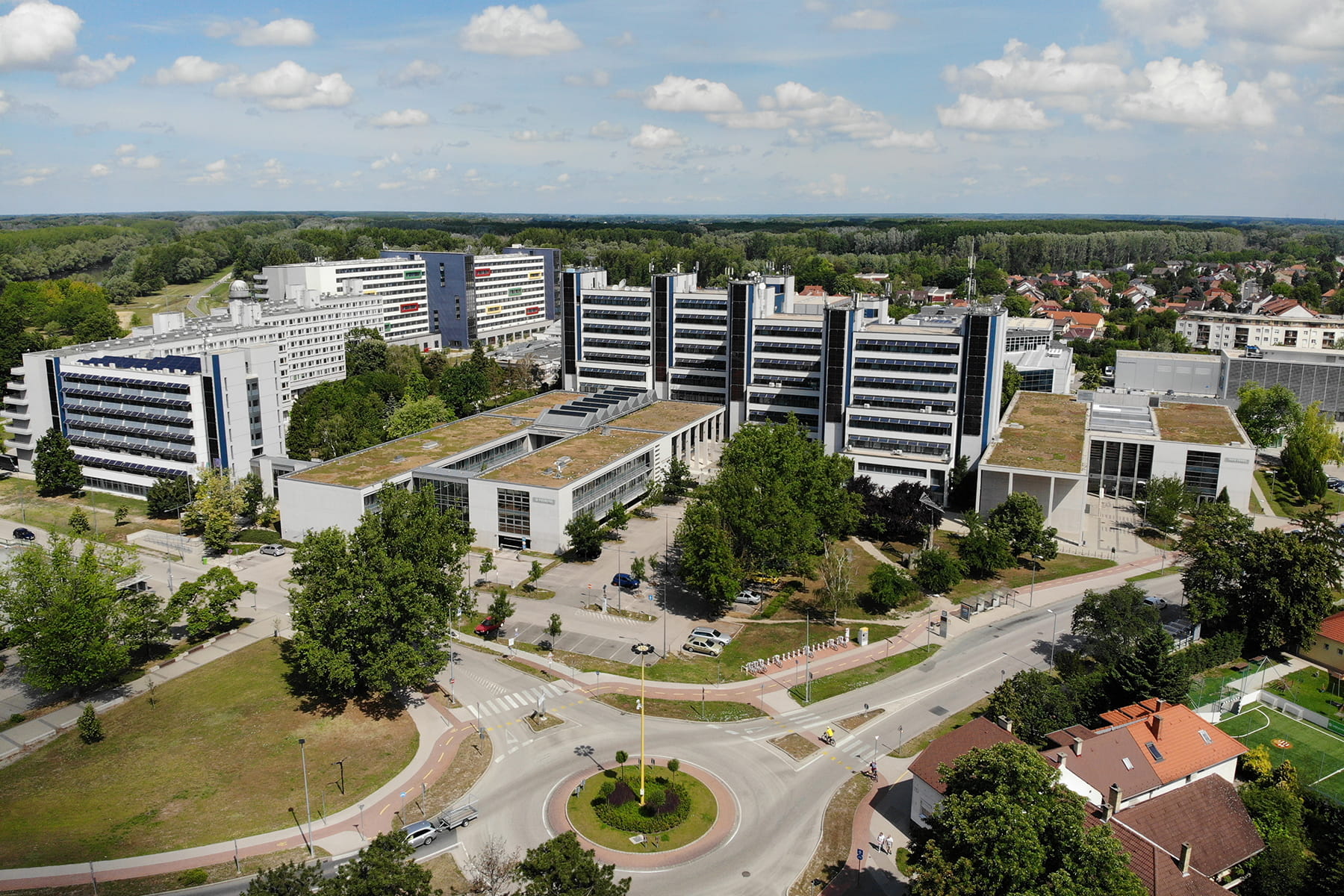
CALL FOR PAPERS: Age of Empires II. Europe and the Empires of the West in a Changing World Order (1900–1937) (Győr: University of Győr, 27-29 OCT 2026) [DEADLINE 30 APR 2026]

(image source: Wikimedia Commons)


The Exposition Universelle, the world exhibition held in Paris in 1900 under the theme ‘19th century: an overview’, opened as a confident display of European and Western dominance. The optimism that shaped contemporary beliefs in a bright future and in scientific progress was reinforced by the many technical solutions and inventions on display—several of which have since become part of everyday life. Yet behind the glittering façade of an event proclaiming the uninterrupted advance of civilisation, intensifying competition among the world’s leading powers was increasingly evident, alongside mounting tensions over access to resources and markets. Europe’s leading states made considerable efforts to expand, develop, and administer their empires, while the limits of cooperation were exposed by a series of open crises in the years following the turn of the century. Moreover, the outcomes of nineteenth-century globalisation—expanding international institutions, accelerating information flows, and deepening transnational economic relations—proved insufficient to prevent the collapse of the nineteenth-century world order in the First World War.


Although the conflict, which profoundly affected territories beyond Europe as well, ultimately enabled the victors to establish a new international order, it did not bring the anticipated easing of tensions or the arrival of a stable and peaceful era. The redrawing of Europe’s political map created space for nationalist and nation-state aspirations; however, strategic considerations remained paramount, and the settlement failed to achieve broad legitimacy. Continental tensions persisted, while the traditional strategic aims of European actors continued, largely unchanged, from the pre-war period. Empire-building, together with a renewed multiplicity of expansionist aspirations, thus became a defining feature of the era. At the same time, newly created institutions sought to shape the international arena alongside both established and emerging state regimes.


In 1937 Paris hosted a world exhibition once again, organised under the theme ‘Arts and technology in modern life’ - the last European world exhibition before the outbreak of war. It entered history not only as the final such event created in the shadow of the post-war peace treaties, but also as an exhibition marked by political rivalry and by visible signs of impending collapse. Although vast territories remained under European control—either directly or through League of Nations mandates—expectations concerning the effective functioning of international organisations, the consolidation of international legal institutions, and the reorganisation of economic and cultural relations increasingly proved illusory. The history of Europe and the empires of the Western world order had reached a new frontier.


The organisers of The Age of Empires II – Europe and the Empires of the West in a Changing World Order (1900–1937) consider it essential to strengthen academic dialogue and to bring together speakers from diverse disciplines and regions. We warmly encourage proposals from researchers in legal history, international law, history, international relations, economics, and related fields, including interdisciplinary approaches.


Key topics (non-exhaustive)

1.Global system or European system? Political and legal instruments of empire-building; stages in the evolution of the international system

2.Economic dimensions of empire-building: transformations in world trade and financial mechanisms; economic and legal perspectives

3.The realm of information: communication networks, international communication organisations, and technological control as a tool of imperial power

4.State territory, citizenship, and mobility within imperial spaces

5.Representation and symbolism: forms and layers of imperial representation

6.Collapses and transitions: the legacies of the Austro-Hungarian Monarchy, Germany, Russia, and the Ottoman Empire

7.The crisis of parliamentarianism and its alternatives: imperial and popular models of representation in a changing world

8.Nation-building and identity: empire-building and the ‘melting pot’ of national unification in new imperial formations

9.Press communication and models of news regulation: state control and instruments of mass communication

10. Variations in social thought: state intervention and instruments of social welfare

The Department of Legal History at the Faculty of Law and Political Sciences, University of Győr, is organising an international symposium from 27 to 29 October 2026. We invite researchers working within the thematic and chronological scope of the conference to present their findings in a 20-minute paper, followed by discussion. Accepted contributions will be published in the form of a study (30,000–40,000 characters). Application Applications must be submitted by 30 April 2026 to aoe2026@sze.hu  and should include: an abstract (including the proposed topic) of no more than 500 words; and a short biography of no more than 100 words. Applicants will be notified of the outcome by 31 May 2026. Presentations may be delivered in English, German, or French.


Attila Barna - Balázs Pálvölgyi

Organizers

09 February 2026

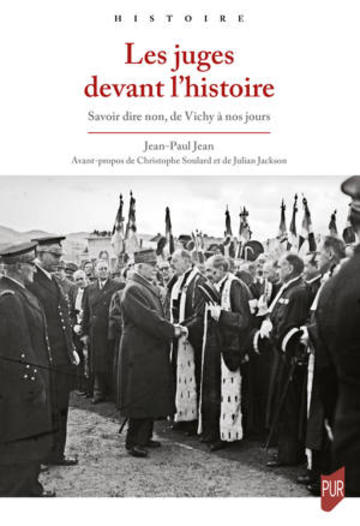
BOOK PRESENTATION: Jean-Paul JEAN, "Judges before history/Les juges devant l’histoire’" (Oxford: Maison française d'Oxford, 18 FEB 2026) [HYBRID]


(image source: MFO)

Presentation:

Jean-Paul Jean will present his book, which examines the role of judges under Vichy and during the Purge, drawing on previously unpublished archives to reassess their responsibilities, choices, and the enduring challenges facing justice and the rule of law. With Lise Jaulin (Liaison Judge, French Embassy in London) I Chair: Anne Simonin (EHESS-CESPRA). How could judges who had sworn an oath of loyalty to Marshal Pétain and served the Vichy regime later go on to preside over the courts of the Purge? What was the justice system’s actual role in enforcing the laws during the Occupation, in the persecution of Jews, and in the repression of members of the Resistance? By presenting the careers of prosecutors and judges throughout the dark years—ranging from wait-and-see attitudes to collaboration, resistance, or the ambiguous position of “Vichy-resisters”—this work places in context the concrete situations magistrates faced and the choices they made in conscience. Why was Paul Didier the only one to refuse to swear an oath to Pétain? What did resistance-minded magistrates actually do? How did the judiciary contribute to the exclusion of Jews? What is the reality behind the controversial career of André Mornet, the “Vichy-resister” and prosecutor general who called for the death penalty against Pétain? How were the judges of the special sections tried after the war? Why were the trials of the Purge able to rely only on very partial evidence? Drawing on numerous previously unpublished documents from public and private archives, the book sheds new light on this period. By placing this dark chapter of history in perspective—also illuminated by post-war reforms, including women’s access to the judiciary and the early foundations of international criminal justice—it opens a broader debate on the contemporary challenges facing justice, a cornerstone of the rule of law now widely threatened by populist and authoritarian drift.

Venue: 

More information here

05 February 2026

SEMINAR: 'In dialogo sulla storia costituzionale italiana: Augusto Antonio Barbera, testimone e protagonista' (Rome: Lumsa Università, 20 FEB 2026)


Il Convegno “In dialogo sulla storia costituzionale italiana - Augusto Antonio Barbera, testimone e protagonista” – in programma nella sala Pia dell’Università LUMSA (via di Porta Castello 44, Roma) il 20 febbraio 2026, dalle ore 11.00 – è organizzato dall’Università LUMSA e dal Centro di Ricerca "Leopoldo Elia" (CREL).


Il Convegno costituisce la tappa di avvio dell’attività dell’Associazione per la storia costituzionale, una società scientifica che coinvolge studiosi di varie materie storiche e giuridiche, fondata il 7 ottobre 2025 a Roma e che ha tra i suoi soci fondatori alcuni professori dell’Università LUMSA (Francesco BoniniAngelo RinellaMarco OlivettiGian Marco SperelliFilippo Benedetti).


Il Convegno intende affrontare il senso degli studi di storia costituzionale in Italia attraverso il contributo di uno dei principali costituzionalisti italiani, il prof. Augusto Antonio Barbera, a lungo ordinario di diritto costituzionale nell’Università di Bologna e testimone-protagonista della storia istituzionale repubblicana nell’ultimo mezzo secolo (come parlamentare, ministro, giudice costituzionale, membro di commissioni sulle riforme costituzionali).


Le attività inizieranno con i saluti ai presenti e con una presentazione a cura del prof. Francesco Bonini (rettore dell’Università LUMSA) e del prof. Luigi Lacché (presidente dell’Associazione per la storia costituzionale).


Il contributo del prof. Barbera assumerà la forma di una intervista, condotta dai membri del direttivo dell’Associazione per la storia costituzionale. Seguirà un dibattito.


L’evento sarà trasmesso da Radio radicale