Search

Showing posts with label history of political thought. Show all posts

22 May 2026

CHAIR: Chaire Villey 2026, James Q. WHITMAN, « La transformation du rang social » (Paris: Université Paris II, Salle des Conseils, 21-22 MAY 2026)


(image source: Institut Villey)

Description of the chair:

La Chaire Villey – Paris Jurisprudence Chair – est une conférence annuelle organisée à l’Université Panthéon-Assas par l’Institut Michel Villey. Elle est prononcée par un universitaire dont les travaux dans le domaine de la philosophie du droit et de l’histoire de la pensée juridique sont particulièrement remarquables.

On the chair holder:

James Q. Whitman is the Ford Foundation Professor of Comparative and Foreign Law at Yale Law School. He earned his B.A. and J.D. from Yale University and Law School and also holds an M.A. in European History from Columbia University and a Ph.D. in Intellectual History from the University of Chicago. From 1988-1989, Professor Whitman clerked for the Hon. Ralph K. Winter of the Second Circuit Court of Appeals, then began his teaching career at Stanford University Law School. He has taught as a visiting professor at universities in France and Italy and has been a professor at Yale Law School since 1994. In 1996 he became the Ford Foundation Professor of Comparative and Foreign Law. Professor Whitman’s many articles have been published internationally and across disciplines. He has also been awarded numerous prizes and fellowships throughout his career. In 2008 he published The Origins of Reasonable Doubt: Theological Roots of the Criminal Trial, which received an honorable mention, Silver Gavel Award, American Bar Association, 2009. His book The Verdict of Battle: The Law of Victory and the Making of Modern War appeared in 2012. He was a John Simon Guggenheim Fellow in 2010-2011. His other scholarship includes an article, « The Two Western Cultures of Privacy: Dignity versus Liberty » published in the 2004 volume of The Yale Law Journal. His 2003 book, Harsh Justice: Criminal Punishment and the Widening Divide Between America and Europe, published by the Oxford University Press, won the 2004 Distinguished Book Award of the Division of International Criminology of the American Society of Criminology.

Read more here

18 May 2026

BOOK: Peter STACEY, The State in Machiavelli (Cambridge: Cambridge University Press, 2025), ISBN 9781009630351, €145,89


Abstract:

While historical scholarship has often downplayed the importance of Machiavelli's theory of the state, this study reconstructs the question of lo stato as the conceptual crux of his political philosophy. Peter Stacey offers a detailed reconstruction of the historical context from which Machiavelli's theory emerges, demonstrating how the intellectual and ideological contours of Machiavelli's thinking, as well as much of its content, were decisively shaped by conceptual apparatuses drawn from Roman philosophical, rhetorical and aesthetic discourse. Stacey further provides a sustained analysis of the development of Machiavelli's picture of the state from his earliest writings onwards, underlining the extent to which the Florentine draws deeply upon several key aspects of this intellectual inheritance in hitherto unacknowledged ways, while calling into question some of its cherished assumptions about the character of collective political entities. As Machiavelli's thinking unfolds across The Prince and the Discourses, Stacey illustrates how a strikingly novel conception of the body politic marks him out as the author of a distinctively new philosophy of the state.

Read more here: DOI 10.1017/9781009630351.

07 May 2026

BOOK: Samuel MOYN & Meredith TERRETTA (eds.), The Cambridge History of Rights, vol. V: The Twentieth and Twenty-First Centuries [The Cambridge History of Rights, eds. Nehal BHUTA, Anthony PAGDEN & Mira L. SIEGELBERG] (Cambridge: Cambridge University Press, 2026), €140,05


(image source: CUP)

Abstract:
The concept of a right, and the idea of human rights, were familiar abstractions on the brink of the twentieth century. But the history of political mobilization since shows that human rights had a transformative capacity in that century that no prior age had demonstrated. Through the twentieth century, human rights became institutionalized internationally in laws, movements, and organizations that transcended state-based citizenship and governance – which irrevocably changed the politics around them. Rights continued to evolve as the imperial world order transitioned to a postcolonial world of sovereign states as a primary form of political organization. Through twenty-six essays from experts around the world demonstrating how this period is historically distinctive, volume five of The Cambridge History of Rights is a comprehensive and authoritative reference for the history of rights in the twentieth and twenty-first centuries.

Table of contents:
General editor introduction Nehal Bhuta, Anthony Pagden and Mira L. Siegelberg Introduction Samuel Moyn and Meredith Terretta 1. Genealogies and human rights Ben Golder Part I. Rights, Politics and Mobilization Around the World: 2. Women's rights in international politics, 1900 –1967 Jean Quataert deceased 3. Rights and empire Miguel Bandeira Jerónimo and José Pedro Monteiro 4. Human rights and self-determination Umut Özsu 5. Rights and communism Ned Richardson-Little 6. Regional rights projects and decolonization in the twentieth century Anne-Isabelle Richard and Stella Krepp 7. Hierarchies of rights Barbara Keys 8. Human rights and cold war foreign policy Michael Cotey Morgan Part II. Forms and Fora of Rights Claiming: 9. Visions of human rights Adam Etinson and Jiewuh Song 10. On the critique of rights Jessica Whyte 11. Race, rights and the politics of petitioning Emma Stone Mackinnon 12. Transnational NGOs and human rights Jan Eckel 13. The 1993 world conference on human rights and the new rights ecosystem 14. Transitional justice, legal non-performatives and the sentiments of moving on Kamari Maxine Clarke Part III. Rights Causes and Their Evolution: 15. Rights without subjects: a history of children's human rights Linde Lindkvist 16. Development as the imperialism of 'free' trade: rights, liberalism and the engineering of African economies Alden Young and Tinashe Nyamunda 17. Economic and social human rights in the twentieth century Steven Jensen 18. Christianity, religious rights and decolonization Justin Reynolds 19. (Trans)gender identity and international human rights law Sandra Duffy 20. Resistance and insistence: making postcolonial indigenous rights Miranda Johnson 21. Health Sara Silverstein 22. Human rights and warfare Boyd van Dijk 23. The rights of artificial intelligence Jim Davies 24. Rights and environmental change Kerri Woods 25. Memorialisation, commemoration, and rights Bonny Ibhawoh 26. Empires of real estate: neoliberal legality and the right to housing Brenna Bhandar.


Read more here: DOI 10.1017/9781108938839.

09 February 2026

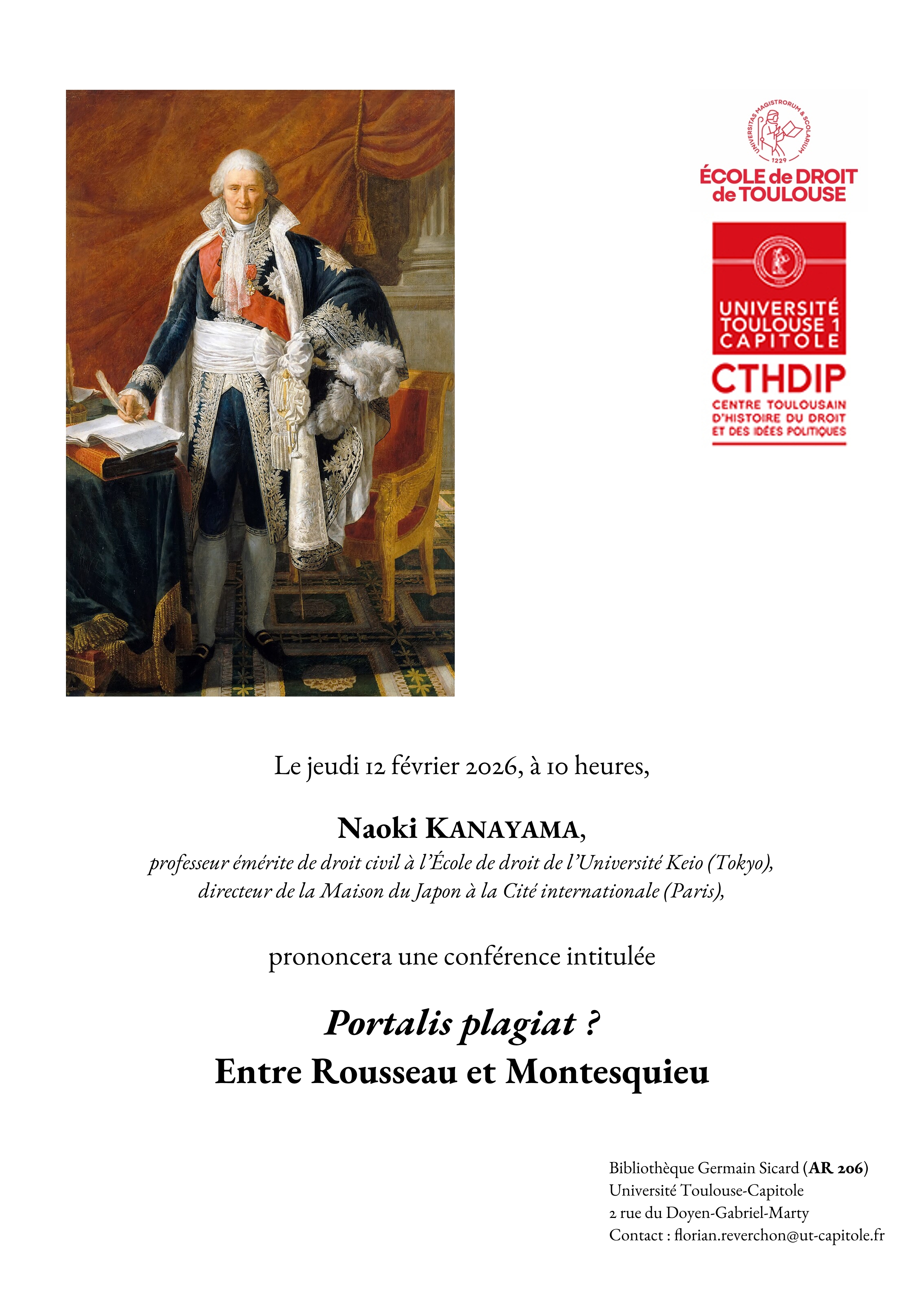
LECTURE: Naoki KANAYAMA, "Portalis plagiat ? Entre Rousseau et Montesquieu" (Toulouse: Université Toulouse 1 Capitole/CTHDIP, 12 FEB 2026)


On the speaker:

Naoki Kanayama est professeur émérite de droit civil à l’École de droit de l’Université Keio (Tokyo) et directeur de la Maison du Japon à la Cité internationale (Paris).

Convened by prof. Florian Reverchon (Toulouse).

Click here for more information

05 February 2026

BOOK: Nicolas MICHEL & Romain WAROQUIER (dir.), Pensée politique et Gouvernement dans l'Occident médiéval (XIe-début XIIIe siècle) [Rencontres, vol. 691; Civilisation médiévale, vol. 66] (Paris: Classiques Garnier, 2026), 288 p.


(image source: Classiques Garnier)

Abstract:

Comment s’opèrent le dialogue et les conditions de la négociation permanente entre norme et pratique du politique au sein des différents niveaux de pouvoir qui structurent la société occidentale du « long xiie siècle » ? Les contributions réunies dans ce volume offrent un éclairage important à cette question.

Read more here: DOI 10.48611/isbn.978-2-406-18979-4.

04 December 2025

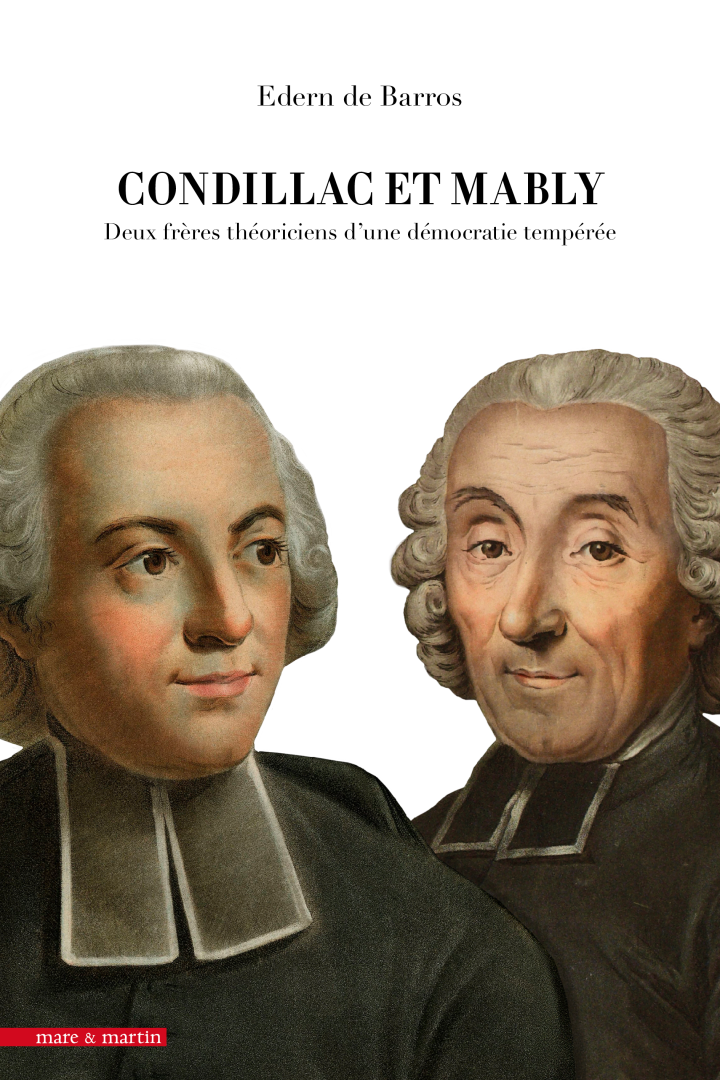
BOOK: Edern DE BARROS, Condillac et Mably. Deux frères théoriciens d'une démocratie tempérée [Politique de l'Esprit] (Paris: Mare & Martin, 2025), 510 p. ISBN 978-2-36222-137-8, € 45


(image source: Mare & Martin)

Abstract:
Condillac (1714-1780) et Mably (1709-1785) sont deux frères dont l’influence sur la Révolution française fut considérable. Figures majeures des Lumières, ils furent durablement séparés par l’historiographie depuis 1789. Condillac, associé aux Idéologues, serait le père du libéralisme français ; Mably, figure de la démocratie égalitaire, un précurseur du communisme. Cette étude déconstruit cette opposition et révèle leur républicanisme libéral commun. À la croisée du droit, de l’histoire et de la philosophie, l’ouvrage articule trois volets : une méthode empiriste fondée sur le lien entre droit naturel et histoire ; une théorie politique de la « démocratie tempérée » fondée sur la souveraineté populaire ; et une critique du « despotisme légal » des physiocrates, au nom d’une liberté économique républicaine. Appuyé sur une lecture comparée de leurs oeuvres complètes, ce livre renouvelle en profondeur notre compréhension des Lumières.

Read more with the publisher


19 September 2025

JOURNAL: Les despotismes de l'Autre (Special Issue Monde(S) 2025/1)


(image source: Cairn)

Abstract:
Ce numéro thématique consacré à la notion de « despotisme oriental » vise à articuler les enjeux de la géopolitique contemporaine avec les débats plus anciens concernant la nature de l’autoritarisme ainsi que ses origines culturelles et structurelles. Le « despotisme oriental » est un concept qui a évolué au fi l des siècles, de l’Antiquité au siècle des Lumières, De l’Esprit des lois de Montesquieu aux théories de Karl Marx sur le « mode de production asiatique », jusqu’à sa théorisation par le sinologue Karl Wittfogel (1957) pendant la Guerre froide. Ce concept constitue le fi l conducteur d’une réfl exion englobant diverses périodes historiques et aires culturelles, qui interroge la représentation des régimes autoritaires, les débats sur le concept de « totalitarisme », les discours orientalistes et les politiques hydrauliques. La portée, bien que très contestée, de la thèse de Wittfogel sur les facteurs écologiques et infrastructurels qui déterminent les systèmes politiques à travers le temps et l’espace ouvre de nombreuses pistes de réfl exion encore inexplorées. Pour cette raison, ce numéro rassemble des historiennes et des historiens s’intéressant aux structures et aux idées politiques, aux formes d’organisation sociales et économiques, à l’histoire des femmes et du genre et de l’environnement. Il couvre un vaste espace géographique incluant l’Europe, la Chine antique et contemporaine, la Russie et le monde musulman médiéval, dans le but de dépasser une perspective trop souvent eurocentrée. En examinant les usages et la pertinence de cette catégorie analytique, les contributions de ce numéro analysent, à travers diff érentes études de cas, à la fois la diff usion mais aussi la disqualification du concept de « despotisme oriental » ainsi que son utilisation dans diff érents débats théoriques et idéologiques. L’objectif est moins de remettre en cause sa validité épistémologique que de comprendre ce que son emploi révèle sur le rapport à l’altérité.

 Read more here.


08 September 2025

BOOK: Anthony MERGEY & Arnault SKORNICKI (eds.), The age of Du Pont de Nemours. Politics, law and physiocracy in the Ancien Régime to the American republic [Oxford University Studies in the Enlightenment, ed. Gregory BROWN (Liverpool: Liverpool University Press, 2025), 400 p. ISBN 9781836242857, 60 GBP

(image source: Liverpool UP)


Abstract:
Pierre-Samuel Du Pont de Nemours (1739-1817) is best known as a significant Enlightenment Physiocrat and economist, and, sometimes, as the ancestor of the famous industrial dynasty. But his thought and action are of an often-unsuspected richness. From Louis XV to the Restoration, between France and his American exiles, Du Pont de Nemours established himself as a prominent public figure, exploring an astonishing variety of issues, beginning as a bold reformer of the monarchy before becoming a moderate Republican. Bringing together an interdisciplinary team, this edited volume explores the myriad facets of Du Pont, as journalist, political thinker, administrator, publisher, legislator, diplomat, jurist, entrepreneur, playwright, and more. This book aims to reveal some of his most remarkable feature: it takes him out of solely the realm of physiocratic studies and the history of economic thought, and focuses on his thought and action, as well as on the legal history, administration, political, social, and even religious ideas. Far from being a pale reflection of a century marked by great democratic revolutions and the rise of capitalism, his work and his career mark the dimensions of a new world that he helped to shape.

On the editors:

Arnault Skornicki is an Associate Professor of Political Science at the University of Paris Nanterre and a member of the ISP. A specialist in the history of political and economic thought, he is currently completing a book on the "roi citoyen" in France and the United Kingdom in the 18th century. Anthony Mergey is a professor of legal history at Paris-Panthéon-Assas University and a member of the Institut d'histoire du droit. His research focuses primarily on the history of political ideas, the history of the state, and the history of administration in the 18th and 19th centuries.

Table of contents:

PREFACE | FOREWORD Anthony MERGEY & Arnault SKORNICKI | Introduction. Pierre-Samuel Du Pont de Nemours, a Journey through the 18th Century
I. ACTION PUBLIQUE, BONHEUR PRIVÉ | PUBLIC ACTION, PRIVATE HAPPINESS Julia ABRAMSON | Family Business at Pierre Samuel Du Pont de Nemours & Cie.: Huguenot Connections, Credit, and Capital in Post-Revolutionary France and AmericaII. UN JURISTE EN ACTION | A LAWYER IN ACTION Jean-Baptiste MASMÉJAN | Du Pont de Nemours et la question hospitalière: un éclairage des enjeux sanitaires à la fin du dix-huitième siècle Sébastien LE GAL | Du Pont De Nemours and the Maintenance of Public Order Thérence CARVALHO | *Abolir la contrainte par corps: le combat du jurisconsulte Du Pont de Nemours *III. UN PENSEUR POLITIQUE À L’EPREUVE DE LA RÉVOLUTION ET DE LA RÉPUBLIQUE | A POLITICAL THINKER CHALLENGED BY THE REVOLUTION AND THE REPUBLIC Thierry DEMALS & Alexandra HYARD | Politique et économie politique chez Pierre-Samuel Du Pont:Les annotations au Contrat social de Jean-Jacques Rousseau Christophe LE DIGOL | From One World to Another. How Du Pont de Nemours became a Revolutionary Liana VARDI | A Physiocratic Mandate: Du Pont de Nemours and l’Historien Annie LÉCHENET | Du Pont de Nemours et la république des ‘propriétaires du sol’IV. GUERRE ET PAIX ENTRE NATIONS | WAR AND PEACE BETWEEN NATIONS Antonella ALIMENTO | Commercial Treaties and the Emergence of a Political Economy of Peace: Dupont de Nemours, Inspirer of the Eden Treaty and Supporter of the Renewal of the Pacte de Famille (1782-1790) Alfred STEINHAUER |* Sur l’intérêt bien entendu des nations éclairées: la correspondance entre Thomas Jefferson et Du Pont de Nemours à propos de l’affaire de la Louisiane * Simona PISANELLI | Du Pont de Nemours: Colonies, Slavery and Economic GrowthV. LE RÊVE AMERICAIN DE DU PONT | DU PONT’S AMERICAN DREAM Gabriel SABBAGH | Du Pont de Nemours, coauteur des Lettres d’Abraham Mansword (1771-1772) et critique (1773-1789) de De Lolme: le modèle politique anglais confronté avec une Amérique rêvée Aya TANAKA | Pontiana: Du Pont de Nemours's Physiocratic Dream in America Manuela ALBERTONE | Des finances et des banques américaines: autour des rapports entre Du Pont de Nemours et Thomas JeffersonAnthony MERGEY & Arnault SKORNICKI | Du Pont de Nemours, between Physiocratic Loyalty and Political Versatility
Read more here

23 May 2025

BOOK: Dan EDELSTEIN & Jennifer PITTS (eds.), The Cambridge History of Rights, vol. IV: The Eighteenth and Nineteenth Centuries [The Cambridge History of Rights, eds. Nehal BHUTA, Anthony PAGDEN & Mira L. SIEGELBERG] (Cambridge: Cambridge University Press, 2025), ISBN 9781316519165, 120 GBP


(image source: Cambridge Core)

Abstract:
The age of Enlightenment and revolutions produced some of our best-known declarations of rights, but they did not create the idea of rights. Writers during this age did such a good job at declaring rights that many historians and politicians later believed that they invented them. The fourth volume of The Cambridge History of Rights shows that the eighteenth and nineteenth centuries are better understood as a time of transformation, extending rights-making to meet the needs of a modernizing world. Rights became a means of liberation for religious minorities, the economic downtrodden, women, slaves, and others. But rights also became a means of control, especially in European colonies around the world, as well as in liberal economic regimes that protected property rights. Through twenty-six essays from experts across the world, this volume serves as an authoritative reference for the development of rights across this period of history.

On the editors:

Dan Edelstein, Stanford University, California Dan Edelstein is the William H. Bonsall Professor of French and (by courtesy) of Political Science and History at Stanford University. Jennifer Pitts, University of Chicago Jennifer Pitts is Professor of Political Science and in the Committee on Social Thought at the University of Chicago.

Table of contents:

Part I. A Revolution in Rights?:
1. Barbeyrac's intervention. Grotius, Pufendorf, Locke David Grewal
2. Rights, mercantile capitalism and the bourgeois revolution: the rise of political economy Martti Koskenniemi
3. Social rights Glauco Schettini and Charles Walton
4. Rights in Enlightenment theories of rights Céline Spector
5. Rights, property, and politics: Hume to Hegel Richard Bourke
6. Antislavery in the age of rights: or, the rights of slaves confront the right to slaves Christopher Leslie Brown
7. The Enlightenment Constitutionalism and the rights of man Vincenzo Ferrone
8. Fundamental rights at the American founding Jud Campbell
9. Declarations of rights Jeremy D. Popkin
10. The rights of women (or women's rights) Karen Offen
11. The image of rights in the French Revolution Adam Lebovitz
Part II. Post-Revolutionary Rights:
12. On the nadir of natural rights theory in nineteenth-century Britain Gregory Conti
13. The 1789 declaration of the rights of man and of the citizen: a civil creed of the French republic? Valentine Zuber
14. Rights in the thought of Kant, Fichte, and Hegel Frederick Neuhouser
15. Rights and socialism 1750–1880 Gareth Stedman Jones
16. Economic liberalism and rights in the nineteenth century David Todd
17. Human rights during the 1848 revolutions Mike Rapport
Part III. Rights and Empires:
18. Rights and empires: relations of authority Lauren Benton and Jane Burbank
19. Rights in Late Mughal and Early Colonial India Hasan Zahid Siddiqui
20. Rights in the Americas Joshua Simon
21. The free sea: an antislavery of human rights Amy Dru Stanley
22. Abolition and Imperialism in Africa Bronwen Everill
23. Rights in Pan-Asian, Pan-Islamic, and Pan-African thought Cemil Aydin
24. Indigenous rights in settler colonies Saliha Belmessous
25. Catholicism and rights: politics, economics and, sexuality Udi Greenberg

26. (Human) Rights Associations (1775–1898) Wolfgang Schmale.

Read more here: DOI  10.1017/9781009019521.

21 May 2025

BOOK: Vincent PETIT (dir.), La conjuration des hommes libres. Une histoire du serment politique (XVIII-XXIe siècle) [Histoire] (Rennes: Presses universitaires de Rennes, 2025), ISBN 9782753593459, € 18


Abstract:
L'histoire du serment politique en Occident est celle d'un long dévoiement. Ce rite habillé d'oripeaux antiques, médiévaux et religieux, avait été pensé comme l'instrument de la conjuration des hommes libres. Il sera devenu un des moyens de conjurer leur liberté. Alliance des hommes libres et égaux sous le regard de Dieu, il est progressivement encadré par les puissances politiques et ecclésiales, puis capté par l'État moderne à partir du XVIIe siècle. L'expérience révolutionnaire cherchera à redonner au serment son caractère démocratique et égalitaire, avant qu'au XIXe il ne devienne un rite de sujétion bureaucratique. Dans les régimes autoritaires et totalitaires, il exprime non seulement une fidélité politique mais il est la marque d'un biopouvoir par lequel l'individu abdique sa conscience et jusqu'à son propre corps dans le peuple, le parti, l'État, l'idéologie, le chef. C'est à une histoire politique enracinée dans les pratiques juridiques et les doctrines religieuses propres à l'Occident, et aujourd'hui négligée, que ce livre s'attache à donner une lecture originale et novatrice, puisqu'il s'agit de la première synthèse en français sur l'histoire du serment.

 Read more here.


28 April 2025

CONFERENCE: Henri Saint-Simon (1760-1825), le fondateur des fondateurs. Colloque du bicentenaire de la mort du philosophe (Paris: Bibliothèque de l'Arsenal, Maison Auguste Comte, Société des Etudes saint-simoniennes, 16-17 MAY 2025)

(image source: Wikimedia Commons)

Abstract:

À l'occasion du bicentenaire de la mort du philosophe Henri Saint-Simon (1760-1825), ce colloque international et pluridisciplinaire, traitera de l’œuvre de Saint-Simon dans son contexte historique et aussi ses multiples interprétations. Il abordera les héritages nombreux de son œuvre dont le saint-simonisme, le positivisme, les socialismes et l’industrialisme.

 Program:

Vendredi 16 mai 

  • Philippe RÉGNIER, CNRS histoire littéraire, IHRIM Saint-Simon à l’heure de sa mort : qu’incarne-t-il pour la jeunesse de 1825 ? 
  • Jean DHOMBRES, EHESS, histoire des sciences  Dynamiques des sciences du temps « scientifique » de Saint-Simon  
  • Sayuri SHIRASE, docteure en philosophie, JSPS Research Fellow  Saint-Simon et le Japon. Réception de la doctrine de l’ère Meiji à nos jours 
  • Diane MORGAN, université de Leeds UK, cultural studies,  La figure du dernier homme et la fin du monde chez Saint-Simon 
  • Dominique IOGNA-PRAT, EHESS, histoire  Saint-Simon en quête d’un « christianisme définitif » 
  • Pierre MUSSO, université de Rennes et Télécom Paris  L’énigme Saint-Simon et la religion industrielle 

Table ronde « Saint-Simon, saint-simonisme et industrie »  à l’Arsenal 17h 30- 19h

animée par Pierre Musso, avec

  • Isabelle BERREBI-HOFFMANN, Directrice de recherche  CNRS au CNAM    - Pascal DALOZ, DG de Dassault Systèmes
  • Nicolas DUFOURCQ, DG de la Banque Publique d’Investissement 
  • Jean-Dominique SENARD, Président de Renault 

Samedi 17 mai 

  • Michel BOURDEAU, CNRS  Auguste Comte, saint-simonien? 
  • Jan E.M. HOUBEN, Ecole Pratique des Hautes Etudes Saint-Simon et la paix
  • Laurent FEDI, université de Strasbourg, philosophie Le temps des prophètes : le dernier Comte et les saint-simoniens 
  • Marie JANIN doctorante et Thérence CARVALHO, université de Nantes, droit et pensée politique Le Droit comme instrument du « Nouveau Christianisme » : la pensée juridique de Saint-Simon et sa diffusion en Europe par l’école saint-simonienne
  • Antoine PICON, histoire, Harvard Graduate School of Design.  Régénérer la connaissance : Saint-Simon, les Saint-simoniens et la Science 
  • Mary PICKERING, histoire, San Jose State University L'idée du « peuple » dans les œuvres de Saint-Simon et Auguste Comte 
Practicalities:

Le vendredi 16 mai il se tiendra à partir de 9 heures à la Bibliothèque de l'Arsenal, 1 rue de Sully à Paris 4e arr. Métro Sully-Morland Le samedi 17 mai, le colloque se déroulera à la Chapelle de l'Humanité, 5 rue Payenne, Paris 3e arr. à partir de 9h 30. Métro Saint-Paul. En parallèle au collooque se tiendront deux expositions autour de Saint-Simon : l'une à la Bibliothèque de l'Arsenal et l'autre à la Maison Auguste Comte, 10 rue Monsieur le Prince, Paris 6e.  Visites en groupe sur rendez-vous.

 Read more here.

02 April 2025

BOOK: Nathalie DROIN & Ludovic de THY (dir.), Décentralisation et République dans la pensée juridique et politique de la Troisième République [Rencontres, ed. ; 661] (Paris: Classiques Garnier, 2025), 293 p. ISBN 978-2-406-18080-7, € 28


(image source: Classiques Garnier)

Abstract:

Si les recherches sur la décentralisation sont nombreuses, en revanche, jusqu’à cet ouvrage, aucune réflexion collective n’a eu pour objet d’examiner la question de la décentralisation du point de vue des grands auteurs de la Troisième République, à qui l’on doit la théorisation du droit public.

Read more here

09 January 2025

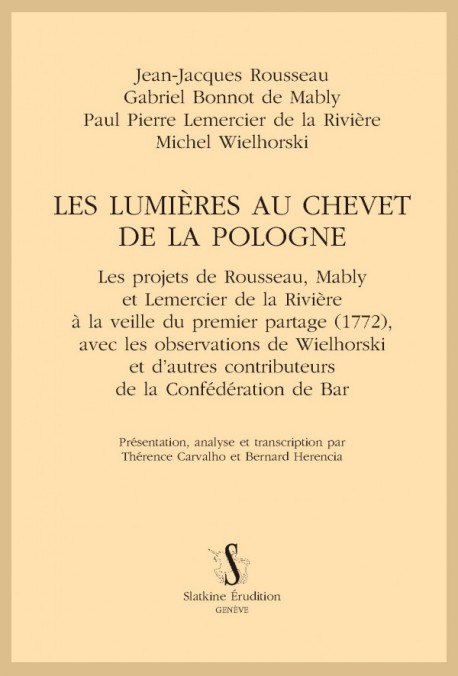
BOOK: Jean-Jacques ROUSSEAU, Gabriel BONOT de MABLY, Paul Pierre LEMERCIER de la RIVIÈRE, Les Lumières au chevet de la Pologne. Les projets de Rousseau, Mably, et Lemercier de la Rivière à la veille du premier partage (1772), avec les observations de Wielhorski et d'autres contributeurs de la Confédération de Bar (ed. Thérence CARVALHO & Bernard HERENCIA) [Naissance de l'économie politique, ed. Bernard HÉRANCIA] (Genève: Slatkine, 2024), 538 p. ISBN 9782051029377, € 59

(image source: Honoré Champion)

Abstract:

Dans la seconde moitié du XVIIIe siècle, la Pologne-Lituanie est une République en péril. Son territoire est âprement convoité par la Russie, la Prusse et l’Autriche, qui finiront après trois partages (1772, 1793 et 1795) par rayer le pays de la carte géopolitique de l’Europe pour plus d’un siècle. Dans l’espoir de mettre fin à cette crise, Michel Wielhorski (1730-1794), émissaire de la confédération de Bar, arrive en France et sollicite le concours de plusieurs philosophes. Trois penseurs mettent leur plume au service de la République : Gabriel Bonnot de Mably (1709-1785), Jean-Jacques Rousseau (1712-1774) et Paul Pierre Lemercier de la Rivière (1719-1801). Cette édition aspire à éclairer d’un jour nouveau ces projets politiques et constitutionnels en rassemblant pour la p remière fois :

– les textes inédits des quatre séries d’Observations sur la réforme des lois de la Pologne de Mably avec les Considérations sur le gouvernement de Pologne de Rousseau et L’intérêt commun des Polonais de Lemercier de la Rivière ;

– les contributions fondamentales de Wielhorski comme son Tableau du gouvernement de Pologne et son Essai sur les mœurs et le caractère des Polonais, qui constituèrent une source majeure d’informations pour Mably et Rousseau ;

– les réactions inédites des membres de la confédération de Bar aux Observations de Mably, qui montrent comment ses idées furent reçues en Pologne-Lituanie et sur quelle base le philosophe fit évoluer son projet.

Outre la version intégrale de ces textes, ce volume comprend de multiples documents qui permettent de mieux comprendre le contexte et la vivacité des débats à la veille du premier partage de 1772. Ce passionnant dialogue francopolonais, qui aborde la question de la modernité du républicanisme et de ses potentialités démocratiques, offre des témoignages exceptionnels de l’émergence d’une pensée constitutionnelle dans l’Europe des Lumières et mérite pleinement d’être redécouvert.

On the editors:

Thérence Carvalho, agrégé des facultés de droit, est professeur à Nantes Université et membre du Laboratoire Droit et Changement social (DCS – UMR CNRS 6297). Ses recherches portent sur l’histoire du droit et de la pensée politique et économique au XVIIIe siècle. Bernard Herencia est maître de conférences habilité à l’Université Gustave Eiffel et membre du Laboratoire Interdisciplinaire d’Etude du Politique Hannah Arendt (LIPHA – EA 7373). Directeur de la présente collection, il consacre ses recherches à l’histoire de la pensée économique au XVIIIe siècle.

More information here

19 December 2024

BOOK: Peter SCHRÖDER (ed.), Pufendorf's International Political and Legal Thought [The History and Theory of International Law, eds. Nehal BHUTA, Francesca IURLARO, Anthony PAGDEN & Benjamin STRAUMANN] (Oxford: OUP, 2024), 304 p., ISBN 9780191979705, 90 GBP


(image source: OUP)
Abstract:
Contemporary research on the genealogy of human rights and the foundations of international law has brought renewed interest to the study of natural law in the early-modern period. German-born Samuel Pufendorf (1632-1694) is one of the eminent thinkers of this tradition, shaping the period's natural jurisprudence. This unique collection of essays edited by historian of political thought Peter Schröder fills in a gap in Pufendorf scholarship, exploring the significance of his contributions to political and legal thought on a broad scale. While many books studying Pufendorf's work are confined to one specific academic area, Pufendorf's International Political and Legal Thought is truly interdisciplinary, and the first book to substantially address the international aspect of Pufendorf's work. Ambitious and accessible, this collection is indispensable for scholars and students of intellectual history, political thought, international legal history, the Enlightenment, and political economy. With its focus on international law, Pufendorf's International Political and Legal Thought is a critical addition to the existing body of work on this renowned philosopher and jurist.

Table of contents:

Contexts and Concepts of Pufendorf's Political and Legal International Thought - An Introduction, Peter Schröder
I
1:Pufendorf on Confessional Strife and Interstate Relations, Nathaniel Boyd
2:De Systematibus Civitatum: Pufendorf on Confederations and Composite Kingdoms, Ben Holland
3:Rhetorical Strategy and Legal Force in Pufendorf's State of Nature, Mark Somos, Ioannis Evrigenis
4:Pufendorf's Contract Theory of the State and the Distinction Between Citizens and Foreigners, Laetitia Ramelet
5:Pufendorf on European Conquest and Non-European Peoples, Theo Christov
6:"Infinite Right": Proportionality and Liability in Early Modern Ethics of War and Self-Defence, Johan Olsthoorn
II
7:Pufendorf's Idea of Natural Equality, Thomas Behme
8:Sovereignty and Interstate Relations, Peter Schröder
9:Sex and Gender in Pufendorf's International Political Thought: Protecting the Body Politic with Body Politics and with a (Gendered) Politics of Self-Esteem, Eva Odzuck
10:Pufendorf on Slavery, Kari Saastamoinen
11:Pufendorf's Revaluation of Hobbes's Friend-Enemy Distinction and Law of War, Heikki Haara
12:The Reception of Pufendorf's "International Thought" in Eighteenth-Century Germany, Ere Nokkala

13:Pufendorf's Enduring Legacy for International Law, Camilla Boisen

On the editor:

Peter Schröder is Professor of the History of Political Thought at University College London. He was awarded an M.A. (1995) and PhD (1999) from Philipps University Marburg, Germany before he joined UCL in 2001. He was visiting professor at universities in Seoul, Rome, and Paris and held numerous senior research fellowships, among others at the Max Weber Centre for Advanced Cultural and Social Studies at University of Erfurt, the Institute for Advanced Studies at Central European University Budapest and the Centre for Advanced Studies of the Royal Flemish Academy of Belgium for Science and the Arts. He has published widely on the history of political thought.

Read more here


05 December 2024

BOOK: Johan OLSTHOORN, Hobbes on Justice [The History and Theory of International Law, eds. Nehal BHUTA, Francesca IURLARO, Anthony PAGDEN & Benjamin STRAUMANN] (Oxford: OUP, 2024), ISBN 9780198867982, 100 GBP


(image source: OUP)

On the book:

Thomas Hobbes (1588-1679) is widely regarded as one of the most important political thinkers in the Western tradition. Justice is one of the main political concepts today. This is the first book-length analysis of Hobbes's ideas on justice. Hobbes made many startling claims about justice. Norms of justice have no place outside the commonwealth, the civil law determines what is just and unjust, and nothing sovereigns do is unjust to their citizens. But what exactly did Hobbes mean by justice? And how did he convince his audience that he was speaking about justice when advancing such controversial views, and not about something else? In Hobbes on Justice, Olsthoorn traces the place of justice in Hobbes's moral, legal, political, and international thought as developed over time. The book reconstructs his idiosyncratic glosses on notions like justice, rights, injury, obligation, and law; proposes new solutions to some long-standing interpretive puzzles; and provides in-depth discussions of property, slavery, treason, just war and other neglected aspects of Hobbes's thought. Olsthoorn shows that Hobbes's theory of justice doubled as a civil theodicy: it aimed to morally empower sovereign rulers by vindicating them from all stains of injustice, no matter how horrid their rule. Combining analytic philosophy, intellectual history, and political theory, this major new study of Thomas Hobbes will be of wide and cross-disciplinary interest to scholars of philosophy, law, politics, and history.


On the author:

Johan Olsthoorn is associate professor in political theory at the University of Amsterdam. He has published extensively on Hobbes and early modern moral, legal, and political theory in journals including Philosophers' Imprint; Journal of the History of Philosophy; History of Political Thought; and European Journal of Political Theory. Co-editor of Hobbes's On the Citizen: A Critical Guide (Cambridge, 2019), this is his first monograph.

Reviews:

"Johan Olsthoorn is one of the most astute commentators on Hobbes's moral and political philosophy writing today. His book is scholarly, rigorously argued, and full of insight. No serious student of Hobbes's philosophy can afford to forgo grappling with Olsthoorn's reading. " - Professor Arash Abizadeh, McGill University "Hobbess theory of justice has been neglected because it has seemed so obviously to fail as an account of what justice is ordinarily taken to be. The great strength of Johan Olsthoorns analysis is that he does not seek to avoid or tone down the implications of the Hobbesian claim that the nature of justice is defined by the will of the sovereign. Instead he follows Hobbess arguments to their conclusions, and in the process brings out both the complexity and the power of Hobbess civil theodicy. This beautifully clear and always rigorous book is a landmark in Hobbes scholarship." - Professor James Harris, University of St Andrews.

Read more here

09 October 2024

BOOK: Cornel ZWIERLEIN & Daniel LEE (eds.), Sovereignty. European and Global Histories, 1400-1800 [Intersections, ed. Karl A. E. ENENKEL] (Leiden/Boston: Martinus Nijhoff/Brill, 2025), XIV + 416 p. ISBN 9789004218628, €135,68


(image source: Brill)

Abstract:

Was the emperor as sovereign allowed to seize the property of his subjects? Was this handled differently in late medieval Roman law and in the practice and theory of zabt in Mughal India? How is political sovereignty relating to the church´s powers and to trade? How about maritime sovereignty after Grotius? How was the East India Company as a ´corporation´ interacting with an Indian Nawab? How was the Shogunate and the emperor negotiating ´sovereignty´ in early modern Japan? The volume addresses such questions through thoroughly researched historical case studies, covering the disciplines of History, Political Sciences, and Law. Contributors include: Kenneth Pennington, Fabrice Micallef, Philippe Denis, Sylvio Hermann De Franceschi, Joshua Freed, David Dyzenhaus, Michael P. Breen, Daniel Lee, Andrew Fitzmaurice and Kajo Kubala, Nicholas Abbott, Tiraana Bains, Cornel Zwierlein, Mark Ravina.

Table of contents:


Introduction
Cornel Zwierlein and Daniel Lee

Part 1: European Sovereignties


Sovereignty, the Prince, and Property Rights
Kenneth Pennington

Offering Sovereignty in Exchange for Assistance? The Appeal of the Dutch to Henry III of France (1584–1585)
Fabrice Micallef

Edmond Richer, Jean Bodin and the Idea of Sovereignty
Philippe Denis

Venetian Republicanism against the Roman Ambitions of Pontifical Theocracy ‒ Sovereignty According to Paolo Sarpi: Political Theory and the Challenge of the Venetian Interdict Crisis (1606–1607) and Its Aftermath
Sylvio Hermann De Franceschi

Jurisdiction, Territory, Sovereignty: Giulio Pace and the Dominion of the Sea
Joshua Freed

Hobbes and the Healthy Sovereign
David Dyzenhaus

‘Le prince doit avoir une autorité souveraine sur les mariages’: Annulments, Sovereignty, and the Law in Early Modern France
Michael P. Breen

Sovereignty and the Duties of Humanity: On Money, Barter, and Sale
Daniel Lee

Part 2: Global Sovereignties


10 ‘Company-states’ and Sovereignty
Andrew Fitzmaurice and Kajo Kubala

11 Zabt and Its Discontents: Property Confiscation, Patrimonial Kingship, and the Performance of Sovereignty in Mughal India, c.1600–1800
Nicholas Abbott

12 Unsettling Sovereignty between the Mughal and British Empires: the Case of the Nawab of Arcot, circa 1749–1795
Tiraana Bains

13 Sovereignty and Untranslatability: European International Law, France, the Ottoman Empire and the Barbary States 1720–1740
Cornel Zwierlein

14 Who Was Sovereign in Early Modern Japan?
Mark Ravina


On the editors:

Cornel Zwierlein is teaching early modern history since 2001, holding Habilitation rights since 2011. He is a specialist in Early Modern European and Global History, Political Theory, Religion and Law. Daniel Lee is Professor of Political Science at the University of California, Berkeley. He is a specialist in political theory, the history of political thought, and jurisprudence. 

Read more: DOI 10.1163/9789004218628.

22 August 2024

BOOK: Dario DI CECCA, Introduzione al socialismo giuridico francese [Collana di Studi di storia del diritto medievale e moderno - Monografie, 14; eds. Paolo ALVAZZI DEL FRATE, Giordano FERRI, Giovanni ROSSI, Elio TAVILLA] (Roma: Historia et Ius, 2024), 152 p. ISBN 979-12-81621-05-3 [OPEN ACCESS]


(image source: Historia et Ius)

Foreword:
Con la defi nizione di socialismo giuridico si intende inquadrare una dottrina giuridica dalla forte connotazione politica aff ermatasi, soprattutto in Italia e in Francia, tra gli anni Ottanta dell’Ottocento e i primi decenni del Novecento. Tale scuola nacque grazie all’ispirazione delle teorie di Anton Menger sulla possibilità di instaurare un sistema giuridico socialista in modo incruento e senza abbattere il regime preesistente. Questo sarebbe stato possibile grazie agli strumenti forniti dal diritto esistente: una graduale modifi ca della legislazione che tenesse conto delle istanze delle classi lavoratrici e meno abbienti e una giurisprudenza che, sulla scorta delle recenti teorie sul ruolo dell’interprete, applicasse il diritto adattandolo al nuovo contesto economico e sociale.

Read the full book here


13 August 2024

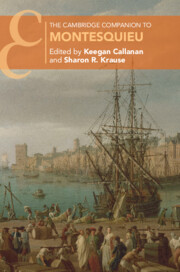
BOOK: Keegan Francis CALLANAN & Sharon Ruth KRAUSE (eds.), The Cambridge Companion to Montesquieu (Cambridge: Cambridge University press, 2023), ISBN 9781108778923


(image source: Cambridge Core)

Abstract:
Montesquieu was among the most influential writers of the eighteenth century, and the study of his thought enriches and complicates our understanding of the Enlightenment. Following renewed interest in his writings over the last three decades, the Cambridge Companion to Montesquieu brings together the variety of disciplinary and interpretive approaches that have shaped the scholarship on his work and legacy. This Companion offers an integrated volume on Montesquieu as philosopher, novelist, historian, economic thinker, political scientist, and political theorist. It introduces readers to key themes and ongoing debates, reflects developments in the field, breaks fresh ground, indicates avenues for future research, and provides multiple perspectives on the relevance of Montesquieu's thought to contemporary problems in political theory.

Table of contents:

1. Montesquieu: life and letters by Paul A. Rahe
2. Persian letters by Catherine Volpilhac-Auger
3. Considerations on the Romans by Thomas L. Pangle
4. On the spirit of the laws by Keegan Callanan
5. Montesquieu and the classical world by Catherine Larrère
6. Montesquieu's guiding principles and foundations by Cecil Courtney
7. Virtue in Montesqueiu by David W. Carrithers
8. Internationalism, cosmopolitanism, and empires by Michael Mosher
9. Liberty in Montesquieu by Céline Spector
10. Political sovereignty in Montesquieu by Sharon R. Krause
11. Montesquieu on slavery by Vickie B. Sullivan
12. Montesquieu on the liberty of women by Diana J. Schaub
13. Political economy by Paul Cheney
14. Religion and politics by Annelien de Dijn
15. Constitutional history by Jacob T. Levy
16. Montesquieu and the enlightenment by Jonathan Israel
17. Montesquieu's liberal legacies by Rebecca E. Kingston
Bibliography.

Read more here: DOI 10.1017/9781108778923

21 March 2024

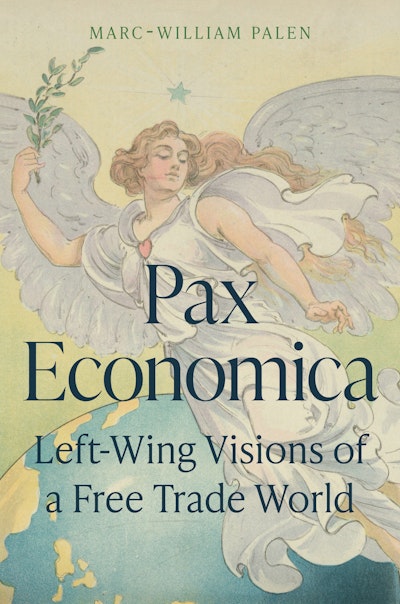
BOOK: Marc-William PALEN, Pax Economica: Left-Wing Visions of a Free Trade World (Princeton: Princeton University Press, 2024), 328 p. ISBN 9780691199320


(image source: Princeton)

Book abstract:

Today, free trade is often associated with right-wing free marketeers. In Pax Economica, historian Marc-William Palen shows that free trade and globalisation in fact have roots in nineteenth-century left-wing politics. In this counterhistory of an idea, Palen explores how, beginning in the 1840s, left-wing globalists became the leaders of the peace and anti-imperialist movements of their age. By the early twentieth century, an unlikely alliance of liberal radicals, socialist internationalists, feminists, and Christians envisioned free trade as essential for a prosperous and peaceful world order. Of course, this vision was at odds with the era’s strong predilections for nationalism, protectionism, geopolitical conflict, and colonial expansion. Palen reveals how, for some of its most radical left-wing adherents, free trade represented a hard-nosed critique of imperialism, militarism, and war. Palen shows that the anti-imperial component of free trade was a phenomenon that came to encompass the political left wing within the British, American, Spanish, German, Dutch, Belgian, Italian, Russian, French, and Japanese empires. The left-wing vision of a “pax economica” evolved to include supranational regulation to maintain a peaceful free-trading system—which paved the way for a more liberal economic order after World War II and such institutions as the United Nations, the European Union, and the World Trade Organization. Palen’s findings upend how we think about globalisation, free trade, anti-imperialism, and peace. Rediscovering the left-wing history of globalism offers timely lessons for our own era of economic nationalism and geopolitical conflict.

On the author:

Marc-William Palen is a historian at the University of Exeter and the author of The “Conspiracy” of Free Trade: The Anglo-American Struggle over Empire and Economic Globalisation, 1846–1896. 

Read more here

18 January 2024

BOOK: Arnault SKORNICKI & Jérôme TOURNADRE (dir.), La nouvelle histoire des idées politiques [Repères] (Paris: La Découverte, 2024), 128 p. ISBN 9782348082023


(image source: cairn)

Abstract:

L’histoire des idées politiques s’est longtemps résumée au commentaire savant de grands penseurs discutant de grandes questions éternelles. De par le monde, les entreprises de refondation se sont pourtant multipliées depuis les années 1960, portées par des approches parfois divergentes, mais s’accordant sur la nécessité de traiter les idées comme des faits insérés dans la réalité historique. Longtemps restée en marge, la France a fini par être gagnée par ces courants étrangers et par développer à son tour de nouvelles entreprises collectives originales. Ce panorama national et international met en relation les divers courants de cette historiographie renouvelée. Disséquant les apports d’écoles consacrées (Cambridge School, sémantique historique allemande, généalogie foucaldienne, histoire sociale des idées politiques, etc.) et mettant en perspective des thématiques ayant peu fait l’objet de synthèses (idées et milieux populaires, idées et décision publique, etc.), il offre des réponses à des questions essentielles : qu’est-ce qu’une idée politique ? Les idées politiques sont-elles le fruit du seul génie créateur de leurs auteurs ? Gouvernent-elles le monde ?

Read more on cairn