Search

Showing posts with label lecture. Show all posts

25 August 2026

YOUTUBE: Michael DOYLE; "More than Just Peace" (Paris: Collège de France, 21 MAY 2026)

Abstract:

John Rawls’s publication of The Law of Peoples was a profound attempt to design a just peace. Beyond the simple cessation of armed hostilities, the Law of Peoples offered more than (just) peace. It committed its peoples to honor human rights, tolerate other decent political regimes and accept a "duty of assistance" owed by all decent societies to all those in dire need. Importantly, for Rawls, the project he outlined in The Law of Peoples is a constructed peace, one that needs to be established among liberal peoples and then extended to other decent societies. The construction raises the questions of why it is that Rawls thought the peace (1) needed to be constructed and could be constructed in a world otherwise divided by insecurity and strife among states. In doing this, he directly addressed the Realist challenges described by Thomas Hobbes in his Leviathan and revived by Thomas Nagel. It also raises the question of (2) why Rawls thought it was necessary to go beyond Perpetual Peace, a Liberal model of international peace constructed by Immanuel Kant (Rawls’s inspiration and answer to the first question), and (3) why Rawls might have thought that the extension beyond the Kantian peace among liberal republics to a wider "just peace" that incorporated a duty of assistance was possible, and indeed "realistic."

More information here


29 April 2026

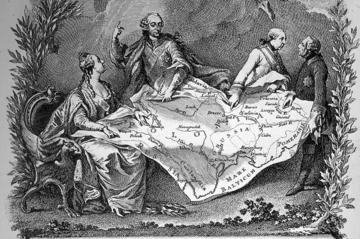
LECTURE: David ARMITAGE, ""Poland was but a breakfast": or, why 1772 helps us to understand 1776" [2026 Annual George Rousseau Lecture] (Oxford: Magdalen College, 13 MAY 2026)


(image source: Oxford)

Description:
The American Revolution is now widely accepted to have been the last civil war within the British Empire of the Atlantic world. However, British, imperial, and Atlantic contexts do not exhaust the historical frames essential to understand the Revolution or, more specifically, 1776. For contemporaries on both sides of the Atlantic, Europe—particularly the European balance of power—was the most important setting for the fears raised by the American War. The greatest assault on that balance of power had occurred only four years before 1776 in 1772 with the first Partition of Poland by Austria, Prussia and Russia. This lecture shows how fears of partition, "Poland like", drove the decision for American independence and how the Polish response to partition shaped the British counterblast to the Declaration of Independence. The lecture will be followed by a drinks reception.

On the speaker:

David Armitage is the Lloyd C. Blankfein Professor of History and former Chair of the Department of History at Harvard University, where he teaches intellectual history and international history. He is also an Affiliated Professor in the Harvard Department of Government, an Affiliated Faculty Member at Harvard Law School, and an Honorary Professor of History at the University of Sydney. Before coming to Harvard in 2004, he taught for eleven years at Columbia University. He is the author or editor of fifteen books, among them The Ideological Origins of the British Empire (2000), The Declaration of Independence: A Global History (2007), Foundations of Modern International Thought (2013), The History Manifesto (co-auth., 2014), and Civil Wars: A History in Ideas (2017). Among his edited works are Shakespeare and Early Modern Political Thought (co-ed., 2009), The Age of Revolutions in Global Context, c. 1760-1840 (co-ed., 2010), and Pacific Histories: Ocean, Land, People (co-ed., 2014).

More information here


11 February 2026

JHIL ANNUAL LECTURE: Michel ERPELDING, "Reflections on a non-lieu de mémoire of international law: the rise and fall of mixed courts for the adjudication of private rights" (Cologne: Akademie für europäischen Menschenrechtsschutz, 16 MAR 2026)

(click on image to enlarge poster)

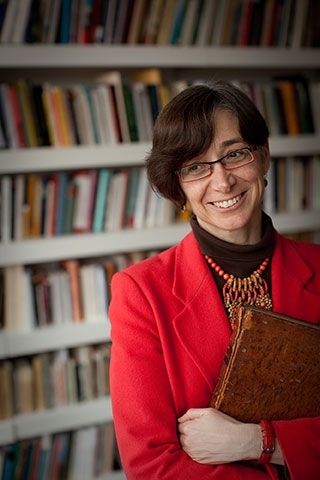
dr. Michel Erpelding (Research Group Leader, MPILHLT) will deliver this year's JHIL Lecture at the Akademie für europäischen Menschenrechtsschutz in Cologne, organised by the Journal of the History of International Law/Revue d'histoire du droit international.

On the speaker:

Michel Erpelding is Research Group Leader at the Max Planck Institute for Legal History and Legal Theory in Frankfurt am Main, Germany. His current research focusses on the history of international and European integration law, with a special interest in their interaction with colonial law and practices. He is an associate member of the Institut de recherche en droit international et européen de la Sorbonne (IREDIES) and teaches at the University of Luxembourg and the Sorbonne Law School.

Abstract:

Present-day commentators often present the rise of the individual as a subject of international law – and notably as a fully-fledged claimant before international courts – as a phenomenon that only emerged after 1945. However, between the end of the 19th century and the first half of the 20th century, several treaty regimes had already established internationally composed judicial institutions endowed with jurisdiction over treaty-based claims by private persons both against other private persons and sovereign states. Despite their pioneering role and their rich practice, these early international courts have today largely disappeared from the collective memories of international lawyers and the broader public, resulting in the creation of what the French historian Gérard Noiriel has described as ‘spaces of collective amnesia’ (non-lieux de mémoire). This presentation will retrace the creation, expansion, and eventual disappearance of this phenomenon while questioning why it fell into oblivion.

The event will take place on Monday 16 March 2026 at 18:00 Cologne time.

Address below:

RSVP with submissions dot jhil at mpil dot de.

10 February 2026

LECTURE SERIES: Figures/Visages de l'administration dans l'Europe des crises politiques (XVIe-XXIe siècles) (Brussels: UCLouvain, St-Louis Bruxelles, 17 FEB 2026)


(click on image to enlarge)

Abstract:

Ce séminaire, intitulé Figures/Visages de l'administration dans l'Europe des crises politiques (XVIe-XXIe siècles), est conçu sur le mode de l'atelier de discussion méthodologique et épistémologique. Après une introduction conduite par Nicolas Simon (ARB), Quentin Verreycken (FNRS/UCLouvain) et Jérémie Ferrer-Bartomeu, nous donnerons la parole à nos trois orateurs : Catherine Thomas (Musée du Verre de Charleroi), Christian Ingrao (CNRS, ancien directeur de l'Institut du Temps Présent) et Xavier Rousseaux (FNRS/UCLouvain). La discussion sera animée par John Pitseys (député au parlement bruxellois, docteur de l'UCLouvain).

Registration (mandatory for logistical purposes) with jeremie dot ferrer at uclouvain dot be. 

09 February 2026

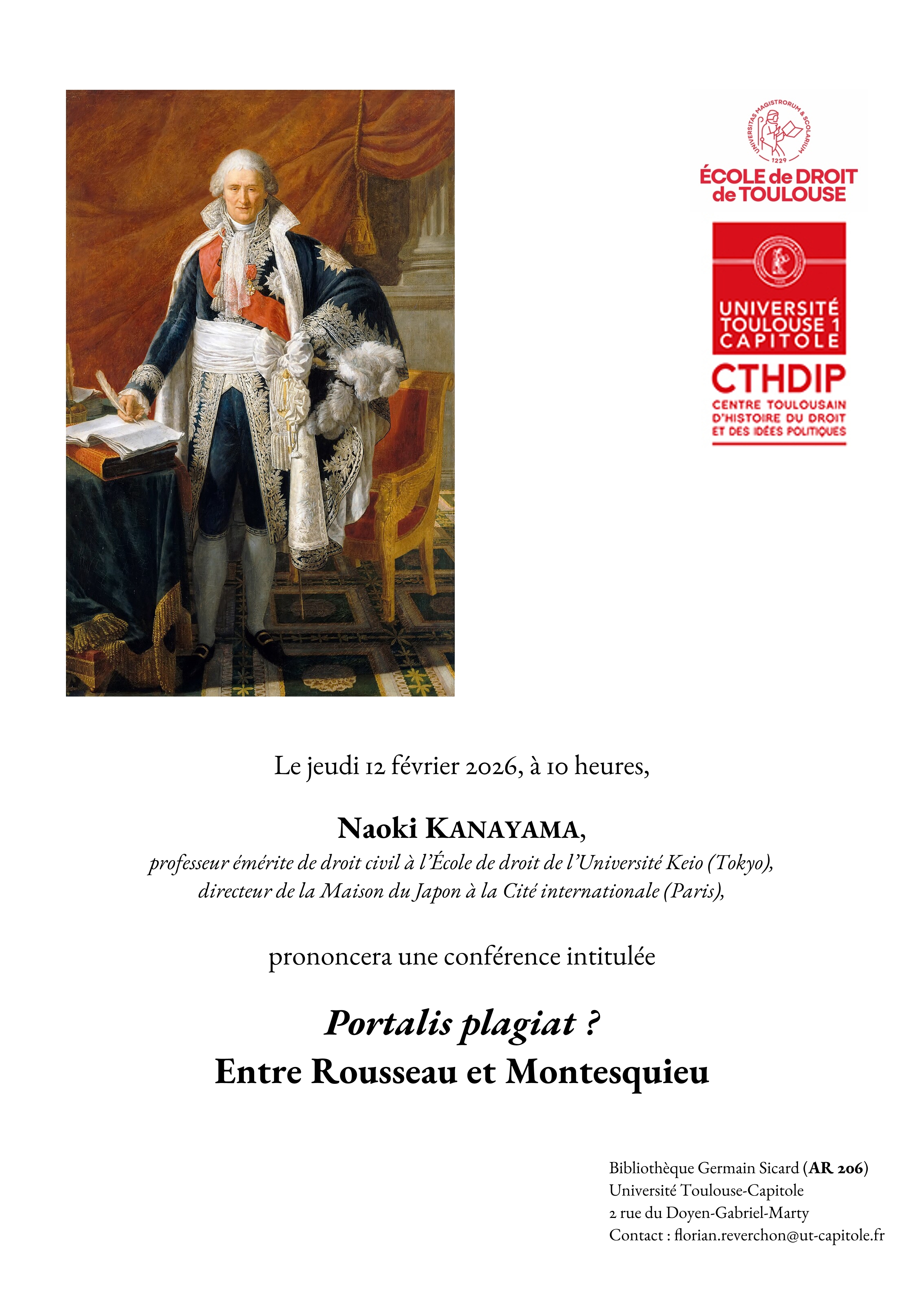
LECTURE: Naoki KANAYAMA, "Portalis plagiat ? Entre Rousseau et Montesquieu" (Toulouse: Université Toulouse 1 Capitole/CTHDIP, 12 FEB 2026)


On the speaker:

Naoki Kanayama est professeur émérite de droit civil à l’École de droit de l’Université Keio (Tokyo) et directeur de la Maison du Japon à la Cité internationale (Paris).

Convened by prof. Florian Reverchon (Toulouse).

Click here for more information

24 October 2025

PRIZE LECTURE: Sarton Medal for Legal History 2025 to Prof. em. dr. Lucien BÉLY (Sorbonne-Université/Institut de France-Académie des sciences morales et politiques), "Les femmes dans la diplomatie aux temps modernes" (Ghent: UGent, 13 NOV 2025)


Sarton Medal 2025 – Sartonmedaille 2025

on Thursday, November 13th at 4 pm


in Auditorium Leon De Meyer of the University Forum

Sint-Pietersnieuwstraat 33, 9000 GENT


The Ghent University Sarton Committee,

Prof. Dr. Michel Tison, Dean of the Faculty of Law and Criminology


have the honour to invite you to the Sarton Lecture,

the laudatio and the handing over of the Sarton Medal to


Prof. Dr. Lucien Bély

(Institut de France – Sorbonne Université)


Programme


- Welcome by dean Michel Tison.


- Laudatio of Prof. Dr. Lucien Bély by Prof. Dr. Rik Opsommer.


- Sarton lecture, in French, by Prof. Dr. Lucien Bély on


Les femmes dans la diplomatie aux temps modernes

to be published in Sartoniana as:

Women in diplomacy in the Early Modern Era


- Handing over of the Sarton Medal by Prof. Dr. Maarten Van Dyck, Academic Secretary of the Sarton Committee


- Drink offered by the Faculty of Law and Criminology.


George Sarton (1884-1956), one of the founding fathers of the history of science as an academic discipline, was an alumnus of Ghent University. In 1912, one year after his graduation in physics and mathematics, he wrote to a friend: “J'ai décidé de vouer ma vie à l'étude désintéressée de l'histoire des sciences”. He established two leading journals in the field (Isis in 1912 and Osiris in 1934) and the History of Science Society. In 1984, at the centenary of Sarton's birthday, Ghent University decided to establish a Sarton Chair of History of Science. Each year the Sarton committee, consisting of representatives of the faculties of Ghent University, selects the Sarton chair holder and the Sarton medallists. The Sarton chair holder and the medallists are invited to lecture on the history of science in the faculties of the university.. The lectures are published in the annual journal Sartoniana. (www.sartonchair.ugent.be).

24 September 2025

PUBLIC LECTURE and PHD SEMINAR: Prof. Lauren BENTON (Yale), "The Atrocity Paradox : from Limited to Extreme Violence in Empire" (Ottignies/Louvain-la-Neuve: UCLouvain, 15 OCT 2025) [DEADLINE 30 SEP 2025]

(image source: UCLouvain)

Abstract:

On the occasion of Prof. Lauren Benton’s (Yale University) visit and conference to the Louvain Lab for Law, History and Society (LHS) at UCLouvain on 15 October 2025, a doctoral research seminar will be held, open to all PhD candidates in law, history, and legal history in Belgium. This workshop will take the form of an encounter between Prof. Benton and early-career researchers, giving participants the opportunity to discuss their doctoral research on one of the following themes: History of law and justice, across all periods History of empires Global and comparative history Colonial history and the history of colonial law History of violence History of international law 

Each participant is invited to give a 10-minute presentation in English on their doctoral research, followed by a discussion with Prof. Benton. To take part in this workshop, please send your paper proposal (350-word abstract + CV) to quentin dot verreycken at uclouvain dot be no later than 30 September 2025. Lauren Benton is Barton M. Biggs Professor of History and Professor of Law at Yale University. Her research focuses primarily on the global history of empires and the history of international law. Her most recent book is They Called It Peace: Worlds of Imperial Violence (Princeton University Press, 2024).

Practical:

15/10/2025 2:00PM-5:00PM UCLouvain, campus Louvain-la-Neuve Salle Dabin, Thomas More Building Place Montesquieu 2, 1348 Louvain-la-Neuve

(more information here)

18 September 2025

CLOSING LECTURE: Prof. dr. Jean-Louis HALPÉRIN (Paris: École normale supérieure, 15 DEC 2025)


(click on image to enlarge)

Jean-Louis Halpérin
Professeur à l’École normale supérieure
ancien directeur du Centre de Théorie et d’Analyse du Droit
prononcera sa leçon de clôture

« Entre nouveau(x) et ancien(s) droits »

à l’occasion de son départ à la retraite,
le lundi 15 décembre 2025 à 16h00, à l’Amphithéâtre Daniel Cohen,
Campus Jourdan de l’Ecole normale supérieure – 48, boulevard Jourdan, 75014 Paris

La conférence sera suivie d’un cocktail.
Collègues, étudiant·e·s et ami·e·s sont chaleureusement convié·e·s
à partager ce moment.

contact@ctad.parisnanterre.fr


12 May 2025

LECTURE: Christoph KÖNIG, "F.A. Mann (1907-1991): Two Double Lives in the Law" (Innsbruck: Universität Innsbruck, 14 MAY 2025)

(image source: Universität Innsbruck)

 Invitation letter excerpt:

It is an honor for me to announce that Dipl.-Jur. Christoph König, BSP Business & Law School Berlin, will join our “Evening Lecture“ event series to present "F.A. Mann (1907-1991): Two Double Lives in the Law". The lecture will take place in the UNO Saal, Innrain 52, at the University of Innsbruck and virtually via Zoom and be moderated by myself as well as Prof. Dr. Walter Doralt, Vice Dean and Dean for Research at Faculty of Law of the University of Graz and co-chairman of the Austrian Hub of the European Law Institute.


Practical details: 

Please note: Participation in the event is free of charge, but please register online at: https://shorturl.at/MVHnF

More information here

08 May 2025

LECTURE: Jake SOLL, Richard Price’s Prudence and the Unintentional Invention of Modern Capitalist Values (1758-1790) [UUCEMS Annual Lecture] (Utrecht: Alex Benninkmeijerzaal, 15 MAY 2025)


(image source: Werkgroep 18e Eeuw)

Abstract:

Historians have typically traced a the tradition of Machiavellian Classical Republicanism as a political and moral movement opposed to commercial values.  While recent research has shown pro-commercial strains of republicanism—in the Dutch Republic for example—my presentation will show a more complex relationship between republican ideas of liberty and capitalist traditions.  The example of Richard Price shows a remarkable attempt to use capitalism to create an innovative form of prudence to mitigate the dangers of finance and complex trade.  Paradoxically, by trying balance greed and finance with anccounting and probabilistic prudence, Richard Price helped build essential elements that would support the rise of financial capitalism.

This talk is organized by UUCEMS in collaboration with the Descartes Centre.

More information here

23 April 2025

LECTURE: Barbara STOLLBERG-RILINGER on the Logic of Autocracy [The 2025 George Rousseau Lecture] (Oxford: Magdalen College, 30 APR 2025)


(image source: Ticketmaster)


Abstract:
What happens if a person who rejects all rules and conventions finds himself in the position of the ruler? The Prussian ‘Soldier King’ Frederick William I (1688-1740), father of Frederick the Great, is a legendary figure of German history. He is known for state reforms, the vast expansion of his army, and for almost sentencing his son to death. Frederick William I demonstratively challenged almost all political, legal, moral, and aesthetic norms of the time: he humiliated the elites, distrusted his officials, avoided the company of women, and traumatized his son. Contemporaries such as Montesquieu regarded him as a ridiculous outsider and a pathological despot. Later historians, however, transformed him into the ‘educator of the German people.’ This bizarre case can serve as an example of the social logic of autocracy and the power of retrospective rationalization.

On the speaker:
Barbara Stollberg-Rilinger (Wissenschaftskolleg zu Berlin / Institute of Advanced Study). Se was, from 1997 to 2021, Professor of Early Modern History at the University of Münster, where she led collaborative research groups on ‘Symbolic Communication and Social Value Systems’ and ‘Religion and Politics.’ Since 2018 she is Rector of the Wissenschaftskolleg zu Berlin / Institute of Advanced Study. She is a member of various academies and a Fellow of the British Academy. Her field of research is the constitutional, political and cultural history of Europe from the 16th century to the 18th, especially the Holy Roman Empire. Her main research focus is on political rituals and procedures, metaphors and symbols.

(source: Ticketmaster


17 April 2025

LECTURE: Tamar HERZOG, "The history(s) of Empire: Where Do We Go From Here and What Should We See on The Way?" [JHIL Lecture] (Leuven: KULeuven, 25 APR 2025)


(image source: Harvard)

Announcement by prof. Inge Van Hulle (KULeuven):

We are pleased to host the upcoming JHIL Lecture, on the occasion of the board meeting of the Journal of the History of International Law/Revue d'histoire du droit international, which will be held in Leuven this year. 

Practicalia:

The lecture will take place on Friday April 25, from 12pm till 1.30pm in the conference room of the International House (Tiensestraat 47, Leuven). RSVP by 23 April with inge dot vanhulle at kuleuven dot be.

(source: KULeuven Roman Law and Legal History newsletter)

30 October 2024

MEDAL: George Sarton Medal for Legal History to Prof. Arno DAL RI Jr. (Universidade Federal de Santa Catarina) (Ghent: UFO, 5 DEC 2024)


Department of Interdisciplinary Study of Law, Private Law and Business Law

Ghent Legal History Institute

Sarton Medal 2024 – Sartonmedaille 2024

on Thursday, December 5th at 4 pm


in Auditorium Leon De Meyer of the University Forum

Sint-Pietersnieuwstraat 33, 9000 GENT


The Ghent University Sarton Committee,

Prof. Dr. Michel Tison, Dean of the Faculty of Law and Criminology,

Prof. Dr. Dirk Heirbaut and Prof. Dr. Georges Martyn, Co-Directors of the Ghent Institute for Legal History


have the honour to invite you to the Sarton Lecture,

the laudatio and the handing over of the Sarton Medal to


Prof. Dr. Arno Dal Ri Jr.

(Universidade Federal de Santa Catarina, Brazil)


Programme


- Welcome by dean Michel Tison.


- Laudatio of Prof. Dr. Arno Dal Ri Jr. by Prof. Dr. Georges Martyn.


- Sarton lecture, in French, by Prof. Dr. Arno Dal Ri Jr. on


François Laurent au Brésil.

La diffusion du principe des nationalités outre-Atlantique (1899-1978)

to be published in Sartoniana as:

François Laurent in Brazil.

The Defence of the Principle of Nationalities that Crossed the Atlantic (1899-1978)


- Handing over of the Sarton Medal by Prof. Dr. Guido Van Huylenbroeck, Academic Secretary of the Sarton Committee


- Drink offered by the Faculty of Law and Criminology.

George Sarton (1884-1956), one of the founding fathers of the history of science as an academic discipline, was an alumnus of Ghent University. In 1912, one year after his graduation in physics and mathematics, he wrote to a friend: “J'ai décidé de vouer ma vie à l'étude désintéressée de l'histoire des sciences”. He established two leading journals in the field (Isis in 1912 and Osiris in 1934) and the History of Science Society. In 1984, at the centenary of Sarton's birthday, Ghent University decided to establish a Sarton Chair of History of Science. Each year the Sarton committee, consisting of representatives of the faculties of Ghent University, selects the Sarton chair holder and the Sarton medallists. The Sarton chair holder and the medallists are invited to lecture on the history of science in the faculties of the university.. The lectures are published in the annual journal Sartoniana. (www.sartonchair.ugent.be).

19 June 2023

LECTURE: Mathias SCHMOECKEL, "Protestant Reformation of Law in France and the Establishment of the Modern State", ONLINE/Copenhagen, 27 JUNE 2023, 13:00


Professorships - Fachbereich Rechtswissenschaft der ...

 (image source: Universität Bonn)

Professor Mathias Schmoeckel is the Director of the Institute for German and Rhenish Legal History and Civil Law and the Rhenish Institute for Notary Law at the University of Bonn.

Abstract: 

The Protestant Reformation in Germany provoked new legal discussions in the Empire. This literature was immediately read in France and led to different reactions, from assent to rejection. From the 1530s onwards, a national discussion started on new foundations of jurisprudence, e.g. a trustworthy methodology, ways to determine history as a source of national law, etc. This not only created the starting point of a scientific legal history and the foundations of new research on Roman, canon, and national French law, but was also meant as a quest for a new legal order in France, which should help to protect individuals in an increasingly violent era of religious wars. The richness of the XVIth-century discussion is astonishing in depth, quality and quantity, with Bodin, Cujas, Montaigne etc, marked by the all-time highlights of French jurisprudence. This new concept led to a new understanding of the French state as a legal order, which decided the different powers, developed terms such as "sovereignty", "constitution" and "fundamental laws", and established national churches. This was the invention of the modern European state, but was also a clear forerunner of the discussion before 1789, and cannot be regarded as a precursor of the absolutism of Richelieu or Louis XIV.

Please register to participate via this link


22 May 2023

LECTURE: James GORDLEY, “The Eclipse of Classical Thought in China and the West”, ONLINE/Louvain-la-Neuve 24 May 2023, 14:30”

(image source: UCLouvain)

Description:
James Gordley specializes in comparative law, contract law and legal history. He has been a professor at Tulane Law School since 2007, which he joined from the University of California, Berkeley, where he had been a law faculty member since 1978. He was a fellow at the Institute of Comparative Law at the University of Florence, an associate with the Boston firm of Foley Hoag & Eliot and an Ezra Ripley Thayer Fellow at Harvard before beginning his teaching career. Gordley has been a Guggenheim Fellow, a Fulbright Fellow, a Senior NATO Fellow and a fellow of the Deutsche Forschungsgemeinschaft. He has been a visiting professor at the Universities of Fribourg, Regensburg, Munich, Milan and Universita Commerciale Luigi Bocconi; a visiting scholar at the Max Planck Institute for Comparative Law in Hamburg, the European University Institute in Fiesole and the University of Cologne; and the Jean Monnet Distinguished Professor in Comparative Law at the University of Trent. He received the UC Berkeley Distinguished Teaching Award in 1984 and the Rutter Award for Teaching Distinction in 2001. Tulane Law School’s graduating class of 2010 selected him for the Felix Frankfurter Distinguished Teaching Award. He is a fellow of the American Academy of Arts and Sciences, a fellow of the European Law Institute, a titular member of the International Academy of Comparative Law and a Corresponding Fellow of the British Academy. He is the author of several books, including The Eclipse of Classical Thought in China and the West (Oxford, OUP, 2022), An Introduction to the Comparative Study of Private Law (Cambridge, CUP, 2021, with Hao Jiang and Arthur von Mehren); The Jurists: A Critical History (Oxford, OUP, 2013); Foundations of Private Law (Oxford, OUP, 2006), The Enforceability of Promises in European Contract Law (Cambridge, CUP, 2001), and The Philosophical Origins of Modern Contract Doctrine (Oxford, Clarendon, 1991). His next book, Foundations of American Contract Law, is forthcoming with OUP.

Agenda: 

Mardi 23 mai 2023 de 14h à 15h (Salle Dabin) : Foundations of American Contract Law - Conférence Mardi 23 mai 2023 de 15h à 17h (Salle Dabin) : Private Law and Legal History - Masterclass Mercredi 24 mai 2023 de 14h30 à 15h30 (Salle Dabin) : The Eclipse of Classical Thought in China and the West - Conférence 

More information here.
02 May 2022

LECTURE: JHIL Lecture - Lauren Benton: „What is Interpolity Law? Protection and Jurisdiction in the Age of Empires“ - Max Planck Institute for Comparative Public Law and International Law, Heidelberg - 5 May 2022, 18:00 h


JHIL Lecture - Lauren Benton: 

„What is Interpolity Law? Protection and Jurisdiction in the Age of Empires“ 

5 May 2022, 18:00 h, Room 038


 Lauren Benton is the Barton M. Biggs Professor of History and Professor of Law at Yale University. A comparative and global historian, she writes on the legal history of European empires and the history of international law. She received her AB from Harvard University and PhD in anthropology and history from The Johns Hopkins University. Prior to Yale, Benton was the Nelson O. Tyrone Jr. Professor of History and professor of law at Vanderbilt University, where she also served as dean of the College of Arts and Sciences, and Julius Silver Professor of History and affiliate professor of law at New York University, where she served as dean of humanities and dean of the graduate school. In 2019, Benton was awarded the Toynbee Prize for significant contributions to global history. She is a recent recipient of a Guggenheim Foundation Fellowship and immediate past president of the American Society for Legal History. 

Benton is the author of four books, including three on the history of empires and law: Rage for Order: The British Empire and the Origins of International Law, 1800–1850, coauthored with Lisa Ford (Harvard, 2016); A Search for Sovereignty: Law and Geography in European Empires, 1400–1900 (Cambridge, 2010); and Law and Colonial Cultures: Legal Regimes in World History, 1400–1900 (Cambridge, 2002), which was awarded the James Willard Hurst Prize and the WHA Jerry Bentley Book Prize. Her coedited books include (with Bain Attwood and Adam Clulow) Protection and Empire: A Global History (Cambridge, 2017); (with Richard Ross) Legal Pluralism and Empires, 1500–1850 (NYU, 2013); and (with Nathan PerlRosenthal) A World at Sea: Maritime Practices and Global History (UPenn, 2020). She is currently the AnnaMaria Kellen Fellow at the American Academy in Berlin. 

Max Planck Institute for Comparative Public Law and International Law Im Neuenheimer Feld 535, 69120 Heidelberg

06 February 2020

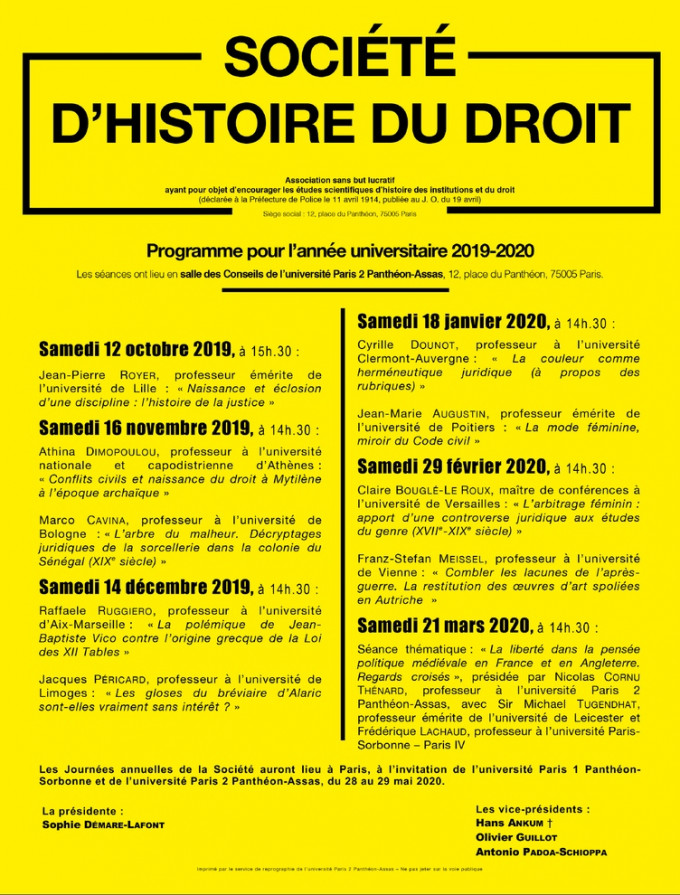
REMINDER, LECTURE SERIES: Conférences de la Société d’histoire du droit 2019-2020 (Paris)

(Source: Hi-D)


The last lectures organised by the Société d’histoire du droit (for the academic year 2019-2020) are going to take place in February and March:

Samedi 29 février 2020
14h30: L’arbitrage féminin : apport d’une controverse juridique aux études du genre (XVIIe-XIXe siècle)
Claire Bouglé-Le Roux, Maître de conférences à l’Université de Versailles

Combler les lacunes de l’après-guerre. La restitution des œuvres d’art spoliées en Autriche 
Franz-Stefan Meissel, Professeur à l’Université de Vienne

Samedi 21 mars 2020
14h30: Séance thématique – «La liberté dans la pensée politique médiévale en France et en Angleterre. Regards croisés», Présidée par Nicolas Cornu Thénard, Professeur à l’Université Paris 2 Panthéon-Assas
Avec: Sir Michael Tugendhat, Professeur émérite de l’université de Leicester 
Frédérique Lachaud, Professeur à l’Université Paris-Sorbonne - Paris IV


Venue: Salle des Conseils, Université Paris 2 Panthéon-Assas 12, place du Panthéon, 75005 Paris

For the original post in the ESCLH blog, see here
More information here


13 November 2019

LECTURE: "Les idées constitutionnelles, idées itinérantes ?" (Département de droit romain et d'histoire du droit, université Paris II Panthéon-Assas, 2 DEC 2019)

(image source: Brill)

Prof. Ulrike Müssig (Passau) will hold a talk entitled "Les idées constitutionnelles, des idées itinérantes ?" at the Centre Sainte-Barbe (4 rue Valette, 75005 PARIS) on Monday 2 December, at 18:00.