Search

Showing posts with label peace. Show all posts

25 August 2026

YOUTUBE: Michael DOYLE; "More than Just Peace" (Paris: Collège de France, 21 MAY 2026)

Abstract:

John Rawls’s publication of The Law of Peoples was a profound attempt to design a just peace. Beyond the simple cessation of armed hostilities, the Law of Peoples offered more than (just) peace. It committed its peoples to honor human rights, tolerate other decent political regimes and accept a "duty of assistance" owed by all decent societies to all those in dire need. Importantly, for Rawls, the project he outlined in The Law of Peoples is a constructed peace, one that needs to be established among liberal peoples and then extended to other decent societies. The construction raises the questions of why it is that Rawls thought the peace (1) needed to be constructed and could be constructed in a world otherwise divided by insecurity and strife among states. In doing this, he directly addressed the Realist challenges described by Thomas Hobbes in his Leviathan and revived by Thomas Nagel. It also raises the question of (2) why Rawls thought it was necessary to go beyond Perpetual Peace, a Liberal model of international peace constructed by Immanuel Kant (Rawls’s inspiration and answer to the first question), and (3) why Rawls might have thought that the extension beyond the Kantian peace among liberal republics to a wider "just peace" that incorporated a duty of assistance was possible, and indeed "realistic."

More information here. 


27 April 2026

BOOK: Michael REYNOLDS, Instruments of Peacemaking 1918-1941. The Failure of Diplomacy (London: Bloomsbury, 2026), 328 p. ISBN 9781509976287


(image source: Hart)

Abstract:

This book is a sequel to Instruments of Peacemaking 1870-1914 in that it considers how attempts were made to settle disputes between states without recourse to war after 'the war to end all wars'. It considers the idealism of President Woodrow Wilson's Fourteen Points which formed the basis for the Armistice in 1918, and his scheme for a League of Nations providing for self-determination of nations and 'collective security' for European states. It goes on to analyse the key challenges that faced statesmen and jurists in attempting to resolve disputes under the provisions of the Treaty of Versailles. It considers the consequences of the Peace Conference of 1919 as well as defects in the treaty as an instrument for resolving future disputes and tensions between the victors and the vanquished. Cases referred to the Reparations Commission and to arbitration under the Treaty of Versailles regarding boundary, industrial property, and shipping including the Lusitania claims are considered. More importantly, it analyses the diplomatic challenges faced by statesmen after 1919. The decline and failure of Wilsonian idealism, the League of Nations, collective security, and diplomacy are traced through the various diplomatic exchanges that took place between governments from official records and contemporaneous accounts of the times as well as academic sources. Mr Chamberlain's private diplomacy to appease Hitler is critically analysed. The final chapter briefly considers aspects of America's isolationism resulting in the attack on Pearl Harbor and her peacetime state of unreadiness.

Table of contents:

Preface
Acknowledgements
Table of Cases
Table of Legal and Related Instruments
1. A New International Order or a Precarious Armistice2. Arbitration as an Instrument of Dispute Resolution3. Diplomacy as an Instrument of Prevention4. The Crisis that Led to War and Why Diplomacy Failed

5. American and Japanese Relations

On the author:

Michael Reynolds is a lawyer, arbitrator and Professor of Dispute Resolution and Arbitration at BPP University Law School, UK. He is also a member of The Royal Institute of International Affairs (Chatham House). 

Read more here.

 (source: Legal History Blog)

06 January 2026

SYMPOSIUM: Le "Consensus". Définitions et usages d'une notion politique, juridique et diplomatique (XIVe-XVIIe siècles) (Genève: Les Délices, 21-22 JAN 2026)


(click on image to enlarge)


MERCREDI 21 JANVIER 2026

09h15 – Accueil


09h30 – Introduction : Noëlle-Laetitia Perret (Université de Genève)

Penser le consensus: genèse, évolutions et enjeux d’un concept interdisciplinaire


PREUVE, CONTRAT SOCIAL ET CONSENTEMENT : PERSPECTIVES JURIDIQUES (XIVE–XVIE SIÈCLES)


10h00 – Emanuele Conte (Università Roma Tre / EHESS–PSL)

Le consentement le plus présumé : Mario Salamone, le contrat social et la probatio


Discutante : Noëlle-Laetitia Perret


10H50 – PAUSE


11h00 – Beatrice Pasciuta (Università degli Studi di Palermo)

Il consenso della donna nel diritto comune: rileggere Presumitur seducta tra diritto, potere e rappresentazioni


Discutant : Ignazio Alessi


11h50 – Discussion collective/synthèse de la matinée 12h30 – Déjeuner

14h00 – Dante Fedele (CNRS, Université de Lille)

Consensus et consentement dans le De regia potestate de Bartolomé de Las Casas


Discutant : Benoît Caruzzo


14H50 – PAUSE


MÉMOIRE, PRUDENCE ET GOUVERNEMENT CONSENSUEL : EXPÉRIENCES MÉDIÉVALES


15h00 – Jean-Marie Moeglin (EPHE-PSL / Académie des Inscriptions et belles-lettres)

Le consensus dans les Mémoires de Philippe de Commynes


Discutant : Maxime Ferroli


15h50 – Ilaria Taddei (Université Grenoble-Alpes)

Prudence, parole et consentement dans la diplomatie florentine (XIVe–XVe siècles)


Discutante : Parwana Emamzadah Roth


16h40 – Discussion collective/synthèse de l’après-midi


19H00 – REPAS


JEUDI 22 JANVIER 2026

CONSENSUS ET NÉGOCIATION DANS L’EUROPE MODERNE


09h00 – Lucien Bély (Sorbonne Université / Académie des sciences morales et politiques)

Un traité comme recherche de consensus: Münster, 1648


Discutant : Adrien Wyssbrod


CORRESPONDANCES ITALIENNES ET CONSTRUCTION DU CONSENSUS POLITIQUE (1454–1455)


09h50 – Isabella Lazzarini (Università di Torino)

Accepter une ligue universelle : négociation et consensus dans la correspondance diplomatique italienne (1454–1455)


Discutant : Gavino Scala


10H40 – PAUSE


11h00 - Discussion collective/Table ronde finale


Quelle définition opératoire du consensus pour les périodes médiévale et moderne ?

Quelles continuités et quels déplacements des usages politiques, juridiques et diplomatiques?


12H30 - DÉJEUNER

Format de la rencontre

La rencontre adopte un format conçu pour encourager un travail collectif autour des textes et un échange scientifique approfondi. En amont, chaque intervenant·e a transmis un court dossier de travail (2–3 pages), comprenant des pistes de réflexion et des extraits de sources. Ce matériel peut être transmis sur demande à : noelle-laetitia.perret@unige.ch Chaque session s’ouvre par une brève introduction assurée par un membre de l’équipe organisatrice, destinée à en situer le thème et les enjeux. L’intervenant·e dispose ensuite d’une quinzaine de minutes pour présenter les points centraux de sa contribution, avant une discussion d’environ trente-cinq minutes menée par un·e discutant·e et enrichie par les échanges avec le groupe. 

Équipe du projet Forging Consensus
Le projet réunit une équipe interdisciplinaire de chercheur.es en histoire, droit, philologie, philosophie et humanités numériques :


Noëlle-Laetitia Perret – Professeure associée, directrice du projet (Principal Investigator). Elle coordonne l’ensemble des axes scientifiques, encadre l’équipe et pilote l’étude des traités diplomatiques médiévaux et renaissants. Gavino Scala – Collaborateur scientifique. Spécialiste des humanités numériques, il développe des protocoles d’analyse lexicale et sémantique appliqués au concept de consensus. Parwana Emamzadah Roth – Collaboratrice scientifique. Spécialiste de la philosophie du langage au Moyen Âge, elle conduit l’analyse argumentative et philologique des traités diplomatiques latins et contribue à la structuration méthodologique du projet. Adrien Wyssbrod – Collaborateur scientifique. Historien du droit et de la culture politique moderne, il prépare l’édition critique du traité de Wicquefort (1676) et participe à l’axe «modernité». Benoît Caruzzo – Doctorant. Il consacre sa thèse aux traités de légation (1603-1670) et à la construction du consensus dans les pratiques diplomatiques de l’Europe moderne. Maxime Ferroli – Chercheur associé. Archiviste de la Ville de Dole et chercheur associé au Centre Lucien Febvre (UMLP/UR 2273), il étudie les formes transfrontalières du consensus diplomatique entre la Franche-Comté et les cantons suisses aux XVIe–XVIIe siècles. Ignazio Alessi – Chercheur associé. SNSF Research Fellow à l’University of Cambridge, spécialiste d’histoire du droit et de la pensée politique médiévale, il contribue aux réflexions théoriques et comparatives sur les usages médiévaux du consensus

11 February 2025

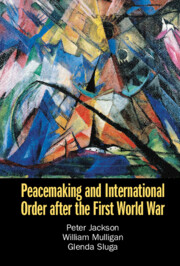
BOOK: Peter JACKSON, William MULLIGAN & Glenda SLUGA (eds.), Peacemaking and International Order after the First World War (Cambridge: Cambridge University Press, 2025), ISBN 9781108827348, 29,99 GBP


(image source: CUP)

Abstract:

The Paris peace settlements following the First World War remain amongst the most controversial treaties in history. Bringing together leading inter-national historians, this volume assesses the extent to which a new international order, combining old and new political forms, emerged from the peace negotiations and settlements after 1918. Taking account of new historiographical perspectives and methodological approaches to the study of peacemaking after the First World War, it views the peace negotia-tions and settlements after 1918 as a site of remarkable innovations in the practice of international politics. The contributors address how a wide range of actors set out new ways of thinking about international order, established innovative institutions and revolutionised the conduct of inter-national relations. They illustrate the ways in which these innovations were layered upon existing practices, institutions and concepts to shape the emerging international order after 1918.

About the editors:

Peter Jackson, University of Glasgow Peter Jackson is Chair in Global Security at the University of Glasgow. He is the author of France and the Nazi Menace (2000), Beyond the Balance of Power (2014) and La France et la menace nazi (2017). He has taught, held fellowships and visiting appointments at Carleton University, Yale University, Aberystwyth University, the Institut d'études politiques (Paris) and the University of Paris Panthéon-Sorbonne. William Mulligan, University College Dublin William Mulligan is Professor of History at University College Dublin. He has written widely about the First World War, including The Origins of the First World War (2017) and The Great War for Peace (2014). He has held visiting fellowships at the Institutes for Advanced Study in Princeton and Berlin. Glenda Sluga, European University Institute, Florence Glenda Sluga researches and teaches at the European University Institute in Florence. She is a fellow of the Australian Humanities Academy, and of the Royal Society of New South Wales. Her previous publications include The Invention of International Order: Remaking Europe after Napoleon (2021), and Internationalism in the Age of Nationalism (2013). 

Table of contents:

1. Introduction Peter Jackson, William Mulligan, and Glenda Sluga
Part I. Ordering Concepts:
2. Vocabularies of self-determination in 1919: the co-constitution of race and gender in international law Sarah C. Dunstan
3. Recasting the 'fabric of civilization': the Paris Peace Settlement and international law, Marcus M. Payk
4. State sovereignty Leonard V. Smith
5. The crisis of power politics Peter Jackson and William Mulligan
6. The challenge of an absent peace in the French and British Empires after 1919 Martin Thomas
Part II. Institutions:
7. A 'new diplomacy'?: the Big Four and peacemaking, 1919 Alan Sharp
8. The League of Nations: the creation and legitimisation of international civil service, Karen Gram-Skjoldager
9. The enforcement of German disarmament and the international order of the 1920s Andrew Webster
10. Planning for international financial order: the call for collective responsibility at the Paris Peace Conference Jennifer Siegel
11. Raw materials and international order from the Great War to the crisis of 1920–1921 Jamie Martin
Part III. Actors and Networks:
12. The Great Conversation: a discussion on peace after the First World War Carl Bouchard
13. An alternative international relations: socialists, socialist internationalism and the postwar order Talbot Imlay
14. The Paris Peace Conference and the origins of global feminism Mona L. Siegel
15. Colonial nationalists and the making of a new international order Erez Manela
Part IV. Counterpoint:
16. The persistence of old diplomacy: the Paris Peace Settlement in perspective T. G. Otte

Afterword: new histories of international order Glenda Sluga.

Read more here (DOI 10.1017/9781108907750) 

27 June 2023

BOOK: Domenico SICILIANO, «Defensive Aufklärung»: Il conflitto tra filosofia, politica e giurisprudenza nell'Articolo segreto per la Pace Perpetua di Immanuel Kant. (Milano: Giuffrè, 2023). ISBN 9788828851547

(Source: https://shop.giuffre.it/024219241-defensive-aufkl-rung-il-conflitto-tra-filosofia-politica-e-giurisprudenza-nell-articolo-segreto-per-la-pace-perpetua-di-immanuel-kant)


Table of contents:

A. IL PROBLEMA OVVERO: UNA LETTERA DI UN MINISTRO A MO’ DI PROLOGO .

B. L’ARTICOLO SEGRETO PER LA PACE PERPETUA

C. LE PRINCIPALI INTERPRETAZIONI DELL’ARTICOLO SEGRETO 

I) Della pericolosità della polis per i filosofi e come neutralizzare il pericolo (Hannah Arendt) 

II) Del fine politico dei « königliche Völker » (Werner Schneiders).

III) Kant e il suo tempo (Georg Cavallar)

IV) Della ‘differenziazione funzionale’ tra politica e filosofia (Volker Gerhardt)  

V) Del ruolo decisivo dell’antropologia pessimistica kantiana (Otfried Höffe) 

VI) Della separazione dei poteri nell’Articolo segreto (Reinhard Brandt)

D. TESI 

I) La questione del « Re-Filosofo »

II) La questione del « Filosofo-Re »

1. Kant e Sieyès 

2. Kant e Sieyès nella letteratura: l’interpretazione di Cavallar 

3. Kant tra la Francia rivoluzionaria e la Prussia reazionaria 

4. La questione del nesso tra il (mancato) contatto tra Kant e Sieyès e l’Articolo segreto ovvero: quando vengono pubblicate la « Neue vermehrte Auflage », la versione francese e quella inglese nel 1796? 

a) La questione della pubblicazione della « Neue vermehrte Auflage » ovvero delle corrispondenti versioni francesi e inglese nel 1796

aa) Le traduzioni in francese del 1796

bb) La traduzione in inglese del 1796

cc) La « Neue vermehrte Auflage » di Per la Pace perpetua

b) Quando è stato scritto l’Articolo segreto ovvero la parte di esso sui « Philosophenkönige »? 

5. Kant e la questione della verità. Ovvero: Kant ‘tra Platone e Kant’

6. Del « possesso della forza »

7. La connessione tra lo Streit tra filosofi e giuristi e il « PhilosophenKönige-Satz » nell’Articolo segreto


07 February 2022

REMINDER - NEW BOOK SERIES: Law, Peace, and Justice in Medieval and Early Modern Europe - General Editor: Prof. Krista Kesselring


Law, Peace, and Justice in Medieval and Early Modern Europe

This series seeks to bring together work on ‘peace-keeping’ amongst medieval and early modern Europeans in the broadest sense: from criminal justice to transitional justice, from the resolution of interpersonal conflict within communities to treaty-making between states, from feud to refuge to reparations, from criminal trials to cultures of toleration. The series crosses conventional boundaries between medieval and early modern and welcomes work that crosses disciplinary boundaries, too, or that uses interdisciplinary approaches to subjects such as law, theology, art, political philosophy, social practice, etc. It aims broadly to promote work that helps us understand how law and justice were implicated in the ways in which people in the past imagined, implemented, and used ‘peace’, both within Europe and as Europeans moved out around the globe.

Prospective authors and editors are encouraged to contact the General Editor, Krista Kesselring, Dalhousie University (krista.kesselring@dal.ca). 

Formal proposals and general inquiries should be sent to imems.press@durham.ac.uk.

Editorial board

Paolo Broggio, Roma Tre University; Tom Hamilton, Durham University; Marie Houllemare, University of Geneva; Elizabeth Papp Kamali, Harvard University; Krista Kesselring, Dalhousie University; Helle Vogt, University of Copenhagen


More information with the publisher.

20 January 2022

NEW BOOK SERIES: Law, Peace, and Justice in Medieval and Early Modern Europe - General Editor: Prof. Krista Kesselring


Law, Peace, and Justice in Medieval and Early Modern Europe

This series seeks to bring together work on ‘peace-keeping’ amongst medieval and early modern Europeans in the broadest sense: from criminal justice to transitional justice, from the resolution of interpersonal conflict within communities to treaty-making between states, from feud to refuge to reparations, from criminal trials to cultures of toleration. The series crosses conventional boundaries between medieval and early modern and welcomes work that crosses disciplinary boundaries, too, or that uses interdisciplinary approaches to subjects such as law, theology, art, political philosophy, social practice, etc. It aims broadly to promote work that helps us understand how law and justice were implicated in the ways in which people in the past imagined, implemented, and used ‘peace’, both within Europe and as Europeans moved out around the globe.

Prospective authors and editors are encouraged to contact the General Editor, Krista Kesselring, Dalhousie University (krista.kesselring@dal.ca). 

Formal proposals and general inquiries should be sent to imems.press@durham.ac.uk.

Editorial board

Paolo Broggio, Roma Tre University; Tom Hamilton, Durham University; Marie Houllemare, University of Geneva; Elizabeth Papp Kamali, Harvard University; Krista Kesselring, Dalhousie University; Helle Vogt, University of Copenhagen


More information with the publisher.