Search

Showing posts with label history of administrative law. Show all posts

27 May 2026

BOOK: Nicolas HUTEN, Basile MÉRAND & Nicolas SILD (eds.), Droit administratif et droit naturel. Premier regard (Paris: LexisNexis, 2026), ISBN 9782711943729, € 29


(image source: LexisNexis)

Abstract:

Le droit naturel classique n’a longtemps suscité d’intérêt que de la part des historiens du droit et des idées, convaincus à juste titre de son utilité pour la compréhension du droit contemporain. Après avoir récemment fait l’objet d’une certaine attention de la doctrine privatiste, le moment est venu pour la doctrine publiciste d’apporter sa contribution à ce renouveau. Telle est la finalité de cet ouvrage, qui envisage le droit administratif à l’aune des catégories du droit naturel classique. L’objet de ces pages pourra légitimement surprendre. À première vue, en effet, le droit administratif est un droit de la puissance publique, certes modéré par le contrôle du juge, mais qui semble exclure par principe toute approche sous l’angle de la justice ou de l’équité. Ce premier regard, qui en appelle d’autres à l’avenir, propose de revenir sur cette idée fort répandue. Sans nier la dimension politique du droit administratif, les contributions réunies dans le présent ouvrage montrent que ce droit est souvent marqué par la présence discrète d’une conception classique, c’est-à-dire gréco-romaine, du droit naturel, tant dans sa construction historique que dans l’application qu’en fait aujourd’hui le juge administratif dans les domaines les plus variés.

Contributiors:

 Miguel Ayuso, Henri Bouillon, Nicolas Huten, Alice Lassale, Basile Mérand, David Mongoin, Marjolaine Monot Fouletier, Jean Claude Ricci, Nicolas Sild.

Read more here

19 May 2026

BOOK: Simon GILBERT, Droit administratif: le cours alpha. Naissance d'une discipline académique et doctrine originelles (1804-1814) [Méthodes du droit] (Paris: Dalloz, 2026), 162 p. ISBN 9782247249268, € 35


(image source: Dalloz)

Abstract:

Peu de recherches ont jusqu'à présent permis d'identifier et d'analyser les premiers usages de l'expression « droit administratif » ni les conditions dans lesquelles l'enseignement de cette matière est apparu sous le Premier Empire. Le présent ouvrage revêt un triple objet : porter à la connaissance des contemporains du xxie siècle un corps de doctrines du Premier Empire aussi remarquables que méconnues inhérentes au caractère politique du droit administratif, qui forgent les conditions pour que la scriptogenèse de ce droit détermine son caractère autoritaire et qui jettent sur le droit contemporain une lumière aussi riche que nouvelle ; faire découvrir le contexte dans lequel est apparu cet enseignement académique en l'an XII (les motifs de son instauration, sa dévolution à une vingtaine de privatistes qui formèrent historiquement la première génération des professeurs de droit administratif, la manière dont ce droit a été représenté comme une matière académique d'un genre à part) ; mettre en relief le caractère mixte de ce droit dans les représentations prégnantes de l'époque, ce droit étant originellement considéré comme un composé de règles de droit public et de droit privé. La doctrine du Premier Empire assignait déjà à ce droit la fonction de déterminer des formes d'harmonie sociale, de fixer un point d'équilibre entre les lois civiles et politiques et de s'appliquer à certains rapports administratifs. Elle était convaincue que ce droit devait être en harmonie avec l'administration et fondé en la raison d'État. Elle a conceptualisé les conditions institutionnelles permettant de garantir que l'écriture matérielle du droit administratif soit compatible avec sa fonction politique.

On the author:

Simon Gilbert est professeur de droit public et doyen de la faculté de droit de l'université Paris-Est Créteil.

Read more here


18 March 2026

PROJECT: CONDUIT, comparing French and Italian colonial law (Institut Universitaire de France, Prof. Monica CARDILLO/Nantes Université)


(image source: IUF)

Project abstract:

Ce projet porte sur l’analyse et la comparaison des administrations coloniales françaises et italiennes, à partir des ressources archivistiques, afin de comprendre comment s’est construit le droit colonial en Afrique. Plus précisément, à travers l’étude de l’activité de terrain des administrateurs des cercles, ce projet s’attache à comprendre l’évolution des normes traditionnelles du fait du contact colonial, et du processus de « disqualification » et « requalification » de la logique juridique locale. Conduit suivant une approche interdisciplinaire, il vise à mettre en œuvre une méthodologie critique de l’archive coloniale. Inscrit dans les sciences juridiques émergentes, ce projet cible la concrétisation d’actions pédagogiques, scientifiques, de sauvegarde d’archives par la numérisation.

(read more here

04 March 2026

SEMINAR: Vivian LAUGIER "« La contribution d’un administrateur à la formation du droit administratif : l’exemple de Léon Aucoc » [Séminaire : Histoire des pratiques administratives, dir. Guillaume RICHARD] (Paris: Université Paris Cité, 11 MAR 2026] [HYBRID]


(image source: Hi-D)

Abstract:

Dans le cadre du cycle de séminaires d’histoire des pratiques administratives, coordonné par M. Guillaume Richard, Professeur d’histoire du droit à l’Université Paris Cité et Directeur de l’Institut d’histoire du droit (IHD), la troisième séance intitulée : « La contribution d’un administrateur à la formation du droit administratif : l’exemple de Léon Aucoc », aura lieu le mercredi 11 mars 2026 à 14h30, à la Bibliothèque de l’Institut d’histoire du droit, Faculté de droit, d’économie et de gestion, 10 avenue Pierre Larousse à Malakoff (92240); et sera animée par Monsieur Vivian Laugier, Maître de conférences en droit public à l’Université de Lorraine.

Practical information:

Dans un souci d’accessibilité, cet événement sera organisé en format hybride, permettant aux participants d’y assister en présentiel ou à distance via Zoom:

https://u-paris.zoom.us/j/82056426426?pwd=N2laRIRK0qsFAKhEi2cXq1sgK2LPtM.1

🔹 ID de réunion: 820 5642 6426

🔹 Code secret: 442208

 (source: Hi-D)

10 February 2026

LECTURE SERIES: Figures/Visages de l'administration dans l'Europe des crises politiques (XVIe-XXIe siècles) (Brussels: UCLouvain, St-Louis Bruxelles, 17 FEB 2026)


(click on image to enlarge)

Abstract:

Ce séminaire, intitulé Figures/Visages de l'administration dans l'Europe des crises politiques (XVIe-XXIe siècles), est conçu sur le mode de l'atelier de discussion méthodologique et épistémologique. Après une introduction conduite par Nicolas Simon (ARB), Quentin Verreycken (FNRS/UCLouvain) et Jérémie Ferrer-Bartomeu, nous donnerons la parole à nos trois orateurs : Catherine Thomas (Musée du Verre de Charleroi), Christian Ingrao (CNRS, ancien directeur de l'Institut du Temps Présent) et Xavier Rousseaux (FNRS/UCLouvain). La discussion sera animée par John Pitseys (député au parlement bruxellois, docteur de l'UCLouvain).

Registration (mandatory for logistical purposes) with jeremie dot ferrer at uclouvain dot be. 

28 January 2026

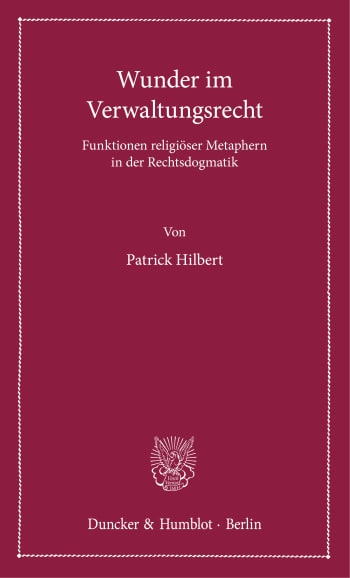
BOOK: Patrick HILBERT, Wunder im Verwaltungs. Funktionen religiöser Metaphern in der Rechtsdogmatik [Lectiones Inaugurales; 20] (Berlin: Duncker & Humblot, 2025), 59 p., ISBN 978-3-428-19085-0

 Cover: Wunder im Verwaltungsrecht 

ABOUT THE BOOK:
 
Wunder gibt es im Verwaltungsrecht immer wieder. Sie begegnen uns als religiöse Metaphern in dogmatischen Argumentationen. Wenn sich etwa der gebundene Anspruch auf Nutzung einer öffentlichen Einrichtung in einen Anspruch auf ermessensfehlerfreie Auswahlentscheidung wandelt, wird hierfür zwar keine klassische dogmatische Begründung gegeben, mit der Bezeichnung als »Wandlung« aber eine Formulierung gebraucht, die nicht nur entfernt an die Transsubstantiation erinnert.
Anhand von drei Beispielen spürt Patrick Hilbert den religiösen Metaphern im Verwaltungsrecht nach, untersucht, ob ihre Verwendung methodisch zulässig ist und welche Funktionen (religiöse) Metaphern in der juristischen Dogmatik erfüllen können.
 
TABLE OF CONTENTS:
 
I. Wunder als Metapher in der verwaltungsrechtlichen Dogmatik
Die Wandlung – Die Auferstehung – Die Heilung

II. Warum Metaphern?

III. Warum religiöse Metaphern?

IV. Funktionen von (religiösen) Metaphern in der Dogmatik

Methodische Zulässigkeit – Name für ein dogmatisches Argument – Vorstufe zu einem dogmatischen Argument – Stilmittel – Multifunktionalität von Metaphern
 
ABOUT THE AUTHOR:
 
Patrick Hilbert, Studium in Bayreuth, Promotion und Habilitation in Heidelberg. Seit 2022 Inhaber des Lehrstuhls für Öffentliches Recht, insbesondere Verwaltungsrecht der Universität Münster, Direktor des Instituts für Umwelt- und Planungsrecht sowie des Zentralinstituts für Raumplanung. Er forscht und lehrt zum deutschen und europäischen Öffentlichen Recht. Seine aktuellen Arbeitsschwerpunkte liegen im Allgemeinen Verwaltungsrecht, den Strukturfragen des Umweltrechts sowie dem Parlamentsrecht.
 
Find more here


27 January 2026

SYMPOSIUM: Between State Power and the Supremacy of Law – (Legal-)Historical Perspectives on Administrative Jurisdiction in Germany and Europe (Regensburg: Institute for East European Law, University of Regensburg, 19-20MAR 2026)


(Source: University of Regensburg)


Organisator: Michael Reichenthaler

For organizational reasons, participants are requested to register by email

(michael.reichenthaler@jura.uni-regensburg.de) by 28 February 2026.


Final Program


Day 1 – March 19, 2026


12.00 – 12.30 Arrival

13.45 – 14.30 Welcome and opening remarks


Panel 1: Constitutional and Administrative Jurisdiction

13.00 – 13.45 Sarah Dersarkissina (Heinrich-Heine-Universität Düsseldorf)

Qui iudicat? Entwicklungsgeschichtliche Perspektiven auf die Abgrenzung

von Verwaltungs- und Verfassungsgerichtsbarkeit

13.45 – 14.30 Max Hopp, David Neuhoff (Ludwig-Maximilians-Universität München)

"Das Politische vor Gericht" - Zur Geschichte des Verhältnisses von

Verwaltungs- und Verfassungsgerichtsbarkeit


Panel 2: Institutional and Personnel (Dis)Continuities in the German Administrative Judiciary

14.45 – 15.30 Paul Schüller (Universität Regensburg)

Das Sächsische Oberverwaltungsgericht - Rechtstaatskontinuitäten und -

brüche zwischen Königreich, Republik und Diktatur

15.30 – 16.15 Philip Bockelmann (Leibniz Institut für jüdische Geschichte und Kultur Leipzig)

„Durchgängiger Rechtsschutz“. Walter Jellinek und die Neubegründung der

Verwaltungsgerichtsbarkeit nach 1945


Panel 3: The Establishment of a West German Administrative Legal Order and the Influence of EU Law

16.30 – 17.15 Julia Nebel (Universität Leipzig)

(Un)politische Richter(wahl): die Erstbesetzung des Bundesverwaltungsgerichts

17.15 – 18.00 Lennat Kokott (Bucerius Law School Hamburg)

Die Rolle der Verwaltungsgerichtsbarkeit bei der Entwicklung der Raumordnung in der Bundesrepublik

18.00 – 18.45 Philip Ermacora (Universität Augsburg)

Unionsrechtliche Einflüsse auf den Vorrang des Gesetzes


19.00

Public evening lecture by Prof. Dr. Hans-Christof Kraus (Universität Passau)


Day 2, March 20, 2026

Panel 4: German and French Administrative Jurisdiction

9.00 – 9.45 Lucya Jakobi (Hellriegel Rechtsanwälte)

Der verwaltungsgerichtliche Untersuchungsgrundsatz im deutsch-französischen Vergleich sowie vor dem EuGH

9.45 – 10.30 Leana Clerc (Jean Moulin Lyon 3 University)

The influence of supreme administrative jurisprudence on lower courts: a Franco-German comparative analysis

10.30 – 11.15 Paul-David Chouinard (University of Ottawa)

The influence of French and English Law on Administrative Justice: Reforms in the province of Quebec


Panel 5: Administrative Jurisdiction in Italy and South Tyrol

11.30 – 12.15 Federico Margheri Biagi (University of Rome Tor Vergata / LUISS Gudio Carli)

Unbestimmte Rechtsbegriffe and the Theory of Administrative Discretion: The Influence of German Theory on the Italien Doctrine of Technical Assessments

12.15 – 13.00 Philipp Rossi (vormals Universität Innsbruck)

Verwaltungsgerichtsbarkeit und Minderheitenschutz am Beispiel Südtirols


Panel 6: The (Non-)Emergence of administrative courts in Russia, Ukraine and Hungary 

14.00 – 14.45 Dr. Alexander Gorskiy (Eberhard-Karls-Universität Tübingen)

Staat, der Allmächtige? Zur Problematik der fehlenden eigenständigen Verwaltungsgerichtsbarkeit in Russland

14.45 – 15.30 Dr. Yuliaa Tsurkalenko (Institut für Ostrecht)

Die historische Entwicklung der Verwaltungsgerichtsbarkeit in der Ukraine im europäischen Kontext

15.30 – 16.15 Prof. Attila Barna (Széchenyi Universität Győr)

Streitigkeiten und Mustern – Die Gründung des Verwaltungsgerichts in Ungarn - Versuche zur Etablierung einer Verwaltungsgerichtsbarkeit in Ungarn, in der zweiten Hälfte des 19. Jahrhunderts


Panel 7: Influences and Developments of Administrative Jurisdiction in Central and Eastern Europe

16.30 – 17.15 Dr. Weronika Szafrańska (Uniwersytet Śląski w Katowicach)

Ist die polnische Verwaltungsgerichtsbarkeit „österreichisch“ geblieben? – Auf der Suche nach Kontinuität und Wandel

17.15 – 18.00 Michał Szudrowicz, Andrzej Paduch (Adam Mickiewicz University Poznan)

The role of the head of administrative court of the highest instance in ensuring the effectiveness and stability of administrative justice

18.00 – 18.45 Prof. Tomáš Gábriš (Trnava University) Institutional Unification of Administrative Justice in Czechoslovakia in the 


Interwar Period (Problems, Challenges, Solutions)

End of the conference

05 June 2025

CONFERENCE RECORDING: Les 150 ans de l’arrêt « Prince Napoléon » (Paris: Conseil d'État, 12 MAY 2025)


(image source: Wikimedia Commons)

Program:

9h30-9h45 | Mot de bienvenue de Martine de Boisdeffre, présidente de la section des études, de la prospective et de la coopération du Conseil d’État, présidente du comité d’histoire du Conseil d’État et de la juridiction administrative

9h45-10h45 | Table-ronde n° 1 : l’arrêt Prince Napoléon dans son contexte (modérateur : Terry Olson, conseiller d’État)

🔸 Le Conseil d’État en période d’incertitude politique (1870-1879) par Guillaume Richard, professeur à l’université Paris Cité

🔸 Les principaux protagonistes : le prince Napoléon, les ministres de la Guerre, le commissaire du gouvernement David par Éric Anceau, professeur d’histoire contemporaine à l’université de Lorraine

🔸 Un coup d’éclat républicain ? par katia weidenfeld, professeure à l’École nationale des chartes

Questions / réponses

11h00-12h15 | Table-ronde n° 2 : L’évolution de la théorie des actes de gouvernement de 1875 à nos jours (modératrice : katia weidenfeld)

🔸 Le mot et la chose jusqu’en 1962 par Catherine Teitgen-Colly, professeure émérite à l’université Paris I

🔸 L’acte de gouvernement aujourd’hui (1) : les rapports entre l’Exécutif et le Parlement par Terry Olson

🔸 L’acte de gouvernement aujourd’hui (2) : la conduite des relations internationales par Céline Guibé, maitresse des requêtes au Conseil d’État

🔸 En contrepoint, l’exemple allemand par Armel LE DIVELLEC, professeur de droit public à l’université Panthéon-Assas

Questions / réponses

12h15-12h30 | Conclusion : l’arrêt Prince Napoléon est-il réellement le premier des « grands arrêts » du Conseil d’État ? par Bruno Genevois, président de section honoraire au Conseil d’État

The recording can be watched here

11 April 2025

BOOK: Frieder GÜNTHER, Verwaltungsstaat. Die Verwaltungskultur der deutschen Innenministerien 1919-1975 [Veröffentlichungen zur Geschichte der deutschen Innenministerien nach 1945; 8] (Göttingen: Wallstein, 2025), 329 p., ISBN: 978-3-8353-5832-4

 Buchcover: Verwaltungsstaat
About the book:

Das Reichsinnenministerium, das Bundesinnenministerium und das Innenministerium der DDR zwischen Kontinuitäten und politischer Systemabhängigkeit.

Wir leben in einem modernen Verwaltungsstaat. Die Verwaltung ordnet und gestaltet Gesellschaft sowie Politik, bereitet Regierungsentscheidungen vor, setzt sie um und greift damit tief in unser Leben ein. Während des gesamten 20. Jahrhunderts war sie ein Fundament deutscher Staatlichkeit. Denn auch wenn sie nicht unabhängig agieren konnte, besaß sie eine zentrale und häufig unterschätzte Funktion für das gesamte Gemeinwesen. Doch wie genau funktionierte sie? Und worin unterschied sie sich angesichts der tiefgreifenden politischen Systembrüche in Deutschland im 20. Jahrhundert? Was waren also die Besonderheiten der Verwaltung in der Weimarer Republik, der NS-Diktatur, der Bundesrepublik und der DDR? Frieder Günther untersucht die deutschen Innenministerien und stellt dabei ihre Verwaltungskultur in den Mittelpunkt. Während auf den ersten Blick Kontinuitäten etwa im Hinblick auf den Aufbau, die Bezeichnungen und die Kompetenzen überwiegen, treten bei genauerer Betrachtung deutliche Unterschiede beim Personal, beim Selbstverständnis, bei den internen Abläufen und bei der Funktion hervor. Besonders drastisch unterschied sich die DDR von der rechtsstaatlichen Verwaltung der Weimarer Republik und der Bundesrepublik, während die nationalsozialistische Verwaltung eine Zwischenstellung einnahm.

About the author:

Frieder Günther, geb. 1971, ist wissenschaftlicher Mitarbeiter und Forschungsprojektleiter am Institut für Zeitgeschichte München-Berlin sowie Privatdozent an der Humboldt-Universität zu Berlin.
Veröffentlichungen u. a.: Heuss auf Reisen. Die auswärtige Repräsentation der Bundesrepublik durch den ersten Bundespräsidenten (2006); Denken vom Staat her. Die bundesdeutsche Staatsrechtslehre zwischen Dezision und Integration 1949–1970 (2004).

Find more here.


06 February 2025

SEMINAR: Histoire des pratiques administratives (Paris: Université Paris Cité, FEB-APR 2025) [ZOOM]

(image source: Hi-D)

Trois séminaires d’histoire des pratiques administratives sont coordonnés par Monsieur Guillaume Richard, Professeur d’histoire du droit, Directeur de l’Institut de l’histoire du droit -IHD de la Faculté de Droit, d’Économie et de Gestion, Université Paris Cité, sise au 10, Avenue Pierre Larousse, 92240 Malakoff.

  •  «  Faire l’histoire de l’intérêt général à partir de la pratique du Conseil d’État » :  lundi 17 février 2025 à 14h30.
  •  «  Pratiques d’écriture et naissance du ministère des Affaires étrangères » : vendredi 21 mars 2025 à 10h.
  •  «  L’agrément des associations par le Gouvernement durant la première moitié du XIXe siècle » :  lundi 7 avril 2025 à 14h30.

Pour ceux qui ne pourront pas y assister, un lien Zoom est mis à votre disposition afin de vous permettre de vous connecter à distance aux séminaires.

More information here (source: Hi-D).

03 December 2024

BOOK: Bartłomiej WRÓBLEWSKI, State Liability and the Law: A Historical and Comparative Analysis [Routledge Studies in Comparative Legal History, eds. Aniceto MASFERRER DOMINGO & Heikki PIHLAJAMÄKI] (London: Routledge, 2024), 250 p. ISBN 9781032354880


(image source: Routledge)

Abstract:
This book explores the historical foundations of holding public authorities accountable for their acts, and discusses how and why the idea that the state should or should not be held liable became established in three significant jurisdictions. The issue of state liability for legislative acts is considered one of the most difficult and controversial problems in jurisprudence. This book analyses the development of concepts and institutions of liability for the acts of legislator pertaining to the general principles of state liability until the mid-20th century in the leading European legal systems: Germany, France and Great Britain. It is shown that, in contrast to the prevailing conviction, the lack of liability for law-making instruments was not an unassailable dogma, and that questions as to whether such liability was possible were being asked from the Middle Ages onwards. The book will be a valuable resource for academics and researchers in the areas of Constitutional Law, Public Law, History of Law, History of Legal and Political Thought, Philosophy of Law, and Comparative Legal Studies.

Table of contents:

Acknowledgements

List of abbreviations

Introduction


Part One : The Institutions and Concepts of State Liability in Selected Legal Systems until the End of the 18th Century

Chapter I: Ancient Greece and Rome

Chapter II: The Middle Ages

Chapter III: The early modern era

Summary of Part One

Part Two: The Development of Contemporary Systems of State Liability for Acts of the Public Authorities

Chapter IV: Germany

Chapter V: France

Chapter VI: England

Summary of Part Two

Part Three: The Problems Associated with State Liability for Legislative Acts

Chapter VII: Liability for acts of the legislator in German scholarship and law

Chapter VIII: Recognition of liability for acts of the legislator in French scholarship and law

Chapter IX. The dogma of lack of liability for acts of the legislator in English scholarship and law

Summary of Part Three

Concluding remarks

On the author:

Bartłomiej Wróblewski is an Assistant Professor of Law at the SWPS University of Social Sciences and Humanities, Poland.

Read more here


17 May 2023

ARTICLE: Mathilde LEMÉE, "Les juristes publicistes du XIXe siècle et l’idée de droit administratif sous l’Ancien Régime" (Historia et Ius, 1 MAY 2023) (OPEN ACCESS)

(image source: HistoriaetIus)

 Abstract:

The dispute over the existence of administrative law under the Ancien Régime is well known. Its origins, however are much less so. Yet, since the Mon- archy of July, many authors have attempted to investigate the history of adminis- trative law. Research on these ideas enables the understanding of the evolution of administrative law itself. It shows that while some authors highlight elements of continuity with the Ancien Régime, others insist upon the fondamental nature of the revolutionary breakage

Read the article on Historia et Ius (an open access peer reviewed journal) .

06 August 2021

JOURNAL: Administory Journal for the History of Public Administration / Zeitschrift für Verwaltungsgeschichte, nº 5, 2020


(Source: https://sciendo.com/_next/image?url=https%3A%2F%2Fsciendo-parsed-data-feed.s3.eu-central-1.amazonaws.com%2F60ac3dc8034b9d7f2f3b5c84%2Fcover-image.jpg&w=1920&q=75)

Mulitinormativität und administrative Logik – neue verwaltungshistorische Perspektiven PETER COLLIN


Administrative Multinormativity

Public Administration and the Challenge to Introduce Egalitarian Legal Order: The Jewish policy of the Duchy of Warsaw (1807–1815) ALEKSANDRA ONISZCZUK

Administrative Multinormativität in der Krankenhaus-Verwaltung am Beispiel der Charité in Berlin, 1820er- bis 1850er-Jahre AXEL C. HÜNTELMANN

Politikfelder als multinormative Ordnungen. Multiple Multinormativitäten im preußischen Chausseewesen am Beispiel der Volmethalstraße, ca. 1816–1850er-Jahre FELIX GRÄFENBERG

Expropriation and the Challenge to Liberal Thought: Multinormative Management of State Intervention beyond the Conflict Liberty vs. Authority: (Brazil, 1826–1930) ARTHUR BARRÊTTO DE ALMEIDA COSTA

Multinormativity Emerges From Multilevel Governance. Uses of the Council of Trent in Examinations for Ecclesiastical Benefices in 19th-Century Brazil ANNA CLARA LEHMANN MARTINS

Zwischen Gesundheit und Wirtschaft: Normen und Interessenkonflikte in der behördlichen Arzneimittelregulierung im Deutschen Reich 1871–1945 NIKLAS LENHARD-SCHRAMM

Normative Konfliktlagen: Eheschließungen mit AusländerInnen in Deutschland als administrative und interkulturelle Herausforderung (ca. 1900–1930) CHRISTOPH LORKE

State Authority and Competing Arrangements in the Kingdom of Serbs, Croats and Slovenes/ Yugoslavia (1918–1941) IVAN KOSNICA

»Wandel durch Annäherung«: Multinormativität und informelle Politik in der europäischen Integration zwischen den 1960er und 1990erJahren PHILIP BAJON

Mehrdimensionale Rechtsmaßstäbe als Herausforderung für die Verwaltung: das Beispiel der Hafenstaatkontrolle KATHARINA REILING

Forum

Turbulente Lebensläufe: Multivalente Bewerbungsstrategien für den preußischen Staatsdienst nach 1815 STEPHAN STRUNZ

Gestalten statt verwalten? These zu Janusköpfigkeit als Kern des verwalterischen Habitus in NS-Zeit und Gegenwart. HEIKE GUTHOFF

Relektüre

Litigious Bukovina: Eugen Ehrlich’s ›Living Law‹ and the Use of Civil Justice in the Late Habsburg Monarchy WALTER FUCHS


22 December 2020

ARTICLES: Direito, Estado e Sociedade, nº 57, 2/2020, OPEN ACCESS


(Source: http://direitoestadosociedade.jur.puc-rio.br/cgi/cgilua.exe/sys/start.htm?tpl=home)

The Brazilian journal Direito, Estado e Sociedade has recently published some articles of legal historical interest:


“Saberei ensinar aos desgraçados a vereda do desespero” – Entre o crime de insurreição e o direito à resistência: o abolicionismo radical de Luiz Gama

Por: Júlio César de Oliveira Vellozo e Silvio Luiz de Almeida


Um Direito Administrativo de Transição: o conceito de direito administrativo na cultura jurídica da Primeira República Brasileira (1889-1930)

Walter Guandalini Junior, Lívia Solana Pfuetzenreiter de Lima Teixeira


02 June 2020

BOOK: Stefano SEPE, Storia dell'amministrazione italiana (1861-2017) (Napoli: Editorial Scientifica, 2018). ISBN: 978-88-9391-401-7, pp. 218, € 14,00


ABOUT THE BOOK

Il volume si divide idealmente in tre parti. La prima (capitolo I) contiene un’interpretazione dei problemi di fondo dell’evoluzione del sistema amministrativo italiano dall’unificazione nazionale ai giorni nostri (ipotesi di periodizzazione, rapporti politica-amministrazione, problema burocratico, trasformazione funzionale e dimensionale degli apparati).
Sottesa a tale interpretazione è la convinzione che occorra una “storia sociale” dell’amministrazione in grado di leggerne i percorsi nel contesto della società italiana. La seconda parte (capp. II-IX) è suddivisa secondo una scansione cronologica che prende le mosse dai momenti di “svolta” nell’attività degli apparati pubblici. Per ciascuna delle fasi considerate, vengono messi in rilievo sia gli aspetti peculiari, sia i caratteri di continuità propri delle amministrazioni. Il capitolo conclusivo tenta di offrire una valutazione di sintesi alla domanda: “potremo avere (o riavere) un giorno un sistema amministrativo all’altezza delle esigenze del Paese?”

 ABOUT THE AUTHOR

Stefano Sepe (Napoli 1950), storico dell’amministrazione, insegna alla “LUISS Guido Carli” e alla “Scuola nazionale dell’amministrazione”. È autore di volumi e saggi sull’evoluzione e sul funzionamento delle amministrazioni pubbliche, nonché sui rapporti tra cittadini e istituzioni. Giornalista pubblicista, già commentatore per il Il Sole 24 ore e il Quotidiano nazionale, è editorialista de L’eco di Bergamo.


More information with the publisher, here.