Search

Showing posts with label rights. Show all posts

23 May 2025

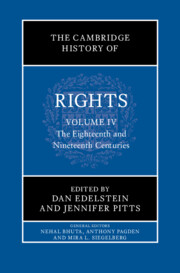
BOOK: Dan EDELSTEIN & Jennifer PITTS (eds.), The Cambridge History of Rights, vol. IV: The Eighteenth and Nineteenth Centuries [The Cambridge History of Rights, eds. Nehal BHUTA, Anthony PAGDEN & Mira L. SIEGELBERG] (Cambridge: Cambridge University Press, 2025), ISBN 9781316519165, 120 GBP


(image source: Cambridge Core)

Abstract:
The age of Enlightenment and revolutions produced some of our best-known declarations of rights, but they did not create the idea of rights. Writers during this age did such a good job at declaring rights that many historians and politicians later believed that they invented them. The fourth volume of The Cambridge History of Rights shows that the eighteenth and nineteenth centuries are better understood as a time of transformation, extending rights-making to meet the needs of a modernizing world. Rights became a means of liberation for religious minorities, the economic downtrodden, women, slaves, and others. But rights also became a means of control, especially in European colonies around the world, as well as in liberal economic regimes that protected property rights. Through twenty-six essays from experts across the world, this volume serves as an authoritative reference for the development of rights across this period of history.

On the editors:

Dan Edelstein, Stanford University, California Dan Edelstein is the William H. Bonsall Professor of French and (by courtesy) of Political Science and History at Stanford University. Jennifer Pitts, University of Chicago Jennifer Pitts is Professor of Political Science and in the Committee on Social Thought at the University of Chicago.

Table of contents:

Part I. A Revolution in Rights?:
1. Barbeyrac's intervention. Grotius, Pufendorf, Locke David Grewal
2. Rights, mercantile capitalism and the bourgeois revolution: the rise of political economy Martti Koskenniemi
3. Social rights Glauco Schettini and Charles Walton
4. Rights in Enlightenment theories of rights Céline Spector
5. Rights, property, and politics: Hume to Hegel Richard Bourke
6. Antislavery in the age of rights: or, the rights of slaves confront the right to slaves Christopher Leslie Brown
7. The Enlightenment Constitutionalism and the rights of man Vincenzo Ferrone
8. Fundamental rights at the American founding Jud Campbell
9. Declarations of rights Jeremy D. Popkin
10. The rights of women (or women's rights) Karen Offen
11. The image of rights in the French Revolution Adam Lebovitz
Part II. Post-Revolutionary Rights:
12. On the nadir of natural rights theory in nineteenth-century Britain Gregory Conti
13. The 1789 declaration of the rights of man and of the citizen: a civil creed of the French republic? Valentine Zuber
14. Rights in the thought of Kant, Fichte, and Hegel Frederick Neuhouser
15. Rights and socialism 1750–1880 Gareth Stedman Jones
16. Economic liberalism and rights in the nineteenth century David Todd
17. Human rights during the 1848 revolutions Mike Rapport
Part III. Rights and Empires:
18. Rights and empires: relations of authority Lauren Benton and Jane Burbank
19. Rights in Late Mughal and Early Colonial India Hasan Zahid Siddiqui
20. Rights in the Americas Joshua Simon
21. The free sea: an antislavery of human rights Amy Dru Stanley
22. Abolition and Imperialism in Africa Bronwen Everill
23. Rights in Pan-Asian, Pan-Islamic, and Pan-African thought Cemil Aydin
24. Indigenous rights in settler colonies Saliha Belmessous
25. Catholicism and rights: politics, economics and, sexuality Udi Greenberg

26. (Human) Rights Associations (1775–1898) Wolfgang Schmale.

Read more here: DOI  10.1017/9781009019521.

20 August 2020

BOOK: Virpi MÄKINEN et al., eds., Rights at the Margins - Historical, Legal and Philosophical Perspectives (Leiden-New York: Brill, 2020). ISBN 978-90-04-43153-9, $119.00


(Source: Brill)

Brill is publishing a new essay collection on the history of rights.

ABOUT THE BOOK

The essays in this volume explore the ways rights were available to those in the margins of society. By tracing pivotal judicial concepts such as ‘right of necessity’ and ‘subjective rights’ back to their medieval versions, and by situating them in unexpected contexts such as the Franciscans’ theory of poverty and colonization or today’s immigration and border control, this volume invites its readers to consider whether individual rights were in fact, or at least in theory, available to the marginalized. By focusing not only on the economically impoverished but also those who were disenfranchised because of disability, gender, race, religion or infidelity, this book also sheds light on the relationship between the early history of individual rights and social justice at the margins. 

Contributors are: Wim Decock, Heikki Haara, Virpi Mäkinen, Alejandra Mancilla, Julia McClure, Ilse Paakkinen, Mikko Posti, Jonathan Robinson, John Salter, Pamela Slotte, and Jussi Varkemaa.

ABOUT THE EDITORS

Virpi Mäkinen is Senior Lecturer in Theological and Social Ethics at the University of Helsinki, Finland. She has published monographs and many articles on medieval and early modern intellectual history, including Property Rights in the Late Medieval Discussion on Franciscan Poverty (Peeters, 2001), and co-edited Transformations in Late Medieval and Early-Modern Rights Discourse (Springer, 2006). 

Jonathan Robinson, Ph.D. (2010) in Medieval Studies at the University of Toronto, Canada. He currently acts as a lawyer and is the author of William of Ockham’s Theory of Property Rights in Context (Brill, 2012).

Pamela Slotte is Associate Professor of Minority Studies at the Åbo Akademi University, Finland. She is the co-author of The Juridification of Religion (Brill, 2017) and co-editor of Revisiting the Origins of Human Rights (Cambridge University Press, 2015). 
Heikki Haara is Senior Lecturer of Political History at the University of Helsinki. He is the author of Pufendorf’s Theory of Sociability: Passions, Habits and Social Order (Springer, 2018).

TABLE OF CONTENTS

Acknowledgements
About the Authors
Abbreviations

Introduction: Rights and Justice towards the Margins
  Virpi Mäkinen, Jonathan Robinson and Pamela Slotte


PART 1: Rights and the Poor Law

1 Poverty and Need in the Fourteenth Century: Johannes Andreae, Bartolus of Saxoferrato, and Baldus de Ubaldis
  Jonathan Robinson

2 Poor and Insolvent: Debtor Relief in Alvarez de Velasco’s De privilegiis pauperum (1630)
  Wim Decock


PART 2: Rights, Duties and Justice

3 Inclination to Self-Preservation and Rights to Life and Body in Samuel Pufendorf’s Natural Law Theory
  Heikki Haara

4 The Right of Necessity: From Hugo Grotius to Adam Smith
  John Salter


PART 3: Rights Beyond the Margins

5 Rights and Needs: Widows as a Protected Group in Christine de Pizan’s Thought
  Ilse Paakkinen

6 Can Animals Have Rights? Conrad Summenhart and Francisco de Vitoria at the Margins of Rights Language
  Jussi Varkemaa

7 Whether Heretics and Infidels Can Possess Dominion Rights? Late Medieval and Early Modern Debates
  Virpi Mäkinen and Mikko Posti


PART 4: Geopolitical, Global, and Contemporary Perspectives at the Margins

8 The Darker Side of Rights in Global Intellectual History: an Ambivalent Case of Franciscan Poverty
  Julia McClure

9 Necessity Knows No Borders: the Right of Necessity and Illegalized Migration
  Alejandra Mancilla

10 “Rights, Not Charity!” On Vocabularies for Conceptualizing the Case of Persons with Disabilities
  Pamela Slotte 

More info here

06 March 2020

BOOK: Mario CARAVALE, Magna Charta Libertatum (Bologna: Il Mulino, 2020). ISBN: 9788815286093, pp. 136, € 12.00


Cover Magna Charta Libertatum
(Source Il Mulino)

ABOUT THE BOOK

Questo libro analizza il contesto storico e giuridico in cui venne promulgata la Magna Carta del 1215, uno dei documenti più celebri del periodo medievale. Quest'ultima consolidava alcuni dei diritti consuetudinari degli ordinamenti vigenti nel regno inglese all’inizio del secolo XIII. Ancora oggi la Magna Carta è considerata come fonte di princìpi per gli ordinamenti giuridici. Inoltre essa continua a rappresentare un manifesto del valore universale delle libertà individuali.

ABOUT THE AUTHOR

Mario Caravale è professore ordinario di Storia del diritto italiano nella Facoltà di Giurisprudenza dell'Università di Roma “La Sapienza”, dopo avere insegnato nella Università di Camerino e, nella stessa sede romana, nella Facoltà di Scienze politiche. E’ direttore del Dizionario Biografico degli Italiani pubblicato dall'Istituto
dell'Enciclopedia Italiana.

TABLE OF CONTENTS

Introduzione
Parte prima: Fondamenti ed evoluzione storica della Magna Carta
I. Gli ordinamenti giuridici del regno d’Inghilterra
II. L’autorità unitaria del re
III. Gli avvenimenti che portarono alla Magna Carta 1215
IV. La Magna Carta Libertatum 1215
V. Inghilterra e Sicilia a confronto
VI. Gli avvenimenti successivi all’accordo di Runnymede: le Cartae del 1216, del 1217 e la Carta de Foresta
VII. La Magna Carta 1225 e i suoi rinnovi
VIII. Il mito della Magna Carta
Parte seconda: Appendice documentale
«Articuli Baronum. Ista sunt Capitula quae Barones petunt et dominus Rex concedit»
Magna Carta Libertatum 1215
Carta de Foresta 1217
Magna Carta 1225
Confirmatio cartae 1297
Riferimenti bibliografici

More information here