Search

Showing posts with label sovereignty. Show all posts

28 October 2026

ONLINE SEMINAR: Invisible Borders in the Maltese Archipelago under the Sicilian Shadow: Entangled Histories II-2 (Thu 29 OCT 2026, 6:00 PM - 8:00 PM CET)


Abstract:

This paper examines the singular institutional configuration of the Maltese archipelago under the rule of the Order of Saint John, analysing the "border" not as a mere geographic demarcation, but as a complex legal and feudal apparatus. Although the settlement of the Knights in 1530 established a state entity endowed with sovereign prerogatives, Malta formally remained a sub-fief of the Kingdom of Sicily. This research explores how this "invisible border" necessitated a constant renegotiation between the Order’s institutions and the Sicilian viceregal administration.

Through the study of grant diplomas (gratie), viceregal correspondence, and normative acts, this talk investigates how feudal dependency influenced the political and material sustainability of the island. The jurisdictional border manifested through symbolic rituals, such as the famous annual tribute of the Maltese falcon, and pragmatic constraints, including the regulation of Sicilian grain exports and access to the Kingdom’s appellate courts. Ultimately, the Maltese case offers a privileged perspective for understanding early modern border dynamics, where territorial stability depended on managing fragmented sovereignty and navigating overlapping spheres of normative authority.


About the speaker:

Agostino Zito is a PhD Candidate and subject specialist in the History of Institutions at the Department of Political Science of the University of Messina, as well as a Visiting Researcher at the University of Malta. He holds a degree in Law from the Kore University of Enna and has been a national council member of SIDRI (Italian Society for Doctoral Studies) since 2025. He is the author of articles published in specialist journals in the fields of legal and institutional history, alongside his work as a legal consultant in agri-food law.


Registration here, free but mandatory.

11 September 2026

BOOK REVIEW: James J. SHEEHAN, Shifting sovereignties: a global history of a concept in practice, by Moritz Mihatsch and Michael Mulligan [Berlin and Boston: Walther de Gruyter, 2025]; Sovereignty: European and global histories, 1400-1800, by Cornel Zwierlein and Daniel Lee [Leiden and Boston: Brill, 2025] (Comparative Legal History, XIV (2026), nr. 1 (June), pp. 140-145)

(image source: Taylor&Francis)

On June 28, 2004, during a meeting of the NATO alliance in Istanbul, National Security Advisor Condoleezza Rice slipped the following handwritten note to President George W Bush: 'Iraq is sovereign. Letter was passed from Bremer, 10.26 am Iraq time. Condi.' The president replied by writing in bold letters, 'Let Freedom Reign.' In retrospect, this exchange is one more example of the false hopes and genuine disappointments that attended the United States' misadventure in Iraq. It also shows just how elusive the concept of sovereignty turns out to be. After all, what could sovereignty possibly mean for Iraq in 2004, a state occupied by foreign troops and without a government that could control most of its divided and contested territory?  

For more than a century, scholars have complained about the concept of sovereignty. Some thought it would eventually collapse under the weight of its own contradictions. In 1919, for example, Harold Laski wrote that 'when we examine the historic perspective of sovereignty, it becomes sufficiently obvious that its association with the modern state is no more than the expression of a particular environment which is already passing away.' Eight decades later, Hans Lindahl remarked that 'while not yet completely routed, the concept of sovereignty certainly seems on the retreat. Sovereignty, of course, has not passed away. Some observers remain convinced that it should. Jacques Maritain, for example, insisted in 1950 that political philosophy must eliminate sovereignty both as a word and as a concept.' More recently, in a book appropriately entitled Sovereignty RIP, legal scholar Don Herzog provided what might be called a […]


To read the full review, please click here. Online access is free for members of the European Society for Comparative Legal History.


DOI: https://www.tandfonline.com/doi/full/10.1080/2049677X.2026.2648456

04 September 2026

BOOK: Marinos DIAMANTIDES, Michel ROSENFELD & Giuseppe MARTINICO (eds.), Research Handbook on the Law and Politics of Sovereignty [Research Handbooks in Law and Politics] (Cheltenham: Elgar, 2026), 496 p. ISBN 9781803926346


(image source: Elgar)

Abstract:

This Research Handbook examines sovereignty as a contested and evolving concept shaped by law, politics, history and culture. Bringing together global experts, it traces the development of sovereignty across plural traditions of authority and legitimacy and analyses its contemporary transformations, from constitutional authority and global governance to political theology, biopower and decolonial critiques.

Read more here: DOI  10.4337/9781803926353.

27 March 2026

BOOK REVIEW: Assaf LIKHOVSKI on Sovereignty and religious freedom: a Jewish history, by Simon Rabinovitch (Comparative Legal History, XIII (2025), nr. 2 (December), pp. 351-356)

(Image source: Taylor&Francis)

Simon Rabinovitch’s book is an ambitious, wide-ranging, and erudite discussion of the past and present status of Jewish collective rights. Using a comparative method, Rabinovitch explores a variety of interactions between Jewish communities and modern states in the last two centuries in various countries around the world. The topic of this book is highly relevant to contemporary political debates, not only regarding the place of Jewish communities in modern Western states but also concerning other minority religious groups such as Muslims and Sikhs. While legal historians and other scholars have long been interested in the relationship between ethnic and religious minorities and modern states, Rabinovitch’s book is unique because of the broad and detailed way he explores this topic. On a more abstract level, the author’s analysis is an essay on the nature of liberalism, discussing the dilemma that modern liberal states face when they try to reconcile the individualist nature of liberal ideology with the fact that in every society, there are collective groups, often of a religious nature, whose beliefs and practices sometimes conflict with those of the majority.

To read the full review, please click here. Online access is free for members of the European Society for Comparative Legal History.

DOI: 10.1080/2049677X.2025.2580113


18 February 2026

SEMINAR SERIES: Souverainetés - Cycle de la Chaire Droit international des institutions au Collège de France (Paris: Collège de France, 26 FEB 2026 - 2 APR 2026)

(Hope, George F. Watts, 1886, Tate Britain, Londres. - © Domaine public).

Abstract

Aujourd’hui revendiquée comme un fait irrésistible ou, au contraire, rejeté comme un fait dépassé, la souveraineté, dont le concept est pourtant normatif, n’aura curieusement que rarement été justifiée ou critiquée dans ses justifications. Le cours de cette année propose une réinterprétation des souverainetés au pluriel par référence, d’une part, à l’égalité des peuples dont l’autodétermination est garantie par le droit international et, d’autre part, à la pluralité des formes institutionnelles que l’exercice de leur autodétermination peut et doit prendre en droit international à l’avenir.

Announcement

Le cours de la Professeure Samantha Besson, titulaire de la Chaire Droit international des institutions au Collège de France clôt un cycle de six ans d’enseignement en revisitant le principe du droit international qui en aura été le fil rouge : la souveraineté.

Aujourd’hui revendiquée comme un fait irrésistible ou, au contraire, rejeté comme un fait dépassé, la souveraineté, dont le concept est pourtant normatif, n’aura curieusement que rarement été justifiée ou critiquée dans ses justifications – du moins, jusqu’il y a peu. Et ce, y compris à l’aune des multiples théories de la légitimité politique du droit international et de ses institutions. Le cours de cette année propose une réinterprétation des souverainetés au pluriel par référence, d’une part, à l’égalité des peuples dont l’autodétermination est garantie par le droit international et, d’autre part, à la pluralité des formes institutionnelles que l’exercice de leur autodétermination peut et doit prendre en droit international à l’avenir.

Programme

Les cours seront dispensés tous les jeudis du 26 février au jeudi 10 avril 2026, de 10h à 11h30

Jeudi 26 février

Jeudi 5 mars

Jeudi 12 mars

Jeudi 19 mars

Jeudi 26 mars

Jeudi 2 avril

Modalités de participation

Les cours sont accessibles à toutes et tous, sans inscription préalable et dans la limite des places disponibles. Toutes les informations sont disponibles vers : https://www.college-de-france.fr/fr/agenda/cours/souverainetes

    Places

    • Amphithéâtre Maurice Halbwachs, site Marcelin-Berthelot - Collège de France, 11 place Marcelin Berthelot, 75005 Paris
      Paris, France (75005)

    Event attendance modalities

    Full on-site event


    Date(s)

    • Thursday, February 26, 2026
    • Thursday, March 05, 2026
    • Thursday, March 12, 2026
    • Thursday, March 19, 2026
    • Thursday, March 26, 2026
    • Thursday, April 02, 2026

    Contact(s)

    • Camille Michel
      courriel : camille.michel@college-de-france.fr

    Reference Urls

    06 January 2026

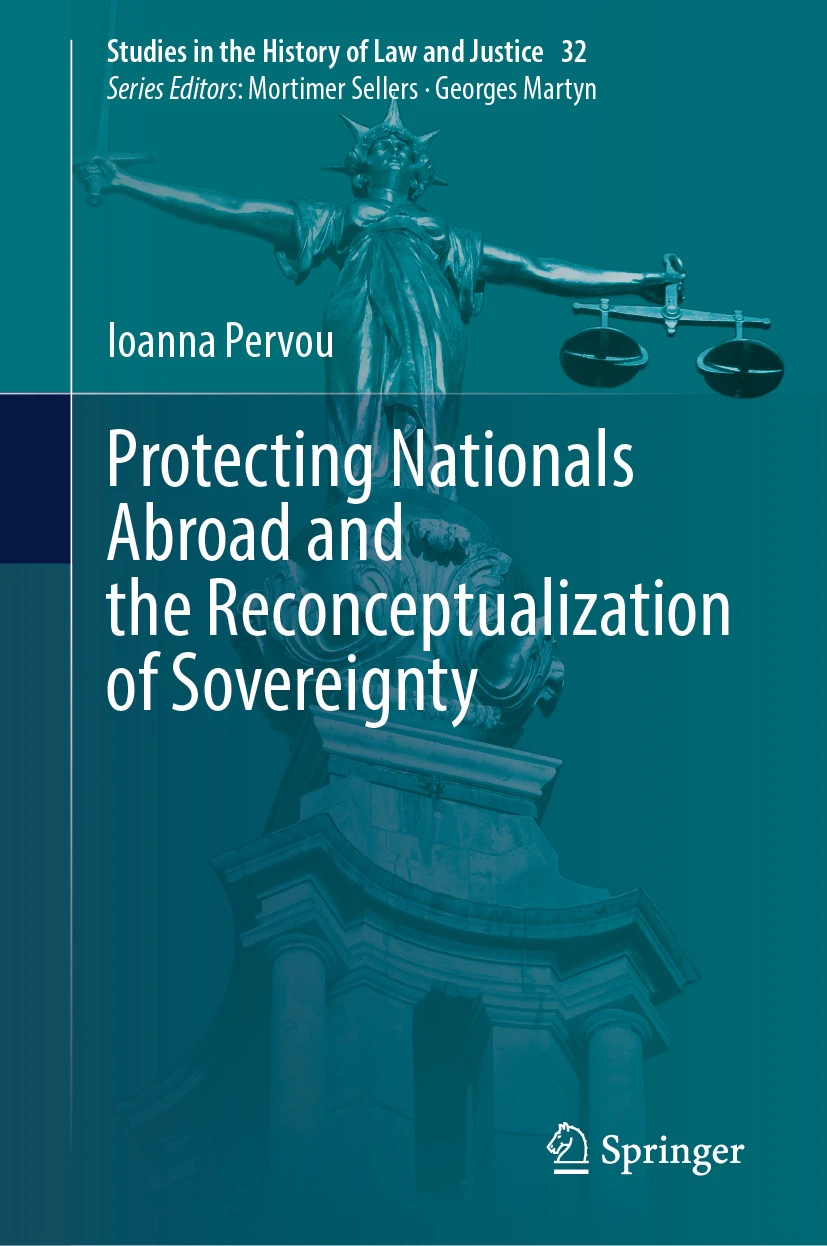
    BOOK: Ioanna PERVOU, Protecting Nationals Abroad and the Reconceptualization of Sovereignty [Studies in the History of Law and Justice, eds. Mortimer SELLERS & Georges MARTYN; 32] (Heidelberg: Springer, 2025), ISBN 9783032052315


    (image source: Springer)

    Abstract:

    This book helps to conceptualize the doctrine of forcible protection of nationals abroad and illustrates the key elements of state practice. States’ interest in protecting their nationals abroad is timeless; nationality and allegiance are constitutive elements of sovereignty and in some cases, take precedence over territoriality. Yet the forcible protection of nationals abroad has long been debated and attracted the attention of international legal theory. Currently, it is particularly in the spotlight due to Russia’s invocation of the doctrine in the armed conflict against Ukraine. However, protection of nationals abroad is a concept which is expected to fuel international debate in the years to come, primarily because of globalization and the growing trend of more and more people living outside their country of birth. Chapters 1 and 2 delve into the doctrine of protecting nationals abroad. More specifically, Chapter 1 examines how the doctrine was formulated and applied in the pre-Charter era and explores whether there was a customary rule permitting the use of force to protect a state’s nationals abroad, while Chapter 2 offers an overview of the doctrinal debate which followed the United Nations Charter and the prohibition of the use of force. In turn, Chapters 3 and 4 take a closer look at state practice from 1945 onwards. Chapter 3 outlines the major features of states’ practices and their justifications for using force for the sake of their nationals. Chapter 4 assesses the Russian discourse on the protection of nationals abroad, specifically with regard to the armed conflict with Georgia, the rhetoric preceding the annexation of Crimea, and the military invasion of Ukraine. Lastly, Chapter 5 explains how the protection of nationals abroad could be made more human-centric and go beyond jus ad bellum. This chapter re-interprets the concept of “nationals” and sheds light on the terms “expatriates,” “naturalized foreigners” and “diaspora,” suggesting that there is a gap between diplomatic and forcible protection, one not reflected in international law regulation and which needs to be addressed.

    On the author:

    Dr. Ioanna Pervou is an Assistant Professor in Public International Law at the Law Faculty, Democritus University of Thrace. Ioanna obtained her bachelor's degree from Aristotle University of Thessaloniki. She holds an LLM in Public International Law from the University of Cambridge, an LLM in Public Law from Democritus University of Thrace and an MBA with a specialization in the administration of public hospitals. Her doctoral thesis, obtained by the Aristotle University of Thessaloniki, received a scholarship from the Academy of Athens. She is a Research Fellow at the Hellenic Foundation for European and Foreign Policy (ELIAMEP) and a Visiting Fellow from 2023 to 2025 at LSE Health. She is a lawyer.

    Read the book here: DOI 10.1007/978-3-032-05231-5. 

    17 November 2025

    BOOK: Indravati FÉLICITÉ & Marine LE PULOCH (dir.), Regard critique sur les souverainetés. Une perspective globale du Moyen Âge à nos jours [Rencontres, 686; Histoire, 18] (Paris: Classiques Garnier, 2025), 297 p. ISBN 9782406186304, € 32


    (image source: Classiques Garnier)

    Abstract:

    La souveraineté est devenue une évidence dans la philosophie politique, bien que son application varie selon les contextes historiques et géographiques. Ce volume propose une analyse interdisciplinaire et comparée de la souveraineté du Moyen Âge à nos jours à travers ses usages politiques.

    Read more here: DOI 10.48611/isbn.978-2-406-18632-8.

    10 November 2025

    CONFERENCE: Territoire(s). Notion, limites et extensions (Lille: Université de Lille, Salle Guy Debeyre, 14-15 NOV 2025)

    (Image source: Univ-droit)

    Abstract

    Understood as part of the earth’s surface in the usual sense, described by Sextus Pomponius in the Digest as ‘all the land within the boundaries of any community’, territory is defined in modern and contemporary times as ‘a constitutive element of the State, for which it forms the geographical basis and whose powers it determines’. The link between territory and public and judicial authorities thus predates the concept of the State. The civil authority freely administers and organises its territory, which is divisible and divided. It can also create subdivisions within the same territory, which have a greater or lesser extent of autonomy and their own powers, as in the case of French decentralisation or the devolution of power in the United Kingdom.

    The notion of territory inherently includes the idea of its own limit, i.e. the border, and raises the question of its extension. 

    National borders can be natural (theory of the natural borders of France) or artificial (borders of the European colonies in Africa and Asia). It can be physical, such as a city wall, but it can also be vague, such as the limes of ancient Rome or the demarcation of the European continent from Asia. The border divides an internal space (the territory itself) from a space beyond, in which sovereignty no longer applies and public authority no longer has any power. It is therefore possible, as the Roman jurist Paul wrote, to disobey ‘the judge who exercises jurisdiction outside his territory’4. In this context, the rules of international private and criminal law clarify the problems raised when a legal act or crime is committed abroad and provide solutions to conflicts of law and jurisdiction.

    This consideration of borders invites us to examine how war shapes territory, particularly through annexation, recognition of a newly-formed state or state succession. These different ways of altering borders can bring up complex legal issues. Medieval jurists developed the ‘just war theory’, derived from Roman fetial law and the reflections of Christian thinkers of late antiquity. International law has gradually incorporated mechanisms to limit the effects of war on territories and populations, but these legal principles are difficult to reconcile with geopolitical realities. At national level, the extension of borders through the incorporation of new territories can lead to the establishment of special public and private law statutes, as in certain overseas territories, former French colonies, or in the British Overseas Territories.

    Territories are constantly extending their borders to new horizons, such as the sea from the end of the Middle Ages and the sky and space in the 20th century. Diplomacy is instrumental in exploring and sharing these new territories and spaces. More generally, diplomacy is a means of preventing or resolving border and territorial disputes between states, as well as maintaining peaceful international relations and boosting economic exchanges. 


    Program:

    Vendredi 14 novembre 2025

    09h00 : Mots d’accueil et propos introductifs
    • Gaël Chantepie, Directeur de l’École doctorale SJPG
    • Serge Dauchy, Directeur du CHJ
    • Alexandra Garifullina, Hugo Neuhauser, Lucie Ranchoux, Université de Lille
    Séance 1. Territoire(s), échelles et frontières
    • 9h30: Daniel Bökenkamp, Tilburg University - Territory and Scale in Urban Legal History: A Framework for Comparative Analysis.
    • 9h50: Quentin Muller, Université de Lorraine / Alexandre Ruelle, CY Cergy Paris Université - Concevoir le(s) territoire(s) dans des États composites au XVIIe siècle. L’exemple des espaces lorrain et savoyard.
    • 10h10: Antoine Laurent, Université Paris Panthéon Assas - Penser le territoire par la frontière : réflexions sur la conceptualisation exclusive du territoire en droit international.
    Séance 2. Territoire(s), cultures et identités
    • 11h20: Natalie Schwabl, Sorbonne Université - Constructions et légitimations des frontières dans les régimes fascistes : l’exemple du territoire de l’« État indépendant de Croatie » (1941-1945).
    • 11h40: Asena Poyrazer, Université Paris Saclay - Territorialiser l’immatériel ? Approche juridique du patrimoine culturel immatériel en contexte post-conflit.
    • 12h00: Raphaël Capet, Université Toulouse Capitole - Le territoire de chasse comme palimpseste.
    Séance 3. Territoire(s) divisés
    • 14h30: Jean-Michel Mangiavillano, Office français de la biodiversité - Le découpage entre le territoire urbain et le territoire rural de la Provence baroque d’après le Code Buisson : le témoignage de la réception de la romanité.
    • 14h50 : Lucie Ranchoux, Université de Lille - Chambres de commerce et territorialisation du pouvoir économique : les cas de Lille et Dunkerque au XVIIIe siècle.
    • 15h10 : Benedetta Rinaldi Ferri, EHESS - Un idiome juridictionnel de la ville : la dédicace des espaces en droit contemporain (Italie, 1971-1988).
    Séance 4. Territoire(s) occupés et colonisés
    • 16h20 : Thao Anh Hoang, Université de Montpellier - La question du conflit de lois sur les territoires colonisés : le cas du Vietnam (1862-1945).
    • 16h40 : Paul-Emmanuel Babin, Fondation pour la Mémoire de la Shoah - Le « quadrillage » du FLN pendant la guerre d’indépendance algérienne ou la constitution d’une véritable atteinte à l’intégrité du territoire national ?
    • 17h00 : Claire de Blois, Université d’Orléans - Du territoire occupé au territoire revendiqué : l’effectivité de la souveraineté territoriale face aux occupations prolongées.

    Samedi 15 novembre 2025
    Séance 5. Territoire(s) et souveraineté
    • 10h00: Stefano Cattelan, Vrije Universiteit Brussel - Sarpi et la mer Adriatique : le territoire maritime vénitien entre souveraineté et déclin (v. 1610–1720).
    • 10h20 : Andrea Raffaele Amato, Università di Macerata - À l’ombre de la Grande Guerre. La nature juridique du territoire d’élément co-essentiel de la souveraineté étatique à simple objet de dominum dans la disponibilité de l’État-nation : Santi Romano, Tommaso Perassi
    • et Donato Donati (1902-1924).
    • 10h40 : Alexandra Garifullina, Université de Lille - The Status of Outer Space in Legal Soviet Doctrine.

    11h30 : Propos conclusifs
    • Alexandra Garifullina, Hugo Neuhauser, Lucie Ranchoux, Université de Lille

    More information can be found here

    23 January 2025

    BOOK: Moritz MIHATSCH & Michael MULLIGAN (eds.), Shifting Sovereignties. A Global History of a Concept in Practice (Berlin: DeGruyter Oldenbourg, 2025), ISBN 9783111447117, €129

    (image source: DeGruyter Oldenbourg) 

    Abstract:

    Shifting Sovereignties explores practical manifestations of sovereignty from antiquity to the Anthropocene. Taking a global-history perspective and centring Africa, the Middle East, and Asia, it destabilises overly neat theoretical notions of the concept. Shifting Sovereignties shows that, in practice, sovereignty is far from absolute, perpetual, indivisible, or supreme; rather it is fuzzy, compromised, fragmented, and layered. From these observations, the authors derive a historical conceptualisation which makes change and contingency core aspects of the understanding of sovereignty. Rather than understanding sovereignty as a characteristic of individual states, Mihatsch and Mulligan propose the notion of “sovereignty regimes”: frameworks of legitimation enforced through mutual recognition. These regimes are created and managed by more or less institutionalised structures which embody what the authors call “system sovereignty.” Sovereignty regimes and system sovereignty are, like sovereignty itself, continuously changing and contingent. This process of change forms the core of the book. Shifting Sovereignties thus contributes a practical, historical perspective on a concept which is foundational in political science, international relations, and international law.

    On the editors:

    Moritz A. Mihatsch, University of Cambridge, UK; Michael R. Mulligan, Euro University of Bahrain.

    Read more here. 

    09 October 2024

    BOOK: Cornel ZWIERLEIN & Daniel LEE (eds.), Sovereignty. European and Global Histories, 1400-1800 [Intersections, ed. Karl A. E. ENENKEL] (Leiden/Boston: Martinus Nijhoff/Brill, 2025), XIV + 416 p. ISBN 9789004218628, €135,68


    (image source: Brill)

    Abstract:

    Was the emperor as sovereign allowed to seize the property of his subjects? Was this handled differently in late medieval Roman law and in the practice and theory of zabt in Mughal India? How is political sovereignty relating to the church´s powers and to trade? How about maritime sovereignty after Grotius? How was the East India Company as a ´corporation´ interacting with an Indian Nawab? How was the Shogunate and the emperor negotiating ´sovereignty´ in early modern Japan? The volume addresses such questions through thoroughly researched historical case studies, covering the disciplines of History, Political Sciences, and Law. Contributors include: Kenneth Pennington, Fabrice Micallef, Philippe Denis, Sylvio Hermann De Franceschi, Joshua Freed, David Dyzenhaus, Michael P. Breen, Daniel Lee, Andrew Fitzmaurice and Kajo Kubala, Nicholas Abbott, Tiraana Bains, Cornel Zwierlein, Mark Ravina.

    Table of contents:


    1 Introduction
     Cornel Zwierlein and Daniel Lee

    Part 1: European Sovereignties


    2 Sovereignty, the Prince, and Property Rights
     Kenneth Pennington

    3 Offering Sovereignty in Exchange for Assistance? The Appeal of the Dutch to Henry III of France (1584–1585)
     Fabrice Micallef

    4 Edmond Richer, Jean Bodin and the Idea of Sovereignty
     Philippe Denis

    5 Venetian Republicanism against the Roman Ambitions of Pontifical Theocracy ‒ Sovereignty According to Paolo Sarpi: Political Theory and the Challenge of the Venetian Interdict Crisis (1606–1607) and Its Aftermath
     Sylvio Hermann De Franceschi

    6 Jurisdiction, Territory, Sovereignty: Giulio Pace and the Dominion of the Sea
     Joshua Freed

    7 Hobbes and the Healthy Sovereign
     David Dyzenhaus

    8 ‘Le prince doit avoir une autorité souveraine sur les mariages’: Annulments, Sovereignty, and the Law in Early Modern France
     Michael P. Breen

    9 Sovereignty and the Duties of Humanity: On Money, Barter, and Sale
     Daniel Lee

    Part 2: Global Sovereignties


    10 ‘Company-states’ and Sovereignty
     Andrew Fitzmaurice and Kajo Kubala

    11 Zabt and Its Discontents: Property Confiscation, Patrimonial Kingship, and the Performance of Sovereignty in Mughal India, c.1600–1800
     Nicholas Abbott

    12 Unsettling Sovereignty between the Mughal and British Empires: the Case of the Nawab of Arcot, circa 1749–1795
     Tiraana Bains

    13 Sovereignty and Untranslatability: European International Law, France, the Ottoman Empire and the Barbary States 1720–1740
     Cornel Zwierlein

    14 Who Was Sovereign in Early Modern Japan?
     Mark Ravina


    On the editors:

    Cornel Zwierlein is teaching early modern history since 2001, holding Habilitation rights since 2011. He is a specialist in Early Modern European and Global History, Political Theory, Religion and Law. Daniel Lee is Professor of Political Science at the University of California, Berkeley. He is a specialist in political theory, the history of political thought, and jurisprudence. 

    Read more: DOI 10.1163/9789004218628.

    28 March 2024

    SEMINAR: La question de la souveraineté sur les océans et le début de la modernité (Cergy-Pontoise: CY Cergy-Paris Université, 29 MAR 2024 h. 14:30)


    La question de savoir qui a le droit de gouverner les océans et d'en réglementer l'utilisation reste d'actualité. Cette présentation vise à montrer comment cette problématique a agité l'esprit des juristes et des diplomates depuis le début de l'époque moderne, lorsque les découvertes géographiques ont ouvert de nouveaux horizons et des problèmes juridiques complexes. En particulier, l'évolution du concept de mare clausum, selon lequel les Etats pouvaient acquérir des droits exclusifs sur la mer, sera abordée.

    THE SPEAKER

    M. Stefano Cattelan, Chercheur post-doctoral à la Vrije Universiteit Brussel - CORE


    PRACTICAL INFORMATION

    Conférence organisée par Carlos-Miguel Herrera, directeur du CPJP, CY Cergy Paris Université. La session sera animée par la Professeure Caroula Argyriadis-Kervégan

    La conférence aura lieu dans la salle B322 de la Faculté de droit de l'Université de Cergy-Paris.


    More information can be found here.

    30 June 2023

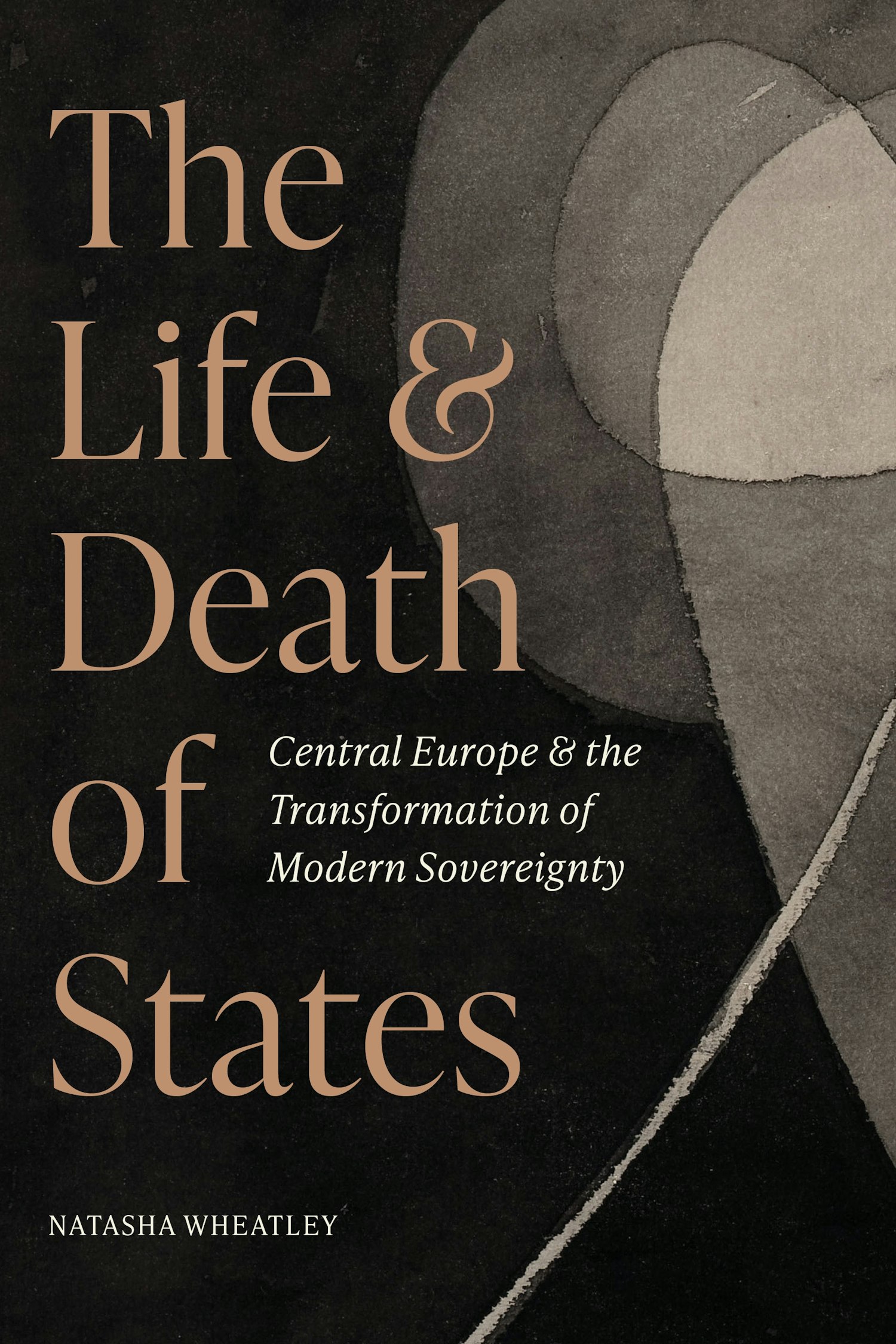
    BOOK: Natasha WHEATLEY, The Life and Death of States: Central Europe and the Transformation of Modern Sovereignty (Princeton, NJ: Princeton University Press, 2023), 424 pp, ISBN 9780691244075, $45

    (image courtesy: Princeton University Press) 

    Book description: 
    Sprawled across the heartlands of Europe, the Habsburg Empire resisted all the standard theories of singular sovereignty. The 1848 revolutions sparked decades of heady constitutional experimentation that pushed the very concept of “the state” to its limits. This intricate multinational polity became a hothouse for public law and legal philosophy and spawned ideas that still shape our understanding of the sovereign state today. The Life and Death of States traces the history of sovereignty over one hundred tumultuous years, explaining how a regime of nation-states theoretically equal under international law emerged from the ashes of a dynastic empire.

    Natasha Wheatley shows how a new sort of experimentation began when the First World War brought the Habsburg Empire crashing down: the making of new states. Habsburg lands then became a laboratory for postimperial sovereignty and a new international order, and the results would echo through global debates about decolonization for decades to come. Wheatley explores how the Central European experience opens a unique perspective on a pivotal legal fiction—the supposed juridical immortality of states.

    A sweeping work of intellectual history, The Life and Death of States offers a penetrating and original analysis of the relationship between sovereignty and time, illustrating how the many deaths and precarious lives of the region’s states expose the tension between the law’s need for continuity and history’s volatility.
    Table of contents: 
    Introduction
    Chapter 1: Constitution as Archive: Drafting the Empire, 1848-1860s
    Chapter 2: The Secret Science of Dual Sovereignty: 1867 and After
    Chapter 3: Fictional States: Lands and Nations
    Chapter 4: Pure Theory: Jellinek and Kelsen Reinvent Legal Philosophy
    Chapter 5: What is a New State? 1919 in the History of the Austro-Hungarian Empire
    Chapter 6: State Birth at the Frontier of Knowledge: Reimagining International Law from Postimperial Vienna
    Chapter 7: Sovereignty in Sequence: Law, Time, and Decolonization 
    Conclusion: The Temporal Life of States

    About the author: 
    Natasha Wheatley is assistant professor of history at Princeton University. She is the coeditor of Remaking Central Europe: The League of Nations and the Former Habsburg Lands and Power and Time: Temporalities in Conflict and the Making of History. Her writing has appeared in Past & Present and the London Review of Books.
    More information can be found here. 

    27 June 2023

    BOOK: Priyasha SAKSENA, Sovereignty, International Law, and the Princely States of Colonial South Asia (Oxford: University Press, 2023). ISBN: 9780192866585, pp. 272, £90.00


    (Source: OUP)

    ABOUT THE BOOK

    What constitutes a sovereign state in the international legal sphere? This question has been central to international law for centuries. Sovereignty, International Law, and the Princely States of Colonial South Asia provides a compelling exploration of the history of sovereignty through an analysis of the jurisdictional politics involving a specific set of historical legal entities.

    Governed by local rulers, the princely states of colonial South Asia were subject to British paramountcy whilst remaining legally distinct from directly ruled British India. Their legal status and the extent of their rights remained the subject of feverish debates through the entirety of British colonial rule. This book traces the ways in which the language of sovereignty shaped the discourse surrounding the legal status of the princely states to illustrate how the doctrine of sovereignty came to structure political imagination in colonial South Asia and the framework of the modern Indian state.

    Opening with a survey of the place of the princely states in the colonial structures of South Asia, Sovereignty, International Law, and the Princely States of Colonial South Asia goes on to illustrate how international lawyers, British politicians, colonial officials, rulers and bureaucrats of princely states, and anti-colonial nationalists in British India used definitions of sovereignty to construct political orders in line with their interests and aspirations. By invoking the vernacular of sovereignty in contrasting ways to support their differing visions of imperial and world order, these actors also attempted to reconfigure the boundaries among the spheres of the national, the imperial, and the international. Throughout the eighteenth, nineteenth, and early twentieth centuries, debates and disputes over the princely states continually defined and redefined the concept of sovereignty and international legitimacy in South Asia.

    Using rich material from the colonial archives,Sovereignty, International Law, and the Princely States of Colonial South Asia conveys an understanding of the history of sovereignty and the construction of the modern Indian nation-state that is still relevant today. A riveting read, this book will be of considerable interest and importance to scholars of international law and South Asia, legal historians, and political scientists.

    ABOUT THE AUTHOR

    Priyasha Saksena is a lecturer at the School of Law, University of Leeds, UK. Her research focuses on the historical development of legal concepts and institutions within the British empire and their contemporary effects. She is particularly interested in exploring how legal doctrines such as sovereignty have shaped the relationship between international law and colonialism.

    TABLE OF CONTENTS

    1: Introduction
    2: Setting the Stage: The Legal Construction of British Paramountcy
    3: Jousting Over Jurisdiction: Sovereignty Debates in the Aftermath of the 1857 Rebellion
    4: The Controversy Over Divisible Sovereignty: The Princes and the Indian States Committee
    5: Political Negotiations: The Princes in the Federation Debates
    6: Building the Nation: The Princely States in the Age of Decolonization
    7: Epilogue


    More information with the publisher.

    17 January 2023

    JOURNAL: Italian Review of Legal History - 8/2022 [open access]


    ​​Prospettive sulla sovranità         Gianluca Russo
              39-77
    Altri temiIn ricordo diLetture