The Collège de France (established by King Francis I in 1530) has published the list of free and openly accessible classes taught by Prof. Patrick Boucheron on the lieux de pouvoir.
More information here.

The ESCLH aims to promote comparative legal history and seeks affiliation with individuals and organisations with complementary aims.
The Collège de France (established by King Francis I in 1530) has published the list of free and openly accessible classes taught by Prof. Patrick Boucheron on the lieux de pouvoir.
More information here.
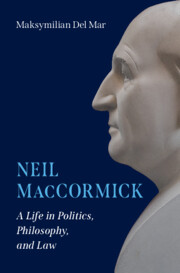
Abstract:
Neil MacCormick (1941–2009) was one of the twentieth century's most important legal philosophers and one of Scotland's most influential public intellectuals. This book tells the story of his political and philosophical life, from his intensely political childhood as the son of 'King John', one of the founders of the Scottish National Party, through to his involvement in Scottish politics – especially as the author of SNP's constitutional policy – and his role as a Member of the European Parliament, helping to draft the European Constitution. With special attention to MacCormick's character, this book offers a reading of his entire oeuvre, covering his contributions to theories of legal and moral reasoning, institutional legal theory, nationalism, post-sovereignty, subsidiarity, and constitutional pluralism in Europe. This book reads MacCormick as a highly creative thinker who excelled in the art of constructing inclusive middles and thereby developed his own distinctive approach to politics and philosophy.
Read more here: DOI 10.1017/9781009609937.
(source: Legal History Blog)

L'histoire du serment politique en Occident est celle d'un long dévoiement. Ce rite habillé d'oripeaux antiques, médiévaux et religieux, avait été pensé comme l'instrument de la conjuration des hommes libres. Il sera devenu un des moyens de conjurer leur liberté. Alliance des hommes libres et égaux sous le regard de Dieu, il est progressivement encadré par les puissances politiques et ecclésiales, puis capté par l'État moderne à partir du XVIIe siècle. L'expérience révolutionnaire cherchera à redonner au serment son caractère démocratique et égalitaire, avant qu'au XIXe il ne devienne un rite de sujétion bureaucratique. Dans les régimes autoritaires et totalitaires, il exprime non seulement une fidélité politique mais il est la marque d'un biopouvoir par lequel l'individu abdique sa conscience et jusqu'à son propre corps dans le peuple, le parti, l'État, l'idéologie, le chef. C'est à une histoire politique enracinée dans les pratiques juridiques et les doctrines religieuses propres à l'Occident, et aujourd'hui négligée, que ce livre s'attache à donner une lecture originale et novatrice, puisqu'il s'agit de la première synthèse en français sur l'histoire du serment.
Read more here.

Vingt ans après sa publication, voici la traduction d’un classique résultant de plusieurs décennies de recherches, L’Italia degli Stati territoriali. Secoli XIII-XV. Isabella Lazzarini livre dans ce texte l’essence des débats qui ont agité l’historiographie italienne sur l’évolution de l’Europe politique et la naissance de l’État moderne. De plus, elle y propose une grammaire du fonctionnement politique des sociétés italiennes de la fin du Moyen Âge et de la Renaissance. Cet ouvrage éclaire d’un jour nouveau le sujet complexe des « deux Italies ». À partir d’un vaste panorama historiographique, l’autrice y retrace le parcours qui mène des régimes politiques que tout oppose, tels que les communes, les royaumes ou les seigneuries, à la création d’États indépendants mais interconnectés. Réfutant la partition entre Italie du Nord, foyer de toutes les modernités (urbanisation, développement économique, etc.), et Italie du Sud, enlisée dans un supposé archaïsme (économique, social, politique, etc.), elle analyse le développement simultané de ces entités et la naissance d’un langage commun au sein du jeu global italien. Ce réseau de pouvoirs en équilibre instable, véritable laboratoire politique à l’échelle européenne dont il s’agit ici de faire la généalogie, dessine la voie italienne vers l’État moderne, barrée à la fin du XVe siècle par l’essor des royaumes de France et d’Espagne.
Read more here.

The Association des historiens du droit de l'Ouest posted videos from a conference dedicated to the most recent edition of prof. Marcel Morabito's classic Histoire constitutionnelle de la France de 1789 à nos jours (LGDJ, currently 17th edition) on Youtube.
Introduction by Prof. Xavier Godin:
"Ecrire l'histoire politique et constitutionnelle" by Prof. Marcel Morabito:
"Retour sur l'élaboration et le contexte de l'élaboration de l'Histoire politique et constitutionnelle de Marcel Morabito, par un humble tributaire" by dr. Yann-Arzel Durelle-Marc
"L'histoire constitutionnelle est-elle tributaire du présent ?" by prof. François Saint-Bonnet
"Penser le droit constitutionnel avant les constitutions: le point de vue d'une médiéviste" by prof. Corinne Leveleux-Texeira
"Prendre l'histoire constitutionnelle au sérieux" by prof. Grégoire Bigot
"Considérations juridiques sur la tradition juilletiste réceptionnée au sein de la IIe république: apport du droit parlementaire à l'histoire constitutionnelle" by dr. Samuel Sanchez
"Marcel Morabito, théoricien du droit" by Prof. Ariane Vidal-Naquet


In the sixteenth and early seventeenth centuries, theories of price regulation were developed in order to analyze the demands of justice in situations where markets cease to function—be it through natural conditions, wars, or artificially induced shortages in supply. This article investigates the relevance of the methodological notion of presumption for the legally binding power of laws concerning price regulation. In particular, the relation between presumptions (assumptions that are taken to be true unless and until proven false), the cost-and-labor theory of value, and the question of the morally binding power of laws concerning legal prices are explored.The Language of “Political Science” in Early Modern Europe (Sophie Smith)
Historians of early modern “scientia civilis” focus on two main understandings of that concept: the juridical and the rhetorical. This article focuses on another way of thinking about civil science in the early modern period, the origins and development of which are in the Aristotelian commentary tradition. This article begins with political science in Aristotle then turns to the works of commentators from Albert the Great in the thirteenth century, to the Oxford philosopher John Case in the late sixteenth. It ends on ways that this history offers new perspectives on Hobbes’s science of politics, and on the broader historiography.The Construction of the Concepts “Democracy” and “Republic” in Arabic in the Eastern and Southern Mediterranean, 1798–1878 (Wael Abu Uksa)
This article illuminates the construction of the concepts “democracy” and “republic” in the Arabic-speaking regions of the eastern and southern Mediterranean between 1798 and 1878. Examining these ideas through conceptual analysis on two levels, language construction and political discourse, the article reveals the layers these concepts acquired and their reception in the context of state reforms in the Ottoman Empire. While both “democracy” and “republic” evolved in Arabic after the French Revolution and acquired their modern morphological forms and content primarily between the 1820s and 1876, “republic” came into use and was perceived as relevant to local circumstances earlier than “democracy.”For these and more articles, see the journal's blog.

