
(Source: Unimc)
More information available here.

The ESCLH aims to promote comparative legal history and seeks affiliation with individuals and organisations with complementary aims.

Abstract:
Where does our modern democracy come from? It is a composite of two very different things: a medieval tradition of political participation, pluralistic but highly elitist; and the notion of individual equality, emerging during the early modern period. These two things first converged in the American and French revolutions – a convergence that was not only unexpected and unplanned but has remained fragile to this day. Democracy's Double Helix does not simply project and trace our modern democracy back into history, assuming that it was bound to come about. It looks instead at the political practices and attitudes prevailing before its emergence. From this perspective, it becomes clear that there was little to predict the coming of democracy. It also becomes clear that the two historical trajectories that formed it obey very different logics and always remain in tension. From this genuinely historical vantage point, we can therefore better understand the nature of our democracy and its current crisis.
On the author:
Lars Behrisch, Universiteit Utrecht, The Netherlands
Read more here: DOI 10.1017/9781009029667.
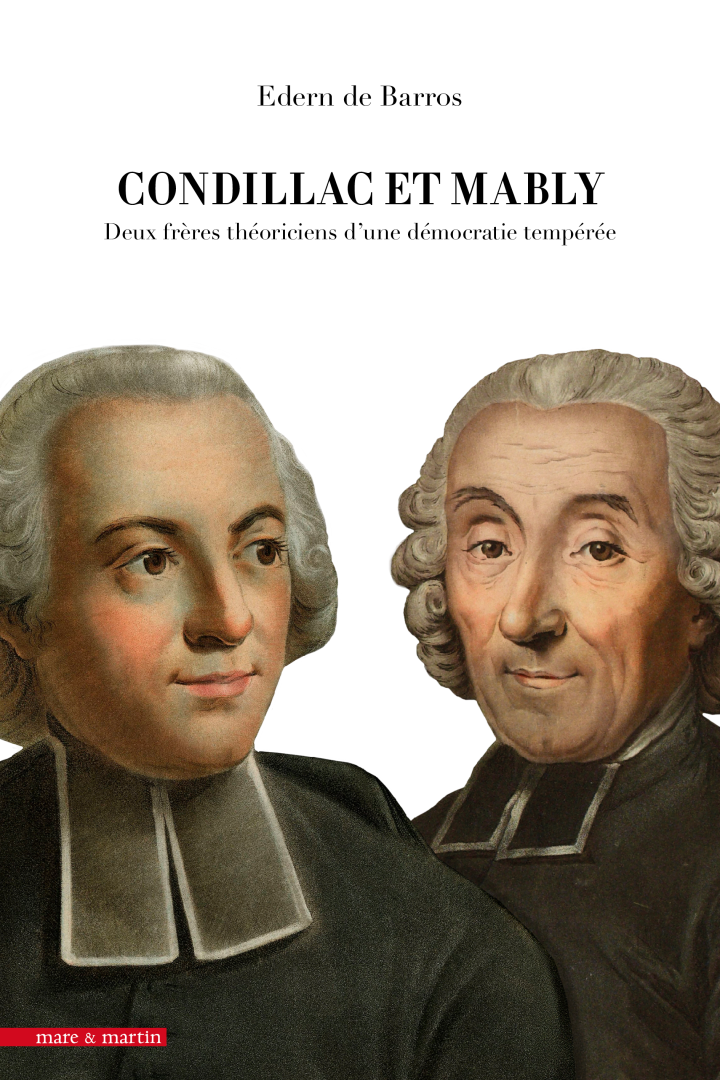
Condillac (1714-1780) et Mably (1709-1785) sont deux frères dont l’influence sur la Révolution française fut considérable. Figures majeures des Lumières, ils furent durablement séparés par l’historiographie depuis 1789. Condillac, associé aux Idéologues, serait le père du libéralisme français ; Mably, figure de la démocratie égalitaire, un précurseur du communisme. Cette étude déconstruit cette opposition et révèle leur républicanisme libéral commun. À la croisée du droit, de l’histoire et de la philosophie, l’ouvrage articule trois volets : une méthode empiriste fondée sur le lien entre droit naturel et histoire ; une théorie politique de la « démocratie tempérée » fondée sur la souveraineté populaire ; et une critique du « despotisme légal » des physiocrates, au nom d’une liberté économique républicaine. Appuyé sur une lecture comparée de leurs oeuvres complètes, ce livre renouvelle en profondeur notre compréhension des Lumières.
Read more with the publisher.
Book abstract:
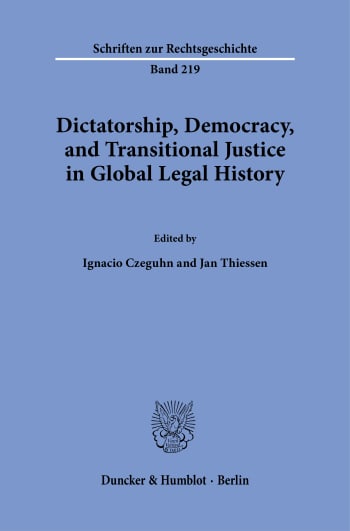
The anthology presents the lectures given on the symposium »From Dictatorship to democracy« at the House of the Wannsee Conference on 13–14 September 2021. The aim of the organizers was to show what problems existed during the transition from dictatorship to democracy in several countries around the world. They all enacted laws or other measures to ensure that fundamental rights and the rule of law would resist anti-democratic ideologies, anti-Semitism, racism, and war crimes in the future. However, the legal system and law in these countries themselves often had their origins in dictatorship. Thus, there were and are obvious and hidden anti-democratic continuities that influence law and the legal system up to the present. Scientifics and jurists from Italy, Japan, Poland, Spain, South Africa, and Germany examine these continuities in their contributions.
Table of contents:
Ignacio Czeguhn and Jan Thiessen
Introduction
Ignacio Czeguhn
The Berlin Administration of Justice after 1945 – Factual and Personnel Continuities with the Nazi Justice System. Presentation of the Project and State of Research
Vittoria Calabrò
Continuità e discontinuità nel passaggio dalla dittatura alla democrazia: la vicenda del giurista
Gaspare Ambrosini
Bronisław Sitek and Albert Pielak: From Sovietization to Democratization of Justice in Poland (1944–1997)
Miho Mitsunari
Wartime Sexual Violence and War Responsibility: The »Comfort Women Issue« in Japan
José Antonio Pérez Juan
The Amnesty Measures of the Spanish Transition
Antonio Sánchez Aranda
Franco’s Regime. From Totalitarism to Authoritarism in its Repressive Model (April 1936–November 1975)
Ramón M. Orza Linares
La transición a la democracia en los países de América Central
Gerhard Kemp
From Dictatorship to Democracy in South Africa
Claudia Vanoni
Drei Jahre Antisemitismusbeauftragte der Generalstaatsanwaltschaft Berlin – ein Erfahrungsbericht
Samuel Salzborn
Kontinuität, Tradierung und Transformation des Antisemitismus
Jan Thiessen
The Treatment of the Nazi Past in Contemporary German Legal Education
Benjamin Lahusen
Learning from History? Current Developments in the Restitution of Nazi-Confiscated Property
Read more here.

L’Europe est le seul continent qui a développé des institutions représentatives exerçant des compétences décisives dans la politique des États. Depuis Otto Hintze (1931), aucun historien n’a plus abordé les conditions spécifiques qui ont permis cette création, ni leur absence ou disparition. Bien que des formes de participation politique aient fonctionné assez généralement au niveau local, leur représentation au niveau des États s’est répandue très inégalement à travers l’Europe. Il convient donc de préciser quelles catégories sociales réussirent à faire valoir leurs intérêts, par quels moyens, et avec quels effets. Le cours-conférence mettra l’accent sur des phases d’expansion et de contraction :
- la condition primaire est la formation de différentes catégories sociales disposant de ressources relativement autonomes, dont aucune n’est hégémonique,
- la croissance économique et démographique produit des catégories sociales nouvelles qui visent à réaliser leurs desseins par l’émancipation,
- les tensions ou luttes inhérentes à cette dynamique mènent à la consolidation des rapports de force dans des institutions,
- les phases de contraction démographique et économique renforcent la tendance à l’oligarchie, inhérente à chaque institution.
Ce modèle sera concrétisé par de courtes discussions de cas typiques, des Ligues lombardes au XIIe siècle à la disparition des assemblées d’États aux XVIIe et XVIIIe siècles, tandis qu’elles furent souveraines ailleurs.
Bibliographie thématique :
- Albareda, Joaquim & Manuel Herrero Sánchez, eds, Political Representation in the Ancien Régime, New York & London 2019.
- Damen, Mario, Jelle Haemers & Alastair J. Mann, eds, Political Representation. Communities, Ideas and Institutions in Europe (c. 1200-c. 1690), Leiden & Boston 2018.
- Gouvernés et Gouvernants, vols. 3 & 4. Recueils de la Société Jean Bodin, XXIV & XXV/ SL-APAE, XXXV & XXXVI, Brussels 1965-66.
- Graves, Michael A.R., The Parliaments of Early Modern Europe, London 2001.
- Hébert, Michel, Parlementer. Assemblées représentatives et échange politique en Europe occidentale à la fin du Moyen Age, Paris 2014.
- Marongiu, Antonio, Medieval Parliaments. A comparative study, London 1968.
- Myers, A.R., Parliaments and Estates in Europe to 1789, London 1975.

ABOUT THE BOOK
This present book examines some of the key features of the interplay between legal history, authoritarian rule and political transitions in Brazil and other countries from the end of 20th Century until today. This book casts light on these aspects of the role of law and legal actors/institutions. In the context of transition from authoritarian rule to democratic state, Brazil has produced a significant literature on the challenges and shortcomings of the transition, but little attention has been given to the role of law and legal actors/institutions. Different approaches focus on the legal mechanisms, discourses and practices used by the military regime and by the players involved in the political transition process in Brazil. A comparative perspective that takes into account different political transitions – and their legal consequences – in Europe and Latin America complements the analysis.
Part 1 (4 essays) discusses some of the central issues of political transition and legal history in contemporary Brazil, focusing on the time of the transition (and its effects on transitional justice) with different perspectives, from racial and gender issues to constitutional reform and police repression. Part 2 (3 essays) brings the comparative studies on South American experiences. Part 3 (4 essays) analyses different cases of transition to democracy in Chile, Portugal, Spain and Italy. Part 4 (3 essays) proposes a historiographical and methodological approach, considering the politics of time involved in the interplay between political transitions and legal history.
ABOUT THE EDITORS
Cristiano Paixão in Professor of legal history at the University of Brasília Law School. Doctor in Law degree from Federal University of Minas Gerais, with post-doctoral studies in historiography at Ecole des Hautes Etudes en Sciences Sociales de Paris and in modern history at Scuola Normale Superiore di Pisa. He was a visiting professor at Macerata University School of Law and at the Master’s Program in Constitutional Law at Seville University, and has published extensively about constitutional history. He was a member of the Brazilian Amnesty Committee (Ministry of Justice), was one of the coordinators of the Anísio Teixeira Memory and Truth Commission (University of Brasília). His main research interests are constitutional history, law and literature, and interdisciplinary studies in law.
Massimo Meccarelli is Professor of Legal History at the University of Macerata (Italy), and affiliate researcher of the Max Planck Institute for European Legal History (Frankfurt am Main). He was visiting professor at: Universidad Autónoma de Madrid, Johann Wolfgang Goethe-Universität in Frankfurt am Main, Universität Wien, Universität Luzern. He is author of several works on history of legal thought, history of justice, historiography and methodology of legal history. Most recently research interests: law and diversity, legal pluralism, constitution making process, time and law, law and humanities.
More information with the pubisher.

ABOUT THE BOOK
O livro que o leitor tem em mãos se caracteriza pela diversidade temática que se encontra nos seus dez capítulos, escritos por autores e autoras que atualmente apresentam sólidas pesquisas nos campos do Direito, da História e da Ciência Política, em torno dos conceitos de “democracia” e “estado de exceção”. Suas investigações exibem os mais variados objetos e problemas de estudo, abordados a partir de diferentes enfoques, com grande aposta na interdisciplinaridade em suas abordagens. Estes estudos se aprofundam sobre conceitos, pensadores, instituições, constituições, códigos, leis e normas, questões de gênero, etnias, sexualidade, identidade e classe social, analisados à luz dos problemas, contradições, utopias e desafios que compõem os processos de lutas, compromissos, golpes e resistências em que se formaram os sistemas democráticos contemporâneos. Esses temas têm ganhado cada vez mais centralidade nas Ciências Sociais, e conquistam a atenção de grandes públicos com o destaque que têm recebido na imprensa e na internet, diante das transformações que demarcam o avanço do neoliberalismo e da globalização, que vem trazendo a reboque alguns dos principais dilemas e contradições de nossos tempos. No centro desses debates encontra-se uma miríade de disputas em torno do passado e do futuro das democracias em que vivemos.
ABOUT THE EDITORS
Antonio Gasparetto Júnior: pós-Doutorando em História pela Universidade de São Paulo (USP), Doutor (2018), Mestre (2014), Bacharel e Licenciado (2010) em História e Bacharel em Administração Pública (2017) pela Universidade Federal de Juiz de Fora (UFJF), com estágio de doutoramento (Chercheur Invité) na École Doctorale d’Histoire Moderne et Contemporaine da Université Paris-IV – Sorbonne (2015-2016). Professor Formador na Universidade Federal Fluminense (UFF), Professor Conteudista na Universidade de Pernambuco (UPE), Professor Substituto no Instituto Federal do Sudeste de Minas Gerais (IF Sudeste MG) e Professor Efetivo de Educação Básica (PEB) no estado de Minas Gerais. Pesquisador integrado ao Laboratório de História Política e Social (LAHPS) e do Laboratório de Estudos e Pesquisas da Contemporaneidade (LEPCON).
Pedro Ivo Dias Tanagino: bolsista de pós-doutoramento (PNPD-CAPES) na Pontifícia Universidade Católica de São Paulo (PUC/SP). Doutor e mestre em História pela Universidade Federal de Juiz de Fora (UFJF), com estágio de doutoramento no Instituto de Ciência Sociais da Universidade de Lisboa (ICS-ULisboa). Autor da tese A Síntese Integral: a teoria do integralismo na obra de Miguel Reale (1932-1939). (UFJF, 2018).
More information and the table of contents with the publisher.

Der Mitbetreuer dieser ambitionierten Greifswalder Habilitationsschrift attestiert der Autorin laut Verlagswerbung, "eine bahnbrechende Leistung in der Wahlrechtsforschung" vorgelegt zu haben und die Besprechung in der "Süddeutschen Zeitung" hält den gewichtigen Band für ebenso bravourös wie lehrreich. Der Rezensent sieht das Werk, das Argumentationslinien der Habilitationsschrift des Mitbetreuers aufnimmt, aber überspitzt, viel kritischer, denn die Analyse erscheint ihm verkürzt sowie von Widersprüchen und relevanten Sachfehlern durchzogen. [ 1 ]Read further here.


