Search

Showing posts with label global legal history. Show all posts

01 July 2026

BOOK: Agustín CASAGRANDE, Constitución y Arbitrariedad. Conceptos e imaginarios del constitucionalismo argentino [Global Perspectives on Legal History, vol. 26, eds. Marietta AUER, Thomas DUVE & Stefan VOGENAUER] (Frankfurt am Main: Max Planck Institute for Legal History and Legal Theory, 2025), 224 p., ISBN 978-3-944773-50-6, € 19,25

(image source: MPILHLT)

Abstract:

The discourse of constitutionalism emerged out of the entanglement of three strands: legal theory, political philosophy, and historical narratives. Its structure revolves around the tension between the counter-concepts (Gegenbegriffe) of arbitrariness (to be denounced) and constitution (to be legitimized). This book presents a threefold genealogical analysis to access the logic of Argentine constitutionalism. First, a conceptual history (Begriffsgeschichte) exposes the distance between recent narratives of the development of Argentine constitutionalism as constructed by political historians, on the one hand, and constitutional scientists, on the other. The second genealogy explores the theoretical rupture between modern law and the traditional knowledge of ius commune in the shift from arbitrium iuris to “legicentric” logic – that is, the preeminence of written law enacted by the state. The narrowing of the concept of arbitrium to arbitrariness was central to the formation of constitutional law’s conception of the political order. Finally, this rupture went hand-in-hand with the establishment of new political imaginaries, including autocratic caudillos, suggestible masas, anarchic tendencies of a people, etc. During the 19th century, these fueled the sense among the elites that a new order was needed; but they also still remain part of current narratives. Revealing these emotional imaginaries that guided, and continue to guide, constitutional practice enables a dialogue between the history of law as written by historians and as written by constitutionalists, with the purpose of understanding the recurrent crises that still afflict Argentine constitutionalism in the 21st century.

On the author:
Agustín E. Casagrande is Professor of Legal Sociology in the Law Faculty of UNLP and Professor of the History of Western Law in the School of Humanities of UNSAM.
Table of contents:

Introducción.
Antinomias del lenguaje constitucional

Primera Parte
Constitución: Teoría e historiografía jurídica

Capítulo I: Historia constitucional, historia conceptual. Genealogía epistemológica de la historia crítica del derecho

1. Historia jurídica de la historia constitucional (y su deriva conceptual)

2. Constitución y «orden concreto»: un nuevo modo de Begriffsbildung

3. Historia del derecho (modo crítico): antropologías e instituciones

4. Historia constitucional desde la historia crítica del derecho.

Capítulo II: ¿Antigua Constitución o Gobernanza Doméstica? Conceptos y categorías en la nueva historia político-constitucional Argentina

1. Ortopedia constitucional: función educativa del constitucionalismo argentino

2. Antigua Constitución e historiografía política

3. Gobernanza doméstica e historia jurídica crítica

4. Crítica y crisis del discurso constitucional histórico argentino

Segunda Parte: Arbitrariedad y Legalidad: Sistemática del derecho

Capítulo III: Una historia conceptual de la arbitrariedad. Aproximación a la sistemática jurídica (Siglos XVI–XX)

1. Arbitrium: concepto integrador del derecho en el mundo jurisdiccional

2. Del arbitrium a la arbitrariedad: legalidad y exterioridad

3. Arbitrariedad: entre sistemática y narrativa histórica

Capítulo IV: Legalidad y arbitrariedad. Aporía nomológica entre Constitución y Administración

1. Legalidad y arbitrariedad: contra-conceptos constitucionales

2. Naturaleza, filosofía, Constitución: génesis y lógica de la legalidad

3. Hacia una legalidad argentina: filosofía jurídica y constitucionalismo

4. Legalización del derecho y ley natural: seguridad de individuo, razón de ley

5. El "imperio de la ley": civilizando las pasiones

6. "Principio de Legalidad": Constitución y administración

7. Del "imperio" al "principio": la gubernamentalidad constitucional

Tercera Parte: Imaginarios: Historia Constitucional argentina

Capítulo V: La Nación, la Ley y la Historia. Fuentes del derecho constitucional argentino

1. La arbitrariedad en el derecho: hipótesis de lectura constitucional

2. Epiqueya y Arbitrio: la aplicación del derecho entre «casuismo y sistema»

3. El momento Sarmiento: estructura literaria de la arbitrariedad argentina

4. Mandones arbitrarios: los caudillos y las masas en la enseñanza constitucional

5. «Escenas de sangre»: un imaginario para el constitucionalismo argentino

Conclusiones: Constitucionalismo e imaginación histórica

Fuentes y bibliografía

1. Fuentes impresas

2. Bibliografía

Find more on: MPILHLT & epubli.

12 June 2026

BOOK: Thomas DUVE & Tamar HERZOG (eds.), Historia del Derecho de América Latina en Perspectiva Global [Historia del Derecho en América Latina, 1ª Edición] (México: Tirant lo Blanch, 2026), 680 p., ISBN 9788410959361

(image source: Tirant)

Abstract:

Este libro es el resultado de un esfuerzo colectivo de investigadores de América Latina, Europa y los Estados Unidos que se propusieron escribir una historia del Derecho centrada en las experiencias compartidas de las sociedades latinoamericanas a lo largo de un extenso período histórico, iniciado antes de la invasión europea del continente y que se prolonga hasta nuestros días. Su propósito era construir un relato capaz de identificar tendencias comunes, dar cuenta de las profundas transformaciones ocurridas a lo largo de este recorrido e integrar dichos procesos en una perspectiva más amplia. Esta historia «pan-latinoamericana», abordada desde una perspectiva global, muestra cómo América Latina se enfrentó a desafíos similares a los de otras regiones del mundo y cómo los debates surgidos en la región estuvieron con frecuencia vinculados a discusiones que tenían lugar en otros contextos. Los actores latinoamericanos contribuyeron activamente a estas discusiones y de ellas recibieron influencias, inspiración y nuevos marcos de reflexión.

Desde el punto de vista metodológico, los autores privilegian las preguntas sobre las respuestas, los procesos sobre los resultados y los contextos sobre las meras descripciones de soluciones jurídicas. La obra explora dónde, cómo y por qué se materializa el Derecho, quiénes son sus protagonistas y cuáles son los principales escenarios en los que actúa. Asimismo, pone de relieve los múltiples niveles en que opera el fenómeno jurídico y su profunda interrelación con los procesos sociales, políticos, culturales y económicos.

On the author:

Thomas Duve es director del Instituto Max Planck de Historia y Teoría del Derecho, y catedrático en la Facultad de Derecho de la Universidad Goethe de Fráncfort. Es especialista en historia del derecho y sus relaciones con la religión en los imperios ibérico.

Tamar Herzog ocupa la cátedra Monroe Gutman en la Universidad de Harvard. Su principal área de interés es la historia jurídica y social de la península ibérica y sus territorios de ultramar.

Table of contents:

Introducción       
Thomas Duve
Tamar Herzog
1. ¿En qué consiste la Historia del Derecho de América Latina en perspectiva global?
1.1. ¿Cómo se escribió y se escribe la Historia del Derecho de América Latina?        
Carlos Petit
1.2 ¿Qué es la Historia del Derecho y cómo se relaciona con otras Historias?       
Tamar Herzog
1.3. ¿Cómo se produce el Derecho?        
Thomas Duve
1.4. ¿Qué es la Historia del Derecho global y cómo puede llevarse a cabo?        
Mariana Dias Paes
2. ¿Cómo aproximarse al Derecho indígena?
2. ¿Cómo aproximarse al Derecho indígena?        
Caroline Cunill
3. ¿Cómo abordar el Derecho colonial?
3.1. Un Derecho civil para una sociedad religiosa        
Tamar Herzog
3.2. Normatividad religiosa para imperios coloniales        
Thomas Duve
3.3. La esfera doméstica        
Romina Zamora
4. Independencia(s): ¿Qué es un Derecho revolucionario?
4. Independencia(s): ¿Qué es un Derecho revolucionario?        
Tamar Herzog
5. ¿El advenimiento de los Estados? El siglo XIX
5.1. Constituciones        
José María Portillo
5.2. Codificaciones        
Agustín Parise
5.3. Contestaciones y exclusiones        
Monica Dantas
Roberto Saba
6. ¿La omnipresencia del Estado? El siglo XX
6.1. Hacia el Estado Administrativo        
Eduardo Zimmermann
6.2. Dictaduras       
Cristiano Paixão
6.3. Justicia transicional y derechos humanos        
Ruti Teitel
Valeria Vegh Weis
7. Más allá del Estado: ¿Puede sobrevivir el Derecho estatal en el siglo XXI?
7. Más allá del Estado: ¿Puede sobrevivir el Derecho estatal en el siglo XXI?        
Daniel Bonilla Maldonado

Find more on: Tirant. 

05 February 2025

CALL FOR PAPERS: Beyond Development: Mapping Legal Entanglements between Africa and Europe (Vienna: Faculty of Law, 4-5 DEC 2025); DEADLINE 28 FEB 2025


The Department of Legal and Constitutional History and the African Law Association jointly invite scholars to participate in the interdisciplinary conference on the topic “Beyond Development: Mapping Legal Entanglements between Africa and Europe”, which will take place from 4 to 5 December 2025 at the Faculty of Law of the University of Vienna, Austria.

The event will also be the 49th Annual Conference of the African Law Association.

Outline of the Conference

The Portuguese colonies in Africa gained their independence 50 years ago. Although colonialism in Africa was by no means over in 1975, this date is regarded in global history as an important turning point for the political and legal independence of the African continent. The conference aims to mark this anniversary by reflecting on the past and considering the future from a legal perspective.

We invite contributions, firstly, about the relationships between the newly independent states and the former colonial empires at the intergovernmental (international law), diplomatic and economic levels, as well as in international organizations. The conference aims to provide a forum for discussing postcolonial criticism directed at outdated romanticization of development, on the one hand, and simplistic narratives of progress on the other. Which conclusions and assessments can be reached when using law as a criterion for analysis?

Secondly, the conference focuses on legal developments since independence and is interested in both grand narratives and micro-studies. The focus is on the topics of constitutional law and reform, regional inner-African legal integration, the regulation of the environment and the economy, human rights, and developments in private law in African countries, also in relation to non-state law.

Thirdly, we explicitly invite conceptual work; conventional descriptions and categories in these areas should be subjected to critical re-reading. The focus here is on interdependencies between Europe and Africa. This also includes the question of the extent to which legal developments on the African continent have triggered reforms in former colonial empires. We are particularly interested in the migration of ideas and people, the African diaspora in the former empires, and non-state networks as actors in the past and present of law.

Panels

When submitting your contribution, please indicate one or more of the following panels to which your topic should be assigned:

Panel 1: Legal entanglements between Africa and Europe

Panel 2: Postcolonial legal systems and non-state law

Panel 3: Regional integration, international organizations and international law

Panel 4: Constitution-making and constitutional reform

Panel 5: Environmental and economic regulation, human rights

Submission

Please submit your abstract in PDF format to lawinafrica.rechtsgeschichte@univie.ac.at and include the following:

 - Title of the submitted paper

 - Panel to which the paper should be assigned

- Abstract of 250–500 words

- Name(s) of the author(s)

- Affiliation(s) of the author(s)

Please note: The language for submitted contributions and of the conference is English. Manuscripts should be original contributions, and by submitting a paper, you accept that the organizers expect you to contribute a corresponding article to the conference proceedings!

The organizers will apply for funding to help cover travel and accommodation costs, especially for researchers from the Global South. However, we will only be able to confirm the extent of cost coverage at a later stage, so participants should be prepared in principle to cover their own costs.

Timeline

Abstract submission deadline 28 February 2025

Notification sent to participants 17 March 2025


(image: Juridicum, Vienna University)

09 April 2024

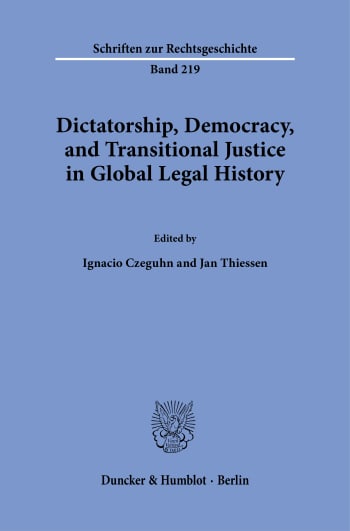
BOOK: Ignacio CZEGUHN & Jan THIESSEN (eds.), Dictatorship, Democracy, and Transitional Justice in Global Legal History [Schriften zur Rechtsgeschichte; 219] (Berlin: Duncker & Humblot, 2023), 214 p., ISBN 978-3-428-18579-5

Cover: Dictatorship, Democracy, and Transitional Justice in Global Legal History

Book abstract:

The anthology presents the lectures given on the symposium »From Dictatorship to democracy« at the House of the Wannsee Conference on 13–14 September 2021. The aim of the organizers was to show what problems existed during the transition from dictatorship to democracy in several countries around the world. They all enacted laws or other measures to ensure that fundamental rights and the rule of law would resist anti-democratic ideologies, anti-Semitism, racism, and war crimes in the future. However, the legal system and law in these countries themselves often had their origins in dictatorship. Thus, there were and are obvious and hidden anti-democratic continuities that influence law and the legal system up to the present. Scientifics and jurists from Italy, Japan, Poland, Spain, South Africa, and Germany examine these continuities in their contributions.

Table of contents:

Ignacio Czeguhn and Jan Thiessen
Introduction

Ignacio Czeguhn
The Berlin Administration of Justice after 1945 – Factual and Personnel Continuities with the Nazi Justice System. Presentation of the Project and State of Research

Vittoria Calabrò
Continuità e discontinuità nel passaggio dalla dittatura alla democrazia: la vicenda del giurista

Gaspare Ambrosini
Bronisław Sitek and Albert Pielak: From Sovietization to Democratization of Justice in Poland (1944–1997)

Miho Mitsunari
Wartime Sexual Violence and War Responsibility: The »Comfort Women Issue« in Japan

José Antonio Pérez Juan
The Amnesty Measures of the Spanish Transition

Antonio Sánchez Aranda
Franco’s Regime. From Totalitarism to Authoritarism in its Repressive Model (April 1936–November 1975)

Ramón M. Orza Linares
La transición a la democracia en los países de América Central

Gerhard Kemp
From Dictatorship to Democracy in South Africa

Claudia Vanoni
Drei Jahre Antisemitismusbeauftragte der Generalstaatsanwaltschaft Berlin – ein Erfahrungsbericht

Samuel Salzborn
Kontinuität, Tradierung und Transformation des Antisemitismus

Jan Thiessen
The Treatment of the Nazi Past in Contemporary German Legal Education

Benjamin Lahusen
Learning from History? Current Developments in the Restitution of Nazi-Confiscated Property

Read more here. 


19 December 2022

BOOK: Ryan Martinez MITCHELL, Recentering the World: China and the Transformation of International Law (Cambridge: Cambridge University Press, 2022), 250pp, ISBN 9781108498968, £95


(image credit: Cambridge University Press)

Book description:
Recentering the World recovers a richly contextual, detailed history of Western-imposed legal structures in China, as well as engagements with international law by Chinese officials, jurists, and citizens. Beginning in the Late Qing era, it shows how international law functioned as a channel for power relations, techniques of economic domination, as well as novel forms of resistance. The book also radically diversifies traditionally Eurocentric accounts of modern international law's origins, demonstrating how, by the mid-twentieth century, Chinese jurists had made major contributions to international organizations and the UN system, the international judiciary, the laws of armed conflict, and more. Drawing on extensive archival research, this book is a valuable guide to China's often conflicted role in international law, its reception and contention of concepts of sovereignty, property, obligation, and autonomy, and its gradual move from the 'periphery' to a shared spot at the 'center' of global legal order.
Table of contents: 
Introduction: 'In the Nineteenth Century, There was No International Law'
Part I. Preserving Stateliness, 1850–1894:
1. Universal Prosperity
2. Synarchy
3. Vast Imperium
Part II. Asserting Sovereignty, 1895–1921:
4. The Public Law of Planet Earth
5. The Problem of Equality
6. Reconstituted Hierarchies
Part III. Internationalisms, 1922–2001:
7. Changing Circumstances
8. New Orders
9. Perpetual Peace
Conclusion: From Object to Subject? – China in a World of Institutions
Glossary of Chinese and Japanese Names
Bibliography
Index
About the author: 
Ryan Martínez Mitchell is an associate professor at the Faculty of Law of the Chinese University of Hong Kong. He holds a J.D. from Harvard Law School and a Ph.D. in Law from Yale University. His scholarship on China and international law has appeared in a number of leading scholarly journals.
More information can be found here.  

10 January 2022

BOOK: Badouin DUPRET & Jean-Louis HALPÉRIN (Eds.), State Law and Legal Positivism. The Global Rise of a New Paradigm (Leiden: Brill, 2021). ISBN: 978-90-04-49865-5, € 103.00

(Source: Brill)

ABOUT THE BOOK

Series: Legal History Library, Volume: 55
 
This volume formulates the hypothesis of a truly global revolution that reflected a Great Divide between ancient and new legal regimes. The volume brings together several case studies of transition from an ancient to a new legal regime characterized by the positivization of the law. This was an effect of Western imperialism, but also of local elites’ conviction that positive law was an efficient instrument of governance. The contributors emphasize the depth and scale of the positivist legal revolution and explore the phenomenon whether it was the outcome of either direct colonialism (Morocco, Egypt, India) or indigenous reformism (Ottoman empire, China, Japan). 

ABOUT THE EDITORS

Baudouin Dupret is Directeur de Recherche at the French National Centre for Scientific Research (CNRS), based at the institute Les Afriques dans le Monde, Bordeaux (France), and guest lecturer at the University of Louvain (Belgium). He has published extensively in the field of the sociology and anthropology of law in the Muslim world. He (co-)edited numerous volumes, the most recent one being Legal Rules in Practice (with J. Colemans and M. Travers, Routledge, 2020), and single-authored several books, including Positive Law from the Muslim World (Cambridge University Press, 2021). 

Jean-Louis Halpérin, Ph. D. (1985), University Paris II, is currently Professor of legal history at the Ecole Normale supérieure - Paris Siences Lettres. He has published monographs and many articles on European and Asian legal history, including Five Legal Revolutions since the 17th Century. A Analysis of Global Legal History(Springer, 2014). 

Contributors are: Léon Buskens, Jean-Philippe Dequen, Baudouin Dupret, Jean-Louis Halpérin, Béatrice Jaluzot, Gianluca Parolin, Avi Rubin, and Tzung-Mou Wu.

TABLE OF CONTENTS

Notes on Contributors 

Introduction 
   Baudouin Dupret 

1 The Great Divide in Legal Discourse: Towards a Global Historical Ontology of the Concept of Positive Law 
   Baudouin Dupret and Gianluca Parolin 

2 Historical Landmarks in Mapping the Spread of Positive Law Teaching 
   Jean-Louis Halpérin 

3 Writing Customs: Three Episodes in the Process of Positivization of Berber Customary Law in Morocco 
   Léon Buskens 

4 Ambiguities and Interdependencies: The Relationship between Legal Positivization and Islamic Law in Colonial India, 1765–1909 
   Jean-Philippe Dequen 

5 The Positivization of Ottoman Law and the Question of Continuity 
   Avi Rubin 

6 How Government Jurists and Lawyering Approached the “Positivizing” of the Law in China 
   Tzung-Mou Wu 

7 The Meiji Era: When Japanese Law Became Positivized 
   Béatrice Jaluzot 

Conclusion 
   Jean-Louis Halpérin 

Index 


More information with the publisher.

22 October 2021

SEMINAR: The Edinburgh Centre for Private Law presents: Global legal comparisons: what can we compare, how, and to what purpose? - Professor Fernanda Pirie - Friday 29 October 2021, 16:00-17:30 (on Zoom)


(Image credit: Photo by Samson on Unsplash)

The Edinburgh Centre for Private Law presents: Global legal comparisons: what can we compare, how, and to what purpose? - Professor Fernanda Pirie, Professor of the Anthropology of Law at the University of Oxford. 

Friday 29 October 2021 - 16:00-17:30

ABOUT THE SPEAKER

An anthropologist specialising in Tibetan societies, Professor Fernanda Pirie uses both ethnographic and historical methods to study and compare legal practices and texts. She has argued for a new anthropology of law, which engages both with legal theory and legal history: The Anthropology of Law (OUP, 2013). This builds on themes and debates developed in the Oxford Legalism project, which brought together scholars from anthropology, history, and other disciplines to compare wide-ranging empirical examples (Legalism, OUP, 4 vols). These themes form the basis for Fernanda’s research into Tibetan legal history and an AHRC-funded project on the legal history of medieval Tibet: Legal Ideology in Tibet: Politics, Practice, and Religion (2016–18) This has led to a series of publications and a web-site containing source material (www.tibetanlaw.org).

Professor Pirie’s latest book is a global history of law, which will be published in November 2021: The Rule of Laws: a 4,000-year quest to order the world (Profile Books, Basic Books).

ABOUT THE SEMINAR

Looking widely at different laws quickly raises questions about what we can compare. Legal systems have taken very different forms and have been created for very different purposes over the course of human history, so what and why should we try to compare? What, after all, counts as law? Rather than focusing on content and detail, I suggest, or on the ways in which lawmakers have tried to address similar problems, global comparisons can better address different questions: who makes law, in what circumstances, and why? And who uses it and to what ends? The starting point must be to examine each system on its own terms and to look for common themes among them, as well as significant differences. This can ultimately shed light on the variety of roles that laws play in human societies, as well as the common threads that unite them.


This event is free and open to all but registration is required (here).