Search

Showing posts with label grotius. Show all posts

10 February 2026

BOOK: Diederik BURGERSDIJK, Henk J.M. NELLEN & Marc DE WILDE (eds.), Hugo Grotius’s On Public Partnership with Unbelievers (De societate publica cum infidelibus). Introduction, Transcription and English Translation [Mini-monographs in Medieval and Early Modern Studies; 5] (Leiden/Boston: Brill, 2025), viii + 146 p. ISBN 9789004744592, € 102,85


(image source: Brill)

Abstract:

In this hitherto unpublished treatise, Hugo Grotius examines what kinds of partnerships between Christians and non-Christians are legally permissible. These include public partnerships, such as treaties and alliances, but also private associations, such as commercial contracts, marriages, and relations of servitude. Grotius’s treatise is indispensable for understanding his ideas about legal relations between Christians and non-Christians, both in international and domestic contexts. This is the first edition of the annotated Latin text with an English translation and introduction.

 On the editors:

Diederik Burgersdijk, Ph.D. (2010), University of Amsterdam, is a lecturer in classics and ancient history at Utrecht University. His research focuses on the rhetoric and historiography of the later Roman empire, with a special interest in the reception of antiquity in later eras. His most recent co-edited volume is Constantinople Through the Ages: The Visible City from its Foundation to Contemporary Istanbul (Brill, 2025). Henk Nellen, Ph.D. (1980), Catholic University of Nijmegen, is a guest researcher at the Huygens Institute in Amsterdam. He co-edited the final five of the seventeen volumes in the series of Hugo Grotius’s correspondence. In 2007, he completed a biography of Grotius (English translation published by Brill, 2014). In 2021, he published a second biographical study: Geen vredestichter is zonder tegensprekers. Hugo de Groot, geleerde, staatsman, verguisd verzoener (Athenaeum, 2021). Marc de Wilde, Ph.D. (2008), University of Amsterdam, is a professor of jurisprudence at the University of Amsterdam with a focus on the history of legal thought. He has published several articles on Grotius, including on his letters to East-Indian rulers and his draft regulations for Jews.

Read more here: DOI  10.1163/9789004744592.

29 May 2025

BOOK: Martine Julia VAN ITTERSUM, The Working Papers of Hugo Grotius. Transmission, Dispersal, and Loss, 1604-1864 [Brill's Studies in Intellectual History, eds. Han VAN RULER, 343] (Leiden/Boston: Brill, 2025), ISBN 978-90-04-53600-5, € 242,74


(image source: Brill)

On the author:

Martine Julia van Ittersum, Ph.D. (2002), is Senior Lecturer in History at the University of Dundee (UK). She has published widely on book history, Dutch history, and the history of Western imperialism and colonialism, including Profit and Principle (Brill, 2006).
Table of contents:
Acknowledgements
List of Maps and Figures

Introduction: Hugo Grotius and the Microsociologies of Archives
 1 Early Modern Scholars and Textual Production and Loss
 2 The Role of Material Wealth in Preserving Personal Archives and Libraries
 3 The Materiality of Texts and the Microsociologies of Archives
 4 The Life and Times of Hugo Grotius
 5 The Fate of Grotius’ Working Papers

Knowledge Production and Records Management in Early Modern Europe: The Case of Hugo Grotius (1583–1645)
 1 Grotius’ Working Methods as a Lawyer and Government Official
 2 Is There a Start Date for Grotius’ Personal Archive?
 3 Where Did Grotius Keep His Books and Papers?
 4 The Working Methods of an Early Modern Scholar
 5 Access to Printed and Manuscript Materials
 6 How Grotius Involved His Relatives and Remonstrant Friends in Knowledge Production
 7 Circulating Manuscripts in the Republic of Letters
 8 The Role of Grotius’ Relatives and Remonstrant Friends in Printed Publication
 9 Conclusion

Confiscated Manuscripts and Books
What Happened to Grotius’ Personal Library and Archive Following His Arrest on Charges of High Treason in August 1618?
 1 What Is Known Already About the Confiscation of Grotius’ Books and Working Papers in the Period 1618–1620?
 2 Did Grotius’ Relatives Squirrel Away Sensitive Materials Following His Arrest in August 1618?
 3 To Which Books and Manuscripts Did Grotius Have Access in Captivity?
 4 How Jan De Groot Recovered Some of His Son’s Books and Papers in Summer 1621
 5 What Happened to Grotius’ Confiscated Papers?
 6 What Happened to Grotius’ Confiscated Books?
 7 Conclusion

Creating a (Definitive) Corpus of Writings: How Grotius’ Employer, Relatives, and Remonstrant Friends Shaped His Intellectual Legacy (1645–1679)
 1 Grotius’ Intellectual Legacy as a Family Project
 2 What Happened to the Book Collection Sold to Christina of Sweden?
 3 Manuscript Hunters in Paris, London, and the Low Countries
 4 Pieter De Groot’s Stewardship of His Father’s Working Papers (1653–1660)
 5 Grotius’ Intellectual Legacy in the Era of the ‘True Freedom’ and Beyond (1660–1678)
 6 What Happened to the Working Papers Inherited by the Descendants of Willem De Groot?
 7 Conclusion

Preserving and Editing Grotius’ Manuscripts for the Sake of Family Honor and the Remonstrant Cause (1679–1747)
 1 Publishing, Advertising and Deconstructing Epistolae Quotquot Reperiri Potuerunt
 2 A Remonstrant Hero: How Jean Le Clerc Shaped Grotius’ Intellectual Legacy
 3 Circulating Manuscripts in the Republic of Letters in the Eighteenth Century
 4 Writing and Publishing an Authoritative Biography of Hugo Grotius
 5 Memorialization through Physical Artifacts
 6 The Cornets De Groot Family in Bergen op Zoom
 7 Conclusion

Confronting Grotius’ Legacy in an Age of Revolution: The Cornets De Groot Family in Rotterdam (1748–1798)
 1 The Cornets De Groot Family as Beneficiaries of the Stadtholders’ Patronage
 2 The Establishment of a Grotius Memorial in the New Church in Delft
 3 A Patriot Revolution in Rotterdam
 4 The Patriot Politics of Paulus Gevers
 5 Hugo Grotius and Pieter De Groot as Patriot Icons
 6 Jan Cornets De Groot’s Efforts to Overturn the Patriot Revolution in Rotterdam
 7 Papers, Portraits, and Memorabilia Passed Down the Generations
 8 Status Symbols: Ancestral Portraits and Grotius Memorabilia
 9 An Inventory of the Papers of Hugo Grotius and Pieter De Groot (April 1778)

Constructing a Conservative National Hero in Response to Patriot Radicalism (1787–1815)
 1 Grotius as the Embodiment of Republican Virtue
 2 The Rediscovery of the Parallelon Rerumpublicarum and the Making of a Dutch National Hero
 3 What Can the Visser Collection Tell Us about the Transmission and Dispersal of Grotius’ Working Papers?
 4 How Jacobus Scheltema Rearranged Grotius’ Working Papers and Marked Up the 1778 Inventory

End of the Lineage: How Hugo Cornets De Groot Disposed of His Grotiana (1802–1864)
 1 A Visit from Lieutenant-General A.W.H. Nolthenius De Man in March 1832
 2 An Epistolary Exchange between Johan Pieter Cornets De Groot Van Kraaijenburg and Distant Relatives in Cuyck and Nijmegen
 3 Why Did Hugo Cornets De Groot Become Estranged from His Relatives?
 4 The Death of a Lonely Bachelor in Cuyck in February 1864
 5 How Jean Baptiste Regouin Rearranged the Working Papers of Hugo Grotius and Pieter De Groot, and Then Sold These to a Tobacco Merchant

Preparing for the Auction of the Working Papers of Hugo Grotius and Pieter De Groot, Mostly Behind the Scenes (February–November 1864)
 1 Christiaan Snelleman, Rotterdam Merchant and Remonstrant
 2 A List of Grotiana Compiled by the Remonstrant Minister C.P. Tiele
 3 How P.A. Tiele Put Together an Auction Catalogue, and Divided Up Manuscript Volumes into Multiple Lots
 4 The Auctioneer Martinus Nijhoff
 5 How Frederik Muller Did Business with the Nederlandsche Handel-Maatschappij

10 The 1864 Auction of the Working Papers of Hugo Grotius and Pieter De Groot, and What Happened Next
 1 How Nijhoff Conducted the Auction and Presented Its Outcome to the Public
 2 The Story Behind the Swedish Government’s Acquisition of Grotiana
 3 What Happened to Lots 1–42?
 4 The Bid and Strike Prices of Lots 43–99, and the Potential and Actual Buyers
 5 The 1864 Auction in Comparative Context
 6 What Explains the Dutch Government’s Total Lack of Involvement?
 7 How Johan Pieter Cornets De Groot Van Kraaijenburg (Re)Assembled a Collection of Family Papers

11 Conclusion

Appendix 1: The 1778 Inventory of the Working Papers of Hugo Grotius and Pieter De Groot, With Notes by Jacobus Scheltema
Appendix 2: Jacobus Scheltema’s Rearrangement of the Papers of Hugo Grotius and Pieter De Groot (May 1803)
Appendix 3: “Short Description of the Contents of the Enclosed Books, Volumes of Letters, Parchments with Seals Attached to Them, etc., Left by Hugo Grotius”
Appendix 4: A List of Grotiana Compiled by C.P. Tiele, at the Request of Christiaan Snelleman (August 1864)
Appendix 5: The Auction of the Working Papers of Hugo Grotius and Pieter De Groot: Bid Prices, Strike Prices, and Horse Trading Behind the Scenes (November 1804)
Appendix 6: The Auction Proceeds: The Final Receipt Sent to Christiaan Snelleman by Martinus Nijhoff
Appendix 7: Grotius’ Working Papers as Rearranged by P.A. Tiele
Appendix 8: Inheriting Ancestral Portraits and Papers: A Genealogical Chart
Bibliography
Indices
Read more here: DOI 10.1163/9789004536029.

29 August 2024

SYMPOSIUM: XXI Giornata Gentiliana ( San Ginesio: Auditorium Sant'Agostino, 13-14 SEPT 2024)

(Source: Sidi)

Alberico Gentili e Ugo Grozio: i “momenti” del diritto internazionale e il contributo degli internazionalisti alla costruzione e allo sviluppo della disciplina.

13-14 settembre 2024, Auditorium Sant’Agostino, San Ginesio.

Evento organizzato dal Centro Internazionale di Studi Gentiliani (CISG) e patrocinato dalla Società Italiana di Diritto Internazionale e di Diritto dell’Unione Europea SIDI.


18 March 2024

REMINDER CFP: Grotian law and modernity at the dawn of a new age 400 years of De jure belli ac pacis 1625-2025 International Conference (The Hague: Leiden University Wijnhaven Campus, 19-20 JUN 2025); DEADLINE 1 MAY 2024


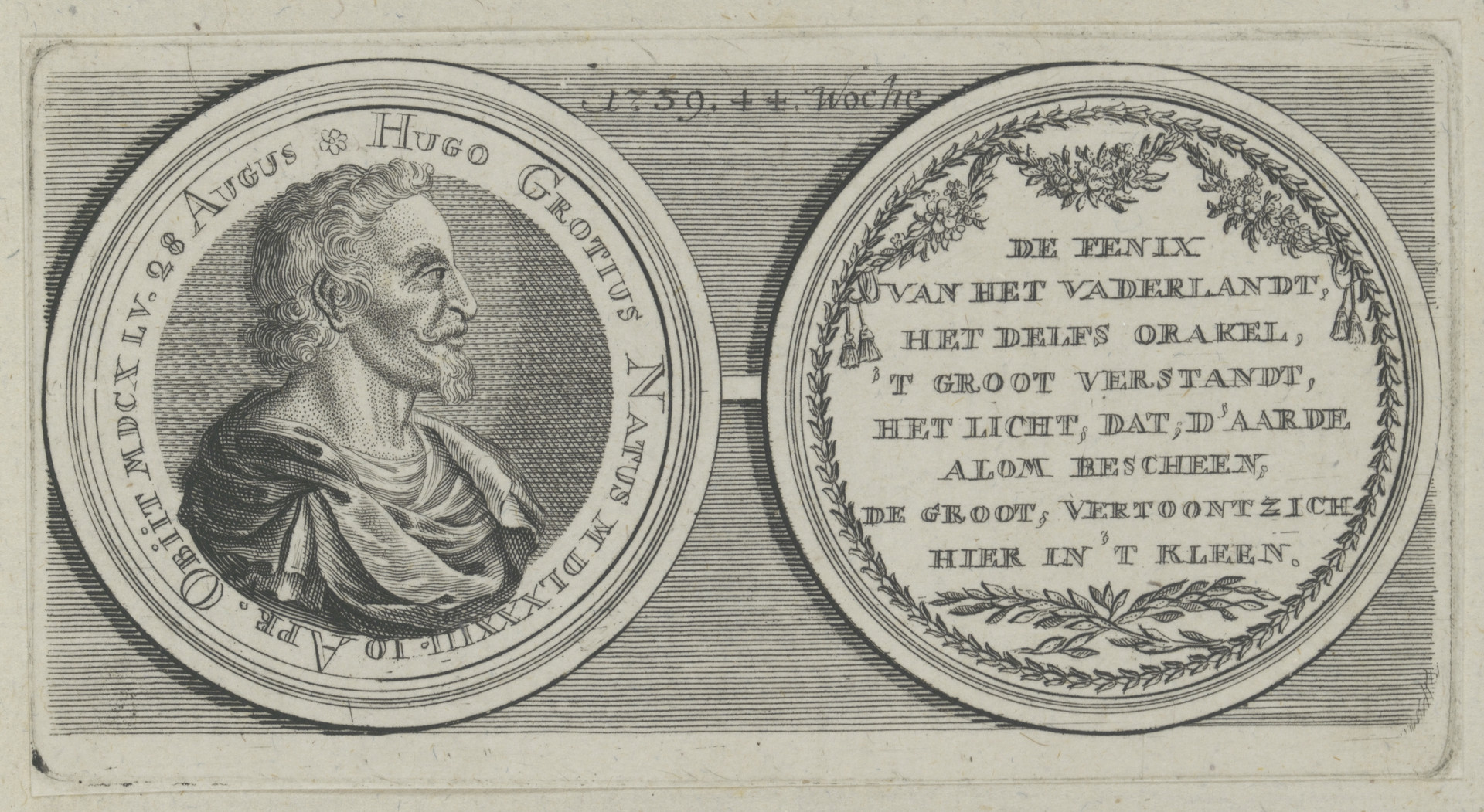
 (image: medal representing Grotius as "phenix of the fatherland" and "oracle of Delft", 1739; Germanisches Nationalmuseum/Europeana)


Grotian law and modernity at the dawn of a new age

400 years of De jure belli ac pacis 1625-2025

International Conference 19-20 June 2025

Leiden University Wijnhaven Campus, The Hague


Call for papers


On the occasion of the 400th anniversary of the first publication of De jure belli ac pacis by Hugo Grotius in 1625, an international conference will be organized by the Grotiana Foundation, the Paul Scholten Centre for Jurisprudence at the University of Amsterdam, the Grotius Centre for International Legal Studies at the University of Leiden and the Department of Public Law and Governance at Tilburg University.


In 1925, the third centenary of the first publication of Hugo Grotius’ most seminal work on the law of nations, De jure belli ac pacis libri tres (Three Books on the Law of War and Peace) offered the occasion for elaborate festivities and commemorating activities in and outside the Netherlands. The anniversary was organized against the backdrop of a revival of interest in Grotius as a trailblazer for international law among proponents of the international ‘peace through law’ movement, which went back to the Hague Peace Conferences and was given new traction after the Great War.


In the past few decades, international academic interest has widened beyond the scope of international law to encompass the full extent of Grotius’ life, thought and works across the disciplines. The mainstream narratives of Grotius as ‘father of international law’ and visionary defender of international peace and justice have given way to more nuanced readings of his life and work, as well as his many receptions and revivals, against the changing patterns of social, political and ethical ideas and values. In recent years, Grotius’ role both as an actor in the Dutch imperialist enterprise and a defender of unity and reconciliation among the Christian confessions have been highlighted. All this solicits critical reconsiderations of De jure belli ac pacis and Grotius’ role in the history of international law.


The major aim of the conference is to foster new narratives on the thought of Grotius, in general legal theory as well as in international law against a the backdrop of present-day rapid, fundamental changes that challenge the very foundations of the modernist paradigm, of which Grotius may be considered a key trailblazer. The core question of the academic conference is to what extent Grotian thought about general legal theory and international law is still relevant today, and what adaptations current foundational changes to our world make necessary. In this context, discussion of the many trajectories of reception, appropriation and reinterpretation of Grotius in different times and places, offers a valuable, additional perspective.


Through the conference ‘Grotian law and modernity at the dawn of a new age’, the organizers want to stimulate debate on the constitutional impact of current changes for the global legal order through the lens of a long-term historical analysis. The speakers in the conference are invited to reach back to Grotius’ thought and work as a starting point for discussing the foundations of the modern legal order of the past four centuries and the changes this is currently undergoing. They are asked to use this long-term historical framework to make sense of current upheavals and look for direction towards the future of law.


The conference program falls into three parts (with parallel sessions).


Part I ‘Lineages of Grotian thought’ discusses the material and ideological receptions, reinterpretations and appropriations of De jure belli ac pacis at different times during the past four centuries. It assembles a number of papers that trace the lineages, in terms of material history or content, of Grotius’ ideas with regards to different branches of legal theory or practical law. It looks to reviewing traditional, often celebratory narratives of Grotius from the late nineteenth and twentieth centuries from the perspective of a wide array of themes including political and economic governance, human rights, imperialism or (in)equality.


Part II ‘Modernity and the dawn of a new age: general theory of law and governance’ and Part III ‘Modernity and the dawn of a new age: international law and governance’ address the question of the significance of current changes for the constitution of a new global legal order, using De jure belli ac pacis as a platform for discussing the development, transformation and superseding of modern law.

Part II concerns general questions of the theory of law and governance.

Part III pertains to specific questions of public international law.


At the end of the second day, an academic session will be organized for a wider audience, with a key note speech and a panel discussion on the core topic of the conference.


Invitation to speakers


In addition to three keynote speakers, the organizers invite twelve speakers for each of the three thematic parts of the conference.


Candidates are requested to send in an abstract of 250-400 words and short c.v. of max. 100 words to the general convener, Randall Lesaffer (lesaffer@tilburguniversity.edu) by 1 May 2024. Please mention your affiliation and indicate a preference for one of the three conference themes.


The event takes place in person without online presentations. The organization is not in a position to fund accommodation or travel expenses and invites selected speakers to search for funding themselves. Those selected speakers for whom this is impossible, are requested to contact the general convener on this.


Propositions will be assessed by the Organizing Committee and selected on the basis of the quality of abstracts and the fit with the programme.


Part I ‘Lineages of Grotian thought’

Convener: Mark Somos

Keynote speaker: Martine van Ittersum

The material conditions of the production and reception of De jure belli ac pacis form a neglected and highly rewarding field of research. Recent studies of the printing history of various editions have started to clarify Grotius’ own role in the revision and timing of new editions; piracy and rivalry among publishers; the marketing strategy for each edition; and the dissemination and movement of copies. The burgeoning study of annotations that legal scholars, aristocrats, municipal and imperial administrators, prominent politicians and thinkers have left behind in their copies of De jure belli ac pacis is shedding new light on the hitherto unseen history of this work’s real impact. Early insights into the lineages of Grotian thought that only close attention to the surviving copies’ materiality can provide include the intensity and ingenuity of the Catholic reception of De jure belli ac pacis. Another set of discoveries that emerges from the material heritage of De jure belli ac pacis reveals historical moments of focused interest in specific passages of the text in response to crises that previous historiography has never considered to be part of the book’s reception, such as the breakup of the Iberian Union, nineteenth-century abolitionism, or the start of World War I. Grounding the reception history of De jure belli ac pacis in the book’s materiality is essential for recovering the four centuries of its impact in full, from its earliest classroom use to its latest invocation in front of an international tribunal, as well as for reassessing Grotius’ role in the evolution of the laws of war, the relationship between morality and law, sovereignty, natural rights, freedom of navigation and imperialism.

Part I welcomes proposals for papers on the various editions’ printing history, surviving annotations, evidence of the book’s use in classrooms, in court and the corridors of power,  and the broader relationship between the material and intellectual receptions of De jure belli ac pacis. We thereby expressly invite papers on receptions of and engagements with Grotius in different parts of the world.


Part II ‘Modernity and the dawn of a new age: general theory of law and governance’

Convener: Marc de Wilde

Keynote speaker: Annabel Brett

In De jure belli ac pacis, Grotius developed three ideas that have been recognized as major innovations in legal theory. First of all, he presented natural law as the moral foundation of both domestic and international legal systems. Secondly, he revolutionized the traditional understanding of natural law by focusing on the natural rights of individuals. And thirdly, he distinguished between natural law and religious belief, arguing that the rights of individuals had to be protected irrespective of religious differences. With these ideas, Grotius stood at the cradle of the modernist paradigm of legal theory which emphasized the need for a secular and universal legal order based on individual rights. However, depending on the context in which Grotius’s theory was applied, its meaning proved to be ambiguous. Thus, Grotius’s concept of natural law was also used to justify imperialism and colonialism, and it served to legitimize the practice of slavery. Moreover, present-day challenges, such as climate change or the rise of artificial intelligence, require us to reconsider the main assumptions behind Grotius’s theory, such as his notion of the free will or the unlimited availability of natural resources. The speakers are invited to reflect critically on Grotius’s contribution to legal theory and its present-day relevance by presenting papers on the following topics: the universality of natural law (or its limitations), individual rights as foundation of the legal system (and its potential downsides), the relation between natural law, imperialism and slavery, the challenges new technologies pose to the free will and legal regulation, and the state’s role in balancing individual rights and the public good (as, for instance, in the case of climate change).


Part III ‘Modernity and the dawn of a new age: international law and governance’

Convener: Eric De Brabandere

Keynote speaker: Hilary Charlesworth

This part pertains to specific questions of contemporary and future public international law. The actual text of De jure belli ac pacis libri tres is often neglected, given the wealth of secondary sources.  This part of the conference invites critique and examination of the potential of De jure belli ac pacis as a text with contemporary relevance. To this end, Part III invites papers that critically explore the Grotian traditions and its potential impact on particularized problems of contemporary international law. Of special interest are papers that adopt a critical lens to the Grotian legacy in the sphere of international humanitarian law and international criminal law. Critical analysis of the idea of a ‘Grotian Moment’ and the mainstream progress narrative of international law is invited.  Analysis of Grotius’ work on the treatment of foreigners and enemies (of all humankind or otherwise) is welcome, as are papers examining Grotian legacy in the context of jus post bellum (the transition from armed conflict to a just and sustainable peace). Ultimately, this section of the conference hopes to imagine how Grotius’ great work could be used to better manage the problems of, if not the next 400 years, at least the next 40.


Speakers are expected to turn in a draft paper before 1 June 2025. Papers will be distributed to the participants in advance of the conference. Those papers which pass peer review will be published in both the journal Grotiana (New Series) as well as collected in a separate book with Brill.


Organizing committee


Jeroen Vervliet (Grotiana), chair

Eric De Brabandere (Grotius Centre for International Legal Studies, University of Leiden), convener ‘International law and governance’

Randall Lesaffer (Department of Public Law and Governance, Tilburg University & Grotiana), general convener

Janne Nijman (Department of Public International Law, University of Amsterdam)

Marc de Wilde (Department of Jurisprudence, University of Amsterdam & Grotiana), convener ‘General legal theory and governance’

Mark Somos (Grotiana), convener ‘Lineages of Grotian thought’


Further introduction to the conference theme


In international law, the term ‘Grotian moments’ is sometimes used to indicate times and occurrences of fundamental change in the constitution of the international legal order. The phrase carries the implication that Grotius’ De jure belli ac pacis was constitutive for the new international order that emerged at the dawn of the modern age.

Grotius’ De jure belli ac pacis is undoubtedly one of the most iconic texts from Western legal history. While this is widely recognized in relation to international law or natural law jurisprudence, its relevance extends beyond the confines of international law into that of law and governance at large. In many ways, Grotius’ major legal treatise has been and remains a major source for imagining, articulating and debating law as both the guarantor of individual autonomy and an instrument of state policy under the paradigm of modernity.

The Western paradigm of modern law came to full fruition during the late 19th and early 20th centuries, the heyday of the sovereign nation-state.  The paradigm of modern law may be caught under its following core features: 1) the autonomy of the individual human being as foundation for social order; 2) consent as the basis for the legal organization of both private transactions and public authority; 3) the separation of a private sphere of liberty from a sphere of public interest; 4) the understanding of the role of public authority and law in terms of balancing between individual autonomy and public interest; 5) the claim to exclusive jurisdiction over law making and law enforcement by the state both in internal and international relations; 6) the global expansion of this model in the context of imperialism, colonization and decolonization.

De jure belli ac pacis held no blueprint for this modern law paradigm, but contained many building blocks, both great and small. Although the question of justice in war stood at the heart of the treatise, Grotius framed it in the context of a novel general theory of law, and did so by addressing a plethora of fundamental issues of private, constitutional and criminal law. Grotius’ reimagination of natural law in terms of individual and individually enforceable rights preconfigured the foundational role of the autonomy of the individual as the key constitutional principle of the modern nation-state with its separation of a private from a public sphere. His contract theory of the state and his equation of the natural rights of the state with those of the individual allowed for the elevation of the state to the sovereign creator of positive law. At the same time, his acknowledgment of the autonomy of natural law from Christian religion allowed to create a standard of justice that was said to derive from universal principles of humanity but at the same time was laden with the inheritance of hundreds of years of Christian and European intellectual tradition.


De jure belli ac pacis does not just stand at the foundations of modern law. For four hundred years it has retained currency as a source of inspiration to argue for new turns and twists along the path of the emergence, the maturation and the transformation of modern law. If 19th-century international lawyers hailed Grotius for having given autonomy to international law as the preserve of the sovereign state, their 20th-century successors have seen in him the remote trailblazer for the supremacy of the international community over the state. In this sense, the relevance of Grotius’ thought has proven resilient to many of the most fundamental changes of the past four centuries and has survived several ‘Grotian moments’ so far.

The two decades that have lapsed since the beginning of the 21st century have witnessed tremendous and profound changes that challenge the very basis of the modern law paradigm. The globalization of economic and social life together with the empowerment of the individual and non-state agents have severely weakened the claims of states to exclusive jurisdiction, furthering the erosion of traditional state-based institutions and principles of democracy and rule of law. The relative decline of the West and the resilience of authoritarianism question the universalism that for the better part of two centuries has been part of the Western paradigm of modernity. Climate change is putting a hard stop on the belief in the unending possibilities of the growth of humankind and its ‘pursuit of happiness’ at the cost of the planet, while according to some the rise of artificial intelligence challenges the very centrality of consent, free will and individual autonomy.

The 400th anniversary of the first publication of Grotius’ De jure belli ac pacis offers an excellent occasion to question the impact of current global changes on the existent global order in terms of a paradigmatic shift away from the modern understanding of law.

23 February 2024

REMINDER CFP: Grotian law and modernity at the dawn of a new age 400 years of De jure belli ac pacis 1625-2025 International Conference (The Hague: Leiden University Wijnhaven Campus, 19-20 JUN 2025); DEADLINE 1 MAY 2024


 (image: medal representing Grotius as "phenix of the fatherland" and "oracle of Delft", 1739; Germanisches Nationalmuseum/Europeana)


Grotian law and modernity at the dawn of a new age

400 years of De jure belli ac pacis 1625-2025

International Conference 19-20 June 2025

Leiden University Wijnhaven Campus, The Hague


Call for papers


On the occasion of the 400th anniversary of the first publication of De jure belli ac pacis by Hugo Grotius in 1625, an international conference will be organized by the Grotiana Foundation, the Paul Scholten Centre for Jurisprudence at the University of Amsterdam, the Grotius Centre for International Legal Studies at the University of Leiden and the Department of Public Law and Governance at Tilburg University.


In 1925, the third centenary of the first publication of Hugo Grotius’ most seminal work on the law of nations, De jure belli ac pacis libri tres (Three Books on the Law of War and Peace) offered the occasion for elaborate festivities and commemorating activities in and outside the Netherlands. The anniversary was organized against the backdrop of a revival of interest in Grotius as a trailblazer for international law among proponents of the international ‘peace through law’ movement, which went back to the Hague Peace Conferences and was given new traction after the Great War.


In the past few decades, international academic interest has widened beyond the scope of international law to encompass the full extent of Grotius’ life, thought and works across the disciplines. The mainstream narratives of Grotius as ‘father of international law’ and visionary defender of international peace and justice have given way to more nuanced readings of his life and work, as well as his many receptions and revivals, against the changing patterns of social, political and ethical ideas and values. In recent years, Grotius’ role both as an actor in the Dutch imperialist enterprise and a defender of unity and reconciliation among the Christian confessions have been highlighted. All this solicits critical reconsiderations of De jure belli ac pacis and Grotius’ role in the history of international law.


The major aim of the conference is to foster new narratives on the thought of Grotius, in general legal theory as well as in international law against a the backdrop of present-day rapid, fundamental changes that challenge the very foundations of the modernist paradigm, of which Grotius may be considered a key trailblazer. The core question of the academic conference is to what extent Grotian thought about general legal theory and international law is still relevant today, and what adaptations current foundational changes to our world make necessary. In this context, discussion of the many trajectories of reception, appropriation and reinterpretation of Grotius in different times and places, offers a valuable, additional perspective.


Through the conference ‘Grotian law and modernity at the dawn of a new age’, the organizers want to stimulate debate on the constitutional impact of current changes for the global legal order through the lens of a long-term historical analysis. The speakers in the conference are invited to reach back to Grotius’ thought and work as a starting point for discussing the foundations of the modern legal order of the past four centuries and the changes this is currently undergoing. They are asked to use this long-term historical framework to make sense of current upheavals and look for direction towards the future of law.


The conference program falls into three parts (with parallel sessions).


Part I ‘Lineages of Grotian thought’ discusses the material and ideological receptions, reinterpretations and appropriations of De jure belli ac pacis at different times during the past four centuries. It assembles a number of papers that trace the lineages, in terms of material history or content, of Grotius’ ideas with regards to different branches of legal theory or practical law. It looks to reviewing traditional, often celebratory narratives of Grotius from the late nineteenth and twentieth centuries from the perspective of a wide array of themes including political and economic governance, human rights, imperialism or (in)equality.


Part II ‘Modernity and the dawn of a new age: general theory of law and governance’ and Part III ‘Modernity and the dawn of a new age: international law and governance’ address the question of the significance of current changes for the constitution of a new global legal order, using De jure belli ac pacis as a platform for discussing the development, transformation and superseding of modern law.

Part II concerns general questions of the theory of law and governance.

Part III pertains to specific questions of public international law.


At the end of the second day, an academic session will be organized for a wider audience, with a key note speech and a panel discussion on the core topic of the conference.


Invitation to speakers


In addition to three keynote speakers, the organizers invite twelve speakers for each of the three thematic parts of the conference.


Candidates are requested to send in an abstract of 250-400 words and short c.v. of max. 100 words to the general convener, Randall Lesaffer (lesaffer@tilburguniversity.edu) by 1 May 2024. Please mention your affiliation and indicate a preference for one of the three conference themes.


The event takes place in person without online presentations. The organization is not in a position to fund accommodation or travel expenses and invites selected speakers to search for funding themselves. Those selected speakers for whom this is impossible, are requested to contact the general convener on this.


Propositions will be assessed by the Organizing Committee and selected on the basis of the quality of abstracts and the fit with the programme.


Part I ‘Lineages of Grotian thought’

Convener: Mark Somos

Keynote speaker: Martine van Ittersum

The material conditions of the production and reception of De jure belli ac pacis form a neglected and highly rewarding field of research. Recent studies of the printing history of various editions have started to clarify Grotius’ own role in the revision and timing of new editions; piracy and rivalry among publishers; the marketing strategy for each edition; and the dissemination and movement of copies. The burgeoning study of annotations that legal scholars, aristocrats, municipal and imperial administrators, prominent politicians and thinkers have left behind in their copies of De jure belli ac pacis is shedding new light on the hitherto unseen history of this work’s real impact. Early insights into the lineages of Grotian thought that only close attention to the surviving copies’ materiality can provide include the intensity and ingenuity of the Catholic reception of De jure belli ac pacis. Another set of discoveries that emerges from the material heritage of De jure belli ac pacis reveals historical moments of focused interest in specific passages of the text in response to crises that previous historiography has never considered to be part of the book’s reception, such as the breakup of the Iberian Union, nineteenth-century abolitionism, or the start of World War I. Grounding the reception history of De jure belli ac pacis in the book’s materiality is essential for recovering the four centuries of its impact in full, from its earliest classroom use to its latest invocation in front of an international tribunal, as well as for reassessing Grotius’ role in the evolution of the laws of war, the relationship between morality and law, sovereignty, natural rights, freedom of navigation and imperialism.

Part I welcomes proposals for papers on the various editions’ printing history, surviving annotations, evidence of the book’s use in classrooms, in court and the corridors of power,  and the broader relationship between the material and intellectual receptions of De jure belli ac pacis. We thereby expressly invite papers on receptions of and engagements with Grotius in different parts of the world.


Part II ‘Modernity and the dawn of a new age: general theory of law and governance’

Convener: Marc de Wilde

Keynote speaker: Annabel Brett

In De jure belli ac pacis, Grotius developed three ideas that have been recognized as major innovations in legal theory. First of all, he presented natural law as the moral foundation of both domestic and international legal systems. Secondly, he revolutionized the traditional understanding of natural law by focusing on the natural rights of individuals. And thirdly, he distinguished between natural law and religious belief, arguing that the rights of individuals had to be protected irrespective of religious differences. With these ideas, Grotius stood at the cradle of the modernist paradigm of legal theory which emphasized the need for a secular and universal legal order based on individual rights. However, depending on the context in which Grotius’s theory was applied, its meaning proved to be ambiguous. Thus, Grotius’s concept of natural law was also used to justify imperialism and colonialism, and it served to legitimize the practice of slavery. Moreover, present-day challenges, such as climate change or the rise of artificial intelligence, require us to reconsider the main assumptions behind Grotius’s theory, such as his notion of the free will or the unlimited availability of natural resources. The speakers are invited to reflect critically on Grotius’s contribution to legal theory and its present-day relevance by presenting papers on the following topics: the universality of natural law (or its limitations), individual rights as foundation of the legal system (and its potential downsides), the relation between natural law, imperialism and slavery, the challenges new technologies pose to the free will and legal regulation, and the state’s role in balancing individual rights and the public good (as, for instance, in the case of climate change).


Part III ‘Modernity and the dawn of a new age: international law and governance’

Convener: Eric De Brabandere

Keynote speaker: Hilary Charlesworth

This part pertains to specific questions of contemporary and future public international law. The actual text of De jure belli ac pacis libri tres is often neglected, given the wealth of secondary sources.  This part of the conference invites critique and examination of the potential of De jure belli ac pacis as a text with contemporary relevance. To this end, Part III invites papers that critically explore the Grotian traditions and its potential impact on particularized problems of contemporary international law. Of special interest are papers that adopt a critical lens to the Grotian legacy in the sphere of international humanitarian law and international criminal law. Critical analysis of the idea of a ‘Grotian Moment’ and the mainstream progress narrative of international law is invited.  Analysis of Grotius’ work on the treatment of foreigners and enemies (of all humankind or otherwise) is welcome, as are papers examining Grotian legacy in the context of jus post bellum (the transition from armed conflict to a just and sustainable peace). Ultimately, this section of the conference hopes to imagine how Grotius’ great work could be used to better manage the problems of, if not the next 400 years, at least the next 40.


Speakers are expected to turn in a draft paper before 1 June 2025. Papers will be distributed to the participants in advance of the conference. Those papers which pass peer review will be published in both the journal Grotiana (New Series) as well as collected in a separate book with Brill.


Organizing committee


Jeroen Vervliet (Grotiana), chair

Eric De Brabandere (Grotius Centre for International Legal Studies, University of Leiden), convener ‘International law and governance’

Randall Lesaffer (Department of Public Law and Governance, Tilburg University & Grotiana), general convener

Janne Nijman (Department of Public International Law, University of Amsterdam)

Marc de Wilde (Department of Jurisprudence, University of Amsterdam & Grotiana), convener ‘General legal theory and governance’

Mark Somos (Grotiana), convener ‘Lineages of Grotian thought’


Further introduction to the conference theme


In international law, the term ‘Grotian moments’ is sometimes used to indicate times and occurrences of fundamental change in the constitution of the international legal order. The phrase carries the implication that Grotius’ De jure belli ac pacis was constitutive for the new international order that emerged at the dawn of the modern age.

Grotius’ De jure belli ac pacis is undoubtedly one of the most iconic texts from Western legal history. While this is widely recognized in relation to international law or natural law jurisprudence, its relevance extends beyond the confines of international law into that of law and governance at large. In many ways, Grotius’ major legal treatise has been and remains a major source for imagining, articulating and debating law as both the guarantor of individual autonomy and an instrument of state policy under the paradigm of modernity.

The Western paradigm of modern law came to full fruition during the late 19th and early 20th centuries, the heyday of the sovereign nation-state.  The paradigm of modern law may be caught under its following core features: 1) the autonomy of the individual human being as foundation for social order; 2) consent as the basis for the legal organization of both private transactions and public authority; 3) the separation of a private sphere of liberty from a sphere of public interest; 4) the understanding of the role of public authority and law in terms of balancing between individual autonomy and public interest; 5) the claim to exclusive jurisdiction over law making and law enforcement by the state both in internal and international relations; 6) the global expansion of this model in the context of imperialism, colonization and decolonization.

De jure belli ac pacis held no blueprint for this modern law paradigm, but contained many building blocks, both great and small. Although the question of justice in war stood at the heart of the treatise, Grotius framed it in the context of a novel general theory of law, and did so by addressing a plethora of fundamental issues of private, constitutional and criminal law. Grotius’ reimagination of natural law in terms of individual and individually enforceable rights preconfigured the foundational role of the autonomy of the individual as the key constitutional principle of the modern nation-state with its separation of a private from a public sphere. His contract theory of the state and his equation of the natural rights of the state with those of the individual allowed for the elevation of the state to the sovereign creator of positive law. At the same time, his acknowledgment of the autonomy of natural law from Christian religion allowed to create a standard of justice that was said to derive from universal principles of humanity but at the same time was laden with the inheritance of hundreds of years of Christian and European intellectual tradition.


De jure belli ac pacis does not just stand at the foundations of modern law. For four hundred years it has retained currency as a source of inspiration to argue for new turns and twists along the path of the emergence, the maturation and the transformation of modern law. If 19th-century international lawyers hailed Grotius for having given autonomy to international law as the preserve of the sovereign state, their 20th-century successors have seen in him the remote trailblazer for the supremacy of the international community over the state. In this sense, the relevance of Grotius’ thought has proven resilient to many of the most fundamental changes of the past four centuries and has survived several ‘Grotian moments’ so far.

The two decades that have lapsed since the beginning of the 21st century have witnessed tremendous and profound changes that challenge the very basis of the modern law paradigm. The globalization of economic and social life together with the empowerment of the individual and non-state agents have severely weakened the claims of states to exclusive jurisdiction, furthering the erosion of traditional state-based institutions and principles of democracy and rule of law. The relative decline of the West and the resilience of authoritarianism question the universalism that for the better part of two centuries has been part of the Western paradigm of modernity. Climate change is putting a hard stop on the belief in the unending possibilities of the growth of humankind and its ‘pursuit of happiness’ at the cost of the planet, while according to some the rise of artificial intelligence challenges the very centrality of consent, free will and individual autonomy.

The 400th anniversary of the first publication of Grotius’ De jure belli ac pacis offers an excellent occasion to question the impact of current global changes on the existent global order in terms of a paradigmatic shift away from the modern understanding of law.

21 November 2023

CFP: 'Arguing over Empire: Hugo Grotius, European Expansionism and Slavery' - University of Amsterdam, Amsterdam Law Hub - 7 June 2024 [DEADLINE 15 January 2024]


 Call for papers

Arguing over Empire: Hugo Grotius, European Expansionism and Slavery

Location: University of Amsterdam, Amsterdam Law Hub

Date: June 7th , 2024

Key-note: Prof. John Cairns (University of Edinburgh)


Workshop Theme

The workshop ‘Arguing over Empire: Hugo Grotius, European Expansionism and Slavery’ is part of a series of conferences organized by the Grotiana Foundation preceding the celebration in 2025 of the 400 th anniversary of Grotius’ opus magnum On the Law of War and Peace (De iure belli ac pacis) published in 1625. Previous conferences in this series have dealt with, e.g., ‘Grotius’ Contribution to Commercial and Maritime Law’ and ‘Non-consequential theories of strict liability in historical perspective.’ The workshop is co-organized by the Paul Scholten Centre for Jurisprudence of the University of Amsterdam in cooperation with the Amsterdam Law Hub, with Grotiana, and with the ‘Servus-project’ funded by the NWO.

Hugo Grotius (1583-1645) is generally regarded as one of the ‘founding fathers of modern international law.’ However, he was also one of the early architects of Dutch colonial and imperial rule in the East Indies. Between 1604 and 1615, he served the Dutch East India Company (VOC) as a legal advisor and political lobbyist. In this capacity, he wrote memoranda and policy documents providing legal and political justifications for the Company’s commercial and military activities in monsoon Asia. In 1604, Grotius was commissioned by the VOC to write a treatise to defend the seizure of a Portuguese vessel off the coast of Johor (present-day Singapore). In the only published chapter of the treatise during his lifetime, titled The Free Sea (Mare Liberum), he argued that the Portuguese violated the natural rights of the Dutch by preventing them from sailing to the East Indies and engaging in trade with indigenous populations. As judicial recourse was lacking, even a private trading company such as the VOC could wage a ‘just war’ to enforce its natural rights. Grotian thinking about natural law, contracts and just war thus legitimized Dutch expansion overseas and the dispossession of the native.

Grotius’ On the Law of War and Peace is another case in point. Although the author was an exile in Paris by then, he relied on many years of practical experience as a VOC advisor and lobbyist in writing his magnum opus. In On the Law of War and Peace, he elaborates the views presented in On the Law of Prize and Booty by conceptualizing the natural rights to travel and free passage, the rights to settle in uninhabited lands and use natural resources, and the right to free trade between ‘persons at a distance’, invoked by Europeans to demand access to non-European markets and territories. On the Law of War and Peace also provides a legal justification of slavery as part of natural law and the law of nations. In the author’s view, those who are defeated in a just war can be enslaved under the law of nations, while human beings may also ‘voluntarily’ submit to slavery under natural law. Moreover, the children of the enslaved inherit the unfree status of their parents according to On the Law of War and Peace.

The aim of this workshop is to explore the many connections between Grotius’ thinking about natural law and the law of nations and his full-throated defense of European expansion overseas and slavery. We invite contributors to critically examine these connections by addressing the imperialist and colonialist readings of Grotius’ theory of natural rights, just war, property, unequal treaties and alliances, monopoly contracts, slavery, and the role of private actors (e.g., trading companies). We specifically welcome contributions that engage with the following questions:

  • What were non-European responses to, or engagement with, such imperialist and colonialist readings? For instance, how did East-Indian rulers receive and interpret, or indeed resist, Grotian conceptualizations of natural rights and (monopoly) contracts? Were alternative conceptualizations proposed to contest Grotius’ justification of slavery?
  • What was the relationship between the ‘Grotian tradition of international law’ and colonial practices in the early modern and modern eras? How were Grotian discourses of international law used to justify colonial warfare, native dispossession and slavery in the Americas, Asia and Africa between the 17th and 20th centuries? For instance, how did Grotian ideas about natural law, freedom of trade and humanitarianism (protecting the oppressed from inhumane treatment) contribute to justifying colonial warfare, and what role did private trading companies play in these wars?

In addressing questions like these, we seek to understand the ambivalent relation between, on the one hand, Grotius’ innovate contributions to international law and humanitarianism, and, on the other hand, the use of his concepts to justify (Western) colonialism and imperialism.


Conditions

A paper proposal of max. 300 words should be sent to j.giltaij@uva.nl and m.dewilde@uva.nl.

The deadline for submissions is January 15th , 2024. Applicants will be notified by February 26th, 2024 whether their paper proposal has been accepted or not. The organizing committee will use two criteria in the selection of paper proposals: intellectual quality and potential fit with the workshop theme. The workshop is meant to be interdisciplinary and small-scale, allowing plenty of time for discussion and interaction. Available slots are limited. However, the committee’s aim is to invite speakers from diverse backgrounds (age, geography, gender, and career status).

The workshop takes place on location. Speakers who are unable to participate in person may do so online. Unfortunately, the organizing committee is not able to cover the costs of accommodation or travel. Selected speakers are requested to obtain funding themselves. Each speaker will be given a 30-minutes time slot, which includes 20 minutes for presentation and 10 minutes for questions and discussion. Our aim is to publish (revised versions of) the presented papers in a leading international journal related to Grotius, the history of international law, or the history of colonialism.


Organizing Committee

Inge Van Hulle (Leuven University and Max Planck Institute, Frankfurt am Main)

Martine van Ittersum (University of Dundee)

Jacob Giltaij (University of Amsterdam)

Jeroen Vervliet (Max Planck Institute, Luxembourg)

Marc de Wilde (University of Amsterdam)