Search

Showing posts with label cfp. Show all posts

28 August 2026

CFP: Premodern State Formation: New Themes and Directions (Dresden: Dresden University of Technology, 20-21 MAY 2027) [DEADLINE 31 OCT 2026]

(Source: TU Dresden)


Organised by: Klaas Van Gelder (Brussels) & Hannes Ziegler (Dresden)

Practical:

Date: 20.-21.5.2027

Place: Dresden University of Technology

Abstract:

Late medieval and early modern societies are often considered to be relatively static: They were estate-based with limited demographic and economic expansion and relatively stable forms of rule, even though dynasties came and went, and multiple regions were part of different composite polities over the centuries. One of the most important challenges in explaining this period remains, however, that these were also, and at the same time, societies in transition. A highly promising model of not only describing but also explaining change with a view to these societies was and still remains the theory of state-building that seeks to explain the transition from medieval forms of statehood to the “modern” state. It

underlines the increasing involvement of the state in everyday matters, the growth of its bureaucratic apparatus, its territorial expansion, and its growing authority. Nevertheless, the causes, catalysts, chronology and consequences of these processes of state-building remain hotly debated until the present day. 

This conference seeks to resume a discussion on state-building that has been somewhat neglected in recent years. Nearly twenty years after the publication of the seminal 2009 volume on “Empowering Interactions” by Wim Blockmans, André Holenstein, and John Mathieu, a wide array of works on the various issues connected to state-building (i.e. taxation, litigation, fiscal-military expansion, etc.), has been published, but what is lacking is a forum to bring this research together and discuss the state of the art of the field in a more condensed manner. “Empowering Interactions” was, after all, the temporary endpoint of a long debate around the question whether state-building was best described as happening “from above” or “from below”. In the shadow of this larger debate, however, other topics have emerged and other problems are being discussed that only marginally touch on this debate. 

The role of gender (and more particularly: women) in processes of state-building is a case in point, but so is the question on how rural landscapes can be integrated in processes hitherto largely conceived by “centrist” perspectives dominated by courts, capitals and cities. Cases such as these are not adequately addressed in what is currently often considered to be the state of the field, and there are likely still more. Furthermore, new and promising analytical concepts have been developed that urged historians to pay greater attention to specific aspects of the aforementioned processes, such as ‘accountability’ and ‘popular control’.

This conference aims to take stock of the current state of the research connected to, resulting from and inspired by the Empowering Interactions approach. It is an open invitation to researchers working in the field of late-medieval and/or early modern state-building to showcase their research and explore the conceptual and methodological lacunae in current research. What is – above and beyond the “Empowering Interactions” – the state of the field? What are the most pressing blank spaces? What are the most promising new avenues of research? Topics of interest include (but are not limited to):

- Litigation
- Rural communities
- Petitions
- Representative institutions
- Dynasties
- Women
- Public administrations
- Cities and towns
- Republicanism
- Media and print

We are currently looking for papers (ca. 25min) addressing one or more of the above aspects. If you are interested in participating, please send an abstract by 31 October 2026 of no more than 500 words and a short CV (1-2 pages) to klaas.van.gelder@vub.be and hannes.ziegler@tu-dresden.de. The organizers are hoping to reimburse participants for travel and accommodation costs.

More information here.

06 January 2026

CALL FOR PAPERS: Workshop "To Write the Earth: Law, the Global, and Planetary World-Making" (Florence: EUI, 26-27 JUN 2026); DEADLINE 15 JAN 2026


Workshop—Call for Contributions   

To Write the Earth: Law, the Global, and Planetary World-Making 

Organising committee: Nikolas M. Rajkovic (Tilburg), Arnulf Becker Lorca (EUI), Tim Lindgren (EUI), Kalypso Nicolaïdis (EUI), Francisco-José Quintana (Edinburgh) & Sofia Ranchordas (Tilburg/LUISS) 


Cartography literally means “to write the earth.” If maps write rather than mirror the world, they function as world-making texts that narrate space, distribute authority, and normalize particular orders under the guise of spatial precision. Modern international law is deeply shaped by this cartographic inheritance: sovereignty, territory, and jurisdiction rest on a vision of the earth as a continuous surface partitioned into polygonal units under human control. That this image appears natural is itself a political achievement. It is a way of writing the world that has come to stand in for the planet itself. 

Yet this anthropocentric world-writing is neither exclusive nor inevitable. Many other modes of composing the earth exist and have persisted across time: indigenous cosmologies, ecological and multispecies ontologies, oceanic and atmospheric imaginaries, logistical and digital infrastructures, climate and earth-system models. These do not merely represent different geographies; they articulate distinct assumptions about agency, relation, obligation, and the grounds of authority. The challenge is not simply to add the non-human or other-thanhuman to existing legal frameworks, but to recognize that the very scale and composition of the world shift when humans are no longer presumed to be its sole authors and agents. 

As climatic destabilization intensifies, the language of the “planetary” has emerged as a conceptual alternative to the “global”, which had itself emerged as an alternative to the “international”. Yet these semantic shifts remains superficial if they do not grapple with the deeper conceptual question: How is the earth written, by whom, and to what ends? And how is it written through law? What, precisely, distinguishes the planetary, the global, and the international—and how might these distinctions matter for legal thought and practice? What does it mean to think of the planetary as something other than the global enlarged? How does “planetary law” depart or intersect with other naming projects such as “global law” and “transnational law”? And what forms of law and authority become possible when the earth is understood as a site of multiple and contested writings? Attending to these shifting modes of earth-writing also requires attention to legal and other expert crafts. Planetary and global projects are made and remade through the expert practices of drafting, interpreting, standard-setting, contracting, modelling, litigating, and enforcing. Asking how the earth is written therefore also means asking who writes these norms, in which institutional sites, with what materials and procedures, and how they travel, sediment, or are resisted. 

This workshop invites participants to examine how diverse practices of earth-writing— cartographic, legal, literary, scientific, ecological, and infrastructural—stabilize or unsettle the relationship between law, the global, and the planetary. The workshop is substantively and methodologically interdisciplinary: no single field possesses the conceptual resources required to rethink world-making at planetary scale. It brings together scholars in law, international relations, geography, anthropology, history, political theory, STS, and critical environmental studies to collaborate experimentally. 

Suggested and Interacting Themes (To explore possible themes of coherence) 

1.  World-Making and International Law’s Anthropocentric Inheritance How international law historically linked its ordering project to human-centered concepts (sovereignty, peoplehood, jurisdiction). What happens when ecological and more-than-human processes are no longer background conditions but legal participants? 

2.  Colonial and Imperial Earth-Writings How imperial mapping, surveying, and classificatory practices produced the “global” as a legible whole. What forms of erasure, enclosure, and extraction are reproduced in contemporary legal frameworks? 

3.  Writing Planetary Codes  How existing legal doctrine is being, and can be, rewritten for planetary purposes. Has work on global and planetary legal thinking paid sufficient attention to doctrine and professional legal work? Can close attention to legal craft and doctrinal imagination open spaces within international, global, and transnational legal thought to reshape legal frameworks towards fairer environmental futures? What would such changes look like, down to the level of doctrinal detail? 

4.  Approaches Beyond the Human: Rights of Nature, Post-Human Legalities, and Planetary Scholarship How emerging thought experiments and legal interventions (rights of rivers, ecological personhood, relational ontologies, multispecies jurisprudence) reconfigure who or what can bear authority. 

5.  Imagining Planetary Legal Orders What conceptual tools, narrative forms, and representational practices might enable legal thought to respond to planetary transformations without reproducing global cartographic logics. How might plural earth-writings co-exist without collapsing into universalism? And what would such orders look like in legal detail? 

6.  The Persistence of the Social What risks being obscured by the rise of the language of the planetary. How might projects of planetary law governance remain accountable to questions of redistribution, labour, care, and welfare, historically understood as core responsibilities of the (sovereign) state?  

Workshop Format 

This workshop is structured as a collaborative research laboratory rather than a venue for presenting finished papers. Participants will circulate short working papers or conceptual position pieces (2,000–4,000 words) in advance. Sessions will proceed through shared reading, roundtable discussion, and collective conceptual exploration. Our aim is to develop new analytic vocabularies, methodological approaches, and research directions that render planetary world-making newly thinkable. The workshop will culminate in the co-development of an edited scholarly volume, To Write the Earth, extending the inquiry initiated in the workshop. 

Call for Contributions 

Interested scholars are invited to submit an abstract of 250–500 words outlining their proposed contribution. Please include your name, institutional affiliation, and a brief biographical note (2–3 sentences). We strongly encourage PhD researchers and postdocs to apply as well as more senior colleagues. There is a limited budget for the workshop, and those submitting abstracts should be prepared to finance their own travel and accommodation.   

Submit abstracts by 15 January 2026 to: n.m.rajkovic@tilburguniversity.edu  In the subject title: “To write the Earth, Abstract submitted by [Your Name]” 

Due to limited human resources, only acceptances and invitations will be communicated by 3 February 2026.  

20 November 2025

CFP: 'Intellectual property: Historical perspectives' - Special Issue of the Revista Chilena de Historia del Derecho [DEADLINE 31 DEC 2025]


A close-up of a stone surface with letters and numbers

AI-generated content may be incorrect.

 CfP: Intellectual property: Historical perspectives

Special Issue of Revista Chilena de Historia del Derecho


The Revista Chilena de Historia del Derecho, a fully electronic journal, invites original, unpublished contributions for a special issue on the histories of intellectual property.

Since the 15th century and the invention of printing in Europe, intellectual property has gradually developed into a legal institution, marked by the meeting of the logics of creation, economics and law. Its history and dissemination evidence the changing relationship between the author, inventor, creator, or breeder, society and the State.

The aim of this special issue is to examine this institution over the long term and beyond European borders. The aim is to gain a better understanding of the historical conditions that led to the emergence of the various forms of intellectual property from the 18th century onwards (literary and artistic property, copyright, patents, etc.).

Contributions may focus on, but are not limited to, the following areas:

·        History of copyright and related rights

·        History of pharmaceutical patent and drug law

·        Brand history and trade mark registration.

·        History of scientific property (inventions, discoveries)

·        History of corporate law and its relationship with employees’ skill and knowledge

·        History of the legal professionalisation of intellectual property rights (specialised lawyers, agents and courts)

·        History of the protection of plant varieties and living organisms

·        The historical challenges of protecting intangible heritage.


Contributions may also address specific methodological or theoretical issues, provided they have a historical dimension.

Proposals for articles (title, an abstract between 300 and 500 words, accompanied by a 5-line bio-bibliographical note) should be sent to the coordinators of this special issue (addresses: J.A.Bellido@kent.ac.uk and gabriel.galvez-behar@univ-lille.fr), with a copy to the editorial board of the Revista Chilena de Historia del Derecho at the following address: aargouse@derecho.uchile.cl

Provisional timetable

Deadline for proposals: December 31, 2025

Notification of acceptance: January 15, 2026

Closing date: August 31, 2026

Publication date: December 2026


Articles, written in French, Spanish or English, must be between 7000 and 9000 words (approx.), and comply with the magazine's editorial standards (available at https://historiadelderecho.uchile.cl/index.php/RCHD/about/submissions).

02 September 2025

CALL FOR PAPERS: Legal History in Asia and Beyond: Lessons from the Past for the Present (Chinese University of Hong Kong: Hong Kong, 17-18 MAR 2026 & Oxford University: Oxford, 23 MAR 2026) [DEADLINE 31 OCT 2025]


(Source: CUHK Law)


Legal History in Asia and Beyond: Lessons from the Past for the Present 

Hong Kong, 17-18 March 2026 & Oxford, 23 March 2026 

CALL FOR PAPERS 


The Transnational Legal History Group, part of the Centre for Comparative and Transnational Law within the Faculty of Law at the Chinese University of Hong Kong, the Oxford Programme in Asian Laws of the Faculty of Law at the University of Oxford and the Asian Legal History Association are jointly hosting a conference on “Legal History in Asia and Beyond: Lessons from the Past for the Present.” The conference will take place in two parts: first on 17 and 18 March 2026 in Hong Kong, and then on 23 March 2026 in Oxford. Applicants should specify at which venue they would prefer to present when making their application. There is no obligation or expectation to attend both sessions, but participants are welcome to do so. 

This unique cross-jurisdictional event will also serve to mark the institutionalization of the Asian Legal History Association (ALHA). The ALHA, which has its Secretariat at CUHK, brings together faculties and institutes from more than a dozen jurisdictions, collectively committed to promoting the study and knowledge of transnational legal history generally, enhancing the status and role of Asia as a generator and hub of global legal history knowledge, and developing collaborative relationships between universities in Asia and around the world. 

Theme 

Studying legal history requires a great deal of time and knowledge, and sensitivity to context. Care is necessary to minimize the extent to which our interpretations are overly influenced by contemporary concerns and modes of understanding. At the same time, history is one of the most fertile and productive arenas in which we can come to a better understanding concerning the complex dynamics of human society, different modes of organization and their relationship to individual and collective wellbeing and equality (or their absence). We welcome papers on the history of law that carry lessons relative to the future. Among other topics, papers might address issues such as: 

• Past laws, institutions and practices structuring public governance and state capacity in general; 

• Private law regimes, their formation, evolution and impacts; 

• The laws and institutions structuring economic life; 

• The history of the welfare state, of employment and labor, of development and of socio-economic rights; 

• Environmental law histories; 

• The evolution of criminal laws, institutions and punishments over time;

• Family law systems and laws governing gender and sexuality; 

• The development of judicial decision-making systems and of legal communities, including lawyers and law schools; 2 • Legal pluralism and the encounter between and interaction of multiple legal orders, including indigenous legal regimes; 

• The history of international law. 

We also welcome papers that challenge the frame and grapple with the complexities involved in seeking lessons for the present in the past, or which address (legal) history methodologies as such. 

Publication 

The organizers hope to assemble a selection of the papers from the conference for publication, potentially via a special edition of a journal, an edited volume, or both. Participants who wish for their piece to be considered for publication should submit a draft of at least 5,000 words (including footnotes) by 28 February 2026. 

Travel and Accommodation

 • The conference will be in person. 

• Applicants will be responsible for their own transportation and accommodation costs. 

• We will suggest hotels in due course. 

Timeline 

• Submission of Abstract: midnight (Hong Kong time) on 31 October 2025 

• Notification of selection: 1 December 2025 

• Conference Days: 17 & 18 March 2026 (Hong Kong), 23 March 2026 (Oxford) 

• Draft paper submission (for participants interested in publication in a special issue or edited volume): 28 February 2026 

Application 

• Proposals may be for individual papers or panels. 

• Individual paper proposals should include a 150-300 word abstract. 

 • Panel proposals should include a brief description of the panel as well as 150-300 word abstracts of three to five individual papers. 

• Applicants should specify at which venue they would like to present their papers. 

• Applicants should indicate their academic affiliations on their applications. 

• Applications should be submitted via the following link: https://cloud.itsc.cuhk.edu.hk/webform/view.php?id=13715426 

• Inquires may be addressed to: alha@cuhk.edu.hk

13 May 2025

CFP: 'Territory(ies): notion, limits and extensions' (Lille: Centre d'Histoire Judiciaire, 14 NOV 2025) [DEADLINE: 6 JUL 2025]


(Source: CHJ)


Territory(ies): notion, limits and extensions 

Call for papers: Doctoral Conference, CHJ, Lille  

14 November 2025 


Understood as part of the earth’s surface in the usual sense, described by Sextus Pomponius in the Digest as ‘all the land within the boundaries of any community’, territory is defined in modern and contemporary times as ‘a constitutive element of the State, for which it forms the geographical basis and whose powers it determines’. The link between territory and public and judicial authorities thus predates the concept of the State. The civil authority freely administers and organises its territory, which is divisible and divided. It can also create subdivisions within the same territory, which have a greater or lesser extent of autonomy and their own powers, as in the case of French decentralisation or the devolution of power in the United Kingdom. 

The notion of territory inherently includes the idea of its own limit, i.e. the border, and raises the question of its extension.  

National borders can be natural (theory of the natural borders of France) or artificial (borders of the European colonies in Africa and Asia). It can be physical, such as a city wall, but it can also be vague, such as the limes of ancient Rome or the demarcation of the European continent from Asia. The border divides an internal space (the territory itself) from a space beyond, in which sovereignty no longer applies and public authority no longer has any power. It is therefore possible, as the Roman jurist Paul wrote, to disobey ‘the judge who exercises jurisdiction outside his territory’. In this context, the rules of international private and criminal law clarify the problems raised when a legal act or crime is committed abroad and provide solutions to conflicts of law and jurisdiction. This consideration of borders invites us to examine how war shapes territory, particularly through annexation, recognition of a newly-formed state or state succession. These different ways of altering borders can bring up complex legal issues. Medieval jurists developed the ‘just war theory’, derived from Roman fetial law and the reflections of Christian thinkers of late antiquity. International law has gradually incorporated mechanisms to limit the effects of war on territories and populations, but these legal principles are difficult to reconcile with geopolitical realities. At national level, the extension of borders through the incorporation of new territories can lead to the establishment of special public and private law statutes, as in certain overseas territories, former French colonies, or in the British Overseas Territories. 

Territories are constantly extending their borders to new horizons, such as the sea from the end of the Middle Ages and the sky and space in the 20th century. Diplomacy is instrumental in exploring and sharing these new territories and spaces. More generally, diplomacy is a means of preventing or resolving border and territorial disputes between states, as well as maintaining peaceful international relations and boosting economic exchanges.  

The aim of the doctoral conference at the Centre d'Histoire Judiciaire (CHJ, ULille), to be held in Lille on 14 November 2025, is to explore the notion of territory(ies) in all its diversity, mainly through its legal and historical meanings, but not exclusively. Proposals for papers from PhD candidates and young researchers, in French or English, should be sent by 6 July 2025 to territoire-s@univ-lille.fr, in PDF format (4,000 characters including spaces), along with a short CV. 

Papers may be published subject to acceptance by the scientific committee. 


More information are available here.

18 March 2024

REMINDER CFP: Grotian law and modernity at the dawn of a new age 400 years of De jure belli ac pacis 1625-2025 International Conference (The Hague: Leiden University Wijnhaven Campus, 19-20 JUN 2025); DEADLINE 1 MAY 2024


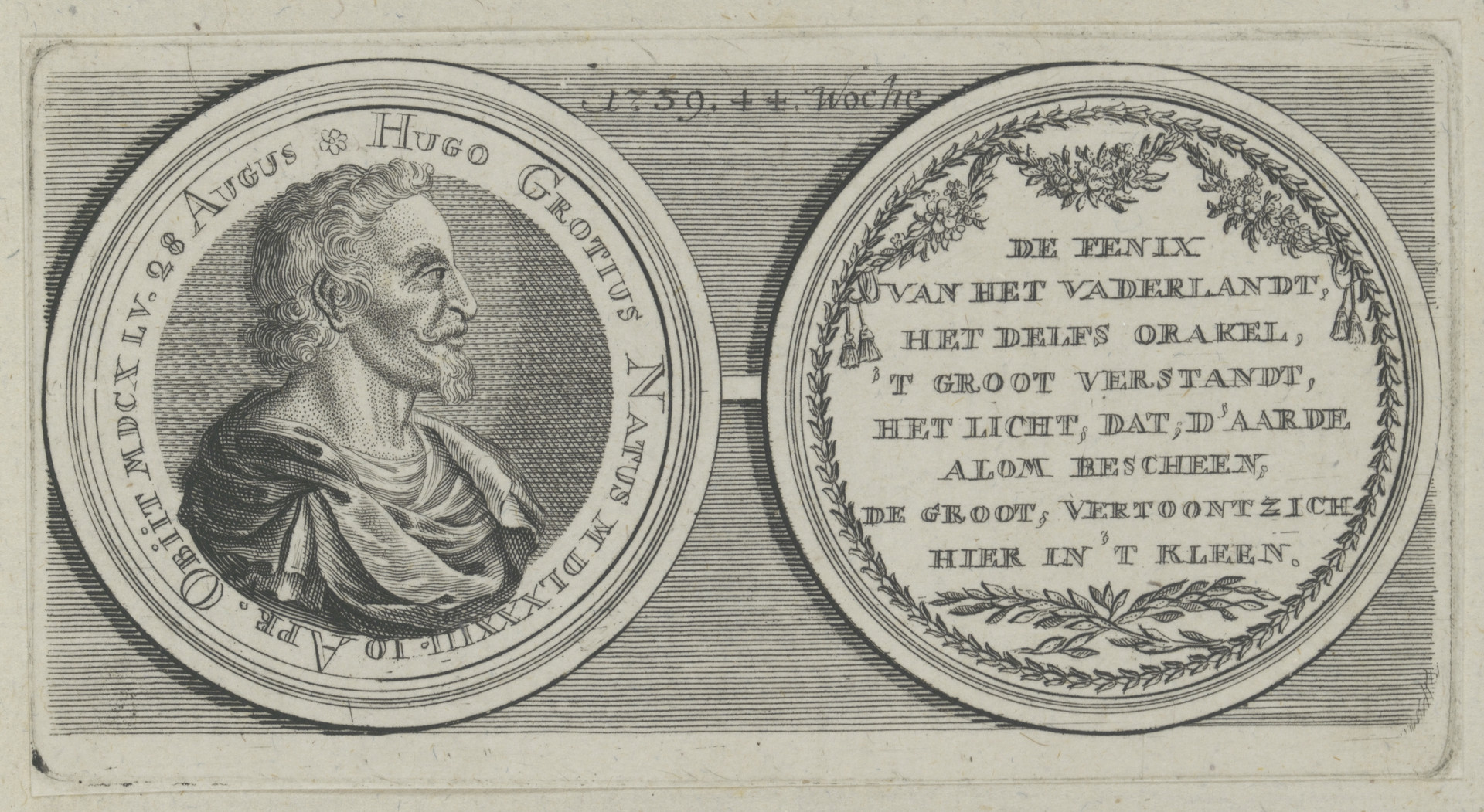
 (image: medal representing Grotius as "phenix of the fatherland" and "oracle of Delft", 1739; Germanisches Nationalmuseum/Europeana)


Grotian law and modernity at the dawn of a new age

400 years of De jure belli ac pacis 1625-2025

International Conference 19-20 June 2025

Leiden University Wijnhaven Campus, The Hague


Call for papers


On the occasion of the 400th anniversary of the first publication of De jure belli ac pacis by Hugo Grotius in 1625, an international conference will be organized by the Grotiana Foundation, the Paul Scholten Centre for Jurisprudence at the University of Amsterdam, the Grotius Centre for International Legal Studies at the University of Leiden and the Department of Public Law and Governance at Tilburg University.


In 1925, the third centenary of the first publication of Hugo Grotius’ most seminal work on the law of nations, De jure belli ac pacis libri tres (Three Books on the Law of War and Peace) offered the occasion for elaborate festivities and commemorating activities in and outside the Netherlands. The anniversary was organized against the backdrop of a revival of interest in Grotius as a trailblazer for international law among proponents of the international ‘peace through law’ movement, which went back to the Hague Peace Conferences and was given new traction after the Great War.


In the past few decades, international academic interest has widened beyond the scope of international law to encompass the full extent of Grotius’ life, thought and works across the disciplines. The mainstream narratives of Grotius as ‘father of international law’ and visionary defender of international peace and justice have given way to more nuanced readings of his life and work, as well as his many receptions and revivals, against the changing patterns of social, political and ethical ideas and values. In recent years, Grotius’ role both as an actor in the Dutch imperialist enterprise and a defender of unity and reconciliation among the Christian confessions have been highlighted. All this solicits critical reconsiderations of De jure belli ac pacis and Grotius’ role in the history of international law.


The major aim of the conference is to foster new narratives on the thought of Grotius, in general legal theory as well as in international law against a the backdrop of present-day rapid, fundamental changes that challenge the very foundations of the modernist paradigm, of which Grotius may be considered a key trailblazer. The core question of the academic conference is to what extent Grotian thought about general legal theory and international law is still relevant today, and what adaptations current foundational changes to our world make necessary. In this context, discussion of the many trajectories of reception, appropriation and reinterpretation of Grotius in different times and places, offers a valuable, additional perspective.


Through the conference ‘Grotian law and modernity at the dawn of a new age’, the organizers want to stimulate debate on the constitutional impact of current changes for the global legal order through the lens of a long-term historical analysis. The speakers in the conference are invited to reach back to Grotius’ thought and work as a starting point for discussing the foundations of the modern legal order of the past four centuries and the changes this is currently undergoing. They are asked to use this long-term historical framework to make sense of current upheavals and look for direction towards the future of law.


The conference program falls into three parts (with parallel sessions).


Part I ‘Lineages of Grotian thought’ discusses the material and ideological receptions, reinterpretations and appropriations of De jure belli ac pacis at different times during the past four centuries. It assembles a number of papers that trace the lineages, in terms of material history or content, of Grotius’ ideas with regards to different branches of legal theory or practical law. It looks to reviewing traditional, often celebratory narratives of Grotius from the late nineteenth and twentieth centuries from the perspective of a wide array of themes including political and economic governance, human rights, imperialism or (in)equality.


Part II ‘Modernity and the dawn of a new age: general theory of law and governance’ and Part III ‘Modernity and the dawn of a new age: international law and governance’ address the question of the significance of current changes for the constitution of a new global legal order, using De jure belli ac pacis as a platform for discussing the development, transformation and superseding of modern law.

Part II concerns general questions of the theory of law and governance.

Part III pertains to specific questions of public international law.


At the end of the second day, an academic session will be organized for a wider audience, with a key note speech and a panel discussion on the core topic of the conference.


Invitation to speakers


In addition to three keynote speakers, the organizers invite twelve speakers for each of the three thematic parts of the conference.


Candidates are requested to send in an abstract of 250-400 words and short c.v. of max. 100 words to the general convener, Randall Lesaffer (lesaffer@tilburguniversity.edu) by 1 May 2024. Please mention your affiliation and indicate a preference for one of the three conference themes.


The event takes place in person without online presentations. The organization is not in a position to fund accommodation or travel expenses and invites selected speakers to search for funding themselves. Those selected speakers for whom this is impossible, are requested to contact the general convener on this.


Propositions will be assessed by the Organizing Committee and selected on the basis of the quality of abstracts and the fit with the programme.


Part I ‘Lineages of Grotian thought’

Convener: Mark Somos

Keynote speaker: Martine van Ittersum

The material conditions of the production and reception of De jure belli ac pacis form a neglected and highly rewarding field of research. Recent studies of the printing history of various editions have started to clarify Grotius’ own role in the revision and timing of new editions; piracy and rivalry among publishers; the marketing strategy for each edition; and the dissemination and movement of copies. The burgeoning study of annotations that legal scholars, aristocrats, municipal and imperial administrators, prominent politicians and thinkers have left behind in their copies of De jure belli ac pacis is shedding new light on the hitherto unseen history of this work’s real impact. Early insights into the lineages of Grotian thought that only close attention to the surviving copies’ materiality can provide include the intensity and ingenuity of the Catholic reception of De jure belli ac pacis. Another set of discoveries that emerges from the material heritage of De jure belli ac pacis reveals historical moments of focused interest in specific passages of the text in response to crises that previous historiography has never considered to be part of the book’s reception, such as the breakup of the Iberian Union, nineteenth-century abolitionism, or the start of World War I. Grounding the reception history of De jure belli ac pacis in the book’s materiality is essential for recovering the four centuries of its impact in full, from its earliest classroom use to its latest invocation in front of an international tribunal, as well as for reassessing Grotius’ role in the evolution of the laws of war, the relationship between morality and law, sovereignty, natural rights, freedom of navigation and imperialism.

Part I welcomes proposals for papers on the various editions’ printing history, surviving annotations, evidence of the book’s use in classrooms, in court and the corridors of power,  and the broader relationship between the material and intellectual receptions of De jure belli ac pacis. We thereby expressly invite papers on receptions of and engagements with Grotius in different parts of the world.


Part II ‘Modernity and the dawn of a new age: general theory of law and governance’

Convener: Marc de Wilde

Keynote speaker: Annabel Brett

In De jure belli ac pacis, Grotius developed three ideas that have been recognized as major innovations in legal theory. First of all, he presented natural law as the moral foundation of both domestic and international legal systems. Secondly, he revolutionized the traditional understanding of natural law by focusing on the natural rights of individuals. And thirdly, he distinguished between natural law and religious belief, arguing that the rights of individuals had to be protected irrespective of religious differences. With these ideas, Grotius stood at the cradle of the modernist paradigm of legal theory which emphasized the need for a secular and universal legal order based on individual rights. However, depending on the context in which Grotius’s theory was applied, its meaning proved to be ambiguous. Thus, Grotius’s concept of natural law was also used to justify imperialism and colonialism, and it served to legitimize the practice of slavery. Moreover, present-day challenges, such as climate change or the rise of artificial intelligence, require us to reconsider the main assumptions behind Grotius’s theory, such as his notion of the free will or the unlimited availability of natural resources. The speakers are invited to reflect critically on Grotius’s contribution to legal theory and its present-day relevance by presenting papers on the following topics: the universality of natural law (or its limitations), individual rights as foundation of the legal system (and its potential downsides), the relation between natural law, imperialism and slavery, the challenges new technologies pose to the free will and legal regulation, and the state’s role in balancing individual rights and the public good (as, for instance, in the case of climate change).


Part III ‘Modernity and the dawn of a new age: international law and governance’

Convener: Eric De Brabandere

Keynote speaker: Hilary Charlesworth

This part pertains to specific questions of contemporary and future public international law. The actual text of De jure belli ac pacis libri tres is often neglected, given the wealth of secondary sources.  This part of the conference invites critique and examination of the potential of De jure belli ac pacis as a text with contemporary relevance. To this end, Part III invites papers that critically explore the Grotian traditions and its potential impact on particularized problems of contemporary international law. Of special interest are papers that adopt a critical lens to the Grotian legacy in the sphere of international humanitarian law and international criminal law. Critical analysis of the idea of a ‘Grotian Moment’ and the mainstream progress narrative of international law is invited.  Analysis of Grotius’ work on the treatment of foreigners and enemies (of all humankind or otherwise) is welcome, as are papers examining Grotian legacy in the context of jus post bellum (the transition from armed conflict to a just and sustainable peace). Ultimately, this section of the conference hopes to imagine how Grotius’ great work could be used to better manage the problems of, if not the next 400 years, at least the next 40.


Speakers are expected to turn in a draft paper before 1 June 2025. Papers will be distributed to the participants in advance of the conference. Those papers which pass peer review will be published in both the journal Grotiana (New Series) as well as collected in a separate book with Brill.


Organizing committee


Jeroen Vervliet (Grotiana), chair

Eric De Brabandere (Grotius Centre for International Legal Studies, University of Leiden), convener ‘International law and governance’

Randall Lesaffer (Department of Public Law and Governance, Tilburg University & Grotiana), general convener

Janne Nijman (Department of Public International Law, University of Amsterdam)

Marc de Wilde (Department of Jurisprudence, University of Amsterdam & Grotiana), convener ‘General legal theory and governance’

Mark Somos (Grotiana), convener ‘Lineages of Grotian thought’


Further introduction to the conference theme


In international law, the term ‘Grotian moments’ is sometimes used to indicate times and occurrences of fundamental change in the constitution of the international legal order. The phrase carries the implication that Grotius’ De jure belli ac pacis was constitutive for the new international order that emerged at the dawn of the modern age.

Grotius’ De jure belli ac pacis is undoubtedly one of the most iconic texts from Western legal history. While this is widely recognized in relation to international law or natural law jurisprudence, its relevance extends beyond the confines of international law into that of law and governance at large. In many ways, Grotius’ major legal treatise has been and remains a major source for imagining, articulating and debating law as both the guarantor of individual autonomy and an instrument of state policy under the paradigm of modernity.

The Western paradigm of modern law came to full fruition during the late 19th and early 20th centuries, the heyday of the sovereign nation-state.  The paradigm of modern law may be caught under its following core features: 1) the autonomy of the individual human being as foundation for social order; 2) consent as the basis for the legal organization of both private transactions and public authority; 3) the separation of a private sphere of liberty from a sphere of public interest; 4) the understanding of the role of public authority and law in terms of balancing between individual autonomy and public interest; 5) the claim to exclusive jurisdiction over law making and law enforcement by the state both in internal and international relations; 6) the global expansion of this model in the context of imperialism, colonization and decolonization.

De jure belli ac pacis held no blueprint for this modern law paradigm, but contained many building blocks, both great and small. Although the question of justice in war stood at the heart of the treatise, Grotius framed it in the context of a novel general theory of law, and did so by addressing a plethora of fundamental issues of private, constitutional and criminal law. Grotius’ reimagination of natural law in terms of individual and individually enforceable rights preconfigured the foundational role of the autonomy of the individual as the key constitutional principle of the modern nation-state with its separation of a private from a public sphere. His contract theory of the state and his equation of the natural rights of the state with those of the individual allowed for the elevation of the state to the sovereign creator of positive law. At the same time, his acknowledgment of the autonomy of natural law from Christian religion allowed to create a standard of justice that was said to derive from universal principles of humanity but at the same time was laden with the inheritance of hundreds of years of Christian and European intellectual tradition.


De jure belli ac pacis does not just stand at the foundations of modern law. For four hundred years it has retained currency as a source of inspiration to argue for new turns and twists along the path of the emergence, the maturation and the transformation of modern law. If 19th-century international lawyers hailed Grotius for having given autonomy to international law as the preserve of the sovereign state, their 20th-century successors have seen in him the remote trailblazer for the supremacy of the international community over the state. In this sense, the relevance of Grotius’ thought has proven resilient to many of the most fundamental changes of the past four centuries and has survived several ‘Grotian moments’ so far.

The two decades that have lapsed since the beginning of the 21st century have witnessed tremendous and profound changes that challenge the very basis of the modern law paradigm. The globalization of economic and social life together with the empowerment of the individual and non-state agents have severely weakened the claims of states to exclusive jurisdiction, furthering the erosion of traditional state-based institutions and principles of democracy and rule of law. The relative decline of the West and the resilience of authoritarianism question the universalism that for the better part of two centuries has been part of the Western paradigm of modernity. Climate change is putting a hard stop on the belief in the unending possibilities of the growth of humankind and its ‘pursuit of happiness’ at the cost of the planet, while according to some the rise of artificial intelligence challenges the very centrality of consent, free will and individual autonomy.

The 400th anniversary of the first publication of Grotius’ De jure belli ac pacis offers an excellent occasion to question the impact of current global changes on the existent global order in terms of a paradigmatic shift away from the modern understanding of law.

23 February 2024

REMINDER CFP: Grotian law and modernity at the dawn of a new age 400 years of De jure belli ac pacis 1625-2025 International Conference (The Hague: Leiden University Wijnhaven Campus, 19-20 JUN 2025); DEADLINE 1 MAY 2024


 (image: medal representing Grotius as "phenix of the fatherland" and "oracle of Delft", 1739; Germanisches Nationalmuseum/Europeana)


Grotian law and modernity at the dawn of a new age

400 years of De jure belli ac pacis 1625-2025

International Conference 19-20 June 2025

Leiden University Wijnhaven Campus, The Hague


Call for papers


On the occasion of the 400th anniversary of the first publication of De jure belli ac pacis by Hugo Grotius in 1625, an international conference will be organized by the Grotiana Foundation, the Paul Scholten Centre for Jurisprudence at the University of Amsterdam, the Grotius Centre for International Legal Studies at the University of Leiden and the Department of Public Law and Governance at Tilburg University.


In 1925, the third centenary of the first publication of Hugo Grotius’ most seminal work on the law of nations, De jure belli ac pacis libri tres (Three Books on the Law of War and Peace) offered the occasion for elaborate festivities and commemorating activities in and outside the Netherlands. The anniversary was organized against the backdrop of a revival of interest in Grotius as a trailblazer for international law among proponents of the international ‘peace through law’ movement, which went back to the Hague Peace Conferences and was given new traction after the Great War.


In the past few decades, international academic interest has widened beyond the scope of international law to encompass the full extent of Grotius’ life, thought and works across the disciplines. The mainstream narratives of Grotius as ‘father of international law’ and visionary defender of international peace and justice have given way to more nuanced readings of his life and work, as well as his many receptions and revivals, against the changing patterns of social, political and ethical ideas and values. In recent years, Grotius’ role both as an actor in the Dutch imperialist enterprise and a defender of unity and reconciliation among the Christian confessions have been highlighted. All this solicits critical reconsiderations of De jure belli ac pacis and Grotius’ role in the history of international law.


The major aim of the conference is to foster new narratives on the thought of Grotius, in general legal theory as well as in international law against a the backdrop of present-day rapid, fundamental changes that challenge the very foundations of the modernist paradigm, of which Grotius may be considered a key trailblazer. The core question of the academic conference is to what extent Grotian thought about general legal theory and international law is still relevant today, and what adaptations current foundational changes to our world make necessary. In this context, discussion of the many trajectories of reception, appropriation and reinterpretation of Grotius in different times and places, offers a valuable, additional perspective.


Through the conference ‘Grotian law and modernity at the dawn of a new age’, the organizers want to stimulate debate on the constitutional impact of current changes for the global legal order through the lens of a long-term historical analysis. The speakers in the conference are invited to reach back to Grotius’ thought and work as a starting point for discussing the foundations of the modern legal order of the past four centuries and the changes this is currently undergoing. They are asked to use this long-term historical framework to make sense of current upheavals and look for direction towards the future of law.


The conference program falls into three parts (with parallel sessions).


Part I ‘Lineages of Grotian thought’ discusses the material and ideological receptions, reinterpretations and appropriations of De jure belli ac pacis at different times during the past four centuries. It assembles a number of papers that trace the lineages, in terms of material history or content, of Grotius’ ideas with regards to different branches of legal theory or practical law. It looks to reviewing traditional, often celebratory narratives of Grotius from the late nineteenth and twentieth centuries from the perspective of a wide array of themes including political and economic governance, human rights, imperialism or (in)equality.


Part II ‘Modernity and the dawn of a new age: general theory of law and governance’ and Part III ‘Modernity and the dawn of a new age: international law and governance’ address the question of the significance of current changes for the constitution of a new global legal order, using De jure belli ac pacis as a platform for discussing the development, transformation and superseding of modern law.

Part II concerns general questions of the theory of law and governance.

Part III pertains to specific questions of public international law.


At the end of the second day, an academic session will be organized for a wider audience, with a key note speech and a panel discussion on the core topic of the conference.


Invitation to speakers


In addition to three keynote speakers, the organizers invite twelve speakers for each of the three thematic parts of the conference.


Candidates are requested to send in an abstract of 250-400 words and short c.v. of max. 100 words to the general convener, Randall Lesaffer (lesaffer@tilburguniversity.edu) by 1 May 2024. Please mention your affiliation and indicate a preference for one of the three conference themes.


The event takes place in person without online presentations. The organization is not in a position to fund accommodation or travel expenses and invites selected speakers to search for funding themselves. Those selected speakers for whom this is impossible, are requested to contact the general convener on this.


Propositions will be assessed by the Organizing Committee and selected on the basis of the quality of abstracts and the fit with the programme.


Part I ‘Lineages of Grotian thought’

Convener: Mark Somos

Keynote speaker: Martine van Ittersum

The material conditions of the production and reception of De jure belli ac pacis form a neglected and highly rewarding field of research. Recent studies of the printing history of various editions have started to clarify Grotius’ own role in the revision and timing of new editions; piracy and rivalry among publishers; the marketing strategy for each edition; and the dissemination and movement of copies. The burgeoning study of annotations that legal scholars, aristocrats, municipal and imperial administrators, prominent politicians and thinkers have left behind in their copies of De jure belli ac pacis is shedding new light on the hitherto unseen history of this work’s real impact. Early insights into the lineages of Grotian thought that only close attention to the surviving copies’ materiality can provide include the intensity and ingenuity of the Catholic reception of De jure belli ac pacis. Another set of discoveries that emerges from the material heritage of De jure belli ac pacis reveals historical moments of focused interest in specific passages of the text in response to crises that previous historiography has never considered to be part of the book’s reception, such as the breakup of the Iberian Union, nineteenth-century abolitionism, or the start of World War I. Grounding the reception history of De jure belli ac pacis in the book’s materiality is essential for recovering the four centuries of its impact in full, from its earliest classroom use to its latest invocation in front of an international tribunal, as well as for reassessing Grotius’ role in the evolution of the laws of war, the relationship between morality and law, sovereignty, natural rights, freedom of navigation and imperialism.

Part I welcomes proposals for papers on the various editions’ printing history, surviving annotations, evidence of the book’s use in classrooms, in court and the corridors of power,  and the broader relationship between the material and intellectual receptions of De jure belli ac pacis. We thereby expressly invite papers on receptions of and engagements with Grotius in different parts of the world.


Part II ‘Modernity and the dawn of a new age: general theory of law and governance’

Convener: Marc de Wilde

Keynote speaker: Annabel Brett

In De jure belli ac pacis, Grotius developed three ideas that have been recognized as major innovations in legal theory. First of all, he presented natural law as the moral foundation of both domestic and international legal systems. Secondly, he revolutionized the traditional understanding of natural law by focusing on the natural rights of individuals. And thirdly, he distinguished between natural law and religious belief, arguing that the rights of individuals had to be protected irrespective of religious differences. With these ideas, Grotius stood at the cradle of the modernist paradigm of legal theory which emphasized the need for a secular and universal legal order based on individual rights. However, depending on the context in which Grotius’s theory was applied, its meaning proved to be ambiguous. Thus, Grotius’s concept of natural law was also used to justify imperialism and colonialism, and it served to legitimize the practice of slavery. Moreover, present-day challenges, such as climate change or the rise of artificial intelligence, require us to reconsider the main assumptions behind Grotius’s theory, such as his notion of the free will or the unlimited availability of natural resources. The speakers are invited to reflect critically on Grotius’s contribution to legal theory and its present-day relevance by presenting papers on the following topics: the universality of natural law (or its limitations), individual rights as foundation of the legal system (and its potential downsides), the relation between natural law, imperialism and slavery, the challenges new technologies pose to the free will and legal regulation, and the state’s role in balancing individual rights and the public good (as, for instance, in the case of climate change).


Part III ‘Modernity and the dawn of a new age: international law and governance’

Convener: Eric De Brabandere

Keynote speaker: Hilary Charlesworth

This part pertains to specific questions of contemporary and future public international law. The actual text of De jure belli ac pacis libri tres is often neglected, given the wealth of secondary sources.  This part of the conference invites critique and examination of the potential of De jure belli ac pacis as a text with contemporary relevance. To this end, Part III invites papers that critically explore the Grotian traditions and its potential impact on particularized problems of contemporary international law. Of special interest are papers that adopt a critical lens to the Grotian legacy in the sphere of international humanitarian law and international criminal law. Critical analysis of the idea of a ‘Grotian Moment’ and the mainstream progress narrative of international law is invited.  Analysis of Grotius’ work on the treatment of foreigners and enemies (of all humankind or otherwise) is welcome, as are papers examining Grotian legacy in the context of jus post bellum (the transition from armed conflict to a just and sustainable peace). Ultimately, this section of the conference hopes to imagine how Grotius’ great work could be used to better manage the problems of, if not the next 400 years, at least the next 40.


Speakers are expected to turn in a draft paper before 1 June 2025. Papers will be distributed to the participants in advance of the conference. Those papers which pass peer review will be published in both the journal Grotiana (New Series) as well as collected in a separate book with Brill.


Organizing committee


Jeroen Vervliet (Grotiana), chair

Eric De Brabandere (Grotius Centre for International Legal Studies, University of Leiden), convener ‘International law and governance’

Randall Lesaffer (Department of Public Law and Governance, Tilburg University & Grotiana), general convener

Janne Nijman (Department of Public International Law, University of Amsterdam)

Marc de Wilde (Department of Jurisprudence, University of Amsterdam & Grotiana), convener ‘General legal theory and governance’

Mark Somos (Grotiana), convener ‘Lineages of Grotian thought’


Further introduction to the conference theme


In international law, the term ‘Grotian moments’ is sometimes used to indicate times and occurrences of fundamental change in the constitution of the international legal order. The phrase carries the implication that Grotius’ De jure belli ac pacis was constitutive for the new international order that emerged at the dawn of the modern age.

Grotius’ De jure belli ac pacis is undoubtedly one of the most iconic texts from Western legal history. While this is widely recognized in relation to international law or natural law jurisprudence, its relevance extends beyond the confines of international law into that of law and governance at large. In many ways, Grotius’ major legal treatise has been and remains a major source for imagining, articulating and debating law as both the guarantor of individual autonomy and an instrument of state policy under the paradigm of modernity.

The Western paradigm of modern law came to full fruition during the late 19th and early 20th centuries, the heyday of the sovereign nation-state.  The paradigm of modern law may be caught under its following core features: 1) the autonomy of the individual human being as foundation for social order; 2) consent as the basis for the legal organization of both private transactions and public authority; 3) the separation of a private sphere of liberty from a sphere of public interest; 4) the understanding of the role of public authority and law in terms of balancing between individual autonomy and public interest; 5) the claim to exclusive jurisdiction over law making and law enforcement by the state both in internal and international relations; 6) the global expansion of this model in the context of imperialism, colonization and decolonization.

De jure belli ac pacis held no blueprint for this modern law paradigm, but contained many building blocks, both great and small. Although the question of justice in war stood at the heart of the treatise, Grotius framed it in the context of a novel general theory of law, and did so by addressing a plethora of fundamental issues of private, constitutional and criminal law. Grotius’ reimagination of natural law in terms of individual and individually enforceable rights preconfigured the foundational role of the autonomy of the individual as the key constitutional principle of the modern nation-state with its separation of a private from a public sphere. His contract theory of the state and his equation of the natural rights of the state with those of the individual allowed for the elevation of the state to the sovereign creator of positive law. At the same time, his acknowledgment of the autonomy of natural law from Christian religion allowed to create a standard of justice that was said to derive from universal principles of humanity but at the same time was laden with the inheritance of hundreds of years of Christian and European intellectual tradition.


De jure belli ac pacis does not just stand at the foundations of modern law. For four hundred years it has retained currency as a source of inspiration to argue for new turns and twists along the path of the emergence, the maturation and the transformation of modern law. If 19th-century international lawyers hailed Grotius for having given autonomy to international law as the preserve of the sovereign state, their 20th-century successors have seen in him the remote trailblazer for the supremacy of the international community over the state. In this sense, the relevance of Grotius’ thought has proven resilient to many of the most fundamental changes of the past four centuries and has survived several ‘Grotian moments’ so far.

The two decades that have lapsed since the beginning of the 21st century have witnessed tremendous and profound changes that challenge the very basis of the modern law paradigm. The globalization of economic and social life together with the empowerment of the individual and non-state agents have severely weakened the claims of states to exclusive jurisdiction, furthering the erosion of traditional state-based institutions and principles of democracy and rule of law. The relative decline of the West and the resilience of authoritarianism question the universalism that for the better part of two centuries has been part of the Western paradigm of modernity. Climate change is putting a hard stop on the belief in the unending possibilities of the growth of humankind and its ‘pursuit of happiness’ at the cost of the planet, while according to some the rise of artificial intelligence challenges the very centrality of consent, free will and individual autonomy.

The 400th anniversary of the first publication of Grotius’ De jure belli ac pacis offers an excellent occasion to question the impact of current global changes on the existent global order in terms of a paradigmatic shift away from the modern understanding of law.