Search

Showing posts with label Constitutionalism. Show all posts

03 July 2026

BOOK: Matthias FRIEHE (ed.), Zur Verfassung der Europäischen Union [Wissenschaftliche Abhandlungen und Rede zur Philosophie, Politik und Geistesgeschichte; 115] (Berlin: Duncker & Humblot, 2026), 161 p., ISBN 978-3-428-19538-1

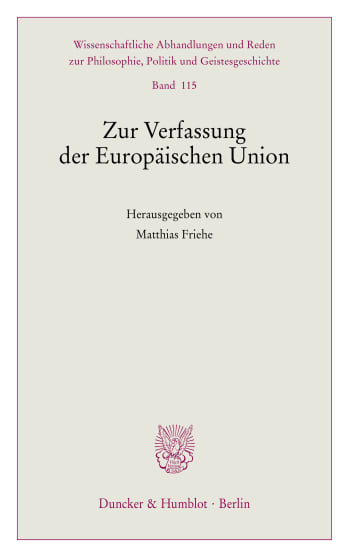
Cover: Zur Verfassung der Europäischen Union 

ABOUT THE BOOK:

Die Europäische Union ist in keiner leichten Verfassung: Unter dem Druck der russischen Aggression in der Ukraine brechen in vielen Mitgliedstaaten gesellschaftliche Konfliktlinien auf, während die Union im Bereich der Verteidigungspolitik ihre eigene Machtlosigkeit erfährt. Die Beiträge in diesem Tagungsband sind aus den Referaten entstanden, die auf der Sitzung der Rechts- und Staatswissenschaftlichen Sektion der Görres-Gesellschaft im September 2024 in Regensburg entstanden sind.

Die Beiträge unterstreichen trotz der genannten Herausforderungen die Stärke der europäischen Einigung und ihre Zukunftsperspektiven. Sie spannen einen weiten Bogen von der Konstitutionalisierung der Europäischen Union, auch vor dem Hintergrund der Souveränität der Mitgliedstaaten, über die Rechtsstaatsaufsicht, das europäische Wahl- und Parlamentsrecht bis hin zur Rolle des Europäischen Gerichtshofs. Beigetragen haben Franz Mayer, András Jakab, Monika Polzin, Winfried Kluth und Claus Dieter Classen.

TABLE OF CONTENT:

Franz C. Meyer
Konstitutionalisierung der Europäischen Union und Souveränität der Mitgliedstaaten

András Jakab
Rechtsstaatsaufsicht der Europäischen Union über ihre Mitgliedsstaaten: Was man über den Rechtsstaat wissen muss, damit wirksam gehandelt werden kann

Monika Polzin
Vorschläge für ein europäisches Wahlgesetz: Hintergründe, Perspektiven und Kritik

Winfried Kluth
Europäischer Parlamentarismus

Claus Dieter Classen.
Der Europäische Gerichtshof als überfordertes Multifunktionsgericht? Reformperspektiven zwischen europäischer Verfassungsgerichtsbarkeit und einheitlicher Rechtsauslegung in der Union

Find more here.


14 May 2025

BOOK: Inken VON BORZYSKOWSKI, Benno GAMMERL, Jakob ZOLLMANN (eds.), Liberalism, Constitutionalism, and Citizenship: Historical Contestations. Essays by Dieter Gosewinkel (Baden-Baden: Nomos, 2025), 318 p., ISBN 978-3-7560-2445-2

Liberalism, Constitutionalism, and Citizenship: Historical Contestations

ABOUT THE BOOK:

Dieter Gosewinkel verbindet juristisches Fachwissen mit historischer Analyse und untersucht liberale, konservative und sozialdemokratische Denkschulen. Sein Werk eröffnet neue Perspektiven auf zentrale Akteure, Debatten über Eigentum, Staatsbürgerschaft und den Konstitutionalismus. Die von ihm präsentierten Sozialgeschichten reichen über die Grenzen des Rechts hinaus und lassen Stimmen der Vergangenheit lebendig werden. So zeigt sich, wie Entwicklungen anders hätten verlaufen können. Die erstmals auf Englisch zugänglichen Texte fördern ein multiperspektivisches Gespräch zwischen liberal-demokratischen Positionen der Gegenwart.

Find more here.

19 November 2024

BOOK: Ronald CAR, Searching for a Leftist Constitutionalism. The German Left vs. the Rechtsstaat 1848-1949 [Studies in the History of Law and Justice, 30, eds. Mortimer SELLERS & Georges MARTYN] (Heidelberg: Springer, 2024), VI + 208 p. ISBN 978-3-031-62097-3, € 148,39


(image source: Springer)

Abstract:
Is there a viable leftist constitutionalism that we can juxtapose with liberal constitutionalism, or is there really no alternative? If the left is considered an a priori enemy of the principle of the rule of law, the equal chance condition proves illusory. Accordingly, those asking for changes to social institutions will deem constitutionalism undemocratic. Hence, in our times of silent de-constitutionalization at the global level and rising populism and democratic backsliding at the national level, this book offers a valuable opportunity to reconsider one of the founding principles of liberal constitutionalism, the Rechtsstaat. It re-examines the controversies that accompanied the affirmation of the concept in a long-term perspective, from 1848 to the post-World War II constitutional debates. Since 1848 the German left has challenged the dominant liberal view of legitimacy, mainly by adopting Marx’s critique of the ideology of law and the state. Thus, the left has had to challenge not only the established order, but also the mainstream political and legal culture generated by the liberal discourse on rights. In search of constitutional viability, the left has oscillated between two tendencies. On the one hand, it has denounced the discourse on rights as an ideological smokescreen used by the ruling class to keep us from paying more attention to the actual level of democracy within the parties, the governmental bodies and in everyday social relations. On the other hand, the left has attempted to adjust its platform to the mainstream idea of constitutional legitimacy by devising its own sozialer Rechtsstaat. However, the break-even point has proven hard to find. If the acceptance of liberal principles was seen as less than wholehearted, leftist constitutional proposals aroused suspicions of a coverup for an unconstitutional rule (Unrechtsstaat). On the other hand, when the left has accepted liberal constitutional principles in full, its potential to challenge the social status quo has ultimately proven to be disappointing. The controversy culminated in a desperate and largely unknown attempt to devise a constitutional compromise between Liberalism and Socialism in East Berlin in the wake of the Cold War. Although doomed to fail and devoid of democratic credibility, the debates of the East German constitutional commission in 1948 offer important insights into a century of experiences, trials and errors in constitution-making seen from the leftist perspective.

Read more here: DOI 10.1007/978-3-031-62098-0.


25 February 2022

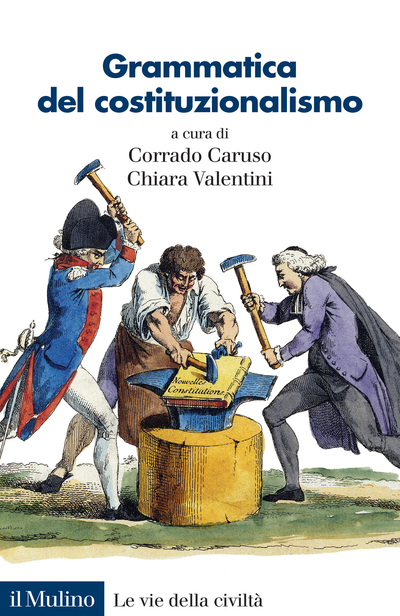
ONLINE BOOK PRESENTATION: CORRADO CARUSO, CHIARA VALENTINI (eds.), Grammatica del costituzionalismo


(Image source: Il Mulino editore)


February 25, at 16:00 (CET), the book "Grammatica del costituzionalismo" will be presented at Bologna (Palazzo Malvezzi, Aula Grande, via Zamboni 22) with the possibility to follow the conference online (please ask the link to claudio.novelli@unibo.it).

More information can be found here.

***

SALUTI

  • Federico Casolari Vicedirettore del Dipartimento di Scienze giuridiche
  • Giovanni Sartor per il CIRSFID-Alma Human AI

DISCUSSIONE

  • Andrea Morrone Università di Bologna (moderatore)
  • Mario Ricciardi Università di Milano
  •  Tania Groppi Università di Siena
  •  Fulvio Cortese Università di Trento
  •  Valeria Ottonelli Università di Genova

CONCLUSIONI

  • Pasquale Pasquino New York University


***

ABOUT THE BOOK   

Costituzione, sovranità, democrazia, stato di diritto. Quante e quali sono le parole del costituzionalismo moderno? Scritta a più mani da costituzionalisti e filosofi del diritto, questa «grammatica» non si concentra su un ordinamento giuridico in particolare, ma enuclea le idee fondamentali che hanno attraversato la dottrina dello stato costituzionale in Europa. Leggendo il costituzionalismo attraverso l’evoluzione delle sue parole, il libro ricostruisce le radici storico-culturali della nostra Carta e le prospettive future, invitando a partecipare al dibattito tutt’oggi in corso su come distribuire il potere in una società di cittadini considerati eguali.


ABOUT THE AUTHORS

Corrado Caruso insegna Diritto costituzionale nell’Università di Bologna. È stato assistente di studio della Corte costituzionale (2017-2021) e visiting researcher nella Yale Law School (2010). Redattore di «Quaderni costituzionali», con il Mulino ha pubblicato «Il governo dei numeri. Indicatori economico-finanziari e decisione di bilancio nello Stato costituzionale» (con M. Morvillo, 2020). 

Chiara Valentini è ricercatrice in filosofia del diritto nell’Università di Bologna. È stata «Ramon y Cajal Fellow» nel Dipartimento di Diritto della Universitat Pompeu Fabra di Barcellona e «Max Weber Fellow» nell’European University Institute. Tra le sue pubblicazioni, «Le ragioni della costituzione. La Corte Suprema americana, i diritti e le regole della democrazia» (Giappichelli, 2011).