Search

Showing posts with label rule of law. Show all posts

03 July 2026

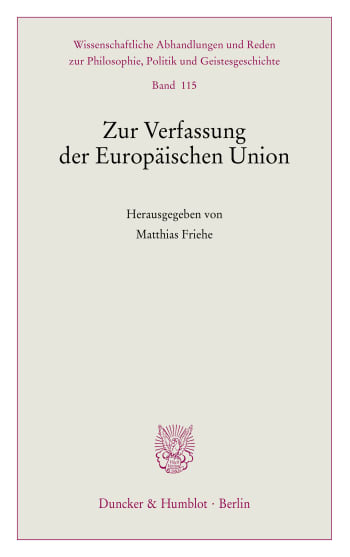
BOOK: Matthias FRIEHE (ed.), Zur Verfassung der Europäischen Union [Wissenschaftliche Abhandlungen und Rede zur Philosophie, Politik und Geistesgeschichte; 115] (Berlin: Duncker & Humblot, 2026), 161 p., ISBN 978-3-428-19538-1

Cover: Zur Verfassung der Europäischen Union 

ABOUT THE BOOK:

Die Europäische Union ist in keiner leichten Verfassung: Unter dem Druck der russischen Aggression in der Ukraine brechen in vielen Mitgliedstaaten gesellschaftliche Konfliktlinien auf, während die Union im Bereich der Verteidigungspolitik ihre eigene Machtlosigkeit erfährt. Die Beiträge in diesem Tagungsband sind aus den Referaten entstanden, die auf der Sitzung der Rechts- und Staatswissenschaftlichen Sektion der Görres-Gesellschaft im September 2024 in Regensburg entstanden sind.

Die Beiträge unterstreichen trotz der genannten Herausforderungen die Stärke der europäischen Einigung und ihre Zukunftsperspektiven. Sie spannen einen weiten Bogen von der Konstitutionalisierung der Europäischen Union, auch vor dem Hintergrund der Souveränität der Mitgliedstaaten, über die Rechtsstaatsaufsicht, das europäische Wahl- und Parlamentsrecht bis hin zur Rolle des Europäischen Gerichtshofs. Beigetragen haben Franz Mayer, András Jakab, Monika Polzin, Winfried Kluth und Claus Dieter Classen.

TABLE OF CONTENT:

Franz C. Meyer
Konstitutionalisierung der Europäischen Union und Souveränität der Mitgliedstaaten

András Jakab
Rechtsstaatsaufsicht der Europäischen Union über ihre Mitgliedsstaaten: Was man über den Rechtsstaat wissen muss, damit wirksam gehandelt werden kann

Monika Polzin
Vorschläge für ein europäisches Wahlgesetz: Hintergründe, Perspektiven und Kritik

Winfried Kluth
Europäischer Parlamentarismus

Claus Dieter Classen.
Der Europäische Gerichtshof als überfordertes Multifunktionsgericht? Reformperspektiven zwischen europäischer Verfassungsgerichtsbarkeit und einheitlicher Rechtsauslegung in der Union

Find more here.


31 October 2025

BOOK: Eleanor COWAN, Kit MORRELL, Andrew PETTINGER & Michael SEVEL (eds.), The Rule of Law in Ancient Rome (Oxford: Oxford University Press, 2025), ISBN 9780198959328


(image source: OUP)

Abstract:

This volume brings together the study of the rule of law—the idea that the law should protect citizens from arbitrary exercises of power—and the study of ancient Rome. Its chapters apply insights and approaches drawn from modern legal theory in order to understand the ways in which Romans thought about law and the place of law in their community, the extent to which Roman institutions and political norms protected citizens against the arbitrary exercise of power, and how these ideas and practices changed with Rome’s transition from republic to empire. Part I offers an overview of the modern concept of the rule of law and some of the challenges and possibilities of seeking a rule of law in ancient Rome. Part II focuses on the Roman republic and the relationship between key institutions and the law (including the senate, magistrates, people, and state religion), as well as the attitudes of some prominent late republican individuals towards the rule of law. Part III on the principate and empire explores aspirations for the rule of law in the wake of civil war, the relationship between the emperor and the law, and the nature of the emperor’s role as above the law but guarantor of justice. Together, the chapters reveal a world where elements of the rule of law are recognizable but inconsistently realized and sometimes subordinate to alternative ideals of justice, popular sovereignty, or the personal authority of individuals.

Table of  contents:

Introduction
Framing Questions
1:The Rule of Law: A Thought Pattern, Michael Sevel
2:In Search of a Roman Rule of Law, Michael Peachin
The Republic
3:Cato and the Rule of Law, Kit Morrell
4:The Populus and the Rule of Law, Amy Russell
5:'Rule of Law' and the Gods in the Late Republic, Catherine Steel
6:The Praetor's Edict and the Rule of Law, Andrew Pettinger
7:Non Iure Rogata: The People, the Senate, and the Rule of Law in Republican Rome, W. Jeffrey Tatum
8:Not in the Last Instance, Andrew M. Riggsby
Principate and Empire
9:Aspiration, Accountability, and Abuse: Augustus and the Law in Post-Conflict Rome, Eleanor Cowan
10:Princeps legibus solutus est an non? Cultures of Legality in the Roman Empire, Tristan S. Taylor
11:The Emperor as the Good Judge: The Emergence of Roman Imperial Jurisdiction as a Discourse on Justice and Rule of Law, Kaius Tuori
12:Some Remarks on Certainty Roman Law, Cosimo Cascione

Read more here: DOI 10.1093/9780198959359.001.0001.

14 May 2025

ARTICLE: Jean-Louis HALPÉRIN, "L’État de droit, un concept occidental ?" [Qui en veut à l'État de droit ?] (Pouvoirs 2025/2, n° 193)


(image source: Cairn)

First paragraph:

Gustave Flaubert en aurait fait une notice pour son Dictionnaire des idées reçues : « État de droit : le contester, résolument ! ». Mais, disparu en 1880, il n’a pas pu suivre le tournant démocratique de la IIIe République, avec l’arrivée des républicains au pouvoir, ni se confronter à ce paradoxe d’un régime politique qui établit un droit à la contestation, notamment par la loi sur la liberté de la presse (1881). Il n’aura pas non plus assisté au développement d’un terrorisme anarchiste fin de siècle, hostile à une république qualifiée de bourgeoise et de liberticide, et qui la conteste, l’arme au poing, jusque dans les prétoires. La démocratie, émergente, se heurtait déjà brutalement à ce dilemme philosophique de tolérer, ou non, les discours hostiles, surtout lorsqu’ils légitiment une contestation armée.

Read the article here: DOI 10.3917/pouv.193.0031.

12 May 2025

CONFERENCE: Defending the rule of law in times of crisis: Past, present and future perspectives [Olof Palme Guest Professor 2025, Dag MICHALSEN] (Uppsala: Upssala University, 12-13 JUN 2025)


Defending the rule of law in times of crisis: Past, present and future perspectives


Conference in Uppsala 12-13 June 2025


We live in times of multiple threats and challenges. War, climate change, pandemics, polarization and more, put society and everyday life into perspective. Each of these threats also seriously challenges democracy and the rule of law, implicitly as well as directly, blatantly so during this spring. This workshop brings together Nordic and Baltic legal researchers to examine weaknesses, resilience and restoration of the rule of law - nationally and regionally – contextualizing, analyzing and imagining past, present and future situations. The researchers participating all have unique insights on how constitutional fundaments such as the rule of law have been tested and questioned in concrete cases. What did we learn from examples from the 20th Century? How can historical and current examples have an impact on future choices and how we relate to state, administration and civil society?


Dag Michalsen, Olof Palme guest professor 2025,

 appointed by The Swedish Research Council


The theme for the Olof Palme guest professor 2025 is Experiences of crisis. Nordic constitutional history, in particular the interwar time.


The workshop is hosted by

The Olin Foundation for Legal History 


Time: 12-13 June 2025

Venue: Faculty Room (fakultetsrummet), Faculty of Law, Uppsala university, Trädgårdsgatan 1.


Thursday 12 June


9.30      Coffee/tea


10.00 – 10.15 Welcome

Anna Singer, Dean, Faculty of Law


10.15 – 12.00 Session 1: Past and Present

Erik Wennerström: Echoes of the 20th Century: The Rule of Law, the ECtHR, and Democratic Resilience in Europe.

Anna Jonsson Cornell: The Rule of Law & National Security - a Swedish Perspective

Comments: Elin Boyer & Inger Österdahl


12.00 – 13.30 Lunch


13.30 – 15.00 Session 2: Restoring the Rule of Law

Karin Sein & Merike Ristikivi: Restoring the Rule of Law in Estonia

Comments: Sara Holmström & Caroline Taube


15.00 – 15.30 Coffee/tea


15.30 – 17.00 Session 3: A Defending the Rule of Law

Anna-Sara Lind: The Constitutional Human Rights Protection

Olof Wilske: Constitutional sustainability

Comments: Rawaz Shanagar & Dag Michalsen


Friday 13 June

9.30-10.00       Coffee/tea

10.00 – 11.00 Session 4: Dismantling the Rule of Law

Hans-Petter Graver: How Autocrats Dismantle the Rule of Law.

Comments: Shirin Ahlbäck Öberg & Linnéa Gullholmer


11.00 – 12.00 Panel Discussion. Shirin Ahlbäck Öberg, Görel Granström, Linnéa Gullholmer, Sara Holmström, Dag Michalsen, Erik Wennerström. Moderator: Anna-Sara Lind.


12.00 – 13.30 Lunch. End of conference.


Registration at Medfarm. Last day for registration Friday 30 May.

For further information, please contact Marianne Dahlén, marianne.dahlen@jur.uu.se


Olof Palme guest professor 2025, Dag Michalsen:

https://www.uu.se/institution/juridiska/forskning/olof-palmes-gastprofessur-2025


Olin Foundation: https://olinfoundation.com/


27 January 2025

SSRN PAPER: Jeremy KESSLER, "The Origins of "The Rule of Law"" (Law & Contemporary Problems LXXXVII (2025)


(image source: Wikimedia Commons)


Abstract:

This Article offers a novel account of the origins of “the rule of law” in the English-speaking world. The phrase itself likely entered the language as a literal translation of the Latin regula juris. Prior to the early seventeenth century, however, the phrase appears to have been used exclusively to refer to the specific legal rule or maxim most relevant to the resolution of a particular kind of dispute. The more general and abstract use of the phrase – to refer to an ideal of political morality or an ideal type of governance – first appeared in the public record around 1610. It did so in the context of English common lawyers’ criticism of royal economic regulation limiting commodity production and circulation. The ideal type of governance that these common lawyers had in mind was the rule of common-law rules. They believed that the “chief subject or object” of these rules was the freedom of Englishmen to dispose of their possessions and professional skills as they wished, and to profit thereby. The earliest advocates of “the rule of law” thus found themselves in the vanguard of a cross-class project that sought to privilege the equal liberty of commodity exchangers over other long-recognized political, religious, and economic entitlements. Consequently, the original rule of law – the rule of common-law rules – came with a set of libertarian and egalitarian expectations, in addition to expectations of publicity, clarity, regularity, and so on. When A.V. Dicey popularized “the rule of law” in the late nineteenth century, he claimed to be restating age-old English common sense. While this claim exaggerated the continuity and coherence of English legal history, Dicey’s conception of the rule of law did indeed track the original, early-seventeenth-century conception in significant respects, including its libertarianism, its market-oriented egalitarianism, and its commitment to the supremacy of the common law. For both Dicey and his early modern precursors, the key to the equal liberty of English subjects was the centrality of common law courts to the settlement of disputes, whether between private parties, or between private parties and public officials. Contemporaneous critics of Dicey’s conception thus rightly understood him to be defending a legal worldview that dated to the early days of competitive capitalism. Yet the appeal of that worldview persists. In the middle of the twentieth century, Anglophone legal philosophers did craft an alternative: a more austere and generalizable conception of the rule of law, one freed from the libertarian, egalitarian, and common-law sensibilities of Dicey and his precursors. While an intellectual coup, this minimalist conception has proven unsatisfying not only to legal practitioners but also to a growing number of legal theorists, including some of the minimalist conception’s erstwhile defenders. For these critics, Jeremy Waldron foremost among them, the minimalist conception fails to capture common-sense understandings of both law and the rule of law. But why does the contemporary common sense to which Waldron appeals so closely echo the concerns of common lawyers in 1610? This Article argues that the answer lies in the limited yet significant socio-economic context shared by early modern common lawyers, late nineteenth century jurists, and contemporary legal theorists. That shared context is the dominance of commodity exchange, which has characterized capitalist societies since their emergence in sixteenth and seventeenth century Europe. The common lawyers who first used the phrase “the rule of law” to denote an ideal of political morality were responding to a profound and lasting social and economic transformation. That transformation – the penetration of commodity exchange into ever more domains of social life – gave rise to demands for the rule of law four hundred years ago, and continues to shape discourse about the rule of law today.

 Source: Legal History Blog.

Read more here.

01 October 2024

BOOK: Aziz Z. HUQ, The Rule of Law. A Very Short Introduction [Very Short Introductions] (Oxford: Oxford University Press, 2024), 152 p. ISBN 9780197657423, 8,99 GBP


(image source: OUP)

Abstract:
Politicians, judges, and citizens commonly use the phrase "rule of law" to describe some good that flows from a legal system. But what precisely is that good? Even in Aristotle's time, there was no agreement on either its nature, and on whether it counted as an unqualified good. Even now, a core rule-of-law aspiration is that law can constrain how power is flexed. But how or when? Disagreement persists as to whether the rule of law is a matter of how law is used or why it is deployed. In consequence, the World Bank, the leaders of Singapore's one-party state, and the Communist Party in China can all offer their own spins on the concept. By charting these disagreements and showing the overlap and the conflicts between different understandings of the concept, Aziz Z. Huq shows how the rule of law can still be used as an important tool for framing and evaluating the goals and functions of a legal system. He traces the idea's historical origins from ancient Greece to the constitutional theorist Albert Venn Dicey to the economist and political philosopher Friedrich Hayek. And he explores how that value is coming under pressure from terrorist threats, macroeconomic crisis, pandemics, autocratic populism, and climate change.

On the author:

Aziz Z. Huq is Frank and Bernice J. Greenberg Professor of Law at the University of Chicago, specializing in U.S. and comparative constitutional law. His previous books include The Collapse of Constitutional Remedies and How to Save a Constitutional Democracy (with Tom Ginsburg).

Table of contents:

Preface
Chapter 1. Why Might the Rule of Law Matter?
Chapter 2. Seeding the Rule of Law
Chapter 3. The Rule of Law's Green Shoots
Chapter 4. Three Branches of the Modern Rule of Law
Chapter 5. Why does the Rule of Law Survive?
Chapter 6. Cultivating the Rule of Law in New Lands
Chapter 7. The Rule of Law Condemned: Critics and Crises
Epilogue

 Read more here.


26 September 2024

BOOK: Michał GIERYCZ, Piotr MAZURKIEWICZ (eds.), Faces of the rule of law in Europe (Göttingen: Vandenhoeck & Ruprecht, 2024), 306 p., ISBN 978-3-525-30258-3

 978-3-525-3025-3.jpg978-3-525-3025-3.jpg

ABOUT THE BOOK:

The current discussion on the rule of law, especially in the EU, seems to be developing because the terms that express the idea of the rule of law in different European languages do not convey the same content. The rule of law, der Rechtsstaat, l'état de droit, to name just three language versions, were coined in different historical contexts and within different traditions of political thought. The question then becomes, to what extent is diversity in the understanding of the rule of law still legitimate today? The answer is sought in the book we have edited, whose authors are academically recognized individuals representing these different traditions of legal and political thinking. The publication is divided into three parts. The first part explains the concept of the rule of law and outlines the development of the idea of the rule of law. The analyses presented also address the issue of legal positivism seen as a minimization of the idea of the rule of law. In addition, this part includes articles on the problem of the rule of law from the perspective of Catholic social thought, as well as a consideration of the transformation of the legal concept of the rule of law into a kind of political fetish. Part two is devoted to various European traditions of understanding the rule of law. In this part of the book, the reader will find articles on approaches to the issue of the rule of law from the Anglo-Saxon, French, German, and Polish perspectives. The third part of the book deals with the issue of the rule of law from the perspective of the European Union. It is about the mechanisms of control of the rule of law in the Member States and the possibility of applying this concept to the EU.

ABOUT THE AUTHORS:

Michał Gierycz is an Associate Professor of Political Science and dean of the Faculty of Social and Economic Science at Cardinal Stefan Wyszynski University in Warsaw (Poland).  

Piotr Mazurkiewicz is a Full Professor of Political Science at Cardinal Stefan Wyszynski University in Warsaw (Poland). 
 
Read more here.

04 December 2023

SPECIAL ISSUE: Towards urban constitutionalism ? Exploring constitutional rule and rule of law challenges in the urban age (Hague Journal on the Rule of Law XV (2023)


(image source: Springer)


Urban Constitutionalism and the Rule of Law: Historical Perspectives and Contemporary Challenges (M. Adams, D. De ruysscher, M.L.P. Groenleer, G. Leenknegt & G. van der Schyff) (OPEN ACCESS)
DOI 10.1007/s40803-023-00192-2
Abstract:
The 21st century may safely be called the ‘urban era’. The year 2007 marked the moment when for the first time in modern history, over 50% of the world’s population lived in urban areas. By the year 2050 almost 70% of humanity is projected to be urban, i.e., a human settlement with usually a high population density and an infrastructure of built environment. While the role of large cities, metropolitan areas and urban regions has been increasing, the political domain of the states, of which these cities or regions constitutionally form part, seems to be continuously shrinking. And although the rise of the urban is unlikely to lead to the disappearance of the sovereign-state model, the idea of states as having final authority is seriously challenged. This is caused by at least two simultaneously occurring trends: the transfer of tasks and responsibilities upwards, to the international and supranational level, through processes of globalization and a development downwards, to the local and regional level (or even the neighborhood or district), through processes of decentralization and regionalization. These combined trends have been called glocalization, a process exemplary for the complexity of modern society, in which authority shifts from hierarchy to networks, and the autonomy and unity of the central and sovereign state are under pressure. This special issue is the fruit of a workshop organized at Tilburg Law School on 25 November 2022, dedicated to the exploration of several constitutional and rule of law challenges posed by what we have dubbed urban constitutionalism.

The Rule of Law in Cities of the Medieval Low Countries: Community-Building in Context (D. De ruysscher) (OPEN ACCESS)
DOI 10.1007/s40803-023-00197-x
Abstract:
Urban communities were established in the twelfth and thirteenth century with the aid of legal concepts that comprised early notions of the rule of law. Cities were envisaged as “communes”, which referred to popular sovereignty. In a first period, urban citizenship was flexible and closely related to place of residence. From around 1220 this model came under increasing pressure. In order to safeguard the interests of the most affluent citizens, large guilds were established. Status determined rights, and there were significant inequalities even among citizens. Ideas of democratic democracy and the civic virtues of citizenship were fostering reforms after 1250. Existing urban governments were expanded to include councils and burgomasters. A framework of checks and balances developed because the commune, now considered as the body of citizens and residents, was seen as a force coexisting with metropolitan institutions. The medieval examples show that, in response to economic and even global conditions, community-building and rule-of-law thinking were solutions offering a “unity-in-diversity”.

A Primacy of Privileges? Urban Constitutionalism, the Rule of Law and Late Medieval Bruges (Niels Fieremans)
DOI 10.1007/s40803-023-00193-1
Abstract:

This article explores the possibilities and limits of urban constitutionalism and its relation to the rule of law for fifteenth century Bruges. Late medieval Bruges was a city of great prominence where several important trade flows came together. Providing adequate justice was a top priority for the aldermen. Scholars have traditionally stressed the importance of privileges in providing this security. Privileges granted a theoretical protection but also entailed other deviations from the general rule. The grant of privileges lay the foundation of an unequal treatment of merchants. This article argues that, though these privileges were essential in protecting merchants, the aldermen of Bruges did not grant far-reaching procedural advantages to merchant communities. In doing so, the aldermen of Bruges ensured that certain basic notions, such as access to the aldermen of Bruges, equal opportunities before this court and the prevalence of Flemish law over foreign law, were present. In the city’s belief that proper justice equalled the common good, some embryonic notions of the rule of law become apparent. However, we should not overextend this argument. The city depended on these merchant communities. Therefore, the city was more susceptible to the leverage of the merchant communities, than, for example, the state. Bruges refused demands for procedural advantages for the most part of the fifteenth century, but once the presence of these communities became indispensable, the city had to give in and alter its legal framework.


Was There a Rule of Law in Early Modern Amsterdam? Mercantile Customary Law as a Test (Marco in 't Veld) (OPEN ACCESS)
DOI 10.1007/s40803-023-00194-0
Abstract:

This contribution intends to shed light on the development of the rule of law, particularly by questioning the existence of such rule of law in early modern Amsterdam. In literature, thinner and thicker definitions are given, mostly presented as a continuum. This contribution will focus on mercantile customary law as it is a legal source that hardly fits in the literature-based categories. The importance of customary law seems to have decreased parallel with the bureaucratization of law; similarly this legal source can be considered as relatively democratic as it was based on the consent of a certain community. This ambiguity was also part of an old debate among legal historians. Some have indeed argued that custom was indeed solely based on the tacit consent of communities while others claimed that custom was a legalistic source in the sense that it provided formal rules of decision often written down in a way very similar to law books. This debate runs parallel to the question to what extend merchants made use of public institutions in the organisation of their trades. With regard to early modern Amsterdam, this contribution argues on the basis of a variety of primary sources that lawyers and proctors had a relatively advanced legal system at their disposal in which moral convictions played an important role. The example of the city’s weigh house will be used to elaborate on the precise way the institutional and legal frameworks were applied in mercantile practice. It will be concluded that many mercantile customary norms can be linked to institutions like the weigh house, but that this institutionalisation was not necessarily at odds with a continuation or even development of democratic elements. Especially the guilds functioned as a vehicle that helped to articulate tacit customs while having a great influence on Amsterdam politics at the same time. For this reason it should be seriously considered that Amsterdam already had a relatively advanced legal system that was dependent on bureaucratic institutions in the early modern period. Such system should be considered as an important step towards the presence of the rule of law.

The Scope of City Autonomy in the Constitutions of the Netherlands and the United Kingdom: Informality, Subsidiarity, Identity (Gert Jan A. Geertjes) (OPEN ACCESS)
DOI 10.1007/s40803-023-00195-z
Abstract:

One of the main issues in the debate on urban constitutionalism is how constitutions can recognize the increasingly important role of cities in relation to the nation-state. This paper examines what we talk about when we talk about city autonomy. This is a pressing question, particularly in the context of European unitary states. This paper pays special attention to the context of two of such states, namely the Netherlands and the United Kingdom (especially England). First, it explores the notion of subsidiarity, which implies that consideration should be given to the distinctiveness of the city as regards the allocation of power to the central and regional levels respectively. However, this idea in itself cannot justify the case for city autonomy, as the claim that the attribution of autonomous powers to cities may improve the quality of decision-making in the state as a whole needs additional empirical evidence. Second, it investigates the concept of city autonomy by exploring the fuzziness of the notion of the city. In addition, it introduces the concept of ‘spatial identities’ in order to explain the interdependence of (large) cities and their surrounding (rural) areas. Lastly, it concludes that if the importance of cities as constitutional actors is to be increased, it should be done so in an informal way rather than by the introduction of formal constitutional arrangements both from a pragmatic and a normative perspective.

Rule of Law Through the ‘Urban Turn’ in South African Constitutionalism (Marius Pieterse) (OPEN ACCESS)
DOI 10.1007/s40803-023-00196-y
Abstract:
The 1996 South African Constitution transformed municipalities from creatures of statute into an interdependent sphere of government, thereby enabling South African cities to carve out a space for autonomous urban governance, which is closely associated with the progressive realisation of socio-economic rights. This article considers how South African courts have deployed, reconfigured and channelled the rule of law in intergovernmental relations disputes, disputes concerning the developmental obligations of local government and socio-economic rights disputes, in order to fortify urban autonomy, to substantively guide its exercise and to ensure dynamic accountability for urban local governments’ role in ensuring the progressive realisation of socio-economic rights.

Market-Engaging Institutions: The Rule of Law, Resilience and Responsiveness in an Era of Institutional Flux (Nandini Ramanujam & Francesca Farrington) (OPEN ACCESS)
DOI 10.1007/s40803-023-00190-4
Abstract:

This article analyses the institutional conditions required to support a strategic state in being responsive to the changing demands of a market-economy, whilst maintaining a credible commitment to long-term policy goals. This article identifies a key pillar of a market economy that we believe is crucial to promoting inclusive economic growth; we term these institutions market-engaging institutions. We propose that market-engaging institutions may form a bridge between the flexibility required by a dynamic market economy and the stability demanded by the rule of law. We define market-engaging institutions as those institutions that facilitate greater political participation for marginalized groups, manage technological disruptions, and support human capital formation. Examples include social partnership agreements, collective bargaining coverage, trade union membership, education and training services, and research and development programmes. We suggest that mobilizing these institutions necessitates credible commitment. Further, we argue that through its commitment to the non-arbitrary administration of general rules the rule of law is an essential condition for signalling the state’s credible commitment. However, at times the requirement for the state to be flexible to the changing needs of market actors may conflict with the rule of law’s demand for constancy and stability. This article examines the delicate balancing act required to sustain a strategic, responsive, and credible state in an era of institutional flux.

Read more on Springer's website.

20 July 2023

JOURNAL: Giornale di Storia Costituzionale, 45, 2023/1 - Rule of Law and Rechtsstaat. Historical and Procedural Perspectives (second part)


(Source: )http://www.storiacostituzionale.it/GSC45.html

Sommario / Contents:

Luigi LacchèIntroduzione / Introduction

FONDAMENTI
Martin Sunnqvist, «EU’s legal history in the making». Substantive Rule of Law in the Deep Culture of European Law / «La storia giuridica dell’Unione europea in divenire»: lo Stato di diritto sostanziale nello strato profondo della cultura del diritto europeo
Juha Raitio, The Concept of the Rule of Law – Just a Political Ideal, or a Binding Principle? / La nozione di Stato di diritto: ideale politico o principio vincolante?
Lotta Maunsbach, Obtaining and Assessing Information about Rule-of-Law Compliance in Member State Courts. Using the European Arrest Warrant as an Illustration / Ottenere e valutare le informazioni sul rispetto del rule of law da parte dei tribunali degli Stati membri. Il ricorso al mandato d’arresto europeo come esempio
Cristina Teleki, The Rule of Law Deficit in EU Competition Law – A Time for Reassessment / Il deficit del rule of law nel diritto della concorrenza dell’Unione europea: tempo di bilanci
Annegret Engel, Judicial Review in the Digital Era: Safeguarding the Rule of Law Through Added Safeguards? / Il controllo giurisdizionale nell’era digitale: è possibile preservare lo Stato di diritto tramite garanzie aggiuntive?
Ðuro Sessa, Filipe Marques, John Morijn, The Action Brought by European Organisations of Judges against the Council of the European Union over the release of EU Recovery and Resilience Funds to Poland / Il ricorso di alcune associazioni europee di magistrati contro il Consiglio dell’Unione europea concernente l’erogazione alla Polonia dei fondi europei del Piano di ripresa e resilienza
Darren Harvey, The Role of the Constitutional Scholar in Relation to the Rule of Law Crisis / Il ruolo del costituzionalista nella crisi dello Stato di diritto

RICORDI
Luigi Lacchè, Bartolomé Clavero e la sua storia critica dell’esperienza costituzionale / Bartolomé Clavero and his critical history of the constitutional experience

TESTI & PRETESTI
Luigi Lacchè, La storia costituzionale e la letteratura italiana / Constitutional history and Italian literature

LIBRIDO
Primo piano / In the foreground
Saverio Gentile legge / reads Roberto Calvo, L’ordinamento criminale della deportazione
Luigi Lacchè legge / reads Valdo Spini, Sul colle più alto

Diciotto proposte di lettura / Eighteen reading proposals

Autori / Authors

08 October 2021

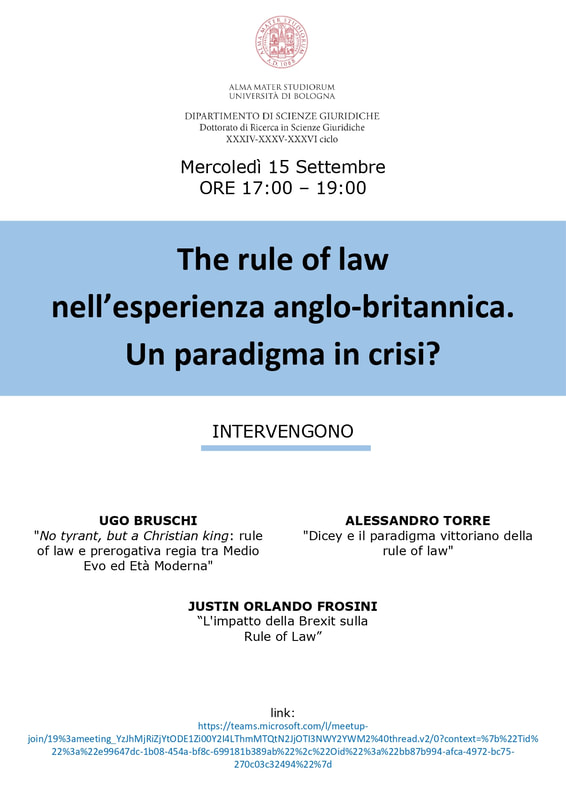
CONFERENCE: The Rule of Law Crisis in Europe - Historical and Procedural Aspects (Lund: Lund University, 28-29 SEP, online)

The following conference took place online last week:


The project Judges Assessing the Independence of Judges. Historical Foundations and Practical Procedures in Facing the Threats against the Rule of Law in Europe runs at the Faculty of Law, Lund University, Sweden, 2020-2022. Members of the research group are professor Xavier Groussot (EU law), associate professor Martin Sunnqvist (legal history) and assistant professor Lotta Maunsbach (procedural law).

Background to the project: Impartial and independent courts are cornerstones of the success of the European project. The recent renaissance of ‘illiberal states’, to use the words of Viktor Orbán in 2014, jeopardizes the application of the rule of law and risk destroying the foundations of the EU legal order. During 2018, the ECJ has developed two new lines of case law: On the one hand, the ECJ has made itself competent to rule on matters regarding the independence of the judiciary, which used to be part of the pure internal competence of the Member States. On the other hand, the ECJ has empowered national courts to realize a ‘rule of law’ check of other Member States, by assessing the independence and impartiality of the issuing judicial authorities in the context of the arrest warrant – a new task for courts of first instance.

Aim of the project: We aim at analyzing this recent evolution using a European, historical and procedural perspective. We combine a historic analysis of the development of the rule of law and similar but not identical concepts Rechtsstaat and état de droit with an analysis of the roles of the EU institutions and the procedural aspects of of a ‘fair trial’ and the mutual trust (and distrust) between courts and judiciaries in different member states. This will be a fruitful way of getting a better understanding of the strengths and weaknesses in the protection of the independence and impartiality of the judiciary in Europe.

In the two-day online conference 28-29 September 2021, we wish to discuss historical and procedural aspects relevant to our project. How do we define the ‘rule of law’ and the ‘Rechtsstaat’ that we are discussing? What is the origin of these concepts? What approaches can courts use in dealing procedurally with a rule of law crisis in another country?

The project is financed by Riksbankens Jubileumsfond and administered by the Faculty of Law, Lund University.


Programme:

(With reservation for changes.)


Tuesday 28 September 2021:

I.                   Rule of law – the origins and the implementation of the thought that the ruler is bound by the laws

Swedish time (CEST — Central European Summer Time)

14.30             Introduction

14.40             Atria Larson (Saint Louis University): Liberty and the Rule of Law in the Medieval Age

15.20             Marie-France Fortin (University of Ottawa): The King Can Do No Wrong – the Evolution of the Rule of Law from the Late Middle Ages up to the 21st Century

16.00 – 16.10 Pause

16.10             Raffaella Bianchi Riva (University of Milan): Independence of Advocates as a Requirement for Independence of Judges

16.50             Martin Sunnqvist (Lund University): The Rechtsstaat in a Material and a Formal Sense

17.30 – 17.40 Pause

17.40             William Phelan (Trinity College, Dublin): Robert Lecourt and the Development of the Basic Principles of EU Legal Order

18.20             Concluding discussion

19.00             End


Wednesday 29 September 2021:

II.                Procedure – how does a court assess whether another state does not adhere to the principle of the rule of law?

Swedish time (CEST — Central European Summer Time)

8.30               Introduction

8.40               Petra Bárd (Central European University/European University Institute): How to Deal with the LM Test?

9.20               Birgit Aasa (Copenhagen university): Mutual Trust and the Rule of Law

10.00 – 10.10 Pause

10.10             Vincent Glerum (Rechtbank Amsterdam/University of Groningen): The Case Law of Dutch Courts Relating to the EAW and Poland

10.50             Lotta Maunsbach (Lund University): Procedural Aspects on Impartial and Independent Judging. How Can a Court Decide Whether Another Court and its Judges are Impartial and Independent?

11.30             Concluding discussion

12.00 – 13.00 Pause


III.             The current status in Hungary and Poland

13.00             Viktor Vadász (Hungarian Judge, member of the National Judicial Council): The Current Situation in Hungary

13.30             Dorota Zabludowska (Polish Judge, board member of the Polish Judges Association Iustitia): The Current Situation in Poland

14.00   Questions and discussion


IV.              How can the concept ‘rule of law’ be defined?

14.30             Xavier Groussot (Lund University): The Distinction between ‘Rule of Law’ and ‘Rule by Law’. A common concept of ‘Rule of Law’ in the European Union?

15.10             Theodore Konstadinides (University of Essex): The Rule of Law in the UK Post-Brexit: An Uncommon Concept of ‘Rule of Law’ outside the European Union?

15.50 – 17.00 Concluding discussion on topics that have been brought forward during the conference, such as:

·         Is there a common definition of the rule of law in Europe, or what are the main differences in various definitions?

·         How can the historical development of the concepts Rechtsstaat and rule of law contribute to our understanding and to clarity?

·         How can these concepts be used as practical tools when the independence of courts and judges is to be assessed?


How to participate?

The conference takes place through Zoom.

To participate, send an e-mail message to martin.sunnqvist@jur.lu.se

19 November 2018

REMINDER: CALL FOR PAPERS: The rule of law and international law in historical perspective (IGHIL Event, ESIL Research Forum Göttingen, 4-5 APR 2019); DEADLINE 30 NOV 2018


(image source: ESIL)

The question of how to settle and enforce norms in the international sphere without a central authority has been a key debate in international law for centuries. While the gradual extension of an international order supported by multilateral treaties and courts was seen as a natural and logical development of international society in the decades following the end of the Cold War, the recent challenges to the very idea of a rules-based international order call for fresh perspectives on the idea and development of the rule of law in the international sphere. How did the concept emerge, how did it evolve over time, and how different is its history in the domestic and the international context?
Moreover, the Rule of Law can be envisaged under a double perspective. On the one hand, it expresses a philosophical and theoretical construct, whose intellectual genealogy conforms to that of the development of international legal thinking over time and in several legal cultures. On the other hand, the rule of law can be used instrumentally as an ideological discourse to legitimate far more basic political instincts and interest. Its invocation is not always conformable to actual legal practice. The Interest Group especially welcomes papers addressing the complex articulation of these two strands in historical cases, illustrated through primary source-research.


Possible topics might include:
·         How have international institutions responded to previous challenges of the very idea of the rule of law in international affairs?
·         How has the extent to which a state respects the rule of law in the domestic sphere influenced their behavior within the international community?
·         Has the meaning of the term ‘rule of law’ changed over time, and is it a universal concept? Does it have different connotations in the natural law or the positivist tradition? How have regional attempts to establish the rule of law influenced the international level?
·         When did we begin to have the ambition to regulate and enforce matters at a global level? How has the creation and enforcement of rules changed since the UN system was set up after the Second World War?
·         What was the impact of the rise of arbitration and international courts? Were they the consequence of a growing belief in the rule of law or drivers of this development?
·         How effective has the rule of law been in defining and protecting global commons (e.g. the success or failure of legal efforts to protect the environment)?
·         Has the ‘rule of law’ evolved differently in different policy areas such trade and investment law, communications or the laws of war?
Abstracts (300 words) must be submitted no later than 30 November 2018 to esilighil@gmail.com on behalf of the Steering Committee of the Interest Group, which shall collectively supervise the blind peer-review process. All those who take part in the ESIL Research Forum, at an Interest Group event and/or in the main Forum, are expected to be ESIL members at the time of their participation. Selected speakers will be expected to bear the costs of their own travel and accommodation. Some ESIL travel grants will be available to offer partial financial support to speakers who have exhausted other potential sources of funding. Please see the ESIL website (www.esil-sedi.eu) for information about travel grants offered to ESIL members and other relevant information about the Research Forum.


10 September 2018

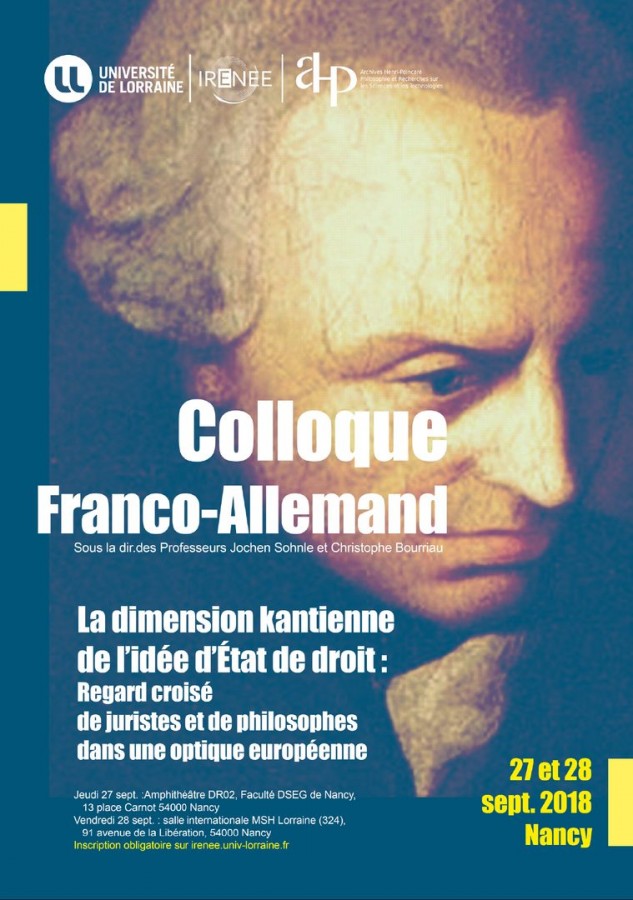
CONFERENCE: La dimension kantienne de l'idée d'État de droit : Regard croisé de juristes et de philosophes dans une optique européenne (Nancy: Maison des Sciences de l'Homme, 27-28 SEP 2018)

(image source: univ-droit)

Le colloque propose de mener une réflexion juridique et philosophique sur l’idée « d’État de droit », en interrogeant les liens entre cette notion et « l’Europe ». Il comporte d’une part un volet historique, retraçant le parcours de cette notion qui prend sa source dans l’œuvre de Kant, avant de se développer chez des philosophes et juristes le plus souvent d’inspiration kantienne. Il comporte d’autre part un volet problématique : l’idée d’État de droit peut-elle trouver des applications dans le cadre de l’Europe et de ses institutions ? L’usage de cette notion en contexte européen est-il pertinent et légitime ? Les échanges porteront à la fois sur la place des différents États de droit en Europe et sur la manière dont on peut concevoir les institutions européennes (Union européenne, Conseil de l’Europe) à la lueur de l’idée d’État de droit. Quels rapports concevoir entre l’idée d’État de droit et l’idée européenne, envisagée à la manière de Kant comme une fédération d’États attachés à préserver la paix et la liberté ?

Programme:
Jeudi 27 Septembre 2018
9h15 : Discours d’ouverture9h30 : Communication introductive
Christophe Bouriau et Jochen Sohnle
La généalogie de l’état de droit dans le contexte kantien

Les géniteurs juridico-philosophiques du concept de l’État de droit
9h45 : La conception kantienne de l’État de droit : Kant et les « Neukantianer » Dietmar Von Der Pfordten, PR de droit, Université de Göttingen
10h15 : Le modèle concurrentiel d’Hegel par rapport à la théorie de l’État de droit Pascaline Motsch, doctorante en droit public, Université de Lorraine/IRENEE
10h45 : Discussion et pause11h30 : L’État de droit et le positivisme sociologique : une alternative au modèle kantien Alexandre Viala, PR de droit public, Université de Montpellier
12h00 : Science juridique, politique, histoire dans le concept d’Etat de droit chez H. Kelsen Carlos-Miguel Herrera, PR de droit public, Université de Cergy-Pontoise
12h30 : Discussion
13h00 : Déjeuner
La progéniture juridico-philosophique véhiculant le concept de l’État de droit
14h30 : La critique du « Rechtsstaat » dans la perspective analytique et marxiste Anna Zielinska, MCF en philosophie, Université de Lorraine/Archives Henri-Poincaré
15h00 : L’État de droit : Arendt, Kant et le retour d’Amérique
Ninon Grangé, MCF/HDR en philosophie, Université Paris 8
15h30 : Pause et discussion16h15 : Ingeborg Maus : L’État de droit kantien dans une approche procédurale de la démocratie Jérôme Germain, MCF/HDR en droit public, Université de Lorraine/IRENEE
16h45 : Cassirer : L’État de droit comme manifestation culturelle de la forme symbolique « droit » Jochen Sohnle, PR de droit public, Université de Lorraine/IRENEE
17h15 : Discussion17h45 : Fin de la journée
Vendredi 28 Septembre 2018

La généalogie de l’État de droit dans le contexte européen
9h30 : La contribution du XIXe siècle dans une perspective actuelle : l’amalgame des différents courants ou la tradition européenne de l’État de droit Marie Rota, MCF de droit public, Université de Lorraine/IRENEE
10h00 : Le concept de l’État de droit, l’Europe et l’éthique politique
Lukas Sosoe, PR de philosophie, Université de Luxembourg
10h30 : Discussion et pause11h15 : Les droits de l’homme et la souveraineté du peuple d’après Kant et Habermas Michael Steinmetz, PR de philosophie, Université de Trèves
11h45 : La notion d’État de droit est-elle fictionnelle ?
Christophe Bouriau, PR de philosophie, Université de Lorraine/Archives Henri-Poincaré
12h15 : L’État de droit à l’épreuve de la pratique : la vision du Conseil de l’Europe Oscar Alarcon, Agent au Conseil de l’Europe (Strasbourg)
12h45 : Discours de clôture

Manifestation gratuite, inscription obligatoire pour tout public sur : https://irenee.univ-lorraine.fr/
(source: univ-droit)