Search

Showing posts with label Polish legal history. Show all posts

03 November 2025

BOOK: Michał GALEDEK and Anna TARNOWSKA, Shaping the Congress Kingdom of Poland (1815–1830). The Interconnectivity of Constitutional and Liberal Ideas in Europe after Napoleon [Legal History Library, eds. Dirk HEIRBAUT, Michelle MCKINLEY, Matthew C. MIROW & C.H. VAN REE; vol. 79] (Leiden/Boston: Martinus Nijhoff/Brill, 2025), ISBN 978-90-04-73992-5, € 191,18


(image source: Brill)


Abstract:
Should the dispute over the interpretation of the 1815 constitution of Congress Poland be considered a key factor that shaped Polish political liberalism, and if so, why? The authors of this volume explore this question against the backdrop of constitutional development in post-Napoleonic Europe. The aim of this book is to illustrate the mutual interdependence between political liberalism and constitutionalism after the Congress of Vienna and to examine how Western European constitutional and liberal ideas intermingled with traditional Polish aristocratic republicanism.

On the authors:

Michał Gałędek, Dr. iur. (2010), Dr. hab. iur. (2018), is Professor and Chair of the Department of Legal History at the University of Gdańsk, as well as Vice-President for Science of the Polish Society for Legal History. His most recent monograph is Ideology and Private Law: Polish Experiences in the Long 20th Century (Brill, 2025). Anna Tarnowska, Dr. iur (2007), Dr hab. iur. (2020), is Professor at the Nicolaus Copernicus University in Toruń's Department of the History of Legal and Political Thought and German Law, Chairwoman of the Legal-Economic Chapter of the Scientific Society in Toruń, and Vice-President of the Polish Society for Legal History. She has authored numerous books and articles on legal history and constitutionalism. 

Read more here: DOI 10.1163/9789004739925


25 September 2025

BOOK: Andrzej DZIADZIO & Franciszek LONGCHAMPS DE BÉRIER (eds.), Five Centuries of Civil Procedure: The Polish Experience in a European Context (16th to 21st Centuries) [Legal History Library, eds. Dirk HEIRBAUT, Michelle MCKINLEY, Matthew C. MIROW & C.H. VAN RHEE, 76] (Leiden/Boston: Martinus Nijhoff/Brill, 2025), ISBN 978-90-04-73666-5


(image source: Brill)

Abstract:

The first codification of Polish court proceedings was made in 1523. Half a millennium later, the jurists in this volume have carefully analyzed the transformation of Polish civil procedure from then to the present day against the historical background of the development of modern European legal orders and institutions. This study is the result of the work of a research group established at the Jagiellonian University in Kraków, consisting of historical and modern jurists and scholars of civil procedure and private law.

Contributors:

Grzegorz J. Blicharz, Andrzej Dziadzio, Radosław Flejszar, Krzysztof Fokt, Kacper Górski, Jan Halberda, Vincent R. Johnson, Izabela Lewandowska-Malec, Martin Löhing, Franciszek Longchamps de Bérier, Dorota Malec, Maciej Mikuła, Andrzej Olaś, Grzegorz Smyk, Kamila Staudigl-Ciechowicz, and Abdoul Yatera.

On the editors:

 Andrzej Dziadzio, Ph.D. (1994), is Professor of Law and the Head of the Department of Common History of the State and the Law at the Faculty of Law and Administration of the Jagiellonian University in Kraków, Poland. Franciszek Longchamps de Bérier, Ph.D. (1997), is Professor of Law and the Head of the Department of Roman Law at the Faculty of Law and Administration of the Jagiellonian University in Kraków. He also teaches at the Faculty of Law and Administration of the University of Warsaw, Poland.

More information here: DOI 10.1163/9789004736672

19 September 2025

BOOK: Andrzej DZIADZIO, Mateusz MATANIAK & Piotr MICHALIK,The French Civil Code in the Free City of Cracow (1815–1846) [Legal History Library, eds. Dirk HEIRBAUT, Michelle McKINLEY, MATTHEW C. MIROW & C.H. VAN RHEE, 73] (Leiden/Boston: Martinus Nijhoff/Brill, 2025), ISBN 978-90-04-68873-5


(image source: Brill)

On the authors:
Andrzej Dziadzio, Ph.D. (1994), Jagiellonian University, is Professor at the Law Faculty of that university, specialising in the constitutional and legal history of the Habsburg monarchy and Poland in the 18th and 19th century. Mateusz Mataniak, Ph.D. (2014), Jagiellonian University, is Senior Researcher at the Law Faculty of that university, specialising in the constitutional and legal history of the Free City of Cracow and the judiciary in Poland. Piotr Michalik, Ph.D. (2010), Jagiellonian University, is Senior Lecturer at the Law Faculty of that university and an attorney. He specialises in the constitutional and legal history of the Free City of Cracow and modern England.

On the book:

This book is a summary of the extensive research by the co-authors on the validity and application of the 1804 French Civil Code in the Free City of Cracow (1815-1846), the Polish constitutional city-state established at the Congress of Vienna. From the wealth of case-law and legal practice of the Cracovian Republic emerges a picture in which its inhabitants were consciously and consistently building the structure of a modern state. As far as was possible amid the realities of post-feudal society, this state was already based on the rule of law. One of the basic elements of this legal structure was precisely the Napoleonic Code, which established the framework for the private law of the Free City, and made it a very small, but important, part of European legal heritage.

Read more here: DOI 10.1163/9789004688742.


19 June 2025

BOOK: Anna MACHNIKOWSKA, Michał Karol GALEDEK & Rafał MANKO (eds.), Ideology and Private Law: Polish Experiences in the Long 20th Century [Legal History Library, eds. Dirk HEIRBAUT, Michelle McKINLEY, Matthew C. MIROW & C.H. VAN RHEE, 74] (Leiden/Boston: Martinus Nijhoff/Brill, 2025), ISBN 978-90-04-72999-5, € 178,08


(image source: Brill)

Abstract:

This book highlights the ideological aspects influencing the modern shape of private law in Central and Eastern Europe (CEE), examining Poland as a representative example given the shared historical trajectory of the 20th century across this region. In the historico-legal literature currently in international circulation, there is a dearth of studies on the development of modern positive law in CEE countries. This volume therefore aims to bridge this gap and deliver a more profound reflection on the long-term social, economic, and political role of private law in this region. 

On the editors:

Anna Machnikowska, Dr.iur. (2000), Dr.habil.iur. (2011), is Professor at the University of Gdańsk and Chair of the Department of Civil Procedure. She specialises in property law, justice systems, and political doctrine in the twentieth century. Michał Gałędek, Dr.iur. (2010), Dr.habil.iur. (2018), is Professor and Chair of the Department of Legal History at the University of Gdańsk, and Vice-President for Science at the Polish Society for Legal History. His most recent monograph is National Tradition or Western Pattern: Concepts of New Administrative System for the Congress Kingdom of Poland (1814–1815) (Brill, 2021). Rafał Mańko, Dr.iur. (2014), Dr. habil.iur. (2019), is Research Affiliate at the Central Eastern European University Democracy Institute. His main areas of research are legal survivals, the theory of adjudication, and Central European legal identity.

Read more here: DOI 10.1163/9789004730021.

11 February 2025

FELLOWSHIP: Brennan Center's Steven M. Polan Fellowship in Constitutional Law and History 2025-2026 (DEADLINE 15 FEB 2025)

(image source: Legal History Blog)

 Abstract:

The Brennan Center [for Justice] is inviting applications for the 2025-26 class of the Steven M. Polan Fellowship in Constitutional Law and History, a fellowship program aimed at enhancing public understanding and appreciation of the meaning and promise of the United States Constitution. The Fellowship is open to outstanding individuals from an array of professional backgrounds – including historians and other experts in constitutional law and history – working on projects to spur urgently needed debate over the proper understanding of our Constitution at this crucial moment, when new approaches to constitutional interpretation including originalism, incubated by the conservative legal movement over the past half century, have gained traction in the courts. These projects may include conducting legal and historical research, publishing original writing, crafting amicus briefs, organizing symposia and public events, spearheading public education projects, and other activities as appropriate.

Practical aspects:

Proposals are due by February 15, 2025. These nonresident, part-time fellowships will be one year in duration. Fellows will be awarded compensation in the form of a $40,000 stipend. The Fellowship is open both to experienced individuals with a proven track record of achievement and expertise and to people at earlier stages of their careers who demonstrate the potential to develop into leaders in their field. We’re looking for visionaries who are animated by the challenge of reclaiming our Constitution as an enduring plan of government suited to the needs of a changing country.

Read more here and here.

(source: Legal History Blog)

20 December 2024

JOURNAL: Bulletin/Handelingen LVIII (2024) (Royal Commission for the Publication of Old Laws and Ordinances of Belgium) [OPEN ACCESS]


(image source: KCOWV/CRALO)

Table of contents:

Rapport d’activités 2022 Werkzaamhedenverslag 2022 (5-8)

Rapport d’activités 2023 Werkzaamhedenverslag 2023 (9-15)

Two legal opinions by Gabriel van der Muyden and Elbert de Leeuw (1553) (Alain Wijffels) (17-113)

First paragraphs:

The privileges of the German Hanse in England were resumed by a decree of the English Privy Council on 24 February 1552. The Council’s decision was triggered by complaints from the London Merchant Adventurers, who claimed that the privileges were detrimental to both the Crown and the English merchants. Moreover, they submitted, recent cases had shown that the Hansards were prone to misuse their privileges, which caused an even greater prejudice to the Treasury and the English merchant community. The merchants’ complaints also gave them an opportunity to rake up old grievances which for generations had marred Anglo-Hanseatic relations, such as the limited access for English merchants in Prussia, in spite of formal agreements of reciprocity allowing Hansards to trade in England, and Englishmen in Prussia.

During the Fall of 1552 and the Spring of 1553, Hanseatic diets deliberated on counter-measures, but also decided to accept the English authorities’ invitation to send an embassy to London in order to negotiate the Hanse’s position in England. The Hanseatic position, however, was that there were no reasons justifying the resumption of their privileges. Their embassy’s mission was therefore to obtain the restoration of these privileges in full.

In June 1553, the embassy’s members were gathering in Bruges and Antwerp, both in order to obtain more detailed information about the Hanseatic trade between England and the Low Countries, and because of the reports of the English King’s ill-health4. They were still in the Southern Netherlands when the news of Edward VI’s death (on 6 July) reached them, followed by reports on the uncertain political situation and succession during the following days. Eventually, when Mary Tudor’s accession was confirmed, they crossed the Channel later in July and settled in London, where they could benefit from the facilities of the Steelyard, the main Hanseatic office in England.

While still in Flanders and Brabant, three members of the Hanseatic embassy, all three doctors of law, made around the 12th of July the journey to Leuven in order to meet and consult “Dr. Gabriel” (i.e. van der Muyden, Mudaeus), about legal issues in connection with their mission in England. The full scope of this consultation is not documented, but two unpublished consilia attributed to van der Muyden (1500-1560) and his junior colleague Elbert de Leeuw (Leoninus, c. 1519-20-1598) deal specifically with the issue of the restrictions imposed by the Gdańsk authorities to foreign, including English, merchants trading in the Polish city. The issue reflected a long-standing controversy in Anglo-Hanseatic relations, which had been raised at several earlier conferences, without ever reaching any substantial agreement. The two consilia (published hereafter) were most probably written during the summer of 1553 as a result of the Hanseatic visit to van der Muyden, whether immediately or within weeks after the meeting with the Leuven professor. Both consilia were obviously written on behalf of the Hanseatic delegates and countenance the position held by the Hanse and Gdańsk in particular.

Read more here. Open access version here.


29 August 2024

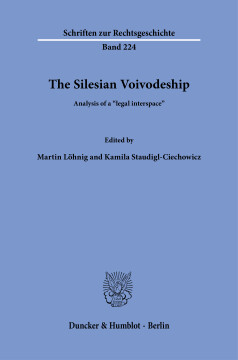
BOOK: Martin LÖHNIG & Kamila STAUDIGL-CIECHOWIZ (Hrsg.), The Silesian Voivodeship. Analysis of a "legal interspace" [Schriften zur Rechtsgeschichte; 224] (Berlin: Duncker & Humblot, 2024), 154 p. ISBN 9783428591787, € 69,9

(image source: Duncker & Humblot)

Abstract:

After World War I, the reorganisation of Europe created many legal interspaces. This volume is intended to be a first step towards in-depth research into Upper Silesia as a legal interspace. The focus is on Upper Silesia as an autonomous region and the jurisdiction in the Silesian Voivodeship. Seven contributions by Polish and German scholars examine the question of autonomy from an interdisciplinary perspective - historical, legal and political. The contributions compare Silesian autonomy with other Polish autonomy projects of the interwar period and situate it in contemporary legal discourse and political debate. At the same time, an arc is drawn to current attempts at autonomy in Poland. Another focus is the question of jurisdiction in Upper Silesia from a national and international perspective.

Table of contents:

Martin Löhnig: Introduction5
Table of Contents7
Ryszard Kaczmarek: Autonomy of the Silesian Voivodeship and Other Projects of Regional Autonomies in Poland 1918–19399
I. The Autonomy Traditions in Poland after the First World War9
II. Administrative Standardization or Decentralization: the Political Dilemma of the Second Polish Republic11
III. Autonomy Projects in Poland after World War I13
1. Territorial Autonomies13
2. Cultural Autonomies17
IV. Summary19
Adam Krychowski: Polish Legal Concept in Relation to the Silesian Autonomy in the Second Polish Republic21
I. Genesis of Silesian Autonomy21
II. Legal Fundamentals of the Silesian Voivodeship24
III. Autonomy and Local Government in Polish Legal Concept25
IV. Supporters of the State Theory of Local Government and Silesian Autonomy29
V. Silesian Autonomy in Naturalistic Concepts31
VI. Conclusion34
Krzysztof Nowak: Between Cieszyn/Teschen and Bielsko/Bielitz. Polish Cieszyn Silesians and the Silesian Autonomy35
I. What was a Region?35
II. During the Border Conflict (1918–1920)37
III. In the Autonomus Silesian Voivodeship (1920/22–1939)40
Anna Muś: The Autonomous Silesian Voivodship and its Legacy47
I. Introduction47
II. Today48
III. Legacy49
IV. The End of World War II51
1. Hypothesis 1 – Centralization: a Clean Slate for a Centralized and Authoritarian State52
2. Hypothesis 2 – Ethno-nationalist: Making an Ethnically Homogenous State53
3. Conclusions54
V. The End of the Great War54
1. Hypothesis 1 – An Instrument of Propaganda before the Plebiscite55
2. Hypothesis 2 – A Practical Solution for Legal Diversity57
3. Hypothesis 3 – Upper Silesian Regional Particularism59
4. Hypothesis 4 – The People's Will61
5. Hypothesis 5 – Neutralization of Upper Silesian Separatism63
6. Conclusions64
VI. Concluding Remarks65
Donata Zehner: Silesian Jurisdiction after Versailles69
I. Introduction69
II. Administration and International Status of Silesia70
1. Organisation of the Territory70
2. Upper-Silesian Arbitral Tribunal73
III. Court organization in Silesia during the 20th Century Polish Legislative Discussion76
1. Poland76
a) Academic Discussion Concerning Coexisting Legal Systems76
b) Examples for Codification Developments83
aa) Commercial Courts83
bb) Sequence of Courts85
2. Czechoslovakia86
IV. Conclusion88
Anna Stawarska-Rippel: Silesian Legal Microcosm: Courts and Court Procedures in the Silesian Voivodeship and the Polish Supreme Court after the First World War before the Unification of Jurisdiction91
Konrad Graczyk: The Application of the German-Polish Agreement on Upper Silesia 1922–1937. State of Research and Research Postulates103
I. Introductory Notes103
II. State of the Research107
III. Research Postulates125
IV. Conclusions127
Kamila Staudigl-Ciechowicz: Closing remarks129
Bibliography133
List of Authors153

 Read more here: DOI 10.3790/978-3-428-59178-7.

04 March 2024

JOB: Doctoral Position Research project: ‘A Tsunami or a Gentle Tide? European Legal Thought Confronted with the French Commercial Code of 1807’ (Gdańsk: University of Gdańsk, DEADLINE: 19 APR 2024)


(image: Sekt. 4: Gdańsk, Polen, 1892 - Deutsche Fotothek, Germany - CC BY-SA. Europeana)

The University of Gdańsk currently has  a PhD vacancy for a legal history research project.

The position does not require relocation to Gdańsk.

1 - Position description

The Faculty of Law, University of Gdańsk, is looking for a PhD-student. 

This vacancy fits within the framework of the Polish National Science Center (NCN) research project “A Tsunami or a Gentle Tide? European Legal Thought Confronted with the French Commercial Code of 1807”, directed by assistant professor Anna Klimaszewska.

The overall scientific objective of the envisaged research is to examine the framing that legislators impose through codes of law by reconstructing how the French Commercial Code (FCC) of 1807 actually resonated in European legal thought and how it affected European legal discourse in the 19th- century in a thoroughly source-based manner through the use of digital tools, free of Western European centralism and national subjectivism.

How people interpret and process information is very much influenced by the way the piece of information is communicated - what narrative has been adopted. This is used, for example, by politicians and the mass media, providing through their narratives a specific “frame” for the social perception of various phenomena. Researchers have been studying these issues for decades. However, no one has so far verified the impact of the framework imposed by the legislator on various spheres of our lives, who, when making the law, introduces a more pervasive and complex frame than, for example, those freely created by the participants in political debates.

The activity of the legislator manifests itself in various forms. However, there is no doubt that codes of law play a special role in it. This is not only because they are systematic and comprehensive collections of rules. Above all, they constitute (at least in concept) the main point of reference in a given domain and carry a strong ideological charge behind them, thus establishing a frame for a given field of social activity.

The goal of the project is to analyse, for the first time, the effect of a frame imposed by the legislator through a code of law in varying social and economic conditions. Through a comparative analysis of case studies from different legal cultures, it will be reconstructed how the world's first modern commercial code - the French Code of 1807 issued by order of Napoleon Bonaparte - resonated in European legal thought and how it influenced European legal discourse in the 19th century. With no competition for many decades, it significantly influenced legal systems around the world. Its “framing effect” in different countries will therefore be compared.

Through the use of interdisciplinary methodology (discourse network analysis, frame analysis) and digital tools, this research creates an entirely new approach to law, thus paving the way for similar research to be carried out on other areas of the law of any country and era.

The backbone of the research, for reasons of feasibility, consists of three in-depth case studies: Belgium (subproject 1), Poland (subproject 2), and Germany (subproject 3). These countries serve as a theoretically informed sample that will allow some general conclusions to be drawn regarding the evolution of legal thought under the influence of the FCC whilst likewise stressing that each case study is complex and unique in its own right. All of them have experienced the implementation of the FCC. Each of them represents, however, a different strategy towards its adoption in different regional circumstances. They show thus varying trajectories of reaction to the code as a frame, as framing effects may occur in different populations at different rates.

This particular vacancy covers subproject 3 and is co-supervised by profs. Anna Klimaszewska (University of Gdańsk) and Mathias Schmoeckel (University of Bonn).

Although Germany, as Europe's largest codification laboratory, was creatively pursuing a direction in the field of commercial law that, almost a century after the promulgation of the FCC (with the 1897 Commercial Code), was considered to be in competition with the French model, the Germans were not operating in a legislative vacuum. The FCC was not only officially introduced in the Rhineland, thus marking the area with the experience of direct application, but also over the decades of work on a uniform German commercial code, which was carried out long before the unification of Germany, the FCC was repeatedly taken into account, even if not as a role model, certainly as a point of reference. Moreover, the 1897 Code’s predecessor, the 1861 General German Commercial Code, followed France to many more points than is commonly believed.

The PhD project will investigate the following sources: 1. Any form of publication by authors commenting on or referring to substantive or formal issues regarding the FCC in the form of, inter alia, monographs, textbooks, articles, collections of court judgments, essays, treatises, comments, diaries, press materials, notes of lectures by university professors, etc. 2. Codification projects and reports of parliamentary debates on codification; 3. Materials of governmental bodies concerning partial reforms of the commercial law, e.g., justifications for projects and reports of the parliamentary reporters (stenographic): the originals have not always been preserved.

About the position:

-        The doctoral position is funded by a 4-year NCN research project and is offered as a bursary position. The project additionally covers expenses related to research queries, participation in conferences, publications, etc., as well as running costs.

-        You will benefit from the interaction with the entire team, an Advisory Committee of professors from France, Belgium and Germany and the visibility of research results produced by the whole team.

2 - What do we expect from you?

-       Master degree in Law;

-       proficiency in English;

-       proficiency in German;

-       expertise in historical research and affinity for legal and/or institutional history is a plus;

-       good editing skills, to be demonstrated by a sample of writing: a copy of the master thesis and/or a research paper;

-       good team working and social skills;

-       interest in participating in international congresses;

-       passion for research in the above-mentioned domain, including archival research.


3 - Offer

You’ll be offered a full-time doctoral position for 48 months and the remuneration of PLN 60,000 per year (including employer's costs),

At the University of Gdańsk, you’re guaranteed an open, involved, and diverse workplace where you are offered opportunities to (further) build on your career.

4 - Interested?

Send us ONLINE and at the latest on 19/04/2024:

-        Motivation letter (in English, max. 500 words), mentioning also the contents of the application file;

-        Curriculum vitae with list of publications if available;

-        Copy of the diploma (if graduated) and grade record of master studies;

-        A sample of writing: your master thesis (if finished) and/or your best research paper (individual work);

-        Annexes, if relevant (awards, certificates, etc.)

-        Consent for the University of Gdańsk to process personal data necessary for recruitment.

Interviews are planned for April 2024.

Do you have questions about the job content?

Contact Anna Klimaszewska at anna.klimaszewska@prawo.ug.edu.pl or at +48-502-290-098.


Further information and the GDPR consent statement is available at:

https://prawo.ug.edu.pl/dzialalnosc-naukowa/oferty-dla-wykonawcow-projektow-naukowych