Search

Showing posts with label interbellum. Show all posts

08 April 2026

SSRN PAPER: Alessandro VOLPI, "Legal and Political Constitutionalism from Schmitt and Kelsen to Contemporary Debates: Notes on Constitutional Guardianship and Democracy" [OPEN ACCESS]


(image: Hanse Kelsen; Source: Wikimedia Commons)

Abstract:

This paper situates the Carl Schmitt-Hans Kelsen dispute on constitutional guardianship within the now-standard categories of political and legal constitutionalism. It examines the conflict between political and legal understandings of the constitution and of constitutional adjudication, alongside divergent conceptions of democracy that strain this institution (notably, the countermajoritarian difficulty). It begins with a close reconstruction of the Weimar-era debate-its legal and political details-covering competing views of adjudication, the constitution as a set of norms or a political decision, and alternative models of guarantees. Through comparative analysis, the paper then traces lines of continuity and discontinuity between those positions and contemporary discussions of constitutional guardianship within debates over legal versus political constitutionalism. What emerges is the enduring persistence of theoretical alternatives that deeply structure the idea of constitutional guardianship in a democratic system. At the same time, we find differences in interpretation and in proposals for legal politics concerning substantive versus procedural conceptions of the constitution, as well as divergent understandings of democratic conflict and pluralism and their implications for constitutional stability. The paper concludes by showing how certain theoretical contradictions at the heart of constitutional guardianship resist easy resolution and must be inhabited, rather than definitively overcome.

On the author:

 Max Planck Institute for the Study of Crime, Security and Law

Read more here: DOI 10.2139/ssrn.6143326.

29 August 2024

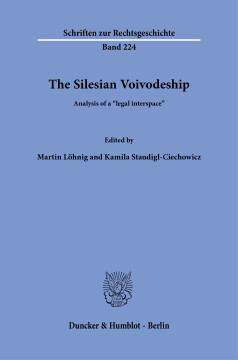
BOOK: Martin LÖHNIG & Kamila STAUDIGL-CIECHOWIZ (Hrsg.), The Silesian Voivodeship. Analysis of a "legal interspace" [Schriften zur Rechtsgeschichte; 224] (Berlin: Duncker & Humblot, 2024), 154 p. ISBN 9783428591787, € 69,9

(image source: Duncker & Humblot)

Abstract:

After World War I, the reorganisation of Europe created many legal interspaces. This volume is intended to be a first step towards in-depth research into Upper Silesia as a legal interspace. The focus is on Upper Silesia as an autonomous region and the jurisdiction in the Silesian Voivodeship. Seven contributions by Polish and German scholars examine the question of autonomy from an interdisciplinary perspective - historical, legal and political. The contributions compare Silesian autonomy with other Polish autonomy projects of the interwar period and situate it in contemporary legal discourse and political debate. At the same time, an arc is drawn to current attempts at autonomy in Poland. Another focus is the question of jurisdiction in Upper Silesia from a national and international perspective.

Table of contents:

Martin Löhnig: Introduction5
Table of Contents7
Ryszard Kaczmarek: Autonomy of the Silesian Voivodeship and Other Projects of Regional Autonomies in Poland 1918–19399
I. The Autonomy Traditions in Poland after the First World War9
II. Administrative Standardization or Decentralization: the Political Dilemma of the Second Polish Republic11
III. Autonomy Projects in Poland after World War I13
1. Territorial Autonomies13
2. Cultural Autonomies17
IV. Summary19
Adam Krychowski: Polish Legal Concept in Relation to the Silesian Autonomy in the Second Polish Republic21
I. Genesis of Silesian Autonomy21
II. Legal Fundamentals of the Silesian Voivodeship24
III. Autonomy and Local Government in Polish Legal Concept25
IV. Supporters of the State Theory of Local Government and Silesian Autonomy29
V. Silesian Autonomy in Naturalistic Concepts31
VI. Conclusion34
Krzysztof Nowak: Between Cieszyn/Teschen and Bielsko/Bielitz. Polish Cieszyn Silesians and the Silesian Autonomy35
I. What was a Region?35
II. During the Border Conflict (1918–1920)37
III. In the Autonomus Silesian Voivodeship (1920/22–1939)40
Anna Muś: The Autonomous Silesian Voivodship and its Legacy47
I. Introduction47
II. Today48
III. Legacy49
IV. The End of World War II51
1. Hypothesis 1 – Centralization: a Clean Slate for a Centralized and Authoritarian State52
2. Hypothesis 2 – Ethno-nationalist: Making an Ethnically Homogenous State53
3. Conclusions54
V. The End of the Great War54
1. Hypothesis 1 – An Instrument of Propaganda before the Plebiscite55
2. Hypothesis 2 – A Practical Solution for Legal Diversity57
3. Hypothesis 3 – Upper Silesian Regional Particularism59
4. Hypothesis 4 – The People's Will61
5. Hypothesis 5 – Neutralization of Upper Silesian Separatism63
6. Conclusions64
VI. Concluding Remarks65
Donata Zehner: Silesian Jurisdiction after Versailles69
I. Introduction69
II. Administration and International Status of Silesia70
1. Organisation of the Territory70
2. Upper-Silesian Arbitral Tribunal73
III. Court organization in Silesia during the 20th Century Polish Legislative Discussion76
1. Poland76
a) Academic Discussion Concerning Coexisting Legal Systems76
b) Examples for Codification Developments83
aa) Commercial Courts83
bb) Sequence of Courts85
2. Czechoslovakia86
IV. Conclusion88
Anna Stawarska-Rippel: Silesian Legal Microcosm: Courts and Court Procedures in the Silesian Voivodeship and the Polish Supreme Court after the First World War before the Unification of Jurisdiction91
Konrad Graczyk: The Application of the German-Polish Agreement on Upper Silesia 1922–1937. State of Research and Research Postulates103
I. Introductory Notes103
II. State of the Research107
III. Research Postulates125
IV. Conclusions127
Kamila Staudigl-Ciechowicz: Closing remarks129
Bibliography133
List of Authors153

 Read more here: DOI 10.3790/978-3-428-59178-7.

03 May 2022

PROJECT INFORMATION: Continuity and Discontinuity of Pre-war Legal Systems in the Post-war Successor States (1918–1939)

(Source: Visegrad Fund)

Continuity and Discontinuity of Pre-war Legal Systems in the Post-war Successor States (1918–1939)

Legal historical research with the support of Visegrad Grants. The commitments focus on the support area “Culture and Common Identity” and consist of three elements:

1. English language collection of texts from the most important sources of Czechoslovak, Hungarian and Polish legal systems in the interwar period; 2. online series of webinars about the legal culture and codification movements of Czechoslovakia, Hungary, and Poland in the interwar period; 3. conference and volume of publications with the title of “Difficult heritage: interwar codification movement in Central and Eastern Europe (1918-1939)”.

Visegrad Grant No. 22030159.

The objective of the project is to integrate the Czech, Polish, Slovak, and Hungarian academic community around the issues of the legal heritage of the interwar period and to popularize joint research on this issue. This heritage can be described as difficult, because after the end of World War I, the countries of Central Europe faced the necessity of either building new legal systems or thoroughly rebuilding the existing ones. The axis of these activities was therefore the confrontation of the needs of the interwar period with the legal heritage from before 1918, generating problems regarding the continuity and discontinuity of pre-war legal systems. While research on the legal codifications of individual countries of the V4 is already far advanced, there are still no comparative approaches that would make it possible to identify the similarities and differences in the legal heritage of these countries. The research questions include, in particular, whether there are any similarities and what the differences were in dealing with problems with the codification of law in the countries of the V4 in the interwar period. It is also necessary to undertake efforts to popularize the legal identity of V4 countries through access to English-language open lectures devoted to this subject. In the dynamics of research and the dissemination of knowledge about the legal culture and identity of the V4 countries, an invaluable help will be the action of translating important interwar legal acts into English and ensuring access to them in an open access format (www.iura.uj.edu.pl). 

The project is coordinated by the Faculty of Law and Administration of the Jagiellonian University (Poland). The Faculty of Law of the University of Trnava (Slovakia) and the Faculty of Law and Political Sciences of the University of Szeged (Hungary) also participate. In the project, we have translated several Polish, Czech, Slovak, and Hungarian legislative acts from the interwar period, which can be found on this link. As a part of the project, we have made webinars as well, which represent topics from the legal history of the participant countries. In order to watch them, please follow this link to the website.

More information is available on the project website: 

http://www.wyznaniowe.law.uj.edu.pl/visegrad.

The project is co-financed by the Governments of Czechia, Hungary, Poland and Slovakia through Visegrad Grants from International Visegrad Fund. The mission of the fund is to advance ideas for sustainable regional cooperation in Central Europe.

11 May 2020

BOOK: Stefano MANNONI, Da Vienna a Monaco (1814-1938). Ordine europeo e diritto internazionale (Torino: Giappichelli, 2019). ISBN: 9788892120426, pp. 256, € 25,00

Da Vienna a Monaco (1814-1938)


ABOUTTHE BOOK

Saggio di storia del diritto internazionale, questo contributo ruota intorno alla questione del rapporto tra la ricerca dell’ordine europeo e l’adozione del diritto come semantica delle relazioni internazionali. I due temi sono intrecciati poiché tratto saliente dell’esperienza europea è stato quello di avere tentato di costruire l’ordine in un sottile rapporto tra diritto e politica.
Era pertanto inevitabile che l’itinerario partisse dal Congresso di Vienna, momento fondatore tanto del Concerto europeo che della centralità del droit de gens, si snodasse lungo le convulsioni di fine Ottocento, attraversasse la Grande Guerra e la creazione della Società delle Nazioni, per approdare infine al capolinea della diplomazia continentale, ossia l’effimero patto di Monaco del 1938. Adottando il lessico tipico delle relazioni internazionali si direbbe che le fasi di questa vicenda sono quattro: equilibrio, deterrenza, sicurezza collettiva e di nuovo, per pochissimo, equilibrio.
Il diritto internazionale è stato, volta a volta, con i suoi istituti, istituzioni e dottrina, partner, comprimario, protagonista e , melanconicamente, succube. Malgrado però gli alti e bassi delle sue fortune, il diritto internazionale ha conosciuto una crescita e uno sviluppo senza precedenti che ne fanno a pieno titolo uno degli elementi qualificanti della identità europea, di oggi come di ieri.

ABOUT THE AUTHOR

Stefano Mannoni Professore ordinario di storia del diritto all’Università di Firenze. Ha scritto sulla storia del diritto internazionale "Potenza e ragione. La scienza del diritto internazionale nella crisi dell’equilibrio europeo", Milano, 1999.

TABLE OF CONTENTS

A pdf version of the the index can be download here


More information here


22 October 2018

LECTURE: ‘Le pacte Briand-Kellog à l’heure de ses 90 ans – La consécration d’une idée révolutionnaire’ by Professor Giovanni Distefano (University of Geneva, 27 November 2018)


(Source: Wikipedia)

We learned that Professor Giovanni Distefano will give a public lecture on the Kellog-Briand pact in Geneva next month:

The ESIL Lecture Series hosts broadcasts of presentations on international law topics held at partner institutions, enabling the presentation to reach a wider audience of ESIL members and non-members alike.

Giovanni Distefano (Professor at the Faculty of Law at the University of Neuchâtel) will give a lecture on Le pacte Briand-Kellog à l’heure de ses 90 ans – La consécration d’une idée révolutionnaire, on 27 November 2018 at 18.15 at the University of Geneva


More information here

16 August 2018

BOOK: Christoph GUSY, 100 Jahre Weimarer Verfassung - Eine Gute Verfassung in Schlechter Zeit (Tübingen: Mohr Siebeck, 2018). ISBN 978-3-16-155343-1, € 35.00

(Source: Mohr Siebeck)

Möhr Siebeck is publishing a new book on the Weimar constitution at 100.  

ABOUT THE BOOK

Einhundert Jahre nach Gründung der demokratischen Republik in Deutschland kann ein Blick in die Weimarer Verfassung irritieren: Vieles in ihr wirkt in hohem Maße aktuell, anschlussfähig und geradezu modern. Sie ist ganz anders als die Bilder und die Lehren, die ihre Überlieferung prägen. Christoph Gusys Blick zurück nimmt seinen Ausgangspunkt in der Entstehungsgeschichte, in welcher viele Väter und einige Mütter unter widrigen Umständen die demokratischen und rechtsstaatlichen Ideen der Zeit diskutiert, zusammengeführt und in Texte gegossen haben. Die Nationalversammlung wollte eine demokratisch-parlamentarische Republik. Wo sie konnte, hat sie den Reichstag gestärkt und konkurrierende Rechte möglicher »Gegengewichte« eingeschränkt. Doch wurde ihr Konzept schrittweise in eine präsidiale Republik transformiert und ist letztlich als solche untergegangen. Christoph Gusy stellt die Stufen auf diesem Weg, ihre verfassungshistorischen Vorbedingungen, ihre juristische Vorbereitung und Legitimation dar. Die Weimarer Verfassung war eine gute Verfassung in schlechter Zeit. Auch wenn man das Ende schon kennt, können wir von ihr mehr lernen als schlechte Erfahrungen. Zu den Errungenschaften zählen etwa die damals neuen Pluralismuskonzepte und die Einsicht in die Notwendigkeit einer selbstbewussten, wehrhaften Demokratie. Vieles, was in der Republik angelegt wurde, konnte nach 1945 vorausgesetzt und ausgebaut werden.

ABOUT THE AUTHOR

Christoph Gusy ist Professor für Öffentliches Recht, Staatslehre und Verfassungsgeschichte an der Universität Bielefeld.

More information here