Search

Showing posts with label 16th Century Legal History. Show all posts

09 October 2025

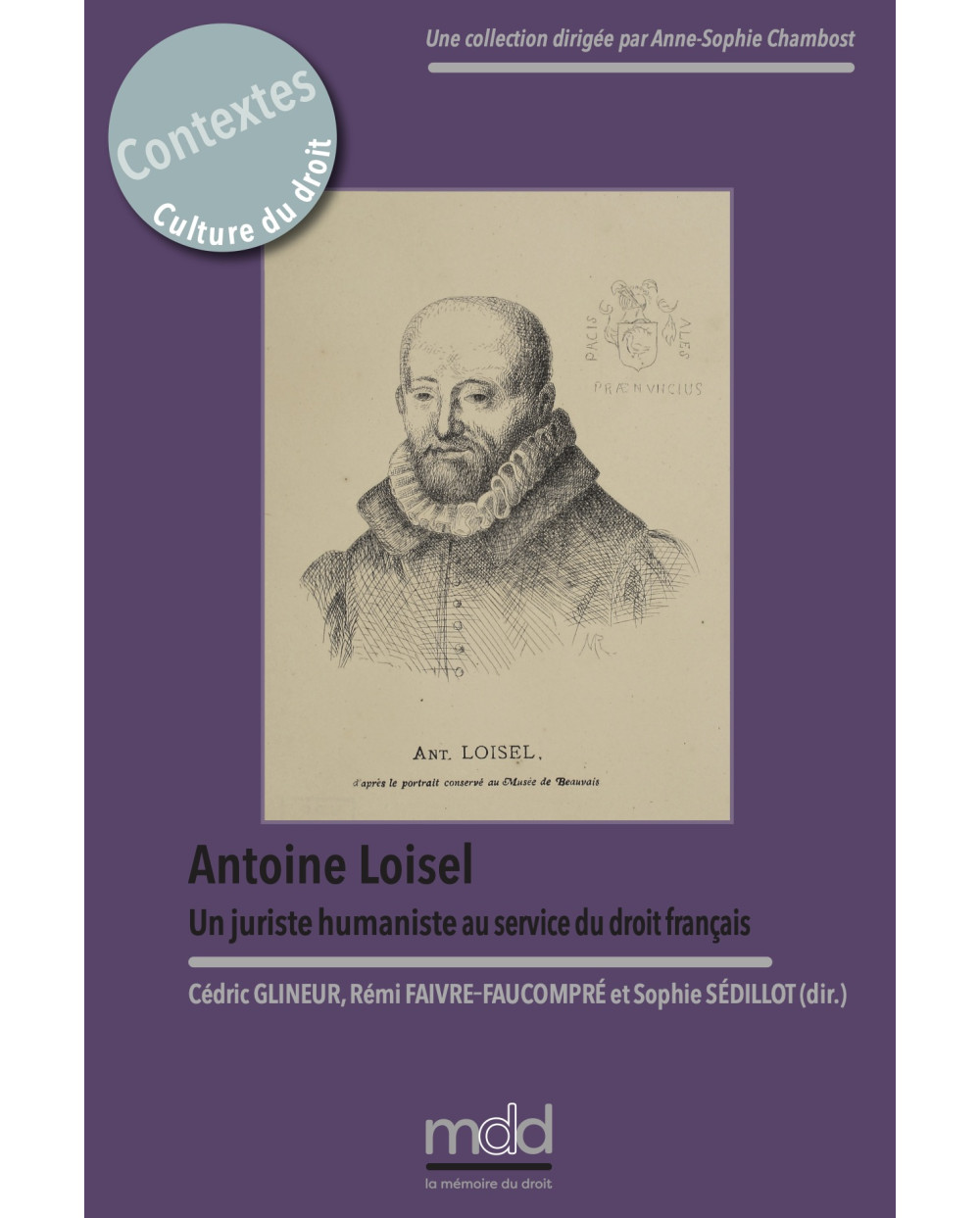
BOOK: Cédric GLINEUR, Rémi FAIVRE-FAUCOMPRÉ & Sophie SÉDILLOT (dir.), Antoine Loisel. Un juriste humaniste au service du droit français [Contextes. Culture du droit, dir. Anne-Sophie CHAMBOST] (Paris: La Mémoire du Droit, 2025), 478 p. ISBN 9782845390829

(image source: MDD)

Abstract:
Quel juriste, ancien ou moderne, privatiste ou publiciste, n’a pas été confronté aux célèbres adages d’Antoine Loisel ? Cette figure majeure de l’humanisme juridique, formé par La Ramée et Cujas, a profondément marqué l’histoire du droit et de la pensée juridique par ses célèbres Institutes coutumières. Ce chef-d’œuvre de la littérature juridique réunit neuf cent huit maximes dont la concision et la sonorité charmante, confinant parfois à la poésie, tranche avec la rudesse et l’âpreté des règles qu’elles dissimulent. Certaines résonnent encore dans les facultés de droit, qu’elles soient employées par les enseignants pour faire comprendre aux étudiants quelque coriace raisonnement juridique ou par les chercheurs pour situer un problème de droit dans la longue tradition juridique. Les Institutes coutumières s’inscrivent dans une œuvre bien plus vaste et foisonnante, l’œuvre d’une vie consacrée à l’écriture et faite d’une multitude de plaidoyers, de harangues, de mémoires ou de remontrances. Elle montre un Loisel plus politique, tout dévoué au pouvoir royal, qu’il considère comme le seul à même de reconstituer l’unité d’une Nation déchirée par les querelles religieuses. Le droit occupe une place essentielle au sein de ce processus. Derrière les adages et les maximes transparaît une certaine vision du droit coutumier dont le Beauvaisien, dans la lignée de juristes comme Du Moulin ou Coquille, voudrait montrer qu’il est commun à l’ensemble d’un royaume alors marqué par la diversité et le morcellement juridique.

Read more here


16 September 2025

BOOK: Virginie LEMONNIER-LESAGE (dir.), Guy Coquille, sieur de Romenay, humaniste et juriste (1523-1603) [Colloques & Essais; 220] (Paris: Institut Francophone pour la Justice et la Démocratie, 2025), 174 p. ISBN 9782370324351, € 19


(image source: LGDJ)

Abstract:
Né le 11 novembre 1523 à Decize dans une famille de juristes – son grand-père maternel est lieutenant général au bailliage de Saint-Pierre-le-Moûtier –, Guy Coquille, sieur de Romenay, est formé au collège de Navarre à Paris avant d’aller étudier le droit civil à l’Université de Padoue. De retour à Paris, il fera son apprentissage pratique, pendant trois ans, auprès de son oncle Noël Bourgoing, conseiller au Parlement de Paris. Entre septembre 1548 et août 1550, Coquille étudie à l’Université d’Orléans où il obtient vraisemblablement le grade de licencié ès lois. Devenu avocat, il exerce à Paris jusqu’en 1553 avant de revenir à Decize et de s’installer définitivement à Nevers à partir de 1559. Guy Coquille exerce différentes charges de procureur fiscal ou bailli avant de se voir confier par le duc de Nevers, en mai 1571, la charge de procureur général et fiscal du duché. Parallèlement à sa carrière de juriste, Guy Coquille mène une carrière politique : conseiller de la ville dès 1560, il devient le premier échevin de Nevers entre 1568 et 1570. Il est élu député du tiers état du Nivernais aux États généraux qui se tiennent à Orléans en 1560 et 1561 et à Blois en 1576 et 1588. Gallican, monarchiste défenseur d’une monarchie tempérée, attaché aux corps intermédiaires et aux institutions locales, Guy Coquille laisse une œuvre doctrinale essentielle, consacrée à la fois au droit privé et au droit public. Auteur gallican, Coquille est aussi auteur coutumier. Défenseur des droits du duché de Nevers, il l’est aussi de ceux du roi catholique. Avocat humaniste, il est auteur de poésies. Autant de centres d’intérêt chez ce grand juriste qui permettent, à l’occasion du cinquième centenaire de sa naissance, de réunir autour de lui de nombreux spécialistes de différentes disciplines : historiens, historiens du droit, historiens des idées politiques, historiens des lettres et tous ceux qui s’intéressent à son œuvre, son environnement ou son influence. Actes du colloque des 29 et 30 juin 2023 organisé, au Château de Romenay, aux Archives départementales de la Nièvre et au Palais ducal de Nevers

On the editor:

Virginie Lemonnier-Lesage, Professeur en Histoire du droit et des institutions.

Read more here


12 May 2025

BOOK: Diego PANIZZA, Diritto, politica, religione nel pensiero di Alberico Gentili. Saggi e interventi 1969-2014 (a cura di Luca SCUCCIMARRA) [Centro internazionale di studi gentiliani San Ginesio (MC), eds. Luca SCUCCIMARRA, Paolo PALCHETTI & Vincenzo LAVENIA] (Macerata: EUM, 2025), ISBN 9788860568151, 667 p. [OPEN ACCESS]


(image source: EUM)


Foreword by Luca Scuccimarra:

Nell’orizzonte degli studi storici contemporanei è difficile trovare percorsi di ricerca e elaborazione riflessiva comparabili a quello che per più di trent’anni ha legato Diego Panizza alla «vicenda umana e intellettuale» di Alberico Gentili1. Dal momento del suo primo incontro con il grande giurista ginesino, alla fine degli anni Sessanta del secolo scorso, Panizza ha dedicato infatti gran parte delle sue energie intellettuali ad un lavoro sempre più approfondito di scavo testuale e messa a punto interpretativa delle opere gentiliane che ha contribuito non poco alla progressiva riscoperta del ruolo spettante a questo autore nella complessa genealogia della modernità politica e giuridica. Si tratta, come è noto, di un percorso che ha trovato la sua principale collocazione istituzionale nel Centro Internazionale di Studi Gentiliani di San Ginesio, della cui attività Diego Panizza è stato a lungo il principale punto di riferimento scientifico e un’instancabile animatore. Anche grazie alla sapiente programmazione delle Giornate Gentiliane, organizzate dal Centro con cadenza biennale a partire dal 1983 e giunte quest’anno alla XXI edizione, tale percorso è venuto assumendo però nel corso del tempo un sempre più spiccato profilo internazionale, intersecandosi variamente con le esperienze di ricerca di alcuni dei principali studiosi che nel corso degli ultimi decenni, al di qua e al di là dell’Oceano Atlantico, hanno contribuito attivamente alla rinascita degli studi sul pensiero di Alberico Gentili, sino a fare di quest’ultimo un vero e proprio autore di rilevanza globale: da Peter Haggenmacher a Alain Wijffels, da Benedict Kingsbury a Benjamin Straumann, per citarne soltanto alcuni. Nato dalla affettuosa sollecitudine di Pepe Ragoni, che del Centro Internazionale di Studi Gentiliani è stata per molti anni l’inesauribile motore organizzativo, questo volume si propone di rendere omaggio all’intenso itinerario di ricerca di Diego Panizza, mettendo a disposizione dei lettori italiani un’ampia silloge degli scritti e degli interventi da lui dedicati all’opera di Alberico Gentili in un arco temporale che dal 1969 giunge sino al 2014, anno della sua scomparsa. Operare una selezione non è stato agevole: come sa chiunque abbia una conoscenza minimamente approfondita di questa direttrice della sua produzione scientifica, il corpo a corpo storiografico di Panizza con il giurista ginesino è stato una sorta di perpetuum mobile, dei cui risultati egli ha dato conto momento dopo momento attraverso una molteplicità di contributi pubblicistici legati tra loro da un’indistricabile rete di riferimenti incrociati e sviluppi interni. Dovendo scegliere, si è deciso ovviamente di privilegiare i testi dai quali emerge con maggiore evidenza il contributo offerto da Panizza al rinnovamento degli studi in questo ambito, a cominciare dalla monografia Alberico Gentili, Giurista ideologo nell’Inghilterra elisabettiana, pubblicata da un piccolo editore padovano nel lontano 1981 e oggi considerata come un passaggio cruciale di quella Gentili Renaissance che si sarebbe sviluppata con una certa continuità nel corso dei successivi decenni. Come emerge dai contributi raccolti nella prima sezione di questo volume, il testo del 1981 ha rappresentato peraltro nell’itinerario scientifico di Diego Panizza il momentaneo (e del tutto provvisorio) punto di arrivo di un processo di progressivo avvicinamento al nucleo portante della produzione gentiliana iniziato almeno una decina di anni prima e portato avanti eminentemente con gli strumenti di lavoro all’epoca disponibili nella cassetta degli attrezzi dello storico del pensiero politico. Non è un caso, da questo punto di vista, che il punto di attacco da lui prescelto per le sue prime esplorazioni dell’universo dottrinario di Gentili coincida proprio con la discussione della possibile influenza esercitata sul metodo giuridico gentiliano dalla teorizzazione di Machiavelli, in quel momento più che mai al centro degli interessi degli storici del pensiero politico, in Italia e non solo. L’idea stessa di poter applicare ad uno dei padri del moderno diritto delle genti categorie e metodi di analisi tradizionalmente propri della storia delle dottrine politiche testimonia, peraltro, della visione dinamica e libera da obsoleti steccati disciplinari che Panizza ha sempre avuto del suo mestiere di storico. Non è un caso, da questo punto di vista, che nella monografia del 1981 egli abbia scelto di porre al centro dell’indagine la figura a tutto tondo del Gentili «ideologo» dell’Inghilterra elisabettiana, proponendosi dichiaratamente di approfondire l’opera di questo pensatore nella sua «totalità», indagandone la genesi e i vari livelli di significato secondo una prospettiva «più pienamente storica»: «con preciso riferimento cioè al contesto politico, religioso e culturale in cui l’autore si trovò a operare»2. Non si tratta, in verità, dell’unico elemento metodologicamente innovativo presente nell’approccio storiografico di Diego Panizza fin dalla primissima fase del suo itinerario di ricerca. Al contrario, come lui stesso ha avuto modo di sottolineare nel saggio che fa da introduzione a questo volume3, il suo rapporto con le fonti gentiliane è stato mediato fin dall’inizio da un’attenta (e personale) rimeditazione di alcune delle più interessanti linee di «rivolgimento» metodologico impostesi nel campo degli studi storici a partire dagli anni Sessanta del Novecento, con particolare riferimento a quella influente forma di «contestualismo linguistico» resa celebre dagli scritti dei principali esponenti della cosiddetta Cambridge School of Intellectual History: Quentin Skinner, John G.A. Pocock e John Dunn4. Al di là di ogni altra considerazione, è a questo gruppo di autori che secondo Panizza va riconosciuto infatti il merito di aver contribuito «a rendere centrale l’imperativo della “comprensione” storica dei testi», nel rispetto dell’«alterità» dell’interprete e della incolmabile distanza che separa presente e passato. Un assunto, questo, senza il quale «si cade necessariamente nel proiezionismo e quindi in ogni sorta di assurdità storiografiche»5. È appunto l’intento di restituire al «discorso» gentiliano la sua originaria specificità storica, ripulendolo dalle molte incrostazioni prodotte nel corso dei secoli dal conflitto delle interpretazioni, che ha guidato Panizza nel suo confronto a tutto campo con i testi, editi e inediti, del grande giurista cinquecentesco. E al centro della sua indagine si è posta fin dall’inizio l’esigenza di comprendere il concreto ruolo rifondativo giocato dal nascente linguaggio – solo in apparenza settoriale – del moderno Ius naturae et gentium nel polarizzato spazio di esperienza prodotto in Europa dalla fine dell’unità religiosa e dall’avvento di quella concezione secolare della politica che proprio nella urticante riflessione di Machiavelli aveva trovato la sua prima compiuta messa a punto teorica. Un problema, questo, che nella monografia del 1981 – e nei numerosi saggi che ad essa fanno corona – troviamo affrontato nella specifica variante “di contesto” da esso assunta nell’Inghilterra di Gentili, quella cioè originata dal rapporto apertamente competitivo instauratosi tra «giurisprudenza» e «teologia» come cornici regolative della società inglese dell’epoca e dalla «rivendicazione alla prima del primato nella funzione di legittimazione dell’ordine politico», ma che nello sviluppo del percorso storiografico di Panizza sarebbe stato ben presto indagato nei suoi più generali tratti epocali, a partire dal confronto con le due contrapposte «visioni d’ordine» prodotte in Europa dal confronto con i tumultuosi processi di trasformazione politica e sociale in atto a partire dall’inizio del Cinquecento: da un lato il paradigma «teologico neo-scolastico» messo a punto da Francisco de Vitoria e dagli esponenti della Scuola di Salamanca in risposta ai dilemmi della Conquista e dall’altro quello «giuristico-umanistico», nato nel grande laboratorio dell’umanesimo civile europeo e destinato a trovare proprio nella teorizzazione di Gentili una seminale messa a punto categoriale e dottrinaria6. Come emerge con una certa evidenza nei saggi raccolti nella seconda sezione di questo volume, a spingere Panizza verso un sempre più deciso allargamento di prospettiva è stata però anche l’esigenza di confrontarsi con le nuove e più complesse linee di ricerca sulla storia del moderno pensiero internazionalistico emerse a cavallo dei due secoli per effetto dell’alluvionale dibattito sul nuovo ordine politico e giuridico dell’«epoca globale». È anche in forza dell’intenso (e in alcuni casi anche ruvido) confronto intellettuale con le innovative interpretazioni della vicenda storica del moderno ius gentium proposte da autori del calibro di Richard Tuck, Anthony Pagden o Martti Koskenniemi che il Gentili di Panizza ha potuto trasformarsi, infatti, dal «giurista ideologo» dell’Inghilterra elisabettiana in uno dei grandi apripista del pensiero della «modernità-mondo», contribuendo ad alimentare quel processo globale di riscoperta dei testi gentiliani sviluppatosi nel corso degli ultimi anni con modalità davvero sorprendenti, come dimostra l’edizione critica del De armis romanis pubblicata in inglese da Benedict Kingsbury e Benjamin Straumann7. L’ultima sezione di questo volume è stata pensata, appunto, per dare piena evidenza ai risultati originali e oltremodo stimolanti raggiunti dalla ricerca di Diego Panizza nel periodo di più intensa riflessione sulle grandi questioni fondative portate al centro del dibattito dal cosiddetto spatial turn delle scienze umane contemporanee. E le parole-chiave sotto le quali si è ritenuto opportuno collocare gli studi gentiliani di questo periodo sono, non a caso, cosmopolitismo ed impero: perché, a ben vedere, è proprio in una originalissima commistione di universalismo morale e realismo politico che nella sua piena maturità di interprete egli ha ritenuto di poter individuare il contributo più rilevante offerto da Gentili al grande laboratorio della modernità politica, la autentica, unitaria cifra costruttiva di una riflessione apparentemente scissa tra aspetti diversi e contrastanti del sapere della sua epoca. Di questo aporetico sforzo rifondativo ci parla, a ben vedere, anche la concezione gentiliana del diritto di guerra, nella sua insuperabile tensione tra la dimensione dell’utile e quella dell’honestum. Ed è proprio in forza della sua irriducibile complessità che a distanza di molti secoli il pensiero giuridico di Gentili continua a sfidare la comprensione degli interpreti, proponendosi, proprio nella sua insuperabile distanza storica, come un prezioso punto di rifrazione degli irrisolti dilemmi del nostro tempo, come dimostra la lettura davvero a tutto campo offertane da Diego Panizza nei contributi raccolti in questo volume.
Download the book for free here.

10 August 2023

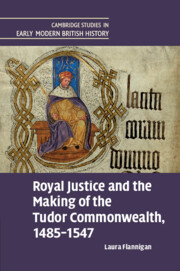
BOOK: Laura FLANNIGAN, Royal Justice and the Making of the Tudor Commonwealth, 1485–1547 [Cambridge Studies in Early Modern British History] (Cambridge: Cambridge University Press, 2025), ISBN 9781009371353


On the book:
The dawn of the Tudor regime is one of most recognisable periods of English history. Yet the focus on its monarchs' private lives and ministers' constitutional reforms creates the impression that this age's major developments were isolated to halls of power, far removed from the wider populace. This book presents a more holistic vision of politics and society in late medieval and early modern England. Delving into the rich but little-studied archive of the royal Court of Requests, it reconstructs collaborations between sovereigns and subjects on the formulation of an important governmental ideal: justice. Examining the institutional and social dimensions of this point of contact, this study places ordinary people, their knowledge and demands at the heart of a judicial revolution unfolding within the governments of Henry VII and Henry VIII. Yet it also demonstrates that directing extraordinary royal justice into ordinary procedures created as many problems as it solved. 

Table of contents:

Introduction. Part I. The New Justice System: Chapter 1. The principle and problem of justice Chapter 2. Conciliar justice at centre and periphery Chapter 3. 'Travailing between the prince and petitioners': the court of requests Part II. Seeking and Requesting Justice: Chapter 4. Geography and demography Chapter 5. Disputes and dispute-resolution Chapter 6. 'Your poor orator': petitioning the king Part III. Delivering and Contesting Justice: Chapter 7. Before the king's honourable council Chapter 8. Answers and arguments Chapter 9. 'A final peax': passing judgment Conclusion. Justice and the Tudor Commonwealth.

On the author:

Laura Flannigan is a researcher at the University of Oxford. She has published several articles in Law and History Review and Historical Research, and was awarded the Sir John Neale Essay Prize in 2020. Her volume on the Court of Requests archive is forthcoming (List and Index Society, 2023).

 Read more here: DOI 10.1017/9781009371346.

18 July 2023

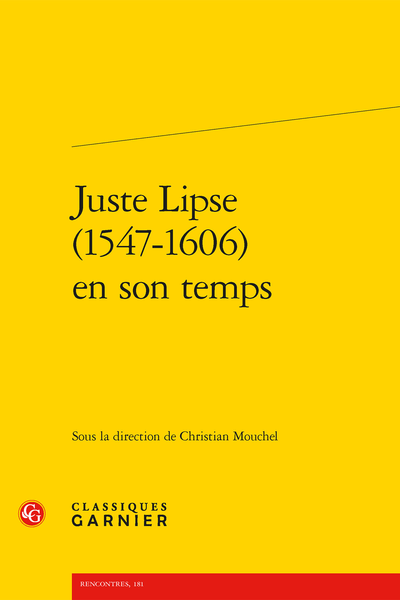
BOOK: Christian MOUCHEL (dir.), Juste Lipse (1547-1606) en son temps [Rencontres; 181 - Colloques, congrès et conférences sur la Renaissance européenne; 8] (Paris: Classiques Garnier, 2023 [1996]), 542 p. ISBN 978-2-8124-5277-2

 (image source: Classiques Garnier)

Abstract:

Promoteur d’un stoïcisme chrétien, Juste Lipse s’illustra dans la philosophie, l’histoire, l’art politique, la philologie, la rhétorique et la poésie. Ces contributions se proposent d’analyser les différentes facettes du savant humaniste tout en le mettant en perspective avec les grandes figures de son temps.

Table of contents:

Préface. Juste Lipse: un philosophe de transition ? (Christian Mouchel)

I. Lipse philosophe

Cicéron chez Juste Lipse: le stoïcisme, l'élégance et le sens de la douleur (Alain Michel)

Juste Lipse : théorie des principes et théologie naturelle (Jacqueline Lagrée)

« Mundum animal esse » (Physiologia stoicorum II, 10) : retour au stoïcisme ou triomphe de l'hermétisme ? (Bernard Joly)

Les fantômes de la raison : le paganisme allégorique de Juste Lipse (Pierre Maréchaux)

Juste Lipse et Erasme : le rôle du stoïcisme dans la transformation de la philosophie chrétienne  (Pierre-François Moreau)

II. Lipse philologue, rhéteur, poète

Le Dialogue des Orateurs de Juste Lipse (Pierre Laurens)

Juste Lipse et la prononciation du latin (Dirk Sacré)

La "divinato lipsiana" nelle notae alle tragedie di Seneca (Silvia Zaninotto)

La poésie de Juste Lipse. Esquisse d'une évaluation critique de sa technique poétique (Jan Papy)

Juste lipse et l'esthétique du jardin (Nathalie Dauvois)

III. Du côté de l'art et de l'archéologie

L'influence de Juste Lipse sur les Arts (Mark Morford)

Juste Lipse antiquaire (Colette Nativel)

Sous l'oeil de Sénèque : les quatre philosophes en miroir de la galerie palatine de Florence (Florence Vuilleumier Laurens)

IV. Relations, échanges, influences

Le retour de Juste Lipse de Leyde à Louvain selon la correspondance (1591-1594) (J. De Landtsheer)

Hubert Audejans (1574-1615) : a Bruges Humanist from Lipsius's Inner Circle (G. Tournoy)

Le stoïcisme de Juste Lipse et de Guillaume du Vair (Maxim Marin)

Les réactions de Juste Lipse aux critiques suscitées par la publication du De Constantia (René Hoven)

Montaigne & Juste Lipse : une double méprise ? (Michel Magnien)

V. Lipse politique

Juste Lipse cicéronien : rhétorique et politique de l'éloge du Cardinal de Granvelle dans les Variae lectiones (Jean-Marc Chatelain)

Vision fragmentée et unitaire : les « Politiques » et les recueils de lieux communs (Ann Moss)

Une réception ambiguë. La diffusion de la pensée politique de Juste Lipse en langue vulgaire dans l'Italie de la première moitié du XVIIe siècle (Jean-Louis Fournel)

Juste Lipse et le Panégyrique de Trajan. Un bilan de la pensée politique lipsienne (Jean Jehasse)

Chronologie des principales œuvres de Juste Lipse

Bibliographie

The book can either be bought in print or consulted online (DOI 10.15122/isbn.978-2-37312-065-3).

16 December 2021

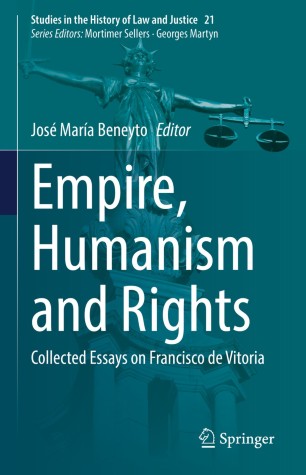
BOOK: José María BENEYTO (ed.), Empire, Humanism and Rights. Collected Essays on Francisco de Vitoria [Studies in the History of Law and Justice, eds. Georges MARTYN & Mortimer SELLARS] (Cham: Springer, 2022). VI + 227 p. 978-3-030-82486-0, € 137,79


(image source: Springer)

Book abstract:

This book deals with Vitoria, Charles V and Erasmus. Vitoria’s ideas had a major influence on Charles V and his European and American policy. In turn, Erasmus’ humanism was decisive in the formation of a new international order intellectually discussed by Vitoria and put into practice by the Emperor. Shedding new light on the influence of Francisco de Vitoria and Erasmus on Charles V’s imperial policy, the book’s goal is to explore the impact of Vitoria’s thought with regard to the history of, and contemporary issues in, international law, while also comparing his thinking with that of the well-known humanist Erasmus and assessing their respective influences on the imperial policy of Charles V.

Table of contents:

Conquest, Empire, and Peace: Vitoria, Charles V, Erasmus and the Foundations of the Law of Nations (José María Beneyto)

“The Affair of the Indies”: International Law Before and After Vitoria (Brett Bowden)

The Three Revivals of Francisco de Vitoria in the History of International Law (Ignacio de la Rasilla)

The Elements of Sovereignty in Francisco de Vitoria’s Political Thought (Luis Valenzuela-Vermehren)

Francisco de Vitoria on the Theology of Dominion and Secular Natural Rights (Mónica García-Salmones)

The Possibility of the New World. Social Cohesion, Legal Order and the Invention of Rights in Iberian Scholastic Thought (Massimo Meccarelli)

On War and Peace in the First Modernity: From Erasmus’ Irenic Discourse to the Just War Theory of the Founder of the School of Salamanca (Simona Langella)

Vitoria and Erasmus on the Justice of War (Leonor Durã Barroso & André Azevedo Alves)

Theorizing on the Institution of War in Erasmus and Vitoria During the Universalmonarchie of Charles V (Yolanda Gamarra)

Vitoria and Erasmus, Together for a New Order of the Universo Mundo (Pablo Antonio Fernández Sánchez)

On the editor:

José María Beneyto, Professor of International Public Law and International Relations at San Pablo CEU University, Madrid. Visiting Professor of Law, Harvard Law School. Chair of the Institute of European Studies in Madrid, a leading Jean Monnet Center at the same University. He obtained his law degree from the University of Navarre, an LL. M. from Harvard Law School (‘90), and a doctoral degree in Law and a doctoral degree in Philosophy and History from the University of Münster (Germany).

Read more on SpringerLink (DOI 10.1007/978-3-030-82487-7).  

18 December 2020

BOOK: Jeremia PELGROM and Arthur WESTSTEIJN, eds., The Renaissance of Roman Colonization - Carlo Sigonio and the Making of Legal Colonial Discourse (Oxford: Oxford University Press, 2020). ISBN 9780198850960, 99.00 USD


(Source: OUP)

Oxford University Press is publishing a new book on the Italian Renaissance scholar Carlo Sigonio (1522/3-1584) and colonial discourse.

ABOUT THE BOOK

The colonization policies of Ancient Rome followed a range of legal arrangements concerning property distribution and state formation, documented in fragmented textual and epigraphic sources. When antiquarian scholars rediscovered and scrutinized these sources in the Renaissance, their analysis of the Roman colonial model formed the intellectual background for modern visions of empire. What does it mean to exercise power at and over distance?

This book foregrounds the pioneering contribution to this debate of the great Italian Renaissance scholar Carlo Sigonio (1522/3-84). His comprehensive legal interpretation of Roman society and Roman colonization, which for more than two centuries remained the leading account of Roman history, has been of immense (but long disregarded) significance for the modern understanding of Roman colonial practices and of the legal organization and implications of empire.

Bringing together experts on Roman history, the history of classical scholarship, and the history of international law, this book analyzes the context, making, and impact of Sigonio's reconstruction of the Roman colonial model. It shows how his legal interpretation of Roman colonization originated and how it informed the development of legal colonial discourse, from imperial reform and colonial independence in the nascent United States of America to Enlightenment accounts of property distribution. Through a detailed analysis of scholarly and political visions of Roman colonization from the Renaissance to today, this book shows the enduring relevance of legal interpretations of the Roman colonial model for modern experiences of empire.

ABOUT THE EDITORS

Jeremia Pelgrom is an assistant professor at Groningen University. His research focuses on Roman Republican colonialism and Italian landscape archaeology. He has co-directed two research projects funded by the Dutch research council (NWO): Landscapes of Early Roman Colonization (with Tesse D. Stek) and Mapping the via Appia (with Stephan Mols and Eric Moormann), and he is co-editor of Roman Republican Colonization. New perspectives from Archaeology and Ancient History (2014).

Arthur Weststeijn is an assistant professor at Utrecht University. He specializes in intellectual history and the history of political thought, with a particular focus on early-modern republicanism and imperialism. He is the author of Commercial Republicanism in the Dutch Golden Age (2012) and co-editor of Ancient Models in the Early Modern Republican Imagination (2017) and The Dutch Empire between Ideas and Practice, 1600-2000 (2019).

TABLE OF CONTENTS

1. Introduction: Settler Colonies Between Roman Colonial Utopia and Modern Colonial Practice, Jeremia Pelgrom and Arthur Weststeijn

2. Roman Colonies and the Distribution of Land before Sigonio, William Stenhouse

3. The Mommsen of the Renaissance: Sigonio, the De antiquo iure populi Romani, and Roman Republican Colonization, John Rich

4. Sigonio in Anglo-American Projects to Reform the Imperial Constitution, 1751-1777, Mark Somos

5. Roman Colonization and Land Division between Enlightenment and Romanticism: Beaufort and Niebuhr, Mattia Balbo

6. Roman Colonization in Twentieth-Century Historiography, Luigi Capogrossi Colognesi

7. Epilogue: Reflections on the Past and Future of the Roman Colonial Discourse, Christopher Smith


More info here

19 October 2020

BOOK: Vittoria FIORELLI (Ed.), Tracce di impero. Cortés tra Napoli e Nuovo Occidente (Napoli: Editoriale Scientifica, 2020). ISBN: 9788893917919, pp.186, € 14,00


ABOUT THE BOOK

Collana: Società Italiana per la Storia dell'Età Moderna

Nell’aprile del 1519 Hermán Cortés, partito dall’isola di Cuba, sbarcava sulla terraferma messicana dando inizio alla conquista dell’impero azteco. A cinquecento anni da quella impresa, ci si è voluti interrogare sull’impatto di quelle vicende, sull’evidenza di mondi “altri” che l’apertura degli spazi geografici ha improvvisamente intrecciato non solo in Europa, ma anche sulla persistente presenza di quella storia nelle culture che ne avrebbero continuato a rivendicare la paternità. I contributi raccolti in questo libro hanno voluto tornare a riflettere su quello snodo in una prospettiva radicalmente mutata dalle sollecitazioni di una storia globale, mettendo alla prova paradigmi storiografici consolidati, ora ripensati con un respiro transculturale ed extraeuropeo.

ABOUT THE EDITHOR

Vittoria Fiorelli is Full Professor of Modern History in the Department of Scienze della Formazione (Education Sciences) of the University Suor Orsola Benincasa in Naples. She is currently teaching Modern and Contemporary History and Methodology of historic research. Since 2003 she is scientific supervisor of the Historical Archive in Naples’ Institute Suor Orsola Benincasa and from 2011 she is scientific coordinator of the Interdisciplinary Center of Studies Margini e confini (CISMEC) in her University. Ordinary member of the Accademia Pontaniana in Naples and of Società Napoletana di Storia Patria, member of the Scientific Commitee of the Seminar of doctoral Studies History and Economy in the Mediterranean countries (ISSM-CNR, Universitat de Barcellona, Istituto storico italiano per il medioevo, Maison méditarrenéenne de science de l’homme-Aix Marseille Université, Università Suor Orsola Benincasa di Napoli) is associated to the Istitut of Studies on Mediterranean Societies – CNR and is actually in the board of Italian Modern History Society national board. She has coordinated many research groups, disciplinary conferences and scientific editions. She is interested in cultural, social and religious history in Early Modern Europe with particular attention to issues of gender and history of institutions in the area of the Ancient Italian States, primarily beneath XVI-XVII century.


More information with the publisher.

15 June 2020

BOOK: Francisco APELLANIZ, Breaching the Bronze Wall: Franks at Mamluk and Ottoman Courts and Markets (Leiden: Brill, 2020). ISBN: 9789004382749, €105.00

Cover Breaching the Bronze Wall: Franks at Mamluk and Ottoman Courts and Markets
(Source: Brill)

ABOUT THE BOOK

Breaching the Bronze Wall deals with the idea that the word of honorable Muslims constituted proof and with the concept that written documents and the word of non-Muslims were inferior. Foreign merchants in cities like Istanbul, Damascus or Alexandria could barely prove any claim, as neither their contracts nor their words were of any value if countered by Muslims. Francisco Apellániz explores how both groups labored to overcome these ‘biases against non-Muslims’ in the courts and markets of Mamluk Egypt and Syria of the 14th and 15th centuries, and how the Ottoman conquest (1517) imposed a new, orthodox view on the problem. The book dives into the Middle Eastern archive and the Ottoman Dīvān, and scrutinizes the intricacies of sharia and the handling of these intracacies by consuls, dragomans, qaḍīs and other legal actors.

ABOUT THE AUTHOR

Francisco Apellániz, Ph.D. (2009) European University Institute, is a lecturer in Islamic and Ottoman History at the University of Naples L'Orientale (and previously at the University of Aix-Marseille). He is the author of Pouvoir et finance en Méditerranée pré-moderne : le deuxième Etat mamelouk et le commerce des épices (1389-1517) (CSIC 2009).

More information here

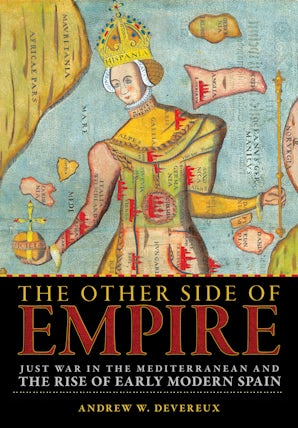
BOOK: Andrew DEVEREUX, The Other Side of Empire : Just War in the Mediterranean and the Rise of Early Modern Spain (Ithaca: Cornell University Press, 2020). ISBN 9781501740121, $49.95


Cornell University Press is publishing a new book on just war theory and early modern imperial Spain.

ABOUT THE BOOK

Via rigorous study of the legal arguments Spain developed to justify its acts of war and conquest, The Other Side of Empire illuminates Spain's expansionary ventures in the Mediterranean in the late fifteenth and early sixteenth centuries. Andrew Devereux proposes and explores an important yet hitherto unstudied connection between the rationales that Spanish jurists and theologians developed in the Mediterranean and in the Americas.

He limns the ways in which Spaniards conceived of these two theatres of imperial ambition as complementary parts of a whole. At precisely the moment that Spain was establishing its first colonies in the Caribbean, the Crown directed a series of Old World conquests that encompassed the Kingdom of Naples, Navarre, and a string of presidios along the coast of North Africa. Projected conquests in the eastern Mediterranean never took place, but the Crown seriously contemplated assaults on Egypt, Greece, Turkey, and Palestine. The Other Side of Empire elucidates the relationship between the legal doctrines on which Spain based its expansionary claims in the Old World and the New.

The Other Side of Empire vastly expands our understanding of the ways in which Spaniards, at the dawn of the early modern era, thought about religious and ethnic difference, and how this informed political thought on just war and empire. While focusing on imperial projects in the Mediterranean, it simultaneously presents a novel contextual background for understanding the origins of European colonialism in the Americas.

ABOUT THE AUTHOR

Andrew W. Devereux teaches history at the University of California, San Diego, and has published in the Journal of Spanish Cultural StudiesMedieval Encounters, and Republics of Letters.


More info here

15 April 2020

BOOK REVIEW: Richard Jeffrey ROSS and Brian Philip OWENSBY (eds.), Justice in a New World : Negotiating Legal Intelligibility in British, Iberian, and Indigenous America (New York: NYU Press, 2018), by Christopher TOMLINS.

(Source : NYU)


THE REVIEW : Christopher TOMLINS (Professor, Berkeley Law Faculty, University of California) is the author of the book review, published in The American Historical Review, Volume 125, Issue 2, April 2020, Pages 642–643, online access : https://doi.org/10.1093/ahr/rhz858

ABOUT THE BOOK :
Brian P. Owensby and Richard J. Ross’s interesting collection Justice in a New World: Negotiating Legal Intelligibility in British, Iberian, and Indigenous America seeks to advance the history of European Atlantic empires by subjecting the legalities of colonizing to comparative assessment, specifically how encounters between Indigenous peoples and Iberian and Anglophone intruders were refracted by their idiosyncratic legal cultures. Comparison, say the editors, promises broadened conceptual purchase for historians of encounter wishing to interrogate the extent and limits of cross-cultural comprehension. Comparison will open up “new vistas on issues of jurisdiction, sovereignty, legal inclusion and exclusion, the quality and role of intermediation in structuring legal encounters and producing legal outcomes, and the intellectual foundation of justice as a guiding idea for legal engagement”.
Richard Jeffrey ROSS and Brian Philip OWENSBY (eds.), Justice in a New World: Negotiating Legal Intelligibility in British, Iberian, and Indigenous America. New York: New York University Press, 2018. Pp. viii, 330. Cloth $89.00, paper $30.00. 
More information here.

10 March 2020

BOOK: Jörg TELLKAMP, ed., A Companion to Early Modern Spanish Imperial, Political and Social Thought (Leiden-New York: Brill, 2020). ISBN 978-90-04-41279-8, €156.00


(Source: Brill)

Brill has published a companion to early modern Spanish imperial political and social thought.

ABOUT THE BOOK

This Companion aims to give an up-to-date overview of the historical context and the conceptual framework of Spanish imperial expansion during the early modern period, mostly during the 16th century. It intends to offer a nuanced and balanced account of the complexities of this historically controversial period analyzing first its historical underpinnings, then shedding light on the normative language behind imperial theorizing and finally discussing issues that arose with the experience of the conquest of American polities, such as colonialism, slavery or utopia. The aim of this volume is to uncover the structural and normative elements of the theological, legal and philosophical arguments about Spanish imperial ambitions in the early modern period. 

Contributors are Manuel Herrero Sánchez, José Luis Egío, Christiane Birr, Miguel Anxo Pena González, Tamar Herzog, Merio Scattola, Virpi Mäkinen, Wim Decock, Christian Schäfer, Francisco Castilla Urbano, Daniel Schwartz, Felipe Castañeda, José Luis Ramos Gorostiza, Luis Perdices de Blas, Beatriz Fernández Herrero.

ABOUT THE EDITOR

Jörg Alejandro Tellkamp (Ph.D. 1997; University Halle-Wittenberg) is Professor of Philosophy at the Universidad Autónoma Metropolitana in Mexico City. His current research focuses on the normative language of the School of Salamanca and its influence in 16th-century Mexico.

TABLE OF CONTENTS

Introduction
By: Jörg Alejandro Tellkamp
Pages: 1–13
Historical Foundations
Spanish Theories of Empire: A Catholic and Polycentric Monarchy
By: Manuel Herrero Sánchez
Before Vitoria: Expansion into Heathen, Empty, or Disputed Lands in Late-Mediaeval Salamanca Writings and Early 16th-Century Juridical Treatises
By: José Luis Egío and Christiane Birr
The “School of Salamanca” and the American Project
By: Miguel Anxo Pena González
Pages: 78–101
Toggle Tree Node
Towards New Normative Orders
Colonial Law: Early Modern Normativity in Spanish America
By: Tamar Herzog
Natural Law and Natural Right in the Spanish Scholasticism
By: Merio Scattola
Dominion Rights: Their Development and Meaning in the History of Human Rights
By: Virpi Mäkinen
Princes and Prices: Regulating the Grain Market in Scholastic Economic Thought
By: Wim Decock
Ethics and Politics of the Conquest and Colonization
Conquista and the Just War
By: Christian Schäfer
The Debate of Valladolid (1550–1551): Background, Discussions, and Results of the Debate between Juan Ginés de Sepúlveda and Bartolomé de las Casas
By: Francisco Castilla Urbano
Caramuel on the Right of Discovery
By: Daniel Schwartz
Spanish Colonialism as Perpetual Dominion in the Writings of Juan Solórzano Pereira
By: Felipe Castañeda
The Debate over the Enslavement of Indians and Africans in the Sixteenth- and Seventeenth-Century Spanish Empire
By: Luis Perdices de Blas and José Luis Ramos Gorostiza
The “New World”: The Shaping of Utopia
By: Beatriz Fernández Herrero

More info here

07 February 2020

BOOK : Barbara J. SHAPIRO, Law Reform in Early Modern England, (Hart publishing), ISBN : 9781509934218, £63.18

(Source : Hart publishing


ABOUT THE BOOK : Law Reform in Early Modern England, Crown, Parliament and the Press.

This book provides an illuminating commentary of law reform in the early modern era (1500–1740) and views the moves to improve law and legal institutions in the context of changing political and governmental environments.
Although lawyers have often been seen as the chief obstacles to law reform, this book emphasises their contributions – particularly their role in legislation and in reforming the corpus of legal materials – and highlights the previously ignored reform efforts of Lord Chancellors.

ABOUT THE AUTHOR : Barbara J Shapiro is Professor Emerita and Professor in the Graduate School at the University of California, Berkeley.

TABLE OF CONTENTS :

1. Introduction
2. The Early Tudors and Law Reform 1509–58
3. The Elizabethan Era 1558–1603
4. The Early Stuarts 1603–40
5. The Civil War and Parliamentary Rule 1640–49
6. Commonwealth and Protectorate 1649–60
7. The Restoration Era 1660–88
8. Revolution and Beyond 1688–1740
9. Conclusion


20 December 2019

BOOK: Manuel LOMAS, Governing the Galleys: Jurisdiction, Justice, and Trade in the Squadrons of the Hispanic Monarchy (Sixteenth-Seventeenth Centuries) (Leiden-New York: Brill, 2020). ISBN 978-90-04-38146-9, OPEN ACCESS


(Source: Brill)

Brill is publishing a new book on Spanish galleys and the law.

ABOUT THE BOOK

The development of the Spanish Navy in the early modern Mediterranean triggered a change in the balance of political and economic power for the coastal populations of the Hispanic Monarchy. The establishment of new permanent squadrons, endowed with very broad jurisdictional powers, was the cause of many conflicts with the local authorities and had a direct influence on the economic and production activities of the region. Manuel Lomas analyzes the progressive consolidation of these institutions in the sixteenth and seventeenth centuries, their influence on the mechanisms of justice and commerce, and how they contributed to the reconfiguration of the jurisdictional system that governed the maritime trade in the Mediterranean.

ABOUT THE AUTHOR

Manuel Lomas, Ph.D. (2009), Universitat de València, is Professor of Early Modern History at that university. His research focuses on the policy of the Hispanic Monarchy towards minorities. He is the author of El proceso de expulsión de los moriscos de España (PUV, 2011).

TABLE OF CONTENTS

Abbreviations, Coinage, Weights, and Measures

Introduction

1 Galleys on the Coast!
 1 The Jurisdiction of the Galleys
  1.1  Continuity and Change under the Catholic Monarchs
  1.2  Culmination of the Process: from Andrea Doria to Don John of Austria
  1.3  The System in Its Maturity: from the Conquest of Portugal to the Thirty Years’ War
 2 Galleys and Ports: Profiles of a Complex Relationship
  2.1  The Galleys: a Vehicle for Concord
  2.2  “That Is Spain’s Flagship, and This Is the Pope’s Fortress”
  2.3  Soldiers, Sailors, and Townspeople
 3 Between Naval Tradition and Military Innovation
  3.1  Galley Ordinances and Corsair Customs
  3.2  Convergence with the Tradition of Military Privileges
  3.3  Roman Law and Experience: the Introduction of Auditores into the Galleys
  3.4  The Galleys’ Jurisdictional Supremacy

2 Captures, Commerce, and Corruption
 1 Prizes, Embargoes, and the Audiencia de las Galeras
  1.1  Ship Capture and Its Benefits to Crews
  1.2  Acquisition of Slaves
  1.3  The Audiencia de las Galeras and Embargoes
 2 Cross-Cultural Trade and Control of Smuggling
  2.1  Between Religious War and Collaboration: the Action of Tunis, 1609
  2.2  Profiles of a Cross-Cultural Trade: Ransoms
  2.3  Purchase of North African Wheat and Control of Maritime Trade
 3 Legitimate Trade and Fraud in the Galleys
  3.1  Smuggling in the Galleys
  3.2  The Visit of 1591
  3.3  The Galleys of Spain and El Puerto de Santa María

3 Resistance, Consensus, and Solidarity
 1 Escapes and Mutinies
  1.1  Escapees
  1.2  Mutineers
 2 Internal Justice, Mercy, and Solidarity in the Galleys
  2.1  The Captain General’s Mediation and Mercy
  2.2  Auditores, Inspectors, and Other Officials
  2.3  Solidarity among Soldiers, Sailors, and Rowers
 3 Religious Belief
  3.1  Catholic Belief
  3.2  Vice among the Crews
  3.3  Captains General and the Inquisition

Conclusion

Bibliography
Index 

More info here

BOOK: Wouter DRUWÉ, Loans and Credit in Consilia and Decisiones in the Low Countries (c. 1500-1680) (Leiden - New York: Brill, 2019). ISBN 978-90-04-41652-9, €209.00


(Source: Brill)

Brill is publishing a new book on loans and credit in the Golden Ages of Antwerp and Amsterdam (c. 1500-1680).

ABOUT THE BOOK

Based on consilia and decisiones, Wouter Druwé studies the multinormative framework on loans and credit in the Golden Ages of Antwerp and Amsterdam (c. 1500-1680). He analyzes the use of a wide variety of legal financial techniques in the Low Countries, such as money lending and the taking of interest, the constitution of annuities, cession and delegation, bearer bonds, bills of exchange, partnerships, and representation in financial affairs, as well as the consequences of monetary fluctuations. Special attention is paid to how the transregional European system of learned Roman and canon law ( ius commune) was applied in daily ‘learned legal practice’. The study also deals with the prohibition against usury and with the impact of moral theology on legal debates.

ABOUT THE AUTHOR

Wouter Druwé (1991) is assistant professor of Roman law and legal history at KU Leuven. He read law (Ph.D. 2018, MLaw 2013), canon law (JCL 2018) and theology (BA 2013). He mainly studies the ius commune in the Low Countries.

TABLE OF CONTENTS

ACKNOWLEDGEMENTS

INTRODUCTION
1. Need for credit in the Golden Age(s) and its normative framework
2. Research questions
3. Methodological considerations
4. Structure

CHAPTER I. CONSILIA AND DECISIONES IN THE LOW COUNTRIES
1. Introduction
2. Consilia and decisiones: a general framework
A. Consilia
B. Decisiones

3. Consilia in the Low Countries
A. The first printed consilia: Nicolaas Everaerts and Angelus a Sancto Ioanne
B. Leuven law professors and their consultation practice (ca. 1550 – 1590)
C. Learned legal practitioners: the Kinschot family (ca. 1580 – 1650) and Antoon Anselmo
D. A humanist counsellor: Jean de Deckher de Walhorn (1583-1646)
E. Learned consultations by a canon lawyer: Franciscus Zypaeus (1580-1650)
F. Jacob Coren
G. The Hollandic and Utrecht consultations: disordered and varied collections
4. Decisiones in the Low Countries
A. Collections of decisiones from the Northern Low Countries
B. Printed collections of decisiones from the Southern Low Countries
5. Conclusion

CHAPTER II. SIMPLE MONEY LENDING AND THE TAKING OF INTEREST
1. Introduction
2. Money loans and the law of evidence
A. Proof of original payment of the capital
B. Proof of mutual intention
C. Other impediments to a claim for restitution: the S.C. Macedonianum
D. Proof of repayment of the money lent
3. The taking of interest
A. Introduction
B. Contractually stipulated interest for the duration of a (money) loan
C. Interest in case of default (mora)
D. Some questions on the proof of usury
E. Sanctions
4. Conclusion

CHAPTER III. SALE OF ANNUITIES
1. Introduction
2. Constitution of annuities
3. Enforcement of annuities: the issue of prescription
4. Redemption, reduction and forced restitution of annuities
A. Redeemability and reductibility by the seller of the annuity
B. Reduction of annuities through the enactment of tax legislation
C. Forced restitution of the capital

5. Conclusion

CHAPTER IV. TRANSFER OF BONDS AND CLAIMS
1. Introduction
2. Cession and assignment
A. Introduction
B. Proof of a cession: transfer and causa
C. Alternative causae for the transfer of a bond
D. Consequences of a cession and its revocability
E. Recourse liability
F. Legal remedies by the ceded debtor
G. Intermediate conclusion

3. Delegation and novation
A. Introductory remarks
B. Proof of novation
C. Recourse liability
D. Legal remedies by a delegated debtor
E. Intermediate conclusion

4. Bonds to bearer
A. Introduction
B. The solution of the ius commune
C. The causa of the transfer
D. Legal remedies by the debtor against the bearer
E. Recourse liability by the bearer against the transferor
F. Questions of proof
G. Intermediate conclusion

5. Bills of exchange
A. Introduction
B. Acceptance by the drawee
C. Liability of the drawer
D. Liability of the remitter of a bill of exchange
E. Bills of exchange and usury
F. Determination of the exchange rate
G. Intermediate conclusion

6. Conclusion

CHAPTER V. PARTNERSHIPS, REPRESENTATION AND SEA LOANS
1. Introduction
2. The law of partnerships
A. Foundation of partnerships
B. Liability of partners vis-à-vis third parties
C. Relationship between partners
D. Leonine clauses and triple contracts
E. Trade in shares

3. Representation in financial affairs
A. Introductory remarks
B. Claims by principals and/or agents
C. Claims against the principal
D. A mandate should not harm the institor

4. Sea loans ( faenus nauticum)
5. Conclusion

CHAPTER VI. MONETARY FLUCTUATIONS AND DEBTS
1. Introduction
2. One-time payments
A. Introductory remarks
B. Coinage to be used
C. Applicable rate or valuation
D. Intermediate conclusion

3. Recurring payments
A. Introductory remarks
B. Rate of payment: relevant location
C. Rate of payment: relevant time

4. Conclusion

CONCLUSION
1. Research questions and the core sources
2. The evolution of the normative framework on loans and credit: a summary
3. Transregional multinormativity
4. Moral theology
5. North and South: An Age of Estrangement?
6. Consilia and decisiones
7. Open questions

BIBLIOGRAPHY
1. Netherlandish sources of learned legal practice: the core material
2. Other primary sources
3. Customary law and ordinances
4. Legal historical literature 

More information here

28 August 2019

BOOK: Christopher LATTMANN, Der Teufel, die Hexe und der Rechtsgelehrte. Crimen magiae und Hexenprozess in Jean Bodins De la Démonomanie des Sorciers [Studien zur europäischen Rechtsgeschichte, 318] (Frankfurt am Main: Klostermann 2019), 390 p., 69,00 €, ISBN 978-3-465-04389-8


(image source: MPIeR)

Jean Bodin is known above all as the author of the Six livres de la République (1576) and the founder of the theory of sovereignty. Most modern readers, however, are less familiar with his demonology of 1580, which was also a bestseller at the time – not least because witchcraft law was hardly standardised in early modern France. In De la Démonomanie des Sorciers (1580), Bodin discussed the nature of witchcraft and gave instructions for the strict legal prosecution of the crimen magiae. Christopher Lattmann’s study is the first to provide a detailed examination of this controversial legal work from the perspective of legal history. Bodin understood witchcraft as a phenomenon that resulted from the interaction of God, devil and man. His view of the world is reflected in his material witchcraft law, above all in his treatment of the various witchcraft offences: from entering into a pact with the devil to participating in the Witches’ Sabbath or using maleficent magic. Lattmann demonstrates the influences of Mosaic, Roman and ecclesiastical law as well as of contemporary demonology on Bodin’s work. Against the background of French criminal procedural law, he shows that Bodin established a special summary procedure for witch trials that differed from the regular inquisition procedure. Since Bodin could not base himself on any existing French law for this purpose, he drew on the doctrines of foreign criminal jurists. Lattmann thus shows how Bodin’s work originated in a European legal sphere and became an important contribution to European criminal law in the 16th century.

(source: MPIeR)

07 August 2019

NEWS: The School of Salamanca – A Digital Collection of Sources and a Dictionary of its Juridical-Political Language


Over the past few months, the “The School of Salamanca – A Digital Collection of Sources and a Dictionary of its Juridical-Political Language” has posted various new digital editions of works by key thinkers from the Salamanca School (e.g. Melchor Cano, Domingo Banez, etc.).

Project Description

The (re-)discovery of the fundamental importance of the School of Salamanca for the early modern discourse about law, politics, religion and ethics is widespread among of philosophers and legal historians. During the 16th and 17th centuries, the intellectual sparks emitted by this academic force field reached not only the most far-flung cities of the Spanish monarchy, be it Mexico, Madrid or Manila: they also spread to universities in the protestant territories of the Ancien Régime. Europe's intellectual history, history of political thought, and legal history can not be understood adequately without being aware of the School of Salamanca as an almost universal intellectual reference point. Nevertheless, the assessment of the School and its intellectual influence remains a much discussed topic until the present day.

The School of Salamanca's significance and influence on more than one continent as well as in different academic fields have given rise to an impressive multitude of research efforts in various disciplines: philosophers, historians, jurists, legal historians, and theologians pursue the reconstruction of complex subareas of the Salamantine intellectual edifice. The sheer number of these research projects wordwide has caused a notable fragmentation of the scientific landscape. Notably the connections between persons, texts, and disciplines threaten to become lost, but also an understanding of comprehensive questions and methods.

These are the problems our project aims to adress by creating an easy access to primary sources, their concepts and contexts. As a foundation of our work we will build a digital text corpus including 116 works of the Salmantine jurists and theologians in selected prints from the 16th and 17th centuries. The high-resolution scans will be complemented by the full text of the featured works, supporting all online researches with comfortable search functionalities. Based on these resources, we will also compose a historic dictionary of circa 300 essential terms of the Salmantine School's juridic-politic language, bringing together international and interdisciplinary research perspectives. In the electronic version, the dictionary articles will be linked to the source texts, enabling easy access to information about concepts, contexts, and authors. At the final stage, a print-version of the dictionary will be published.

More info about the project can be found here, the latest news on the project can be found here

28 June 2019

SEMINAR SERIES: l’Humanisme juridique (Paris, January-May 2020)


(Source: Hi-D)

Via Hi-D, we learned of the programme for an international interdisciplinary seminar series on “l’humanisme juridique” in Paris next year.

L’HUMANISME JURIDIQUE

Séminaire international pluridisciplinaire
sous la direction de
Luigi-Alberto Sanchi (IHD, Cnrs/université Paris II Panthéon-Assas) et Xavier Prévost (IRM-CAHD, université de Bordeaux)

Année 2020

Géographies de l’humanisme juridique
L’Institut d’histoire du droit de l’université Paris II Panthéon-Assas, en collaboration avec l’Institut de recherche Montesquieu-CAHD de l’université de Bordeaux, organise des séances de séminaire qui ont lieu au Collège Sainte-Barbe, en salle Collinet (4 rue Valette, 75005 Paris, 3e étage), le vendredi de 14h30 à 16h30.

LES CONFÉRENCES SONT PUBLIQUES.

Vendredi 10 janvier 2020 – 14h30-16h30
Avignon, un lieu majeur du développement et de la diffusion de l’humanisme juridique (c.1518-1529) ?
Géraldine CAZALS, université de Rouen (CUREJ)
Vendredi 7 février 2020 – 14h30-16h30
L’enseignement juridique en Allemagne (1520-1540). Mathias SCHMOECKEL, université de Bonn
Vendredi 13 mars 2020 – 14h30-16h30
Le schisme des parlements « royalistes » en 1591 : théorie et application des thèses gallicanes.
Marco PENZI, université Paris 1 Panthéon-Sorbonne (IHMC)
Vendredi 3 avril 2020 – 14h30-16h30
Peregrinatio academica et circulation du savoir juridique au XVIe siècle.
Luisa BRUNORI, Cnrs / université de Lille (CHJ)
Vendredi 15 mai 2020 – 14h30-16h30
Dall’interpretazione delle antiche epigrafi milanesi alla ricostruzione delle cariche municipali a Milano in epoca romana.
Annalisa BELLONI, université catholique de Milan

(Source: Hi-D)


28 January 2019

BOOK: K.J. KESSELRING, Making Murder Public: Homicide in Early Modern England, 1480-1680 (Oxford: Oxford University Press, 2019). ISBN 9780198835622, £60.00


(Source: OUP)

Next month, Oxford University Press is publishing a book on homicide in Early Modern England.  

ABOUT THE BOOK

Homicide has a history. In early modern England, that history saw two especially notable developments: one, the emergence in the sixteenth century of a formal distinction between murder and manslaughter, made meaningful through a lighter punishment than death for the latter, and two, a significant reduction in the rates of homicides individuals perpetrated on each other.

Making Murder Public explores connections between these two changes. It demonstrates the value in distinguishing between murder and manslaughter, or at least in seeing how that distinction came to matter in a period which also witnessed dramatic drops in the occurrence of homicidal violence. Focused on the 'politics of murder', Making Murder Public examines how homicide became more effectively criminalized between 1480 and 1680, with chapters devoted to coroners' inquests, appeals and private compensation, duels and private vengeance, and print and public punishment. The English had begun moving away from treating homicide as an offence subject to private settlements or vengeance long before other Europeans, at least from the twelfth century. What happened in the early modern period was, in some ways, a continuation of processes long underway, but intensified and refocused by developments from 1480 to 1680.

Making Murder Public argues that homicide became fully 'public' in these years, with killings seen to violate a 'king's peace' that people increasingly conflated with or subordinated to the 'public peace' or 'public justice.'

ABOUT THE AUTHOR

K.J. Kesselring, Professor of History, Dalhousie University
K.J. Kesselring is Professor of History at Dalhousie University, Halifax, Nova Scotia. She is the author of a series of articles and essays on homicide and criminal forfeiture, and books on Mercy and Authority in the Tudor State and The Northern Rebellion of 1569. She has also edited or co-edited collections on The Trial of Charles I, Married Women and the Law: Coverture in England and the Common Law World (with Tim Stretton), and Crossing Borders: Boundaries and Margins in Medieval and Early Modern Britain (with Sara M. Butler).

TABLE OF CONTENTS

Acknowledgements
Abbreviations and Conventions
1: Introduction
2: 'In Corona Populi': Early Modern Coroners and their Inquests
3: 'An Image of Deadly Feud': Recompense, Revenge, and the Appeal of Homicide
4: 'That Saucy Paradox': The Politics of Duelling in Early Modern England
5: 'For Publick Satisfaction': Punishment, Print, Plays, and Public Vengenance
Conclusion
Appendix I: The Records and the Database
Bibliography

More information here