Search

Showing posts with label Legal History of the European Union. Show all posts

19 December 2025

BOOK REVIEW: Donal K. COFFEY on Brexit, union, and disunion: the evolution of British constitutional unsettlement by Sionaidh Douglas-Scott (Comparative Legal History, XIII (2025), nr. 2 (December), pp. 362-366)

(Image source: Taylor&Francis)

Brexit blew up the United Kingdom’s constitutional settlement. When the UK voted to leave the European Union, it threw into sharp relief a series of delicate constitutional arrangements that governed the relationship of the Government to Parliament through prorogation, the integration of direct democracy into a system ostensibly founded on representative democracy, the balance of power between Westminster and the devolved regions, the rights that citizens held in the UK – and that is merely to scratch the surface. In the current volume, Sionaidh Douglas-Scott takes the crisis offered by Brexit to provide an overview of the British constitutional settlement across a number of different axes. The monograph as a whole is an entertaining scholarly tour de force which demonstrates the application of a wide range of methodologies in a sophisticated fashion.

To read the full review, please click here. Online access is free for members of the European Society for Comparative Legal History.

DOI: 10.1080/2049677X.2025.2580105


22 February 2024

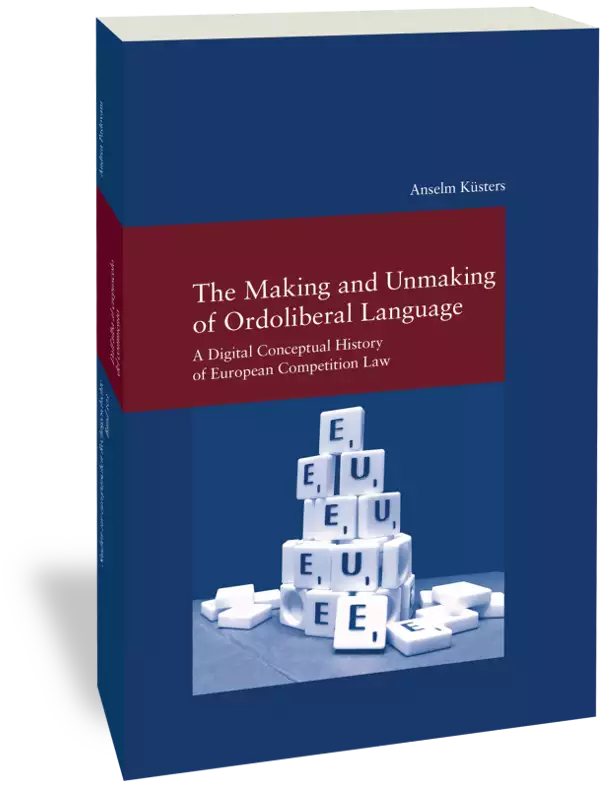
BOOK: Anselm KÜSTERS, The Making and Unmaking of Ordoliberal Language. A Digital Conceptual History of European Competition Law (Frankfurt am Main: Klostermann, 2023), ISBN: 9783465046011


ABOUT THE BOOK

The ordoliberal school of competition thought is a distinct linguistic community whose conceptual and semantic influence extended far beyond Germany and eventually shaped the European legal order. Linguistic misunderstandings still impacted the negotiations of the founding European Treaties, but in the subsequent application of the new rules, the Freiburg School’s ordoliberal ideas gained in popularity. In the early 2000s, this ordoliberal language was replaced by neoliberal concepts borrowed from the Chicago School. This study combines archival materials, oral history interviews, case law and Text Mining methods. In doing so, it contributes to the historiography of EU competition law, the post-war history of ordoliberalism, and methodological debates about Digital Humanities.


More information can be found here.

13 January 2021

BOOK: Geoffrey GRANDJEAN, Histoire de la construction européenne (Brussels : Larcier, 2020). ISBN 9782802739708, 90.00 EUR


(Source: Larcier)

Larcier has published a book on the history of “la construction européenne”.

ABOUT THE BOOK

À l’heure où l’Union européenne donne des signes d’un délitement annoncé, cet ouvrage s’intéresse, dans la perspective du temps long, aux États et aux personnalités politiques ayant joué et jouant encore un rôle majeur dans l’histoire de la construction européenne. En interrogeant l’idée d’Europe, en examinant les conséquences des deux guerres mondiales et en détaillant les étapes de la construction européenne, cet ouvrage tend à démontrer que l’Union européenne ne vit que par ses États et pour ses États.

À travers l’analyse de faits historiques, la présentation de notices biographiques et l’étude de textes fondamentaux, cette Histoire de la construction européenne propose une immersion dans des contextes politiques, sociaux, économiques ou encore culturels à la fois convergents et divergents. Elle est surtout l’occasion de s’interroger sur la possibilité de concrétiser une commune solidarité entre les citoyens et les États européens.

ABOUT THE AUTHOR

Geoffrey Grandjean : Professeur de science politique à la Faculté de Droit, de Science politique et de Criminologie (ULiège)


The table of contents can be found here


More info here

16 December 2020

BOOK: Claire KILPATRICK & Joanne SCOTT (Eds.), New Legal Approaches to Studying the Court of Justice (Oxford: Oxford University Press, 2020). ISBN 9780198871477, 70.00 GBP


(Source: OUP)

Oxford University Press is publishing a new book on studying the European Court of Justice, including by using its archives.

ABOUT THE BOOK

At the beginning of 2015, the Court of Justice opened its archives, which created a new and challenging primary source for those studying the Court of Justice: the dossiers de procédure which contain much more than the contemporary documents published by the Court. This volume includes five chapters which analyse the activities of the Court of Justice from a highly diverse range of non-doctrinal perspectives. However, they also highlight significant new developments at the Court itself which attract attention and deserve analysis. Thus, the idea behind this volume is to make available new tools and approaches through which the activities of the Court of Justice can be studied. It shows a more intense engagement with scholars across disciplines to reflect on law and courts, with the Court of Justice as a central focus, and new methods (such as network citation analysis) and sources (such as the Court's archives) being discovered and developed. It also shows a more intense and deeply knowledgeable engagement with EU law and the Court of Justice by non-legal scholars, such as the new sociologies and histories of the Court of Justice. These and other new approaches have spawned productive and ongoing conversations across disciplines.

ABOUT THE EDITORS

Edited by Claire Kilpatrick, Professor of International and European Labour and Social Law, European University Institute, and Joanne Scott, Professor of European Law, European University Institute


Claire Kilpatrick is Professor of International and European Labour and Social Law at the European University Institute and Co-Director of the Academy of European Law at the EUI. She is also the EUI's Dean of Graduate Studies. Before coming to the EUI in 2011, she worked at LSE and before that at Cambridge University. Her interests lie mainly in the law and policy construction of Social Europe, especially the EU's roles. A focus of her recent work is EMU and Social Europe with a particular focus on sovereign debt loan arrangements and legal challenges to those arrangements from those within debtor EU states. Professor Kilpatrick is involved in two research projects at present concerning 'Equality Law in Europe - A New Generation' and 'The Court of Justice in the Archives'. These projects are hosted by the Academy of European Law at the EUI and involve the participation of many EUI researchers.


Joanne Scott is Professor of European Law and Co-Director of the Academy of European Law at the European University Institute. She is currently on leave from University College London, where she taught from 2005 to 2017. Before that she taught at the University of Cambridge, Queen Mary University of London and the University of Kent. Her research interests lie in the areas of environmental law and climate change law, EU extraterritoriality, new modes of EU governance and the relationships between different legal orders. Among her recent publications is a co-edited book (with Marise Cremona) on EU Law Beyond EU Borders: The Extraterritorial Reach of EU Law (2019). She was elected as a Fellow of the British Academy in 2013 and a Fellow of the Royal Society of Edinburgh in 2012. Along with Claire Kilpatrick and Marise Cremona, she is currently involved in the Academy research project exploring 'The Court of Justice in the Archives'. This project is funded by the EUI Research Council.

TABLE OF CONTENTS

Introduction, Claire Kilpatrick and Joanne Scott

1:The Many Ages of the Court of Justice of the European Union, Anthony Arnull

2:From Close-Ups to Long Shot: In Search of the 'Political Role' of the Court of Justice of the European Union, Antoine Vauchez

3:Waiting for the Barbarians: Inside the Archives of the European Court of Justice, Fernanda G Nicola

4:The Relevance of the Network Approach to European Case Law: Reflection and Evidence, Urska Sadl and Fabien Tarissan

5:Judicial Legitimacy in the European Union, Jan Komárek


More info here

10 December 2020

BOOK: Pedro Gustavo TEIXEIRA, The Legal History of the European Banking Union (London: Bloomsbury, 2020). ISBN 9781509940622, 67.50 GBP


(Source: Bloomsbury)

Bloomsbury is publishing a book on the legal history of the European banking union.

ABOUT THE BOOK

How was the Banking Union, the most advanced legal and institutional integration in the single market, created? How does European law impact European integration?

To answer these questions, this book provides a sweeping account of the evolution of European law. It identifies five integration periods of the single financial market, intertwined with the development of global finance, from its origins, through its expansion and crisis, to the Banking Union. Each period is defined by innovations to deepen integration, such as the single passport for financial services, soft governance and comitology, agencies, or a single rulebook.

Providing a far-reaching explanation of the legal and institutional rationality of the European Banking Union, this book demonstrates that the Banking Union is not an accident of history or simply the product of the existential crisis of the Monetary Union. It has deep roots in the evolutionary process of European law and its drive towards supranational integration.

ABOUT THE AUTHOR

Pedro Gustavo Teixeira is Director-General of the Directorate-General for Governance and Operations of the Single Supervisory Mechanism of the European Central Bank, Secretary of its Supervisory Board, and Lecturer at the Institute for Law and Finance of the Goethe University, Frankfurt am Main.

TABLE OF CONTENTS

Introduction

Chapter 1: Integration through Harmonisation

Chapter 2: Integration through Competition

Chapter 3: Integration through Governance

Chapter 4: (Dis-) Integration through Crisis

Chapter 5: Integration through Centralisation – The Banking Union

Chapter 6: Decrypting the Past and Future of the Banking Union

Conclusion


More info here

01 September 2020

BOOK: Frank SCHORKOPF, Der europäische Weg - Geschichte und Gegenwart der europäischen Union, 3rd ed. (Tübingen: Mohr Siebeck, 2020). ISBN 978-3-16-159600-1, 22.00 EUR


(Source: Mohr Siebeck)

Mohr Siebeck is publishing a new edition of Professor Frank Schorkopf’s monograph on the history of the European Union.

ABOUT THE BOOK

Published in German.

Frank Schorkopf succinctly describes the lead-up to European integration and paves the way to a better knowledge and understanding of its ideational, political, and legal contexts. This substantially revised third edition has also been extended to include current aspects of the integration process.

ABOUT THE AUTHOR

Frank Schorkopf Geboren 1970; Studium der Rechtswissenschaft in Hamburg und London; 1999 Promotion; 2007 Habilitation; Inhaber des Lehrstuhls für Öffentliches Recht und Europarecht der Georg-August-Universität Göttingen und ordentliches Mitglied der Akademie der Wissenschaften zu Göttingen.


More info here

20 August 2020

BOOK: Leonardo PIERDOMINICI, The Mimetic Evolution of the Court of Justice of the EU A Comparative Law Perspective (London: Springer, 2020). ISBN 978-3-030-47863-6, 90.09 EUR


(Source: Springer)

Palgrave is publishing a new book on the institutional development of the CJEU.

ABOUT THE BOOK

This book provides fresh perspectives in the legal study of the Court of Justice of the European Union. In the context of European studies, the Court has mainly been analysed in light of its central role in the process of continental integration. Moreover, the Court has traditionally been studied by specialists for its important role as an agent of comparative law. This book studies the evolution of the Court itself, rather than that of the EU legal order in its judge-made dimension, and addresses several institutional aspects of its structure and organization, selected and constructed as a complete range of symptomatic figures of judicial institutionalisation. In doing so, the author seeks to showcase how the development and the institutional evolution of the CJEU happened through a selective internalization of comparative influences.

ABOUT THE AUTHOR

Leonardo Pierdominici is a researcher at the School of Law of the Alma Mater Studiorum – University of Bologna, Italy. He previously worked as a research associate at the Robert Schuman Center for Advanced Studies of the European University Institute.

More info here

31 July 2020

PODCAST: Europas Weg – Podcast zur Verfassungsgeschichte der Europäischen Union


We learned of a new podcast, narrated by Professor Schorkopf (Göttingen), on the legal history of the European Union.

Der Podcast hat das europäische Recht in seinen ideelen, politisch-gesellschaftlichen und wirtschaftli-chen Zusammenhängen zum Gegenstand. Es geht um Verträge, Ereignisse und Personen, um das Denken und Sprechen, um Partizipaton und Repräsenation im organisierten Europa von der Gründung der Montanunion in den frühen 1950er Jahren bis zur Europäischen Union der 2000er Jahre. Dieses digitale Vorhaben soll die Grundlagen europäischer Integration, besonders des Europarechts für Studenten nicht nur, aber auch der Rechtswissenschaft, im Grunde jedoch allen Interessierten zugänglich machen.


01 May 2020

BOOK: Vera FRITZ, Juges et avocats généraux de la Cour de Justice de l’Union européenne (1952–1972). Une approche biographique de l’histoire d’une révolution juridique (Frankfurt am Main: Klostermann, 2018). ISBN: 9783465043508, pp. IX-396, € 79,00

Fritz, Vera: Juges et avocats généraux de la Cour de Justice de l´Union européenne (1952-1972)
(Source: Klostermann)

ABOUT THE BOOK

En s’appuyant sur des archives rassemblées dans les six pays fondateurs de l’Union européenne, cet ouvrage propose un regard nouveau sur le "processus de constitutionnalisation" des traités européens lancé dans les années 1960 par la Cour de Justice de l’UE. En mettant en lumière les parcours professionnels et personnels des premiers juges et avocats généraux européens, il étudie les dynamiques qui règnent à l’intérieur de l’institution pendant ses années "révolutionnaires" et s’intéresse aux relations que la juridiction entretient avec les Etats membres. À travers une étude détaillée du processus de sélection des membres de la Cour, il apporte notamment des réponses inédites à la question de savoir si les gouvernements ont tenté de mettre un terme à sa jurisprudence audacieuse.

Drawing on archives gathered in the six founding member states of the European Union, this book offers a new perspective on the "constitutionalization" of the European treaties, which was launched in the 1960s by the Court of Justice of the EU. By highlighting the professional and personal backgrounds of the first European judges and advocates general, its author studies the dynamics which prevailed within the institution during its "revolutionary" years and analyzes the Court’s relationship with the Member States of the European Communities. Through a detailed study of the selection process of the members of the Court, it also provides new answers to the question of whether governments tried to put an end to its bold jurisprudence.

ABOUT THE AUTHOR

Vera Fritz is a postdoc researcher/research associate at the Center for Contemporary and Digital History, Université du Luxembourg. 


More information with the publisher.

08 April 2020

BOOK: Kaius TUORI, Empire of Law Nazi Germany, Exile Scholars and the Battle for the Future of Europe (Cambridge: Cambridge University Press, 2020). ISBN 9781108483636, £ 85.00


(Source: CUP)

Cambridge University Press is publishing a book on the formation of the European legal tradition before and after World War II.

ABOUT THE BOOK

European legal integration is often justified with reference to the inherent unity of European legal traditions that extend to ancient Rome. This book explores the invention of this tradition, tracing it to a group of legal scholars divided by the onslaught of Nazi terror and totalitarianism in Europe. As exiles in Britain and the US, its formulators worked to build bridges between the Continental and the Atlantic legal traditions, incorporating ideas such as rule of law, liberty and equality to the European heritage. Others joined the Nazi revolution, which promoted its own idea of European unity. At the end of World War Two, natural law and human rights were incorporated into the European project. The resulting narrative of Europe, one that outlined human rights, rule of law and equality, became consequently a unifying factor during the Cold War as the self-definition against the challenge of communism.

ABOUT THE AUTHOR

Kaius Tuori, University of Helsinki

Kaius Tuori is Professor of European Intellectual History at the Centre for European Studies, Faculty of Social Sciences, University of Helsinki. He is a legal historian and author of two monographs and numerous articles spanning the topics of tradition, culture, identity, memory and the uses of the past.

TABLE OF CONTENTS

1. Introduction
2. Legal refugees from Nazi Germany and the idea of liberty
3. Redefining the rule of law, jurisprudence and the totalitarian state
4. The long legal tradition and the European heritage in Nazi Germany
5. Reconfiguring European legal tradition after the war
6. The European narrative and the tradition of rights
7. Conclusions.

More info here

23 March 2020

CALL FOR PAPERS: The Borders of Europe. The Schengen System in a Historical Perspective (1990-2020) (Florence, 11-12 June 2020) (DEADLINE: 31 March 2020)


(Source: HSozkult)

Via Hsozkult, we learned of a call for papers for a conference on the Schengen System in a historical perspective.

“In 1985, a group of five member states of the European Community (EC), i.e. France, the Federal Republic of Germany and the Benelux countries, signed an agreement in Schengen, whose aim was to remove internal border controls. It also provided for measures to strengthen external border controls and to ramp up the fight against drug trafficking, international crime and illegal immigration. This document, however, was more a working programme than a detailed plan of action and it was outside the community framework. After the Schengen Agreement had been signed, negotiations were therefore opened to decide upon a convention implementing it (CISA). The CISA, signed in 1990 in the wake of the fall of the Berlin Wall, specified the measures, which were to compensate for the abolition of internal border controls; it also established the Schengen Information System, to support external border control and law enforcement cooperation in the Schengen states.” […]

More info here

09 March 2020

BOOK: Julien CHAISSE, Sixty Years of European Integration and Global Power Shifts Perceptions, Interactions and Lessons. (Oxford: Hart Publishing, 2020). ISBN 9781509933747, £82.62


(Source: Hart Publishing)

Hart Publishing is publishing a new book on the history of EU integration.

ABOUT THE BOOK

This book focuses on a review of how sixty years of case-law and regulatory activity transformed the European continent and the world. It provides a critical analysis of the key features of EU integration and how this integration is perceived (internally and externally). In this context, this book also explores the EU's interactions with a number of other countries and organisations with the objective of assessing the EU's role in global governance.

ABOUT THE AUTHOR

Julien Chaisse is Professor of Law at the City University of Hong Kong (CityU) and Advisory Board Member of the Asian Academy of International Law (AAIL).

TABLE OF CONTENTS

1. The European Union: Achievements, Ongoing Challenges
and Future Prospects
Julien Chaisse

PART I
EUROPEAN LEGAL INTEGRATION: PROCESS, DIFFICULTIES AND ACHIEVEMENTS
2. The Rule of Law and Integration in the EU
Ian Forrester QC
3. The European Union as an Oxymoron: From Contest via Contradiction to Constitution?
Rostam J Neuwirth
4. The Social Dimension of the EU
Manfred Weiss
5. Geographical Scope and Diversity of EU Rules on Public Procurement
Trygve Ben Holland
6. Spatial Configurations of Welfare in the EU: The Case of Cross-border Healthcare
Irene Sobrino Guijarro
7. Godot is Finally Coming? The Great Convergence of Services Markets within the EU
Panagiotis Delimatsis
8. Government, Culture and Movies: In Search of a Common Understanding from a European Perspective
Susana de la Sierra

PART II
THE EUROPEAN UNION AS A GLOBAL ACTOR: ISSUES AND PARTNERS
9. The European Union and Global Economic Governance: A Leader Without a Roadmap?
Jan Wouters and Akhil Raina
10. Lessons from European Constitutionalism for Reforming Multilevel Governance of Transnational Public Goods in Asia?
Ernst-Ulrich Petersmann
11. The EU's Civil Justice Policy Field: Perspectives for Asia?
Helen E Hartnell
12. Bilateralism in an Interregional World? From EU Negotiations with MERCOSUR to a Bilateral Strategic Partnership with Brazil
Katharina L Meissner
13. Reclaiming the Comprehensive Strategic Partnership through the EU–China Partnership and Cooperation Agreement: Taking Stock and Moving Forward
Chien-Huei Wu
14. Legalisation of International Economic Relations: Is Asia Unique?
Shintaro Hamanaka

PART III
EUROPEAN UNION'S TRADE POLICY: GLOBAL AND REGIONAL TRADE CHALLENGES
15. Trade for All? Transparency in the EU's Common Commercial Policy
Fernando Dias Simões
16. Investor to State Dispute Settlement Mechanisms: A Comparison of Evolving Legal Approaches in Brazilian and Latin American Relations with the European Union
Daniele Bianchi and Kirstyn Inglis
17. The Rise of the RCEP: Regional Multilateralism and its Impact on the EU–China BIT
Olga Boltenko
18. The Comprehensive and Progressive Agreement for Trans-Pacific Partnership: Intellectual Property Chapter, Research in Biotechnology and Price of Medicine with Lessons from the European Union
Sufian Jusoh
19. Geographical Indications in the EU, China and Australia: WTO Case Bottling Up Over Prosecco
Danny Friedmann
20. Indian Pharma Sector's Journey for the Innovation Panacea: Lessons from Negotiations wiTheU and RCEP
Debashis Chakraborty and Nilanjan Banik

More info here

14 January 2020

BOOK: Johann P. ARNASON, ed., European Integration Historical Trajectories, Geopolitical Contexts (Edinburgh: Edinburgh University Press, 2019).


(Source: OUP)

Edinburgh University Press is publishing a book dealing with historical aspects of European integration.

ABOUT THE BOOK

Explores the historical, geopolitical and conjunctural aspects of European integration, and their relevance to understanding the current crisis

To understand the current difficulties and future prospects of European integration, multiple perspectives are required. The essays in this collection explore historical and geopolitical aspects of European integration and their relevance to interpretations of the current climate. They also examine the different regional dynamics of integration and the attitudes that result from those experiences, including in the European peripheries that are so often overshadowed by the dominant centres. In drawing all of these perspectives together, the collection allows the reader to assess the EU's current crisis in context.

ABOUT THE AUTHOR

Johann P. Arnason is Emeritus Professor of Sociology at La Trobe University, Melbourne, and Visiting Professor in the Faculty of Human Studies at Charles University, Prague. He taught sociology in Heidelberg and Bielefeld from 1972 to 1975, and at La Trobe University in Melbourne, Australia, from 1975 to 2003. He has been a visiting professor at the Ecole des Hautes Etudes en Sciences Sociales, Paris, and at the University of Leipzig, and a research fellow of the Alexander v. Humboldt-Stiftung, the Swedish Institute of Advanced Studies, the Kulturwissenschaftliches Institut (Essen), the Lichtenberg-Kolleg in Göttingen and the Max-Weber-Kolleg in Erfurt. His research interests centre on social theory and historical sociology, with particular emphasis on the comparative analysis of civilizations.

TABLE OF CONTENTS

1.Introduction: Perspectives on European Unity and Diversity
Johann P. Arnason

2. Europe as a Civilisation and the Hidden Structure of Modernity
Toby E. Huff

3. To Hell and Beyond: The European Civilisational Crisis of the Twentieth Century
Johann P. Arnason

4. The Fall of the Habsburg Monarchy and the Crisis of Contemporary Europe
Helmut Kuzmics

5. Europe in Crisis: The History, the Players and the Stakes
Dennis Smith

6. Constitutionalism, Judicialisation and Human Rights in the Integration of European Society
Paul Blokker

7. Islam and the European Crisis: Reciprocal Discrimination and Co-Radicalisation
Natalie J. Doyle

8. Central and Eastern Europe: The New Core or the Periphery of Europe
Ireneusz Pawel Karolewski

9. Scandinavia Within and Without Europe
Bo Stråth

10. Conceit and Deceit in the European Union: Imaginaries of Europe and a Pan-Eurasian Alternative
Chris Hann

More info here

17 October 2019

BOOK: Jean-Marie PALAYRET, Isabelle RICHEFORT, and Dieter SCHLENKER, eds., Histoire de La Construction Européenne (1957-2015) Sources et Itinéraires de Recherche Croisés (Paris: Editions du Comité des Travaux historiques et scientifiques, 2019). ISBN 978-2-7355-0908-9, 24.00 EUR


(Source: CTHS)

Editions du Comité des Travaux historiques et scientifiques has published a new book on the history of the European Union.

ABOUT THE BOOK

Initiée par Robert Schuman et Jean Monnet, la Communauté européenne du charbon et de l’acier (CECA) précurseur de la construction européenne – a comme premier objectif de « créer une solidarité de fait » (Déclaration Schuman, 9 mai 1950) entre les Européens pour éviter une nouvelle guerre. Le plan Schuman marque le point de départ de la construction européenne.

La présente conférence, qui s’est tenue au centre des Archives diplomatiques les 30 juin et 1er juillet 2016, se propose de faire un état des lieux de la recherche historique sur la construction européenne et des dernières tendances de l’historiographie, de présenter divers fonds d’archives (publiques et privées) récemment ouverts au public en la matière et de découvrir quelques-uns des réseaux associatifs ou professionnels qui la sous-tendent.

En collaboration avec la direction des Archives du ministère français des Affaires étrangères, la Conférence « Sources et itinéraires de recherche croisés de l’histoire de la construction européenne – 1957-2015 » a été organisée par l’Association des « Amis des Archives historiques de l’Union européenne ». Celle-ci est une association qui regroupe tous ceux qui souhaitent apporter leur concours à l’enrichissement et à la connaissance des Archives historiques de l’Union européenne.

TABLE OF CONTENTS

Remarques introductives
Jean-Marie Palayret


Historiographie du processus de construction européenne

The History of the European construction: development and current trends
Antonio Varsory

Alan S. Milward’s legacy: deconstructing the history of the construction of Europe
Frances MB Lynch

European Integration and the Cold War
Maria Eleonora Guasconi

Les états membres


« Les négociations d’adhésion de l’Espagne à la CEE et les relations hispano-communautaires : sources, parcours et perspectives de recherche »
Mathieu Trouvé

La poursuite et la demande d’adhésion de la Grèce aux Communautés européennes à travers les Archives grecques
Giorgios Polydorakis

Les archives du ministère des Affaires étrangères sur la Construction européenne : état des fonds et présentation de documents
Isabelle Nathan

La construction européenne vue à travers les archives hongroises
Gergely Fejérdy

A History of European Law: The ‘Constitutional Practice’ and the ‘Veto Politics’
Philip Bajon

Le Cedefop, 40 ans au service de la formation professionnelle en Europe : collecte et exploitation des archives d’une agence européenne
Marc Willem


L’apport des archives privées à l’historiographie de la construction européenne

Les archives de la présidence de Jacques Delors à la Commission européenne
Catherine Allaire-Previti

Sources et historiographie de l’Agence spatiale européenne
Nathalie Tinjod

Les sources privées dans la reconstruction biographique des responsables communautaires, années 1950-1970
Mauve Carbonell


Le rôle des fondations

Le Groupe de Liaison des Professeurs d’histoire auprès de la Commission européenne
Wilfried Loth

Le projet d’histoire de la Commission européenne
Éric Bussière

Towards an European Research infrastructure on Integration Policy?
Marc Dierikx

La Maison de l’histoire européenne au défi d’un récit sur l’unité de l’Europe : une histoire de papier(s) ?
Étienne Deschamps


L’Europe a-t-elle tenu toutes ses promesses ?
Jean-Marie Palayret

More info here

14 October 2019

CALL FOR PAPERS: Law and Policy in European Integration (1960s-1990s) (Max Planck Institute for European Legal History, 9-10 June 2020) (DEADLINE: 1 December 2019)


The fourth annual conference of the Research Field ‘Legal History of the European Union’ to be held at the Frankfurt Max Planck Institute on 9 and 10 June 2020, will focus on the relationship between law and policy in European integration from the 1960s to the 1990s.

From its beginnings, European integration involved legal solutions to very concrete policy issues. Since the 1960s, the European Economic Community (EEC) developed policies and set legal rules, for example on agriculture, competition, trade and the internal market. New policies, including fisheries, regional, social, environmental and cultural issues followed in the 1970s and 1980s, while other policies such as transport did not move forward. Policy and rule making intensified and changed further in the 1990s, in the context of Economic and Monetary Union.

European policy making involved the build-up of a growing body of European law on a wide range of policy-relevant issues. This so-called acquis communautaire deeply influenced the law and policies of the member states. At the same time, political scientists and lawyers have highlighted the weakness of actual implementation of EU law. In the face of this contradictory evidence – between formal strength and informal weakness – this conference will take a closer look at how the relationship between law and policy in European integration developed over time. This relationship goes both ways, and raises various questions.

First, how did European law shape European policy making? How did the various Treaty bases and decision making rules and ECJ judgements enable or limit the development of various policies? How did legal doctrines and principles shape the issues of EC/EU law making and the legal instruments chosen? What was the role of lawyers, legal scholarship and expertise in policymaking? How did advocates or opponents of certain policies use the law to influence policy?

Secondly, how did European policy shape European law – through legislation and court cases? How did changing visions of effective policy making, for instance, economic instruments, change the shape of European legislation? How did transfers of policy knowledge and policy principles from international organisations and (member) states change European law?

This call invites contributions that seek to help us better understand the link between European law and policy in a historical perspective. All contributions should at least address one policy area, and should relate to at least one of the questions raised above, making explicit which part of the relation between law and policy (and which direction of this relation) they are most interested in. Topics may include issues of

- Policy making, legal bases and law making
- Policy implementation and the role of law therein
- Policy relevant jurisdiction – ECJ and national courts
- Legal doctrines and policy principles
- Legal expertise and policy expertise
- Transfer of legal and policy knowledge
- Policy advocacy and opposition in legislation and in the courts

The objective of the conference is to enhance our understanding of what integration through law means with a view to European policies. By bringing together case studies from a range of policy areas, we will be able to (1) flag up the varying roles of different actors involved, (2) compare the relations between policy and law across policy areas old and new, and (3) assess change over time, including potential path dependencies. We will thus get a better understanding of why and how European policy, which increasingly influences citizens’ lives, has come to address problems the way it does.

We welcome proposals for contributions of not more than 150 words by 1st December 2019. Please email your proposal and a short CV (100 words) to jmeyer@rg.mpg.de.

Stefan Vogenauer & Jan-Henrik Meyer
Max Planck Institute for European Legal History
Hansaallee 41
60323 Frankfurt am Main

More info here

27 June 2019

Vincent Dujardin et al., La Commission européenne 1986-2000 (Luxembourg: Office des publications de l’Union européenne, 2019). ISBN 978-92-79-89755-9, open access


The Publications Office of the EU has published a new book (open access) on the history of the European Commission during the period 1986-2000 (published in a French, German and English language version). All other publications in this series can be found here.

ABOUT THE BOOK

À la suite de la relance de Fontainebleau de 1984, puis de l’arrivée de Jacques Delors qui peut s’appuyer sur un couple franco-allemand revigoré, le processus d’intégration européenne va rapidement s’accélérer. La Commission joue un rôle moteur à cet égard. Sous Jacques Delors, trois grands projets ont été initiés: l’achèvement du marché intérieur, l’Union économique et monétaire et l’ouverture aux pays d’Europe centrale et orientale après la chute du mur deBerlin. Sous Jacques Santer et Romano Prodi, la Commission a veillé à la mise en place de ces projets ou à en assurer la continuité, menant de front les négociations préparatoires à la mise en place de l’Union économique et monétaire et au plus grand élargissement de l’histoire de l’Union européenne, les eff orts en matière d’approfondissement et la réfl exion relative à la gouvernance européenne en vue des futures adhésions. En outre, de nouveaux traités sont signés, conduisant à un accroissement substantiel des compétences de la Communauté. Mais la diffi cile ratifi cation de celui de Maastricht montre aussi que les opinions publiques sont à conquérir, qu’elles doivent être la cible d’une communication et d’une information plus soutenue. Cinquante-deux professeurs et chercheurs, appartenant à plus de trente universités ou centres de recherche en Europe ou aux États-Unis et à une quinzaine de pays, ont pris part à la rédaction de cet ouvrage. Pour mener à bien leurs travaux, les auteurs ont pu avoir accès à des archives inédites de la Commission. De plus, de nombreux témoins, anciens fonctionnaires, commissaires ou présidents de la Commission ont pu être interrogés. Il reste que l’ensemble de ces sources inédites, orales ou écrites a constitué une abondante et riche documentation qui a permis aux chercheurs de jeter un éclairage nouveau sur l’action de la Commission entre 1986 et 2000. Un projet similaire avait déjà mené à la publication de deux ouvrages, le premier consacré aux années 1958-1972 et le deuxième aux années 1973-1986. Le présent ouvrage est le troisième volume d’une série dont le premier, La Commission européenne 1958-1972 — Histoire et mémoires d’une institution, a été publié en 2007 et le deuxième, La Commission européenne 1973-1986 — Histoire et mémoires d’une institution, l’a été en 2014

All info can be found here

24 June 2019

SEMINAR: Deutsch-Französisches Forschungsseminar 2019: „Futures Past of European Constitutional Imaginaries in the 1950s and 1990s: A Dialogical Exploration“ - Dialogvortrag von Alexandra Kemmerer und Prof. Dr. Jan Komárek (Berlin, 25 June 2019)


The Humboldt University in Berlin is hosting the Deutsch-Französisches Forschungsseminar 2019 this week, dealing with European legal integration.

From its very beginnings, European legal integration has been driven and shaped by transnational constitutional imagination. European constitutional imaginaries are manifold – and they encompass utopian as well as ideological components. "The Magic of the C-Word“ (Eric Stein) was at the core of a "Transformation of Europe" (Joseph H.H. Weiler) that transformed, in turn, the conceptual framework of Western-liberal constitutionalism. In our conversation, we shall revisit futures past of European constitutional imaginaries at two crucial constitutional moments. In the 1950s, in the immediate aftermath of the entry into force of the treaty of Rome, the transnational encounter of the protagonists of legal and political integration was based on and shaped by a heterodox variety of constitutional trajectories, inter alia by French and German public law traditions. As our second crucial moment in time to be discussed in our conversation, the fall of communism in 1989 was transformative not only for the New Europe, but also for the Old Europe. The image of the Union as a guarantee of democracy and freedom from foreign domination brought about changes in the "deep structure" of the Union as a whole. 1989, the "year of miracles", made a particular version of constitutional imaginary of the EU particularly dominant - an imaginary that borrows heavily from liberal, US-inspired constitutionalism which resonated globally at the time, and came to be perceived both as utopia and ideology. A profound disenchantment with European liberal constitutionalism, a disillusionment that spread from the New to the Old Europe was to follow. If we want to understand current legal and political dynamics within the EU, it is imperative to understand the futures past of European constitutional imaginaries, and the views held by European constitutionalists – both from a conceptual and an empirical angle.

Alexandra Kemmerer, Juristin und Publizistin, ist Wissenschaftliche Referentin und Koordinatorin am Max-Planck-Institut für ausländisches öffentliches Recht und Völkerrecht, dessen Berliner Büro sie leitet. Ihre Forschungsinteressen liegen im Völkerrecht, im Europäischen öffentlichen Recht, der Rechtsvergleichung, den Grundlagen und Kontexten des Rechts und der Medientheorie und kommunikativen Praxis des Rechts und der Rechtswissenschaft. Ihr besonderes Augenmerk gilt derzeit den Verflechtungen der Geschichte des Rechts der Europäischen Integration und des Völkerrechts im Kontext des Kalten Krieges und Verbindungen zwischen Biographie, Dogmatik und Theorie.

Jan Komárek ist Professor an der University of Copenhagen. Zuvor lehrte er EU-Recht an der London School of Economics und diente als Fachberater im auswärtigen Ministerium der Tschechischen Republik und beim Vorsitzenden des tschechischen Verfassungsgerichts. Seine Forschungsschwerpunkte liegen im Bereich des Rechts der europäischen Integration, des europäischen Verfassungsrechts und der Verfassungstheorie. Seit 2019 ist er Projektleiter des ERC Starting Grant "IMAGINE: European Constitutional Imaginaries: Utopias, Ideologies and the Other", welches die verfassungsrechtliche Imaginäre der europäischen Integration sowohl auf nationaler als auch auf Unionsebene untersucht.

Der Vortrag findet im Rahmen des Deutsch-Französischen Forschungsseminars "Neueste Entwicklungen im Öffentlichen Recht und in der Rechtstheorie in Frankreich und Deutschland" statt, das von der Humboldt European Law School in Kooperation mit dem Max-Planck-Institut für ausländisches öffentliches Recht und Völkerrecht sowie dem Centre Marc Bloch Berlin organisiert wird. Das detaillierte Programm dieser Veranstaltungsreihe finden Sie hier: 
Zum Programm des Deutsch-Französischen Forschungsseminars im Sommersemester 2019.

Die Teilnahme erfolgt ohne Anmeldung. Der Vortrag findet auf Englisch statt, die Diskussion auf Englisch, Deutsch und Französisch. Die Wahl der Sprache ist dabei jeder Teilnehmerin und jedem Teilnehmer freigestellt;es werden lediglich passive Kenntnisse der anderen Sprachen vorausgesetzt. Hilfsweise kann punktuell gedolmetscht werden.

Über Ihre Teilnahme würden wir uns sehr freuen!

All info to be found here

27 May 2019

CONFERENCE: The Contribution of the Legal Services of the European Institutions to European Union Law (Frankfurt, 18-19 June 2019)


The Max Planck Institute for European Legal History is hosting its annual conference for the “Legal History of the European Union” research field.

While the most recent research on the legal history of the European Union has established that the European Court of Justice (ECJ) has played a critical role in the functioning of European institutions, other legal actors have also played important roles, exerting a decisive influence on the ECJ and on legislators. This, for instance, was the case with the legal services of institutions such as the Commission, the Council of Ministers and the European Parliament, decisively influencing the negotiation of various European treaties and the resolution of legal controversies – especially concerning institutional competencies, which was ultimately resolved through bilateral meetings between these legal services, and by the ECJ.

Hosted at the Max Planck Institute for European Legal History (Frankfurt am Main), this conference will bring together scholars and former members of these institutions' legal services. They will present the historical trajectories of the legal services via key figures, the doctrinal developments achieved by each institution, and their cooperation with academics and legal practitioners. Contributions will reflect on how each of these legal services has influenced the general development of EU law as a constitutional practice, their implications for the process of European integration and its institutional evolution.

Guests are welcome to register for the event to take place at Frankfurt am Main, Campus Westend, on 18 and 19 June 2019. There is no conference fee.

The program and more can be found here


06 March 2019

CALL FOR PAPERS: The Contribution of the Legal Service of the European Institutions to European Union Law (Frankfurt: MPIER, 18-19 JUN 2019)

(image source: Max Planck Gesellschaft)

‘Legal History of the European Union’ is a recently established research field at the Max Planck Institute for European Legal History at Frankfurt. The MPIeR attempts to situate the history of European law in a longue durée perspective, emphasizing the comparative dimension and taking into account the broader political and socio-economic context. Among its activities the research group organizes an annual conference.

The first conference in 2017 explored the Treaties of Rome, and the focus of the 2018 conference was on the biographies of key personalities contributing to the legal dimension of European integration.

A follow-up conference, entitled ‘The Contribution of the Legal Services of the European Institutions to European Union Law’, will be held on 18-19 June 2019. It will scrutinize the history of European law with a distinct focus on the contribution of the legal services of the European Institutions to European Union law from its origins until the present day.

Possible paper topics include (but are not restricted to):
• The role of the Legal Services in the institutional and informal practices aiming to influence constitutional practices
• Scholarly and policy contributions by key administrators serving in Legal Services
• The history of legal doctrines elaborated in these services in the process of European integration • Inter-institutional controversies between the Legal Services
• The contribution of the Legal Services regarding treaty negotiations

We welcome proposals of not more than 150 words by 29 March 2019 Please email your proposal and a short CV to ramirez@rg.mpg.de.

More information at https://www.rg.mpg.de/1523526/event-2018-07-23-eucon2019.

06 February 2019

BOOK: Giuliano AMATO et al. eds., The History of the European Union : Constructing Utopia (London: Bloomsbury, 2018). ISBN 9781509917419, £120.00


(Source: Hart Publishing)

Hart Publishing is publishing a book on the history of the European Union.

ABOUT THE BOOK

The European Union celebrated its 60th anniversary in 2017, but celebrations were muted by Brexit and the growing sense of a crisis of identity. However, as this seminal work shows, the history and ambition of the European Union are considerable. Written by key stakeholders who, between them, acted as architects, adjudicators and arbitrators of the project, it presents the definitive history of the first two generations of the European Union.

This book revisits the birth and consolidation of the great project of a united Europe and the political, institutional, judicial and economical frameworks of the European Union: from the process towards integration, to the advancements and the impasses in building a political union.

ABOUT THE EDITORS

Giuliano Amato is a Judge at the Italian Constitutional Court.
Enzo Moavero-Milanesi is the Minister of Foreign Affairs and International Cooperation of the Italian Republic.
Gianfranco Pasquino is Emeritus Professor of Political Science, University of Bologna and Senior Adjunct Professor, Hopkins SAIS-Europe as well as a Fellow at Accademia dei Lincei.
Lucrezia Reichlin is Professor at London Business School.

More information here