Search

Showing posts with label Max Planck Institute for European Legal History. Show all posts

23 August 2023

BOOK: Marietta AUER, Thomas DUVE & Stefan VOGENAUER (Hrsg.), Michael Stolleis - zum Gedenken [Studien zur europäischen Rechtsgeschichte; band 342] (Frankfurt am Main: Vittorio Klostermann, 2023), X + 90 p., ISBN 9783465046257 € 22


(image source: Klostermann)

Abstract:

This volume presents the lectures written for the academic memorial service for Michael Stolleis (1941–2021) on June 24, 2022. They pay tribute to the many facets of the jurist and historian, the scientist as well as the university teacher. Tying in with his work, some essays shed light on the academic history of "German international law" or the history of colonial law; others highlight his great importance for European colleagues. Yet through all the contributions runs one basic idea: that legal history and legal histories inseparably belong together, as Stolleis masterfully demonstrated in his last book bearing the title "recht erzählen" (2021). Thus, personal recollections of friends and academic companions sustain the memory of an unique narrator of law. Michael Stolleis himself also has his say once again in a reprinted conversation about fathers, educational paths and contemporaneity.

Read more here

23 November 2020

JOB: PhD positions at the Max Planck Institute for European Legal History (Frankfurt)


The Max Planck Institute for European Legal History in Frankfurt has two calls for PhD students in:

·        The newly established department “Multidisciplinary Theory of Law” directed by Professor Dr. Marietta Auer (DEADLINE: 1 December 2020). The call can be found here

·         Two open positions in Abteilung II  („Historische Normativitätsregime“) (Direktor Professor Dr. Thomas Duve) (DEADLINE: 31 December 2020). The call can be found here


06 October 2020

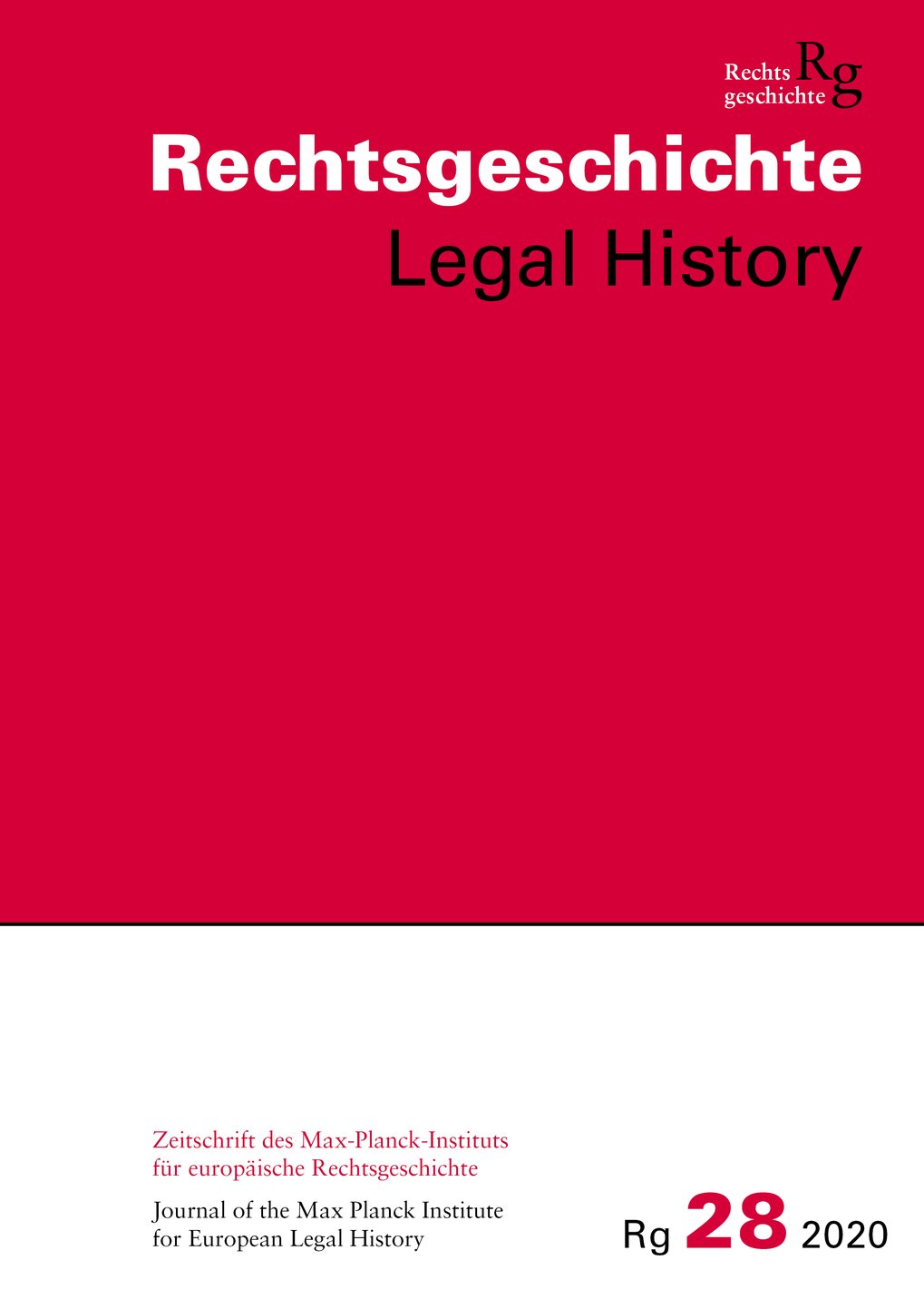
JOURNAL: Rechtsgeschichte (Issue 28)


The MPI for European Legal History published a new issue of its journal Rechtsgeschichte.

This year's edition of Rechtsgeschichte – Legal History. Journal of the Max Planck Institute for European Legal History was published recently in September and once again brings together outstanding research contributions on legal historical topics as well as a considerable number of reviews. Our sincere thanks go to the 57 authors who, despite the difficult conditions created by the Covid-19 pandemic, made it possible for us to deliver this year’s issue on time.

Five research contributions on very different topics kick off the issue. Tamar Herzog explores the debates between Romanists and Germanists regarding the origins of European law, with a particular focus on Spanish legal historiography. Her study demonstrates what narratives of legal origins reveal about law as well as about national or European identities. Christoph Meyer’s article is devoted to the epitomisation of Latin legal texts: a widespread technique that was significant not just in methodological and literary but also in normative-functional terms. Based on a plethora of primary sources and a detailed knowledge of the scholarly literature, Meyer offers a tour d'horizon of the often underrated method of epitomisation from late antiquity to the modern era. Thomas Pierson uses the substantial collection of so-called »service letters« (Dienstbriefe) of the city of Frankfurt am Main to trace the development of the contractual employment conditions of the city’s employees from the late 14th to the early 19th century. His findings provide stimuli for both the legal and the social history of pre-industrial labor. Martin Schennach probes the little-known depths of Austrian constitutional law scholarship. Since the second half of the 18th century, the flourishing genre of Staatsrechtslehre developed that aimed at the construction of an »entire Austrian state« (österreichischer Gesamtstaat). Finally, Klaus Günther analyses the historical conditions, characteristics, and consequences of the democratic transformation of modern criminal law. This leads him to examine the basic values of social cohesion and the assumption of duties of care and respect (Fürsorge- und Respektpflichten) by the citizens of a state.

Seven focus articles then deal with the legal history of the financial markets, for the first time systematically examining the fundamental relationships between risk cultures, crisis experiences, and developmental dynamics of (the knowledge of) law. The editors of this section, Carsten Fischer and Andreas Thier, introduce the topic. Jan Schröder provides the foreword to the second focus section, which is dedicated to the memory of Knut Wolfgang Nörr, who died in 2018. Three contributions pay tribute to both the personality and the oeuvre of Nörr, who for many years maintained a close association with the MPIeR as an External Scientific Member.

More than three dozen reviews deal with publications of relevance to legal history and published within the last two years. As in previous issues of the Rg, many reviews are written in a language other than that of the publication itself. The reviewed works’ contents range chronologically from antiquity to the present, and geographically from the coasts of Chile and the highlands of Mexico to northern European regions and on to Tanzania, Indochina and the empire of Genghis Khan.

Finally, the theme of the finance is also taken up by Juliane Voß-Wiegand, who provides an introduction to the numismatic collection of the Deutsche Bundesbank. She is not only the author of this issue’s marginalia on the historical monetary symbols preserved there, but also curated the impressive series of images that illustrates this year's print edition of the Rg.

Rechtsgeschichte — Legal History 28 is as always available in print from the publisher Vittorio Klostermann and online in Open Access via the journal's website.

JOB: Postdoctoral Research Fellows – Multidisciplinary Theory of Law (MPI for European Legal History, Frankfurt) (DEADLINE: 1 December 2020)


The newly established department “Multidisciplinary Theory of Law” at the Max Planck Institute for European Legal History  is looking to recruit up to four postdoctoral research fellows. Here the call:

The Max Planck Institute for European Legal History in Frankfurt is a world leader in researching the history of law in Europe and beyond. Its three research departments with more than 60 scholars, the unrivalled collections of its specialised library and its numerous national and international co-operations make it the central research hub for a global scientific community investigating the past, present and future of legal regimes.

Under the direction of Prof Dr Marietta Auer, the newly established department “Multidisciplinary Theory of Law” is looking to recruit, starting from 1 December 2020 (or as soon as possible thereafter) up to four (4)

Postdoctoral Research Fellows (m/f/d)

Your tasks


You will develop, co-ordinate and pursue an independent project within the framework of the newly established department for “Multidisciplinary Theory of Law”. The research fields Law in Modernity, Multidisciplinary Theory of Law and Private Law Theory, and Theory of Legal Science and the History of Legal Scholarship constitute the three foci of investigation. Projects related to the departmental research profile in the areas of private and commercial law as well as legal theory, legal philosophy and comparative law are also welcome. You will publish your findings and actively contribute to the research activities of the Institute.

Your profile


You hold a first class degree in law, the humanities or the social sciences, and you produced an outstanding doctoral thesis or an equivalent portfolio of publications in one of these disciplines. You are fully proficient (written and spoken) in both the German and English languages. For those with German legal training, a second state legal exam is preferred.
Your CV should demonstrate your potential to pursue research at the highest international level. You are able to adopt interdisciplinary approaches, work independently and efficiently, have excellent communication skills and the capacity to work in a team.

Our Offer


We offer an attractive and international research environment with unparalleled facilities and a good working atmosphere. Generous opportunities for personal and career development are provided. Support may be granted for research trips and conference travel in Germany and abroad. There is no obligation or expectation to teach, although teaching activities are encouraged.

Applicants may seek a part time or a full time position (39 hours per week), with mandatory presence in Frankfurt required. Remuneration and social benefits are based on the German Civil Service Collective Agreement (TVöD). Depending on your qualification and relevant experience, the annual salary before tax will be on a scale from EUR 51,100 (E 13 band 1) to EUR 74.300 (E13 band 6) for a full time position. The position is a fixed-term appointment for three years in the first instance, with the possibility of renewal for a further fixed-term period subject to satisfactory performance and the requirements of the 2007 Act on Academic Fixed-term Contracts (Wissenschaftszeitvertragsgesetz).

We are located on Campus Westend, one of the most beautiful university campuses in Europe, right at the heart of the thriving and cosmopolitan city of Frankfurt am Main, the centre of finance, banking and the legal professions of Europe’s biggest economy. The Institute belongs to the Max Planck Society, Germany’s most successful research organisation. Since its establishment in 1948, no fewer than 18 Nobel laureates have emerged from the ranks of its researchers, putting it on par with the most prestigious research institutions worldwide. The mission of the Max Planck Society is to conduct fundamental (ie, non-applied) research in the natural sciences, life sciences, social sciences and the humanities at the highest possible level. Its 86 Institutes are scattered across Germany and beyond, and they focus on research fields that are particularly innovative and require unusually extensive resources. The Institute is part of Max Planck Law, the network of eleven Max Planck Institutes that engage in advanced legal research. The first of these was established in Berlin in 1924. Today, we cover a broad range of legal studies, from the anthropology of law to tax law, at nine different locations across Germany and Luxembourg.

The Max Planck Society is committed to increasing the number of individuals with disabilities in its workforce and therefore encourages applications from such qualified individuals.
The Max Planck Society strives for gender and diversity equality. We welcome applications from all backgrounds.
Furthermore, the Max Planck Society seeks to increase the number of women in those areas where they are underrepresented and therefore explicitly encourages women to apply.

Application procedure
Your application should be written in either English or German and contain the following documents:

  1. Cover letter with a description of your research project;
  2. CV;
  3. List of publications and, if applicable, a list of courses taught and scholarly presentations;
  4. copies of school and university degree certificates as well as professional activities;
  5. one representative publication ca. 20 pages in length (journal article or book chapter)


Your application must be submitted online via the following link by the closing date of 1 November 2020https://www.rg.mpg.de/job-offers. Strong applicants will be invited for an interview here at the Institute shortly after the close of the call for applications.

Contact
Informal enquiries may be directed to Prof Dr Marietta Auer (auer@rg.mpg.de). Questions as to the terms and conditions of employment may be directed to Ms Rita Gommermann (jobs@rg.mpg.de).


More info here

07 September 2020

NEWS: Appointment Professor Marietta Auer as new director Max Planck Institute for European Legal History


(Source: MPI for European Legal History)


We learned that Professor Marietta Auer has been appointed as the new director of the Max Planck Institute for European Legal History in Frankfurt. Here the press release from the MPI:

The Institute is pleased to announce that Marietta Auer has accepted the Max Planck Society's offer to become a scientific member and director of the Max Planck Institute for European Legal History. Marietta Auer's appointment means that a further full-fledged department with a focus on legal theory will be established at the Institute, complementing the two existing departments dedicated to ‘European and comparative legal history’ (Department I, S. Vogenauer) and ‘Historical Regimes of Normativity’ (Department II, T. Duve). Marietta Auer is expected to take up her work in Frankfurt September, 1st, 2020.

Marietta Auer (1972) completed both legal examinations at the University of Munich. There she also earned her doctorate in law and was later habilitated — both under the supervision of Claus Wilhelm Canaris. Prof. Auer also had two longer stays at Harvard Law School, where she received her LLM in 2000 and her SJD in 2012. In addition to her legal studies, she has an MA in philosophy and sociology (Munich). After her habilitation in 2012, she received a professorship at the University of Giessen. There she has held the chair for private law and philosophy of law since 2013 and has served as dean since 2016. Her research focuses on private law and legal theory.

The directors, researchers and staff are all pleased about this strengthening of fundamental legal research within the Max Planck Society and the intellectual and institutional growth connected with Marietta Auer's appointment!

Thomas Duve, Stefan Vogenauer

27 July 2020

CALL FOR APPLICATIONS: Research Fellowship in the field of European Administrative History (MPI for European Legal History) (DEADLINE: 30 September 2020)


We learned of a call for applicants for the JEV Fellowship for European Administrative History at the Max Planck Institute for European Legal History. Here the call:

"JEV-Fellowship for European Administrative History"


At the end of 2012 Prof. Dr. Erk Volkmar Heyen, who served as Professor of Public Law and European Administrative History at the Ernst-Moritz-Arndt University of Greifswald until his retirement and as editor of the “Jahrbuch für europäische Verwaltungsgeschichte/Yearbook of European Administrative History” (JEV), which ran from 1989 to 2008, endowed a research fellowship in the field of European Administrative History ("The JEV-Fellowship for European Administrative History"). The fellowship falls within the framework of the German University Foundation (Bonn, Germany).

The scholarship is intended to benefit the next generation of researchers, particularly doctoral and post-doctoral students, to enable them to complete their research project in as brief a period as possible, ordinarily up to a maximum of 6 months. The scholarship is based on the usual rates for doctoral fellowships of the German Research Foundation (DFG). Should a fellowship be awarded to a researcher outside Germany, local scholarship rates will be taken into consideration. Marital status will not be taken into account, nor will travel or overhead costs be reimbursed.

The Board of the German University Foundation awards the fellowship on the recommendation of a jury, which is based at the Max Planck Institute for European Legal History (MPIeR) in Frankfurt.

Early stage researchers from Germany and abroad are invited to apply. In accordance with the thematic and methodological spectrum covered by the JEV, the scholarship is open to all historical disciplines, provided the research project addresses an aspect of European administrative history or history of administrative law from the sixteenth to the twentieth century. The relevance of the research topic should not be restricted to a particular national context. Comparative research questions are particularly welcome. It is expected that the research results will be published.

Applications for a scholarship commencing in January 2021 can be submitted until 30 September 2020. Applications in English or German should be sent in electronic form to: Priv.-Doz. Dr. Peter Collin, collin@rg.mpg.de. The application, which must also indicate  the intended duration of the fellowship, should include: a tabular CV with details on the applicant’s university education with copies of examination results and diplomas to be enclosed, a list of academic publications, where applicable; a detailed description of the research project including a detailed outline of the intended structure of the resulting book, a detailed report on the current state of the project and writing progress, including the reasons for any delay in its completion; extensive excerpts from the manuscript; information on the project’s previous,  current and planned financing arrangements; a precise timetable to complete the manuscript within the duration of the fellowship. Furthermore, at least one expert opinion on the research project and a personal reference from a university lecturer are to be submitted directly to the jury.

The MPIeR provides fellowship recipients with the opportunity to work in its library. Fellows are given the opportunity to present and discuss their research projects with members of the Institute. Upon expiration of the fellowship, the recipient is to submit a report on the status of the manuscript. The MPIeR provides for the publication of the manuscript in one of its book series, assuming it meets internal and scientific standards. The book is to acknowledge the support provided by the “JEV-Fellowship for European Administrative History” in the masthead or in the preface.

All info can be found here

17 July 2020

CALL FOR PAPERS: Conference - Digital Methods and Resources in Legal History (Frankfurt, 4-5 March 2021) (DEADLINE: 20 September 2020)


We learned of a call for papers for the next conference on digital methods and resources in legal history at the Max Planck Institute for European Legal History.

Um eine Gelegenheit für den kritischen Austausch über digitale Methoden und Ressourcen in der Rechtsgeschichte zu schaffen, und um einen Überblick über das breite Spektrum jener Methoden und Ressourcen zu vermitteln, veranstaltet das Max-Planck-Institut für europäische Rechtsgeschichte am 4./5. März 2021 eine Konferenz "Digital Methods and Resources in Legal History". Wir laden dazu ein, Sammlungen, Datenbanken, Gazetteers und andere für die Rechtsgeschichte einschlägige Ressourcen vorzustellen, sowie zu diskutieren, wie solche digitalen Ansätze in konkreten rechtshistorischen Projekt-Kontexten eingesetzt wurden. Ausdrücklich laden wir auch zum Bericht über Erfahrungen ein, in denen digitale Mittel nicht befriedigend gefunden, erzeugt oder eingesetzt werden konnten. Der Call for Papers/Posters ist hier einzusehen, zusammen mit einer ausführlicheren Darstellung der Thematik und weiteren Informationen. Einreichungen sollten bis 20. September 2020 per E-Mail an dlh@rg.mpg.de erfolgen.

The full call can be found here

13 June 2020

E-JOURNAL : MPI for European Legal History, SSRN Research paper series, Vol. 9, No. 2: Jun 11, 2020


(Source : MPI)

The MPI for European Legal History in Frankfurt has released a new issue of its online Research Paper Series on SSRN, Vol. 9, No. 2: Jun 11, 2020, T.Duve and S.Vogenauer (Eds). 

TABLE OF CONTENTS:

-Usuras (DCH) (Usuries (DCH))
María del Pilar Martínez López-Cano, National Autonomous University of Mexico (UNAM) - Instituto de Investigaciones Históricas

-The Salamanca School on Slavery: From Naturalism to Culture and Awareness
Francisco Castilla Urbano, University of Alcalá

-Depósito (DCH) (Deposit (DCH)
Gilberto Guerra Pedrosa, Max Planck Society for the Advancement of the Sciences - Max Planck Institute for European Legal History, Law School

-Sources of Law and Legal Method in Comparative Law
Stefan Vogenauer, Max Planck Society for the Advancement of the Sciences - Max Planck Institute for European Legal History

-Diversity as Paradox: Legal History and the Blind Spots of Law
Manuel Bastias Saavedra, Max Planck Society for the Advancement of the Sciences - Max Planck Institute for European Legal History

-Trueque (DCH) (Barter (DCH)
Pol Rene Moutin, Facultad de Derecho y Ciencias Sociales del Rosario

-Oficios Divinos (DCH) (Divine Offices (DCH))
Osvaldo Rodolfo Moutin, Max Planck Society for the Advancement of the Sciences - Max Planck Institute for European Legal History

-Reconvención (DCH) (Counterclaim (DCH))
Leopoldo López, El Colegio de Michoacán - Centro de Estudios de las Tradiciones

-The Research on the School of Salamanca (2008-2019). A Conceptual and Multidisciplinary Bibliography
Celia Alejandra Ramírez Santos, Universidad Complutense de Madrid (UCM)
José Luis Egío García, affiliation not provided to SSRN