Search

Showing posts with label ancient legal history. Show all posts

01 June 2026

SEMINAR: “Le rite réalise le droit“? – Rituals and the Law in the Ancient World (Marburg: Universität Marburg, 12–13 JUN 2026)

(image source: Universität Marburg)

“Le rite réalise le droit“? – Rituals and the Law in the Ancient World

Marburg University&Marburg Center for the Ancient World (MCAW)

In person participation: Marburg University, Room 00A26, Deutschhausstraße 12, 35032 Marburg

12–13 June 2026 (Friday–Saturday)

Program:

Friday, 12 June 2026
14:00. Introduction: Nils Heeßel (Marburg) and Constantin Willems (Marburg)

14:30. The Legal Value of Contractual Rites in Mesopotamia: Sophie Démare Lafont (Paris)

16:00. The Performative Nature of Sealing Clay Tablets: Steffen Jauß (Frankfurt)

17:00. In Search of the Lost Ritual. Ritual(s) and the implementation of Assyrian adê: Lionel Marti (Paris)

Saturday, 13 June 2026
09:00. The Role of Ritual in the Roman Legal Process: Grzegorz Blicharz (Cracow)

10:30. Formal Contracts in Roman Law and in the New Belgian Civil Code: Jean-François Gerkens (Liège)

11:30. Final Discussion, Conclusions: Nils Heeßel (Marburg) and Constantin Willems (Marburg)

The full Program is available in PDF format here: ProgramMCAW.

30 September 2022

BOOK: Koenraad VERBOVEN & Paul ERDKAMP (Eds.), Law and Economic Performance in the Roman World (Leiden: Brill, 2022). ISBN: 978-90-04-52512-2, €132.50


(Source: Brill)

ABOUT THE BOOK

Series: Impact of Empire, Volume: 44

This book offers critical analyses of the dynamic relation between legal regulations, institutions and economic performance in the Roman world. It studies how law and legal thought affected economic development, and vice versa. Inspired by New Institutional Economics scholars the past decades used ancient law to explain economic growth. There was, however, no natural selection process directing legal changes towards macro-economic efficiency. Ancient rulers and jurists modified institutions to serve or safeguard particular interests—political, social, or economic. Nevertheless both economic performance and legal scholarship peaked at unprecedented levels. These were momentous historical developments. How were they related?

ABOUT THE EDITORS

Koenraad Verboven, PhD (1998) Ghent, Professor of Ancient History at Ghent University, published extensively on ancient social and economic history, including The Economy of Friends (Latomus 2002) and The Impact of Justice on the Roman Empire (co-ed. O. Hekster, Brill 2019)

Paul Erdkamp, PhD (1998) Nijmegen, Professor of Ancient History at the Vrije Universiteit Brussel, published extensively on Roman economic history, including The Grain Market in the Roman Empire (CUP 2005) and Climate and Society in Ancient Worlds (co-ed. J. Manning and K. Verboven, Palgrave 2020)

Contributors are: Ulrike Babusiaux, Alberto Dalla Rosa, Paul Erdkamp, Hernán González Bordas, Stefania Gialdroni, Sven Günther, Lina Girdvainyte, Merav Haklai, Philip Kay, Dennis Kehoe, Emilia Mataix Ferrándiz, Peter Sarris, Boudewijn Sirks, Koenraad Verboven.


More information and table of contents with the publisher.

28 January 2021

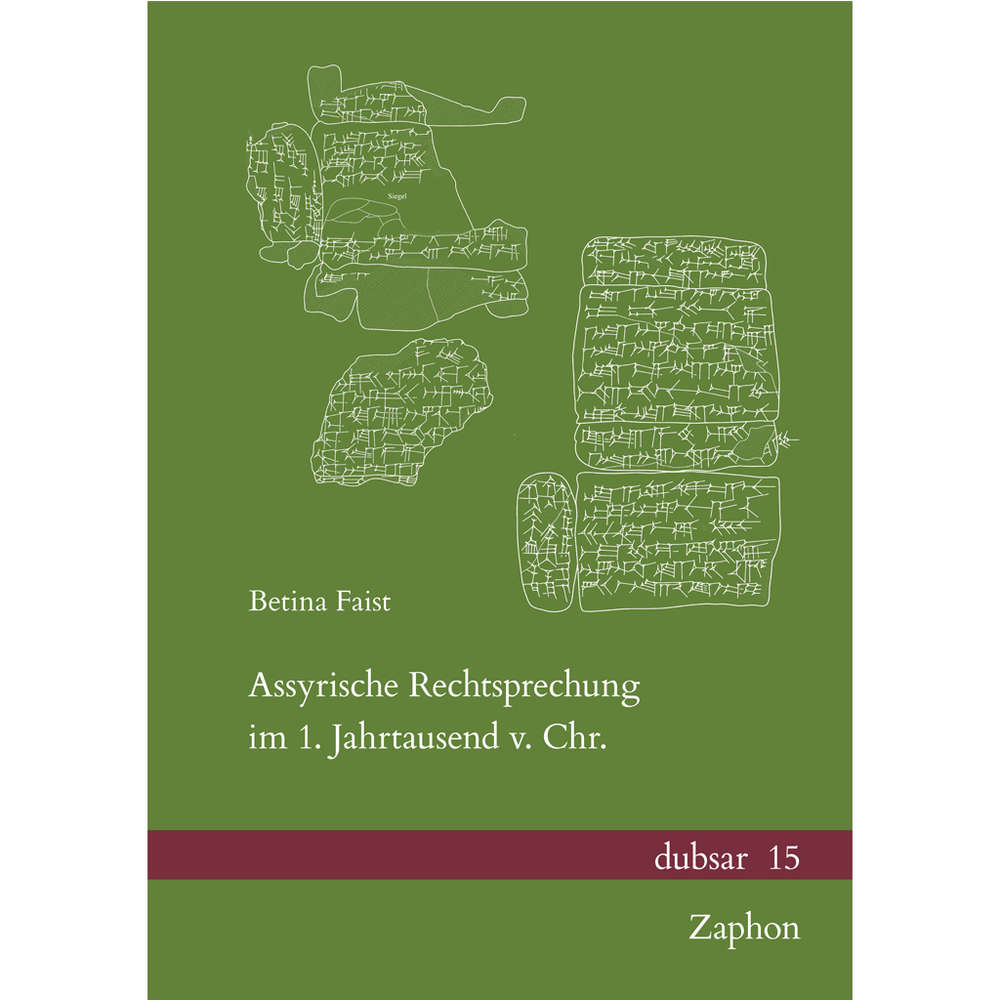
BOOK: Betina FAIST, Assyrische Rechtsprechung im 1. Jahrtausend v. Chr. (Münster: Zaphon, 2020). ISBN 978-3-96327-092-5, 90.00 EUR


(Source: Zaphon)

Zaphon has published a book on jurisprudence in the Neo-Assyrian period.

ABOUT THE BOOK

Betina Faist offers a systematic presentation of the jurisprudence in the Neo-Assyrian period based on a detailed examination of the traditional cuneiform texts. The methodological starting point is the analysis of the linguistic design of the texts, the research of the relevant terms and expressions as well as the critical examination of the available sources with regard to their thematic significance. This philological-historical approach is supplemented by a comparison with other epochs of the cuneiform tradition and with other legal circles. The sources available come from the “living” law of the Assyrians. First and foremost, these are documents in Neo-Assyrian language and script that were written down in the context of the settlement and settlement of private legal disputes. These are characterized by their formal diversity, which sets them apart from the other major types of documents such as A distinction is made between sales contracts and debt certificates, which follow a uniform form. The jurisprudence documented in the procedural documents mainly concerns disputes under private law (“civil jurisdiction”). Legal disputes affecting public interests, d. H. relating to the king, the palace (as an institution) or the temples are not recorded, but are discussed in royal correspondence. From this finding a more or less conscious distinction between individual and collective interests, between injustice against a fellow human being and injustice against the “state”, between “private” and “public” law can be derived. In contrast, no distinction is made between private and criminal law.

An appendix offers editions of 14 exemplary texts. Extensive lists of the documents examined complete the study.

TABLE OF CONTENTS

Abkürzungen / Allgemeine Abkürzungen / Bibliographische Abkürzungen 

1. Einleitung

    1.1 Auswahl des Themas 

    1.2 Ziel und Methode

    1.3 Aufbau der Arbeit

2. Das Quellenmaterial

    2.1 Der Textbestand 

    2.2 Die Typologie der Prozessurkunden

        2.2.1 Die Prozessurkunden nach ihrem Formular 

        2.2.2 Die Prozessurkunden nach ihrer Funktion

        2.2.3 Die Prozessurkunden nach ihrem Erscheinungsbild

        2.2.4 Die Prozessurkunden nach der assyrischen Terminologie 

3. Das Urkundenschema

4. Die Parteien und ihre Konflikte 

    4.1 Der soziale Hintergrund der Parteien

    4.2 Die Prozessfähigkeit von Frauen, Sklaven und Fremden

    4.3 Die Streitgegenstände

    4.4 Außergerichtliche Einigungen

5. Die Gerichtsorganisation 

    5.1 Die Richter 

    5.2 Die Rolle des Königs 

    5.3 Götter als Richter 

    5.4 Hilfspersonal

    5.5 Ort und Zeit des Gerichts 

6. Der Verfahrensablauf 

    6.1 Die Prozesseinleitung

    6.2 Das Erkenntnisverfahren

        6.2.1 Die Aussagen der Parteien

        6.2.2 Die Beweismittel 

            6.2.2.1 Zeugenbeweis

            6.2.2.2 Urkundenbeweis

            6.2.2.3 Eid 

            6.2.2.4 Gottesurteil (Ordal)

            6.2.2.5 Auf frischer Tat ertappt 

            6.2.2.6 Anscheinsbeweis 

            6.2.2.7 Geständnis 

    6.3 Die Streitbeilegung

7. Die Rechtsfolgen

    7.1 Charakterisierung 

    7.2 Vollstreckung 

    7.3 Anfechtung 

8. Abschließende Betrachtungen 

8.1 Zusammenfassung 

8.2 Prozessgrundsätze

8.3 Formen der Gerichtsbarkeit 

Anhang 1: Prozessurkunden aus Assur 

    Text 1: VAT 20374

    Text 2: VAT 9745

    Text 3: VAT 19169

    Text 4: VAT 20387

    Text 5: VAT 19493

    Text 6: VAT 20369

    Text 7: VAT 9312

    Text 8: VAT 9370

    Text 9: VAT 15579

    Text 10: VAT 19510

    Text 11: VAT 20398

    Text 12: VAT 20691

    Text 13: VAT 20792

    Text 14: VAT 20798

Anhang 2: Die Typologie der Prozessurkunden 

Anhang 3: Die Gerichtsorganisation 

Anhang 4: Die Datierung der Prozessurkunden 

Konkordanzen

    Konkordanz der Prozessurkunden in diesem Band 

    Konkordanz der Prozessurkunden in Jas 1996

Literatur 

Indizes 


More info here

21 January 2021

BOOK: Jacques BOUINEAU (Ed.), Les aspects politico-juridiques de la domination. De l'Antiquité au Moyen-Âge (Paris: L'Harmattan, 2020). ISBN: 978-2-343-21502-0, pp. 276, € 27,5

 
(Source: L'Harmattan)

ABOUT THE BOOK

Collection : Méditerranées

Quels sont les aspects politiques et juridiques de la domination ? Ce volume traite de l'Antiquité et du Moyen Âge. Il regroupe les textes issus de conférences prononcées dans le cadre du CEIR (Centre d'Études Internationales sur la Romanité) durant l'année 2019-2020 ou de communications présentées lors du colloque 2019 de « Méditerranées ». Des phénomènes d'évidence font sauter aux yeux la domination, tandis qu'existent aussi des zones de demi-teintes dans lesquelles la domination possède le double profil de Janus.

ABOUT THE EDITOR

Agrégé des facultés de droit et docteur en histoire médiévale, Jacques Bouineau a été successivement professeur aux universités de Poitiers, Paris X Nanterre, et La Rochelle. Il est également président de l'association Méditerranées, de l'association Antiquité-Avenir. Réseau des associations liées à l'Antiquité, directeur du CEIR et professeur d'histoire du droit.

Ont contribué à ce volume Raphaël Nicolle, Frédéric Payraudeau, Giovanni Lobrano, Emilia Ndiaye, Laurent Reverso, Nathalie Cros, Hadrien Chino, Lacen Oulhaj, Benoît Alix, Benjamin Galeran, Ivan Biliarsky.


More information with the publisher.

14 December 2020

BOOK: Michael GAGARIN and Paula PERLMAN, The Laws of Ancient Crete, c.650-400 BCE (Oxford: Oxford University Press, 2020). ISBN 9780198832515, 40.00 USD


We missed this book on the laws of Ancient Crete back in 2016, and which is now being published in paperback version.

ABOUT THE BOOK

This volume presents the Greek text of approximately 200 stone inscriptions, which detail the laws of ancient Crete in the archaic and classical periods, c.650-400 BCE. The texts of the inscriptions, many of which are fragmentary and relatively unknown, are accompanied by an English translation and also two commentaries; one focused on epigraphical and linguistic issues, and the other, requiring no knowledge of Greek, focused on legal and historical issues.

The texts are preceded by a substantial introduction, which surveys the geography, history, writing habits, social and political structure, economy, religion, and law of Crete in this period.

ABOUT THE AUTHORS

Michael Gagarin, Professor Emeritus of Classics, University of Texas at Austin,Paula Perlman, Professor of Classics, University of Texas at Austin

Michael Gagarin is Professor Emeritus of Classics at the University of Texas at Austin.

Paula Perlman is Professor of Classics at the University of Texas at Austin.

TABLE OF CONTENTS

Preface
Acknowledgements
List of Figures
Abbreviations
Note on Chronology
Introduction
Archaic and Classical Crete: Unity or Diversity?
Setting the Stage
The Inscriptions
Government
Persons
Social Institutions
Economy
Inter-Polis Relations
Religion
Law
Catalogue of Texts
Axos
Datala
Dreros
Eleutherna
Eltynia
Gortyn
Knossos
Lyktos
Phaistos
Prinias
Location of Inscriptions
Bibliography
Index of Greek Words
Index Locorum
Subject Index


More info here

16 November 2020

BOOK: Pamela BARMASH, The Laws of Hammurabi: At the Confluence of Royal and Scribal Traditions (Oxford: Oxford University Press, 2020). ISBN 9780197525401, 99.00 USD


(Source: OUP)

Oxford University Press is publishing a new book on the laws of Hammurabi.

ABOUT THE BOOK

Among the best-known and most esteemed people known from antiquity is the Babylonian king Hammurabi. His fame and reputation are due to the collection of laws written under his patronage. This book offers an innovative interpretation of the Laws of Hammurabi.

Ancient scribes would demonstrate their legal flair by composing statutes on a set of traditional cases, articulating what they deemed just and fair. The scribe of the Laws of Hammurabi advanced beyond earlier scribes in composing statutes that manifest systematization and implicit legal principles, and inserted the Laws of Hammurabi into the form of a royal inscription, shrewdly reshaping the genre. This tradition of scribal improvisation on a set of traditional cases continued outside of Mesopotamia. It influenced biblical law and the law of the Hittite empire significantly. The Laws of Hammurabi was also witness to the start of another stream of intellectual tradition. It became the subject of formal commentaries, marking a profound cultural shift. Scribes related to it in ways that diverged from prior attitudes; it became an object of study and of commentary, a genre that names itself as dependent on another text. The famous Laws of Hammurabi is here given the extensive attention it continues to merit.

ABOUT THE AUTHOR

Pamela Barmash teaches at Washington University in St. Louis and has served as director of Jewish, Islamic, and Near Eastern Studies there. She is the author of Homicide in the Biblical World, the co-editor of Exodus in the Jewish Experience: Echoes and Reverberations, and the editor of The Oxford Handbook of Biblical Law.

TABLE OF CONTENTS

Introduction

Chapter One: The Stela of the Laws of Hammurapi and the Representation of Political Power

Chapter Two: Royal Legitimization Through the Establishment of Justice

Chapter Three: The Laws of Hammurabi as a Royal Inscription

Chapter Four: Scribes and Statutes

Excursus: Scribes and Scribal Education

Chapter Five: Adoption in the Laws of Hammurabi

Chapter Six: The Legal Authority of the Laws of Hammurabi

Chapter Seven: The Afterlife of the Laws of Hammurabi: The Continuation of Scribal

Improvisation Outside of Mesopotamia and the Creation of Commentaries in

Mesopotamia

Conclusion

Acknowledgments

List of Abbreviations

List of Illustrations

Bibliography


More info here

10 November 2020

BOOK: David C. FLATTO, The Crown and the Courts: Separation of Powers in the Early Jewish Imagination (Cambridge: Harvard University Press, 2020). ISBN 9780674737105, EUR 36.00


Harvard University Press is publishing a new book on the separation of powers in the early Jewish imagination.

ABOUT THE BOOK

A scholar of law and religion uncovers a surprising origin story behind the idea of the separation of powers.

The separation of powers is a bedrock of modern constitutionalism, but striking antecedents were developed centuries earlier, by Jewish scholars and rabbis of antiquity. Attending carefully to their seminal works and the historical milieu, David Flatto shows how a foundation of democratic rule was contemplated and justified long before liberal democracy was born.

During the formative Second Temple and early rabbinic eras (the fourth century BCE to the third century CE), Jewish thinkers had to confront the nature of legal authority from the standpoint of the disempowered. Jews struggled against the idea that a legal authority stemming from God could reside in the hands of an imperious ruler (even a hypothetical Judaic monarch). Instead scholars and rabbis argued that such authority lay with independent courts and the law itself. Over time, they proposed various permutations of this ideal. Many of these envisioned distinct juridical and political powers, with a supreme law demarcating the respective jurisdictions of each sphere. Flatto explores key Second Temple and rabbinic writings—the Qumran scrolls; the philosophy and history of Philo and Josephus; the Mishnah, Tosefta, Midrash, and Talmud—to uncover these transformative notions of governance.


The Crown and the Courts argues that by proclaiming the supremacy of law in the absence of power, postbiblical thinkers emphasized the centrality of law in the people’s covenant with God, helping to revitalize Jewish life and establish allegiance to legal order. These scholars proved not only creative but also prescient. Their profound ideas about the autonomy of law reverberate to this day.

ABOUT THE AUTHOR

David C. Flatto, Professor of Law and of Jewish Philosophy at The Hebrew University of Jerusalem, is a scholar of Jewish law and philosophy as well as comparative constitutional law and jurisprudence.

TABLE OF CONTENTS

Introduction: Law and Power in Biblical and Western Jurisprudence

I. Second Temple Literature

1. Postbiblical Jurisprudence

2. Philo’s Jurisprudence

3. Qumran Literature on Kingship, Councils, and Law

4. Josephus on Kingship, Theocracy, and Law

II. Rabbinic Literature

5. Kingship and Law in Tannaitic Literature

6. Juridical Models in Tannaitic Literature

7. The Nasi and the Judiciary in Rabbinic Literature

III. Roots, Theory, Afterlife

8. Formative Factors

9. Ancient and Modern Jurisprudence

Conclusion

Abbreviations

Notes

Acknowledgments

Index of Names and Terms

Index Locorum


More info here

03 August 2020

BOOK: Wolfram BUCHWITZ, Schiedsverfahrensrecht in Antike Und Mittelalter - Eine Historische Grundlegung (Göttingen: Vandenhoeck & Ruprecht, 2020). ISBN 978-3-412-51933-9, 60,00 EUR


Vandenhoeck & Ruprecht is publishing a new book on arbitration during Antiquity and the Middle Ages.

ABOUT THE BOOK

Schiedsverfahren waren auch in Antike und Mittelalter verbreitete Mittel der außergerichtlichen Konfliktlösung. Das römische Recht hat viele konzeptionelle Grundlagen gelegt, auf denen spätere Epochen aufgebaut haben. Aus dem Mittelalter stammt die Einbettung in das Verfahrensrecht. Auf diesen historischen Vorläufern beruhen selbst noch einige Grundsätze des modernen Schiedsverfahrensrechts. In diesem Buch wird ein weiter Bogen geschlagen, der erstmalig die entsprechenden Unterschiede, Gemeinsamkeiten und Entwicklungslinien aufzeigt. Dabei werden die wichtigsten epochenübergreifenden dogmatischen Fragen des Schiedsverfahrensrechts thematisiert, aber auch die in der Praxis entwickelten Vertragsformulare in die Deutung mit einbezogen. Zeitlich umfasst die Darstellung die Periode vom 1. Jahrhundert v.Chr. bis zum 13. Jahrhundert n.Chr.

ABOUT THE AUTHOR

Wolfram Buchwitz ist Ordinarius für Bürgerliches Recht, Römisches Recht, Historische Rechtsvergleichung und Zivilprozessrecht an der Julius-Maximilians-Universität Würzburg und Richter am Oberlandesgericht Frankfurt.

More info here

29 June 2020

BOOK: Lorenzo GAGLIARDI & Laura PEPE (Eds.), Dike. Essays on Greek Law in Honor of Alberto Maffi (Milano: Giuffrè Francis Lefebvre, 2019). ISBN: 9788828803034, pp. XX-396, € 40,00

Dike


ABOUT THE BOOK

The essays collected in this volume are meant to honor of Alberto Maffi, two years after his retirement. They are all on Greek law, the subject to which professor Maffi has devoted most of his life and scholarship. The papers, whose authors are among the most eminent scholars from all over the world, deal with the main topic of ancient Greek law (private law, criminal law, constitutional law), and range from archaic and hellenistic Greece to Egypt in Roman times. The title of this Festschrift, Dike, celebrates the first international review in Greek and Hellenistic law that Alberto Maffi established, together with Eva Cantarella, twenty years ago.

ABOUT THE EDITORS

Lorenzo Gagliardi is associate professor at the Department of Private Law and Legal History, Università degli Studi di Milano.
Laura Pepe is research fellow at the Department of Private Law and Legal History, Università degli Studi di Milano.


More information available with the publisher.

11 March 2020

BOOK: Michael GAGARIN, Democratic Law in Classical Athens (Austin: University of Texas Press, 2020). ISBN 978-1-4773-2037-2, $45.00


University of Texas Press has published a new book on law in classical Athens.

ABOUT THE BOOK

The democratic legal system created by the Athenians was completely controlled by ordinary citizens, with no judges, lawyers, or jurists involved. It placed great importance on the litigants’ rhetorical performances. Did this make it nothing more than a rhetorical contest judged by largely uneducated citizens that had nothing to do with law, a criticism that some, including Plato, have made?

Michael Gagarin argues to the contrary, contending that the Athenians both controlled litigants’ performances and incorporated many other unusual features into their legal system, including rules for interrogating slaves and swearing an oath. The Athenians, Gagarin shows, adhered to the law as they understood it, which was a set of principles more flexible than our current understanding allows. The Athenians also insisted that their legal system serve the ends of justice and benefit the city and its people. In this way, the law ultimately satisfied most Athenians and probably produced just results as often as modern legal systems do. Comprehensive and wide-ranging, Democratic Law in Classical Athens offers a new perspective for viewing a legal system that was democratic in a way only the Athenians could achieve.

ABOUT THE AUTHOR

Michael Gagarin is the James R. Dougherty, Jr. Centennial Professor of Classics Emeritus at the University of Texas at Austin. His books include, most recently, The Laws of Ancient Crete, c. 650–400 BCE (with Paula Perlman).

TABLE OF CONTENTS

Preface
Introduction
Chapter 1. Democracy
Chapter 2. Performance
Chapter 3. Negotiation
Chapter 4. Rhetoric
Chapter 5. Rules and Relevance
Chapter 6. Justice
Chapter 7. Public Interest
Chapter 8. The Rule of Law
Conclusion
Bibliography
Index Locorum
General Index

More info here

03 March 2020

BOOK: Sinclair W. BELL and Paul DU PLESSIS, eds., Roman Law before the Twelve Tables - An Interdisciplinary Approach (Edinburgh: Edinburgh University Press, 2020). ISBN 9781474443968, £85.00


Edinburgh University Press is publishing a new book on Roman law before the Twelve Tables.

ABOUT THE BOOK

Bringing together a team of international experts from different subject areas – including law, history, archaeology and anthropology – this book re-evaluates the traditional narratives surrounding the origins of Roman law before the enactment of the Twelve Tables. Much is now known about the archaic period, relevant evidence from later periods continues to emerge and new methodologies bring the promise of interpretive inroads. This book explores whether, in light of recent developments in these fields, the earliest history of Roman law should be reconsidered.

Drawing upon the critical axioms of contemporary sociological and anthropological theory, the contributors yield new insights and offer new perspectives on Rome’s early legal history. In doing so, they seek to revise our understanding of Roman legal history as well as to enrich our appreciation of its culture as a whole.

ABOUT THE EDITORS

Sinclair W. Bell is Professor of Art History at Northern Illinois University. His research interests include art and archaeology of the Etruscans, spectacles in the Roman imperial period and the visual representation of slaves and foreigners in Roman imperial art. Sinclair currently the Editor of the Memoirs of the American Academy in Rome. He is co-editor of 12 books, including Companion to the Etruscans (Wiley, 2016) and Free at Last: The Impact of Freed Slaves on the Roman Empire (Bloomsbury, 2012).

Paul J. du Plessis is Professor of Roman Law at the University of Edinburgh. His research focuses predominantly on the multifaceted and complex set of relationships between law and society in a historical context. Paul is an experienced editor and author. He is co-editor of the following publications: The Making of the Ius Commune: From Casus to Regula (EUP, 2010), Beyond Dogmatics: Law and Society in the Roman World (EUP, 2007), Reassessing Legal Humanism and Its Claims (EUP, 2015) and The Oxford Handbook of Roman Law and Society (OUP, 2016). He is also editor of New Frontiers: Law and Society in the Roman World (EUP, 2013), Cicero's Law: Rethinking Roman Law of the Late Republic (EUP, 2016) and Borkowski's Textbook on Roman Law (OUP, 2015).

TABLE OF CONTENTS

Introduction: The Dawn of Roman Law
Paul J. du Plessis and Sinclair W. Bell
Part I: The Materiality of Roman Law: New Archaeological Discoveries
1. Roman Law in its Italic Context
James Clackson
2. Central Italian Elite Groups as Aristocratic Houses in the Ninth to Sixth Centuries B.C.E.
Matthew Naglak and Nicola Terrenato
3. Authority and Display in Sixth-Century Etruria: The Vicchio Stele
P. Gregory Warden and Adriano Maggiani
Part II: Constructing Early Roman Law: Sources and Methods
4. The Twelve Tables and the Leges regiae: A Problem of Validity
Carlos Amunátegui Perelló
5. The Leges regiae in Livy: Narratological and Stylistic Strategies
Marco Rocco
6. The Leges regiae through Tradition, Historicity and Invention: A Comparison of Historico-Literary and Jurisprudential Sources
Rossella Laurendi
7. The Laws of the Kings – A View from a Distance
Christopher Smith
8. Beyond the Pomerium: Expansion and Legislative Authority in Archaic Rome
Jeremy Armstrong
Part III: Roman Law in Historiography and Theory
9. Niebuhr and Bachofen: New Forms of Evidence on Roman History
Luigi Capogrossi Colognesi
10. Finding Melanesia in Ancient Rome: Mauss’s Anthropology of nexum
Alain Pottage
Index

More info here

06 February 2020

BOOK: Christine LEHNE-GSTREINTHALER, Iurisperiti et Oratores : Eine Studie zu den römischen Juristen der Republik (Göttingen: Vandenhoeck & Ruprecht, 2020). ISBN 978-3-412-50899-9, 110.00 EUR


Vandenhoeck & Ruprecht has published a new book on legal scholars in the Roman republic.

ABOUT THE BOOK

In der Studie gibt die Verfasserin in einem ersten Teil zunächst einen prosopographischen Überblick über die Juristen der römischen Republik, welche mit einer Zusammenschau ihrer responsa nebst weiterführenden Literaturangaben verbunden sind. Der zweite Teil enthält einen Überblick über die Disziplin „Rechtswissenschaft“ während dieser Epoche: Geschildert wird u.a., wie sich die Ausbildung eines Juristen gestaltete, was genau der Aufgabenbereich eines Juristen war und welche soziale Stellung diese in Rom innehatten.

Die Monographie bietet aufgrund des erweiterten Personenkreises nicht nur einen breiteren Überblick über die während der Republik tätigen römischen Juristen als die bisher zu diesem Themenbereich publizierten Werke, sondern zeigt auch neue, bisher unbekannte Aspekte aus dem Leben und Wirken der römischen Juristen auf.

Das Buch zeigt, dass für die römischen Juristen der Republik Recht und Rechtsfortbildung nicht nur eine "Privatangelegenheit" war, vielmehr prägten sie durch ihr Mitwirken an Gesetzesvorhaben, ihre responsa zum ius sacrum und ius publicum und ihre Beratung der politischen Führungspersönlichkeiten auch die Politik ihrer Epoche.

ABOUT THE AUTHOR

Christine Lehne-Gstreinthaler ist Assistenzprofessorin am Institut für Römisches Recht und Rechtsgeschichte der Universität Innsbruck.

TABLE OF CONTENTS

Can be found here

More info here

29 January 2020

BOOK : R. SZRAMKIEWICZ and O. DESCAMPS, Histoire du droit des affaires (Paris, L.G.D.J), 39 EUR. ISBN : 978-2-275-04507-8

(Source : LGDJ


 ABOUT THE AUTHORS :

Pr. Romuald SZRAMKIEWICZ (†) was a leading Professor of legal history in different French universities.

Pr. Olivier DESCAMPS is Professor at the University Paris II Panthéon-Assas, and Director of the Institut d'Histoire du Droit (CNRS-UMR 7184), Paris. 

BOOK ABSTRACT :

This is a new edition of the famous publication of Pr. Romuald SZRAMKIEWICZ (†). This book provides a historical perspective on trade law and institutions (from the earliest Antiquity to Contemporary times), at the time of globalisation. 

This publication is especially dedicated to students, academics, and those who want to understand current issues by learning the discipline's past.  

MORE INFORMATION (IN FRENCH) :

https://www.lgdj.fr/histoire-du-droit-des-affaires-9782275045078.html


04 October 2019

BOOK: Ilan PELED, Law and Gender in the Ancient Near East and the Hebrew Bible (London: Routledge, 2019). ISBN 9780367371494, £92.00


(Source: Routledge)

Routledge is publishing a new book on the regulation of gender relations in the ancient Near East and biblical law.

ABOUT THE BOOK

This volume examines how gender relations were regulated in ancient Near Eastern and biblical law. The textual corpus examined includes the various pertinent law collections, royal decrees and instructions from Mesopotamia and Hatti, and the three biblical legal collections.

Peled explores issues beginning with the wide societal perspective of gender equality and inequality, continues to the institutional perspective of economy, palace and temple, the family, and lastly, sex crimes. All the texts mentioned or referred to in the book are given in an appendix, both in the original languages and in English translation, allowing scholars to access the primary sources for themselves.

Law and Gender in the Ancient Near East and the Hebrew Bible offers an invaluable resource for anyone working on Near Eastern society and culture, and gender in the ancient world more broadly.

ABOUT THE AUTHOR

Ilan Peled is an Assyriologist working at the University of Amsterdam, author of Masculinities and Third Gender: The Origins and Nature of an Institutionalized Gender Otherness in the Ancient Near East, and editor of Structures of Power: Law and Gender Across the Ancient Near East and Beyond.

TABLE OF CONTENTS

Introduction
1. The Societal Perspective: Social Status and Gender (In)equality
2. The Institutional Perspective: Bureaucracy and Economy: The Palace, Temple, and Beyond
3. The Familial Perspective: Regulation of Family Life
4. The Individual Perspective: Morality and Sex Crimes
5. Summary, Analysis and Conclusions
Part II
6. Texts: The Primary Sources Mentioned and Discussed in the Book

All info here

12 June 2019

BOOK: Larry MAY, Ancient Legal Thought : Equality, Justice, and Humaneness from Hammurabi and the Pharaohs to Justinian and the Talmud (Cambridge: Cambridge University Press, 2019). ISBN 9781108484107, £110.00


(Source: CUP)

Cambridge University Press has published a new book on legality and the role of law in ancient societies.

ABOUT THE BOOK

This is a study of what constituted legality and the role of law in ancient societies. Investigating and comparing legal codes and legal thinking of the ancient societies of Mesopotamia, Egypt, Greece, India, the Roman Republic, the Roman Empire and of the ancient Rabbis, this volume examines how people used law to create stable societies. Starting with Hammurabi's Code, this volume also analyzes the law of the pharaohs and the codes of the ancient rabbis and of the Roman Emperor Justinian. Focusing on the key concepts of justice equity and humaneness, the status of women and slaves, and the idea of criminality and of war and peace; no other book attempts to examine such diverse legal systems and legal thinking from the ancient world.

ABOUT THE AUTHOR

Larry MayVanderbilt University, Tennessee

Larry May is Professor of Philosophy and Law, Emeritus at Vanderbilt University, Tennessee. He has published thirty-seven books, including Limiting Leviathan: Hobbes on Law and International Affairs (2013), Proportionality in International Law, with Michael Newton, (2014), Contingent Pacifism (Cambridge, 2015), Necessity in International Law, with Jens Ohlin (2016), International Criminal Tribunals, with Shannon Fyfe (Cambridge, 2017), and is editor of The Cambridge Handbook of the Just War (Cambridge, 2017). His books have won awards in law, philosophy, and political science and he has advised the US State Department, the CIA, the NIH, and the International Committee of the Red Cross.

TABLE OF CONTENTS

Part I. Mesopotamia and Egypt: Section 1. Ancient Procedural Law:
1. Ancient legal reasoning
2. Judging, trials, and assemblies
3. Oaths, ordeals, and truth
Section 2. Freedom, Equality, and Legal Status:
4. Debt forgiveness and equity
5. Freedom and slavery
6. Class, legal status, and equality
7. Women's separate sphere
Section 3. Crime and Punishment:
8. Complicity and conspiracy
9. Crime and Lex Talionis
10. Capital punishment
Section 4. International Justice:
11. Ancient treaties and trust
12. Aggressive war and necessity
Part II. Greece and China: Section 5. Law, Justice and Equity:
13. Custom and law in Ancient Greece and China
14. Justice and equity
15. Trial, juries, and democratic assemblies
Section 6. Legal Status:
16. Citizens and aliens
17. Women
18. Slavery and democracy
Section 7. Responsibility and Punishment:
19. Causation and responsibility
20. Homicide and pollution
21. Justification, excuse, and mitigation
22. Hubris and impiety
Section 8. War and Amnesty:
23. Amnesty, sanctuary, and exile
24. Justified war and the law of nations
Part III. India and the Roman Republic: Section 9. Law, Justice and Equity:
25. Law and its sources in Ancient Roman and Indian law
26. Legal procedures and trials
27. Equity and justice
Section 10. Legal Status and Social Class:
28. Legal status of women
29. Social class and slavery
Section 11. Responsibility and Punishment:
30. Political and moral crimes
31. Punishment, cruelty, and humaneness
32. Crimes concerning legal and political abuse
Section 12. War and Treaties:
33. Treaties, hostages, and keeping faith
34. The rules of war and the law of peoples
Part IV. Rabbinic Law and the Roman Empire: Section 13. Justice, Equity, and Conflict of Laws:
35. Law, morality, and religion
36. Dual legal regimes
37. The law and ancient legal scholars
Section 14. Differential Status:
38. Women in Jewish and Roman thought
39. Slaves in Jewish and Roman legal thought
Section 15. Responsibility:
40. Intention and causation in criminal law
41. Injury and murder
42. Public punishment, penal prisons, and police
Section 16. Universal Law at the End of Ancient Times:
43. Universal law and human rights
44. The origins of the just war doctrine
45. Final thoughts on equity, justice, and humaneness.

More information here

13 December 2018

INTERVIEW: Prof. dr. Philipp SCHEIBELREITER, "Von antiken Rechtsquellen lernen" (Vienna: Universität Wien, 9 NOV 2018)

(image source: Universität Wien)

At the occasion of his nomination as Professor of Ancient Legal History and Roman Law, the University of Vienna published an interview with our colleague Philipp Scheibelreiter.

Extract:
Können wir aus der Geschichte lernen? Natürlich, sagt Philipp Scheibelreiter, seit März Professor für Antike Rechtsgeschichte und Römisches Recht an der Universität Wien. Zeitlose, dogmatische Argumente und unterschiedliche juristische Lösungsansätze stehen bei seiner Forschung im Mittelpunkt.
Aus der Vergangenheit lernen nicht nur HistorikerInnen, sondern auch JuristInnen. Zumindest, wenn sie sich wie Philipp Scheibelreiter mit der Antiken Rechtsgeschichte und dem Römischen Recht beschäftigen. Für den gebürtigen Wiener, der seit März 2018 Professor an der Rechtswissenschaftlichen Fakultät der Uni Wien ist, steht dabei das Zeitlose seines Faches im Vordergrund: "Wir können von der funktionierenden und lebendigen Rechtswissenschaft der römischen Antike viel lernen. Natürlich existierte damals noch keine Rechtsordnung, wie wir sie heutzutage kennen, aber mich interessieren die zeitlosen, dogmatischen Argumentationslinien der römischen Juristen: Wie kamen sie zu einer Entscheidungsfindung? Welche Argumente gebrauchten sie zur Problemlösung und warum?"

Read further here.