Search

Showing posts with label Jewish law. Show all posts

12 February 2026

LECTURE SERIES: Focus (Jewish) law, (Jewish) history & theory (Wien: Universität Wien, JAN-DEC 2026)

(image source: Uni Wien)


University of Vienna

Faculty of Law

Department for Legal & Constitutional History


Team Wendehorst


Focus (Jewish) law, (Jewish) history & theory


10 February 2026


Programme 2026

-        […] not yet decided


13/14 February 2026, Vienna, Juridicum

Empire, Law & Debts. Lessons from the Holy Roman Empire VIII

Workshop

contact: Eric Lanzrath, eric.lanzrath@univie.ac.at; Prof. Dr. Rainer Klump, klump@hof.uni-frankfurt.de

For more see https://rechtsgeschichte.univie.ac.at/news-events/?no_cache=1


21/22 February 2026, Baden bei Wien/Vienna

Engagement at the Margins with Other Legal Systems: Jewish Law Locally and Globally,

CFP/Workshop

Together with the Jewish Law Association (JLA), European Chapter

Contact: Dr George Wilkes george.wilkes@kcl.ac.uk, Dr Stephan Wendehorst, stephan.wendehorst@univie.ac.at

For more see https://rechtsgeschichte.univie.ac.at/news-events/detailansicht/news/call-for-papers-engagement-at-the-margins-with-other-legal-systems-jewish-law-locally-and-globall/?no_cache=1&cHash=462ae2633857659437427640c174fc46


22-28 February 2026, Baden bei Wien, Reichenau & Payerbach an der Rax

Winterschool „Palaeography skills in Jewish, general and legal history 

Contact: Mohamed Attia, mohamed.attia@univie.ac.at

For more see https://jhrr.univie.ac.at/en/teaching/winter-school-palaeography-skills-in-jewish-general-and-legal-history/


22-27 February 2026, Baden bei Wien, Reichenau & Payerbach an der Rax

10th Jewish Law Moot Court, Leg 1 (together with the law faculties of the universities of Belgrade, Rijeka, Tel Aviv and Vilnius, the Masaryk University Brno, the Hebrew University Jerusalem and Cardozo Law School New York)

Contact: david.fuchs@univie.ac.at

For more see https://jhrr.univie.ac.at/en/teaching/historical-jewish-law-moot-court/


26 February 2026, University of Vienna Campus, Spitalgasse 2-4, Courtyard 1, Seminar Rooms 1 & 2

Book Presentation

Daniela F. Eisenstein and Carsten L. Wilke, eds., Mayer Bretzfeld (1747–1823) – der letzte bayerische Landesrabbiner. Briefe aus dem privaten Nachlass mit geschichtlichen Studien, Baden-Baden: Ergon-Verlag, 2025.

In cooperation with the library of the department of Judaic Studies of the University of Vienna

Contact: Paula Somogyi, MA, paula.somogyi@univie.ac.at


6 – 12 April 2026, Jerusalem, Austrian Hospice, Hebrew University of Jerusalem, Israel Institute for Advanced Studies, Jerusalem  

Legal History & Palaeography Clinic

Contact: Vincent Adali vincent.adali@univie.ac.at

For more see https://jhrr.univie.ac.at/en/teaching/paleography-legal-history-clinics/


14 April 2026, Juridicum Vienna

Lecture and Round-Table Discussion

Human Rights to Health and Dignity in Gaza, Physicians for Human Rights and Clean

Shelter

In Cooperation with the New Israel Fund

Contact: Dr Eleonore Lappin-Eppel, eleonore.lappin@chello.at, Dr. Stephan Wendehorst, stephan.wendehorst@univie.ac.at

For more see https://rechtsgeschichte.univie.ac.at/news-events/?no_cache=1


20 Mai 2026, Mühlhausen 

Die Reichsstadt Mühlhausen am Reichshofrat: Regesten, Bde 1-2, hg. von. Stephan Wendehorst, bearb. von Ulrich Hausmann (with numerous Jewish cases before the Imperial Aulc Council)

Contact: Birte Frerichs, birte.frerichs@lesser-stiftung.de, Ulrich Hausmann, MA, ulrich.hausmann@univie.ac.at

For more see https://rechtsgeschichte.univie.ac.at/news-events/?no_cache=1


11 June 2026, Fulda Kanzlerpalais-Volkshochschule

Paula Somogyi, Fuldaer jüdische Familiennamen der frühen Neuzeit (Veröffentlichung des Fuldaer Geschichtsvereins)    

Book Presentation

Contact: Paula Somogyi, MA, paula.somogyi@univie.ac.at, Dr. Thomas Heiler, Fuldaer Geschichtsverein, Thomas.Heiler@fulda.de

For more see https://rechtsgeschichte.univie.ac.at/news-events/?no_cache=1


23-31 July 2026, Kopenhagen, Hamburg-Altona

17th summer academy „History of the Jews in the Holy Roman Empire and its successor states

Contact: Georg Donabauer, B.A., georg.donabauer@univie.ac.at

For more see https://jhrr.univie.ac.at/en/teaching/univiesummerschool/


16.- 24. August 2026, Fulda

10th Jewish Law Moot Court, 2nd Coaching-Week (together with the law faculties of the universities of Vilnius, the Masaryk University Brno, the Hebrew University Jerusalem, Tel Aviv University, Cardozo Law School New York and the University of Rijeka)

Contact: david.fuchs@univie.ac.at

For more see https://jhrr.univie.ac.at/en/teaching/historical-jewish-law-moot-court/


[17.-26. August 2026, Fulda] 

Legal History & Palaeography Clinic

For more see https://jhrr.univie.ac.at/en/teaching/paleography-legal-history-clinics/


25 August 2026, Fulda, City Palace, State Hall 

10th Jewish Law Moot Court, Finals (together with the law faculties of the universities of Vilnius, the Masaryk University Brno, the Hebrew University Jerusalem, Tel Aviv University, Haifa University and Cardozo Law School New York)

Contact: david.fuchs@univie.ac.at

For more see https://jhrr.univie.ac.at/en/teaching/historical-jewish-law-moot-court/


[31 August – 5 September 2026 Mantua]

Legal History & Palaeography Clinic

For more see https://jhrr.univie.ac.at/en/teaching/paleography-legal-history-clinics/


17-22 September 2026, Jerusalem, Austrian Hospice, Hebrew University, Israel Institute for Advanced Studies, Jerusalem  

Legal History & Paleography Clinic

Contact: Vincent Adali vincent.adali@univie.ac.at

For more see https://jhrr.univie.ac.at/en/teaching/paleography-legal-history-clinics/


[November/Dezember 2026, 18.30 Uhr, University of Vienna, Juridicum

8th Salo-Wittmayer-Baron Lecture


In connection with the book presentations of the previous Salo-Wittmayer-Baron lectures

Contact: Dr Stephan Wendehorst, stephan.wendehorst@univie.ac.at

For more see https://jhrr.univie.ac.at/en/salo-wittmayer-baron-society/


17-22 December 2026, Jerusalem, Austrian Hospice, Israel Institute for Advanced Studies, Jerusalem  

Legal History & Palaeography Clinic

For more see https://jhrr.univie.ac.at/en/teaching/paleography-legal-history-clinics/


More information : Vincent dot adali at univie dot ac.

vincent.adali@univie.ac.at

12 December 2022

BOOK: Piet VAN BOXEL, Kristen MACFARLANE & Joanna WEINBERG (eds.), The Mishaic Moment. Jewish Law among Jews and Christiand and Early Modern Europe [Oxford-Warburg Studies] (Oxford: OUP, 2022), 432 p., IBSN 9780192898906


(image source: OUP)

Table of contents:

Introduction: The Mishnah between Jews and Christians in Early Modern Europe, Piet van Boxel, Joanna Weinberg, and Kirsten Macfarlane
Prelude
Humanism and the Mishnah: Paulus Fagius Edits Avot, Anthony Grafton
Some Concepts of Mishnah among 16th-Century Safedian Kabbalists, Moshe Idel
Translation and Pedagogy
The First Complete Latin translation of the Mishnah (1663-1676): Isaac Abendana and Rabbinic Erudition in Restoration England, Theodor Dunkelgrün
Isaac Abendana's German Student Theodor Dassow, the Latin translation of the Mishnah and the conversion of the Jews, Guido Bartolucci
'El sabio Jacob Abendana' and the Spanish Translation of the Mishnah, Yosef Kaplan
Commentary and Scholarship
Bringing Maimonides to Oxford: Edward Pococke, the Mishnah, and the Porta Mosis, Benjamin Williams
William Guise: the application of Arabic to the interpretation of Mishnah Zera'im, Alastair Hamilton
'Ancient Rabbis Inspired by God': Robert Sheringham's Surprising Edition of Mishnah Tractate Yoma (1648), Thomas Roebuck
Johann Christoph Wagenseil: From Scholar to Missionary, Piet van Boxel
Communities and Curricula
Between Law and Antiquarianism: The Christian Study of Maimonides's Mishneh Torah in Late Seventeenth-Century Europe, Marcello Cattaneo
The Significance of Historical Judaism and the Career of Humphrey Prideaux, Scott Mandelbrote
Cultivating Education and Piety: Menasseh ben Israel, Lay Readership, and the Printing of the Mishnah in the Seventeenth Century, David Sclar
Guilielmus Surenhusius (1664-1729)
The role of Jewish commentaries in Christian interpretation of the Mishnah in 17th century Northern Europe, Joanna Weinberg
Imagining Visually the Mishnah - From Wagenseil to Surenhuis (1674-1703), Richard Cohen
'To the advantage of the Republic of Letters'? Guilielmus Surenhusius's Projects, Plans, and Collaborations Beyond the Mishnah, Dirk van Miert
Christianity as Jewish Allegory? Guilielmus Surenhusius, Rabbinic Hermeneutics and the Reformed Study of the New Testament in the Early Eighteenth Century, Kirsten Macfarlan

See further here

08 March 2022

ROUND TABLE: "What’s Secular About Religious Law? Christian, Islamic, and Jewish Perspectives” with Rushain Abbasi, Orit Malka, and Atria Larson (March 31, University of Stanford, ONLINE)

(Image source: Wikipedia)

The Stanford Center for Law and History and the Taube Center for Jewish Studies are hosting a panel conversation on March 31, “What’s Secular About Religious Law? Christian, Islamic, and Jewish Perspectives.” The hybrid event will feature a discussion between Rushain Abbasi (Stanford Religious Studies), Orit Malka (Taube Center Stanford) and Atria Larson (Saint Louis University).

The panel will be a hybrid event held in-person (Stanford Law School Room 320D) and via Zoom on Thursday, March 31 from 4pm - 5pm (Pacific). As a reminder, we ask that you RSVP for each of our events in advance so that we can provide the Zoom link and for food ordering purposes for those of you who wish to join us in-person.

Current guidelines do not allow us to bring food into events. For those who attend in-person, however, food will be provided at 3:40PM, 20 minutes before the session at a table in Crocker Garden to the left of Room 190 entry doors.

To RSVP, click here. Those who confirm their attendance will receive a separate email containing the link to the event.


ABSTRACT

What makes a legal system “religious” or “secular”? How are the legal traditions of Islam, Judaism, and Christianity distinct from law as it is understood and practiced today? These are some of the questions which will be probed during this scholarly roundtable. In examining the relevance of the idea of the “secular” to premodern “religious” law, this panel aims to interrogate the very idea of “law” through a historical exploration of how law was conceptualized and applied within three distinct premodern religious traditions spanning the Late Antique and late medieval contexts. By bringing these distinct faith traditions into conversation, it is hoped that a more robust understanding of the place of law in history and its function within society may be obtained.


10 November 2020

BOOK: David C. FLATTO, The Crown and the Courts: Separation of Powers in the Early Jewish Imagination (Cambridge: Harvard University Press, 2020). ISBN 9780674737105, EUR 36.00


Harvard University Press is publishing a new book on the separation of powers in the early Jewish imagination.

ABOUT THE BOOK

A scholar of law and religion uncovers a surprising origin story behind the idea of the separation of powers.

The separation of powers is a bedrock of modern constitutionalism, but striking antecedents were developed centuries earlier, by Jewish scholars and rabbis of antiquity. Attending carefully to their seminal works and the historical milieu, David Flatto shows how a foundation of democratic rule was contemplated and justified long before liberal democracy was born.

During the formative Second Temple and early rabbinic eras (the fourth century BCE to the third century CE), Jewish thinkers had to confront the nature of legal authority from the standpoint of the disempowered. Jews struggled against the idea that a legal authority stemming from God could reside in the hands of an imperious ruler (even a hypothetical Judaic monarch). Instead scholars and rabbis argued that such authority lay with independent courts and the law itself. Over time, they proposed various permutations of this ideal. Many of these envisioned distinct juridical and political powers, with a supreme law demarcating the respective jurisdictions of each sphere. Flatto explores key Second Temple and rabbinic writings—the Qumran scrolls; the philosophy and history of Philo and Josephus; the Mishnah, Tosefta, Midrash, and Talmud—to uncover these transformative notions of governance.


The Crown and the Courts argues that by proclaiming the supremacy of law in the absence of power, postbiblical thinkers emphasized the centrality of law in the people’s covenant with God, helping to revitalize Jewish life and establish allegiance to legal order. These scholars proved not only creative but also prescient. Their profound ideas about the autonomy of law reverberate to this day.

ABOUT THE AUTHOR

David C. Flatto, Professor of Law and of Jewish Philosophy at The Hebrew University of Jerusalem, is a scholar of Jewish law and philosophy as well as comparative constitutional law and jurisprudence.

TABLE OF CONTENTS

Introduction: Law and Power in Biblical and Western Jurisprudence

I. Second Temple Literature

1. Postbiblical Jurisprudence

2. Philo’s Jurisprudence

3. Qumran Literature on Kingship, Councils, and Law

4. Josephus on Kingship, Theocracy, and Law

II. Rabbinic Literature

5. Kingship and Law in Tannaitic Literature

6. Juridical Models in Tannaitic Literature

7. The Nasi and the Judiciary in Rabbinic Literature

III. Roots, Theory, Afterlife

8. Formative Factors

9. Ancient and Modern Jurisprudence

Conclusion

Abbreviations

Notes

Acknowledgments

Index of Names and Terms

Index Locorum


More info here

05 August 2020

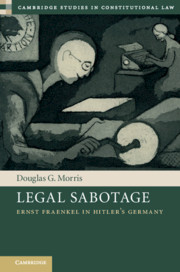
BOOK: Douglas G. MORRIS, Legal Sabotage : Ernst Fraenkel in Hitler’s Germany (Cambridge: Cambridge University Press, 2020). ISBN 9781108835008, USD 110.00


(Source: CUP)

Cambridge University Press is publishing a book on the Jewish leftist lawyer Ernst Fraenkel.

ABOUT THE BOOK

The Jewish leftist lawyer Ernst Fraenkel was one of twentieth-century Germany's great intellectuals. During the Weimar Republic he was a shrewd constitutional theorist for the Social Democrats and in post-World War II Germany a respected political scientist who worked to secure West Germany's new democracy. This book homes in on the most dramatic years of Fraenkel's life, when he worked within Nazi Germany actively resisting the regime, both publicly and secretly. As a lawyer, he represented political defendants in court. As a dissident, he worked in the underground. As an intellectual, he wrote his most famous work, The Dual State – a classic account of Nazi law and politics. This first detailed account of Fraenkel's career in Nazi Germany opens up a new view on anti-Nazi resistance – its nature, possibilities, and limits. With grit, daring and imagination, Fraenkel fought for freedom against an increasingly repressive regime.

ABOUT THE AUTHOR

Douglas MorrisFederal Defenders of New York

Douglas Morris is both a legal historian and a criminal defense attorney for indigent clients in New York City. He has published widely on twentieth-century German legal history and was a recipient of the 1998 Thurgood Marshall Award from the Association of the Bar of the City of New York for serving 'as pro bono counsel to a human being under a sentence of death'.

TABLE OF CONTENTS

Introduction
1. Setting the scene of a Jewish lawyer, like Fraenkel, in nazi Germany
2. Fraenkel as a social democrat practicing law in nazi Germany
3. Fraenkel as an essayist supporting the illegal underground
4. Fraenkel as a scholar renouncing the nazi regime's dual state
5. Thinking about legal justifications for sabotaging a tyrannical regime
Conclusion. The Ernst Fraenkel dilemma.

More info here

22 June 2020

ARTICLE: Sarah MANDEL, 'From London to Bombay: Judicial Comparisons between Parsis and Jews, 1702–1865' (English Historical Review CXXXV (2020), nr. 572 (Feb), 63-93)

(image source: OUP)

Abstract:
As England extended its authority over Bombay, Calcutta and other localities in early imperial India, law served as a medium of transfer between metropole and colony and English judges faced complex questions about the law’s relationship with its non-Christian subjects. While Hindus and Muslims were provided with authorised religious advisors at the English courts in India, Parsis remained officially excluded as a minority religious group. Judicial creativity, when faced with questions of Parsi marriage, divorce, child custody and conversion, was limited by judges’ ‘available conceptual resources’. Cases involving Jews in England from the eighteenth century proved to be uniquely relevant, as they rehearsed the fundamental challenges involved in the interaction of the Anglican establishment with non-Christian subjects. The common legal paradigm of Jews and Parsis was further manifested in the unconscious framing of outsiders in the courtroom using the metaphor of a ‘body of people’. This phrase, which appears only twenty times in the corpus of English Law Reports, reflects the physicalisation or personification of a society of individuals with a shared history, values, and political and legal framework. It expresses a judicial conception of them as distinct and unified, with the corollary negative associations of being threatening and potentially subversive. Despite their strong mercantile ties to the colonisers, Parsis thus served as the ‘Jews’ of India in the sense that they helped define and secure the majority by contradistinction, and their separateness was reinforced both explicitly and implicitly in legal encounters.
Read more with Oxford Journals.

09 December 2019

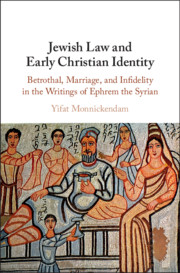
BOOK: Yifat MONNICKENDAM, Jewish Law and Early Christian Identity Betrothal, Marriage, and Infidelity in the Writings of Ephrem the Syrian (Cambridge: Cambridge University Press, 2019). ISBN 9781108480321, £ 75.00


Cambridge University Press is publishing a book on early Syriac Christianity and family law.

ABOUT THE BOOK

Ephrem, one of the earliest Syriac Christian writers, lived on the eastern outskirts of the Roman Empire during the fourth century. Although he wrote polemical works against Jews and pagans, and identified with post-Nicene Christianity, his writings are also replete with parallels with Jewish traditions and he is the leading figure in an ongoing debate about the Jewish character of Syriac Christianity. This book focuses on early ideas about betrothal, marriage, and sexual relations, including their theological and legal implications, and positions Ephrem at a precise intersection between his Semitic origin and his Christian commitment. Alongside his adoption of customs and legal stances drawn from his Greco-Roman and Christian surroundings, Ephrem sometimes reveals unique legal concepts which are closer to early Palestinian, sectarian positions than to the Roman or Jewish worlds. The book therefore explains naturalistic legal thought in Christian literature and sheds light on the rise of Syriac Christianity.

ABOUT THE AUTHOR

Yifat MonnickendamTel-Aviv University

Yifat Monnickendam is a senior lecturer in the Department of Jewish History at Tel Aviv University. Her work focuses on the rise of the Christian legal tradition in its Roman and Jewish context and she has published widely in leading journals.

TABLE OF CONTENTS

Introduction
1. Creating a primary bond: what is betrothal?
2. During betrothal: is premarital cohabitation an option?
3. Creating a marital bond: can rape determine marital status?
4. Breaking a marital bond: what do fornication and adultery do?
5. Discussion and conclusions.

More information here

19 November 2019

BOOK: Jay R. BERKOVITZ, Law's Dominion: Jewish Community, Religion, and Family in Early Modern Metz (Leiden-New York, Brill) ISBN 978-90-04-41740-3, EUR €63.00


(Source: Brill)

We learned of the publication of a new book on early modern Jewry and the law in Metz.

ABOUT THE BOOK

In Law’s Dominion, Jay Berkovitz offers a novel approach to the history of early modern Jewry. Set in the city of Metz, on the Moselle river, this study of a vibrant prerevolutionary community draws on a wide spectrum of legal sources that tell a story about community, religion, and family that has not been told before.

Focusing on the community’s leadership, public institutions, and judiciary, this study challenges the assumption that Jewish life was in a steady state of decline before the French Revolution. To the contrary, the evidence reveals a robust community that integrated religious values and civic consciousness, interacted with French society, and showed remarkable signs of collaboration between Jewish law and the French judicial system.

ABOUT THE AUTHOR

Jay R. Berkovitz, Ph.D. (1983), Brandeis University, is Distinguished Professor of Judaic and Near Eastern Studies (Emeritus) at the University of Massachusetts Amherst. He has published extensively in the fields of early modern history and law, including Protocols of Justice (Brill, 2014).

TABLE OF CONTENTS

Contents
Preface
Acknowledgments
Abbreviations
Maps

Introduction


Part 1: Foundations

Writing Jewish History through a Legal Lens
 Rabbinic Responsa Literature
 Communal Registers (Pinkasim)
 Lay and Rabbinic Court Records
 Law as a Cultural System
 The Production of the Metz Pinkas Beit Din

The Foundations of the Metz Kehillah
 Return of the Jews to France and the Establishment of the Metz Community
 Ritual and Identity
 Material Culture
 Economic Integration


Part 2: Community, Governance, Authority

Communal Autonomy and Governance
 Electoral and Administrative Procedures
 Consumption and Social Status
 Poverty and Social Welfare
 Juridical Autonomy and Recourse to Non-Jewish Courts
 Policing Religious and Cultural Boundaries

Lay and Rabbinic Judicial Authority
 Lay and Rabbinic Tribunals
 Sources of Law
 Judicial Procedure
 Functions of the Beit Din

Navigating the Challenges of Multiple Jurisdictions
 Language
 Production of Bi-lingual Documents
 Patterns of Litigation in the Beit Din
 Judicial Behavior of the Metz Beit Din
 The Acquaintance of the Beit Din with French Law and Judicial Procedure
 Navigating the Two Systems
 The Impact of French Law on Rabbinic Jurisprudence


Part 3: Family Affairs

Guardianship and Inheritance
 Guardianship
 Inheritance
 Testamentary Charity

Women, Marriage, and Property
 Betrothal and Marriage
 Marital Property
 Women in Credit and Commerce

Conclusion and Epilogue 
Glossary
Bibliography
Index 

More info here

06 March 2019

ADVANCE ARTICLE: Yifat MONNICKENDAM, "The Exposed Child: Transplanting Roman Law into Late Antique Jewish and Christian Legal Discourse " (American Journal of Legal History, 2019)

(image source: OUP)

Abstract:
In classical Roman law, a private act such as child exposure, child sale, or the pledging of children could not change the legal status of a child or turn a freeborn into a slave. In practice, however, decisions concerning the status of foundlings lay with their finders, who could readily enslave them. In the fourth century CE, in an attempt to minimize child exposure, Constantine legalized this practice, granting finders the official power to decide the legal status of foundlings: whether a child would be raised as a slave or adopted and raised as a freeborn citizen.Jews and Christians living under Roman rule addressed this question using Roman legislation alongside their own legal thought, practices, and traditions. In this paper, I survey the Jewish and Christian approaches to child exposure and demonstrate how Roman legislation was transplanted into two new legal contexts. While the Palestinian rabbis cited the Constantinian legislation, they molded it in the form of conversion, because Palestinian rabbinic halakha did not acknowledge legal adoption of children. The Christian writers, by contrast, at first sight appear to have ignored the question of status. They focused on defining exposure as murder, comparable to abortion and infanticide. A closer look, however, reveals that they replaced the question of civil status with one of religious status, describing the adoption of a foundling as baptism and inclusion in the growing Christian community.
Read more on Oxford Scholarship.

22 February 2019

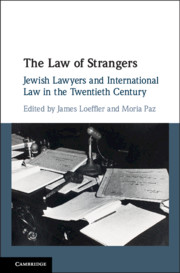
BOOK: James LOEFFLER & Moria Paz (eds.), The Law of Strangers Jewish Lawyers and International Law in the Twentieth Century (Cambridge: Cambridge UP, Sep 2019, ISBN 9781107140417, 110 USD

(image source: CUP)

Book abstract:
From the Nuremberg Trials to contemporary human rights, Jews have long played prominent roles in the making of international law. But the actual ties between Jewish heritage and legal thought remain a subject of mystery and conjecture even among specialists. This volume of biographical studies takes a unique interdisciplinary approach, pairing historians and legal scholars to explore how their Jewish identities and experiences shaped their legal thought and activism. Using newly-discovered sources and sophisticated interpretative methods, this book offers an alternative history of twentieth-century international legal profession – and a new model to the emerging field of international legal biography.
Table of contents:
1. Introduction: The Law of Strangers James Loeffler and Moria Paz
Part I: Hersch Zvi Lauterpacht
2. The “Natural Right of the Jewish People”: Zionism, International Law, and the Paradox of Hersch Lauterpacht James Loeffler
3. A Closet Positivist: Lauterpacht between Law and Diplomacy Martti Koskeniemmi
Part II: Hans Kelsen
4. Assimilation through Law: Hans Kelsen and the Jewish Experience Eliav Lieblich
5. Philosophy beyond Historicism: Reflections on Hans Kelsen and the Jewish Experience Leora Batnitzky
Part III: Louis Henkin
6. Louis Henkin, Human Rights, and American-Jewish Constitutional Patriotism, Samuel Moyn
7. Louis Henkin and the Genealogy of Jewish/American Liberalism William Forbath
Part IV: Egon Schwelb
8. Egon Schwelb and the Human Rights Legal Activism within Borders Mira Siegelberg
9. “Emotional Restraint” as Legalist Internationalism: Egon Schwelb's Liberalism after the Fall Umut Özsu
Part V: René Cassin
10. A Most Inglorious Right: René Cassin, Freedom of Movement, Jews and Palestinians Moria Paz
11. There's No Place Like Home: Domicile, René Cassin, and the Aporias of Modern International Law Nathaniel Berman Part VI: Shabtai Rosenne
12. Shabtai Rosenne: The Transformation of Sefton Rowson Rotem Giladi
13. Shabtai Rosenne: A Personal Aspect Philippe Sands
Part VII: Julius Stone
14. Enablement and Constraint: Julius Stone and the Contradictions of the Sociological Path to International Law Jacqueline Mowbray
15. An Axionormative Dissenter: Reflections on Julius Stone David N. Myers
Index.

More information with the publisher.

08 February 2019

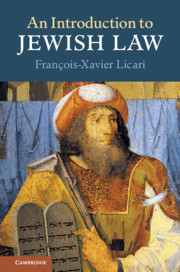
BOOK: François-Xavier LICARI, An Introduction to Jewish Law (Cambridge: CUP, 2019), ISBN 9781108379878

(image source: CUP)

Book abstract:
Jewish law is a singular legal system that has been evolving for generations. Often conflated with Biblical law or Israeli law, Jewish law needs to be studied in its own right. An Introduction to Jewish Law expounds the general structure of Jewish law and presents the cardinal principles of this religious legal system. An introduction to modern Jewish law as it applies to the daily life of Jews around the world, this volume presents Jewish law in a way that answers all the questions that a student of comparative law would ask when encountering an unfamiliar legal system. Sources of Jewish law such as revelation, rabbinical and communal legislation, judicial decisions, and legal reasoning are defined and analyzed, and the authority of who decides what Jewish law is and why their decisions are binding is investigated.
Advance praise:
‘Dr Licari has written an excellent and concise introduction to Jewish law for the reader of English. He provides a masterful overview of the basic jurisprudence of this very unique religious legal system. Many would benefit from reading this work.' (Michael J. Broyde - Emory University, Atlanta)
This penetrating essay will stimulate new research on Jewish law while also providing an invaluable resource for undergraduate and postgraduate courses – on Jewish law, on comparative law, and on religion and law. With rigorous attention to legal methodologies, and with well-chosen and wide-ranging bibliographies for all topics, the essay presents a refreshing account of the unfolding of Talmudic law as a field of study.' (George R. Wilkes, Jewish Law Association)

More information with CUP.

12 July 2018

BOOK: Neil NETANEL, From Maimonides to Microsoft : The Jewish Law of Copyright since the Birth of Print (Oxford: Oxford University Press, 2018). ISBN 9780190868772, $29.95


(Source: OUP)

Oxford University Press has just published the paperback edition of a book on the history of Jewish copyright law.

ABOUT THE BOOK

Jewish copyright law is a rich body of jurisprudence that developed in parallel with modern copyright laws and the book privileges that preceded them. Jewish copyright law owes its origins to a reprinting ban that the Rome rabbinic court issued for three books of Hebrew grammar in 1518. It continues to be applied today, notably in a rabbinic ruling outlawing pirated software, issued at Microsoft's request.

In From Maimonides to Microsoft, Professor Netanel traces the historical development of Jewish copyright law by comparing rabbinic reprinting bans with secular and papal book privileges and by relaying the stories of dramatic disputes among publishers of books of Jewish learning and liturgy. He describes each dispute in its historical context and examines the rabbinic rulings that sought to resolve it. Remarkably, the rabbinic reprinting bans and copyright rulings address some of the same issues that animate copyright jurisprudence today: Is copyright a property right or just a right to receive fair compensation? How long should copyrights last? What purposes does copyright serve? While Jewish copyright law has borrowed from its secular law counterpart at key junctures, it fashions strikingly different answers to those key questions.

The story of Jewish copyright law also intertwines with the history of the Jewish book trade and with steadfast efforts of rabbinic leaders to maintain their authority to regulate that trade in the face of the dramatic erosion of Jewish communal autonomy in the eighteenth and nineteenth centuries. This book will thus be of considerable interest to students of Jewish law and history, as well as copyright scholars and practitioners.

ABOUT THE AUTHOR

Neil Weinstock Netanel is the Pete Kameron Professor of Law at the University of California at Los Angeles School of Law where he writes and teaches in the areas of copyright, international intellectual property, and media and telecommunications. Prior to joining UCLA, Netanel served for a decade on the faculty of the University of Texas at Austin School of Law, where he was the Arnold, White & Durkee Centennial Professor of Law. He has also taught at the law schools of Harvard University, Haifa University, the Hebrew University of Jerusalem, Tel-Aviv University, the University of Toronto, and New York University. He authored Copyright's Paradox (Oxford, 2008; Paperback, 2010); and he edited The Development Agenda: Global Intellectual Property and Developing Countries (Oxford, 2008).

TABLE OF CONTENTS

Preface
Note on Transliteration, Translation, Acronyms, Word Choice, and Dates
1. Introduction: Microsoft in Bnei Brak
2. From Privileges and Printers' Guilds to Copyright
3. Rabbinic Reprinting Bans: Between Ktav Dat and Privilege
4. Maharam of Padua versus Giustiniani: Rival Editions of Maimonides's Mishneh Torah
5. Rabbinic Reprinting Bans Take Hold
6. From a Yiddish Bible to a German Prayer Book
7. Internecine Battles and the Slavuta Talmud
8. Moving Beyond Reprinting Bans: From Property to the Law of the Sovereign
9 The Present-Day Debate: Is Copyright Infringement "Stealing"?
Bibliography
Glossary and Biographies
Names Index
Subject Index

More information here