Search

Showing posts with label Early Christian Law. Show all posts

09 December 2019

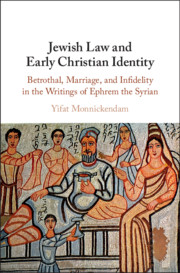
BOOK: Yifat MONNICKENDAM, Jewish Law and Early Christian Identity Betrothal, Marriage, and Infidelity in the Writings of Ephrem the Syrian (Cambridge: Cambridge University Press, 2019). ISBN 9781108480321, £ 75.00


Cambridge University Press is publishing a book on early Syriac Christianity and family law.

ABOUT THE BOOK

Ephrem, one of the earliest Syriac Christian writers, lived on the eastern outskirts of the Roman Empire during the fourth century. Although he wrote polemical works against Jews and pagans, and identified with post-Nicene Christianity, his writings are also replete with parallels with Jewish traditions and he is the leading figure in an ongoing debate about the Jewish character of Syriac Christianity. This book focuses on early ideas about betrothal, marriage, and sexual relations, including their theological and legal implications, and positions Ephrem at a precise intersection between his Semitic origin and his Christian commitment. Alongside his adoption of customs and legal stances drawn from his Greco-Roman and Christian surroundings, Ephrem sometimes reveals unique legal concepts which are closer to early Palestinian, sectarian positions than to the Roman or Jewish worlds. The book therefore explains naturalistic legal thought in Christian literature and sheds light on the rise of Syriac Christianity.

ABOUT THE AUTHOR

Yifat MonnickendamTel-Aviv University

Yifat Monnickendam is a senior lecturer in the Department of Jewish History at Tel Aviv University. Her work focuses on the rise of the Christian legal tradition in its Roman and Jewish context and she has published widely in leading journals.

TABLE OF CONTENTS

Introduction
1. Creating a primary bond: what is betrothal?
2. During betrothal: is premarital cohabitation an option?
3. Creating a marital bond: can rape determine marital status?
4. Breaking a marital bond: what do fornication and adultery do?
5. Discussion and conclusions.

More information here

12 September 2018

CALL FOR PROPOSALS: Ecclesiastical History Society – Winter Meeting 2019: The Church and the Law (DEADLINE: 31 October 2018)

(Source: EHS)

We learned of a Call for Proposals for the EHS’ Winter Meeting 2019. Here the call:

12 January 2019, Winter Meeting

Institute of Historical Research, London

The Winter Meeting continues with the 57th Summer Conference theme of The Church and the Law. As ever, the intention is to attract a broad spectrum of papers from across the history of Christianity.
Proposal forms for the Winter Meeting are available here. The deadline for proposals of 20-minute papers on the theme is 31 October 2018. Booking forms will be made available later this year and will be accompanied by an amended conference poster.

This theme addresses the legal issues and legal consequences underlying relations between secular and religious authorities in the context of the Christian church, from its earliest emergence within Roman Palestine as a persecuted minority sect through to the period when it became legally recognised within the Roman empire, its many institutional manifestations in East and West throughout the middle ages, the reconfigurations associated with the Reformation and Counter- Reformation, the legal and constitutional complications (such as in Reformation England or Calvin’s Geneva), and the variable consequences of so-called secularisation thereafter. On many occasions in recent years, moreover, we have been confronted with contemporary discrepancies, contradictions, and even rejection of secular laws, modern social mores or social attitudes. What were the legal consequences and implications of the Reformation, (including the confiscation and restitution of property), of the French wars of religion; the French Revolution; the political transformations of the nineteenth and twentieth centuries? Are there particular influences on the formation of ecclesiastical law (the Bible, Roman law, national law codes)? The engagement of secular and religious authorities with the law and what that law actually comprised (Roman law, canon law, national laws, state and royal edicts) are further issues to be addressed. This is also a theme that requires the examination of the formation of bodies of law and how and why it became recognised as law. The formation of canon law is a case in point. There is also the problem of definition. How early, for example, can a ‘code of canon law’ be defined, and what are the processes by which opinion and conciliar decision became perceived as ‘law’? What light does the transmission and reception of ‘canon law’ throw on such questions?

Delegates are encouraged to range widely within the theme. Possible case studies might include:

-  court cases
-  ​legal challenges to authority
-  discussions of legal culture and legal practice
-  legally orchestrated clashes between secular and ecclesiastical law
-  legal documents of many kinds


More information here 

03 August 2018

BOOK: Karl-Heinz LADEUR, Der Anfang des Westlichen Rechts - die Christianisierung der römischen Rechtskultur und die Entstehung des universalen Rechts (Tübingen: Mohr Siebeck, 2018). ISBN 978-3-16-155927-3, € 29,00


(Source: Mohr Siebeck

Mohr Siebeck has published a new book on the evolution of Roman law at the time of the Christianisation of the Roman Empire.

ABOUT THE BOOK

Karl-Heinz Ladeur entwickelt eine von der Rechtstheorie bestimmte neue Perspektive auf die römische Rechtskultur der Spätantike und deren Wandel im Prozess der Christianisierung. Damit gewichtet er auch die Bedeutung der Spätantike für die Herausbildung des neuzeitlichen Rechtsverständnisses anders. Die drei Gründungsorte der westlichen Rechtskultur, Jerusalem, Athen und Rom, bilden den Ursprung der Unruhe, die deren Evolution geprägt hat. Deren paradoxe »longue durée« hat Unterbrechungen nicht verhindert, aber die produktive wechselseitige Irritation zwischen Religion, Philosophie und Recht nie abgebrochen. Dadurch ist eine unfertige, unvollständige Rechtskultur ohne Einheit entstanden, die auf die Beobachtung und Ermöglichung des Wissens von der Welt eingestellt war. Die Bedingungen der Möglichkeit des subjektiven Rechts, der Rechtsperson, des universalen Rechts, sind in dieser Zeit entstanden.

ABOUT THE AUTHOR

Karl-Heinz Ladeur Geboren 1943; Professor für öffentliches Recht, zunächst Universität Bremen, Europäisches Hochschulinstitut (Florenz) und zuletzt (bis zur Emeritierung) Universität Hamburg; danach (2008–12) Distinguished Bremen Professor an der Bremen International Graduate School of Social Sciences; Ehrendoktorwürde der Universität Fribourg (CH); Forschungsaufenthalte in Paris, an der Harvard und an der Stanford University.


More information here  

31 August 2014

BOOK: "Jews in Early Christian Law", J. V. Tolan, N. de Lange, L. Foschia, C. Nemo-Pekelman (eds.)


Jews in Early Christian Law 
Byzantium and the Latin West, 6th-11th centuries

379 p., 156 x 234 mm, 2014

All information here

The sixth to eleventh centuries are a crucial formative period for Jewish communities in Byzantium and Latin Europe: this is also a period for which sources are scarce and about which historians have often had to speculate on the basis of scant evidence. The legal sources studied in this volume provide a relative wealth of textual material concerning Jews, and for certain areas and periods are the principal sources. While this makes them particularly valuable, it also makes their interpretation difficult, given the lack of corroborative sources.
The scholars whose work has been brought together in this volume shed light on this key period of the history of Jews and of Jewish-Christian relations, focusing on key sources of the period: Byzantine imperial law, the canons of church councils, papal bulls, royal legislation from the Visigoths or Carolingians, inscriptions, and narrative sources in Hebrew, Greek and Latin. The picture that emerges from these studies is variegated. Some scholars, following Bernhard Blumenkranz, have depicted this period as one of relative tolerance towards Jews and Judaism; others have stressed the intolerance shown at key intervals by ecclesiastical authors, church councils and monarchs.
Yet perhaps more than revealing general tendencies towards "tolerance" or "intolerance", these studies bring to light the ways in which law in medieval societies serves a variety of purposes: from providing a theologically-based rationale for social tolerance, to attempting to regulate and restrict inter-religious contact, to using anti-Jewish rhetoric to assert the authority or legitimacy of one party of the Christian elite over and against another. This volume makes an important contribution not only to the history of medieval Jewish-Christian relations, but also to research on the uses and functions of law in medieval societies.