Search

Showing posts with label Egyptian legal history. Show all posts

17 October 2025

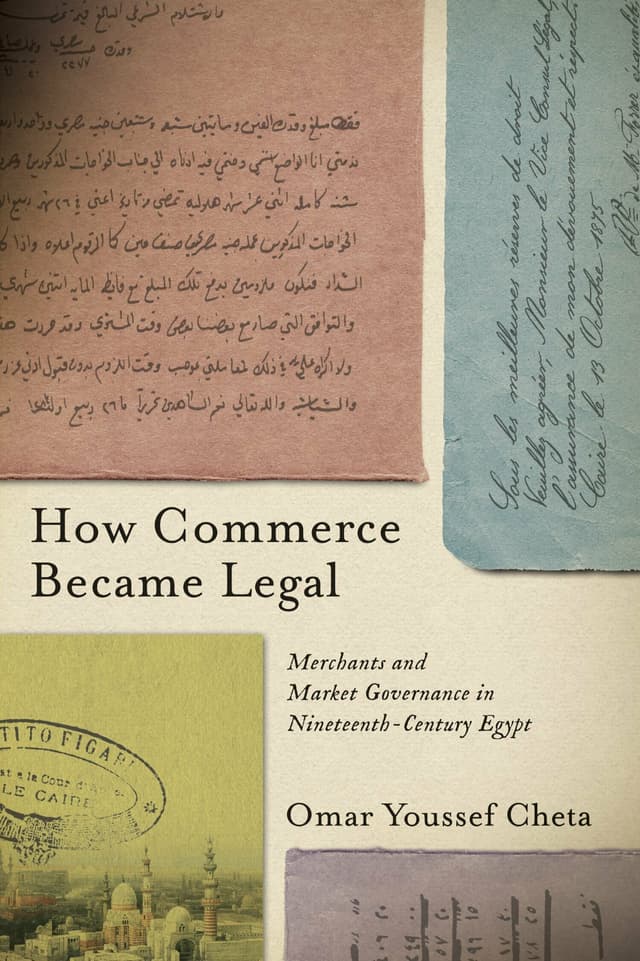
BOOK: Omar Youssef CHETA, How Commerce Became Legal. Merchants and Market Governance in Nineteenth-Century Egypt (Stanford: Stanford University Press, 2025), 268 p. ISBN 9781503643390, 70 USD


(image source: Stanford UP)

Abstract:

When Egypt's markets opened to private capital in the 1840s, a new infrastructure of commercial laws and institutions emerged. Egypt became the site of profound legal experimentation, and the resulting commercial sphere reflected the political contestations among the governors of Egypt, European consulates, Ottoman rulers, and a growing number of private entrepreneurs, both foreign and local. How Commerce Became Legal explores the legal and business practices that resulted from this fusion of Ottoman, French, and Islamic legal concepts and governed commerce in Egypt. Focusing on the decades between the formalization of Cairo's practical autonomy within the Ottoman Empire in the 1840s and its incorporation into the British Empire in the 1880s, Omar Cheta considers how modern laws redefined the commercial sphere, shaping a mode of market governance that would persist for decades to come. He highlights the demarcation of a new law-defined commercial realm separate from the land regime and from civil or family-centered exchanges, and reconstructs these changes through both legal codes and state orders, as well as individual merchant voices preserved in court documents. As this book documents both individual experiences and structural explanations, it offers a rare perspective on the scope and reach of market governance over the mid nineteenth century, revealing changes simultaneously from within and without state institutions.

On the author:

 Omar Youssef Cheta is Assistant Professor of History at Syracuse University.

Read more with the publisher. 

12 February 2025

BOOK: Mathieu TILLIER, Naïm VANTHIEGHEM, Mariages et séparations en Égypte au Moyen Âge. Actes inédits sur papyrus, papier, parchemin et tissu [Archiv für Papyrusforschung; Beihefte] (Berlin: De Gruyter 2024). ISBN: 9783111450339

(Image source: De Gruyter)


One day of December 875, the weaver ʿUmar b. Mūsā, married Ḥalīma bint Nafīs before illustrious witnesses from Fusṭāṭ. Some six centuries later, in the spring of 1411, Lady Fāṭima bint Fatḥ al-Dīn celebrated a second wedding with Ṭūġān, a promising Mamluk officer, and hosted him with her retinue in her Cairene palace. Present-day historians would know nothing of them had their marriage contract not withstood the ravages of time, as have the hundred or so documents that Mathieu Tillier and Naïm Vanthieghem are publishing, translating and studying for the first time in this volume. Rich or poor, free or enslaved, the men and women of Medieval Egypt adopted the habit, from at least the eighth century CE onwards, of having their unions recorded in order to lay down the terms and conditions of their marriage. Dissolution by repudiation (ṭalāq) or amicable divorce (ḫulʿ) were also entrusted to the care of notaries. The hitherto unpublished documents collected here, which span across the Abbasid, Fatimid, Ayyubid and Mamluk periods, provide a unique insight into matrimonial strategies among commoners as well as elite members, and into marital relationships and legal practices, both in the capital and in the Egyptian countryside. After a first part devoted to the editing of marriage contracts and divorces deed as well as a few related documents, the authors offer a detailed study of matrimonial practices in medieval Egypt based on Arabic documents.


On the authors

Mathieu Tillier, Sorbonne Université, Paris, France
Naïm Vanthieghem, IRHT-CNRS, Paris, France.


More information can be found here.

10 January 2022

BOOK: Roberto MASCELLARI. La lingua delle petizioni nell’Egitto romano Evoluzione di lessico, formule e procedure dal 30 a.C. al 300 d.C. (Firenze: FUP, 2021). DOI: 10.36253/978-88-5518-446-5. OPEN ACCESS


(Source: https://fupress.com/catalogo/la-lingua-delle-petizioni-nell-egitto-romano/7342)

This book investigates the linguistic and formal aspects of more than a thousand requests for justice and protection preserved in Egyptian papyri of the Roman Principate, mainly written in Greek. For many centuries in Egypt, from the Ptolemaic period to the late Roman Empire, petitions addressed to the judicial authorities shared the same textual structure and made use of recurring lexical formulas. Such uniformity was the result of the adherence by scribes and legal advisers to repertoires that had wide circulation. This study evaluates the correspondence between the formulas of the petitions and legislation, normative conventions, and spoken and literary language, and how these factors interacted with each other over the centuries.


More information: https://fupress.com/catalogo/la-lingua-delle-petizioni-nell-egitto-romano/7342 

02 March 2020

BOOK: Yaacov LEV, The Administration of Justice in Medieval Egypt From the 7th to the 12th Century (Edinburgh: Edinburgh University Press, 2020). ISBN 9781474459235, $125.00


(Source: OUP)

Edinburgh University Press is publishing a new book on judicial institutions in medieval Egypt.

ABOUT THE BOOK

This book shows how political and administrative forces shaped the way justice was applied in medieval Egypt. It introduces the model that evolved during the 7th to the 9th centuries, which involved four judicial institutions: the cadi, the court of complaint (mazalim), the police/shurta (responsible for criminal justice) and the Islamized market law (hisba) administrated by the market supervisor/muhtasib.

Literary and non-literary sources are used to highlight how these institutions worked in real-time situations such as the famine of 1024-1025, which posed tremendous challenges to the market supervisors in Cairo. The inner workings of the court of complaint during the 11th-12th century Fatimid state are revealed through array of documentary sources. Further, non-Muslim communities, their courts and their sphere of responsibilities are treated as integral to how justice was dispensed in medieval Islam. Documentary sources offers significant insights into these issues and illuminate the scope and limits of non-Muslims self-rule/judicial autonomy.              

In sum, the book shows that the administrative and political history of the judiciary in medieval Egypt implicitly and explicitly illuminates broader questions about religious and social forces that shaped the lives of medieval people in the Middle East, Muslims and non-Muslims alike.

ABOUT THE AUTHOR

Yaacov Lev is Professor (Emeritus) in Middle Eastern Studies at Bar Ilan University, Israel. He is author of several books including Saladin in Egypt (Brill, 1998), Charity, Endowments, and Charitable Institutions in Medieval Islam (University Press of Florida, 2006) and Towns and Material Culture in the Medieval Middle East (Brill, 2013). His most recent publications include articles in JSAI and Medieval Encounters, and a chapter in Developing Perspectives in Mamluk History, edited by Yuval Ben-Bassat (Brill, 2017).

TABLE OF CONTENTS

Acknowledgments

Introduction

Part One. The Cadi: Judge and Administrator

Chapter One. The Cadi's Jurisdiction: Evolution and Consolidation

Chapter Two. Sunn' Rulers and Their Cadis

Chapter Three. Ismaili Rulers and the Judicial System

Part Two. Judicial Institutions outside the Pale of Islamic Law

Chapter Four. Criminal Justice and the Police

Chapter Five. The Law of the Market

Chapter Six. The Ruler's Justice: The Mazalim Institution

Part Three. The Administration of Justice in Non-Muslim Communities

Chapter Seven. Judicial Autonomy: Medieval Realities and Modern Discourse

Chapter Eight. Administration of Justice in a Broader Perspective

More info here

12 June 2019

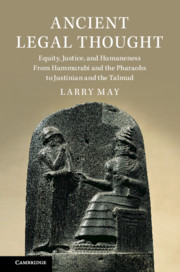
BOOK: Larry MAY, Ancient Legal Thought : Equality, Justice, and Humaneness from Hammurabi and the Pharaohs to Justinian and the Talmud (Cambridge: Cambridge University Press, 2019). ISBN 9781108484107, £110.00


(Source: CUP)

Cambridge University Press has published a new book on legality and the role of law in ancient societies.

ABOUT THE BOOK

This is a study of what constituted legality and the role of law in ancient societies. Investigating and comparing legal codes and legal thinking of the ancient societies of Mesopotamia, Egypt, Greece, India, the Roman Republic, the Roman Empire and of the ancient Rabbis, this volume examines how people used law to create stable societies. Starting with Hammurabi's Code, this volume also analyzes the law of the pharaohs and the codes of the ancient rabbis and of the Roman Emperor Justinian. Focusing on the key concepts of justice equity and humaneness, the status of women and slaves, and the idea of criminality and of war and peace; no other book attempts to examine such diverse legal systems and legal thinking from the ancient world.

ABOUT THE AUTHOR

Larry May, Vanderbilt University, Tennessee

Larry May is Professor of Philosophy and Law, Emeritus at Vanderbilt University, Tennessee. He has published thirty-seven books, including Limiting Leviathan: Hobbes on Law and International Affairs (2013), Proportionality in International Law, with Michael Newton, (2014), Contingent Pacifism (Cambridge, 2015), Necessity in International Law, with Jens Ohlin (2016), International Criminal Tribunals, with Shannon Fyfe (Cambridge, 2017), and is editor of The Cambridge Handbook of the Just War (Cambridge, 2017). His books have won awards in law, philosophy, and political science and he has advised the US State Department, the CIA, the NIH, and the International Committee of the Red Cross.

TABLE OF CONTENTS

Part I. Mesopotamia and Egypt: Section 1. Ancient Procedural Law:
1. Ancient legal reasoning
2. Judging, trials, and assemblies
3. Oaths, ordeals, and truth
Section 2. Freedom, Equality, and Legal Status:
4. Debt forgiveness and equity
5. Freedom and slavery
6. Class, legal status, and equality
7. Women's separate sphere
Section 3. Crime and Punishment:
8. Complicity and conspiracy
9. Crime and Lex Talionis
10. Capital punishment
Section 4. International Justice:
11. Ancient treaties and trust
12. Aggressive war and necessity
Part II. Greece and China: Section 5. Law, Justice and Equity:
13. Custom and law in Ancient Greece and China
14. Justice and equity
15. Trial, juries, and democratic assemblies
Section 6. Legal Status:
16. Citizens and aliens
17. Women
18. Slavery and democracy
Section 7. Responsibility and Punishment:
19. Causation and responsibility
20. Homicide and pollution
21. Justification, excuse, and mitigation
22. Hubris and impiety
Section 8. War and Amnesty:
23. Amnesty, sanctuary, and exile
24. Justified war and the law of nations
Part III. India and the Roman Republic: Section 9. Law, Justice and Equity:
25. Law and its sources in Ancient Roman and Indian law
26. Legal procedures and trials
27. Equity and justice
Section 10. Legal Status and Social Class:
28. Legal status of women
29. Social class and slavery
Section 11. Responsibility and Punishment:
30. Political and moral crimes
31. Punishment, cruelty, and humaneness
32. Crimes concerning legal and political abuse
Section 12. War and Treaties:
33. Treaties, hostages, and keeping faith
34. The rules of war and the law of peoples
Part IV. Rabbinic Law and the Roman Empire: Section 13. Justice, Equity, and Conflict of Laws:
35. Law, morality, and religion
36. Dual legal regimes
37. The law and ancient legal scholars
Section 14. Differential Status:
38. Women in Jewish and Roman thought
39. Slaves in Jewish and Roman legal thought
Section 15. Responsibility:
40. Intention and causation in criminal law
41. Injury and murder
42. Public punishment, penal prisons, and police
Section 16. Universal Law at the End of Ancient Times:
43. Universal law and human rights
44. The origins of the just war doctrine
45. Final thoughts on equity, justice, and humaneness.

More information here

19 November 2018

BOOK: Khaled Mahmoud FAHMY, In Quest of Justice : Islamic Law and Forensic Medicine in Modern Egypt (Berkeley: University of California Press, 2018). ISBN 9780520279032, $39.95


The University of California Press has published a new book on Islamic law and forensic medicine in Modern Egypt

ABOUT THE BOOK

In Quest of Justice provides the first full account of the establishment and workings of a new kind of state in Egypt in the modern period. Drawing on groundbreaking research in the Egyptian archives, this highly original book shows how the state affected those subject to it and their response. Illustrating how shari’a was actually implemented, how criminal justice functioned, and how scientific-medical knowledges and practices were introduced, Khaled Fahmy offers exciting new interpretations that are neither colonial nor nationalist. Moreover he shows how lower-class Egyptians did not see modern practices that fused medical and legal purposes in new ways as contrary to Islam. This is a major contribution to our understanding of Islam and modernity.

ABOUT THE AUTHOR

Khaled Fahmy is Sultan Qaboos bin Sa’id Professor of Modern Arabic Studies at the University of Cambridge. He is the author of All the Pasha’s Men: Mehmed Ali, His Army and the Making of Modern Egypt.

More information here

13 July 2018

BOOK: James E. BALDWIN, Islamic Law and Empire in Ottoman Cairo (Oxford: Oxford University Press, 2018). ISBN 9781474432139, $29.95


Oxford University Press has just published the paperback edition of a book on Islamic law in Ottoman Cairo.

ABOUT THE BOOK

What did Islamic law mean in the early modern period, a world of great Muslim empires? Often portrayed as the quintessential jurists' law, to a large extent it was developed by scholars outside the purview of the state. However, for the Sultans of the Ottoman Empire, justice was the ultimate duty of the monarch, and Islamic law was a tool of legitimation and governance. James E. Baldwin examines how the interplay of these two conceptions of Islamic law - religious scholarship and royal justice - undergirded legal practice in Cairo, the largest and richest city in the Ottoman provinces. Through detailed studies of the various formal and informal dispute resolution institutions and practices that formed the fabric of law in Ottoman Cairo, his book contributes to key questions concerning the relationship between the shari'a and political power, the plurality of Islamic legal practice, and the nature of centre-periphery relations in the Ottoman Empire.

ABOUT THE AUTHOR

James E. Baldwin is Lecturer in Empires of the Early Modern Muslim World at Royal Holloway, University of London.

TABLE OF CONTENTS

Abbreviations
Abbreviations
Note on transliteration and dates
Introduction
1. A Brief Portrait of Cairo under Ottoman Rule
2. Cairo's Legal System: Institutions and Actors
3. Royal Justice: The Divan-i Hümayun and the Diwan al-Ali
4. Government Authority, the Interpretation of Fiqh, and the Production of Applied Law
5. The Privatization of Justice: Dispute Resolution as a Domain of Political Competition
6. A Culture of Disputing: How Did Cairenes Use the Legal System?
Conclusion: Ottoman Cairo's legal system and grand narratives
Appendix: Examples of Documents Used in this Study
Notes
Map: Cairo in the Eighteenth Century
Glossary
Sources and Works Cited
Index

More information here