Search

Showing posts with label islamic legal history. Show all posts

19 April 2022

BOOK: Rutger KRAMER, Walter POHL (eds.), Empires and Communities in the Post-Roman and Islamic World, C. 400-1000 CE (Oxford: Oxford University Press, 2021), ISBN: 9780190067 OPEN ACCESS


(Image source: Oxford University Press


ABOUT THE BOOK

This book deals with the ways empires affect smaller communities like ethnic groups, religious communities and local or peripheral populations. It raises the question how these different types of community were integrated into larger imperial edifices, and in which contexts the dialectic between empires and particular communities caused disruption. How did religious discourses or practices reinforce (or subvert) imperial pretenses? How were constructions of identity affected in the process? How were Egyptians accommodated under Islamic rule, Yemenis included in an Arab identity, Aquitanians integrated in the Carolingian empire, Jews in the Fatimid Caliphate? Why did the dissolution of Western Rome and the Abbasid Caliphate lead to different types of polities in their wake? How was the Byzantine Empire preserved in the 7th century; how did the Franks construct theirs in the 9th? How did single events in early medieval Rome and Constantinople promote social integration in both a local and a broader framework?

Focusing on the post-Roman Mediterranean, this book deals with these questions from a comparative perspective. It takes into account political structures in the Latin West, in Byzantium and in the early Islamic world, and does so in a period that is exceptionally well suited to study the various expansive and erosive dynamics of empires, as well as their interaction with smaller communities. By never adhering to a single overall model, and avoiding Western notions of empire, this volume combines individual approaches with collaborative perspectives. Taken together, these chapters constitute a major contribution to the advancement of comparative studies on pre-modern empires.


ABOUT THE EDITORS

Rutger Kramer, Assistant Professor of Medieval History, Radboud University, The Netherlands.

Walter Pohl, Professor of History, University of Vienna, Austria.


TABLE OF CONTENTS

  1. Introduction: Empires and Communities in the Post-Roman and Islamic World (Walter Pohl and Rutger Kramer)
  2. The Emergence of New Polities in the Break-Up of the Abbasid Caliphate (Hugh Kennedy)
  3. The Emergence of New Polities in the Break-Up of the Western Roman Empire (Walter Pohl)
  4. Comparative Perspectives: Differences between the Dissolution of the Western Roman Empire and the Abbasid Caliphate (Walter Pohl and Hugh Kennedy)
  5. Fragmentation and Integration: A Response to the Contributions by Hugh Kennedy and Walter Pohl (Peter Webb)
  6. Historicizing Resilience: The Paradox of the Medieval East Roman State; Collapse, Adaptation, and Survival (John Haldon)
  7. Processions, Power, and Community Identity: East and West (Leslie Brubaker and Chris Wickham)
  8. Death of a Patriarch: The Murder of Yuhanna ibn Jami (966) and the Question of 'Melkite' Identity in Early Islamic Palestine (Daniel Reynolds)
  9. Diversity and Convergence: The Accommodation of Ethnic and Legal Pluralism in the Carolingian Empire (Stefan Esders and Helmut Reimitz)
  10. Franks, Romans, and Countrymen: Carolingian Interests, Local Identities, and the Conquest of Aquitaine (Rutger Kramer)
  11. From the Sublime to the Ridiculous: Yemeni Arab Identity in Abbasid Iraq (including Appendix: translations of selected poems) (Peter Webb)
  12. Loyal and Knowledgeable Supporters: Integrating Egyptian Elites in Early Islamic Egypt (Petra Sijpesteijn)
  13. Concluding Thoughts: Empires and Communities (Chris Wickham)


More information can be found here

The entire publication can be read in open access at this link

21 December 2021

BOOK: Talal AL-ZALEM, Rule-Formulation and Binding Precedent in the Madhhab-Law Tradition. Ibn Quṭlūbughā’s Commentary on The Compendium of Qudūrī (Leiden: Brill, 2016). ISBN: 978-90-04-32283-7, €110.00

(Source: Brill)

ABOUT THE BOOK

Series: Islamicate Intellectual History, Volume: 2

In Rule-Formulation and Binding Precedent in the Madhhab-Law Tradition, Talal Al-Azem argues for the existence of a madhhab-law tradition’ of jurisprudence underpinning the four post-classical Sunni schools of law. This tradition celebrated polyvalence by preserving the multiplicity of conflicting opinions within each school, while simultaneously providing a process of rule formulation ( tarjīḥ) by which one opinion is chosen as the binding precedent ( taqlīd). The predominant forum of both activities, he shows, was the legal commentary. Through a careful reading of Ibn Quṭlūbughā's (d. 879/1474) al-Taṣḥīḥ wa-al-tarjīḥ, Al-Azem presents a new periodisation of the Ḥanafī madhhab, analyses the theory of rule formulation, and demonstrates how this madhhab-law tradition facilitated both continuity and legal change while serving as the basis of a pluralistic Mamluk judicial system. 

ABOUT THE AUTHOR

Talal Al-Azem, DPhil (2011), University of Oxford, is the Mohammed Noah Fellow at the Oxford Centre for Islamic Studies. His research focuses on traditions of law and learning in the medieval and early modern Muslim world.

TABLE OF CONTENTS

Introduction 1 
Chapter 1 Authors 23 
A The compendium author: Qudūrī . . . . . . . . . . . . . . 24 
B The commentator: Ibn Quṭlūbughā . . . . . . . . . . . . . 37 
Chapter 2 History 51 
A Ibn Quṭlūbughā’s sources . . . . . . . . . . . . . . . . . . 51 
B Periodisation . . . . . . . . . . . . . . . . . . . . . . . . . 53 
Period 1: Foundational ‘Ḥanafī’ opinions (ca. 150–200) . . . 57 
Period 2: Formative transmission (ca. 200–300) . . . . . . 58 
Period 3: Classical consolidation (ca. 300–400) . . . . . . 60 
Period 4: Tarjīḥ (ca. 400–650) . . . . . . . . . . . . . . . . 63 
Period 5: Taṣḥīḥ (ca. 650–870) . . . . . . . . . . . . . . . . 79 
Who are the ‘latter-day jurists’ (al-muta’akhkhirūn)? . . . . 87 
C Historical geographical patterns . . . . . . . . . . . . . . . 90 
D Periodisation and the typologies of jurists (ṭabaqāt al-fuqahā’) 96 
Chapter 3 Theory 105 
A Ibn Quṭlūbughā’s introduction to al-Taṣḥīḥ wa-al-tarjīḥ . . 108 
B Analysis of the topics . . . . . . . . . . . . . . . . . . . . . 118 
1 Definitions . . . . . . . . . . . . . . . . . . . . . . . . 118 
2 The procedures of rule-determinacy . . . . . . . . . . 125 
3 Judicial discretion . . . . . . . . . . . . . . . . . . . . 134 
C Arguments for binding precedent . . . . . . . . . . . . . . 137 
1 The ethico-religious argument . . . . . . . . . . . . . 138 
2 The argument from legal-system consistency . . . . . 139 
3 The argument from legal-system coherence . . . . . . 143 
4 The argument from strengthened decision-making . . 145 
5 The argument from predictability . . . . . . . . . . . 145 
viii CO N T E N T S 
6 The argument from historical determinism . . . . . . 146 
D Historical developments . . . . . . . . . . . . . . . . . . . 149 
1 Target audiences: muftis and muftis . . . . . . . . . . 149 
2 Rule-determination (tarjīḥ) vs. rule-review (taṣḥīḥ) . . 150 
3 From monist to pluralistic legal systems . . . . . . . . 153 
4 Madhhab-law: tradition, system, concurrent jurisdictions 154 
E The (lack of) definition of ẓāhir al-riwāya . . . . . . . . . . 157 
Chapter 4 Practice 163 
A Ibn Quṭlūbughā’s practice of rule-review . . . . . . . . . . 163 
B The functional relationships of commentary . . . . . . . . 166 
To resolve a juristic dispute . . . . . . . . . . . . . . . . . 169 
To clarify a point of ambiguity . . . . . . . . . . . . . . . . 174 
To identify the opinion or the transmission used in the rule formulation 
. . . . . . . . . . . . . . . . . . . . . . . . . 177 
To further expand upon the passage . . . . . . . . . . . . 179 
To identify an editorial problem in the passage itself . . . . 187 
C Employed legal rhetorical reasoning . . . . . . . . . . . . . 189 
1 Arguments of juristic evidence (dalīl) . . . . . . . . . 190 
2 Arguments of transmission (riwāya) . . . . . . . . . . 192 
3 Arguments of language and logic . . . . . . . . . . . . 195 
4 Arguments from revelation and the early Muslim community 
. . . . . . . . . . . . . . . . . . . . . . . . . . . . 197 
5 Arguments from scholarship . . . . . . . . . . . . . . 200 
6 Justifications from juristic considerations . . . . . . . 202 
7 Justifications from context . . . . . . . . . . . . . . . 207 
8 Justifications from exigencies of change and necessity . 209 
9 Justifications of lifting difficulty and facilitating ease . 212 
10 Justifications of preceding juristic authority . . . . . . 214 
D Operative principles of rule-determination . . . . . . . . . 218 
E The degree of congruence between theory and practice . . 229 
Conclusion 235 
Appendices 243 
A The Writings of Qudūrī 245 
B Jurists cited by Ibn Quṭlūbughā 249 
C Works cited by Ibn Quṭlubughā 255 
CO N T E N T S ix 
Works Cited 259 
Index 271


More information with the publisher.

BOOK: Carolyn BAUGH, Minor Marriage in Early Islamic Law (Leiden: Brill, 2017). ISBN: 978-90-04-34483-9, €99.00

(Source: Brill)

ABOUT THE BOOK

Series: Studies in Islamic Law and Society, Volume: 41

In Minor Marriage in Early Islamic Law, Carolyn Baugh offers an in-depth exploration of 8th-13th century legal sources on the marriageability of prepubescents, focusing on such issues as maintenance, sexual readiness, consent, and a father’s right to compel. Modern efforts to resist establishment of a minimum marriage age in countries such as Saudi Arabia rest on claims of early juristic consensus that fathers may compel their prepubescent daughters to marry. This work investigates such claims by highlighting the extremely nuanced discussions and debates recorded in early legal texts. From the works of famed early luminaries to the “consensus writers” of later centuries, each chapter brings new insights into a complex and enduring debate. 

ABOUT THE AUTHOR

Carolyn G. Baugh, Ph.D. (2011), University of Pennsylvania, is Assistant Professor of History at Gannon University. In addition to scholarly articles, she has translated Ibn Khaldūn’s treatise on Sufism, Shifāʾ al-sāʾil fī tahdhīb al-masāʾil for the Library of Arabic Literature.

TABLE OF CONTENTS

Part One: The Early Formative Era 
Chapter One: Contextualizing and Conceptualizing Minor Marriage 
Chapter Two: The Early Compendia 
Chapter Three: Early Ḥanafī Thought 
Chapter Four: Early Mālikī Thought 
Chapter Five: Al-Shāfiʿī 

Part Two; Consensus, Consensus Writing, Post-Formative Era Writing, and Whether Consensus Matters 
Chapter Six: Consensus 
Chapter Seven: Writing Consensus 
Chapter Eight: Post-Formative Era Thought on Minor Marriage 
Conclusion: Does Consensus Matter? 

Appendix: Excerpts from the Early Compendia 
Bibliography 
Index 


More information with the publisher.

16 December 2020

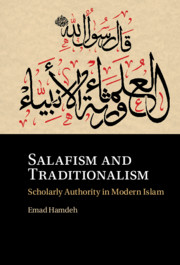
BOOK: Emad HAMDEH, Salafism and Traditionalism - Scholarly Authority in Modern Islam (Cambridge: Cambridge University Press, 2020). ISBN 9781108485357, 75.00 GBP


(Source: CUP)

Cambridge University Press is publishing a new book on the history of Islamic scholarship and scholarly authority in the 20th century, with a focus on Salafism.

ABOUT THE BOOK

One of the most contentious topics in modern Islam is whether one should adhere to an Islamic legal school or follow scripture directly. For centuries, Sunni Muslims have practiced Islam through the framework of the four legal schools. The 20th century, however, witnessed the rise of individuals who denounced the legal schools, highlighting cases where they contradict texts from the Qur'ān or Sunna. These differences are exemplified in the heated debates between the Salafi ḥadīth scholar Muḥammad Nāṣir al-Dīn al-Albānī and his Traditionalist critics. This book examines the tensions between Salafis and Traditionalists concerning scholarly authority in Islam. Emad Hamdeh offers an insider's view of the debates between Salafis and Traditionalists and their differences regarding the correct method of interpreting Islam. He provides a detailed analysis of the rise of Salafism, the impact of the printing press, the role of scholars in textual interpretation, and the divergent approaches to Islamic law.

ABOUT THE AUTHOR

Emad HamdehEmbry-Riddle University

TABLE OF CONTENTS

Part I. History:

1. Traditionalism and Salafism

2. A controversial Salafi

3. Gatekeepers of knowledge: self-learning and Islamic expertise

Part II. Islamic Law:

4. Can two opposing opinions be valid? Legal pluralism in Islam

5. Qur'an and Sunna or the Madhhabs?

6. The pursuit of authencity: reevaluating weak Hadith

7. Challenging early Hadith Scholarship.


More info here

04 December 2020

BOOK: Jocelyn HENDRICKSON, Leaving Iberia Islamic Law and Christian Conquest in North West Africa (Cambridge: Harvard University Press, 2020). ISBN 9780674248205, 45.00 EUR


(Source: HUP)

Harvard University Press is publishing a new book on Islamic legal responses to Muslims living under Christian rule in medieval and early modern Iberia and North Africa.

ABOUT THE BOOK

Leaving Iberia: Islamic Law and Christian Conquest in North West Africa examines Islamic legal responses to Muslims living under Christian rule in medieval and early modern Iberia and North Africa. The fall of al-Andalus, or reconquista, has long been considered a turning point, when the first substantial Muslim populations fell under permanent Christian rule. Yet a near-exclusive focus on conquered Iberian Muslims has led scholars to overlook a substantial body of legal opinions issued in response to Portuguese and Spanish occupation in Morocco itself, beginning in the early fifteenth century.

By moving beyond Iberia and following Christian conquerors and Muslim emigrants into North Africa, Leaving Iberia links the juristic discourses on conquered Muslims on both sides of the Mediterranean, critiques the perceived exceptionalism of the Iberian Muslim predicament, and adds a significant chapter to the story of Christian–Muslim relations in the medieval Mediterranean. The final portion of the book explains the disparate fates of these medieval legal opinions in colonial Algeria and Mauritania, where jurists granted lasting authority to some opinions and discarded others.
Based on research in the Arabic manuscript libraries of five countries, Leaving Iberia offers the first fully annotated translations of the major legal texts under analysis.

ABOUT THE AUTHOR

Jocelyn Hendrickson is Associate Professor of Religious Studies at the University of Alberta.

More info here

14 April 2020

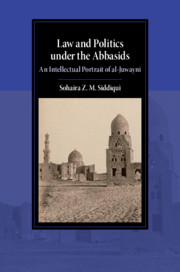
BOOK: Sohaira Zahid SIDDIQUI, Law and Politics under the Abbasids : An Intellectual Portrait of Al-Juwayni (Cambridge: Cambridge University Press, 2019). ISBN 9781108496780, £ 75.00


Cambridge University Press is publishing a new book on law and politics under Abu Ma'ali al-Juwayni of the Abbasid dynasty.

ABOUT THE BOOK

Abu Ma'ali al-Juwayni (d.478/1085) lived in a politically tumultuous period. The rise of powerful dynastic families forced the Abbasid Caliph into a position of titular power, and created instability. He also witnessed intellectual upheavals living amidst great theological and legal diversity. Collectively, these experiences led him to consider questions of religious certainty and social and political continuity. He noted that if political elites are constantly changing, paralleled with shifting intellectual allegiances, what ensures the continuity of religion? He concluded that continuity of society is contingent upon knowledge and practice of the Shari'a. Here, Sohaira Siddiqui explores how scholars grappled with questions of human reason and knowledge, and how their answers to these questions often led them to challenge dominant ideas of what the Shari'a is. By doing this, she highlights the interconnections between al-Juwayni's discussions on theology, law and politics, and the socio-political intellectual landscapes that forged them.

ABOUT THE AUTHOR

Sohaira Z. M. SiddiquiGeorgetown University, Qatar

Sohaira Z. M. Siddiqui is an Assistant Professor at Georgetown University, Qatar. She has published a series of articles in the Journal of Islamic Studies, Islamic Law and Society, the Journal of the American Oriental Society and Middle East Law and Governance. She is also the editor of a forthcoming volume entitled Locating the Shari'a: Legal Fluidity in Theory, History and Practice. She has held fellowships at the University of Cambridge and Harvard Law School and is a series editor for Sapientia Islamica, published with Mohr Siebeck.

ABOUT THE AUTHOR

Introduction
Part I. Historical Background:
1. Politics, patronage, and scholarship in Nishapur
2. Al-Juwaynī: life of a scholar
Part II. Epistemology:
3. Intellectual fissures: the Ashʿarīs and the Muʿtazila
4. The epistemology of al-Juwaynī
Part III. Legal Theory:
5. Certainty in legal sources: Hòadīth
6. Certainty in legal sources: Ijmāʿ
7. The rise of legal uncertainty: Qiyās al-Maʿnā
8. Coping with legal uncertainty: Qiyās al-Shabah
Part IV. Political Thought:
9. The search for continuity: al-Juwaynī's political thought
10. Continuity, custom, and applied epistemology in al-Juwaynī's political thought
Conclusion.

More info here

12 March 2020

BOOK: Intisar A. RABB & Abigail KRASNER BALBALE (eds.), Justice and Leadership in Early Islamic Courts [Harvard Series in Islamic Law, 7] (Cambridge (Mass.): Harvard University Press, 2017), 260 p. ISBN 9780674984219, € 40,5

(image source: Harvard UP)

Abstract:
This book presents an in-depth exploration of the administration of justice during Islam’s founding period, 632–1250 CE. Inspired by the scholarship of Roy Parviz Mottahedeh and composed in his honor, this volume brings together ten leading scholars of Islamic law to examine the history of early Islamic courts. This approach draws attention to both how and why the courts and the people associated with them functioned in early Islamic societies: When a dispute occurred, what happened in the courts? How did judges conceive of justice and their role in it? When and how did they give attention to politics and procedure? Each author draws on diverse sources that illuminate a broader and deeper vision of law and society than traditional legal literature alone can provide, including historical chronicles, biographical dictionaries, legal canons, exegetical works, and mirrors for princes. Altogether, the volume offers both a substantive intervention on early Islamic courts and on methods for studying legal history as social history. It illuminates the varied and dynamic legal landscapes stretching across early Islam, and maps new approaches to interdisciplinary legal history.
(more information with Harvard University Press)

23 January 2020

BOOK : Samy A. AYOUB, Law, Empire, and the Sultan, (Oxford, 2020) ISBN: 9780190092924, £75.00

                                     (Source : Oxford University Press)
 

Law, Empire, and the Sultan Ottoman Imperial Authority and Late Hanafi Jurisprudence

ABOUT THE BOOK:  

-Reconsiders fundamental premises about Ottoman sultanic authority.
-Gives a new perspective on the later development of the Hanafi school of Islamic law in the Ottoman Empire.
-Explains how legal revisions by Muslim jurists of the period were not temporary strategies but rather involved the use of built-in mechanisms to reinterpret Islamic law and keep it relevant to the changing social, political, and economic circumstances of the Ottoman Empire.
-Provides detailed analysis and fresh insights on a wide range of legal issues through careful reading of understudied sources, uncirculated manuscripts, and extensive references to authoritative Hanafi texts.
ABOUT THE AUTHOR:

-Samy Ayoub specializes in Islamic law, modern Middle East law, and law and religion in contemporary Muslim societies. He focuses on issues concerning the interaction between religion and law, and the role of religion in contemporary legal and socio-political systems within a global comparative perspective.


11 December 2019

BOOK: Nurit TSAFRIR, Collective Liability in Islam The ‘Aqila and Blood Money Payments (Cambridge: Cambridge University Press, 2019). ISBN 9781108498647, $ 99.99


(Source: CUP)

Cambridge University Press is publishing a new book on the Aqila in the history of Islamic law.

ABOUT THE BOOK

Offering the first close study of the ʿAqila, a group collectively liable for blood money payments on behalf of a member who committed an accidental homicide, Nurit Tsafrir analyses the group's transformation from a pre-Islamic custom to an institution of the Shari'a, and its further evolution through medieval and post medieval Islamic law and society. Having been an essential factor in the maintenance of social order within Muslim societies, the ʿAqila is the intersection between legal theory and practice, between Islamic law and religion, and between Islamic law and the state. Tracing the history of the ʿAqila, this study reveals how religious values, state considerations and social organization have participated in shaping and reshaping this central institution, which still concerns contemporary Muslim scholars.

ABOUT THE AUTHOR

Nurit TsafrirTel-Aviv University

Nurit Tsafrir is Senior Lecturer in the Department of Middle Eastern and African History at Tel-Aviv University. She was previously a member of the Israel Institution for Advanced Studies in the Hebrew University of Jerusalem, and of the Institute for Advanced Study in Princeton University, New Jersey. A specialist in medieval Islam focusing on the Hanafi school of law, she is the author of The History of an Islamic School of Law: The Early Spread of Hanafism (2004).

TABLE OF CONTENTS

Part I. The Contribution of Islamic Values:
1. The modern perspective and the Islamic perspective, and their application to the law of homicide
2. Major modifications of the Islamic law of homicide
3. The 'Āqila's liability for homicide restricted, and justified
Part II. The Contribution of the State Administration:
4. The Dīwān innovation in Umayyad practice
5. From Umayyad practice to Ḥanafī law
6. The Dīwān innovation in Ḥanafī law
Part III. The Contribution of the Persians:
7. The Eastern Iranian Ḥanafī views on the 'Āqila: a presentation
8. The Eastern Iranian Ḥanafī views: the general context
9. The Eastern Iranian Ḥanafī views on the 'Āqila: an examination
Conclusion
Bibliography
Index.

More info here

13 November 2019

BOOK: Nesrine BADAWI, Islamic Jurisprudence on the Regulation of Armed Conflict (Leiden-New York: Brill, 2019). ISBN 978-90-04-41062-6, €154.00


(Source: Brill)

Brill is publishing a new book on the regulation of armed conflict in Islamic jurisprudence.

ABOUT THE BOOK

In Islamic Jurisprudence on the Regulation of Armed Conflict: Text and Context, Nesrine Badawi argues against the existence of a “true” interpretation of the rules regulating armed conflict in Islamic law. In a survey of formative and modern seminal legal works on the subject, the author sheds light on the role played by the sociopolitical context in shaping this branch of jurisprudence and offers a detailed examination of the internal deductive structures of these works.

ABOUT THE AUTHOR

Nesrine Badawi, Ph.D (2011), School of Oriental and African Studies, University of London, is an Assistant Professor of Public and International Law at the American University in Cairo. Her work focuses on the regulation of armed conflict in Islamic law.

TABLE OF CONTENTS

Contents
Acknowledgments
Introduction
 1 How Do We Study Islamic Legal History?
 2 Indeterminacy in Islamic Jurisprudence on the Regulation of Armed Conflict
 3 Primary Concerns of Classical Jurisprudence
1 Islamic Jurisprudence in the Expansive Empire
 1 Al-Shaybānī: a Jurist-Judge
 2 Al-Shāfiʿī and the Exclusionary Project
 3 Conclusion
2 The Muslim World at the Frontiers: Al-Andalus
 Section One: Andalusī Jurisprudence
 1 Al-Andalus: Loss of Muslim Power
 2 Ibn Ḥazm and the Ṭāʿīfa States
 3 The Jurist-Judge in al-Andalus: Ibn Rushd al-Jadd
 4 Remarks on Andalusī Jurisprudence
 Section Two: the Mongol “Threat”
 5 Ibn Taymiyya and “Quasi”-Muslims
3 Mainstream Narratives
 1 Official Institutions
 2 Mainstream Independent Scholarship
 3 Mainstream Scholarship: a New Consensus?
4 Contemporary Militant Approaches
 1 The Complexity of Militant Literature
 2 al-Qāʿida Debated
 3 ISIS: the “Fear Doctrine”
 4 Militant Groups: Concluding Remarks
Conclusion: Authority and the Classical Tradition
 1 Personal Raʾy: Employed by Its Critics
 2 Modern Projects: Eclectic Approaches to Classical Legal Authority
 3 Modern Institutions: What Can They Do?
Bibliography
Index

More info here

29 May 2019

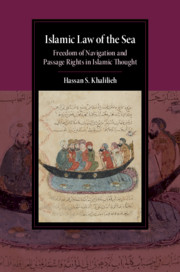
BOOK: Hassan Salih KHALILIEH, Islamic Law of the Sea Freedom of Navigation and Passage Rights in Islamic Thought (Cambridge: Cambridge University Press, 2019). ISBN 9781108481458, £ 75.00


(Source: CUP)

Cambridge University Press has published a new book on law of the sea from an Islamic legal historical perspective.

ABOUT THE BOOK 

The doctrine of modern law of the sea is commonly believed to have developed from Renaissance Europe. Often ignored though is the role of Islamic law of the sea and customary practices at that time. In this book, Hassan S. Khalilieh highlights Islamic legal doctrine regarding freedom of the seas and its implementation in practice. He proves that many of the fundamental principles of the pre-modern international law governing the legal status of the high seas and the territorial sea, though originating in the Mediterranean world, are not a necessarily European creation. Beginning with the commonality of the sea in the Qur'an and legal methods employed to insure the safety, security, and freedom of movement of Muslim and aliens by land and sea, Khalilieh then goes on to examine the concepts of the territorial sea and its security premises, as well as issues surrounding piracy and its legal implications as delineated in Islamic law.

ABOUT THE AUTHOR

Hassan S. KhaliliehUniversity of Haifa, Israel

Hassan S. Khalilieh is a senior lecturer in the departments of Maritime Civilizations and Multidisciplinary Studies and a senior research fellow in the Leon Recanati Institute for Maritime Studies, Leon H. Charney School of Marine Sciences at the University of Haifa, Israel. His publications include Islamic Maritime Law: An Introduction (1998) and Admiralty and Maritime Laws in the Mediterranean Sea (ca.800–1050): The Kitāb Akriyat al-Sufun and the Nomos Rhodion Nautikos (2006).

TABLE OF CONTENTS

Introduction
1. Freedom of the seas
2. Offshore sovereignty and the territorial sea
3. Piracy and its legal implications
Conclusion.

More information here

08 January 2019

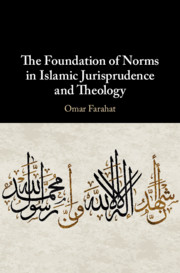
BOOK: Omar FARAHAT, The Foundation of Norms in Islamic Jurisprudence and Theology (Cambridge: Cambridge University Press, 2019). ISBN 9781108476768, £ 75.00


Cambridge University Press is publishing a new book on classical Islamic law.

ABOUT THE BOOK

In this book, Omar Farahat presents a new way of understanding the work of classical Islamic theologians and legal theorists who maintained that divine revelation is necessary for the knowledge of the norms and values of human actions. Through a reconstruction of classical Ashʿarī-Muʿtazilī debates on the nature and implications of divine speech, Farahat argues that the Ashʿarī attachment to revelation was not a purely traditionalist position. Rather, it was a rational philosophical commitment emerging from debates in epistemology and theology. He further argues that the particularity of this model makes its distinctive features helpful for contemporary scholars who defend a form of divine command theory. Farahat's volume thus constitutes a new reading of the issue of reason and revelation in Islam and breaks new ground in Islamic theology, law and ethics.

ABOUT THE AUTHOR

Omar Farahat, McGill University, Montréal
Omar Farahat is Assistant Professor of Law at McGill University, Montreal.

TABLE OF CONTENTS

Introduction: classical Islamic thought and the promise of post-secularism
Part I. Epistemological and Metaphysical Foundations:
1. What do we know without revelation? The epistemology of divine speech
2. God in relation to us: the metaphysics of divine speech
3. The nature of divine speech in classical theology
Part II. The Construction of Norms in Islamic Jurisprudence:
4. The nature of divine commands in classical legal theory
5. Divine commands in the imperative mood
6. The persistence of natural law in Islamic jurisprudence.

More information here

12 December 2018

BOOK: Khaled R. BASHIR, Islamic International Law : Historical Foundations and Al-Shaybani’s Siyar (London: Edward Elgar Publishing, 2018). ISBN 9781788113854, £90.00


Edward Elgar Publishing has published a new book on Mohammad Al-Shaybnai’s contribution to Siyar (Islamic International Law).

ABOUT THE BOOK

Through the analysis of Al-Shaybani’s most prolific work As-Siyar Al Kabier, this book offers a unique insight into the classic Islamic perspective on international law. Despite being recognised as one of the earliest contributors to the field of international law, there has been little written, in English, on Al-Shaybani’s work. This book will go some way towards filling the lacuna.

Islamic International Law examines Al-Shaybani’s work alongside that of other leading scholars such as Augustine, Gratian, Aquinas, Vitoria and Grotius, proving a full picture of early thinking on international law. Individual chapters provide discussion on Al-Shaybani’s writing in relation to war, peace, the consequences of war and diplomatic missions. Khaled Ramadan Bashir uses contemporary international law vocabulary to enable the reader to consider Al-Shaybani’s writing in a modern context.

This book will be a useful and unique resource for scholars in the field of Islamic International law, bringing together and translating a number of historical sources to form one accessible and coherent text. Scholars researching the historical and jurisprudential origins of public international law topics, such as international humanitarian law, just war, international dispute resolution, asylum and diplomacy will also find the book to be an interesting and valuable text.

ABOUT THE AUTHOR

Khaled Ramadan Bashir, The University of Aberdeen, UK

TABLE OF CONTENTS

Contents: 1. Introduction 2. Reading Historical Sources 3. The Law of War 4. Rules on the Consequences of War 5. The Law of Peace 6. Conclusion Bibliography Index

More information here

19 November 2018

BOOK: Khaled Mahmoud FAHMY, In Quest of Justice : Islamic Law and Forensic Medicine in Modern Egypt (Berkeley: University of California Press, 2018). ISBN 9780520279032, $39.95


The University of California Press has published a new book on Islamic law and forensic medicine in Modern Egypt

ABOUT THE BOOK

In Quest of Justice provides the first full account of the establishment and workings of a new kind of state in Egypt in the modern period. Drawing on groundbreaking research in the Egyptian archives, this highly original book shows how the state affected those subject to it and their response. Illustrating how shari’a was actually implemented, how criminal justice functioned, and how scientific-medical knowledges and practices were introduced, Khaled Fahmy offers exciting new interpretations that are neither colonial nor nationalist. Moreover he shows how lower-class Egyptians did not see modern practices that fused medical and legal purposes in new ways as contrary to Islam. This is a major contribution to our understanding of Islam and modernity.

ABOUT THE AUTHOR

Khaled Fahmy is Sultan Qaboos bin Sa’id Professor of Modern Arabic Studies at the University of Cambridge. He is the author of All the Pasha’s Men: Mehmed Ali, His Army and the Making of Modern Egypt.

More information here

28 August 2018

BOOK: Nobuaki Kondo, Islamic Law and Society in Iran: A Social History of Qajar Tehran (London: Routledge, 2018). ISBN 9781138348189, £36.99


(Source: Routledge)

Last year, Routledge published a book on the relationship between Islamic Law and the Iranian society during the 19th century. The paperback was recently published. 

ABOUT THE BOOK

The relationship between Islamic law and society is an important issue in Iran under the Islamic Republic. Although Islamic law was a pivotal element in the traditional Iranian society, no comprehensive research has been made until today. This is because modern reformers emphasized the lack of rule of law in nineteenth-century Iran. However, a legal system did exist, and Islamic law was a substantial part of it.

This is the first book on the relationship between Islamic law and the Iranian society during the nineteenth century. The author explores the legal aspects of urban society in Iran and provides the social context in which political process occurred and examines how authorities applied law in society, how people utilized the law, and how the law regulated society. Based on rich archival sources including court records and private deeds from Qajar Tehran, this book explores how Islamic law functioned in Iranian society. The judicial system, sharia court, and religious endowments (vaqf) are fully discussed, and the role of ‘ulama as legal experts is highlighted throughout the book. It challenges nationalist and modernist views on nineteenth-century Iran and provides a unique model in terms of the relationship between Islamic law and society, which is rather different from the Ottoman case.

Providing an understanding of this legal system in Iran and its role in society, this book offers a basis for assessing the motives and results of modern reforms as well as the modernist discourse. This book will be of interest to students of Middle Eastern and Iranian Studies.

ABOUT THE AUTHOR

Nobuaki Kondo is a Professor at Research Institute for Languages and Cultures of Asia and Africa, Tokyo University of Foreign Studies. His research interests cover early modern history of Iran and the Persianate societies. His most important publication is Persian Documents (Routledge, 2003).

TABLE OF CONTENTS

Introduction
1. Historical Development of Tehran 
2. Judicial System
3.Shari‘a Court 
4. Actual Dispute: Case of Double Vaqf
5. Attestations and Transactions in Shari‘a Courts
6. Vaqfs in Tehran
7. Vaqf and Private Property
8. Transformation of Vaqfs
Conclusion

More information here

13 July 2018

BOOK: James E. BALDWIN, Islamic Law and Empire in Ottoman Cairo (Oxford: Oxford University Press, 2018). ISBN 9781474432139, $29.95


Oxford University Press has just published the paperback edition of a book on Islamic law in Ottoman Cairo.

ABOUT THE BOOK

What did Islamic law mean in the early modern period, a world of great Muslim empires? Often portrayed as the quintessential jurists' law, to a large extent it was developed by scholars outside the purview of the state. However, for the Sultans of the Ottoman Empire, justice was the ultimate duty of the monarch, and Islamic law was a tool of legitimation and governance. James E. Baldwin examines how the interplay of these two conceptions of Islamic law - religious scholarship and royal justice - undergirded legal practice in Cairo, the largest and richest city in the Ottoman provinces. Through detailed studies of the various formal and informal dispute resolution institutions and practices that formed the fabric of law in Ottoman Cairo, his book contributes to key questions concerning the relationship between the shari'a and political power, the plurality of Islamic legal practice, and the nature of centre-periphery relations in the Ottoman Empire.

ABOUT THE AUTHOR

James E. Baldwin is Lecturer in Empires of the Early Modern Muslim World at Royal Holloway, University of London.

TABLE OF CONTENTS

Abbreviations
Abbreviations
Note on transliteration and dates
Introduction
1. A Brief Portrait of Cairo under Ottoman Rule
2. Cairo's Legal System: Institutions and Actors
3. Royal Justice: The Divan-i Hümayun and the Diwan al-Ali
4. Government Authority, the Interpretation of Fiqh, and the Production of Applied Law
5. The Privatization of Justice: Dispute Resolution as a Domain of Political Competition
6. A Culture of Disputing: How Did Cairenes Use the Legal System?
Conclusion: Ottoman Cairo's legal system and grand narratives
Appendix: Examples of Documents Used in this Study
Notes
Map: Cairo in the Eighteenth Century
Glossary
Sources and Works Cited
Index

More information here

03 July 2018

BOOK: Maaike VAN BERKEL, Léon BUSKENS and Petra M. SIJPESTEIJN eds., Legal Documents as Sources for the History of Muslim Societies : Studies in Honour of Rudolph Peters [Studies in Islamic Law and Society] (Leiden - New York: Brill, 2017). ISBN 978-90-04-34372-6, €125.00


(Source: Brill)

Last year, Brill published a book on the use of legal documents for the study of the history of Muslim societies.

ABOUT THE BOOK

This volume is a tribute to the work of legal and social historian and Arabist Rudolph Peters (University of Amsterdam). Presenting case studies from different periods and areas of the Muslim world, the book examines the use of legal documents for the study of the history of Muslim societies. From examinations of the conceptual status of legal documents to comparative studies of the development of legal formulae and the socio-economic or political historical information documents contain, the aim is to approach legal documents as specialised texts belonging to a specific social domain, while simultaneously connecting them to other historical sources. It discusses the daily functioning of legal institutions, the reflections of regime changes on legal documentation, daily life, and the materiality of legal documents.

Contributors are Maaike van Berkel, Maurits H. van den Boogert, Léon Buskens, Khaled Fahmy, Aharon Layish, Sergio Carro Martín, Brinkley Messick, Toru Miura, Christian Müller, Petra M. Sijpesteijn, Mathieu Tillier, and Amalia Zomeño.

ABOUT THE EDITORS

Maaike van Berkel is professor of Medieval History at Radboud University. Her research focuses on the social and cultural history of medieval Muslim societies, with a particular interest in literacy, court culture and urban organization.

Léon Buskens holds a chair for Law and Culture in Muslim societies at Leiden University and is director of the Netherlands Institute in Morocco. His research focuses on Islamic law and society, and the anthropology of Muslim societies, with a particular interest in Morocco and Indonesia.

Petra Sijpesteijn is professor of Arabic at Leiden University. Her research concentrates on recovering the experience of Muslims and non-Muslims living under Islamic rule, using the vast stores of radically under-used documents surviving from the early Islamic world. 

TABLE OF CONTENTS

Introduction, Maaike van Berkel, Léon Buskens and Petra M. Sijpesteijn 
Notes on Contributors
Bibliography Rudolph Peters
Rudolph Peters and the History of Modern Egyptian Law, Khaled Fahmy

I. REGIME CHANGE AND LEGAL INSTITUTIONS
The Qadis’ Justice according to Papyrological Sources (Seventh–Tenth Centuries C.E.), Mathieu Tillier
Delegation of Judicial Power in Abbasid Egypt, Petra M. Sijpesteijn
The Mahdi’s Legal Opinion as an Instrument of Reform: Issues in Divorce, Inheritance, False Accusation of Unlawful Intercourse and Homicide,Aharon Layish

II. PRACTICES OF RECORDING AND VERIFYING
Identifying the ʿudūl in Fifteenth-Century Granada, Sergio Carro Martín and Amalia Zomeño
Crimes without Criminals? Legal Documents on Fourteenth-Century Injury and Homicide Cases from the Ḥaram Collection in Jerusalem, Christian Müller
From Trash to Treasure: Ethnographic Notes on Collecting Legal Documents in Morocco, Léon Buskens
Notes for a Local History of Falsehood, Brinkley Messick

III. DAILY LIFE
Waqf Documents on the Provision of Water in Mamluk Egypt, Maaike van Berkel
Ottoman amān: Western Ownership of Real Estate and the Politics of Law Prior to the
Land Code of 1876, Maurits H. van den Boogert
A Comparative Study of Contract Documents: Ottoman Syria, Qajar Iran, Central Asia, Qing China and Tokugawa Japan, Toru Miura 

More information here