Search

Showing posts with label empire. Show all posts

06 July 2026

CALL FOR ABSTRACTS: Imperial Legal Spaces and Transitions: Law, Statehood and Administration in Ukraine between Empire, War and State Formation (~1900-1922) (Regensburg: University of Regensburg/Institute for East European Law, 18-19 MAR 2027); DEADLINE 31 JUL 2026


https://www.ostrecht.de/wp-content/uploads/2022/05/ior-LOGO-Standard-2048x1017-1-1920x953.png

Application Deadline: 31 July 2026
Location: University of Regensburg / Institute for East European Law, Germany

Description:

The early 20th century marked a period of profound political, social and legal upheaval for the region
that is now Ukraine. Within a few decades, the region witnessed the collapse of empires, the First World
War, successive occupations and military administrations, competing attempts to establish states, and
the transition to Soviet structures of governance. These developments were accompanied not only by
political and social transformations, but also by a fundamental reorganisation of legal institutions, norms and practices.
While the political history and history of violence of this transitional period have already been researched to some extent, there is still a lack of legal and administrative historical analysis that focuses not only on breaches of the law or the breakdown of legal systems, but also on how the law and institutions function in transitional situations.
The conference therefore focuses on the question: How do legal spaces function when political orders
collapse but institutions (must) continue to operate?
The conference aims to examine the region of present-day Ukraine between approximately 1900 and
1922 as an imperial, or, respectively, post-imperial legal space in which different normative orders, ad-
ministrative traditions and institutional practices did not disappear abruptly, but continued to operate,
overlap, adapt or hybridise.
The conference does not view law merely as a codified norm, but, above all, as a social practice, an
instrument of power and legitimacy, and a resource for stabilising everyday life and administration.

Potential Topics Include:

• Legal transfer and legal pluralism between Habsburg Galicia and the territories oft he Russian
Empire
• Military law and extraordinary justice in the First World War
• Competing legal systems in the years 1917–1921
• Administrative and judicial practice in local borderland spaces
 

The conference adopts a practice- and actor-oriented approach that views law not merely as a normative
system, but as a framework for action. Particular attention is paid to institutional continuities, informal
practices and the role of local decision-makers. At the same time, the conference adopts a transnational
and comparative perspective. The region of present-day Ukraine is not considered in isolation but within its interconnections with Central European, Russian, and later Soviet legal systems. This approach allows for the analysis of regional and local transitions not merely as national anomalies but as part of broader European transformation processes.
The conference seeks to foster an international exchange of perspectives on the region’s history. We
therefore warmly encourage not only scholars from Ukraine but also scholars from other countries, in-
cluding Germany, Poland, Hungary, Romania, Slovakia, and the Czech Republic, to participate.
We welcome contributions from legal history, history, political science, and related disciplines. Applica-
tions from researchers at all career stages are strongly encouraged.

The conference languages are Ukrainian, German and English.

An application for external funding is currently being prepared. Subject to approval, travel and accom-
modation costs may be covered.

As an outcome of the conference, an edited volume with an internationally renowned publisher is
planned. In addition, selected contributions will be published in an open working paper series.

Application Guidelines:

To participate in the conference, please submit the following application documents by July 31, 2026:

1. Detailed academic CV
2. Topic proposal for the presentation and short abstract (max. 2,000 characters including spaces)
3. List of publications, highlighting the five most relevant to the conference

Please send your application (as a single PDF file) and any inquiries to:
office@ostrecht.de

The results of the selection process will be announced by early September 2026.

We look forward to receiving your submissions and to welcoming you in Regensburg in March
2027!

Find more here

20 March 2026

BOOK PRESENTATION: Lauri MÄLKSOO, "Russia, the Soviet Union, and Imperial Continuity in International Law" (Cambridge: Lauterpacht Centre for International Law, 2 FEB 2026) [YOUTUBE]

(source: Youtube)

Abstract:

Empire is a big theme in international law. At the same time, the historical discussion on imperialism and international law had focussed primarily on the West European Empires. This presentation examines Russian and Soviet historical engagements with international law through imperial ideas and practices. Of the doctrines of international law, the ideas of state identity (continuity) and also termination of treaties via the doctrine of clausula rebus sic stantibus are examined, and how their use has served the imperial construction and practice of international law in Russia. Understanding the history of international law in Russia through the lens of Empire helps us inter alia to situate Russia's war against Ukraine.

On the speaker:

Lauri Mälksoo is Professor of International Law at the University of Tartu in Estonia. He is member of the Institut de Droit International, of the Venice Commission of the Council of Europe and of the Estonian Academy of Sciences. He has published two monographs on the history and theory of international law in Russia and the Soviet Union at the Oxford University Press.

 See here.

19 April 2022

BOOK: Rutger KRAMER, Walter POHL (eds.), Empires and Communities in the Post-Roman and Islamic World, C. 400-1000 CE (Oxford: Oxford University Press, 2021), ISBN: 9780190067 OPEN ACCESS


(Image source: Oxford University Press


ABOUT THE BOOK

This book deals with the ways empires affect smaller communities like ethnic groups, religious communities and local or peripheral populations. It raises the question how these different types of community were integrated into larger imperial edifices, and in which contexts the dialectic between empires and particular communities caused disruption. How did religious discourses or practices reinforce (or subvert) imperial pretenses? How were constructions of identity affected in the process? How were Egyptians accommodated under Islamic rule, Yemenis included in an Arab identity, Aquitanians integrated in the Carolingian empire, Jews in the Fatimid Caliphate? Why did the dissolution of Western Rome and the Abbasid Caliphate lead to different types of polities in their wake? How was the Byzantine Empire preserved in the 7th century; how did the Franks construct theirs in the 9th? How did single events in early medieval Rome and Constantinople promote social integration in both a local and a broader framework?

Focusing on the post-Roman Mediterranean, this book deals with these questions from a comparative perspective. It takes into account political structures in the Latin West, in Byzantium and in the early Islamic world, and does so in a period that is exceptionally well suited to study the various expansive and erosive dynamics of empires, as well as their interaction with smaller communities. By never adhering to a single overall model, and avoiding Western notions of empire, this volume combines individual approaches with collaborative perspectives. Taken together, these chapters constitute a major contribution to the advancement of comparative studies on pre-modern empires.


ABOUT THE EDITORS

Rutger Kramer, Assistant Professor of Medieval History, Radboud University, The Netherlands.

Walter Pohl, Professor of History, University of Vienna, Austria.


TABLE OF CONTENTS

  1. Introduction: Empires and Communities in the Post-Roman and Islamic World (Walter Pohl and Rutger Kramer)
  2. The Emergence of New Polities in the Break-Up of the Abbasid Caliphate (Hugh Kennedy)
  3. The Emergence of New Polities in the Break-Up of the Western Roman Empire (Walter Pohl)
  4. Comparative Perspectives: Differences between the Dissolution of the Western Roman Empire and the Abbasid Caliphate (Walter Pohl and Hugh Kennedy)
  5. Fragmentation and Integration: A Response to the Contributions by Hugh Kennedy and Walter Pohl (Peter Webb)
  6. Historicizing Resilience: The Paradox of the Medieval East Roman State; Collapse, Adaptation, and Survival (John Haldon)
  7. Processions, Power, and Community Identity: East and West (Leslie Brubaker and Chris Wickham)
  8. Death of a Patriarch: The Murder of Yuhanna ibn Jami (966) and the Question of 'Melkite' Identity in Early Islamic Palestine (Daniel Reynolds)
  9. Diversity and Convergence: The Accommodation of Ethnic and Legal Pluralism in the Carolingian Empire (Stefan Esders and Helmut Reimitz)
  10. Franks, Romans, and Countrymen: Carolingian Interests, Local Identities, and the Conquest of Aquitaine (Rutger Kramer)
  11. From the Sublime to the Ridiculous: Yemeni Arab Identity in Abbasid Iraq (including Appendix: translations of selected poems) (Peter Webb)
  12. Loyal and Knowledgeable Supporters: Integrating Egyptian Elites in Early Islamic Egypt (Petra Sijpesteijn)
  13. Concluding Thoughts: Empires and Communities (Chris Wickham)


More information can be found here

The entire publication can be read in open access at this link

21 February 2022

ARTICLE: Richard REID, Africa’s Revolutionary Nineteenth Century and the Idea of the “Scramble” (AHR CXXVI (2021), No. 4 (Dec), 1424-1447)


(image source: OUP)

Abstract:

This paper seeks to position the Scramble for Africa in the context of the continent’s transformative, global nineteenth century. While imperial historiography develops apace, Africa-facing analyses of the continent’s partition and the processes which led to it are increasingly rare. European expansion into Africa was characterized by an aggressive dynamism, and millions of Africans experienced profound crisis in the process of the establishment of colonial rule. Yet Africa’s revolutionary nineteenth century was both driven by, and culminated in, complex processes of co-option on the part of Africans and Europeans. The paper proposes that a more Africa-centered assessment of the Scramble is possible, one which aims to contextualize the partition of the continent as part of an ongoing, endogenously shaped but often exogenously connected, transformation in political, economic, and social organization and behavior. While no single overarching theory can apply to the entire continent, it is possible to identify dynamics and processes for change that recur across Africa, from political and military reform to economic innovation. These point toward possibilities for reframing Africa’s development in the late precolonial period, and enable us to challenge the hegemony long enjoyed by scholars of European empires.

Read more with Oxford Journals (DOI 10.1093/ahr/rhab539

06 January 2022

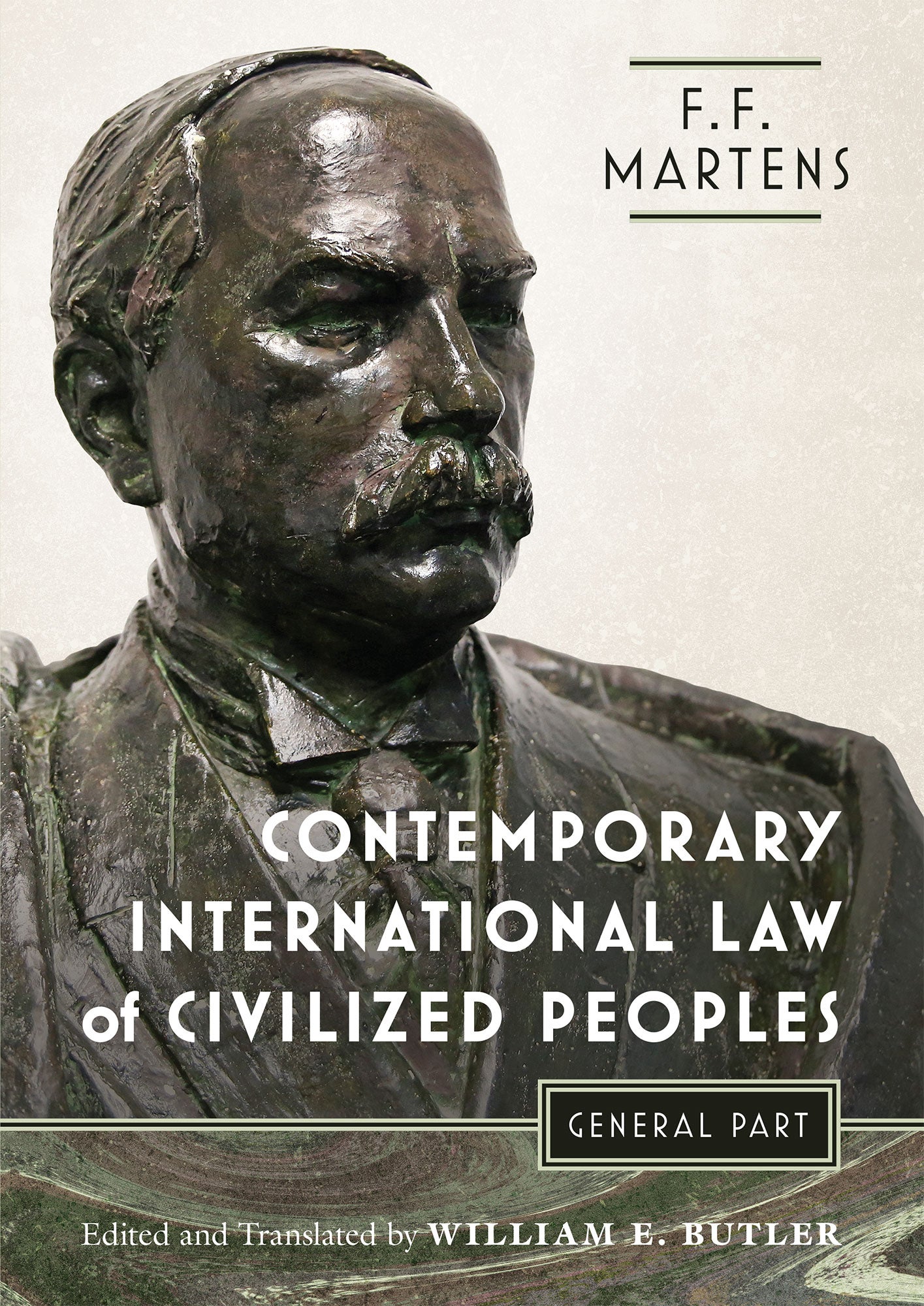
BOOK: F.F. MARTENS, Contemporary International Law of Civilized Peoples, General Part (transl. and ed. William E. BUTLER) (Clark (New Jersey): Talbot Publishing, 2021), LXII + 355 p. ISBN 9781616196608


(image source: Lawbook Exchange)

Book description:

 First published in Russian in 1882-1883, Contemporary International Law of Civilized Peoples ranks among the greatest treatises on international law and relations written during the nineteenth century. In this work Martens develops his concept of the international community and the respective roles of "civilized" and "uncivilized" peoples, and promotes several concepts that would become important in the twentieth century, such as the importance of "international administrative law" and the central role of human rights. The work has two complementary parts: the General Part, which addresses the conceptual and historical foundations of international law, the status of the international community, states, and individuals and territory and law of treaties, and the Special Part, which addresses Martens's concept of international administration, diplomatic and consular law, human rights, private international law, international criminal law and the laws of war and neutrality. Enriched by an extensive biographical introduction, Butler's is the first English translation of this important work and the only version in any language to address changes made by the author between editions, including sections omitted in later versions. At long last, the English reader has access to the leading Russian thinker and diplomatist of the Imperial Russian period, one who continues to influence the development of international law. Fedor Fedorovich Martens [1845-1909], the pre-eminent Russian international lawyer of the pre-1917 era, was Professor of International Law at St. Petersburg University, repeated candidate for the Nobel Peace Prize, senior legal advisor to the Ministry of Foreign Affairs and the Emperor of the Russian Empire, member of the Hague Permanent Court of International Arbitration, a principal architect of the 1899 and 1907 Hague peace conferences, an important historian of diplomacy, author of major treatises on international law and the leading Russian textbook on that subject. A recipient of honorary doctorates at Continental and American law schools and a me.

30 September 2021

REMINDER: CALL FOR PAPERS: Third Legal Histories of Empire Conference - Beyond the Pale: Legal Histories on the Edges of Empires (Maynooth University, 29 June-1 July 2022)

(image: Maynooth (Kildare, Ireland); source: Wikimedia Commons)

We received a reminder for the call for the Third Legal Histories of Empire Conference (Maynooth, 29 June-1 July 2022, see earlier on this blog)

The Third Legal Histories of Empire Conference*: Maynooth, Ireland, 29 June -1 July 2022.


A reminder that the call for papers for the Third Legal Histories of Empire Conference is currently open!  Deadline for abstracts is 31 October 2021


The theme for the upcoming conference is /Beyond the Pale: Legal Histories on the Edges of Empires/.  There will be hybrid attendance options available (in-person and virtual).


Keynote Panel: Jane Ohlmeyer, Richard J Ross, Philip Stern:

Anglicisation of and through law in British America, Ireland, and India, c.1550-1800


All details at lhbe.org – including the CFP, information on the specialised streams offered at the conference and information on funding opportunities.


27 August 2021

JOURNAL: Outre-Mers. Revue d'histoire 410-411 [Numéro Spécial: L'impérialisme informel de la France et de l'Espagne au XIXe siècle] (JUN 2021)


(image source: SFHOM)

Description:

"La Société Française d’Histoire des Outre-mers publie dans ce numéro de sa revue un travail novateur d’Arnaud Bartolomei, de Xavier Huetz De Lemps et de Martín Rodrigo Y Alharilla sur l’impérialisme informel de la France et de l’Espagne au XIXe siècle. Si la notion d’impérialisme informel a été mobilisée par les historiens britanniques pour comprendre la puissance coloniale hégémonique d’outre-manche, cette notion a été plus rarement sollicitée pour analyser les trajectoires impériales d’autres puissances européennes. Les auteurs pallient cette carence pour les empires français et espagnol dont l’historiographie s’est trop longtemps attachée à la seule conquête territoriale afin d’évaluer leur puissance impériale. Toute proportion gardée avec le modèle britannique, les auteurs interrogent la puissance heuristique d’une telle perspective et les modalités de domination informelle envisagées par la France et l’Espagne au XIXe siècle. David Todd focalise son attention sur les agents français et les collaborateurs autochtones des outre-mers, sur les promoteurs et les bénéficiaires de ces nouvelles formes d’influence en France métropolitaine. Ce cadre établi, Arnaud Bartolomei, Manuel Talamante et Xavier Daumalin ouvrent respectivement des perspectives sur l’expansion commerciale de la France au Mexique, à Montevideo mais aussi en Afrique. Pour l’Espagne, les contributions d’Eloy Martín Corrales et de Juan Inarejos Muñoz portent sur l’analyse des motivations des politiques d’expansion espagnole qui vont à l’encontre de la seule lecture de la « matrice » du désastre de 1898. D’autres acteurs et d’autres intentions ont pu générer de nouvelles formes d’impérialisme. Martín Rodrigo y Alharilla et Lizbeth Chaviano Pérez montrent ainsi que la question de l’esclavage et de la traite a constitué le principal moteur de l’implantation de l’Espagne en Afrique sub-saharienne. De même, L. Chaviano Pérez met clairement en évidence des formes de sous-impérialisme informel en montrant que le sort des établissements espagnols en Guinée a été intimement lié aux intérêts cubains et aux pressions de ses planteurs. En focalisant leur attention sur la fin de l’époque moderne et le début de la reprise de l’expansion européenne dans le dernier tiers du XIXe siècle, l’ensemble de ces contributions invite le lecteur à appréhender les « conditions d’une domination économique » qui se voulait « si possible exclusive ou privilégiée, sur le reste du monde »."

(read more: SFHOM

(source: ESILHIL Blog)

24 May 2021

CALL FOR PAPERS: Third Legal Histories of Empire Conference - Beyond the Pale: Legal Histories on the Edges of Empires (Maynooth University, 29 June-1 July 2022)


(image: Maynooth (Kildare, Ireland); source: Wikimedia Commons)

Empires. Plural. Across time and across the globe, interconnected, mutually constitutive. We invite papers which consider the interconnections and the legal relations between empires. The conference will particularly focus on the role played by law (broadly defined) in facilitating, constituting, and enabling these connections; on the people of law who moved between these places; and the institutions which bound them together. How might we map Empires through these connections? How do we now conceptualise such movement, and are there new ways in which we could envisage legal interchange across time and place? Of particular interest are the connections between places with very different legal systems and traditions. How can we better bring together the efforts of historians working in different legal traditions? In this third Legal Histories of Empires conference we hope to more deeply uncover the legal threads that bound different empires, places, laws and legal traditions across the globe.


Keynote Panel: Jane Ohlmeyer, Richard J Ross, Philip Stern: ‘Anglicisation of and through law in British America, Ireland, and India, c.1550-1800’


Abstracts to conference2022@lhbe.org or the relevant stream by 31 October 2021. Acceptances will be sent in late November 2021.


The organisers are not able to provide funding for travel. However, the Max Planck Institute has generously offered scholarships for scholars from the Global South. The information on these is on the website (lhbe.org) and applicants should follow the instructions on that site.


Format: Face to Face with provision for virtual presentations and attendance. Please indicate on your abstract whether your participation is contingent on the availability of online participation.


Individual papers: If you are submitting an individual paper, please submit an abstract of no more than 250 words.

Panels (of no more than 4 speakers: a chair and/or commentator can be included): If you are submitting a panel, please submit:

1)       A panel abstract of no more than 250 words; and

2)       Individual paper abstracts of no more than 200 words.


Personal information: For each participant (presenter, chair, or commentator), please submit:

1)       Biographical details of no more than 200 words; and

2)       Where you will be in July 2022 if you are not physically in Ireland, and what timezone that place is in.


Only one proposal can be submitted per person. For streams please send to the relevant panel organiser (below). For general proposals please send to the main conference email address. No multiple submissions will be accepted.


Streams

In addition to papers and panels addressing the theme generally, the following streams will be offered. Individual paper proposals and panel proposals in the same format as above should be sent to the organisers of the relevant stream.

Intellectual Property in Empire: Prof Isabella Alexander: Isabella.Alexander@uts.edu.au

The Maritime World in Legal History: Prof Diane Kirkby: Diane.Kirkby@uts.edu.au

Indigeneity, Law and Empires: Prof Pooja Parmar: parmar@uvic.ca

Legal Transfer in the Common Law World: Prof Stefan Vogenauer and Dr Donal Coffey: vogenauer@lhlt.mpg.de

21 May 2021

BOOK: François GODICHEAU & Mathieu GRENET (dir.), Raison administrative et logiques d'empire (XVIe-XIXe siècle) [Collection de la Casa de Velázquez] (Madrid: Casa de Velázquez, 2021), 440 p. ISBN 9788490961957, € 29. OPEN ACCESS


(image source: Casa de Velázquez)

Book abstract:
Entre le XVIe et le XIXe siècles émerge et s'affirme un pouvoir formidable, que nous connaissons sous le nom d'administration. Il se développe notamment dans le contexte des empires européens des époques moderne et contemporaine : le sens du mot administrer évolue alors que s'impose la nécessité de gouverner des espaces multiples et hétérogènes, proches et lointains. Ce livre propose de remonter aux sources puis de suivre la trace de cette raison administrative et de son affirmation au cours d'une chronologie habituellement associée à l'histoire de l'Etat, ici au second plan. Historiens et historiens du droit s'emparent du sujet à partir de l'étude de cas concrets, inscrits dans des contextes chronologiques et spatiaux différents, ainsi que dans des cultures politiques et juridiques fortement diversifiées. Ils tentent de saisir des logiques administratives à bonne distance des téléologies traditionnelles, depuis l'analyse des institutions étatiques et des dynamiques centres-périphéries, vers les redéfinitions de la potestas et l'exercice du commandement à l'échelle locale.

Table of contents:

Introduction. Une histoire politique (François Godicheau, Mathieu Grenet)

PREMIÈRE PARTIE. ADMINISTRATION ENTRE DROIT ET SOCIÉTÉ

Espace français, espace anglo-américain. Pour une sémantique comparée du mot « administration » à l’âge moderne (Luca Mannori)

Des territoires entre tutelle et auto-administration : le premier débat constitutionnel en Espagne (José Maria Portillo Valdés)

La raison administrative : figures d’un mode de normativité (Paolo Napoli)

Droit et autorité politique dans leur contexte social (Michael J. Braddick)

DEUXIÈME PARTIE. RAISON ADMINISTRATIVE, GOUVERNEMENT ET EMPIRE

Raison fiscale et logiques d’Empire : administrer un impôt sans État (XVIIe‑XVIIIe siècles) (Rachel Renault)

Députés du commun : représentation et gouvernement des pueblos en Espagne (1766-1812) (Carlos Garriga Acosta)

Logique militaire et ordre public. Le statut ambigu de l’administration des territoires catalans dans la première moitié du XIXe siècle (Manel Risques Corbella & François Godicheau)

Inflexions et échos d’une politique impériale dans la Monarchie hispanique (1580-1610) (José Javier Ruiz Ibánez)

Dilemmes de l’anthropologie historique (Jean-Frédéric Schaub)

TROISIÈME PARTIE. RAISON ADMINISTRATIVE ET GOUVERNEMENTS TERRITORIAUX

L’administration des campagnes de l’empire avant « l’ordre public », entre besoins de justice et gouvernement des populations (1759-1808) (Darío Barriera, François Godicheau)

En attendant quels barbares ? Pouvoir et administration dans le Stato da Mar vénitien : le cas de Leucade/Sainte-Maure à la fin des années 1770 (Mathieu Grenet)

Les territoires des corporations : l’administration et la justice dans les places commerciales de l’Empire portugais (v. 1750-1820) (Andréa Slemian)

Administrer les territoires d’une nation pluricontinentale. Représentations, connaissances et logiques administratives dans l’Empire portugais du XIXe siècle (Cristina Nogueira da Silva)

L’État italien entre administration et tutelle dans l’Empire français (Alessandro Giovanazzi)

Lecture (Bernard Vincent)

L’administration d’une « ombre d’empire » : l’organisation des « Portugais » en Afrique et en Asie (António Manuel Hespanha)

More information with the Casa de Velázquez


18 February 2021

ZOOM SEMINAR: Legal Histories of Empire with Lisa Ford and Jessica Hinchy (Sydney, 5 MAR 2021)


(image source: Wikimedia Commons)

The following announcement circulated on the Legal History Blog and the ANZLHS blog:

Join us for the second of several symposia planned for 2020 and 2021 for Legal Histories of Empire.

Our speakers:

Lisa Ford: ‘The King’s Colonial Peace: Variable subjecthood and the transformation of empire’

This paper is drawn from my forthcoming book, The King’s Peace: Empire and Order in the British Empire. The book uses colonial peacekeeping as a lens through which to examine the shifting parameters of crown prerogative in Empire in the Age of Revolutions. This paper will argue that the legal vulnerability of (and often threats to order posed by) a diverse array of subjects – formerly French Catholics in Quebec, Caribbean slaves and NSW convicts – both prompted and justified the unravelling of the very idea of the freeborn Englishman that had been mobilised by protestant Britons in pre-revolutionary America.

Lisa Ford is Professor of History at the University of New South Wales, Australia. Her major publications include Settler Sovereignty: Jurisdiction and Indigenous People in America and Australia, 1788-1836 (2010) which won the Littleton-Griswold Prize (American Historical Association); the Thomas J. Wilson Prize (Harvard University Press); and the Premiers History Award (NSW). She is also co-author of Rage for Order: The British Empire and the Origins of International Law, 1800-1850 (co-authored with Lauren Benton, 2016) and author of The King’s Peace, which will be published by Harvard later this year. Ford is currently leading a collaborative project funded by the Australian Research Council exploring the role of commissions of inquiry sent throughout the British Empire in the 1820s on which subject she hopes to lead author a book manuscript this year. She also holds a four-year ARC Future Fellowship, during which she will explore the changing use of martial law in the British Empire from the late eighteenth century until 1865.

Jessica Hinchy: ‘Child Removal and the Colonial Governance of the Family: Hijra and “Criminal Tribe” Households in North India, c. 1865-1900’

Historians have primarily examined colonial child removal projects in settler colonial contexts. Yet from 1865, the colonial government in north India forcibly removed children from criminalised communities. Child separation began in the households of gender non-conforming people labelled ‘eunuchs,’ particularly Hijras, and eventually extended to socially marginalised people designated as ‘criminal tribes,’ especially Sansiyas. First, what does a comparison of these child removal schemes tell us about the colonial governance of the family? Patrilineal, conjugal and reproductive household models marginalised Hijras and Sansiyas in differing ways, while the category of ‘child’ was contingently defined. Child separation was attempted to varying ends, including both elimination and assimilation. Yet often, the colonial state could not sustain such intensified forms of intimate governance in the face of resistance from households. Nor could officials simply determine removed children’s futures. Second, what does child removal suggest about the making of colonial law? When children were initially removed from Hijra and Sansiya households, officials admitted that ‘the law may have been somewhat strained,’ since existing laws did not provide police or magistrates with legal powers to separate these children. The Sansiya child removal project, for instance, prompted debates about colonial legal exceptions and the ‘legality’ of the colonial state’s practices among colonial officials and Indian and European non-officials.

Jessica Hinchy is an Assistant Professor of History at Nanyang Technological University in Singapore. She researches the history of gender, sexuality, households and family in colonial north India. In 2019, Cambridge University Press published her first monograph, Governing Gender and Sexuality in Colonial India: The Hijra, c. 1850-1900. Her research has also appeared in Modern Asian Studies, Gender & History and Asian Studies Review, among other journals.

The event will take place by zoom on Friday 5 March (or Thursday 4 March, depending on your timezone – see below). Please register here (via Eventbrite) to attend.

Timezones:

Sydney @ 12.30 pm on 5 March

Singapore @ 9.30 am on 5 March

Auckland @ 2.30 pm on 5 March

New Delhi @ 7.00 am on 5 March

London/Dublin @ 1.30 am on 5 March

Nairobi @ 4.30 am on 5 March

Vancouver @ 5.30 pm on 4 March

New Haven/Toronto @ 8.30 pm on 4 March

(source: Legal History Blog - ANZLHS - ESILHIL

28 August 2020

ARTICLE: D. L. NOORLANDER, "The Dutch Atlantic world, 1585–1815: Recent themes and developments in the field" (History Compass XVIII (2020), No. 8)


 Abstract:

Scholarship on the Dutch Atlantic has grown and changed a lot in 30 years, with older themes like colonial weakness and insignificance giving way to a newly discovered Dutch vitality. This essay demonstrates the change by summarizing the recent research and highlighting the military, economic, and cultural impact of the Dutch in West Africa and America, plus the possible impacts of both places on the Dutch in Europe. The essay also cautions writers against taking arguments about dynamism, diversity, tolerance, cosmopolitanism, and modernity too far.

(source: Wiley)

03 July 2020

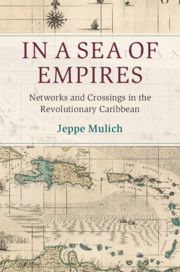
BOOK: Jeppe MULICH, In a Sea of Empires: Networks and Crossings in the Revolutionary Caribbean (Cambridge: Cambridge University Press, 2020). ISBN 9781108489720, $ 99.99


(Source: CUP)

Cambridge University Press is publishing a new book on the interconnected nature of imperial politics and colonial law in the maritime borderlands of the Leeward Islands in the early 19th century.

ABOUT THE BOOK

At the turn of the nineteenth century, the Caribbean was rife with revolutionary fervor and political turmoil. Yet, with such upheaval came unparalleled opportunities. In this innovative and richly detailed study, Jeppe Mulich explores the interconnected nature of imperial politics and colonial law in the maritime borderlands of the Leeward Islands, where British, Danish, Dutch, French, Spanish, and Swedish colonies both competed and cooperated with one another. By exploring the transnational networks involved in trade, slavery, smuggling, privateering, and marronage, he offers a new account of the age of revolutions in the Caribbean, emphasizing the border-crossing nature of life in the region. By approaching major shifts in politics, economy, and law from the bottom-up, a new story of early nineteenth-century globalization emerges – one that emphasizes regional integration and a multiplicity of intersecting networks.

ABOUT THE AUTHOR

Jeppe MulichLondon School of Economics and Political Science

Jeppe Mulich is Teaching Associate in Global History at the University of Cambridge and St John's College.

TABLE OF CONTENTS

1. Introduction
2. Free ports and black markets
3. Imperial warfare, colonial violence
4. Prize courts and privateers
5. Slave laws and free communities
6. Abolition and the illegal slave trade
Conclusion.

More info here

11 June 2020

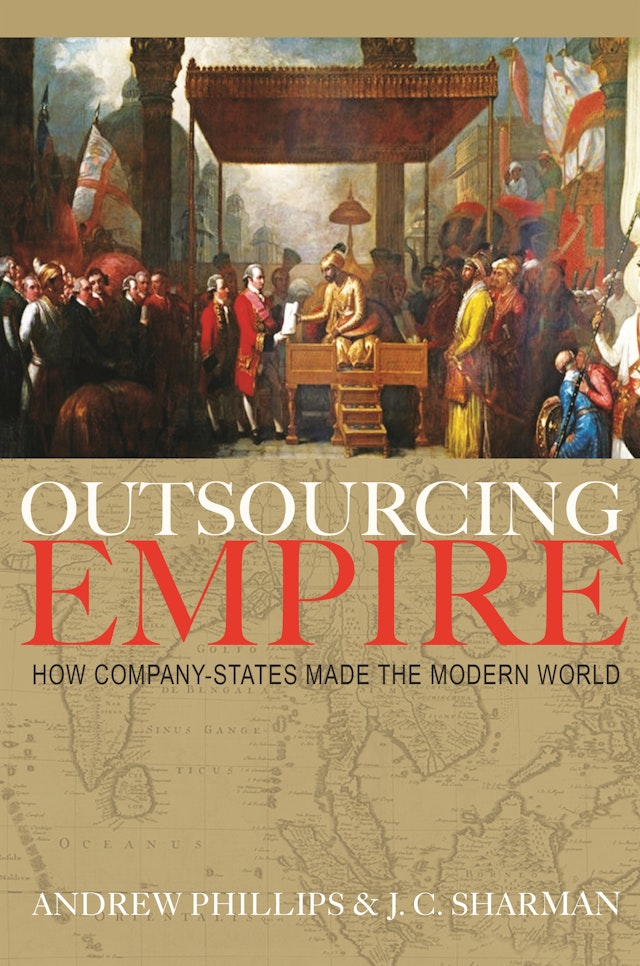
BOOK: Andrew PHILLIPS and J. C. SHARMAN, Outsourcing Empire: How Company-States Made the Modern World (Princeton: Princeton University Press, 2020). ISBN 9780691203515, 29.95 USD


Princeton University Press is publishing a new book on the history of chartered company and their historical contribution to the global order.

ABOUT THE BOOK

How chartered company-states spearheaded European expansion and helped create the world’s first genuinely global order

From Spanish conquistadors to British colonialists, the prevailing story of European empire-building has focused on the rival ambitions of competing states. But as Outsourcing Empire shows, from the seventeenth to the twentieth centuries, company-states—not sovereign states—drove European expansion, building the world’s first genuinely international system. Company-states were hybrid ventures: pioneering multinational trading firms run for profit, with founding charters that granted them sovereign powers of war, peace, and rule. Those like the English and Dutch East India Companies carved out corporate empires in Asia, while other company-states pushed forward European expansion through North America, Africa, and the South Pacific. In this comparative exploration, Andrew Phillips and J. C. Sharman explain the rise and fall of company-states, why some succeeded while others failed, and their role as vanguards of capitalism and imperialism.

In dealing with alien civilizations to the East and West, Europeans relied primarily on company-states to mediate geographic and cultural distances in trade and diplomacy. Emerging as improvised solutions to bridge the gap between European rulers’ expansive geopolitical ambitions and their scarce means, company-states succeeded best where they could balance the twin imperatives of power and profit. Yet as European states strengthened from the late eighteenth century onward, and a sense of separate public and private spheres grew, the company-states lost their usefulness and legitimacy.

Bringing a fresh understanding to the ways cross-cultural relations were handled across the oceans, Outsourcing Empire examines the significance of company-states as key progenitors of the globalized world.

ABOUT THE AUTHOR

Andrew Phillips is associate professor of international relations and strategy at the University of Queensland. He is the author of War, Religion and Empire
J. C. Sharman is the Sir Patrick Sheehy Professor of International Relations at the University of Cambridge, where he is a fellow of King’s College. His books include Empires of the Weak (Princeton) and The Despot’s Guide to Wealth Management. Phillips and Sharman are the coauthors of International Order in Diversity.

More info here

05 June 2020

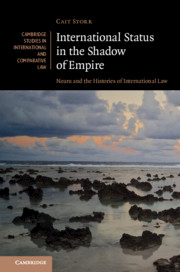
BOOK: Cait STORR, International Status in the Shadow of Empire Nauru and the Histories of International Law (Cambridge: Cambridge University Press, 2020). ISBN 9781108498500, £ 85.00


(Source: CUP)

Cambridge University Press is publishing a new book on Nauru’s imperial history and its significance for the history of international law.

ABOUT THE BOOK

Nauru is often figured as an anomaly in the international order. This book offers a new account of Nauru's imperial history and examines its significance to the histories of international law. Drawing on theories of jurisdiction and bureaucracy, it reconstructs four shifts in Nauru's status – from German protectorate, to League of Nations C Mandate, to UN Trust Territory, to sovereign state – as a means of redescribing the transition from the nineteenth century imperial order to the twentieth century state system. The book argues that as international status shifts, imperial form accretes: as Nauru's status shifted, what occurred at the local level was a gradual process of bureaucratisation. Two conclusions emerge from this argument. The first is that imperial administration in Nauru produced the Republic's post-independence 'failures'. The second is that international recognition of sovereign status is best understood as marking a beginning, not an end, of the process of decolonisation.

ABOUT THE AUTHOR

Cait StorrUniversity of Glasgow
Cait Storr is Chancellor's Postdoctoral Research Fellow at the University of Technology Sydney. She is an associate member of the Institute of International Law and the Humanities at Melbourne Law School, and junior faculty with the Institute of Global Law and Policy at Harvard Law School. Her doctoral thesis was awarded the University of Melbourne Chancellor's Prize.

TABLE OF CONTENTS
1. International Status, Imperial Form: Nauru and the Histories of International Law
2. From Trading Post to Protectorate, 1888
3. From Protectorate to Colony to Mandate, 1920
4. From Mandate to Trust Territory, 1947
5. From Trust Territory to Sovereign State, 1968
6. After Independence: Sovereign Status and the Republic of Nauru.

More info here

04 June 2020

SSRN PAPER: Mitra SHARAFI, Mixing Legal Systems in the British Empire

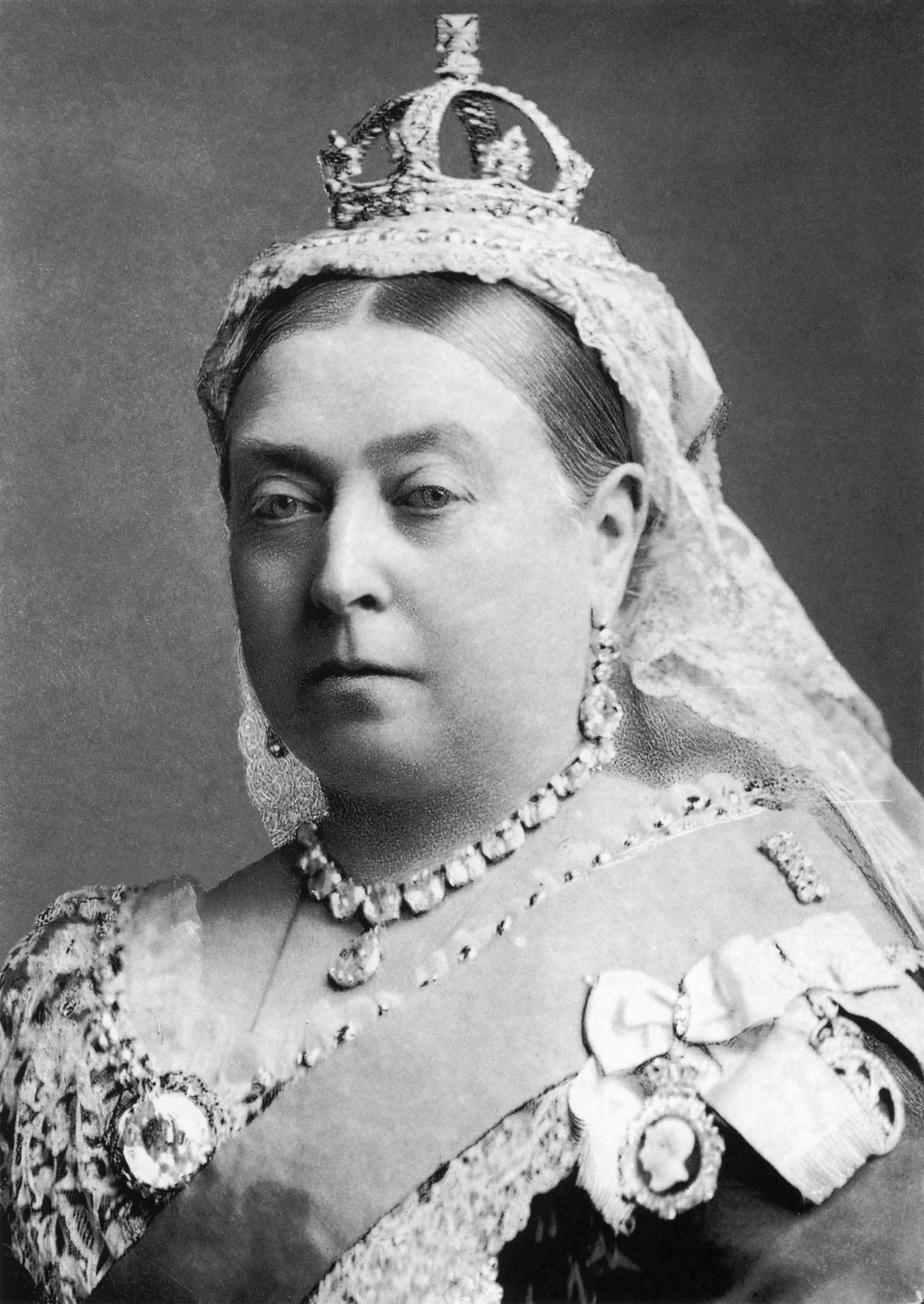
(image: Queen Victoria; Source: Wikimedia Commons)

Abstract:
This talk was given as part of a mini-plenary session on histories of empire and legal pluralism at the New Orleans meeting of the Law and Society Association in 2016. It examines mixed legal systems in the British empire between the eighteenth and twentieth centuries, focusing on fusions of Roman law or various bodies of personal law with common law. The history of the legal profession sheds light on how new kinds of mixed legal systems became feasible at particular times. Legal pluralism in the form of diverse legal systems administered by the state emerged through practicality as much as principle. As a result, the question for British colonial officials was perhaps not so much "what bodies of non-Anglo law should we retain, as a matter of principle?" as "what bodies of non-Anglo law can we retain, as a matter of personnel and practice?"
Read more on SSRN.


30 October 2019

LECTURE SERIES: Norms and Empires (Max Planck Institute for European Legal History, November-December 2019)


We learned of a lecture series on Norms and Empires at the MPI in Frankfurt.

Norms and Empires Lecture Series

In the course of the 16th century, religion, empire, and trade built up networks that made the world more interconnected than at any previous point in history. The world’s oceans began taking over traditional land routes in their importance for moving goods, peoples, and communications. The Iberian empires, Portugal and Spain, played an important role in this process, connecting Europe, Africa, Asia, and the Americas through the Atlantic, the Indian, and the Pacific oceans, constructing between them a vast territorial reach. In these interconnected spaces, the normative representations of settlers, missionaries, and imperial agents collided with local normativities, forming a process of normative production and reconfiguration that took on different paths in different places. Drawing on the complexities in normative construction involved in this process, the Glocalising Normativities project seeks to combine a global perspective on legal history with local case studies based on detailed analysis of archival sources to understand how norms produced in the different spaces that were part of the sphere of influence of one of the Iberian Empires. The Norms and Empires Lecture Series invites leading historians in the field of imperial history to reflect on the issue of normative production in light of their own research experience.

Tuesday, October 8, 2019, 17:00-19:00
Federica Morelli (University of Turin)
Between Citizenship and Foreignness. Free People of Color during the Age of Atlantic Revolutions
Tuesday, November 5, 2019, 17:00-19:00
Chouki El Hamel (Arizona State University)
The Justification of Concubinage as an Institution of Slavery and Arab Genealogical Turn in Islam
Tuesday, December 3, 2019, 17:00-19:00
Ângela Barreto Xavier (Universidade de Lisboa)
Local normativity and the Portuguese imperial order. The case of Goa in the 16th and 17th centuries


15 October 2019

COLLOQUIUM: Imperialiter. L'eschatologie impériale du souverain (Paris, 16-18 October 2019)


We learned of a colloqium at the Collège de France on “l'eschatologie impériale du souverain”.

L’histoire des Empires connaît un engouement récent qui a fait émerger un champ spécifique, « l’impériologie ». En revanche, la question de l’« impérialité », c’est-à-dire de l’Empire comme horizon des possibles, n’a pas bénéficié d’une approche complète. Or, comme l’ont montré de récentes études, le succès de l’idéologie impériale se mesure aussi à sa marque dans des monarchies non impériales (France, Sicile, Angleterre, Castille, États pontificaux...). Le programme Imperialiter (2017-2021) vise ainsi à mener de manière exhaustive l’analyse des réappropriations de l’Empire au Moyen Âge et à l’époque moderne par le biais de rencontres scientifiques régulières. 

Quatre d'entre elles se sont tenues successivement à Rome (deux rencontres, en octobre 2017), Oxford (juin 2018), Madrid (octobre 2019). Le colloque accueilli au Collège de France est donc le cinquième de la série. Le thème de « l'eschatologie impériale du souverain » que ce colloque explore s'est dégagé lors des précédentes journées, qui ont mis en lumière dans les discours, les représentations, les modèles associés aux rois impérialisants, l’importance du thème de l’eschatologie et de ses diverses manifestations (le messianisme, le prophétisme, la croisade et la libération des villes saintes, l'Antéchrist, le « roi des trois religions »), lesquelles permettent au souverain d’amplifier les manifestations de sa souveraineté par l’association de traits qui le lient à la seconde Parousie, celle, définitive, du retour du Christ (modèle royal par excellence) qui abrogera toute souveraineté terrestre et impériale.

More info, including the full program, can be found here

29 August 2019

ARTICLE: Edward CAVANAGH, "Legal thought and empires: analogies, principles, and authorities from the ancients to the moderns", Journal Jurisprudence. An International Journal of Legal and Political Thought

(image source: Routledge)

Abstract:
Empire reveals some of the reasons why the history of legal thought should not be prepared in precisely the same way as the history of political thought. This article, beginning in the Mediterranean before adopting a more transnational scope, identifies analogy, principle, and authority as some of the principal modes of legal reasoning, and then seeks to examine several instances of their application within different imperial and colonial contexts. The British Empire is the most obvious trajectory in what follows. Like many other modern empires, however, it is optimally approached in view of longer term institutional and intellectual developments in Europe. Substantively and procedurally, European law became elaborate over time as dominant communities expanded to interact with more fixed communities. The motivations of those lawyers who elaborated this body of law were various and must be comprehended. While imperialism spurred innovation and change in the kind of objectives that were tasked to legal thinkers, what remained essential to the realisation of those objectives was their ability to enjoy recourse to those very modes of reasoning (analogies, principles, and authorities) that had characterised the development of European legal thought for millennia.
More on the Routledge website.

25 March 2019

PhD Fellowships: “Global History of Empires”, University of Turin – Higher School of Economics (DEADLINE: 17 April 2019)


(Source: HSozKult)


We learned of 7 PhD fellowships at the University of Turin/Higher School of Economics (Moscow and St. Petersburg) on the Global History of Empires. One of the thematic foci is “legal pluralism in comparative perspective”.

The Program in Global History of Empires announces the call for applications for admission in 2019. The program is implemented by the University of Turin (Italy) and the Higher School of Economics (Moscow and St. Petersburg, Russia). The program is for three years, enrolled students pursue their dissertation research in the international environment and enjoy international academic supervision. Scholarships are allocated at the University of Turin (4 scholarships) and Higher Schools of Economics (3 scholarships) […]

More info can be found on Hsozkult

26 February 2019

OPEN ACCESS ARTICLE: Daniel S. ALLEMANN, "Empire and the Right to Preach the Gospel in the School of Salamanca, 1535-1600", Historical Journal 2018

(image source: Cambridge Core)

The Historical Journal published an article in open access by Daniel S. Allemann (Gonville & Caius College, Cambridge) on "Empire and the Right to Preach the Gospel in the School of Salamanca".

Abstract:
The sixteenth-century theologians of the School of Salamanca are well known for their sophisticated reflections on the Spanish conquest of the New World. But the nature of their responses seems far from clear and is subject to historiographical debate. Recent studies from the discipline of intellectual history suggest that the Salmantine theologians challenged the legitimacy of Spanish claims to the Americas. Scholars associated with the field of post-colonial studies, on the other hand, forcefully stress their entanglement in Spain's imperial venture overseas. This article, however, argues that these seemingly irreconcilable approaches are not in fact mutually exclusive. It shifts our attention to the sorely neglected ius praedicandi, the right to preach the gospel, which served to translate the Spanish theologians’ deeply rooted belief in the hegemonic truth of the Christian faith into a discourse of otherwise ‘secular’ natural rights. In adopting this novel lens, the article makes a case for assessing the language of the university theologians in its own terms while simultaneously exposing the support of Salamanca for Spain's imperial venture.

This article (20 pages) can be read online for free here.

(source: ESILHIL Blog)