Search

Showing posts with label network. Show all posts

05 August 2020

CALL FOR PAPERS: Mapping South-South Connections: Networks, Alliances and New Actors on the International Scene during the Decolonization Process and Cold War in Latin America, Asia and Africa (1810-1990) (21-22 November 2020, Teheran) (DEADLINE: 10 September 2020)


We learned of a call for papers for an international conference in Teheran on connections between Latin America, Asia and Africa during the decolonization process and the Cold War from an interdisciplinary perspective. Here the call:

This conference aims to explore historical, political and cultural connections between Latin America, Asia and Africa during the decolonization process and the Cold War from an interdisciplinary perspective. Traditionally, the history of the ‘international’ has been presented from the perspective of major Western European and North American powers, based on their specific experience of the events and according to their imperial expansion, geostrategic and economic interests, the challenges they faced and the strategies they developed to counter them, and more generally the political and cultural or ideological climate and circumstances prevalent in the Europe and North America. Little attention has been paid to works developed taking into account or written from the perspective of the territories that were the object of the Western European and North American powers’ projection and interests. Networks, connections and alliances that were put into place by state and non-state actors coming from the so-called Global South that did not serve or follow those projections and interests were overlooked by historians. Although in the last two decades some works have appeared in the fields of Political Science and Economy, these are limited in number and moreover do not offer an adequate historical perspective. In addition, fields such as Diplomacy, Visual Studies or the Arts remain largely understudied if not unexplored. This is due to several reasons, among them the difficulty to access primary sources, instability or insecurity in different Global South countries, long distances among them and language diversity. The aim of the conference is to fill this gap by fostering the mapping of South-South connections between Latin America, Asia and Africa.

More info on the conference website.

03 July 2020

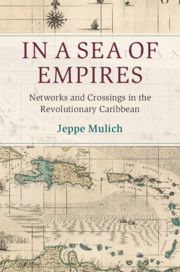
BOOK: Jeppe MULICH, In a Sea of Empires: Networks and Crossings in the Revolutionary Caribbean (Cambridge: Cambridge University Press, 2020). ISBN 9781108489720, $ 99.99


(Source: CUP)

Cambridge University Press is publishing a new book on the interconnected nature of imperial politics and colonial law in the maritime borderlands of the Leeward Islands in the early 19th century.

ABOUT THE BOOK

At the turn of the nineteenth century, the Caribbean was rife with revolutionary fervor and political turmoil. Yet, with such upheaval came unparalleled opportunities. In this innovative and richly detailed study, Jeppe Mulich explores the interconnected nature of imperial politics and colonial law in the maritime borderlands of the Leeward Islands, where British, Danish, Dutch, French, Spanish, and Swedish colonies both competed and cooperated with one another. By exploring the transnational networks involved in trade, slavery, smuggling, privateering, and marronage, he offers a new account of the age of revolutions in the Caribbean, emphasizing the border-crossing nature of life in the region. By approaching major shifts in politics, economy, and law from the bottom-up, a new story of early nineteenth-century globalization emerges – one that emphasizes regional integration and a multiplicity of intersecting networks.

ABOUT THE AUTHOR

Jeppe MulichLondon School of Economics and Political Science

Jeppe Mulich is Teaching Associate in Global History at the University of Cambridge and St John's College.

TABLE OF CONTENTS

1. Introduction
2. Free ports and black markets
3. Imperial warfare, colonial violence
4. Prize courts and privateers
5. Slave laws and free communities
6. Abolition and the illegal slave trade
Conclusion.

More info here

23 March 2018

ANNOUNCEMENT: PHEDRA - Pour une Histoire Européenne du DRoit des Affaires


PHEDRA
Pour une Histoire Européenne du DRoit des Affaires 

Sano di Pietro, La Madonna raccomanda Siena a Papa Callisto III, détail, 1456, Siena, Pinacoteca Nazionale

Droit particulier, mais droit universel, tel semble être le paradoxe apparent du droit des affaires. Ius proprium, il l’est évidemment : c’est le droit propre aux affaires. Pourtant, sa propension à l’universalité a clairement été mise en évidence : la dimension transfrontalière du droit des affaires se révèle précocement, conduisant à lui conférer une homogénéité et une porosité internationale qui n’ont pas d’égaux. Cela est particulièrement vrai pour ce qui concerne l’Europe. Des dynamiques de longue durée dans l'évolution du droit des affaires – tant dans ses aspects normatifs que discursifs – ont investi l'ensemble du continent, laissant des sillons homogènes qui ont considérablement influencé le développement des cultures juridiques contemporaines, lesquels méritent, à nos yeux, une confrontation approfondie et étendue, qui ne doit pas pour autant nier les ruptures historiques et les diversités géographiques. 
Cette dimension transfrontalière du ius mercatorum, lequel porte dans son nom même les caractères du particularisme juridique, a conduit certains juristes contemporains à parler de la lex mercatoria comme d'un ordre juridique « anational »[1]. Cette qualification par la négative a, selon nous, le défaut de faire abstraction du substrat culturel propre à l’espace européen – au-delà de ses seuls aspects juridiques – dans lequel le droit des affaires s'est façonné. 
En effet, si ce droit profondément proprium a tendu vers l’uniformité à l'échelle européenne2, les raisons de ce phénomène ne peuvent pas, sans doute, être trouvées uniquement dans la force irréfrénable du marché. La seule analyse économique du droit des affaires ne saurait suffire à en comprendre les dynamiques.
Au-delà des raisons de praticité, il semble donc indispensable de s’interroger sur les ressorts historiques, culturels voire anthropologiques, qui pourraient permettre de dégager des caractères européens de l'évolution du droit des affaires. Il s’agit là d’un débat passionnant qui, loin d’être clos – malgré d’importantes contributions –, a récemment été rouvert de manière magistrale, dans une perspective d’ensemble, laquelle se demandait si le droit européen a une histoire[2].
Partant de ces constats et de ces questionnements, nous souhaitons lancer une réflexion d’ampleur sur l’histoire du droit des affaires à l'échelle européenne. L’idée-force consiste à travailler sur la longue durée (du Moyen Âge au XXIe siècle) et au niveau européen (Europe continentale et insulaire) de façon structurée, sur les trajectoires du développement du droit des affaires. Pour ce faire la constitution d'un groupe de travail stable et ramifié, permettant le développement dans le temps d'une réflexion approfondie et d’envergure, semble être l’instrument à la fois le plus efficace et le plus prometteur.

(davantage d'informations ici)


[1] Filali OSMAN, Les principes généraux de la lex mercatoria : contribution à l'étude d'un ordre juridique anational, Paris, 1992. 2 Albrecht CORDES, « The search for a medieval Lex mercatoria », in Vito Piergiovanni (ed.), From Lex Mercatoria to Commercial Law, Berlin, 2005, p. 53-68.
[2] Alain WIJFFELS, Le droit européen a-t-il une histoire ? En a-t-il besoin ?, Paris, Fayard [Leçons inaugurales au Collège de France], 2017.