Search

Showing posts with label communties. Show all posts

16 September 2024

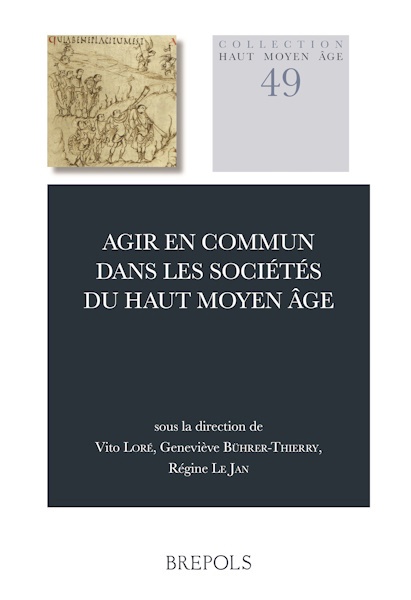
BOOK: Vito LORE, Geneviève BUHRER-THIERRY, Régine LE JAN (eds.), Agir en commun dans les sociétés du haut Moyen Âge (Turnhout: Brepols, 2024). ISBN: 9782503606897

(Image source: Brepols)


ABOUT THE BOOK

Au-delà des communautés stables et durables qu’on peut saisir autour des lieux ou dans un cadre institutionnel, les petites communautés locales du haut Moyen Âge n’avaient habituellement pas de statut formalisé : en l’absence de cadres institutionnels, nous ne pouvons souvent saisir leurs caractères qu’à travers les récits de leurs actions, ou à travers d’autres traces, laissées par leurs actes dans la documentation, écrite ou archéologique. Mais encore faut-il se poser la question de savoir comment agissaient les communautés au haut Moyen Âge, dans quels contextes et dans quels buts ? L’action commune, surtout si elle est récurrente, fortifie-t-telle ou forme-t-elle la communauté ? Le présent ouvrage vise à décrypter les différentes manières « d’agir en commun » dans les sociétés du haut Moyen Âge, en posant les questions de l’initiative de l’action, des différents modes d’action et de leur influence sur la structure de la communauté, des types et des formes d’action communautaire.


ABOUT THE EDITORS

Vito Loré est professeur à l’Université Roma3; Geneviève Bührer-Thierry et Régine Le Jan sont professeure et professeure émérite à l’Université Paris1-Panthéon-Sorbonne et membres du LaMOP UMR8589. Tous trois sont des spécialistes reconnus de l’histoire des sociétés du Haut Moyen Âge.


TABLE OF CONTENTS

Introduction (Geneviève Bührer-Thierry et Régine Le Jan)

Part I : Modalités d’action communautaire

  • Philippe Depreux, Se rendre ensemble à la cour royale ou impériale pour obtenir un privilège – la présentation concomitante de requêtes par des fidèles originaires d’une même région (VIIIe – Xe s.)
  • Cristina La Rocca et Gianmarco De Angelis, Spectating communities? Agents, spaces and rituals of taking possessions in Carolingian Lombardy
  • Luigi Provero, I limiti dell’azione contadina nell’Italia carolingia
  • Wendy Davies, Was there collective action in or by the plebes of ninth-century Brittany ?
  • Catarina Tente, The early medieval communities of Beira Alta (Central-Nortern Portugal): settlement, economy and social organization
  • Adrien Bayard, Communautés de travail, communautés au travail. Moines et sauniers de l’Atlantique (Xe-XIe siècle)
  • Paolo Tomei,  « Alla casa del signore. » Forme e spazi di azione dell’aristocrazia alto- medievale lucchese : una « comunità domestica. »

Part II : Communautés en interaction, communautés en tension

  • Hans-Werner Goetz, Les conjurationes du haut Moyen Âge sont elles des communautés ?
  • Alban Gautier, Guerriers solitaires, guerriers solidaires. Le combat entre acte singulier et expérience de la communauté dans la littérature héroïque du haut Moyen Âge
  • Johanna Jebe, Quelle communauté monastique ? Réflexions stratégiques et réflexions rétrospectives sur les actions des moines de Fulda au IXe siècle
  • Laurent Jégou, « Conciliés, déconciliés, réconciliés ». Unanimité et discorde dans le cadre conciliaire au haut Moyen Âge
  • Inaki Martin Viso, Orta fuit intentio. Communities and placita in Northern Iberia (9th-11th centuries)
  • Marco Stoffella, Spazi e forme di azione del clero delle cattedrali in Toscana e in Veneto tra VIII e IX secolo: una comparazione
  • Giacomo Vignodelli, I canonici delle cattedrali del regno italico tra élites locali e potere regio (secoli X-XI) : comunità in azione ?
  • Igor Santos Salazar, Un espacio desigual: concilia y comunidades rurales en Castilla y La Rioja (940-1109)

Conclusion (Vito Loré)


More information can be found here.


19 April 2022

BOOK: Rutger KRAMER, Walter POHL (eds.), Empires and Communities in the Post-Roman and Islamic World, C. 400-1000 CE (Oxford: Oxford University Press, 2021), ISBN: 9780190067 OPEN ACCESS


(Image source: Oxford University Press


ABOUT THE BOOK

This book deals with the ways empires affect smaller communities like ethnic groups, religious communities and local or peripheral populations. It raises the question how these different types of community were integrated into larger imperial edifices, and in which contexts the dialectic between empires and particular communities caused disruption. How did religious discourses or practices reinforce (or subvert) imperial pretenses? How were constructions of identity affected in the process? How were Egyptians accommodated under Islamic rule, Yemenis included in an Arab identity, Aquitanians integrated in the Carolingian empire, Jews in the Fatimid Caliphate? Why did the dissolution of Western Rome and the Abbasid Caliphate lead to different types of polities in their wake? How was the Byzantine Empire preserved in the 7th century; how did the Franks construct theirs in the 9th? How did single events in early medieval Rome and Constantinople promote social integration in both a local and a broader framework?

Focusing on the post-Roman Mediterranean, this book deals with these questions from a comparative perspective. It takes into account political structures in the Latin West, in Byzantium and in the early Islamic world, and does so in a period that is exceptionally well suited to study the various expansive and erosive dynamics of empires, as well as their interaction with smaller communities. By never adhering to a single overall model, and avoiding Western notions of empire, this volume combines individual approaches with collaborative perspectives. Taken together, these chapters constitute a major contribution to the advancement of comparative studies on pre-modern empires.


ABOUT THE EDITORS

Rutger Kramer, Assistant Professor of Medieval History, Radboud University, The Netherlands.

Walter Pohl, Professor of History, University of Vienna, Austria.


TABLE OF CONTENTS

  1. Introduction: Empires and Communities in the Post-Roman and Islamic World (Walter Pohl and Rutger Kramer)
  2. The Emergence of New Polities in the Break-Up of the Abbasid Caliphate (Hugh Kennedy)
  3. The Emergence of New Polities in the Break-Up of the Western Roman Empire (Walter Pohl)
  4. Comparative Perspectives: Differences between the Dissolution of the Western Roman Empire and the Abbasid Caliphate (Walter Pohl and Hugh Kennedy)
  5. Fragmentation and Integration: A Response to the Contributions by Hugh Kennedy and Walter Pohl (Peter Webb)
  6. Historicizing Resilience: The Paradox of the Medieval East Roman State; Collapse, Adaptation, and Survival (John Haldon)
  7. Processions, Power, and Community Identity: East and West (Leslie Brubaker and Chris Wickham)
  8. Death of a Patriarch: The Murder of Yuhanna ibn Jami (966) and the Question of 'Melkite' Identity in Early Islamic Palestine (Daniel Reynolds)
  9. Diversity and Convergence: The Accommodation of Ethnic and Legal Pluralism in the Carolingian Empire (Stefan Esders and Helmut Reimitz)
  10. Franks, Romans, and Countrymen: Carolingian Interests, Local Identities, and the Conquest of Aquitaine (Rutger Kramer)
  11. From the Sublime to the Ridiculous: Yemeni Arab Identity in Abbasid Iraq (including Appendix: translations of selected poems) (Peter Webb)
  12. Loyal and Knowledgeable Supporters: Integrating Egyptian Elites in Early Islamic Egypt (Petra Sijpesteijn)
  13. Concluding Thoughts: Empires and Communities (Chris Wickham)


More information can be found here

The entire publication can be read in open access at this link