Search

Showing posts with label company law. Show all posts

11 October 2021

BOOK: Holger FLEISCHER & Sebastian MOCK (Eds.), Große Gesellschaftsverträge aus Geschichte und Gegenwart (Berlin: De Gruyter, 2021). ISBN 9783110738483, 189.95 EUR


(Source: De Gruyter)

We learned of a new edited collection on major articles of association and company charters in history.

ABOUT THE BOOK

For this first time, this volume analyzes major articles of association and company charters past and present and discusses them in accompanying essays. Twenty-seven contributions gauge the world of articles of association, from the Medici to the Dutch East India Company to Google; from the Fugger family to Siemens, the Auto Union, the ADAC and FIFA; and from IG Farben to the Alfried Krupp von Bohlen und Halbach Foundation.

  • Grundlagenwerk zur Entwicklung des Gesellschaftsrechts
  • Erschließung bisher unbekannter Gesellschaftsverträge und Satzungen
  • einmalige Inspirationsquelle für Forschung und Gestaltungspraxis
  • Brückenschlag zur Unternehmensgeschichte

ABOUT THE EDITORS

Holger Fleischer, Max-Planck-Institut Hamburg, Germany; Sebastian Mock, Vienna University of Economics and Business, Austria.

The table of contents can be found here

11 June 2020

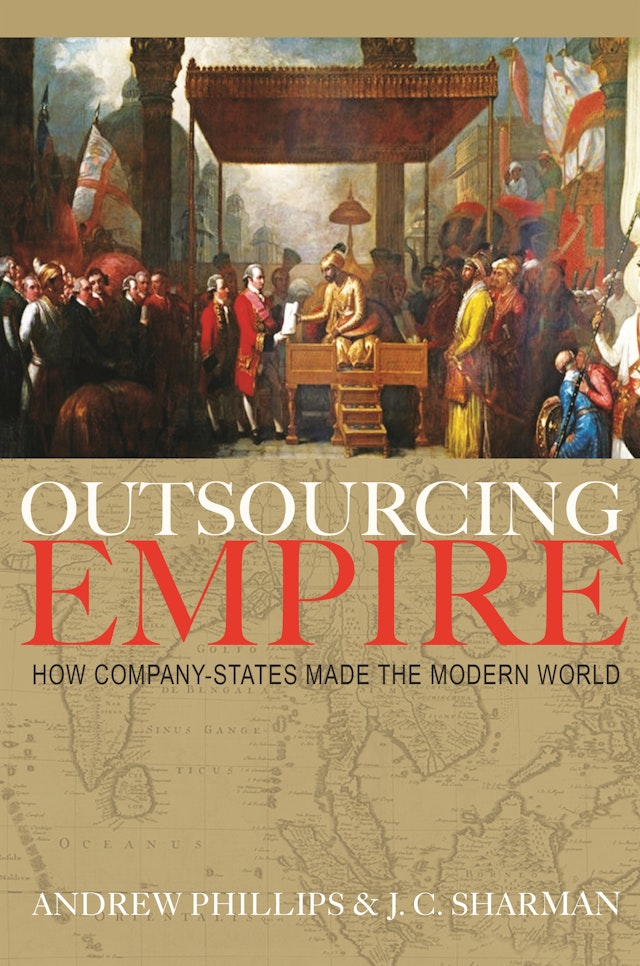
BOOK: Andrew PHILLIPS and J. C. SHARMAN, Outsourcing Empire: How Company-States Made the Modern World (Princeton: Princeton University Press, 2020). ISBN 9780691203515, 29.95 USD


Princeton University Press is publishing a new book on the history of chartered company and their historical contribution to the global order.

ABOUT THE BOOK

How chartered company-states spearheaded European expansion and helped create the world’s first genuinely global order

From Spanish conquistadors to British colonialists, the prevailing story of European empire-building has focused on the rival ambitions of competing states. But as Outsourcing Empire shows, from the seventeenth to the twentieth centuries, company-states—not sovereign states—drove European expansion, building the world’s first genuinely international system. Company-states were hybrid ventures: pioneering multinational trading firms run for profit, with founding charters that granted them sovereign powers of war, peace, and rule. Those like the English and Dutch East India Companies carved out corporate empires in Asia, while other company-states pushed forward European expansion through North America, Africa, and the South Pacific. In this comparative exploration, Andrew Phillips and J. C. Sharman explain the rise and fall of company-states, why some succeeded while others failed, and their role as vanguards of capitalism and imperialism.

In dealing with alien civilizations to the East and West, Europeans relied primarily on company-states to mediate geographic and cultural distances in trade and diplomacy. Emerging as improvised solutions to bridge the gap between European rulers’ expansive geopolitical ambitions and their scarce means, company-states succeeded best where they could balance the twin imperatives of power and profit. Yet as European states strengthened from the late eighteenth century onward, and a sense of separate public and private spheres grew, the company-states lost their usefulness and legitimacy.

Bringing a fresh understanding to the ways cross-cultural relations were handled across the oceans, Outsourcing Empire examines the significance of company-states as key progenitors of the globalized world.

ABOUT THE AUTHOR

Andrew Phillips is associate professor of international relations and strategy at the University of Queensland. He is the author of War, Religion and Empire
J. C. Sharman is the Sir Patrick Sheehy Professor of International Relations at the University of Cambridge, where he is a fellow of King’s College. His books include Empires of the Weak (Princeton) and The Despot’s Guide to Wealth Management. Phillips and Sharman are the coauthors of International Order in Diversity.

More info here

27 January 2014

ARTICLE: Flume on "Law and commerce. The evolution of codified business law in Europe"

Johannes W. Flume's  "Law and Commerce – The Evolution of Codified Business Law in Europe", forthcoming inComparative Legal History (2014)


Abstract

This paper tracks the evolution of the codification of commercial law and company law, also known as business law. While the literature on codification in general is vast, little attention has been dedicated to the importance of business law in this context although the first major moves towards codification were achieved in this field. A comparative and historical survey of the codification of business law in France, England and Germany illustrates how the European legal landscape has been affected by the process of casting the law into statutory form. Indeed, despite the commonly held misconception that there is “a” commercial code, the legislative responses to the needs of commerce have varied widely from country to country, for while company law was always in focus, the rest of the corpus differs substantially. The code de commerce of 1807 was primarily of procedural nature, while the German commercial code of 1863 created its own “private law cosmos” and the late English codes adopted yet another, very selective, strategy. The aim of this comparative study is to understand the foundations of the legal institutions of the 19th century which still form the basis of our current statutes. This in turn allows to make some predictions for likely future developments.

full paper here