Search

Showing posts with label Ottoman legal history. Show all posts

05 October 2022

CALL FOR ABSTRACTS: Remapping Decisions: Splendid Encounters XI (Vienna, 27–28 April 2023) (DEADLINE: 15 October 2022)


(Source: RSA)

We learned of Call for Abstracts for a conference on diplomatic decision-making in the context of the multi-faceted political and cultural contacts between the Ottoman Empire and the rest of early modern Europe.

 The conference hosted by the Institute for Habsburg and Balkan Studies of the Austrian Academy of Sciences (IHB ÖAW) and the Institute for History of the Polish Academy of Sciences (IH PAN) seeks to examine the problem of diplomatic decision-making in the context of the multi-faceted political and cultural contacts between the Ottoman Empire and the rest of early modern Europe. Firstly, its main scope focuses on both power conflicts and conflict-management practice in Central Europe, Southeast Europe and the Mediterranean. In light of political actions, it shall also reflect the significance of cultural exchange in the directly affected regions, as well as the growing interest in the Ottoman Empire and the Near East in Europe. Secondly, in order to enrich this increasingly popular research field by new approaches, this event centers the procedure of decision-making which has been largely under-investigated in the field of European-Ottoman relations so far.

Splendid Encounters is a series of international and interdisciplinary conferences that aims to bring together scholars from different fields of study to consider diplomacy and diplomatic activities in the early modern period within the broadest possible framework. After nine successful meetings in, among others, Warsaw, Bath, Budapest, Prague, Toulouse, Florence and Lisbon we invite you to join us for another event, this time hosted by the Institute for Habsburg and Balkan Studies of the Austrian Academy of Sciences (IHB ÖAW) in Vienna.

View full CFP in a new window (PDF)

More info here

12 January 2021

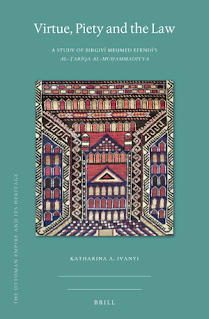
BOOK: Katharina Anna IVANYI, Virtue, Piety and the Law. A Study of Birgivī Meḥmed Efendī’s al-Ṭarīqa al-muḥammadiyya (Leiden: Brill, 2020). ISBN: 9789004419865, € 105.00

(Source: Brill)

ABOUT THE BOOK

Series: The Ottoman Empire and its Heritage, Volume: 72

In Virtue, Piety and the Law Katharina Ivanyi examines Birgivī Meḥmed Efendī’s (d. 981/1573) al-Ṭarīqa al-muḥammadiyya, a major work of pietist exhortation and advice, composed by the sixteenth-century Ottoman jurist, Ḥadīth scholar and grammarian, who would articulate a style of religiosity that had considerable reformist appeal into modern times. Linking the cultivation of individual virtue to questions of wider political, social and economic concern, Birgivī played a significant role in the negotiation and articulation of early modern Ottoman Ḥanafī piety. Birgivī’s deep mistrust of the passions of the human soul led him to prescribe a regime of self-surveillance and control that was only matched in rigor by his likewise exacting interpretation of the law in matters of everyday life, as much as in state practices, such as the cash waqf, Ottoman land tenure and taxation.

ABOUT THE AUTHOR

Katharina A. Ivanyi, Ph.D. (2012), Princeton University, is External Lecturer at the Department of Near Eastern Studies at the University of Vienna.

TABLE OF CONTENTS

Acknowledgements 

Abbreviations and Frequently Cited Sources 

Note on Transliteration and Transcription 

Introduction 

1 Please Provide Chapter Title 

 1 Context I: Birgivī’s Life 

 2 Context II: Birgivī’s oeuvre 

 3 Context III: the Bigger Picture—Early Modern Sunnitization, the Negotiation of Orthodoxy and the Pietist Turn 

2 The Intellectual Framework 

 1 The Ḥanafī Tradition—Law and Ethics 

 2 Post-Classical fatāwā Handbooks 

 3 Abū al-Layth al-Samarqandī 

 4 Other Ḥanafī Literature 

 5 The Corruption of Times 

 6 Legal Sources beyond the Ḥanafī School 

 7 Birgivī and the Ḥanbalīs 

 8 Birgivī and Ḥadīth 

 9 Sufism 

 10 Science of the Hearts 

 11 Ghazālī 

 12 Emulation of the Prophet 

 13 Birgivī in Contemporary Comparison: Shāhzāde Ḳorḳud 

 14 Birgivī and the Ottoman naṣīḥat-nāme: Muṣṭafā ʿĀlī 

 15 Birgivī and Ottoman Jurisprudence: Ebūʾs-Suʿūd 

3 The Fundamentals of Piety: an Overview of the Structure and Contents of al-Ṭarīqa al-muḥammadiyya 

 1 Introduction 

 2 A Note on the Textual History of al-Ṭarīqa al-muḥammadiyya 

 3 General Structure of TM and Overview of Contents 

 4 Detailed Summary of Contents—Introduction 

 5 Innovation 

 6 Bidʿa and Sufism 

 7 Moderation 

 8 Part Two—Chapter One—Doctrine 

 9 The Legal Status of the various sciences 

 10 Part Two, Chapter Three: Piety 

 11 The Practical Manifestations of Piety—the Core of TM 

 12 The Vices of the Heart 

 13 Birgivī’s Conception of the Soul 

 14 The Vices of the Tongue 

 15 The Vices of the Ear 

 16 The Vices of the Eye 

 17 The Vices of the Hand 

 18 The Vices of the Belly 

 19 The Vices of the Private Parts 

 20 The Vices of the Leg 

 21 Vices Unspecified by Any One Part of the Body 

 22 Part Three of TM—Ritual Purity 

 23 Part Three—Chapter Two—Finance, Land Tenure and Taxation 

 24 What Holds It All Together 

4 The Slippery Slope of Piety: Birgivī on Sincerity, Sanctimony and How to Determine Right Intention 

 1 Introduction 

 2 Vocabulary and Semantics, Definitions and Classifications 

 3 Riyāʾ as Lesser Shirk 

 4 Other Types of Dissimulation 

 5 Sincerity (ikhlāṣ and iḥsān) 

 6 Truthfulness (ṣidq) 

 7 Various Taxonomies of riyāʾ 

 8 Legal Categorization 

 9 The Why(s) and How(s) of riyāʾ 

 10 The “People of Religion” 

 11 When Things Are Not That Clear-Cut 

 12 Embarrassment 

 13 How to Cure the Evil of riyāʾ 

 14 Display in Order to Guide, but How Can You Be Sure 

 15 Conclusion 

5 The Economics of Piety: Birgivī on Wastefulness, the Cash waqf and Ottoman Land Tenure and Taxation 

 1 Introduction 

 2 Basic Concepts—the Good and Bad Qualities of Wealth 

 3 Stinginess, Generosity and Waste 

 4 The Causes, Manifestations and Antidotes of Wastefulness 

 5 Charity, Poverty and Begging 

 6 Payment for Religious Services 

 7 The Cash waqf 

 8 Land Tenure and Taxation 

 9 Conclusion 

Conclusion 

Bibliography 

 Reference Works, Library Catalogues, Bibliographies 

 Primary Sources 

 Secondary Sources 

Index 


More information with the publisher.

01 October 2020

BOOK: Colin HEYWOOD & Ivan PARVEV (Eds.), The Treaties of Carlowitz: Antecedents, Course and Consequences (Leiden-New York: Brill, 2020). ISBN 978-90-04-40950-7, EUR 105.00

(Source: Brill)


Brill has published a new book on the Treaties of Carlowitz (1699).

ABOUT THE BOOK

The Treaties of Carlowitz (1699) includes recent studies on the Lega Sacra War of 1683-1699 against the Ottoman Empire, the Peace treaties of Carlowitz (1699), and on the general impact of the conflict upon Modern Europe and the Balkans. With its contributions written by well-known international specialists in the field, the volume demonstrates that sometimes important conflicts tend to be forgotten with time, overshadowed by more spectacular wars, peace congresses or diplomatic alliances. The “Long War” of 1683-1699 is a case in point. By re-thinking and re-writing the history of the conflict and the subsequent peacemaking between a Christian alliance and the Ottoman state at the end of the 17th century, new perspectives, stretching into the present era, for the history of Europe, the Balkans and the Near East are brought into discussion.


Contributors are: Tatjana Bazarova, Maurits van den Boogert, John Paul Ghobrial, Abdullah Güllüoğlu, Zoltan Györe, Colin Heywood, Lothar Höbelt, Erica Ianiro, Charles Ingrao, Dzheni Ivanova, Kirill Kochegarov, Dariusz Kołodziejzcyk, Hans Georg Majer, Ivan Parvev, Arno Strohmeier.

ABOUT THE EDITORS

Colin Heywood, Ph.D. (London, 1970) is an Honorary Research Fellow at the University of Hull. He has published numerous studies and articles on Ottoman history and historiography and on Mediterranean and maritime history in the late medieval and early modern period. 

Ivan Parvev, Ph.D. (1993), Habil. D. (2011), University of Sofia, is Professor of Early Modern Balkan history at that university. He has published monographs and articles on Habsburg-Balkan relations, including Land in Sicht. Südosteuropa in den deutschen politischen Zeitschriften des 18. Jahrhunderts (Zabern, 2008).

TABLE OF CONTENTS

  Preface 
  About the Authors 
  Introduction 


Part 1: The War of 1683–1699 – Political Strategies and Balance of Power in Europe


 1On the Road to Carlowitz: Visions of Ottoman Diplomacy in the Letters of Thomas Coke, 1691–1694 
  Jean-Paul A. Ghobrial 
 2‘This Great Work’: Lord Paget and the Processes of English Mediating Diplomacy in the Latter Stages of the Sacra Lega War, 1697–1698 
  Colin Heywood 
 3The Spoils of Peace: What the Dutch Got Out of Carlowitz 
  Maurits H. van den Boogert 
 4The War of 1683–1699 and the Beginning of the Eastern Question 
  Ivan Parvev 


Part 2: The Sacra Lega War Viewed by the Sublime Porte


 5Ottoman Diplomacy in the First Years (1683–1685) of the Ottoman “Long War” 
  Abdullah Güllüoğlu 
 6Ottoman Subjects, Habsburg Allies. The Reaya of the Chiprovtsi Region (Northwestern Bulgaria) on the Front Line, 1688–1690 
  Dzheni Ivanova 
 7Ottoman Knowledge of the Imperial Commanders 
  Hans Georg Majer 


Part 3: Time for War, Time for Peace


 8From Slankamen to Zenta: The Austrian War Effort in the East during the 1690s 
  Lothar Höbelt 
 9The Habsburgs and the Holy League: Religion or Realpolitik? 
  Charles Ingrao 
 10From the ‘Eternal Peace’ to the Treaty of Carlowitz: Relations between Russia, the Sublime Porte and the Crimean Khanate (1686–1699) 
  Kirill Kochegarov 
 11The Treaty of Carlowitz in Polish Memory – A Date Better Forgotten? 
  Dariusz Kołodziejczyk 
 12The Symbolic Making of the Peace of Carlowitz: The Border Crossing of Count Wolfgang IV of Oettingen-Wallerstein during His Mission as Imperial Grand Ambassador to the Sublime Porte (1699–1701) 
  Arno Strohmeyer 
 13The Treaty of Carlowitz and its Impact on Russian-Ottoman Relations, 1700–1710 
  Tatiana Bazarova 


Part 4: Early Modern Demographic and Economic Context


 14War and Demography: The Case of Hungary 1521–1718 
  Zoltán Györe 
 15Venice after Carlowitz: Change and Challenge in Eighteenth-century Venetian Policy 
  Erica Ianiro 
 Concluding Remarks 
  Index 


More info here

09 January 2020

CONFERENCE: Commercial Law in South-eastern Europe: Legislation and Jurisdiction from Tanzimat Times until the Eve of the Great War (Regensburg, 23-24 April 2020)


Via Hsozkult, we learned of a conference on 19th century commercial law in South-eastern Europe at the Universität Regensburg.

“Im 19. Jahrhundert sah sich das Osmanische Reich zu umfassenden Reformen gezwungen. Diese betrafen neben Verfassung und Verwaltung insbesondere auch Zivilrecht und Rechtspflege. Man orientierte sich stark an Frankreich und setzte unter anderem 1850 den Code de Commerce in Geltung, ohne daß die bisher geltenden Regelungen vollständig außer Kraft getreten wären. Im Aufeinandertreffen von überkommenem osmanischem Recht, Gerichtssystem und Gerichtspersonal einerseits und hochmodernem französischem Recht andererseits hat sich ein eigenständiger Rechtskulturraum in Südosteuropa entwickelt [...]“

The full conference program can be found here

11 December 2019

BOOK: M. Safa SARACOGLU, Nineteenth Century Local Governance in Ottoman Bulgaria : Politics in Provincial Councils (Oxford: Oxford University Press, 2019). ISBN 9781474431002, $29.95


(Source: OUP)

Oxford University Press recently published a book on local governance in Ottoman Bulgaria.

ABOUT THE BOOK

This book provides a detailed exploration of the way in which administrative and judicial offices and practices provided an essential space for politics in 19th-century Bulgaria, securing local inhabitants' participation with Ottoman imperial governance. Combining a wealth of primary documents in both Bulgarian and Ottoman Turkish, this is the first systematic and comprehensive study of the connection between imperially-designed institutions and local politics.

ABOUT THE AUTHOR

M. Safa Saracoglu is a Professor of History at Bloomsburg University of Pennsylvania. He is co-editor (with Kent F. Schull) of Law and Legality in the Ottoman Empire and Republic of Turkey (2016).

TABLE OF CONTENTS

Acknowledgements
Table of Contents
Abbreviations
Preface

1 - INTRODUCTION
The Argument
Vidin
Structure of The Book

2 - CONTEXTUALIZING THE NINETEENTH CENTURY
The Tanzimat Era: Marking a Crisis and a Transition
Means of Production and Ottoman Social Formation
From Tax Farmers to Tax Collectors
The Liberal-Capitalist Ottoman Social Formation
Governance, Official Print and Information Flow
Conclusion

3 - SITTING TOGETHER: LOCAL COUNCILS AND THE POLITICS OF ELECTION IN THE COUNTY OF VIDIN
The Many Parts of the Imperial Dominions: The County as an Administrative Unit
The 1871 Regulation: The County as a Reflection of the Province
Councils: Inevitable Dynamism?
Councils: Conveying or Constituting Reality?
Of Permanency and Change: the Politics of Election
Conclusion

4 - ONCE INSIDE THE CHAMBER... : PARTICIPATION IN THE POLITICS OF LOCAL ADMINISTRATION
Seals: Images of Participation?
The Rationale for the Seals
The Frequency and Synchronicity
Right side up?
Yearbooks: Reflections of the Judicio-Administrative Sphere.
Conclusion: A Better Vision of the System?

5 - WRITING POLITICS: OTTOMAN GOVERNMENTALITY AND THE LANGUAGE OF REPORTS
'Several Times He had been Given Well-Intended Reminders': A case of Local Antagonism
Land and Power in Berkofça
Ottoman Governmentality
Utilizing Ottoman Governance
Staying Out: Challenging Ottoman Governmentality
Conclusion

6 - 'CATTLE THIEVES': REFUGEE SETTLEMENT, OTTOMAN GOVERNMENTALITY AND BIOPOLITICS
The Numbers
Cattle as Liquidity
'Security, Territory, Population' in Vidin
From Refugees to Cattle Thieves
Conclusion

7 - CONCLUSION
Survival of Lower-Tier Elites
Crisis and Means of Production
Connected Offices
Contentious Dynamics
Conniving Narratives
Politics of Liberalism

Select Bibliography
Archives
Encyclopaedias and Dictionaries
Official publications
Secondary Sources

More info here

16 September 2019

BOOK: Viorel PANAITE, Ottoman Law of War and Peace - The Ottoman Empire and Its Tribute-Payers from the North of the Danube., 2nd ed. (Leiden - New York, 2019). ISBN 978-90-04-41110-4, €149.00


(Source: Brill)

Brill has published a second, revised edition of “Ottoman Law of War and Peace”.

ABOUT THE BOOK

Making use of legal and historical sources, Viorel Panaite analyzes the status of tribute-payers from the north of the Danube with reference to Ottoman law of peace and war. He deals with the impact of Ottoman holy war and the way conquest in Southeast Europe took place; the role of temporary covenants, imperial diplomas and customary norms in outlining the rights and duties of the tributary princes; the power relations between the Ottoman Empire and the tributary-protected principalities of Wallachia, Moldavia and Transylvania. He also focuses on the legal and political methods applied to extend the pax ottomanica system in the area, rather than on the elements that set these territories apart from the rest of the Ottoman Empire.

ABOUT THE AUTHOR

Viorel Panaite, PhD (1995), University of Bucharest, is Professor of Ottoman History, and Researcher at the Institute of Southeast European Studies, Romanian Academy. He has extensively published on war, peace and tributaries in Ottoman view, and Western merchants in the Levant.

TABLE OF CONTENTS

Preface and Acknowledgments
List of Facsimiles, Illustrations and Maps
Transliteration and Pronunciation of Turkish and Romanian
Abbreviations
Part 1: Ottoman Law of War and Peace
1 Islamic Tradition and the Ottoman Law of War and Peace
Part 2: The Danube as a Gazi River
2 The Ottoman Ideology of Holy War
3 Ottoman Holy War to the North of the Danube
Part 3: Submission and Conquest
4 The Islamic Ottoman Law of Peace
5 Obeying Ottoman Sultans in Southeastern Europe: a Chronological Survey
6 From Allegiance to Conquest: Terminology, Meanings, Myths
Part 4: Covenants and Customs
7 Ottoman Peace Agreements
8 Oaths as a Guarantee of Fidelity
9 Pacta Sunt Servanda and Tributary Status
10 Customary Practices
Part 5: Tribute-Payers and Protected Peoples
11 Sultans and Voivodes
12 Voivodes as Tribute-Payers
13 Reʿayas and Protected Peoples
14 Tributary-Protected Principalities
Conclusion
Glossary of Ottoman Turkish Terms and Locutions on War, Peace and Tributaries
Table of Correspondence
Bibliography
Index

More information here

24 May 2019

CALL FOR APPLICATIONS: Translation and Transitions. Legal Practice in 19th Century Japan, China, and the Ottoman Empire, Max Planck Institute for European Legal History (DEADLINE: 31 MAY 2019)


The Max Planck Research Group “Translation and Transitions. Legal Practice in 19th Century Japan, China, and the Ottoman Empire” invites researchers of related fields to work with the group for a period of 1-3 months in the calendar year 2020.

The research group has started its work in 2017. Its aim is to compare the legal transformations that took place in 19th and early 20th century Japan, China and the Ottoman Empire. Even though not being colonized, all three countries faced the pressure to adopt Western standards.

Applications are possible for researchers of any stage, starting from advanced PhD students who have been working on their project for at least two years. 

Please contact for further information the head of the research group Dr. Lena Foljanty (
foljanty@rg.mpg.de). If you are interested in this program, please send a description of your project (2-3 pages) and a CV before 31st May 2019 to the same email address.


13 February 2019

BOOK: Heather L. FERGUSON, The Proper Order of Things : Language, Power, and Law in Ottoman Administrative Discourses (Stanford: Stanford University Press, 2018). ISBN 9781503603561, $70.00


Stanford University Press has published a new book on Ottoman law, using textual analysis of legal documents to show “how their formulation of the "proper order of things" configured the state itself”

ABOUT THE BOOK

he "natural order of the state" was an early modern mania for the Ottoman Empire. In a time of profound and pervasive imperial transformation, the ideals of stability, proper order, and social harmony were integral to the legitimization of Ottoman power. And as Ottoman territory grew, so too did its network of written texts: a web of sultanic edicts, aimed at defining and supplementing imperial authority in the empire's disparate provinces. With this book, Heather L. Ferguson studies how this textual empire created a unique vision of Ottoman legal and social order, and how the Ottoman ruling elite, via sword and pen, articulated a claim to universal sovereignty that subverted internal challengers and external rivals.

The Proper Order of Things offers the story of an empire, at once familiar and strange, told through the shifting written vocabularies of power deployed by the Ottomans in their quest to thrive within a competitive early modern environment. Ferguson transcends the question of what these documents said, revealing instead how their formulation of the "proper order of things" configured the state itself. Through this textual authority, she argues, Ottoman writers ensured the durability of their empire, creating the principles of organization on which Ottoman statecraft and authority came to rest.

ABOUT THE AUTHOR

Heather L. Ferguson is Associate Professor of Middle East and Ottoman History at Claremont McKenna College. She is Associate Editor of the International Journal of Islamic Architecture and Editor of the Review of Middle East Studies.

The ToC can be found here

More information here

24 January 2019

BOOK: Natalia KROLIKOWSKA-JEDLINSKA, Law and Division of Power in the Crimean Khanate (1532-1774) (Leiden-New York: Brill, 2019). ISBN 978-90-04-38432-3, €102.00


(Source: Brill)

Brill has published a book on law in the Crimean Khanate.

ABOUT THE BOOK

The Crimean Khanate was often treated as a semi-nomadic, watered-down version of the Golden Horde, or yet another vassal state of the Ottoman Empire. This book revises these views by exploring the Khanate’s political and legal systems, which combined well organized and well developed institutions, which were rooted in different traditions (Golden Horde, Islamic and Ottoman). Drawing on a wide range of sources, including the Crimean court registers from the reign of Murad Giray (1678-1683), the book examines the role of the khan, members of his council and other officials in the Crimean political and judicial systems as well as the practice of the Crimean sharia court during the reign of Murad Giray.

ABOUT THE AUTHOR

Natalia Królikowska-Jedlińska, Ph.D. (2010), University of Warsaw, is Assistant Professor at that university. She has published articles on the Crimean Khanate and the Northern Caucasus in the Early Modern Period.

TABLE OF CONTENTS

Preface
 The Chronological Scope of the Research
 Outline of the Book
Acknowledgments
List of Illustrations
List of Abbreviations
Note on Place Names, Proper Names, and Transliteration
Concordance of Frequently Mentioned Place Names
Glossary
Introduction
 Historiography of the Crimean Khanate
 Sources
1 Murad Giray and His Times
 1 The Context of the Crimean Khanate Ruled by Murad Giray
 2 Murad Giray as Viewed by Crimean Chroniclers
2 The Household, Deputies, and the Council of the Khan
 1 The Khan’s Household
 2 The Kalga
 3 The Nuraddin and His Officials
 4 The Khan’s Council
3 The Khan and the Nobles
 1 The Crimean Nobles to 1532
 2 The Crimean Nobles in the Years from 1532 to 1774
4 Provincial Kadıs and Their Courts
 1 The Kadı and Court Personnel
 2 The Limitations of the Judicial Power of the Kadı and His Subordinates
5 Law and Its Practice in the Khanate’s Sharia Courts
 1 The Law Applied in the Crimean Courts
 2 Litigants of the Sharia Courts: A Basic Statistical Analysis
Conclusion: A Fragile Balance
Appendices
Appendix I: Transliteration, Translation, and Facsimile of the Order Issued by Khan Canibeg Giray
Appendix II: Transliteration, Translation, and Facsimile of a Case Brought to the Council of Murad Giray
Appendix III: Summaries of the Cases Judged at the Khan’s Council (1678–82)
Appendix IV: List of the Officials Recorded in the Crimean Sicils during the Reign of Murad Giray
Selected Bibliography
Index

More information here

19 October 2018

BOOK: Avi RUBIN, Ottoman Rule of Law and the Modern Political Trial: the Yildiz Case [Modern Intellectual and Political History of the Middle East] (Syracuse: Syracuse UP, 2018), ISBN 978-0-8156-3597-0, 60 USD

(image source: Legal History Blog)


Book abstract:
In 1876, a recently dethroned sultan, Abdülaziz, was found dead in his chambers, the veins in his arm slashed. Five years later, a group of Ottoman senior officials stood a criminal trial and were found guilty for complicity in his murder. Among the defendants was the world-famous statesman former Grand Vizier and reformer Ahmed Midhat Paşa, a political foe of the autocratic sultan Abdülhamit II, who succeeded Abdülaziz and ruled the empire for thirtythree years. The alleged murder of the former sultan and the trial that ensued were political dramas that captivated audiences both domestically and internationally. The high-profile personalities involved, the international politics at stake, and the intense newspaper coverage all rendered the trial an historic event, but the question of whether the sultan was murdered or committed suicide remains a mystery that continues to be relevant in Turkey today. Drawing upon a wide range of narrative and archival sources, Rubin explores the famous yet understudied trial and its representations in contemporary public discourse and subsequent historiography. Through the reconstruction and analysis of various aspects of the trial, Rubin identifies the emergence of a new culture of legalism that sustained the first modern political trial in the history of the Middle East.
On the author:
Avi Rubin is senior lecturer in the Department of Middle East Studies at Ben-Gurion University of the Negev. He is the author of Ottoman Nizamiye Courts: Law and Modernity. 
Praise:
"A tour de force of socio-legal history of the late Ottoman Empire. Rubin leads the reader into a breathtaking journey through the history and historiography of one of the most serious political crises in late Ottoman history, the Yildiz Trial (1881), turning it into a thrilling microhistory."—Iris Agmon, author of Family and Court: Legal Culture and Modernity in Late Ottoman Palestine"; A fascinating and detailed micro-history of the trial of Midhat Paşa."—James E. Baldwin, author of Islamic Law and Empire in Ottoman Cairo 
More information with the publisher.

11 September 2018

BOOK: Avi RUBIN, Ottoman Rule of Law and the Modern Political Trial - The Yildiz Case (Syracuse: Syracuse University Press, 2018). ISBN 978-0-8156-3601-4, $29.95


Syracuse University Press is publishing a new book on the Yildiz Case in 19th century Ottoman law.

ABOUT THE BOOK

In 1876, a recently dethroned sultan, Abdülaziz, was found dead in his chambers, the veins in his arm slashed. Five years later, a group of Ottoman senior officials stood a criminal trial and were found guilty for complicity in his murder. Among the defendants was the world-famous statesman former Grand Vizier and reformer Ahmed Midhat Paşa, a political foe of the autocratic sultan Abdülhamit II, who succeeded Abdülaziz and ruled the empire for thirtythree years.

The alleged murder of the former sultan and the trial that ensued were political dramas that captivated audiences both domestically and internationally. The high-profile personalities involved, the international politics at stake, and the intense newspaper coverage all rendered the trial an historic event, but the question of whether the sultan was murdered or committed suicide remains a mystery that continues to be relevant in Turkey today. Drawing upon a wide range of narrative and archival sources, Rubin explores the famous yet understudied trial and its representations in contemporary public discourse and subsequent historiography. Through the reconstruction and analysis of various aspects of the trial, Rubin identifies the emergence of a new culture of legalism that sustained the first modern political trial in the history of the Middle East.

ABOUT THE AUTHOR

Avi Rubin is senior lecturer in the Department of Middle East Studies at Ben-Gurion University of the Negev. He is the author of Ottoman Nizamiye Courts: Law and Modernity.

More information here

05 September 2018

BOOK: Will SMILEY, From Slaves to Prisoners of War - The Ottoman Empire, Russia, and International Law [The History and Theory of International Law] (Oxford: Oxford University Press, 2018). ISBN 9780198785415, £65.00


(Source: OUP)

Oxford University Press has published a book on the concept of prisoners of war in the context of the 18th century Ottoman-Russian wars.

ABOUT THE BOOK

The Ottoman-Russian wars of the eighteenth century reshaped the map of Eurasia and the Middle East, but they also birthed a novel concept - the prisoner of war. For centuries, hundreds of thousands of captives, civilians and soldiers alike, crossed the legal and social boundaries of these empires, destined for either ransom or enslavement. But in the eighteenth century, the Ottoman state and its Russian rival, through conflict and diplomacy, worked out a new system of regional international law. Ransom was abolished; soldiers became prisoners of war; and some slaves gained new paths to release, while others were left entirely unprotected. These rules delineated sovereignty, redefined individuals' relationships to states, and prioritized political identity over economic value. In the process, the Ottomans marked out a parallel, non-Western path toward elements of modern international law. Yet this was not a story of European imposition or imitation-the Ottomans acted for their own reasons, maintaining their commitment to Islamic law. For a time even European empires played by these rules, until they were subsumed into the codified global law of war in the late nineteenth century. This story offers new perspectives on the histories of the Ottoman and Russian Empires, of slavery, and of international law.

ABOUT THE AUTHOR

Will Smiley, Assistant Professor of History & Humanities, Reed College
Will Smiley is a historian of the Middle East and of international and Islamic law, with a particular interest in the Ottoman Empire. He is Assistant Professor of History and Humanities at Reed College in Portland, Oregon. He received his PhD from the University of Cambridge and his JD from Yale Law School, and previously held fellowships in Near Eastern Studies at Princeton University, and in Legal History at New York University.

TABLE OF CONTENTS

Introduction
1: Into Captivity
2: Slavery and Ransom
3: From the Law of Ransom to the Law of Release
4: Defining the Law of Release
5: Prisoners of War
6: Negotiating the Prisoner-of-War System
7: The Rules Expand
8: Those Left Out
9: Reform and Reciprocity
10: Humanitarianism and Legal Codification
Conclusion

More information with the publisher

13 July 2018

BOOK: James E. BALDWIN, Islamic Law and Empire in Ottoman Cairo (Oxford: Oxford University Press, 2018). ISBN 9781474432139, $29.95


Oxford University Press has just published the paperback edition of a book on Islamic law in Ottoman Cairo.

ABOUT THE BOOK

What did Islamic law mean in the early modern period, a world of great Muslim empires? Often portrayed as the quintessential jurists' law, to a large extent it was developed by scholars outside the purview of the state. However, for the Sultans of the Ottoman Empire, justice was the ultimate duty of the monarch, and Islamic law was a tool of legitimation and governance. James E. Baldwin examines how the interplay of these two conceptions of Islamic law - religious scholarship and royal justice - undergirded legal practice in Cairo, the largest and richest city in the Ottoman provinces. Through detailed studies of the various formal and informal dispute resolution institutions and practices that formed the fabric of law in Ottoman Cairo, his book contributes to key questions concerning the relationship between the shari'a and political power, the plurality of Islamic legal practice, and the nature of centre-periphery relations in the Ottoman Empire.

ABOUT THE AUTHOR

James E. Baldwin is Lecturer in Empires of the Early Modern Muslim World at Royal Holloway, University of London.

TABLE OF CONTENTS

Abbreviations
Abbreviations
Note on transliteration and dates
Introduction
1. A Brief Portrait of Cairo under Ottoman Rule
2. Cairo's Legal System: Institutions and Actors
3. Royal Justice: The Divan-i Hümayun and the Diwan al-Ali
4. Government Authority, the Interpretation of Fiqh, and the Production of Applied Law
5. The Privatization of Justice: Dispute Resolution as a Domain of Political Competition
6. A Culture of Disputing: How Did Cairenes Use the Legal System?
Conclusion: Ottoman Cairo's legal system and grand narratives
Appendix: Examples of Documents Used in this Study
Notes
Map: Cairo in the Eighteenth Century
Glossary
Sources and Works Cited
Index

More information here