Search

Showing posts with label Laws of war. Show all posts

13 September 2023

CFP: Nuova Antologia Militare (NAM): Modern Military History Issues (1400-1815), Vol. 5, Issue 19 (Summer 2024), NAM Vol. 6, Issue 23 (Summer 2025)


Call for Papers: Nuova Antologia Militare (NAM)

Modern Military History Issues (1400-1815)

NAM Vol. 5, Issue 19 (Summer 2024); NAM Vol. 6, Issue 23 (Summer 2025)

www.nam-sism.org


Publication date: No. 19 Summer 2024; No. 22 Summer 2025

Last date for submission: No. 19 End March 2024, No. 23 End March 2025


We are inviting submissions of original papers and book reviews to be considered for publication in
the fifth and sixth NAM issues specialized in Early Modern and Modern Military History.

Papers should deal with warfare and military. Papers may cover different topics: not only military art and science (tactics, strategy, operations, campaigns and battles, technology, fortifications and siege, naval warfare, intelligence, statistics, topography) but also on all field concerning war studies and polemology, as diplomatic, political, legal, philosophical, economic, social, religious, gender aspects of war. Including literature, iconography, memory, commemoration, anthropology of conflict, and s. o. from Early Modern Era to 1815.

Submissions can be made in Italian, English, French, German, or Spanish; they should be no less than 6 000 and no more than 8000 words in length and should be accompanied by an abstract of 100-250 words in English, and final bibliography.

NAM is an open access, double blind peer-reviewed, DOI indexed journal in the Scopus list, which publishes scholarly articles in the field Military History and publishes 4 issues a year respectively devoted to Ancient, Medieval, Modern and Contemporary MH. It was founded in November 2019 by the Italian Society of Military History and is co-directed by Virgilio Ilari and Giovanni Brizzi. So far NAM has published 243 articles and 216 book reviews (10,000 pages), including 72 and 71 of Modern Military History (3.378 pages).


Please address submissions to virgilio.ilari@gmail.com

NAM Ethics: Articles will be submitted to a double-blind peer review. The articles are indexed with DOI and stored. The authors retain the copyright of their articles. More: https://www.nam-sism.org/2.2%20codice%20etico.html

NAM Guidelines: https://www.nam-sism.org/2.1%20linee%20guida.html


Previous NAM Ancient MH issues published here: https://www.nam-sism.org/3.2%20%20fascicoli.html


17 January 2022

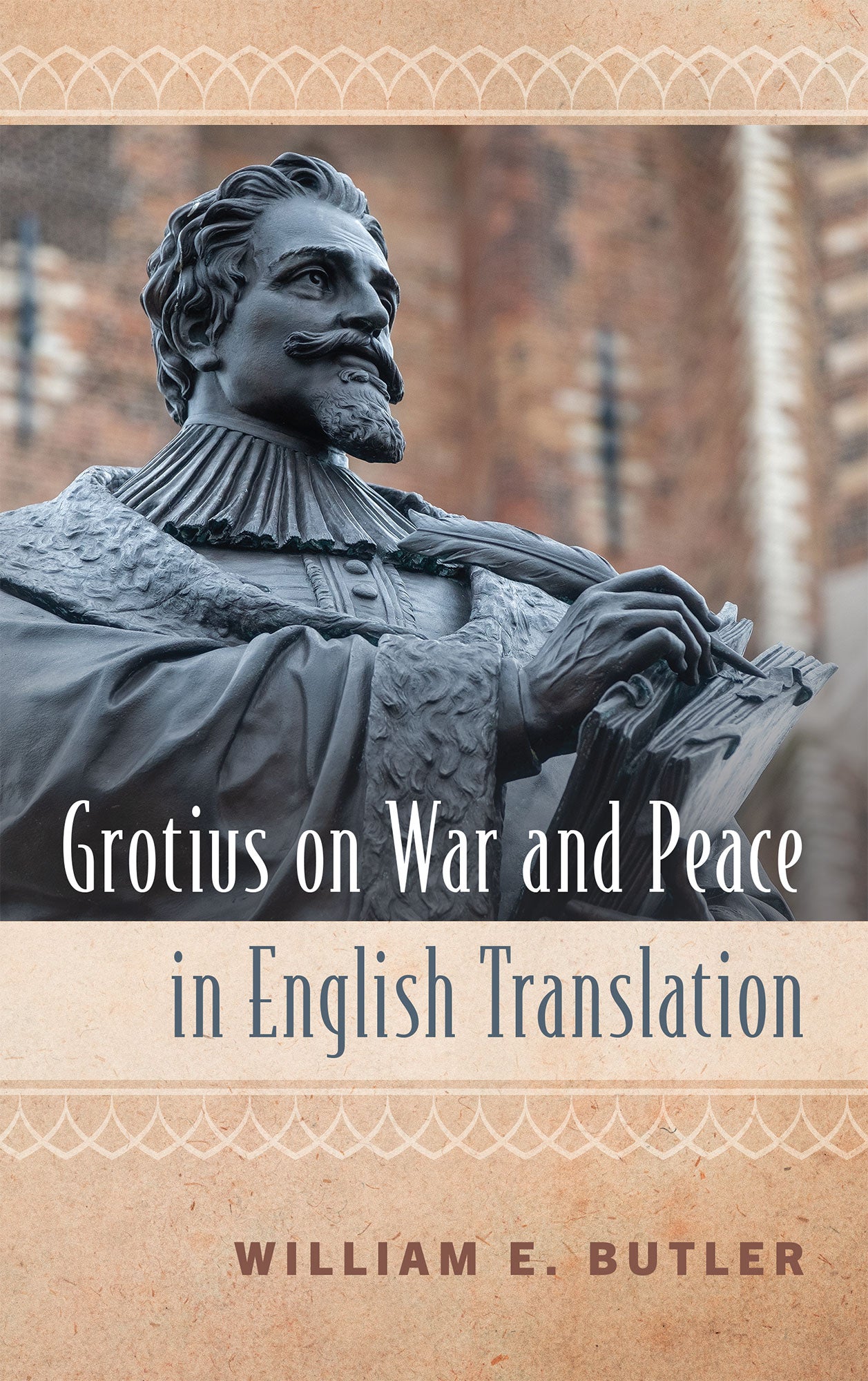
BOOK: William E. BUTLER, Hugo Grotius on War and Peace in English Translation (Clark (New Jersey): Talbot Publishing, 2021), VIII + 162 p. ISBN 9781616196615, 95 USD


On the book:

The seven principal English-language versions of Grotius's classic work On the Law of War and Peace (1625) were published between 1654 and 1928. Either by design or serendipity, each of these appeared on the eve of, during, or immediately after a major international conflict. All major achievements in their time, they expressed an overriding conviction that Grotian insights would enlighten present-day readers and help to lessen the incidence and horrors of armed conflict. Drawing upon archival sources never used previously, this study considers the history of these translations and their different approaches to Grotius's often complicated text. William E. Butler has written extensively on the history of international law and is the founding editor of Jus Gentium: Journal of International Legal History (2016-). He is the John Edward Fowler Distinguished Professor of Law, Dickinson Law, Pennsylvania State University, Professor Emeritus of Comparative Law in the University of London (University College London), Foreign Member, Russian Academy of Natural Sciences and Foreign Member, National Academy of Sciences of Ukraine and National Academy of Legal Sciences of Ukraine.

(source: Lawbook Exchange


02 November 2021

BOOK: Jens IVERSON, Jus Post Bellum: The Rediscovery, Foundations, and Future of the Law of Transforming War into Peace (Leiden: Brill, 2021). ISBN: 978-90-04-33102-0, €200.00,

(Source: Brill)

ABOUT THE BOOK

Series:  Leiden Studies on the Frontiers of International Law, Volume: 8

In Jus Post Bellum, Jens Iverson provides the Just War foundations of the concept, reveals the function of jus post bellum, and integrates the law that governs the transition from armed conflict to peace. This volume traces the history of jus post bellum avant la lettre, tracing important writings on the transition to peace from Augustine, Aquinas, and Kant to more modern jurists and scholars. It explores definitional aspects of jus post bellum, including current its relationship to sister terms and related fields. It also critically evaluates the current state and possibilities for future development of the law and normative principles that apply to the transition to peace. Peacebuilders, scholars, and diplomats will find this book a crucial resource.

ABOUT THE EDITOR

Jens Iverson, Ph.D. (2017), is Assistant Professor of Law at Leiden. He has edited volumes and published many articles on jus post bellum, including Just Peace after conflict: Jus Post Bellum and the Justice of Peace (OUP 2020); War Aims Matter, Jus Post Bellum: Environmental Protection and Transitions from Conflict to Peace (OUP 2017); Jus Post Bellum and Foreign Investment; Jus Post Bellum: Mapping the Normative Foundations (OUP 2014); Transitional Justice, and Jus Post Bellum and International Criminal Law.


More information and a table of contents are available with the publisher.

18 February 2021

BOOK: Lothar BROCK and Hendrik SIMON (Eds.), The Justification of War and International Order - From Past to Present (Oxford: Oxford University Press, 2021). ISBN 9780198865308, 125.00 USD


(Source: OUP)

OUP is publishing a new edited collection on the history of justifications for war.

ABOUT THE BOOK

The history of war is also a history of its justification. The contributions to this book argue that the justification of war rarely happens as empty propaganda. While it is directed at mobilizing support and reducing resistance, it is not purely instrumental. Rather, the justification of force is part of an incessant struggle over what is to count as justifiable behaviour in a given historical constellation of power, interests, and norms. This way, the justification of specific wars interacts with international order as a normative frame of reference for dealing with conflict. The justification of war shapes this order, and is being shaped by it.

As the justification of specific wars entails a critique of war in general, the use of force in international relations has always been accompanied by political and scholarly discourses on its appropriateness. In much of the pertinent literature the dominating focus is on theoretical or conceptual debates as a mirror of how international normative orders evolve. In contrast, the focus of the present volume is on theory and political practice as sources for the re- and de-construction of the way in which the justification of war and international order interact.

With contributions from international law, history, and international relations, and from Western and non-Western perspectives, this book offers a unique collection of papers exploring the continuities and changes in war discourses as they respond to and shape normative orders from early modern times to the present.

ABOUT THE EDITORS

Lothar Brock is Senior Professor of Political Science at Goethe University Frankfurt and at the Peace Research Institute Frankfurt. He is co-author of Fragile States: Violence and the Failure of Intervention (Polity, 2012) and co-editor of Democratic Wars: Looking at the Dark Side of Democratic Peace (Palgrave, 2006).


Hendrik Simon is Lecturer at Goethe University Frankfurt and Research Associate at the Peace Research Institute Frankfurt. He was Visiting Fellow at the Centre for Advanced International Theory/University of Sussex (2017), at the University of Vienna (2018, 2016), at the Max Planck Institute for European Legal History Frankfurt (2015-16) and at the Cluster of Excellence 'Normative Orders' (2011-12).

TABLE OF CONTENTS

Introduction

1. The Justification of War and International Order. From Past to Present, Hendrik Simon and Lothar Brock

Part I Basic Theoretical Considerations: On War and Order(s)

2. Politics, Ethics and History in Just War, Anthony Lang, Jr.

3. Imperialism, International Law and War: Enduring Legacies and Curious Entanglements, Siddharth Mallavarapu

Part II The Early Modern War Discourse: A Process of Transformation?

4. Princes' Justifications of War in Early Modern Europe: the Constitution of an International Community by Communication, Anuschka Tischer

5. The Legal Mechanics of Spanish Conquest: War and Peace in Early Colonial Peru, Arnulf Becker Lorca

6. Capitalism, British Grand Strategy and the Peace Treaty of Utrecht: Towards A Historical Sociology of War- and Peacemaking in the Construction of International Order, Benno Teschke

7. Kant's Rejection of Just War: International Order between Democratic Constitutionalism and Revolutionary Violence, Oliver Eberl

Part III The 19th Century as the Birth Era of the Modern War Discourse

8. Anarchy over Law? Towards a Genealogy of Modern War Justifications (1789-1918), Hendrik Simon

9. Protection Emergencies: Justifying Measures Short of War in the British Empire, Lauren Benton

10. The Great War and International Law: German Justifications of Prevention and Pre-emptive Self-Defence, Isabel V. Hull

11. Salvation through War? The Ottoman Search for Sovereignty in 1914, Aimee Genell and Mustafa Aksakal

12. Juridification, Politicisation, and Circumvention of Law: (De-)Legitimising Chemical Warfare before and after Ypres, 1899-1925, Miloš Vec

Part IV From the League to the UN: The Universe of Western International Legal Order Revealing its Self-Contradictions

13. Peace through Law: Lessons from 1914, B.S. Chimni

14. Re-Ordering the World from the Skies? The Emergence and Justification of Aerial Warfare, Thomas Hippler

15. The Justificatory Potential of International Law. National Socialists' Dreams of African Colonies, Felix Lange

Part V 'Democratic Wars' and the Post-Cold War International Order: Rise and Decline of the 'Liberal Peace'

16. 'What We Are Fighting For': Democracies' Justifications of Using Armed Force since the End of the Cold War, Anna Geis and Wolfgang Wagner

17. The War on Terror and the Law of War: Shaping International Order in the Context of Irregular Violence, Michael Stohl

18. 'We Are Going to War.' Narratives of Self-Defence & Responsibility in Afghanistan War Documentaries, Axel Heck and Gabi Schlag

19. Justifying Interventions - The Case of ECOWAS in Liberia, Nina Wilén

20. Humanitarian Intervention: Justifying War for a New International Order, Beate Jahn

Part VI Alternative Paths: Non-Western Perspectives on the Justification of War and International Order from Past to Present

21. The Islamic Law of War and Peace and the International Legal Order: Convergence or Dissonance?, Sohail H. Hashmi

22. In the Name of State Sovereignty? The Justification of War in Russian History and the Present, Paul Robinson and Mikhail Antonov

23. China's Approach to the Use of Force: A Short Review of China's Changing Attitudes towards the Justification of Humanitarian Intervention, Manjiao Chi

Paty VII International Rule of Law: Justifying, Contesting and Perpetuating the Use of Force

24. Justified: Just War and the Ethics of Violence and World Order, Chris Brown

25. How Many Deaths Can Art 2 (4) UN Charter Die?, Thilo Marauhn

26. Justification and Critique: Humanitarianism and Imperialism over Time, B.S. Chimni

27. The Justification and Critique of Coercion as World Order Politics, Christopher Daase and Nicole Deitelhoff

An Attempt at a Synthesis

28. Justifications of the Use of Force as Constitutive Elements of World Order - Points of Departure, Arrivals and Moving Destinations, Lothar Brock and Hendrik Simon


More info here

10 November 2020

BOOK: Emmanuelle CRONIER & Benjamin DERUELLE (Eds.), Argumenter en guerre. Discours de guerre, sur la guerre et dans la guerre de l'Antiquité à nos jours (Villeneuve d'Ascq: Presses Universitaires du Septentrion, 2019). ISBN: 102757424580, pp. 420, € 28,00


ABOUT THE BOOK

L'art de l’argumentation ne cède pas ses droits en situation de guerre. Au contraire, la préparation des conflits, la conduite des opérations et la reconstruction de la paix sont d’intenses moments de persuasion, de négociation et de confrontation dans lesquels l’art oratoire occupe toute sa place. Fruit d’une collaboration active entre historiens et juristes, cet ouvrage propose, au travers d’un parcours s’étendant de la guerre antique aux conflits contemporains, une réflexion riche, passionnante et novatrice sur les usages et les fonctions du discours en situation de conflit armé. Il nous transporte des plaines du Péloponnèse et de l’Italie romaine au Tribunal international, en passant par les guerres d’Attila et des ducs de Bourgogne, par les conflits religieux et de la monarchie absolue des temps modernes, ou encore par les guerres de sécessions et les deux conflits mondiaux. S’y découvrent alors les modalités et les enjeux de la parole en guerre, qu’il s’agisse de justifier ou de contester l’engagement, la violence ou les buts de guerres ; de convaincre les autorités politiques et l’opinion publique d’entrer dans le conflit ou les combattants de sacrifier leur vie ; ou encore d’implorer le pardon et de réparer des exactions, mais aussi de s’emparer de la gloire d’une victoire ou de repousser la honte d’une défaite.

ABOUT THE EDITORS

Emmanuelle Cronier est maîtresse de conférences en histoire contemporaine à l'Université de Picardie-Jules Verne et chercheuse au Centre d’Histoire des Sociétés, des Sciences et des Conflits (CHSSC, EA4289).

Benjamin Deruelle est professeur d'histoire moderne à l’Université du Québec à Montréal. Agrégé d’histoire et docteur de l’Université Paris 1 Panthéon-Sorbonne, il est chercheur à l’IRHIS (Institut de Recherches Historiques du Septentrion UMR 8529-CNRS-Université de Lille).

TABLE OF CONTENTS

Introduction

Emmanuelle Cronier & Benjamin Deruelle

Partie 1

Dire, justifier, contester la guerre

Justifier ou restreindre la violence de la guerre : arguments juridiques et arguments moraux dans l'Antiquité tardive

Hervé Huntzinger

Justifier et légitimer l’engagement : la guerre de Candie (1645-1669) et la France

François Pugnière

L’argumentation juridique dans les guerres de sécession

Emanuel Castellarin

Les arguments juridiques contemporains de l’intervention en guerre

Marie-Clotilde Runavot

Partie 2

Convaincre, adhérer, mobiliser

Quand les femmes parlent de la guerre : le dossier des apophtegmes laconiens

Jean-Manuel Roubineau

La guerre, ultima ratio des ducs de Bourgogne ? Argument guerrier et autorité du prince législateur (fin XIVe – début XVe siècle)

Jean-Baptiste Santamaria

L’argument de la guerre dans la négociation fiscale, le cas valdôtain au XVIIe siècle

Julien Alerini

Monarchie absolue et monarchie limitée face à la guerre : les stratégies argumentatives françaises et anglaises à la fin du XVIIe siècle

Solange Rameix

Illustrer ou persuader ? 

Schémas et dessins dans la réflexion militaire de la France des Lumières

Arnaud Guinier

Le théâtre de la guerre révolutionnaire : Cris, harangues et discours des généraux à l’armée des Pyrénées orientales (1793-1795)

Laurent Cuvelier

Partie 3

Argumenter au cœur du combat

Argumenter en plein combat : 

Formes et fonctions de l’exhortation au combat dans les batailles rangées romaines à la fin de la République

Xavier Lapray

Le contrôle de la parole dans la cité assiégée selon Énée le Tacticien (IVe siècle av. J.-C.)

Jonathan Andujar & Christian Bouchet

Argumenter en guerre civile : les partis de la guerre et de la paix au Conseil du roi pendant les premières guerres de Religion (1563-1570)

Antoine Rivault

Haranguer ses capitaines ? 

Le duc de Guise, chef de guerre et stratège de mots à Châlons-en-Champagne (26 mars 1585)

Xavier Le Person

Le Mercure François entre en guerre

Virginie Cerdeira

La déportation de civils en vue du travail forcé – le discours normatif de l’occupant allemand, d’une guerre à l’autre

Michel Erpelding

Partie 4

Mémoire, appropriation et droit

« Poure compaignon de guerre » ou « meschant homme » ? 

La représentation du soldat dans les lettres de rémission des ducs de Bourgogne (1386-1482)

Quentin Verreycken

L’affaire d’Hastenbeck, la relation de bataille en tant qu’instrument de diffamation

Antoine Roussel

L’œuvre de mémoire en Europe après la Seconde Guerre mondiale : l’appropriation de la Guerre par le Droit

Marion Larché

Conclusion

Émilie Dosquet

Les auteurs

Résumés

Index


More information with the publisher.

15 October 2020

BOOK: Pablo KALMANOVITZ, The Laws of War in International Thought (Oxford: Oxford University Press, 2020). ISBN 9780198790259, 95.00 USD


(Source: OUP)

OUP is publishing a new book on the laws of war in international thought.

ABOUT THE BOOK

The Law of Armed Conflict is usually understood to be a regime of exception that applies only during armed conflict and regulates hostilities among enemies. It assigns privileges to states far beyond what they are allowed to do in peacetime, and it mandates certain protections for non-combatants, which can often be defeated by appeals to military necessity or advantage.

The Laws of War in International Thought examines the intellectual history of the laws of war before their codification. It reconstructs the processes by which political and legal theorists built the laws' distinctive vocabularies and legitimized some of their broadest permissions, and it situates these processes within the broader intellectual project that from early modernity spelled out the nature, function, and powers of state sovereignty.

The book focuses on four historical moments in the intellectual history of the laws of war: the doctrine of just war in Spanish scholasticism; Hugo Grotius's theory of solemn war; the Enlightenment theory of regular war; and late nineteenth-century humanitarianism. By looking at these moments, Pablo Kalmanovitz shows how challenging and polemical it has been for international theorists to justify the exceptional and permissive character of the laws of war. In this way, he contributes to recover a sense of the historical foundations and many still problematic aspects of the Law of Armed Conflict.

ABOUT THE AUTHOR

Pablo Kalmanovitz is research professor at the Centro de Investigación y Docencia Económicas (CIDE) in Mexico City.

TABLE OF CONTENTS

Introduction

1. Political Theology, Ius Gentium, and Just War in Spanish Scholasticism

2. Hugo Grotius on Solemn War and the Difference Sovereignty Makes

3. Regular War and Resort to Force in the Enlightenment

4. Enlightenment Ideals of Limited Warfare

5. Humanizing War in the 19th Century


More info here

16 October 2019

BOOK: Renaud MORIEUX, The Society of Prisoners: Anglo-French Wars and Incarceration in the Eighteenth Century (Oxford University Press, 2019). ISBN 9780198723585, £85.00


(Source: OUP)

Oxford University Press has published a new book on war captivity in the 18th century.

ABOUT THE BOOK

In the eighteenth century, as wars between Britain, France, and their allies raged across the world, hundreds of thousands of people were captured, detained, or exchanged. They were shipped across oceans, marched across continents, or held in an indeterminate limbo. The Society of Prisoners challenges us to rethink the paradoxes of the prisoner of war, defined at once as an enemy and as a fellow human being whose life must be spared. Amidst the emergence of new codifications of international law, the practical distinctions between a prisoner of war, a hostage, a criminal, and a slave were not always clear-cut. Renaud Morieux's vivid and lucid account uses war captivity as a point of departure, investigating how the state transformed itself at war, and how whole societies experienced international conflicts. The detention of foreigners on home soil created the conditions for multifaceted exchanges with the host populations, involving prison guards, priests, pedlars, and philanthropists. Thus, while the imprisonment of enemies signals the extension of Anglo-French rivalry throughout the world, the mass incarceration of foreign soldiers and sailors also illustrates the persistence of non-conflictual relations amidst war. Taking the reader beyond Britain and France, as far as the West Indies and St Helena, this story resonates in our own time, questioning the dividing line between war and peace, and forcing us to confront the untenable situations in which the status of the enemy is left to the whim of the captor.

ABOUT THE AUTHOR

Renaud Morieux, Senior Lecturer, Faculty of History, University of Cambridge

Renaud Morieux has been a lecturer in British history at Cambridge since 2011, before which he lectured in modern history at Lille for five years. His career, spanning the Channel, exemplifies his attempts to cross the intellectual and academic borders between France and Britain.

TABLE OF CONTENTS

Introduction
1: Defining the prisoner of war in international law: a comparative approach
2: Hate or love thy enemy? Humanitarian patriotism
3: The multiple geographies of war captivity
4: The anatomy of the war prison
5: The reinvention of Society?
6: War captivity and social interactions
Conclusion
Epilogue: Napoleon the prisoner of peace

More info here

16 September 2019

BOOK: Viorel PANAITE, Ottoman Law of War and Peace - The Ottoman Empire and Its Tribute-Payers from the North of the Danube., 2nd ed. (Leiden - New York, 2019). ISBN 978-90-04-41110-4, €149.00


(Source: Brill)

Brill has published a second, revised edition of “Ottoman Law of War and Peace”.

ABOUT THE BOOK

Making use of legal and historical sources, Viorel Panaite analyzes the status of tribute-payers from the north of the Danube with reference to Ottoman law of peace and war. He deals with the impact of Ottoman holy war and the way conquest in Southeast Europe took place; the role of temporary covenants, imperial diplomas and customary norms in outlining the rights and duties of the tributary princes; the power relations between the Ottoman Empire and the tributary-protected principalities of Wallachia, Moldavia and Transylvania. He also focuses on the legal and political methods applied to extend the pax ottomanica system in the area, rather than on the elements that set these territories apart from the rest of the Ottoman Empire.

ABOUT THE AUTHOR

Viorel Panaite, PhD (1995), University of Bucharest, is Professor of Ottoman History, and Researcher at the Institute of Southeast European Studies, Romanian Academy. He has extensively published on war, peace and tributaries in Ottoman view, and Western merchants in the Levant.

TABLE OF CONTENTS

Preface and Acknowledgments
List of Facsimiles, Illustrations and Maps
Transliteration and Pronunciation of Turkish and Romanian
Abbreviations
Part 1: Ottoman Law of War and Peace
1 Islamic Tradition and the Ottoman Law of War and Peace
Part 2: The Danube as a Gazi River
2 The Ottoman Ideology of Holy War
3 Ottoman Holy War to the North of the Danube
Part 3: Submission and Conquest
4 The Islamic Ottoman Law of Peace
5 Obeying Ottoman Sultans in Southeastern Europe: a Chronological Survey
6 From Allegiance to Conquest: Terminology, Meanings, Myths
Part 4: Covenants and Customs
7 Ottoman Peace Agreements
8 Oaths as a Guarantee of Fidelity
9 Pacta Sunt Servanda and Tributary Status
10 Customary Practices
Part 5: Tribute-Payers and Protected Peoples
11 Sultans and Voivodes
12 Voivodes as Tribute-Payers
13 Reʿayas and Protected Peoples
14 Tributary-Protected Principalities
Conclusion
Glossary of Ottoman Turkish Terms and Locutions on War, Peace and Tributaries
Table of Correspondence
Bibliography
Index

More information here

10 September 2019

CALL FOR PAPERS: Waging war and making peace: European ways of inciting and containing armed conflict, 1648-2020 (Venice, 24-26 June 2020) (DEADLINE: 2 December 2019)


(Source: H-Net)

We learned of a call for papers for a conference on war making and peacemaking from Westphalia to the present day.

Call for Papers

Waging war and making peace
European ways of inciting and containing armed conflict, 1648-2020
Eleventh annual conference of the
Research Network on the History of the Idea of Europe
Venice, 24-26 June 2020

The history of Europe is as much about violence and divisions – including religious wars, national clashes and ideological conflicts – as it is about shared cultural, social and economic accomplishments. If war has been such a constant presence in the history unfolding on the continent, the incessant efforts to limit its destructiveness are also an undeniable fact. It was such efforts that eventually led to the birth of Jus ad bellum and, ultimately, laid down the foundations of modern international law. From such a viewpoint, one might even find another definition of what European history might be. Some scholars have suggested that if war has structured a common European space, the containment of violence and the art of peacemaking have constituted ‘Europe’ in thought and practice. In the second half of the eighteenth century, however, Voltaire asserted that the propensity to war and destruction had taken much less possession of the minds of the people of India and China, than of the minds of Europeans, arguing that war has also constituted ‘Europe’ in thought and practice.

All this raises the question what, if anything, may be regarded as ‘typically European’ in ideas of war and peace that referred to, or originated within, Europe and its space. Scholars interested in participating in the eleventh annual conference of the Research Network on the History of the Idea of Europe are invited to consider their research with regards to the meaning and function that concepts such as ‘Europe’, ‘European’, ‘European civilization’ etc. have within the treatises, treaty texts, minutes, speeches, propaganda material, and so on. In our conference discussion, we will try to find out whether there are long-term patterns of ‘Europe’-related discourses concerning peace and war, and if so, what they consist of.

These aspects may be considered in relation to a number of narrower questions, including, but not limited to: How do Jus ad bellum and the various peace treaties, from Westphalia 1648 to Paris 1947, and the international conflict-reducing arrangements, like Minsk 2015, conceive of the nature of war in relation to ideas of Europe? What were and are the ideas of legitimate, just, and unlawful war? Who were or are seen as legitimate and illegitimate actors in wartime? What is the role of terrorism in European perceptions of threat after the 2004–2005 al-Qaeda attacks and the 2015–2017 Islamic State attacks on European soil? How have the differences between war crimes and the crime of war been defined? What are, historically, the legal and philosophical bases of peace treaties? In the European mind, has peace been considered a state of exception, the prevalent and desirable normality, or a utopian ideal that humanity should strive for under European leadership? What have been the conceptual differences between wars amongst Europeans and wars against extra-European populations? Is there a European long-term pattern of war propaganda and enemy depiction? How are peace and war related to moral claims within discourses about Europe? How are efforts to bridge the divide between ‘us’ and the ‘other’ been related to Europe? How are initiatives of reconciliation and understanding construed in connection to ideas of Europe?

The themes listed above are examples and by no means limited to the exclusion of others. Scholars of history, international law, legal history, philosophy, political science, literature and any other discipline related to the topic are invited to send their proposals (max. 300 words, with a title and a short biography) to m.dauria@uea.ac.uk and bellipacisque@libero.it  by December 2nd, 2019. Please note that the working language will be English. There will be no fees for participating.

Sponsors:  
Fondazione Venezia per la Ricerca sulla Pace; Regional Council of Veneto; Venice City Council; Ca’ Foscari University of Venice; Institute for the Study of Ideas of Europe (University of East Anglia)

Scientific Committee:
Matthew D’Auria (University of East Anglia); Fernanda Gallo (University of Cambridge); Florian Greiner (University of Augsburg); Rolf Petri (Ca' Foscari University of Venice); Laura Picchio Forlati (University of Padua); Peter Pichler (Karl-Franzens-University Graz); Jan Vermeiren (University of East Anglia); Anita Ziegerhofer (Karl-Franzens-University Graz)

Organizational Committee:
Matthew D’Auria (University of East Anglia); Rolf Petri (Ca' Foscari University of Venice); Jan Vermeiren (University of East Anglia)


Contact Info: 
Dr Matthew D’Auria
Lecturer in Modern European History and PGR Director 
Co-Editor of History: The Journal of the Historical Association
School of History, University of East Anglia
Norwich, NR47TJ
United Kingdom

Tel.: +44 (0)1603 59 3661
Contact Email: 

(Source: ESILHIL)


13 December 2018

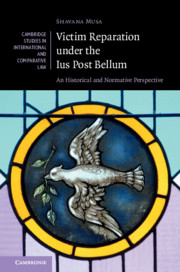
BOOK: Shavana MUSA, Victim Reparation under the Ius Post Bellum : An Historical and Normative Perspective [Cambridge Studies in International and Comparative Law] (Cambridge: Cambridge University Press, 2018). ISBN 9781108471732, £ 85.00


Cambridge University Press is publishing a book on victim reparations under the ius post bellum.

ABOUT THE BOOK

Victim Reparation under the Ius Post Bellum fills an enormous gap in international legal scholarship. It questions the paradigmatic shift of rights to reparation towards a morality-based theory of international law. At a time when international law has a tendency to take a purely positivistic and international approach, Shavana Musa questions whether an embrace of an evaluative approach alongside the politics of war and peace is more practical and effective for war victims. Musa provides a never-before-conducted contextual insight into how the issue has been handled historically, analysing case studies from major wars from the seventeenth century to the modern day. She uses as-yet untouched archival documentation from these periods, which uncovers unique data and information on international peacemaking, and actually demonstrates more effective practices of reparation provisions compared with today. This book combines historical analysis with modern day developments to provide normative assertions for a future reparation system.

ABOUT THE AUTHOR

Shavana MusaUniversity of Manchester
Shavana Musa is a Lecturer in international law, security and human rights at the University of Manchester, and a Fulbright Scholar in Cyber Security at the Carnegie Endowment for International Peace in Washington DC. She is also Founder and CEO of Ontogeny Global, a revolutionary risk management firm. She has conducted projects on human rights within the international investment regime, child labour, as well as the complexities surrounding law and technology.

TABLE OF CONTENTS

1. Introduction
2. Peace treaties and Admiralty Courts
3. The Anglo-Dutch wars
4. The Silesian loan affair and the Seven Years War
5. The American War of Independence
6. The Anglo-Argentine Commission
7. The American Civil War
8. The Second Anglo-Boer War
9. Reparation and international law from the twentieth century
10. A peaceful and normative conclusion?
List of cases
List of treaties, Legislation and other legal instruments
Bibliography
Index

More information here

19 July 2018

CALL FOR PAPERS: Colloque « Dommages de guerre et responsabilité de l’État » (Paris), DEADLINE 25 OCTOBER 2018


Via Hi-D, we learned of a Call for Papers for a colloquium on war damages and state responsibility in the context of the aftermath of World War I.

Colloque organisé par l’Institut d’Histoire du Droit EA 2515 de l’Université Paris Descartes et le CESICE, Centre d’études sur la sécurité internationale et les coopérations européennes de l’Université de Grenoble – Alpes

Décembre 2019 – Conseil d’État, Paris

Organisation :
– Pr Guillaume RICHARD de l’Institut d’Histoire du Droit de l’Université Paris Descartes
– Pr Sébastien LE GAL du CESICE de l’Université de Grenoble – Alpes
Comité scientifique :
– M. Jean BARTHÉLÉMY (avocat honoraire aux Conseils)
– Pr Grégoire BIGOT (Université de Nantes)
– Pr Alain CHATRIOT (Sciences Po Paris)
– Pr Sébastien LE GAL (Université Grenoble Alpes)
– Pr Bernard PACTEAU (Université de Bordeaux)
– Pr Xavier PERROT (Université de Limoges)
– Pr Guillaume RICHARD (Université Paris-Descartes)

Appel à communication à télécharger ICI
Les propositions de communications sont à envoyer à l’adresse suivante avant le 26 octobre 2018 à : guillaume.richard@parisdescartes.fr

PROJET SCIENTIFIQUE

Le centenaire de la loi du 17 avril 1919 sur la réparation des dommages matériels causés par les faits de guerre (la « Charte du sinistré ») offre l’occasion de réfléchir aux relations entre les phénomènes de guerre et de violence collective et la responsabilité de l’État à l’époque contemporaine. La Première Guerre mondiale marque en effet la reconnaissance générale d’une obligation de l’État vis-à-vis des sinistrés ayant subi des dommages physiques ou des destructions sur leurs biens à cause de la guerre. Deux lois, celles du 31 mars 1919 et du 17 avril 1919, indemnisent respectivement les dommages matériels et les dommages physiques subis par les Français, civils ou militaires. Pendant longtemps, l’État avait été tenu irresponsable des faits de guerre : on estimait que ceux-ci résultaient d’un état de nécessité ou correspondaient à des cas de force majeure exonérant de toute responsabilité. Depuis le début du XXe siècle, à l’inverse, un processus continu étend les cas d’indemnisation par l’État des situations de crise ou de violence (guerre, attentats terroristes, émeutes) au nom de la solidarité nationale.

Le colloque s’attachera à questionner l’apparition de la responsabilité de l’État pour la guerre ou les faits liés à une situation de guerre, au sens large, au moment de la Première Guerre mondiale, et ses conséquences ou les formes de sa mise en œuvre. Le colloque entend s’inscrire dans un pan devenu important des études sur la Première Guerre mondiale : celui de la transition entre la guerre et la paix et du retour à la paix. Les recherches se sont multipliées sur les aspects humains de la démobilisation ou de la reconnaissance accordée aux soldats, comme aux victimes civiles ou aux réfugiés. La dimension architecturale ou économique de la reconstruction ou les conférences internationales préparatoires à la signature des traités de paix sont aussi l’objet d’investigations nombreuses. Mais l’indemnisation des dommages de guerre reste un champ d’investigation riche et peu exploité sur le plan juridique.

Il s’agit ainsi d’explorer selon quels principes, avec quels effets juridiques et selon quelles modalités d’indemnisation l’État est tenu responsable des violences de guerre au moment de la Première Guerre mondiale. Le développement de ces mécanismes révèle une tension entre enjeux individuels et collectifs. D’un côté, ils s’inscrivent dans une logique de juridicisation des réparations qui emprunte largement aux mécanismes du droit civil de la responsabilité et reconnaît (en France, mais aussi en Italie ou en Belgique) un droit individuel à réparation ; de l’autre, l’indemnisation est envisagée d’emblée comme la mise en œuvre d’une politique aux effets collectifs, qui engage l’ensemble de la communauté, déterminant par là même des modalités en partie distinctes de la responsabilité civile.
Sans être exhaustives, trois directions paraissent envisageables pour explorer cette tension. Comment peut-on expliquer le passage du principe d’irresponsabilité au principe de responsabilité de l’État au début du XXe siècle ? Comment les mécanismes divers de responsabilité en matière de faits de guerre sont-ils articulés et comment les plans juridique, politique et symbolique des réparations se concilient-ils ou s’opposent-ils ? Comment, enfin, fonctionne l’évaluation et la procédure d’indemnisation et avec quels enjeux ?

1. DE L’IRRESPONSABILITÉ À LA RESPONSABILITÉ

Anciennement, le principe d’irresponsabilité publique pour les dommages aux civils et les destructions domine. La guerre ou les violences, qu’elles soient ou non le fait des autorités publiques, résultent d’un état de nécessité qui les exonère de toute faute ; le déploiement inévitable de la souveraineté étatique excuse l’État (the King can do no wrong). Cela n’empêche pas des mécanismes ponctuels de soutien ou d’assistance, en particulier pour les soldats et les vétérans, ni la réflexion de certains juristes, comme Grotius, en faveur de réparations pour les faits de guerre (De Iure Belli ac Pacis, III, 13). Le début du XXe siècle semble représenter un tournant. Les réflexions se font plus nombreuses pour dégager une responsabilité juridique de l’État, indépendante de la faute et fondée sur la solidarité ou la situation de risque à laquelle sont exposés particulièrement certains habitants.
Il faut ainsi s’interroger sur les raisons ayant conduit à la reconnaissance d’un principe de responsabilité. Comment expliquer le renversement par lequel on passe de l’irresponsabilité de l’État à sa responsabilité ? La Première Guerre mondiale en est-elle le moment pivot ? Même si le principe de responsabilité de l’État avait déjà été proclamé au moment de la Révolution française, il était resté sans réelles suites financières. Plusieurs textes au XIXe siècle réaffirment au contraire l’irresponsabilité de l’État. Des indemnités sont pourtant prévues après la guerre de 1870-1871 par trois lois adoptées entre 1871 et 1874, mais l’attribution se fait de manière hétérogène selon les sinistrés et sans véritable contrôle juridictionnel. Les mécanismes indemnisant tous les sinistrés en 1919 accordent un véritable droit dont le sinistré peut faire contrôler l’application par le juge, à l’inverse du simple « secours » accordé après 1871. Si, en France, les résistances restent limitées à la reconnaissance d’un droit à réparation, non sans controverses violentes sur la portée du droit, d’autres pays, comme l’Angleterre, ne procèdent à aucune reconnaissance générale d’un droit à réparation.

La reconnaissance du droit à réparation est-elle tributaire des conformations du système juridique (systèmes de common law ou de droit écrit) ou de l’intensité des dommages subis ? Le contexte immédiat explique-t-il cette reconnaissance ou faut-il raisonner dans une perspective de plus long terme ? Des expériences de guerre antérieures à la Première Guerre mondiale, anciennes (remontant à la période révolutionnaire) ou plus rapprochées (ainsi la conquête coloniale de la Libye par l’Italie, qui entraîne une première législation sur les dommages de guerre en Italie dès 1913), ont ainsi pu servir de modèle ou de référence. Plus largement, quel rôle les situations de guerre ont pu jouer dans l’extension des cas de responsabilité et le développement d’une responsabilité sans faute de l’État ?
L’apparition de mécanismes semblables de responsabilité a-t-elle également influencé la responsabilité de l’État pour les faits de guerre ? Dès la fin de l’Ancien Régime, des procédures d’indemnisation sont prévues pour certaines catastrophes naturelles, ainsi après des inondations en 1784, plaçant au premier plan le rôle de l’État pour garantir le retour à la normale. La responsabilité publique pour les émeutes fournit un autre exemple significatif: des violences internes sont indemnisées par l’ensemble de la communauté. Le décret du 23 février 1790 ouvre la voie à la responsabilité des communes. Plus tard, la loi du 16 avril 1914, promulguée peu avant le déclenchement de la guerre, transfère partiellement cette responsabilité à l’État, signe d’une monopolisation par l’État des fonctions de solidarité collective. En quoi la guerre renforce la volonté de socialisation ou d’étatisation du risque qui fait de l’État le garant de la sécurité et de l’intégrité physique et matérielle de sa population ?

Il faut enfin s’interroger sur le lien entre la reconnaissance d’une responsabilité liée à la guerre et les enjeux financiers, explicitement mis en avant dans les pays d’Europe de l’Est. Les effets de concurrence de diverses responsabilités jouent aussi leur rôle. Ainsi, en Italie, la réparation de l’État pour les dommages de guerre se heurte aux réticences de certains parlementaires du Mezzogiorno ; ils estiment qu’elle favorisera le Nord, région la plus touchée par les combats, mais aussi la plus riche avant la guerre, alors que la Sicile et la Calabre, touchées par des tremblements de terre à partir de 1908, ne sont toujours pas indemnisées.

La notion de responsabilité sans faute n’est-elle pas finalement trop simple ? Sur le plan strictement juridique, aucune faute ne doit être prouvée pour mettre en jeu la responsabilité ; mais cela ne signifie pas que toute idée de faute ait disparu de l’horizon des réparations. La jurisprudence internationale sur les émeutes le confirme a contrario : si l’État a fait ce qu’il devait pour éviter les dommages, il n’est pas responsable des dommages causés. Il faudrait aussi distinguer une approche juridique (puisque la faute de l’État n’a pas à être prouvée, elle est indifférente) et une approche plus sociale ou politique : l’État indemnise des dommages, car il est en partie, politiquement ou symboliquement, la cause des dommages qui se sont produits, ou parce qu’il est important qu’il se manifeste comme puissance réparatrice vis-à-vis de ses citoyens.

2. L’ARTICULATION DES MÉCANISMES DE RESPONSABILITÉ : PROGRAMME UNITAIRE OU ACCUMULATION HÉTÉROCLITE ?

La responsabilité de l’État face à la guerre se traduit-elle par une réponse unitaire ? Les textes concernant les dommages de guerre, comme la Charte du Sinistré de 1919 en France, ou les législations équivalentes dans les autres pays européens, n’ont jamais couvert tous les cas de responsabilité, ni entraîné la suppression de régimes spécifiques. Les servitudes militaires ou les réquisitions, par exemple, ont fait l’objet de législations spéciales plus précoces, pour reconnaître ou au contraire refuser la réparation par l’État. Dans certains cas, comme au Royaume-Uni, seules certaines situations sont couvertes, sans qu’un principe général de responsabilité de l’État soit reconnu. Cette différenciation peut poser un problème d’égalité entre victimes, couvertes par des régimes différents ; les modes d’évaluation peuvent favoriser telle ou telle catégorie. Elle amène également à distinguer entre la responsabilité pour des faits particuliers et la responsabilité générale du fait de la guerre, sur le plan international, mais aussi interne.

Le principe général de responsabilité a été proclamé à propos de l’Allemagne par l’article 231 du traité de Versailles en 1919. Cette responsabilité générale s’appuie sur un instrument de droit international fondant sa légalité sur de nouveaux outils juridiques. Mais elle peine à faire disparaître le vieux principe du vae victis, selon lequel les vainqueurs pouvaient se payer sur la bête vaincue en espérant ainsi compenser leurs propres pertes. De plus, l’indemnisation internationale se fait souvent au bénéfice des États ou des armées et non des populations. La juridicisation des processus internationaux de réparations au moment de la Première Guerre mondiale, loin d’entraîner une véritable évolution, ne reste-t-elle pas un leurre ? Par ailleurs, quelles relations cette responsabilité internationale des États pour la guerre entretient-elle avec les mécanismes internes prévus par chaque État et avec la réparation individuelle des dommages ? Au moment de la Première Guerre mondiale, la législation des différents États conditionne parfois l’indemnisation des citoyens aux versements effectués par les États vaincus, tandis que d’autres États, comme la France, la Belgique ou l’Italie, affirment que le droit à réparation n’en dépend pas juridiquement (sinon financièrement).

La diversité des mécanismes de réparation attire également l’attention sur un autre enjeu. La responsabilité ou le principe de réparations s’inscrivent-ils seulement dans la perspective du droit à réparation ? Cette réparation, entendue au sens juridique d’une restitutio in integrum, repose sur une approche individuelle, de traitement au cas par cas, qui entre en tension avec une approche plus collective des réparations, comme réponse sociale unitaire à un phénomène exceptionnel. Les conflits juridiques et politiques entre partisans du droit à réparation individuel, qui n’est soumis à aucune obligation, et ceux d’un droit socialisé ou collectif, par lequel l’État peut guider et déterminer la conduite des victimes, révèlent les tensions à l’œuvre entre ces deux approches.

Quel modèle de réparation et quelle conception du droit prédominent au moment de la Première Guerre mondiale ? En quoi, par ailleurs, les débats sur la reconstruction s’inscrivent-ils dans des mouvements plus larges, participant, par exemple, de l’élaboration d’un droit de l’urbanisme avec les lois de 1902 sur l’hygiène et de 1919 et 1924 sur les plans d’extension ? La reconstruction apparaît aussi comme une phase pendant laquelle il devient possible de mettre en œuvre à grande échelle les principes d’hygiène et d’aménagement urbain.

Ces différents éléments permettent d’interroger la dimension politique, mais aussi symbolique ou morale prise en compte dans le processus de réparation. Bien loin d’un simple enjeu juridique, les réparations se voient assigner des fonctions multiples : reconstitution de la cohésion nationale, redémarrage économique, reconstruction des régions détruites, pacification et réconciliation sociale, etc. Dans quelle mesure les mécanismes de responsabilité prévus au moment de la Première Guerre mondiale ont-ils formé un programme cohérent de réparation ou de reconstruction ou simplement un assemblage d’objectifs divers et parfois contradictoires ?

3. DIMENSION TECHNIQUE DE LA RÉPARATION

Si l’on se place dans le cadre de la réparation pécuniaire des dommages, d’autres enjeux apparemment plus techniques permettent d’envisager le principe de justice mis en œuvre par tel régime de responsabilité. On peut indiquer au moins les points suivants :

a/ Délimitation des dommages inclus. La délimitation exacte des dommages ou des personnes couvertes est l’objet de très nombreux ajustements. La guerre n’est pas reconnue en tant que telle comme un phénomène pouvant mettre en jeu de façon générale la responsabilité de l’État : le dommage ne découlant qu’indirectement des faits de guerre n’est ainsi pas indemnisé. Quels sont les dommages dont l’État peut être tenu responsable ou qui sont au contraire exclus de toute réparation ? Comment sont définis la guerre et les faits de guerre dans ces procédures ? Comment le lien avec la guerre ou l’acte de guerre est-il établi ? La définition des dommages passe-t-elle par une liste des différents cas ou par des formules plus générales ? Derrière ces questions techniques apparaît l’étendue même du système de réparation mis en place au moment de la Première Guerre mondiale.

b/ Différence entre évaluation et dédommagement. La mise en jeu de la responsabilité de l’État suppose d’évaluer les dommages. Cette évaluation est individuelle, mais doit se faire dans des conditions similaires pour des dommages très nombreux. L’évaluation est donc fortement standardisée, à l’aide de barèmes et de grilles, loin d’une évaluation individuelle in concreto. Cette standardisation a déterminé des procédures spécifiques (séries de prix de construction utilisées pour les marchés publics, barèmes des assurances) montrant la proximité avec les mécanismes assuranciels ; elle a aussi correspondu à un travail statistique permettant d’évaluer la richesse nationale perdue et qu’il faudrait restaurer. L’évaluation a pu ainsi participer au travail de construction des connaissances de l’État sur son propre territoire et sa population et à la densification des réseaux étatiques, renforçant l’intrication entre connaissance et effets de pouvoir au bénéfice de l’État. En ce sens, la reconnaissance de sa responsabilité par l’État ne participe-t- elle pas paradoxalement de son renforcement ?

L’évaluation elle-même ne débouche pas toujours sur une indemnité, soit parce que le financement des dommages évalués fait défaut, soit parce que l’évaluation concerne des dommages sortant du champ de la réparation, soit enfin parce que ce cadre même n’existe pas encore ou est contesté. C’est le cas des étrangers, exclus d’une législation développée dans la plupart des pays européens au nom de la solidarité nationale, mais aussi plus généralement de certains sinistrés ou de certaines catégories qui protestent contre les restrictions ou retards que l’administration oppose fréquemment aux paiements. L’évaluation sans indemnisation n’est pourtant pas sans but : elle peut être un moyen de faire pression sur les autorités publiques ou de faciliter en amont leur travail (ainsi du travail statistique des comités locaux en France ou en Italie). Il faudra ainsi situer la pratique évaluative non seulement comme une question technique, mais aussi politique (délimitation et valeur de dommages parfois intangibles) et sociale (avec les formes d’organisation collective des sinistrés qui émergent dans l’après-guerre).

c/ Procédure et instances spéciales. La responsabilité de l’État donne souvent lieu à l’adoption de procédures spécifiques et d’instances spéciales chargées de traiter les demandes – quand bien même elles le feraient selon des critères proches du droit ordinaire. La compétence est en général confiée à des instances civiles, qui peuvent agir selon une modalité administrative ou juridictionnelle. Quelles raisons président au choix de tel ou tel mode de résolution ? Peut-on déceler une évolution progressive en faveur de la juridictionnalisation, qui accompagnerait la reconnaissance du droit à réparation ou tout dépend-il de facteurs contextuels ?

Cela doit aussi être l’occasion d’interroger le fonctionnement des instances spéciales mises en place, et notamment des tribunaux des dommages de guerre ou de la Commission supérieure des dommages de guerre, mis en place en France, ou des juridictions spéciales existant dans d’autres pays. Ces instances ont-elles calqué leur fonctionnement sur celui d’un tribunal ou d’une commission administrative ? Quel rôle donnaient-elles à la victime et à l’État ? Apparaissent-elles comme des lieux de pacification (comme le terme de « commissions de conciliation » le suggère en France) ou de confrontation ? Comment leur travail s’articulait-il avec la justice ordinaire, compétente notamment pour le contrôle et la cassation des décisions ?

PROPOSITIONS DE COMMUNICATION

Les propositions de communication s’inscriront dans une perspective destinée à éclairer la reconnaissance du droit à réparation ou sa mise en œuvre au moment de la Première Guerre mondiale. Elles peuvent concerner l’espace français comme européen ou colonial. Elles seront principalement consacrées à l’indemnisation des dommages matériels, mais des communications sur l’indemnisation des dommages physiques permettant d’éclairer le lien entre la responsabilité de l’État et la guerre ou les faits de guerre sont également bienvenues. De même, les communications peuvent s’intéresser à la question de la responsabilité étatique interne ou sur le plan international. Les propositions préciseront quel(s) aspect(s) de l’appel à communication elles entendent en particulier traiter.

Une proposition d’une page maximum doit être envoyée avant le 26 octobre 2018. Les réponses seront données en décembre 2018. Le colloque se tiendra à la fin de l’année 2019 au Conseil d’État à Paris. La date sera précisée ultérieurement.

More informationhere