Search

Showing posts with label World War I. Show all posts

28 May 2025

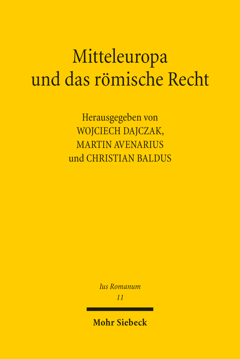
BOOK: Wojciech DAJCZAK, Martin AVENARIUS, Christian BALDUS (eds.), Mitteleuropa und das römische Recht. Methodische Herausforderungen an die Romanistik im Kontext der neuen politischen Ordnung nach dem Ersten Weltkrieg [Ius Romanum; 11] (Tübingen: Mohr Siebeck, 2025), 319 p., ISBN 978-3-16-163956-2

Cover von 'undefined'
ABOUT THE BOOK:
 
Paul Koschakers 1947 publiziertes Buch Europa und das römische Recht löste Diskussionen und Kontroversen über die kulturelle Bedeutung des römischen Rechts für die europäische Rechtsidentität und den Verlauf der Ostgrenze Europas aus. Der vorliegende Band nimmt Bezug auf Koschakers Werk. Die Bedeutung des römischen Rechts für die Rechtsidentität Mitteleuropas nach dem Ersten Weltkrieg stellt sich hier und heute völlig anders dar als bei Koschaker und in der von ihm inspirierten Diskussion. Das Leitmotiv besteht in der Frage, ob und wie methodische Innovationen und Probleme der römisch-rechtlichen Forschung, die vor allem aus Italien und Deutschland bekannt sind, das Studium des römischen Rechts in den Ländern beeinflussten, die nach dem Ersten Weltkrieg in Mitteleuropa wiedergeboren oder gegründet wurden. Grundlage hierfür sind Rekonstruktionen methodischer Profile ausgewählter Romanisten aus der Region.
 
TABLE OF CONTENTS:
 
Joanna Kruszyńska-Kola: Römisches Recht an den mittelosteuropäischen Universitäten in der Zwischenkriegsperiode (1918-1939) - Bulgarien / Konstantin Tanev: The Beginning of History of Law And Roman Law Studies and the Changes of Scientific Method during the Interwar Period in Bulgaria - Estland / Hesi Siimets-Gross/Marju Luts-Sootak: Methodenwechsel durch Generationenwechsel - Romanistik an der estnischen Universität zu Tartu - Lettland / Janis Lazdins/Sanita Osipova: Das Studium des römischen Rechts in der Lettischen Republik in der Zwischenkriegsperiode (1919-1940): Professor Benedikt Cornelius Georg Frese, Professor Vassily Sinaisky und sein Schüler Voldemars Kalninsch - Polen / Wojciech Dajczak: Franciszek Bossowski - ein Privatrechtler, der sich im wiedergeborenen Polen dem römischen Recht widmete - Franciszek Longchamps de Bérier: Borys Łapicki: Marxism as a Remedy for the Crisis in Roman Law - Rumänien / Mihnea-Dan Radu Ștefan Longinescu and Constantin Stoicescu - Important Romanists of the Interwar Period - Sowjetrussland / Martin Avenarius: Bürgerliches Recht im revolutionären Russland. Verteidigung und Fortentwicklung des bedrohten Privatrechtsdenkens bei Pokrovskij und Kantorovič - Tschechoslowakei / Jakub Razim: Miroslav Boháček: Ein tschechoslowakischer Wissenschaftler von europäischem Rang - Pavel Salák jr.: Heyrovský und Sommer - Gründer und Nachfolger - Ungarn / Gergely Deli: Der Grosschmid-Effekt - oder ein Paradigmenwechsel in der ungarischen Romanistik - Emese Újvári: Methodenkonformität der ungarischen Romanistik? Anhaltspunkte aus der ersten Hälfte des 20. Jahrhunderts im Werk von Géza Kiss und Kálmán Személyi 
 
Find more here.

16 December 2021

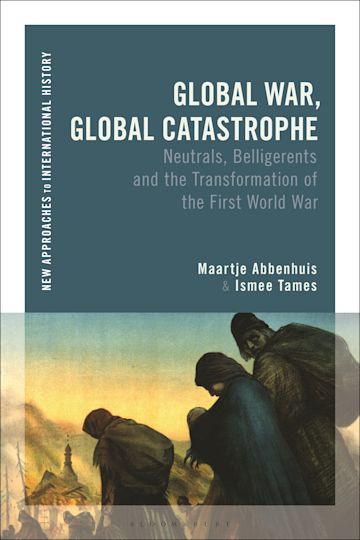
BOOK: Maartje ABBENHUIS & Ismee TAMES, Global War, Global Catastrophe. Neutrals, Belligerents and the Transformations of the First World War (London: Bloomsbury, 2021), 248 p. ISBN 9781474275859 GBP 19,99


(image source: Bloomsbury)

On the book:

Global War, Global Catastrophe presents a history of the First World War as an all-consuming industrial war that forcibly reshaped the international environment and, with it, impacted the futures of all the world's people. Narrated chronologically, the authors identify key themes and moments that radicalized the war's conduct and globalized its impact, affecting neutral and belligerent societies alike. These include Germany's invasion of Belgium and Britain's declaration of war in 1914, the expansion of economic warfare in 1915, anti-imperial resistance, the Russian revolutions of 1917 and the United States' entry into the war. Each chapter explains how individuals, communities, nation-states and empires experienced, considered and behaved in relationship to the conflict as it evolved into a total global war. Above all, the book argues that only by integrating the history of neutral and subject communities can we fully understand what made the First World War such a globally transformative event. This book offers an accessible and readable overview of the major trajectories of the global history of the conflict. It offers an innovative history of the First World War and an important alternative to existing belligerent-centric studies.

Table of contents:

Acknowledgements
Note on Sources
List of Illustrations

Introduction: A Total Global Tragedy
1. A World of War before 1914
2. Germany's Invasion of Belgium and the Expectations of 'Civilized' War
3. Short-War Ambitions: The Global Importance of Britain's Declaration of War
4. Long-War Realities: Economic Warfare and the Evolution of Total War in 1915
5. The 'Barbarian' Next Door: Total War at Home and Abroad in 1915
6. The Test of Endurance: Rethinking the War in 1916
7. Nothing Stays the Same: Revolutionary Transformations in 1917
8. The End of Neutrality? The Global Importance of the United States' Declaration of War

9. Exit… 1918-1919

 Read more with the publishers here.

11 August 2020

BOOK: Manfried RAUCHENSTEINER, The First World War and the End of the Habsburg Monarchy, 1914-1918 (Wien: Böhlau, 2014), 1188 p. ISBN 9783205795889 (OPEN ACCESS)

(image source: oapen)
 

Abstract: 

The origins of World War I were different and varied. But it was Austria-Hungary which unleashed the war. After more than four years the Habsburg Monarchy was defeated and ended as a failed state. Die Ursachen des Ersten Weltkriegs sind vielfältig. Die Entfesselung des Kriegs geschah jedoch durch Österreich-Ungarn. Nach mehr als vier Jahren zerfiel die Habsburgermonarchie als Folge innerer Auflösung und der militärischen Niederlage.

Download the book (DOI 10.26530/oapen_482374)

 (source: Pierre Grosser/Twitter)

22 April 2020

BOOK: Leonard V. SMITH, Sovereignty at the Paris Peace Conference of 1919 (Oxford: University Press, 2018). ISBN: 9780199677177, pp. 304, £36.99

Cover for 

Sovereignty at the Paris Peace Conference of 1919
(Source: OUP)

ABOUT THE BOOK

We have known for many decades that the Paris Peace Conference of 1919 "failed", in the sense that it did not prevent the outbreak of World War II. This book investigates not whether the Paris Peace Conference succeeded or failed, but the historically specific international system it created. It explores the rules under which that system operated, and the kinds of states and empires that inhabited it. Deepening the dialogue between history and international relations theory makes it possible to think about sovereignty at the Paris Peace Conference in new ways. Sovereignty in 1919 was about not just determining of answers demarcating the international system, but also the questions. Sovereignty in 1919 was about remaking the world.
Most histories of the Paris Peace Conference stop with the signing of the Treaty of Versailles with Germany on 28 June 1919. Sovereignty at the Paris Peace Conference of 1919 considers all five treaties produced by the conference as well as the Treaty of Lausanne with Turkey in 1923. It is organized not chronologically or geographically, but according to specific problems of sovereignty. A peace based on "justice" produced a criminalized Great Power in Germany, and a template problematically applied in the other treaties. The conference sought to unmix lands and peoples in the defeated multinational empires by drawing boundaries and defining ethnicities. The conference sought not so much to oppose revolution as to instrumentalize it in the new international system. The League of Nations, so often taken as the supreme symbol of the failure of the conference, is better considered as a continuation of the laboratory of sovereignty established in Paris.

ABOUT THE AUTHOR

Leonard V. Smith is Frederick B. Arz Professor of History at Oberlin College, Ohio. He has previously written extensively about France and the Great War. His first book, Between Mutiny and Obedience: The Case of the French Fifth Infantry Division During World War I (1994) won the Paul Birdsall Prize from the American Historical Association. France and the Great War, 1914-1918 (co-authored with Stéphane Audoin-Rouzeau and Annette Becker, 2003) won the Norman B. Tomlinson Prize from the Western Front Association. Smith is also the author of The Embattled Self: French Soldiers Testimony of the Great War (2007).

TABLE OF CONTENTS

Introduction: The Riddles of Sovereignty at the Paris Peace Conference
1: The Agents and Structures of Peacemaking
2: The Sovereignty of Justice
3: The "Unmixing" of Lands
4: The "Unmixing" of Peoples
5: Mastering Revolution
6: Sovereignty and the League of Nations, 1920-1923
Conclusion: History, IR, and the Paris Peace Conference

More information here

21 April 2020

BOOK: Alison CARROL, The Return of Alsace to France, 1918-1939 (Oxford: University Press, 2018). ISBN: 9780198803911, pp. 248, £60.00

Cover for 

The Return of Alsace to France, 1918-1939
(Source: OUP)

ABOUT THE BOOK

In 1918, the end of the First World War triggered the return of Alsace and Lorraine to France after almost fifty years of annexation into the German Empire. Enthusiastic crowds in Paris and Alsace celebrated the return of the 'lost provinces,' but return proved far more difficult than expected. Over the following two decades, politicians, administrators, industrialists, cultural elites, and others grappled with the question of how to make the region French again. Differences of opinion emerged, and reintegration rapidly descended into a multi-faceted struggle as voices at the Parisian centre, the Alsatian periphery, and outside France's borders offered their views on how to introduce French institutions and systems into its lost borderland. Throughout these discussions, the border itself shaped the process of reintegration, by generating contact and tensions between populations on the two sides of the boundary line, and by shaping expectations of what it meant to be French and Alsatian.
Borderland is the first comprehensive account of the return of Alsace to France which treats the border as a driver of change. It draws upon national, regional, and local archives to follow the difficult process of Alsace's reintegration into French society, culture, political and economic systems, and legislative and administrative institutions. It connects the microhistory of the region with the 'macro' levels of national policy, international relations, and transnational networks, and with the cross-border flows of ideas, goods, people, and cultural products that shaped daily life in Alsace as its population grappled with the meaning of return to France. In revealing the multiple voices who contributed to the region's reintegration, it underlines the ways in which regional populations and cross-border interactions have forged modern nations.

ABOUT THE AUTHOR

Alison Carrol is Senior Lecturer in European History at Brunel University, London. She has published on questions of borders and integration in modern French history, and in 2010 she was awarded the Etienne Baluze prize in European local history. This is her first book.

TABLE OF CONTENTS

Introduction
1: A Bridge Across the Rhine
2: Remaking French Alsace: Citizenship, Administration, and Laws
3: Borderland Politics
4: Economic Reintegration
5: Reimagining Alsatian Culture
6: The Border Landscape
Conclusion

More information here


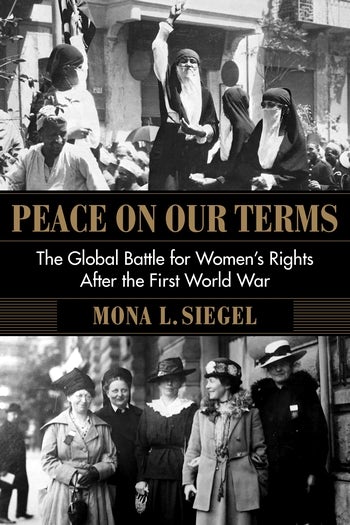
BOOK: Mona L. SIEGEL, Peace on Our Terms: The Global Battle for Women’s Rights After the First World War (New York: Columbia University Press, 2020). ISBN 9780231195102, $35.00


Columbia University Press has published a new book on the struggle to advance women’s rights in the aftermath of World War I.

ABOUT THE BOOK

In the watershed year of 1919, world leaders met in Paris, promising to build a new international order rooted in democracy and social justice. Female activists demanded that statesmen live up to their word. Excluded from the negotiating table, women met separately, crafted their own agendas, and captured global headlines with a message that was both straightforward and revolutionary: enduring peace depended as much on recognition of the fundamental humanity and equality of all people—regardless of sex, race, class, or creed—as on respect for the sovereignty of independent states.

Peace on Our Terms follows dozens of remarkable women from Europe, the Middle East, North America, and Asia as they crossed oceans and continents; commanded meeting halls in Paris, Zurich, and Washington; and marched in the streets of Cairo and Beijing. Mona L. Siegel’s sweeping global account of international organizing highlights how Egyptian and Chinese nationalists, Western and Japanese labor feminists, white Western suffragists, and African American civil rights advocates worked in tandem to advance women’s rights. Despite significant resistance, these pathbreaking women left their mark on emerging democratic constitutions and new institutions of global governance. Drawing on a wide range of sources, Peace on Our Terms is the first book to demonstrate the centrality of women’s activism to the Paris Peace Conference and the critical diplomatic events of 1919. Siegel tells the timely story of how female activists transformed women’s rights into a global rallying cry, laying a foundation for generations to come.

ABOUT THE AUTHOR

Mona L. Siegel is professor of history at California State University, Sacramento. She is the author of The Moral Disarmament of France: Education, Pacifism, and Patriotism, 1914–1940 (2004).

TABLE OF CONTENTS

Timeline of International Women’s Activism in 1919
List of Illustrations
Prologue: The Closing Days of the First World War
1. A New Year in Paris: Women’s Rights at the Peace Conference of 1919
2. Winter of Our Discontent: Racial Justice in a New World Order
3. March(ing) in Cairo: Women’s Awakening and the Egyptian Revolution of 1919
4. Springtime in Zurich: Former Enemies in Pursuit of Peace and Freedom
5. May Flowers in China: The Feminist Origins of Chinese Nationalism
6. Autumn on the Potomac: Women Workers and the Quest for Social Justice
Epilogue: Rome, 1923
Acknowledgments
Abbreviations
Notes
Index

More info here

27 February 2020

CALL FOR PAPERS: Local Administration during the First and Second World Wars (Prague, 2-4 September 2020) (DEADLINE: 17 March 2020)


(Source: Pol-Int)

We learned of a call for papers for a conference in Prague on local administrations during the two world wars. Here the call:

Local administration has always played a key role in securing, implementing and stabilizing the authority of the modern state. After the outbreak of the First World War, the warring countries were confronted with a difficult supply situation, including famine, disease, refugees and labor shortages. The clerks of the local administration were responsible for implementing new policies and solving problems. They were the ones in direct contact with local populations which were often multi-ethnic and presented a broad variety of needs.

In many cases, local administrations were reorganized to deal with vast and unprecedented tasks and problems. In other cases, the German Empire and Austria-Hungary established military occupation administrations which depended on existing local administration, for example in Belgium, Serbia and Ukraine.

Not only military defeat but also the failure of overtaxed local administrations to solve substantial problems such as obtaining sufficient food supplies for the population led to revolts in the German Empire and the Habsburg Monarchy.

This drastic experience prompted Nazi Germany in particular to undertake a reorganization of local administration shortly before the outbreak of the Second World War. Even after large parts of Europe were under German occupation, local administrations remained largely responsible for the daily life needs of local populations, such as organizing production, distribution and rationing of food and other basic goods, such as heating fuel and clothing. Since state food allotments were often insufficient to meet basic needs, local populations reacted with the development of a variety of illegal practices. Farmers evaded compulsory levies of food and sold undocumented, illegally butchered meat. Hidden stores of products, food and ration stamps were traded for other goods as part of a comprehensive black market. Although nominally supervised by German occupiers, the actual prosecution of these new economic crimes generally fell in the responsibility of local administrations and courts. Local courts continued to hear non-political cases and disputes within local populations as well.

Recent research in Holocaust Studies have showed that local administrations not only played an important role in making the mass murder of the European Jews possible, but that it was often local administrations that took the initiative.

This conference aims to bring together scholars who work on specific aspects of local administration in the First World War and the Second World War and analyze and compare a diversity of methodologies, findings and approaches.

We are particularly interested in papers that are dealing with the following historical focuses:

- The relationship between the occupying power and local administration.
- Local administration and the war economy
- Local courts under occupation
- Continuity and change in staffing aspects of local administration under occupation
- Questions of local administration and local interpretation of collaboration

Prof. Jonathan Gumz will give a keynote address on local administration and the First World War.

Prof. Dieter Pohl will give a keynote address on local administration and the Second World War.

At the moment we are able to cover accommodation and parts of the travel costs, we are still looking for funds for travel costs.

The conference language is English.

Please send your abstracts of approximately 500 words by 17 March 2020 to:

(Source: Pol-Int.org)

06 November 2019

LECTURE: 11 November lecture by Lois Bibbings on “War Resistance During the First World War: Reflections from beyond the Centenary” (Brussels, 11 November 2011)


We learned that Professor Lois Bibbings (University of Bristol) will give a lecture on 11 November (Armistice Day) at the Flemish Peace Institute.

Datum

10/11/2019
20:30 - 22:30
In this lecture professor Lois Bibbings (University of Bristol) will look at groups and individuals who in various ways refused or resisted war during First World War, including oncsientious objectors, soldiers and women peace activits. In this context, links will be made with war resistance and peace activism today. Whilst the focus will be upon the United Kingdom and Ireland, historical and present-day examples will also be drawn from around the world.

Programme

8.30 pm
Welcome by Piet Chielens Coordinator In Flanders Fields Museum in Ypres
8.35 pm
Speech by Emmily Talpe Mayor of Ypres
8.45 pm
11 November Lecture by Lois Bibbings Professor of Law, Gender and History at the University of Bristol
“War resistance during the First World War: Reflections from beyond the Centenary”
(Lecture in English)
9.15 pm
Concert by the female choir Amaranthe
9.45 pm
Reception
The event takes place in the cultural center het Perron in Ypres.
Admission is free, but please register by sending a message to kenniscentrum@ieper.be.
Biography Professor Lois Bibbings
Lois Bibbings is Professor of Law, Gender and History at the University of Bristol. Much of her research has centred upon the First World War in Britain, looking at hidden histories or lesser known stories of the conflict, and she has spoken and published extensively in this area. Thirty years ago she started researching conscientious objection to military service. Her work in this area has focused upon legal issues, gender and the nature of conscience. Her monograph on objectors, Telling Tales About Men: Conceptions of Conscientious Objectors to Military Service During the First World War (Manchester University Press, 2009) offered a completely original perspective by considering objectors, along with soldiers and male and female civilians, in terms of gender. In the lecture professor Lois Bibbings will look at groups and individuals who in various ways refused or resisted war during the First World War.

More info here

30 October 2019

BOOK: Lisa BECKENBAUGH, The Treaty of Versailles. A Primary-Document Analysis (Santa Barbara: ABC Clio, 2018) ISBN 978-1-4408-5909-0, 83 USD

(image source: ABC Clio)

Book abstract:
An indispensable resource on the Treaty of Versailles, one of the most influential and controversial documents in history, this book explains how the treaty tried to solve the complex issues that emerged from the destruction of World War I. This carefully curated primary source collection includes roughly 60 documents related to the signing of the Treaty of Versailles. By collecting all of the most significant documents in one volume, it allows readers to hear the original arguments surrounding the treaty and to explore the voices of the people involved at the Paris Peace Conference. Moreover, it allows readers to engage with the documents so as to better understand the complex motivations and issues coming out of World War I and highlights the differences between the victors and identifies the problems many countries had with the treaty before it was even signed. The documents are organized in chronological order, providing a blueprint to help students to understand all of the significant events that led to the treaty, as well as the vast repercussions of the treaty itself. In addition to the Treaty of Versailles itself, documents include such significant primary sources as the Sykes-Picot Agreement, the Balfour Declaration, the Treaty of Brest-Litovsk, President Woodrow Wilson's Fourteen Points, and Germany's response to the treaty.
On the author:
Lisa L. Beckenbaugh, PhD, is assistant professor of military and security studies at Air University's Air Command and Staff College. She received her MA from St. Cloud State University and her PhD from the University of Arkansas. Dr. Beckenbaugh has taught at a variety of undergraduate and graduate civilian institutions. She also served as the interim project lead and military analyst II for the Operational Leadership Experiences Project under the aegis of the Combat Studies Institute at Fort Leavenworth and was a Post-Graduate Historical Research Fellow at the Defense POW/Missing Personnel Office. 
More information with the publisher.

(source: ESILHIL Blog)

06 June 2019

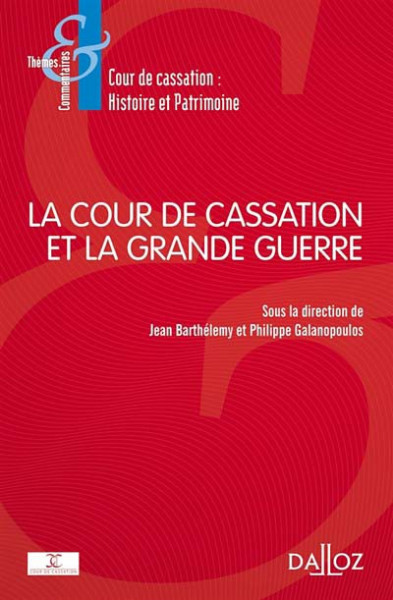
BOOK: Jean BARTHÉLÉMY & Philippe GALANOPOULOS, La Cour de cassation et la Grande Guerre [Thèmes & commentaires - Cour de Cassation: Histoire et Patrimoine] (Paris: Dalloz, 2019), 150 p. ISBN 978-2-2471-8890-1, € 38

(image source: univ-droit)

Book presentation:
À l'occasion des commémorations nationales célébrant le centenaire de l'armistice du 11 novembre 1918, le Comité d'histoire de la Cour de cassation a souhaité étudier la période de la Grande Guerre à travers le fonctionnement, l'activité et la jurisprudence de la haute juridiction. Si les magistrats de la Cour de cassation ne furent pas mobilisés, il n'en fut pas de même pour les avocats aux conseils et les personnels de greffe ou de services, dont certains ne sont pas revenus du front. Désorganisée dans un premier temps et confrontée à une situation sans précédent, la Cour de cassation n'a pourtant jamais cessé de rendre des arrêts, aussi bien dans les matières civiles que pénales. Les contributions rassemblées dans ce volume font, pour la première fois, le point sur la jurisprudence de la Cour de cassation pendant et immédiatement après les années de guerre, commentant certaines des décisions les plus importantes de la période pour mieux les mettre en perspective avec la situation politique, militaire, économique et sociale de la France. Ainsi ce sont tour à tour les questions de la censure et de la liberté d'expression qui sont abordées, ainsi que le problème de la naturalisation ou encore le pouvoir de réquisition par la puissance publique. La jurisprudence de la Cour de cassation en matière de droit commercial et de droit des obligations fait l'objet d'une attention toute particulière. Enfin, le lien entre la justice ordinaire et la justice d'exception est abordé, en particulier le rôle de la cour de révision dans le cas des « fusillés pour l'exemple ».
Contibutors:
Jean Barthélemy, David Deroussin, Serigne Dione, Céline Drand, Philippe Galanopoulos, Jean Lecaroz, Yann Le Foulgoc, Bertrand Louvel, François Martineau, Jean-Yves Mollier, Xavier Prétot.
(source: Nomôdos)

21 November 2018

BOOK: Stanislas HORVAT, Belgian Courts-Martial. Prosecution of Military Law Offences during World War (Brussels: ASP/VUBPress, 2018), 404 p. ISBN 9789057188305, € 34,95

(image source: ASP)

Book abstract:
This publication is the first in-depth study of the Belgian military court during World War I. Martial law application and procedures are described in detail and evaluated on the basis of a comprehensive study of previously unexamined archive documents from the Attorney General's Office and the Military Court, including more than 300 Attorney General's circulars, about 5,500 judgments and nearly 1,000 Military Court cases. Criminal procedure, from inquiry to execution, is fully explained through statutes, jurisprudence, circulars and a large number of scientific publications. Martial law practice and its significance for the soldiers are briefly presented and analysed through a number of key questions addressing the language issue and social relations in the army, but also the legal impact of the war, the roles played by military authorities, the relationship between armed forces, etc. This volume contains an enlightening study for all those who want an insight into the prosecution of the military law crimes during World War I.
On the author:
Dr. Stanislas Horvat is professor and head of the Chair of Law at the Belgian Royal Military Academy and affiliated researcher at the Faculty of Law and Criminology of the Free University of Brussels (Vrije Universiteit Brussel). He is member of the board of directors and director of publications of the International Society for Military Law and the Law of War, member of the managing board of the Belgian Military Law and the Law of War Centre and secretary of the Scientific Committee of Legal History of the Royal Flemish Academy of Belgium for Science and the Arts. 
 More information here.
(source: ESILHIL Blog)

BOOK: Olivier DEVAUX and Florent GARNIER, Le livre d’or de la faculté de droit de Toulouse (Paris: LGDJ, 2018). ISBN 978-2-36170-181-9, € 20.00


(Source: LGDJ)

LGDJ has published the University of Toulouse Faculty of Law’s livre d’or (on World War I)

ABOUT THE BOOK

Dès les premiers temps de la Grande Guerre, le nombre de morts au combat et de disparus est considérable. De multiples institutions entreprennent d'en dresser progressivement la liste et, à la fin du conflit, seront publiés des Livres d'or destinés à honorer, au même titre que les monuments aux morts, la mémoire de ceux qui se sont sacrifiés.

La Faculté de droit de Toulouse a participé à ce mouvement avec pour ambition première d'y faire figurer non seulement ceux de ses étudiants et anciens étudiants qui avaient perdu la vie, mais aussi leurs camarades survivants dès lors qu'ils avaient été blessés. La notice consacrée à chacun d'eux devait aussi être accompagnée d'une photographie. Mais son Livre d'or, qui n'existe qu'en un seul exemplaire, n'a jamais été publié.

Les auteurs, s'appuyant essentiellement sur des documents d'archives, en même temps qu'ils retracent la procédure d'élaboration de ce document et présentent des extraits de lettres de combattants ou de leurs parents, ont eu pour ambition de combler cette lacune en enrichissant les notices établies, il y a un siècle, par les autorités de la Faculté.

ABOUT THE AUTHORS

Olivier DEVAUX est Professeur d'Histoire du droit et des institutions à l'Université Toulouse Capitole, auteur de nombreux ouvrages et articles

Florent GARNIER est Professeur d'Histoire du droit et des institutions à l'Université Toulouse Capitole. Il mène des recherches dans les Institutions urbaines médiévales, la fiscalité au Moyen Âge (droits savants et pratique), la doctrine commerciale (XIXe-XXe s.), la norme et le droit du patrimoine culturel.

More information here

16 November 2018

VIRTUAL EXHIBITION: Des facultés sur le front du droit: Paris et Toulouse dans la Grande Guerre (Paris: Bibliothèque Cujas, 2018)

(image source: Bibliothèque Cujas)

Exhibition abstract:
La réflexion sur la Première Guerre mondiale a emprunté diverses voies historiographiques. Ce conflit a été perçu depuis cent ans de manière militaire, diplomatique puis dans sa dimension sociale et culturelle. Il a été donné à voir, notamment par la restitution de nombreux témoignages, le quotidien des acteurs de la guerre, sur le front, dans les tranchées et à l’arrière. C’est à certains des acteurs, étudiants et professeurs de facultés de droit, que cette exposition virtuelle s’intéresse.
Traiter de l’histoire des facultés de droit de Paris et de Toulouse pendant le premier conflit mondial, c’est faire le choix de considérer ces institutions comme imbriquée dans un temps social, économique, intellectuel et politique mais également traiter d’histoires du droit diverses et complémentaires de ce premier quart du xxe siècle. Ce temps doit aussi être éclairé à la lumière des évolutions de la science du droit, notamment des réflexions intellectuelles liées à la guerre, d’une communauté particulière, celle d’enseignants parisiens et toulousains, tant comme un entre-soi que de juristes en réseaux et en relation en Europe.
« Capitale du droit » (Paris) et Faculté de province (Toulouse) prennent position sur le « front du droit ». C’est à saisir et comprendre la Grande Guerre à travers des juristes, leurs actions, leurs discours et leurs idées au sein des deux institutions considérées séparément ou comparativement que cette exposition virtuelle entend apporter quelques lumières nouvelles. Elle n’est pas à proprement dit une histoire des facultés de droit pendant la Première Guerre mondiale. Elle n’est pas non plus une histoire sociale des étudiants et des enseignants. Par le prisme de certaines thématiques fortes, elle souhaite davantage interroger le quotidien d’acteurs qui forment ou qui ont été formés au sein d’une institution, les possibles tensions entre position scientifique et discours patriotique, la mobilisation dans la guerre du droit et l’engagement pour la construction de la paix, l’affirmation d’un discours par le vecteur d’une autorité décanale et l’expression rhétorique de conceptions du droit ou encore de la fabrique d’une mémoire institutionnelle.
Ce site est une exposition virtuelle. L’internaute y trouve, au centre de la page d’accueil, et dans les onglets du haut, un accès aux différents articles, réunis par thèmes. Sur la droite, une série de galeries : avec toujours un renvoi vers les textes précédemment évoqués, elles présentent les documents, iconographiques ou textuels, qui illustrent, complètent et fondent ces analyses. Un ordre, qui a semblé logique aux créateurs de l’exposition, est proposé. Libre à l’internaute de le suivre ou non.
Visit the exibition here.

14 November 2018

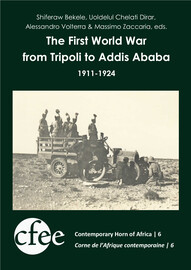
BOOK: Shiferaw BEKELE, Uoldelul Chelati DIRAR, Alessandro VOLTERRA & Massimo ZACCARIA (eds.), The First World War from Tripoli to Addis Ababa (1911-1924) [Corne de l'Afrique contemporaine/Contemporary Horn of Africa, vol. 6] (Addis Abeba: Centre français des études éthiopiennes, 2018), ISBN 9791036523786

(image source: openedition)

Book abstract:
For a long time now it has been common understanding that Africa played only a marginal role in the First World War. Its reduced theatre of operations appeared irrelevant to the strategic balance of the major powers. This volume is a contribution to the growing body of historical literature that explores the global and social history of the First World War. It questions the supposedly marginal role of Africa during the Great War with a special focus on Northeast Africa. In fact, between 1911 and 1924 a series of influential political and social upheavals took place in the vast expanse between Tripoli and Addis Ababa. The First World War was to profoundly change the local balance of power. This volume consists of fifteen chapters divided into three sections. The essays examine the social, political and operational course of the war and assess its consequences in a region straddling Africa and the Middle East. The relationship between local events and global processes is explored, together with the regional protagonists and their agency. Contrary to the myth still prevailing, the First World War did have both immediate and long-term effects on the region. This book highlights some of the significant aspects associated with it.
Table of contents:

  •  Introduction (Shiferaw Bekele, Uoldelul Chelati Dirar, Alessandro Volterra & Massimo Zaccaria)

    International and Regional Politics/Developments
  • Great War Intrigues in the Horn of Africa (Patrick Gilkes & Martin Plaut)
  • WWI in the Middle East and Africa: Nationalist Movements in a Formative Age (Haggai Erlich)
  • Aftershocks of the First World War in the Nile Valley (Anne-Claire de Gayffier-Bonneville)
  • Transnationalism from Below after the First World War: The Case of the 1924 Revolution in Anglo-Egyptian Sudan (Elena Vezzadini)
  • Ethiopia, International Law and the First World War. Considerations of Neutrality and Foreign Policy by the European Powers, 1840-1919 (Jakob Zollmann)

    Colonial Policies
  • Why did the Italians go to Libya? (Andrea Ungari)
  • Askaris and the Great War. Colonial Troops Recruited in Libya for the War but Never Sent to the Austrian Front (Alessandro Volterra)
  • Feeding the War: Canned Meat Production in the Horn of Africa and the Italian Front (Massimo Zaccaria)
  • The First World War Seen from Djibouti: Controlling, Recruiting, Enlisting (Laurent Jolly)
  • Living the War Far Away from the Front: Creating Territories around Djibouti (Simon Imbert-Vier)

    Local Agencies and the War
  • Claiming Islamic Authenticity. The Ḫatmīya Sufi order confronting WWI (Silvia Bruzzi)
  • “Our delight is for the amir of the English”: a Bornoan history of the First World War (North-Eastern Nigeria) (Rémi Dexière & Vincent Hiribarren)
  • World War I and the Perspective of a Hashemite Order in Yemen. Study of the Chronicle of Ismā‛īl b. Muḥammad al-Washalī (Juliette Honvault)
  • Writing WWI with African Gazes. The Great War Through the Writing of Tigrinya Speaking Expatriates (Uoldelul Chelati Dirar)
  • The Italian community of Tunisia: From Libyan Colonial Ambitions to the First World War (Gabriele Montalbano)
The book is available in open access (HTML-version). The PDF and print versions are dependent on library subscriptions to the openedition-platform.

More information here.

(source: ESILHIL-blog)

12 November 2018

BOOK: William A. SCHABAS, The Trial of the Kaiser (Oxford University Press, 2018). ISBN 9780198833857, $34.95


(Source: OUP)

Oxford University Press is publishing a book on the failed attempts to bring Kaiser Wilhelm II to justice in the aftermath of World War I.

ABOUT THE BOOK

In the immediate aftermath of the armistice that ended the First World War, the Allied nations of Britain, France, and Italy agreed to put the fallen German Emperor Kaiser Wilhelm II on trial, in what would be the first ever international criminal tribunal. In Britain, Lloyd George campaigned for re-election on the slogan 'hang the Kaiser', but the Italians had only lukewarm support for a trial, and there was outright resistance from the United States. 

During the Peace Conference, international lawyers gathered for the first time to debate international criminal justice. They recommended trial of the Kaiser by an international tribunal for war crimes, and the Americans relented, agreeing to a trial for a 'supreme offence against international morality'. However, the Kaiser had fled to the Netherlands where he obtained asylum, and though the Allies threatened a range of measures if the former Emperor was not surrendered, the Dutch refused and the demands were dropped in March 1920.

This book, from renowned legal scholar William A. Schabas, sheds light on perhaps the most important international trial that never was. Schabas draws on numerous primary sources hitherto unexamined in published work, including transcripts which vividly illuminate this period of international law making. As such, he has written a book which constitutes a history of the very beginnings of international criminal justice, a history which has never before been fully told.

AUTHOR INFORMATION

William A. SchabasProfessor of International Law, Middlesex University in London

William A. Schabas is professor of international law at Middlesex University in London. He is also professor of international human law and human rights at Leiden University, distinguished visiting faculty at Sciences Po in Paris, and honorary chairman of the Irish Centre for Human Rights. Professor Schabas holds BA and MA degrees in history from the University of Toronto and LLB, LLM and LLD degrees from the University of Montreal, as well as several honorary doctorates. He is the author of more than twenty books in the fields of human rights and international criminal law. Professor Schabas drafted the 2010 and 2015 United Nations quinquennial reports on the death penalty. He was a member of the Sierra Leone Truth and Reconciliation Commission. Professor Schabas is an Officer of the Order of Canada and a member of the Royal Irish Academy since 2007.

TABLE OF CONTENTS

1. The Power of the Beaten Path
2. 'Hang the Kaiser'
3. Kaiserdammerung
4. Making the Case in International Law
5. Britain, France, and Italy Agree to Try the Kaiser
6. The Dutch are Divided
7. Aborted Kidnap
8. The Commission on Responsibilities
9. Prosecuting Crimes Against Peace
10. International Law and War Crimes
11. An International Criminal Court
12. The Council of Virgins
13. Finalising the Treaty of Versailles
14. Implementing Article 227
15. Readying the Case for Trial
16. The Kaiser in Limbo
17. Demand for Surrender
18. Was he Guilty?

More information here

20 September 2018

CALL FOR PAPERS: Conference - The Making of a World Order: A Reappraisal of the Paris Peace Conference and the Treaty of Versailles, The American University of Paris (DEADLINE: 15 October 2018)


(Source: Wikipedia)

Via Hsozkult, we learned of a call for papers for a conference on the Paris Peace Conference and the Treaty of Versailles. Here the call:

Upon the occasion of the hundredth anniversary of the signing of the Treaty of Versailles, the Belfer Center for Science and International Affairs, John F. Kennedy School of Government, Harvard University, and the Center for Critical Democracy Studies at The American University of Paris will hold two conferences in the Spring of 2019 in Paris and the Fall of 1919 in Cambridge, MA. Designed as a pair of facing conferences, the first will re-appraise the 1919 Paris Peace Conference from the vantage point of new historical evidence and recent scholarly focus on its global impact, while the second conference will look back upon 1919 from the perspective of their continuing contemporary relevance to both international relations and policy making. Both conferences will be deeply interdisciplinary, including featured speakers and panelists from history, international relations, public policy and diplomacy, in an effort to approach the Paris Peace Conference from multiple, international perspectives.

Call for Papers for the Paris 2019 Conference: May 23-25, 2019 (deadline for paper and panel submissions, October 15, 2018)

To commemorate the 100th anniversary of the signing of the Treaty of Versailles, the Paris conference will explore the Treaty, and the Paris Peace Conference of 1919 more broadly, from the perspective of a new world order it simultaneously did and did not make. In 1994, on the 75th Anniversary of the Versailles Treaty, leading scholars of European and international history gathered to reassess the Treaty of Versailles and its impact on the trajectory of twentieth-century history. The result was a path-breaking volume that both re-assessed the divergent aims of the different Great Powers at the Paris Peace Conference, as well as how the negotiations themselves laid the foundation for its own collapse twenty years later. But the volume remained largely Eurocentric—the rest of the world emerged in the volume as bit players on a European stage. In the past two decades, historians of modern Europe have pushed our understanding of the long nineteenth century toward new borders, asking novel questions and forcing us to recognize the power of movements, processes, trends, and influences on a planetary scale. Indeed, it was this “transformation of the modern world” (Osterhammel) during the global nineteenth-century that ran headlong into the cataclysmic events of the first “World” War. From 1914-1918, the world slipped into a massive military conflict on an unprecedented scale. In the immediate aftermath of the war, the task at hand was little less than constructing a new world order.

Building on the growing interest in World War I as a global conflict that extended far beyond the borders of Europe, the Paris 2019 conference will explore the global political ramifications of the treaties prepared at the Paris Peace Conference in 1919. It is hard to overstate the importance of the 1919 Paris Peace Conference for redefining the place of the United States in the world, re-shaping the geo-political configurations of the Middle East, Asia and Europe, the new place of the South Pacific, the need to re-conceive of world relations with a new Soviet Russia, the massive impact on European colonies in Africa, the place of Latin America, and the construction of the League of Nations. Far from a mere cessation of hostilities, the peace treaties signed in 1919 and 1920 marked a massive transformation on local, national, continental and global scales.

Four renowned experts of the First World War have agreed to present keynote addresses at the conference: Margaret MacMillan (Oxford University), Priya Satia (Stanford University), Tze-ki Hon (City University of Hong Kong), and Adam Tooze (Columbia University).

Besides the four plenary speakers, the Paris 2019 Conference will invite panelists in multiple disciplines relating to all aspects of the 1919 Paris Peace Conference. Alongside historians, the conference seeks to include other perspectives from the social sciences and humanities, including, but not limited to, historical sociology, political anthropology, political science, economics, and literature. Since the conference focuses particularly on the global effects of 1919, the organizers encourage the participation of scholars whose area of focus is outside Europe. To this end, there will be some funding available for early-career scholars and those traveling long distances.

The Paris conference organizers will proceed immediately to a broad call for papers, and a simultaneous invitation to specialists in the field to participate. Possible Panel Themes may include:

- Migration and Minority Rights and the Paris Peace Conference
- The Paris Peace Conference and New International Intellectual Networks
- The Creation of New Regional and Inter-Regional Politics
- The Paris Peace Conference and the Rise of New International Organizations
- Sovereignty, Self-Determination, and De-Colonization
- The “New Woman” and the Paris Peace Conference
- The Paris Peace Conference, International Socialism, and the Specter of Communism

The intention of the organizers of the conference, in alignment with the mission of the Center for Critical Democracy Studies, is to weave the conference preparation and presentation into course work at the American University of Paris, making the Treaty the subject of its annual freshman seminar, Democracy Lab, and summer Democracy Institute. In addition, the Center publishes the Tocqueville Review, which will devote a special two-volume issue to the best papers of the conference.

The Paris Conference will take place on May 23-25, 2019.

Please submit paper or full-panel proposals (300 words) and a brief (2-page) cv to parispeace1919@aup.edu by October 15, 2018.

Summary of key dates:
October 15, 2018 Deadline for paper proposals
November, 2018 Final decisions on paper and panel proposals
January, 2018 Preliminary Program released
March, 2018 Final Program released
May 23-25, 2018 Conference

Kontakt
Albert Wu
awu@aup.edu / albert.wu@gmail.com
102 rue St. Dominique
75007 Paris

(Source: Hsozkult.de)

19 September 2018

CONFERENCE: Der Vertrag von Saint Germain 1919 im Kontext der europäischen Nachkriegsordnung (27-29 September 2018, Vienna)


(Source: ÖAW)

We learned of a conference on the 1919 Treaty of Saint-Germain between the Allies of World War I on the one hand and by the Republic of German-Austria on the other.

ÖAW und Universität Wien laden ein, die rechtlichen Grundlagen der europäischen Nachkriegsordnung nach dem Ersten Weltkrieg sowie deren Konsequenzen für die politische, wirtschaftliche und kulturelle Entwicklung Europas aus einer globalen Perspektive zu diskutieren.
Der für die Republik Österreich so bedeutende Vertrag von Saint Germain aus dem Jahr 1919 ist im internationalen Kontext nach wie vor Gegenstand globaler Forschungsinitiativen.

Eine Konferenz unter österreichischer Federführung zum Thema „Der Vertrag von Saint Germain 1919 im Kontext der europäischen Nachkriegsordnung“ will diese Initiativen vernetzen. Das Institut für Neuzeit- und Zeitgeschichtsforschung der ÖAW, die Kommission für Rechtsgeschichte Österreichs der ÖAW sowie die Forschungsstelle für Rechtsquellenerschließung der Universität Wien laden ein, das Entstehen und Wirken des Vertrags im Kontext der Neuordnung der Welt nach 1918 gemeinsam zu analysieren. Neben den zentralen politischen Themen sollen auch bislang wenig beachtete wirtschaftliche und kulturelle Aspekte, die dieser Vertrag ebenso beeinflusst hat, zur Sprache kommen. Die wissenschaftliche Auseinandersetzung strebt eine Neubewertung von St. Germain an, welche  Ressentiments und nationalistische Vorurteile der Nachkriegszeit überwindet.

The programme can be found here

More information here

17 September 2018

CONFERENCE: Sur le front du droit (Toulouse, 16 October 2018)


(Source: CTHDIP)

Via Hi-D, we learned of a conference series on European and American lawyers during World War I.

Le Centre Toulousain d’Histoire du Droit et des Idées Politiques (E.A 789) organise un cycle de conférences sur les juristes européens et américains dans la Grande Guerre.

Ce cycle de conférences est organisé en collaboration avec le Collège supérieur du Droit et l’École européenne de droit.

Les conférences sont destinées aux étudiants et au grand public. Elles ont pour objectif commun de questionner la place des juristes et du droit au cours de la période 1914-1918 et dans l’après-guerre. Comment le droit est appliqué au cours de cette période ? Comment ces circonstances sont prises en considération par le juge et la doctrine ? En quoi la guerre influe-t-elle sur la formation et le développement de domaine(s) juridique(s) ?

Mardi 16 octobre 2018 (18 h),Université Toulouse Capitole, Salle des conférences, BU de l’Arsenal
Michaël AMARA (Chef de service « Archives contemporaines », Archives générales du Royaume), La Cour militaire belge durant la Grande Guerre ou le difficile exercice de la Justice militaire en Belgique (1914-1918) (Résumé)

Annamaria MONTI (Professeur à l’Università Commerciale Luigi Bocconi), Les juristes universitaires italiens et la guerre : pistes de recherche.

Ces conférences font partie d’un ensemble de publications et manifestations portées par le C.T.H.D.I.P. et associant divers partenaires (Label Mission Centenaire)

(Source : Hi-D)

05 September 2018

Marcus M. PAYK, Frieden durch Recht? Der Aufstieg des modernen Völkerrechts und der Friedensschluss nach dem Ersten Weltkrieg [Studien zur Internationalen Geschichte, 42] (Berlin: De Gruyter Oldenbourg, 2018), VIII + 739 p. ISBN 978-3-11-058148-5, € 49,95

(image source: DeGruyter Oldenbourg)

Book abstract:
This study presents the Paris Peace Treaties of 1919-20 in a new light. Going beyond conventional narratives about the "dictated" peace of Versailles and the failures of the peacemakers, the book offers a fresh and comprehensive look at the five peace treaties with Germany, Austria, Hungary, Bulgaria and the Ottoman Empire. Marcus Payk exhibits the influence of late 19th century normative expectations and demonstrates how the entire peace settlement was deeply imbued by notions of international law, justice, and legality. The study examines the political power as well as intrinsic logic of legal arguments in foreign affairs, arguing for a more nuanced picture of a juridification of international politics.
More information with the publisher (including free access to the table of contents).

(source: ESILHIL blog)

21 August 2018

COLLOQIUM: Le principe d’autodétermination un siècle après le traité de Versailles : d’hier à aujourd’hui - et demain ? (26-27 September 2018, Strasbourg)


Via Portail Universitaire du Droit, we learned of a colloquium dealing with aspects of the principle of self-determination over the last century. Here the programme: 

Mercredi 26 septembre / Mittwoch, den 26. September
(Faculté de droit)
13:45 : Accueil des participants/Empfang der Teilnehmer/-innen
14:00 : Allocutions d’ouverture / Eröffnungsansprachen
Le principe d’autodétermination dans le contexte de la décolonisation/Das Selbstbestimmungsprinzip im Rahmen der Entkolonialisierung
Président/ Sitzungsleiter : Robert Uerpmann-Wittzack
14:30 : Uti possidetis juris et droit des peuples à disposer d’eux-mêmes : le premier peut-il condamner la réalisation du second ? / Uti possidetis juris und Selbstbestimmungsrecht der Völker : Könnte Ersteres die Verwirklichung des Letzteren verhindern ? 
Hamedy Camara, Université Paris-Sud XI/ Universität Paris-Sud XI

Le droit à l’autodétermination dans la médiation pour la paix : entre paix libérale et post-colonialisme / Das Selbstbestimmungsrecht in der Friedensmediation : Zwischen liberal peace und Post-Kolonialismus 
Felix Würkert, Université Europe Viadrina de Francfort (Oder) / Europa-Universität Viadrina Frankfurt (Oder)

L’Etat-Nation face à la revendication autochtone : l’autodétermination interne du peuple kanak de Nouvelle-Calédonie/ Der Nationalstaat im Angesicht von Unabhängigkeitsbewegungen : Die interne Selbstbestimmung des kanakischen Volkes in Neukaledonien 
Anne-Lise Madinier, Université de Perpignan et Université d’Ottawa/ Universität Perpignan und Universität Ottawa

16:00 : Pause
Création d’Etats dans la société internationale contemporaine/Schaffung der Staaten in der heutigen Völkergemeinschaft
Président/ Sitzungsleiter : Stefan Oeter
16:30 : Le principe d’autodétermination en interaction entre l’ONU et l’Etat/ Das Selbstbestimmungsprinzip im Zusammenspiel zwischen UNO und Staat 
Edith Vanspranghe, Université Paris 8 et Université libre de Bruxelles/ Universität Paris 8 und Université libre de Bruxelles

Droit à l’autodétermination et Etats in statu nascendi/ Recht auf Selbstbestimmung und im Entstehen befindliche Staaten 
Robin Caballero, Université Paris 1 Panthéon-Sorbonne et Université Humboldt de Berlin/ Universität Paris 1 Panthéon-Sorbonne und Humboldt-Universität zu Berlin

La limitation par la description : les voies d’une juridicisation de la sécession/ Beschränkung durch Beschreibung : Wege zur Verrechtlichung der Sezession 
Lennart Bültermann, Université de Jena/ Universität Jena

18:00 : Fin de la journée/ Ende des Tages

Jeudi 27 septembre / Donnerstag, den 27. September
(Bâtiment Escarpe)
L’autodétermination de et dans l'Etat constitué dans la sphère politique/Selbstbestimmung des und im bereits bestehenden Staat(es) im politischen Bereich
Président/ Sitzungsleiter : Antoine Basset
09:30 : L’évolution du droit à l’autodétermination : de l’aspiration à l’étaticité au droit à la démocratie ? / Selbstbestimmungsrecht im Wandel –vom eigenen Staat zum Recht auf Demokratie ? 
Ralph Janik, Université de Vienne/ Universität Wien

La constitutionnalisation du droit à l’autodétermination à l’épreuve de la thèse des limites matérielles au pouvoir de révision constitutionnelle/ Die Konstitutionalisierung des Selbstbestimmung srechts als Ausdruckeiner materiellen Beschränkung der verfassungsändernden Gewalt 
Anthony Sfez, Université Paris 2 Panthéon-Assas/ Universität Paris 2 Panthéon-Assas

Le rôle du principe d’autodétermination dans l’Union européenne/ Die Rolle des Selbstbestimmungsprinzips in der EU 
Elisa Stotz, Université de Constance/ Universität Konstanz

Le principe d’autodétermination et le principe de bon voisinage/ Das völkerrechtliche Selbstbestimmungsprinzip und das Prinzip der guten nachbarschaftlichen Beziehungen 
Mihai Corman, Université Humboldt de Berlin/ Humboldt-Universität zu Berlin

Droits politiques des anciens guérilleros en Colombie/ Politische Partizipationsrechte ehemaliger Guerilla-Kämpfer in Kolumbien 
Victoria Adouvi, Université de Francfort/ Universität Frankfurt

12:30 : Pause déjeuner/ Mittagspause
L’autodétermination en matière économique/Selbstbestimmung im wirtschaftlichen Bereich
Président/Sitzungsleiter : Matthias Goldmann
14:30 : Autodétermination et droit budgétaire/Selbstbestimmung und Budgetrecht 
Kevin Hinzen, Université de Francfort/ Universität Frankfurt

Souveraineté fiscale et droit à l’autodétermination/ Steuerhoheit und Selbstbestimmungsrecht 
Celine Braumann, Université de Vienne/ Universität Wien

Protection des investissements et autodétermination de l’Etat/ Investitionsschutz und staatliche Selbstbestimmung 
Alicia Köppen, Université Humboldt de Berlin/ Humboldt-Universität zu Berlin

16:00 : Pause
Le principe d’autodétermination dans le droit des minorités et des droits de l’homme/Das Selbstbestimmungsprinzip im Minderheiten recht und Menschenrechtsschutz
Président/ Sitzungsleiter : Ivan Boev
16:30 : Le droit à l’autodétermination dans les traités de protection des droits de l’homme : à la recherche d’une reconnaissance effective ?/Das Recht auf Selbstbestimmung in den Menschenrechtsabkommen: Eine Suche nach seiner effektiven Anerkennung ? 
Arnaud Lobry, Université Cergy-Pontoise / Universität Cergy-Pontoise

La relation du principe d’autodétermination avec les droits individuels/ Der Zusammenhang zwischen dem Selbstbestimmungsprinzip und subjektiven Rechten 
Stefanos Gakis, Université de Strasbourg/ Universität Straßburg

Les minorités à l’épreuve de l’autodétermination : quelle évolution en droit international ?/ Minderheiten und Selbstbestimmung : Zur Entwicklung Des Völkerrechts 
Liliana Haquin-Saenz, Université Lyon 3/ Universität Lyon 3

18:00 : Remarques conclusives/ Schlusswort 
Stefan Oeter


Contact/Kontact : fru6703-contact@unistra.fr