Search

Showing posts with label Women Legal History. Show all posts

07 October 2022

CALL FOR ABSTRACTS : The Forgotten Foundations of Feminist Legal Scholarship, Part 2: 1985-1995 (London/Zoom, 4 November 2022) (DEADLINE: 16 October 2022)


Via Criticallegalthinking, we learned of this call for paper proposals.

Contemporary feminist legal scholarship appears to have no history and almost no canonical texts. Unlike other fields in the humanities and social sciences, there has been an absence of interest in questions of feminist inheritance in law; a certain unwillingness to grapple with feminism’s intellectual and/or textual traditions. Individual studies, however radical or sophisticated in their orientation, appear to be situated in the ‘feminist present’ only, such that the past of legal feminism is void of any heritage worthy of being handed down. 

Yet despite this disregard or disavowal, contemporary feminist legal scholarship rests on the foundations of a corpus of post-war feminist texts. Those texts’ vital power shaped new, creative, and critical modes of thinking, new routes for understanding and reflection that challenged dominant thought inside and outside the academy. They animated multiple ways of revalorising lived experience and the subject’s embodied nature and in so doing raised radical questions about women’s social being. It is the forgetfulness of these earlier texts that these workshops wish to interrogate. The first workshop, held in Summer 2022, focused on feminist theoretical texts produced (mainly) in the years between 1970-1985. The second workshop, to be held in Autumn 2022, will focus on the body of new feminist, feminist legal, critical race feminist, postcolonial feminist and queer legal scholarship that emerged from the mid-1980s to early 1990s. 

In these two one-day workshops we wish to pose as a problem the present of feminist legal scholarship that has not only lost sight of most of these earlier texts, but has left this disconnection from its past to go entirely unnoticed. It is as if what credits feminist legal scholarship with contemporaneity is precisely the erasure of these earlier texts from its horizon. The questions to be addressed include: what is the position of these texts with regards to the present? How should we think of the feminist (legal) texts of the 1970s-90s today? How should we place our contemporary thought in relation to those texts?  How are we to receive these texts today? Why is it that feminist legal scholarship has developed no feminist canon or classical literature while continuing to reference/reverence the work of white male philosophers? In short, are we to reconnect and reconcile with the rich inheritance that feminist thought and practice of the ’70s, ’80s and ’90s has bequeathed us? Or should we continue to acknowledge as a sign of our contemporaneity the disjunction with our heritage? 

Call for Paper Proposals

Please send proposals of papers for the second workshop to Maria Drakopoulou (m.drakopoulou@kent.ac.uk) and/or Rosemary Hunter (r.c.hunter@kent.ac.uk). Proposals, including title and abstract of 150-300 words, should be submitted by 16 October 2022.

An indicative list of texts is attached although texts outside this list with justifications for inclusion are welcome.

Limited funding for travel costs may be available for research students and early career researchers. If you would need funding in order to attend, please let us know, with approximate cost, as soon as possible.

Workshop Organisers: Maria Drakopoulou and Rosemary Hunter.

Place: London in person + online for participants unable to travel

Date: 4 November 2022

09 July 2021

DATABASE: "Droits des femmes" (Gallica/BnF - Les essentiels du droit)

 
(image source: Gallica)

Description:

Cette rubrique thématique propose une sélection d'ouvrages disponibles dans Gallica sur la situation juridique des femmes dans différents domaines du droit. Elle sera progressivement enrichie. Les textes sélectionnés sont répartis en plusieurs catégories : ouvrages généraux sur la situation juridique des femmes,  par branches du droit (droit romain, droit civil, droit commercial, droit du travail, protection sociale, droits politiques), sur des sujets plus précis (nationalité, droit à l'éducation, femmes avocates) ou plus spécifiques (droit et féminisme). Devant être libres de droits, les ouvrages sélectionnés ne peuvent pas rendre compte de l’avancée majeure des droits des femmes tout au long du XXe siècle, en particulier après la seconde guerre mondiale. Ils peuvent néanmoins témoigner de la situation juridique des femmes en France au cours du XIXe siècle et des débuts de son évolution.

Read more here

08 June 2021

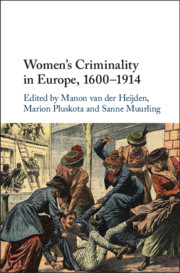
BOOK: Manon VAN DER HEIJDEN, Marion PLUSKOTA & Sanne MUURLING, Women's Criminality in Europe, 1600–1914 (Cambridge: CUP, 2021). ISBN 9781108477710, $ 99.99


(Source: CUP)

CUP is publishing an edited collection on women’s criminality in Europe.

ABOUT THE BOOK

Bringing together the most current research on the relationship between crime and gender in the West between 1600 and 1914, this authoritative volume places female criminality within its everyday context. It reveals how their socio-economic and cultural contexts provided women with 'agency' against a range of European backdrops, despite a fundamentally patriarchal criminal justice system, and includes in-depth analysis of original sources to show how changing living standards, employment, schooling and welfare arrangements had a direct impact on the quality of life of working class women, their risk of becoming involved in crime, and the likelihood of being prosecuted for it. Rather than treating women's criminality as always exceptional, this study draws out the similarities between female and male criminality, demonstrating how an understanding of specific cultural and socio-economic contexts is essential to explain female criminality, both why their criminal patterns changed, and how their crimes were represented by contemporaries.

ABOUT THE EDITORS

Manon van der Heijden, Universiteit Leiden

Manon van der Heijden is Professor of Comparative Urban History at Universiteit Leiden. Her research interests include crime and justice, marriage and the family, urban finances and public services. In 2012, she was granted a NWO VICI project Crime and Gender 1600–1900. She is a member of the Academia Europaea and author of Women and Crime in Early Modern Holland (2016).


Marion Pluskota, Universiteit Leiden

Marion Pluskota is Assistant Professor in Social History at Universiteit Leiden. She has published extensively on prostitution and criminality in the eighteenth and nineteenth centuries. She is the author of Prostitution and Social Control in Eighteenth-Century Port (2015).


Sanne Muurling, Universiteit Leiden

Sanne Muurling recently completed her Ph.D. at Universiteit Leiden with a dissertation on everyday crime and gender in early modern Bologna, Italy. Her research focuses on the social history of everyday life, including crime and deviance, single motherhood, welfare institutions, poverty and living culture.

TABLE OF CONTENTS

1. Introduction: women and crime in history Sanne Muurling, Marion Pluskota and Manon van der Heijden

2. Explaining crime and gender in Europe between 1600 and 1900 Manon van der Heijden

Part I. Violence, Space and Gender:

3. Women, violence and the uses of justice before the Criminal Court of early modern Bologna Sanne Muurling

4. The 'vanishing' female perpetrator of common assault Jo Turner

Part II. Prosecution and Punishment:

5. Gender and the prosecution of adultery in Geneva, 1550–1700 Sara Beam

6. 'Find the lady': tracing and describing the incarcerated female population of London in 1881 Lucy Williams and Barry Godfrey

7. Gender and release from imprisonment: convict licensing systems in mid- to late-nineteenth-century England Helen Johnston and David J. Cox

8. Female and male prisoners in Queensland 1880–1899: re-entry, risk factors, recidivism Alana Piper, Catrien Bijleveld, Susan Dennison and Jonathan de Bruin

Part III. Representation of Crime:

9. Girls, young women and crime: perceptions, realities and responses in a long-term perspective Sarah Auspert, Margo de Koster and Veerle Massin

10. 'Monstrous and indefensible'? Newspaper accounts of sexual assaults on children in nineteenth-century England and Wales Daniel J. R. Grey

11. Gender and Dutch newspaper reports of intimate violence, 1880–1910 Clare Wilkinson.


More info here

14 May 2021

BOOK: Alessandra BASSIONI, Beatrice DEL BO. Schiave e schiavi: riflessioni storiche e giuridiche. (Milano: Giuffrè, 2020). ISBN 9788828820932. 35 EUR.


(Source: https://shop.giuffre.it/024209652-schiave-e-schiavi-riflessioni-storiche-e-giuridiche.html)

Tema purtroppo di straordinaria attualità, la schiavitù ha percorso tutte le epoche storiche ed è stata analizzata con ottiche di ricerca che privilegiavano la razza e la condizione di mancanza di libertà degli uomini neri, molto poco delle donne, con una attenzione particolare per l'età moderna. Schiavitù femminile è un concetto che nel tempo resta strettamente legato ad altri: emigrazione, servizio domestico, sfruttamento sessuale, prostituzione, determinando nei secoli il manifestarsi di una domanda di schiave connotata da specifiche esigenze. Di fronte all'orrore di questo fenomeno, una lettura di genere offre spunti di riflessione e spazi al dibattito che scaturiscono dalle dinamiche sul lungo periodo e dai protagonisti storici: storie di uomini e donne, schiave e liberi, libere e schiavi, giustificazioni etiche, dilemmi religiosi, ragioni economiche, distinzione di status, occasioni di progresso sociale. Questo libro guarda alla schiavitù femminile nella storia da prospettive disciplinari diverse alla ricerca della female agency e al contempo dei diritti negati.

Table of contents: https://shop.giuffre.it/pub/media/Indice/INDICE_024209652.pdf#search=%22%22


27 April 2021

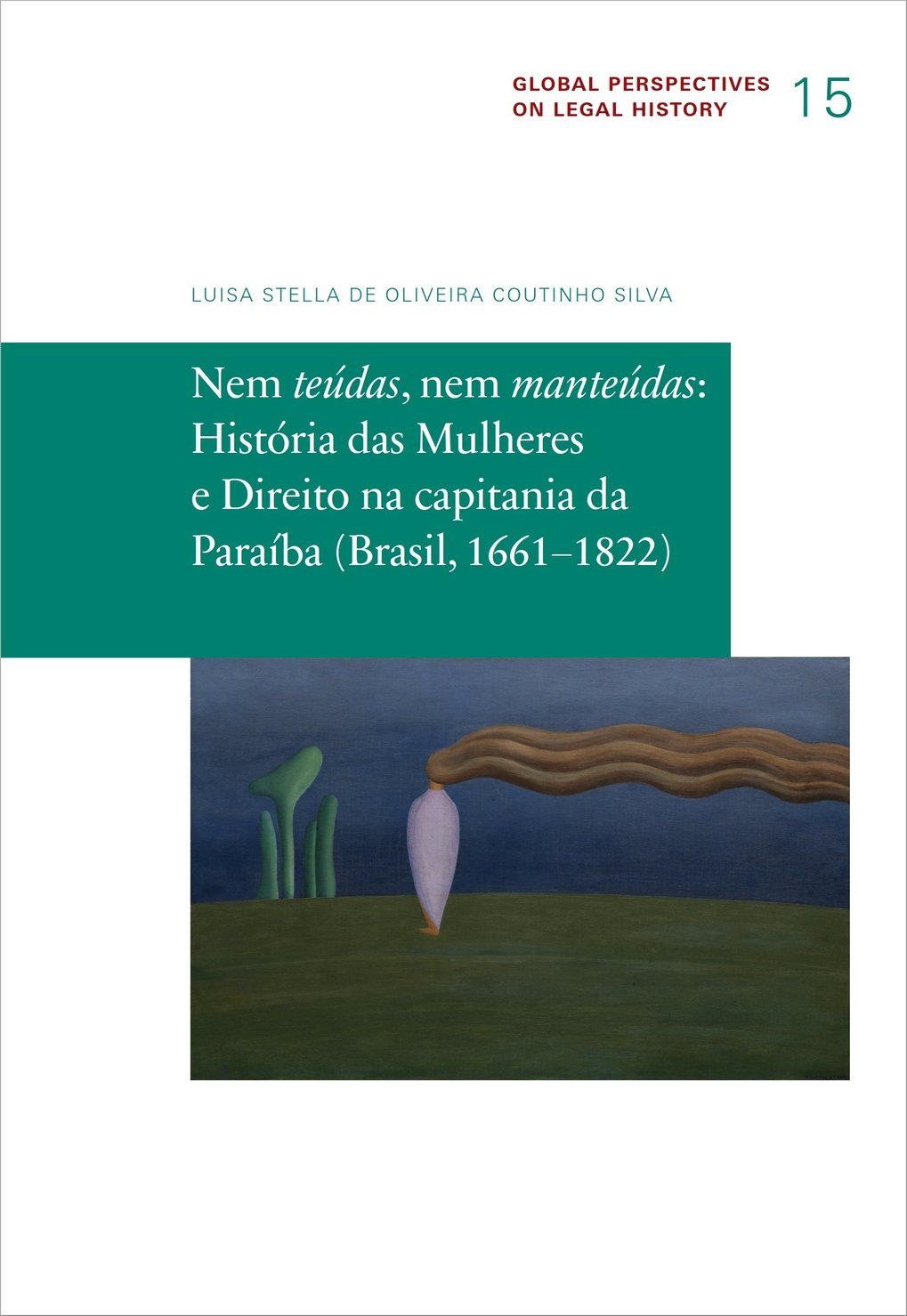
BOOK: Luisa STELLA DE OLIVEIRA COUTINHO SILVA, Nem teúdas, nem manteúdas: História das Mulheres e Direito na capitania da Paraíba (Brasil, 1661−1822) (Frankfurt: MPI for European Legal History, 2021). ISBN 978-3-944773-29-2, OPEN ACCESS


The Max Planck Institute for Legal History and Legal Theory has published a new open access book in its Global Perspective on Legal History series.

ABOUT THE BOOK

This book develops a legal history of colonial women as a methodological approach to studying the women of Paraíba, a captaincy on the northeast coast of Brazil, from the end of the Dutch occupation (1661) to Brazilian independence in 1822. It uses the concept of multiple normativities to analyse dozens of daily life cases from Portuguese and Brazilian archives.

To study women’s everyday normative contexts in a colonial space, the author analyses traditional Ius Commune and Portuguese legal sources from different jurisdictions (including compilations of laws, Roman law, Visigothic influences, canon law and inquisitorial regulations), but also legal doctrines, medical treatises, moralist works and literature to enrich interpretations in women’s history, gender studies, feminist legal theory and legal history. Furthermore, a comparison of the works of Portuguese legislators, jurists, writers and moralists was carried out in order to reveal how these sources from different normative spheres defined and described women.

In order to show the impact of these normative traditions in the colonial Captaincy of Paraíba, the book examines how the administration, the application of justice and the resolution of conflicts were carried out not only by the secular administration, the Church and the Inquisition, but also by newly created institutions and practices specific to Paraíba, which were the result of adapting the law of the metropole to local circumstances.

To do so, the study focuses on normativities of a more pragmatic character, analysing archival documents portraying women’s daily life situations relating to both secular and religious jurisdictions. The issues touched upon include marriage and other family formations, single parenthood, concubinage and cohabitation; different experiences of motherhood, filiation and illegitimacy, loss of virginity in cases of rape, and widowhood; as well as consanguinity, bigamy, adultery and divorce. The legal and normative experiences of married women are also compared with those of women living in monasteries, houses of retreat (recolhimentos) or prisons, and with those of prostitutes. The book examines questions of women’s ownership of goods and land, and whether adherence to a certain religion influenced their room for manoeuvre and experiences in normative contexts.

These analyses demonstrate that the law from the metropole neither offered pre-established solutions for women’s daily lives, nor was it applied unchanged in the colony. On the ground, law was dynamic, and the interplay of multiple normativities provided different possibilities that depended on the intersection of women’s condition and status, religion and sexual options, proving that sex and gender categories are not immutable, but, on the contrary, flexible according to the practices of law in colonial Paraíba.

TABLE OF CONTENTS

IX

Agradecimentos

1

Introdução: Uma História do Direito das Mulheres Coloniais

Capítulo 1

41

Um Portugal transplantado? Normatividades imperiais na capitania da Paraíba

Capítulo 2

93

A vida das mulheres casadas na capitania da Paraíba: vozes femininas e normatividades no Império português

Capítulo 3

193

Promessas frustradas

Capítulo 4

211

As experiências da maternidade

Capítulo 5

231

As possibilidades de uma vida fora do casamento tridentino

Capítulo 6

275

Os espaços de segregação da vida pública

Capítulo 7

295

Desfazendo um vínculo eterno?

Capítulo 8

305

Adquirindo e possuindo: donas de terras e herdeiras

Capítulo 9

321

Religião e cotidiano: as mulheres e a prática do judaísmo na Paraíba

337

Conclusões

351

Fontes e bibliografia

375

About the Author


More info here

15 December 2020

SEMINAR: Mulheres vítimas e delinquentes nos primórdios do direito penal moderno, Ana Lúcia Sabadell, 15 December


We were informed of this event on "women victms and perpetrators in the begginins of modern criminal law". Il will be held online at 15 December, 19h, time of Florianópolis.

O Ius Commune – UFSC/CNPq (Grupo de Estudos e Pesquisa em História da Cultura Jurídica), juntamente com o Studium Iuris - UFMG (Grupo de Pesquisa em História da cultura jurídica) realizará uma webconferência, no dia 15 de dezembro de 2020 - 19h00 com o tema "Mulheres Vítimas e Delinquentes nos Primórdios do Direito Penal Moderno", com a professora Ana Lúcia Sabadell (UFRJ) como conferencista.
▶️ Conferencista: Prof Ana Lúcia Sabadell (UFRJ)
▶️ Moderador: Prof. Arno Dal Ri Júnior (UFSC)
▶️ Debatedores: Marilía de Nardin Budó (UFSC), Luana Renostro Heinen (UFSC), Ricardo Sontag (UFMG) e Diego Nunes (UFSC).
▶️ Será emitido, pela UFSC, um certificado de 2 horas/aula para os que comparecerem;
▶️ As inscrições deverão ser feitas no link http://inscricoes.ufsc.br/mulheres-delinquentes-nos... até o dia 15/12 (terça-feira).


07 December 2020

BOOK: Sanne MUURLING, Everyday Crime, Criminal Justice and Gender in Early Modern Bologna (Leiden: Brill, 2020). ISBN: 9789004440586, € 121.00

(Source: Brill)

ABOUT THE BOOK

Series: Crime and City in History, Volume: 5

Female protagonists are commonly overlooked in the history of crime; especially in early modern Italy, where women’s scope of action is often portrayed as heavily restricted. This book redresses the notion of Italian women’s passivity, arguing that women’s crimes were far too common to be viewed as an anomaly. Based on over two thousand criminal complaints and investigation dossiers, Sanne Muurling charts the multifaceted impact of gender on patterns of recorded crime in early modern Bologna. While various socioeconomic and legal mechanisms withdrew women from the criminal justice process, the casebooks also reveal that women – as criminal offenders and savvy litigants – had an active hand in keeping the wheels of the court spinning.

ABOUT THE AUTHOR

Sanne Muurling, Ph.D. (2019), Leiden University, is a postdoctoral researcher at Radboud University. She has published on the social history of daily life, crime and deviance, gender, disease, poverty and welfare arrangements.


More information with the publisher.

06 October 2020

SEMINAR: La mujer en la historia del Derecho. Universidad de Chile, 7th October, 18:00


Tomorrow, the University of Chile will promote this online seminar on "the women in legal history" at 18:00 (Chile).

More information: http://derecho.uchile.cl/agenda/168963/coloquio-la-mujer-en-la-historia-del-derecho

25 June 2020

BOOK: Mark W. ORMROD, Women and Parliament in Later Medieval England (Cham: Springer, 2020). ISBN 978-3-030-45219-3, 51,99 EUR


(Source: Springer)

Springer is publishing a new book on the role played by women in the workings and business of the English Parliament in the late Middle Ages.

ABOUT THE BOOK

This Palgrave Pivot provides the first ever comprehensive consideration of the part played by women in the workings and business of the English Parliament in the later Middle Ages. Breaking new ground, this book considers all aspects of women’s access to the highest court of medieval England. Women were active supplicants to the Crown in Parliament, and sometimes appeared there in person to prosecute cases or make political demands. It explores the positions of women of varying rank, from queens to peasants, vis-à-vis this male institution, where they very occasionally appeared in person but were more usually represented by written petitions. A full analysis of these petitions and of the official records of parliament reveals that there were a number of issues on which women consistently pressed for changes in the law and its administration, and where the Commons and the Crown either championed or refused to support reform. Such is the concentration of petitions on the subjects of dower and rape that these may justifiably be termed ‘women’s issues’ in the medieval Parliament.

ABOUT THE AUTHOR

W. Mark Ormrod is Professor Emeritus of History at the University of York. Specialising in the politics of later Medieval England, he has authored Political Life in Medieval England, 1300-1450 (1995) and Edward III (2011). Most recently, with Bart Lambert and Jonathan Mackman, he has published Immigrant England, 1300-1550 (2019).  

More info here

21 April 2020

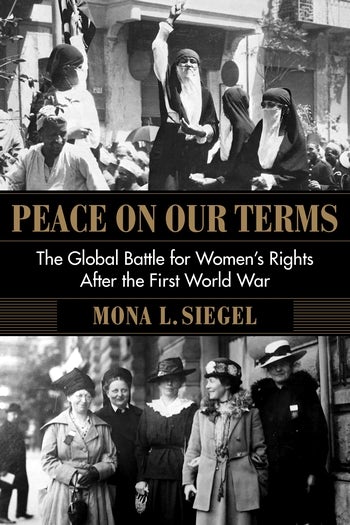
BOOK: Mona L. SIEGEL, Peace on Our Terms: The Global Battle for Women’s Rights After the First World War (New York: Columbia University Press, 2020). ISBN 9780231195102, $35.00


Columbia University Press has published a new book on the struggle to advance women’s rights in the aftermath of World War I.

ABOUT THE BOOK

In the watershed year of 1919, world leaders met in Paris, promising to build a new international order rooted in democracy and social justice. Female activists demanded that statesmen live up to their word. Excluded from the negotiating table, women met separately, crafted their own agendas, and captured global headlines with a message that was both straightforward and revolutionary: enduring peace depended as much on recognition of the fundamental humanity and equality of all people—regardless of sex, race, class, or creed—as on respect for the sovereignty of independent states.

Peace on Our Terms follows dozens of remarkable women from Europe, the Middle East, North America, and Asia as they crossed oceans and continents; commanded meeting halls in Paris, Zurich, and Washington; and marched in the streets of Cairo and Beijing. Mona L. Siegel’s sweeping global account of international organizing highlights how Egyptian and Chinese nationalists, Western and Japanese labor feminists, white Western suffragists, and African American civil rights advocates worked in tandem to advance women’s rights. Despite significant resistance, these pathbreaking women left their mark on emerging democratic constitutions and new institutions of global governance. Drawing on a wide range of sources, Peace on Our Terms is the first book to demonstrate the centrality of women’s activism to the Paris Peace Conference and the critical diplomatic events of 1919. Siegel tells the timely story of how female activists transformed women’s rights into a global rallying cry, laying a foundation for generations to come.

ABOUT THE AUTHOR

Mona L. Siegel is professor of history at California State University, Sacramento. She is the author of The Moral Disarmament of France: Education, Pacifism, and Patriotism, 1914–1940 (2004).

TABLE OF CONTENTS

Timeline of International Women’s Activism in 1919
List of Illustrations
Prologue: The Closing Days of the First World War
1. A New Year in Paris: Women’s Rights at the Peace Conference of 1919
2. Winter of Our Discontent: Racial Justice in a New World Order
3. March(ing) in Cairo: Women’s Awakening and the Egyptian Revolution of 1919
4. Springtime in Zurich: Former Enemies in Pursuit of Peace and Freedom
5. May Flowers in China: The Feminist Origins of Chinese Nationalism
6. Autumn on the Potomac: Women Workers and the Quest for Social Justice
Epilogue: Rome, 1923
Acknowledgments
Abbreviations
Notes
Index

More info here

06 March 2020

VICTORIA KENT PRIZE

The Victoria Kent Prize of the University of Malaga for studies on women, gender or feminism was awarded to Maria Sol Calandria for her PhD thesis "Matar a la madre. Infanticidios, honor y género en la Provincia de Buenos Aires (1886-1921)".

Source: https://laplata.conicet.gov.ar/una-becaria-del-conicet-fue-galardonada-internacionalmente-por-una-tesis-sobre-genero-y-feminismo/?fbclid=IwAR3nD3AjQjCcQDcZAIFcCwFTfYRLXpCiOA0oYwRBrRmQOSSmQN4Hl6vscx4

12 December 2019

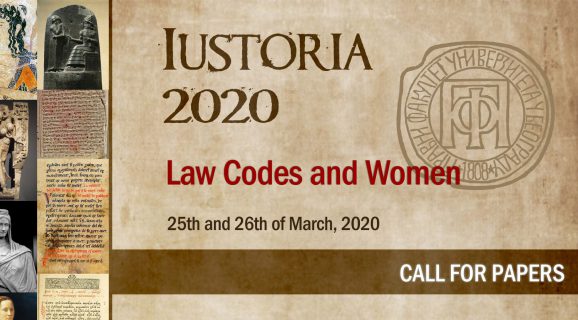
CALL FOR PAPERS: First Student Conference on Legal History Iustoria 2020 (Belgrade, 25-26 March 2020) (DEADLINE: 15 January 2020)


We learned that the University of Belgrade Faculty of Law is receiving paper proposal for its first student conference on legal history. Here the call:

The University of Belgrade Faculty of Law is now receiving paper proposals for the First student conference on legal history – the Iustoria 2020, to be held on the 25th and 26th of March, 2020, its topic being “Law Codes and Women”.

The choice of this subject stems from an anniversary – this year marks the 175th anniversary of the Serbian Civil Code (1844), and one of the most heavily debated issues during its creation was precisely the regulation of the position of women: a woman’s right to inherit, her role in the family, the legal capacity of a married woman… Without a doubt, dilemmas such as these were present in the minds of other creators of civil codes pertaining to the 19th and the beginning of the 20th century – however, this is but a small portion of the issues that fall under the realm of this conference. What was the status of women as perpetrators – or victims – of crimes in criminal codes? What was the procedural status of women as parties in lawsuits or as witnesses? Did commercial codes contain special rules for women merchants? When we move further into the past, the very presence of norms that are concerned with the status of women in the legal codes of the Antiquity and the Middle Ages tells us a lot about their position in society, and many laws contain specific and original institutions that deserve scholarly attention. In recent history we could divert our attention to women as lawmakers, and analyse their influence on modern codes of law. We are looking forward to proposals related to these and many other issues pertaining to the main subject!

All students of graduate and post-graduate studies pertaining to law or other humanities are eligible to apply for the conference. The applications should contain basic personal information (name and surname, faculty, department, level and year of study), along with an abstract containing anywhere between 500 and 1000 words.

The applications should be e-mailed to iustoria@ius.bg.ac.rs before the 15th of January, 2020. The students will be informed by the 25th of January whether or not their application has been accepted. A provisional programme for the conference will be announced by the 1st of February. Drafts of the chosen papers need to be sent by the 15th of March. For any additional information you may enquire at the same e-mail address, or consult the official Facebook page of the conference – https://www.facebook.com/iustoria

Apart from the presentations given by their colleagues, the students at the conference will have an opportunity to attend several lectures given by renowned experts – more details on this will be available in the final version of the programme.

As a general rule, the participants who do not reside in Belgrade are expected to cover the travelling and accomodation expenses by themselves. Exceptionally, there is a possibility of securing accomodations either at the student dorms or with student host families for those students who are unable to finance their stay at Belgrade. These arrangements will depend on the number of available spots.

The final versions of the papers presented at the conference, with final changes and corrections submitted within a reasonable time after the conference, will be published in the first issue of the future student journal for legal history!

More info here

03 July 2019

BOOK: Gregory J. DURSTON, Crimen Exceptum: The English Witch Prosecution in Context. (Sherfield on Loddon: Waterside Press, 2019). ISBN 9781909976658, £22.50


(Source: Waterside Press)

Waterside Press has published a new book on witch prosecutions in early modern England.

ABOUT THE BOOK

As the author notes, ‘The early-modern European witch-hunts were neither orchestrated massacres nor spontaneous pogroms. Alleged witches were not rounded up at night and summarily killed extra-judicially or lynched as the victims of mob justice. They were executed after trial and conviction with full legal process’.

In this concise but highly-informed account of the persecution of witches Gregory Durston demonstrates what a largely ordered process was the singling-out or hunting-down of perceived offenders. How a mix of superstition, fear, belief and ready explanations for ailments, misfortune or disasters caused law, politics and religion to indulge in criminalisation and the appearance of justice. Bearing echoes of modern-day ‘othering’ and marginalisation of outsiders he shows how witchcraft became akin to treason (with its special rules), how evidentially speaking storms, sickness or coincidence might be attributed to conjuring, magic, curses and spells. All this reinforced by examples and detailed references to the law and practice through which a desired outcome was achieved.

In another resonance with modern times, the author shows how decisions were often diverted into the hands of witch-hunters, witch-finders (including self-appointed Witchfinder General, Matthew Hopkins), witch-prickers and other experts as well as the quaintly titled ‘cunning-folk’ consulted by prosecutors and ‘victims’. 

Crimen Exceptum (crimes apart). A straightforward and authoritative guide. Shows the rise and fall of prosecutions. Backed by a wealth of learning and research. 

ABOUT THE AUTHOR

Gregory J Durston is a barrister-at-law who has taught in law schools in England and Japan. He was for many years Reader in Law at Kingston University, Surrey and is currently an adjunct professor at Southern Cross University School of Law and Justice, New South Wales, Australia. He is the author of 
Fields, Fens and Felonies and Whores and Highwaymen (both Waterside Press).

More info here

26 June 2019

BOOK: Lindsay R. MOORE, Women before the court Law and patriarchy in the Anglo-American world, 1600–1800 (Manchester: Manchester University Press, 2019). ISBN 978-1-5261-3633-6, £80.00


Manchester University Press has published a book on women’s legal rights in the Anglo-American world during the period 1600-1800.

ABOUT THE BOOK

This book offers an innovative, comparative approach to the study of women's legal rights during a formative period of Anglo-American history. It traces how colonists transplanted English legal institutions to America, examines the remarkable depth of women's legal knowledge and shows how the law increasingly undermined patriarchal relationships between parents and children, masters and servants, husbands and wives. The book will be of interest to scholars of Britain and colonial America, and to laypeople interested in how women in the past navigated and negotiated the structures of authority that governed them. It is packed with fascinating stories that women related to the courts in cases ranging from murder and abuse to debt and estate litigation. Ultimately, it makes a remarkable contribution to our understandings of law, power and gender in the early modern world.

ABOUT THE AUTHOR

Lindsay R. Moore teaches European and World History at University of Missouri-Kansas City

TABLE OF CONTENTS

Introduction: 'When Women goe to Law, the Devill is full of Businesse'
Part I
1 The varieties of Anglo-American law: property, patriarchy, and women's legal status in England and America
2 Women as plaintiffs and defendants: the common law, equity, and ecclesiastical jurisdictions
Part II
3 Masters and mistresses, servants and slaves: patriarchy and subordinate agency in the household
4 Wives and (unwed) mothers: women's claims for financial support
5 Inheritance and family feuds: the legal power of elite women
Part III
6 Economic expansion and the erosion of patriarchy
Index

More info here

02 August 2018

CALL FOR PAPERS: Suffrage at 100: Women and American Politics Since 1920 (DEADLINE 15 SEPTEMBER 2018)


(Source: The Guardian)

Via H-Announce, we learned of a call for papers on “Suffrage at 100” (the 100th anniversary of the 19th Amendment is in 2020). Here the call:

As the 100th anniversary of the Nineteenth Amendment approaches, women are seemingly at a crossroads in American politics. They appear to be gaining traction in this traditionally masculine realm, but are still far behind.  Women continue to grapple with the disappointment that gender parity in politics did not easily follow the right to vote.

Will this trend change in the twenty-first century? Many journalists and political pundits anticipate a “pink wave” in 2018 midterm elections. More women candidates have come forward than in any other period on record, spurred in part by the historic Women’s March in 2017 and mobilization around #blacklivesmatter, #metoo, and #timesup, the latter with its own legal defense fund. In all this expectant fervor, Debbie Walsh, director of the Center for American Women and Politics, has cautioned, “We are not going to see, in one cycle, an end to the underrepresentation of women in American politics that we’ve seen for 250 years. . . . This is a marathon, not a sprint.”

This collection will map out the last 100 years of this lengthy struggle, focusing on efforts to recognize, appreciate, and cultivate women’s civic engagement since the ratification of the Nineteenth Amendment.  Our purpose is not celebratory.  Instead, we seek to trace the uneven road to suffrage and public office women of different backgrounds and means experienced after 1920.  We also intend to expose the institutional barriers and masculinist conceptions of leadership that women in politics have faced and continue to tackle.  Women have exhibited considerable democratic imagination within and outside the traditional channels of electoral politics.  Melding gender, social, cultural, and political history, this collection seeks to capture examples of women acting together and on their own within and outside electoral and governmental channels to claim a political presence, enlist state action, and create alternative services and solutions.  In doing so, we use this historic centennial to make visible the determined presence of women in politics since 1920, while also calling attention to the ways these women have and continue to be written out of history.

Collection Structure and Themes
We welcome new articles (8,000 to 10,000 words including notes) broadly addressing women and American politics since 1920.  We also welcome related historiographic essays and interpretive analysis accompanying relevant primary source document(s).  We hope to fully cover 1920-2020, dividing the collection into themes. Below are some questions that potential contributors might consider.

Women at the Ballot Box
How has the achievement of women’s suffrage and full expression of political citizenship proved elusive for different groups of women since 1920?
In what ways have women tried to build on the Nineteenth Amendment?  When have these efforts been successful, partial victories or failures, and why?
What have been the limitations and advantages of thinking about a “women’s voting bloc” for activists and for historians?
How has gender factored into party realignment from 1920 forward?  What is the history and usefulness of the “gender gap” concept, and its relation to voting patterns based on race, class, sexuality, religion, ideology, and region?
How has racial gerrymandering impacted women?  Is there such thing as “gender gerrymandering”?
Women Who Run
What paths to electoral politics have women taken or chosen not to travel?  And what does this tell us about the structure and function of U.S. democracy?
What can we learn from women candidates not only who have won, but who have lost elections?
Have gender and other intersectional forms of oppression (e.g., race, class, sexuality) acted as barriers to entry for women in politics? What solutions, if any, have female candidates divined as a result?
What tactics have women used to navigate party patronage systems, develop campaign financing, and build a constituent base?  Have women used grassroots or party channels most?
How have organizations such as the National Women’s Political Caucus, Emily’s List, or the Concerned Women for America developed over time?  Have these groups been effective?
Women Who Lead
Does proportional representation in U.S. legislatures matter?
What reformist strategies have women leaders pursued to change the culture and structure of governance?
How do women function as power brokers?  How should we assess the disempowering actions women with and in pursuit of political power take impacting other individuals? 
How has the cultural representation of women in politics changed over time?  Is there an enduring male leadership mystique in U.S. society?
Do women lead differently?  Are “women’s issues” all issues?  What are the costs and benefits of women legislators caucusing together?
Women Redefining Politics
In what ways have women creatively imagined and shaped their place in politics?
How have women purposefully resisted or reshaped the gendered (or other) parameters of civic engagement and governance?  How have they actively defined their political identities or created alternative governance systems?
What are the advantages and costs of engaging in politics using the mantle of “women’s issues” or maternalism?  What intersectional approaches to issues and organizing have women in politics used?
What is the relationship between women’s domestic and global engagement in politics?  How have women navigated multiple political arenas at once? 
Women in Political History
Should women’s political history complicate the usual conceptualization of “political time” centered on presidential politics and divided by election cycles?
What might political history look like if gender was at the center instead of the periphery?
How might we evaluate women’s political citizenship through an intersectional lens?
The Nineteenth Amendment as a Milestone
What place has the Nineteenth Amendment had in the national story of the United States since its passage?
Is the passage of the Nineteenth Amendment relevant as a political milestone for any group other than white, cisgender, middle-class and elite women?
How has the achievement of the Nineteenth Amendment been memorialized and debated through monuments and exhibits?
How have activists and politicians referenced the Nineteenth Amendment as a tool to forward their agendas and actions?

Collection Production Timeline
We believe this will be the only collection marking the suffrage centennial from the angle of 1920-forward. We expect the production timeline for this collection will be swift if we are to publish by August 2020.

Please send article abstracts of 500 words and a CV by September 15, 2018 to: Stacie at staranto@ramapo.edu or Leandra at lrzarnow@central.uh.edu.  We also welcome questions and comments at those email addresses.

Applicants will be notified by November 1, 2018.  The due date for polished drafts will be May 1, 2019.

We hope you will consider contributing to this exciting collection!

Contact Info:
Please send article abstracts of 500 words and a CV by September 15, 2018 to: Stacie at staranto@ramapo.edu or Leandra at lrzarnow@central.uh.edu.  We also welcome questions and comments at those email addresses.

Contact Email:
staranto@ramapo.edu

09 May 2016

BOOK: "Legal Codes and Talking Trees. Indigenous Women’s Sovereignty in the Sonoran and Puget Sound Borderlands, 1854-1946" by Katrina Jagodinsky (2016)


Legal Codes and Talking Trees. Indigenous Women’s Sovereignty in the Sonoran and Puget Sound Borderlands, 1854-1946, by Katrina Jagodinsky

all information here


Katrina Jagodinsky’s enlightening history is the first to focus on indigenous women of the Southwest and Pacific Northwest and the ways they dealt with the challenges posed by the existing legal regimes of the nineteenth and twentieth centuries. In most western states, it was difficult if not impossible for Native women to inherit property, raise mixed-race children, or take legal action in the event of rape or abuse. Through the experiences of six indigenous women who fought for personal autonomy and the rights of their tribes, Jagodinsky explores a long yet generally unacknowledged tradition of active critique of the U.S. legal system by female Native Americans.
Katrina Jagodinsky is assistant professor of history at the University of Nebraska and a former fellow of the Clements Center for Southwest Studies at SMU. She lives in Lincoln, NE.

17 November 2014

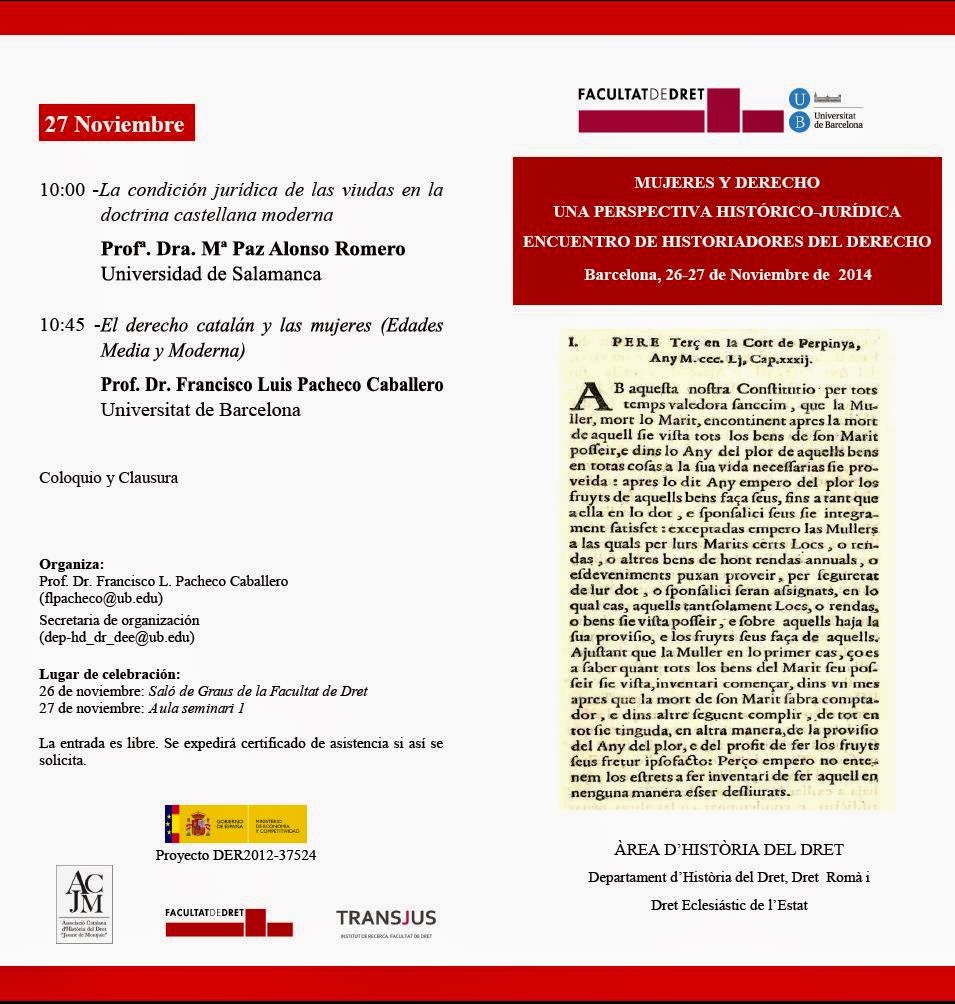
CONFERENCE: "Law and Women: a legal historical perspective" (Barcelona, 26/27 November 2014)


WHAT:"Mujeres y derecho: una perspectiva historico-juridica", Conference

WHERE: Barcelona University, Law Faculty, 26 November,Saló de Graus de la Facultat de Dret
27 November: Aula seminari 1

WHEN: 26/27 November 2014

Prof. Dr. Francisco L. Pacheco Caballero(flpacheco@ub.edu)

06 October 2014

CFP: "Woman, politics and institutions"


Book on the subject: "Woman, politics and istitutions"

Deadline 30 november 2014 

All essays will be submitted to the procedure refereed according to the system of peer review

All information here (section "Notizie")

01 October 2014

BOOK: "Women in Law and Lawmaking in Nineteenth and Twentieth-Century Europe", edited by Eva Schandevyl


Women in Law and Lawmaking in Nineteenth and Twentieth-Century Europe

edited by Eva Schandevyl, Vrije Universiteit Brussel, Belgium

All information here

Exploring the relationship between gender and law in Europe from the nineteenth century to present, this collection examines the recent feminisation of justice, its historical beginnings and the impact of gendered constructions on jurisprudence. It looks at what influenced the breakthrough of women in the judicial world and what gender factors determine the position of women at the various levels of the legal system.

Every chapter in this book addresses these issues either from the point of view of women's legal history, or from that of gendered legal cultures. With contributions from scholars with expertise in the major regions of Europe, this book demonstrates a commitment to a methodological framework that is sensitive to the intersection of gender theory, legal studies and public policy, and that is based on historical methodologies. As such the collection offers a valuable contribution both to women's history research, and the wider development of European legal history.


Eva Schandevyl is Assistant Professor of modern history at the Vrije Universiteit Brussel, Belgium. She is the editor of ‘In haar recht? Vrouwe Justitia feministisch bekeken’ (VUB Press, 2009) and author of ‘Tussen revolutie en conformisme. Het engagement en de netwerken van linkse intellectuelen in België 1918-1956’ (VUB Press, 2011). Her articles on the history of law and gender, social and intellectual history, and migration have appeared in ‘European Review of History’, ‘National Identities and Revue Belge de Philologie et d’Histoire’. She is presently working on a comparative project that examines the feminisation of justice in the twentieth century.