Search

Showing posts with label Hammurabi. Show all posts

16 November 2020

BOOK: Pamela BARMASH, The Laws of Hammurabi: At the Confluence of Royal and Scribal Traditions (Oxford: Oxford University Press, 2020). ISBN 9780197525401, 99.00 USD


(Source: OUP)

Oxford University Press is publishing a new book on the laws of Hammurabi.

ABOUT THE BOOK

Among the best-known and most esteemed people known from antiquity is the Babylonian king Hammurabi. His fame and reputation are due to the collection of laws written under his patronage. This book offers an innovative interpretation of the Laws of Hammurabi.

Ancient scribes would demonstrate their legal flair by composing statutes on a set of traditional cases, articulating what they deemed just and fair. The scribe of the Laws of Hammurabi advanced beyond earlier scribes in composing statutes that manifest systematization and implicit legal principles, and inserted the Laws of Hammurabi into the form of a royal inscription, shrewdly reshaping the genre. This tradition of scribal improvisation on a set of traditional cases continued outside of Mesopotamia. It influenced biblical law and the law of the Hittite empire significantly. The Laws of Hammurabi was also witness to the start of another stream of intellectual tradition. It became the subject of formal commentaries, marking a profound cultural shift. Scribes related to it in ways that diverged from prior attitudes; it became an object of study and of commentary, a genre that names itself as dependent on another text. The famous Laws of Hammurabi is here given the extensive attention it continues to merit.

ABOUT THE AUTHOR

Pamela Barmash teaches at Washington University in St. Louis and has served as director of Jewish, Islamic, and Near Eastern Studies there. She is the author of Homicide in the Biblical World, the co-editor of Exodus in the Jewish Experience: Echoes and Reverberations, and the editor of The Oxford Handbook of Biblical Law.

TABLE OF CONTENTS

Introduction

Chapter One: The Stela of the Laws of Hammurapi and the Representation of Political Power

Chapter Two: Royal Legitimization Through the Establishment of Justice

Chapter Three: The Laws of Hammurabi as a Royal Inscription

Chapter Four: Scribes and Statutes

Excursus: Scribes and Scribal Education

Chapter Five: Adoption in the Laws of Hammurabi

Chapter Six: The Legal Authority of the Laws of Hammurabi

Chapter Seven: The Afterlife of the Laws of Hammurabi: The Continuation of Scribal

Improvisation Outside of Mesopotamia and the Creation of Commentaries in

Mesopotamia

Conclusion

Acknowledgments

List of Abbreviations

List of Illustrations

Bibliography


More info here

12 June 2019

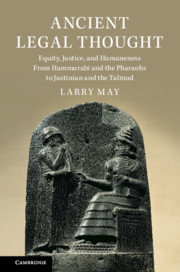
BOOK: Larry MAY, Ancient Legal Thought : Equality, Justice, and Humaneness from Hammurabi and the Pharaohs to Justinian and the Talmud (Cambridge: Cambridge University Press, 2019). ISBN 9781108484107, £110.00


(Source: CUP)

Cambridge University Press has published a new book on legality and the role of law in ancient societies.

ABOUT THE BOOK

This is a study of what constituted legality and the role of law in ancient societies. Investigating and comparing legal codes and legal thinking of the ancient societies of Mesopotamia, Egypt, Greece, India, the Roman Republic, the Roman Empire and of the ancient Rabbis, this volume examines how people used law to create stable societies. Starting with Hammurabi's Code, this volume also analyzes the law of the pharaohs and the codes of the ancient rabbis and of the Roman Emperor Justinian. Focusing on the key concepts of justice equity and humaneness, the status of women and slaves, and the idea of criminality and of war and peace; no other book attempts to examine such diverse legal systems and legal thinking from the ancient world.

ABOUT THE AUTHOR

Larry MayVanderbilt University, Tennessee

Larry May is Professor of Philosophy and Law, Emeritus at Vanderbilt University, Tennessee. He has published thirty-seven books, including Limiting Leviathan: Hobbes on Law and International Affairs (2013), Proportionality in International Law, with Michael Newton, (2014), Contingent Pacifism (Cambridge, 2015), Necessity in International Law, with Jens Ohlin (2016), International Criminal Tribunals, with Shannon Fyfe (Cambridge, 2017), and is editor of The Cambridge Handbook of the Just War (Cambridge, 2017). His books have won awards in law, philosophy, and political science and he has advised the US State Department, the CIA, the NIH, and the International Committee of the Red Cross.

TABLE OF CONTENTS

Part I. Mesopotamia and Egypt: Section 1. Ancient Procedural Law:
1. Ancient legal reasoning
2. Judging, trials, and assemblies
3. Oaths, ordeals, and truth
Section 2. Freedom, Equality, and Legal Status:
4. Debt forgiveness and equity
5. Freedom and slavery
6. Class, legal status, and equality
7. Women's separate sphere
Section 3. Crime and Punishment:
8. Complicity and conspiracy
9. Crime and Lex Talionis
10. Capital punishment
Section 4. International Justice:
11. Ancient treaties and trust
12. Aggressive war and necessity
Part II. Greece and China: Section 5. Law, Justice and Equity:
13. Custom and law in Ancient Greece and China
14. Justice and equity
15. Trial, juries, and democratic assemblies
Section 6. Legal Status:
16. Citizens and aliens
17. Women
18. Slavery and democracy
Section 7. Responsibility and Punishment:
19. Causation and responsibility
20. Homicide and pollution
21. Justification, excuse, and mitigation
22. Hubris and impiety
Section 8. War and Amnesty:
23. Amnesty, sanctuary, and exile
24. Justified war and the law of nations
Part III. India and the Roman Republic: Section 9. Law, Justice and Equity:
25. Law and its sources in Ancient Roman and Indian law
26. Legal procedures and trials
27. Equity and justice
Section 10. Legal Status and Social Class:
28. Legal status of women
29. Social class and slavery
Section 11. Responsibility and Punishment:
30. Political and moral crimes
31. Punishment, cruelty, and humaneness
32. Crimes concerning legal and political abuse
Section 12. War and Treaties:
33. Treaties, hostages, and keeping faith
34. The rules of war and the law of peoples
Part IV. Rabbinic Law and the Roman Empire: Section 13. Justice, Equity, and Conflict of Laws:
35. Law, morality, and religion
36. Dual legal regimes
37. The law and ancient legal scholars
Section 14. Differential Status:
38. Women in Jewish and Roman thought
39. Slaves in Jewish and Roman legal thought
Section 15. Responsibility:
40. Intention and causation in criminal law
41. Injury and murder
42. Public punishment, penal prisons, and police
Section 16. Universal Law at the End of Ancient Times:
43. Universal law and human rights
44. The origins of the just war doctrine
45. Final thoughts on equity, justice, and humaneness.

More information here