Search

11 January 2019

JOURNAL: Giornale di Storia Costituzionale 36 (2018/II): Constitutional History and Historiography in Italy: key-elements and new trends. For the 70 years of the Italian Constitution


  • Introduction: The memory of the constitution and the value of constitutional history (Luigi Lacchè)
  • The Constitution’s “Workshop of ideas” (Sabino Cassese)
    Abstract:
What is behind the Republican Constitution? The members of the Constituent Assembly were not entirely aware of what they were creating. The heterogeneous character of the Constitutional Charter and the oscillation of judgments on the subject imply the necessity of a research on the history of the culture of the Constitution. Should we believe that the Constitution was the result of contingent events, of the “Resistenza” to fascism, substantially a reaction to the previous regime? or alternatively was it the result of a legacy, even fascist, statalism? More generally, what were the strands of ideas that contributed to the formulation of constitutional precepts? The text indicates some “paths” on which work to answer these questions.
  • From the Eighteen century to Unification: the Italians and the discovery of constitution (Luca Mannori)
    Abstract:
The contribution sums up the recent evolution of the historical research about the concept of Constitution during the period of Risorgimento. The most significant innovation of the last decades has been the definitive abandoning of a teleological view of the nation building process. The struggle for the constitution fought by the Italian élites during the first half of XIXth century is not assumed anymore as the consequence of a generic tendency to the modernization, but as the effect of many specific phenomena, whose internal dynamics the historians are called upon to investigate and to connect. Up to the end of the XVIIIth century, the Italian political culture didn’t conceive the State as a general community, but as a mere political aggregate of intermediate bodies: so that, the idea of a political ‘Constitution’ of the commonwealth was completely outside the common experience both of the people and the ruling classes. This concept was progressively discovered during the first half of XIXth century; and the article offers a survey of the recent interpretations of this intriguing process
  • Between fiction and reality (Reflections on historiographical trends from 1866 to nowadays) (Romano Ferrari Zumbini)
  • Abstract
The article questions some long-standing and widely circulated interpretative trends in Italian legal and institutional historiography dealing with the birth and evolution of modern constitutionalism before and after the unification, focusing on the first years of the Albertine statute. Many entrenched assumptions are found to be based on a narrow set of early accounts characterised by a non-neutral and sometimes deliberately inaccurate portrayal of events. These results emerge from a factual comparison with findings from first-hand sources, often inexplicably disregarded (even though promptly available, as is the case with parliamentary records).
  • An accepted challenge: monarchy as subject of study of Constitutional history (Paolo Colombo)
    Abstract
Paolo Colombo’s essay retraces the evolution of the Italian constitutional history in the last two decades from the point of view of the studies on constitutional monarchies, especially the Italian one. The subject of this research activity is seen as a challenge that, starting from the end of the Nineties (of the last century), encourages some scholars of history of political institutions to renovate the methods of analysis and the criteria for identifying the sources. Thus, several important lines of interpretation on the political and institutional DNA of our country have been renovated. It is also in this way that the constitutional history carves out a space for herself, consciously and measuredly autonomous from that of administrative history, which marked the first decades of the Italian history of political institutions. Therefore, the essay brings the future research prospects and the new challenges waiting for the constitutional history (and, in general, for the history of the institutions) to light, both from a strictly scientific point of view and from that of the role to play and the goals to pursue in the broader framework of the Italian cultural life.
  • The monarchy in the constitutional history of the long nineteenth century: Italy, Germany, Austria (Anna Gianna Manca)
    Abstract
Object of the essay is a summary reflection on the monarchical institution in the long nineteenth century based on the acquisitions of the most recent Italian constitutional historiography but with an eye to the constitutional historiographies of Germany and Austria. The aim is to collect and highlight correspondences, referrals, parallels, synchronies, common features, which are both real and outlining trends, both structural and functional, both static and dynamic, between the historical events of the Italian constitutional monarchy and the aforementioned foreign monarchical- constitutional experiences.
  • Work, democracy and new forms of citizenship: work- ers participation in a historical perspective (Leonardo Pompeo d'Alessandro)
    Abstract
From the first ideas on the establishment of a “constitutional regime” in the factory to the most recent reform of company law, the issue of worker participation in the control or management of companies has transversely covered the whole of the Twentieth century and the comparison on the different ways of its realization did not fail with the start of the new century. The essay reviews some of the different phases into which this comparison is structured in Italy and focuses on some periodizing nodes: the First World War, the Constituent period and the Seventies. The debate among the members of Constituent Assembly assumes a particular centrality at a time when the theme is reformulated in relation to the connection work-citizenship and to the birth of the newly defined concept of the “working citizen”. The decision to recognize the importance of the topic by enclosing it in a Constitution article (46 art.) made it possible to keep the debate alive and to reformulate the issue adapting it to the changes occurred in society, despite the breaking of the constituent compromise in the Seventies and the affirmation of a new relationship between capital and labor as a result of the loss of centrality of the large factory.
Itinerari
  • Italian constitutionalists and the Resistenza (Giuseppe Filippetta)
    Abstract
Most of the Italian constitutionalists were not interested in the Resistance movement or they told it only as the Resistance of the anti-fascist parties, forgetting the fundamental and spontaneous role of Italian individuals and partisan formations. This happened because the thought of the Italian constitutionalists is characterized by an anti-individualism and anti-pluralism, inherited from the liberal-authoritarian legal thought and from the fascist one, that don’t allow them to think the single individual as a sovereign subject and direct protagonist of the juridical and political life.
  • Constitution and Time. Regimes of Historicity of a legal-political Project (Mauriczio Cau)
    Abstract
Historical research does not seem to have sufficiently reflected on the plurality of the temporal horizons that define the “being in the time” of a Constitution. The contribution aims to analyze the “regimes of historicity” of the Republican Constitution (how it has related to time and how time  has shaped its forms), using in particular the category of “transition”, which has recently captured the interest of some historians. The focus is on the “founding era”, therefore on the beginning of the Republican project. Through the use of the category of transition some characteristics are re- discussed, in particular the coexistence of continuity profiles which, even in a context of strong discontinuity with the past, mark the start of the new constitutional order. The presence of concurrent temporal horizons suggests that the traditional chronology relating to the founding era should be partially revised, blurring the contours.
  • A «Justice with new robe»? Judiciary and 1948 Constitution (Antonella Meniconi)
    Abstract
Prepared by a debate of about two years, especially among the insiders (magistrates and pol- iticians experts in law), the new Constitution of 1948 guaranteed autonomy and independence to the Judiciary. On the issues of justice, a compromise between the different political forces was re- alized, as in general, but the role of jurists such as Piero Calamandrei was decisive in establishing the new constitutional principles for the protection of judicial power. Nevertheless, the transition was a slow and fought process. Many years will be indeed necessary still for the independence of the magistrates to be fully established and the judiciary be freed from the hierarchical constraints that had previously dominated it even in the exercise of jurisdiction.
  • Texts and contexts of the mercy’s power (1848-2018) … to be continued (Monica Stronati)
  • Abstract
This contribution deals with the mercy’s power (Article 87 of the Italian Constitution). The judgement of the Constitutional Court (No. 200, 2006) has changed by way of interpretation a constitutional custom dating back to the time of the Albertine Statute. The decision of the Court has attributed exclusively to the Head of State the right to exercise this power, thus removing any political responsibility from the act, and has made this institution solely devoted to humanitarian purposes, thus denying the political and multi-functional nature of the act of granting pardon. The marginality of the institution has not caused a change in the form of Government, however it has brought to light a series of issues and problems connected to the relationship between powers, particularly to the role and function of the Head of State, its relationship with the executive power, and the relationship between executive and judicial power.
  • Constitution and Administration (Guido Melis)
    Abstract
In the Italian Constitution only two articles, 97 and 98, are explicitly about Public Administration. Even if this subject appears indirectly in some other points of the text, but in general the constituents gave few attention to this issue. The members of the assembly did not have any experiences, or studies, about the world and culture of public office. Even the political parties were outside this topic. The debate about Public Administration went on with lack of participation and modest follow ups. All the profitable work made by the two Fortis committees (by the second in particular) had been ignored in anticipation of the Constitution. Massimo Severo Giannini, who tried to introduce the consciousness of all the great transformations during the thirties in public authorities field, hadn’t been elected in Assembly. Even if he was chief of staff at the Ministry for constituent Assembly his contribution remained the only one. From the point of view of the attention to the administrative state, to new public agencies, to the imprenditorial state, the Constitution was born already old.
  • The Costituente on the radio: Teaching Democracy in the Italian media to the dawn of the Republic (1945-1946) (Giacomo Demarchi)
    Abstract
The paper aims to offer a first reconstruction of the role that the mass media had in spreading the new democratic values in the early post-war years. With this purpose, we study the productions of the Ministero per la Costituente addressed to the mainstream citizens and the relationship between the state radio-cinematographic institutions and the high legal culture. We have focused the investigation on publications and archival sources of the Ministero per la Costituente, the digital archives of Teche RAI and the Istituto Luce, as well we use some personal archives, such as the Umberto Calosso archive.
  • Processes of constitutional enforcement and periodizing of the Republic (Cesare Pinelli)
    Abstract
In the Italian legal and political environment, enforcement of the 1948 Constitution has always raised the greatest attention, due both to the changes, which the very approval of the constitutional text had promised and to the deep divide that characterized the political system in the decades following its entry into force. After having premised that, according to a widely shared scholarly opinion, the Constitution enforcement has been accomplished at the end of the 1970s, the Author observes that such opinion obliterates significant findings, and proposes a more complex reconstruction of the Constitution enforcement that takes into account of the legal developments no less than of the political changes that have affected the country.
  • A review of the studies on the Italian Parliament between an ever- changing electoral legislation and a static form of government (Nicola Lupo)
    Abstract

    The contribution offers a review of the studies, of constitutional law and political science, devoted to the Italian Parliament and to the electoral legislation in the last 30 years, focussing mainly on monographs. The attempts, recurring but unfruitful, to revise the Constitutional provisions on the form of government, as well as the very frequent changes of the electoral law brought to a substantial stalemate of the reforms and updates of the rules of procedures of the Chamber and Senate. Furthermore, they discouraged a full development of parliamentary studies, especially preventing the completion of organic treaties of parliamentary law and practice. Concerning electoral legislations, the recent and incisive judgements of the Constitutional Court are stimulating a growth of the constitutional law studies on the features of electoral systems.
  • Sovereignty: re- turn to the past? (Giovanni Di Cosimo)
    Abstract
The essay analyzes the latest developments in sovereignty that seem to configure a return to previous conceptions. To this end, it traces the evolution of the concept from the liberal age, and comes up to the recent emergence of the sovereign conception.

Virtute et conoscenza
  • The cultural identity of the “Constitutional History”. Reflections on the last 25 years of scientific production (Marco Fioravanti)
    Abstract
Academic teaching and research on the subject of Constitutional History up to the end of the 1980s was almost absent and the production of handbooks in this direction was little more crowded. However, in the last 25 years, the picture has strongly changed and a scientific and cultural profile of Constitutional History has progressively been affirmed, not easily referable, however, to a precise disciplinary space. In this article, I will limit myself to offer a fresco, necessarily incomplete, of the most important handbooks and essays in the field of the History of the Constitutions, Constitutional History, History of Public Law and History of Institutions, leaving aside the distinctions of scientific- disciplinary sectors, inappropriate to identify the cultural identity of Constitutional History.

Ricerce
  • Occultus propter metum. Esotericism and exoterism in the thought of Carl Schmitt about the State (1938-1948) (Carlo Pontorieri)
    Abstract
Through a survey of the writings of Carl Schmitt between 1938 and the post-war period, the author identifies a line of self-interpretation of the complex intellectual and political biography of the jurist from Plettenberg, which feeds on traces, implicit quotations and allusions to the reader. The essay on Thomas Hobbes in 1938 thus becomes the sign of a turning point in the relationship between Schmitt and the Nazi regime, as evidenced by the diaries of the writer Ernst Jünger. In addition, it shows a peculiarity of Schmitt’s writings, a double reading level that can be found as well in the post- war years.
  • A weak State? The relationship between public and private in the United States of America. A his- torical-institutional perspective (Lorenzo Castellani)
    Abstract
The article analyses the recent historiographical debate ongoing in the United States of America on the weakness of the American state. For classical historiography the United States are considered as a statelessness society. Most of the most recent studies on the American institutions are contesting the idea of weak State advocated by the classical historiography of the twentieth century. Considered this debate, the second part of the article focuses on the public-private governance in historical terms. It analyses the relationships of public-private governance through history and it shows cooperation between private and public institutions and the powerful penetration of the State within the American society.
  • A great administrator for a Great Society: the presiden- tial reorganization authority under Lyndon B. Johnson (Cristina Bon/Gauco Vecchiato)
    Abstract
Through the historical analysis of the Presidential reorganization authority, this essay aims at showing how, far from being unequivocally sculpted in the American Constitution, the Chief Executive decision-making power has changed over time, especially during the 20 th Century. On this respect, while on the one hand the presidential reorganization authority has certainly represented a useful tool for granting to any President’s political program a successful outcome, on the other hand this authority can be only granted by the Congress, which recognized the reorganization power to the President only in the time span going from 1932 to 1984. At the same time, this historical grant of authority has also been responsible for the increased public perception of a wide decision- making ability conferred by the US Constitution to the President. A case to the point is represented by Lyndon B. Johnson’s Presidency, which made an extensive use of the reorganization authority granted by the Congress and took advantage of this power to realize one of the most significant efforts made by an American President to adapt the federal administration to the changing needs of the American society.

Librido
  • Antonino Scalone reads Carl Schmitt, Legalità et legalità
  • Thirteen reading proposals
(read more here)

BOOK: John SNAPE and Dominic DE COGAN, eds., Landmark Cases in Revenue Law (Oxford: Hart Publishing, 2019). ISBN 9781509912261, £85.00


(Source: Hart Publishing)


Hart Publishing is publishing a book on landmark cases in UK revenue law.

ABOUT THE BOOK

In an important addition to the series, this book tells the story of 20 leading revenue law cases. It goes well beyond technical analysis to explore questions of philosophical depth, historical context and constitutional significance. The editors have assembled a stellar team of tax scholars, including historians as well as lawyers, practitioners as well as academics, to provide a wide range of fresh perspectives on familiar and unfamiliar decisions. The whole collection is prefaced by the editors' extended introduction on the peculiar significance of case-law in revenue matters. This publication is a thought provoking and engaging showcase of tax writing that is accessible equally to specialists and non-specialists.

ABOUT THE EDITORS

John Snape is an Associate Professor of Law at the University of Warwick.
Dominic de Cogan is University Lecturer in Tax Law in the Law Faculty in the University of Cambridge.

TABLE OF CONTENTS

Introduction: On the Significance of Revenue Cases 
John Snape and Dominic de Cogan
1. Case of Ship-Money (R v Hampden) (1637): Prerogatival Discretion in Emergency Conditions 
Michael J Braddick
2. Farmer v Glyn-Jones (1903): The Perils of Revenue Practice 
Chantal Stebbings
3. De Beers Consolidated Mines Ltd v Howe (1906): Corporate Residence: An Early Attempt at European Harmonisation 
John Avery Jones and Johann Hattingh
4. Thomas Gibson Bowles v Bank of England (1913): A Modern John Hampden? 
Martin Daunton
5. Great Western Railway Co v Bater (1922): A Question of Classification 
John HN Pearce
6. The Archer-Shee Cases (1927): Trusts, Transparency and Source 
Malcolm Gammie
7. Commissioners of Inland Revenue v Crossman (1936): Keeping it in the Family 
Ann Mumford
8. Edwards v Bairstow and Harrison (1955): Fact Finding and the Power of the Courts 
Anne Fairpo
9. Odeon Associated Theatres Ltd v Jones (HM Inspector of Taxes) (1971): A Delphic Pronouncement and a Fundamental Tension 
Judith Freedman
10. WT Ramsay v Commissioners of Inland Revenue (1981): Ancient Values, Modern Problems 
John Snape
11. CIR v National Federation of Self-Employed and Small Businesses (1981): All Grievances Converging on Tax Law 
Dominic de Cogan
12. Conservative and Unionist Central Office v Burrell (1981): A Case of Hidden Significance 
Victor Baker
13. Mallalieu v Drummond (1983): Allowable Deductions, Inadmissible Arguments 
Geoffrey Morse
14. Zim Properties Ltd v Proctor (1985): Compromise of Action, Compensation and CGT 
David Salter
15. The Commerzbank Litigation (1990): UK Law, Tax Treaty Law and EU Law 
Philip Baker
16. Pepper v Hart and Others (1992): The Case of the Misunderstood Minister 
Philip Ridd
17. R v Secretary of State for Foreign and Commonwealth Affairs, ex parte World Development Movement (1994): Financial Prudence, Interfering Busybodies 
Abimbola A Olowofoyeku
18. Barclays Mercantile Business Finance v Mawson (2004): Living with Uncertainty 
John Vella
19. Cadbury Schweppes and Cadbury Schweppes Overseas (2006): CFC Rules Under EU Tax Law 
Christiana HJI Panayi
20. Jones v Garnett (2007): Legal Form, Legal Problem 
Glen Loutzenhiser

More information here


BOOK: Marc REUTER, Ghettorenten : eine Rechtsmethodische und -Historische Untersuchung zum Umgang mit nationalsozialistischem Unrecht in der Sozialversicherung (Tübingen: Mohr Siebeck, 2019). ISBN 978-3-16-156573-1, €90.00


(Source: Mohr Siebeck)

Mohr Siebeck is publishing a book on Nazi ghetto labour and its relation to social security questions.

ABOUT THE BOOK

War Arbeit, die insbesondere jüdische Verfolgte des Nationalsozialismus in Ghettos während des Zweiten Weltkriegs unter unmenschlichen Bedingungen erbrachten, eine rentenversicherungspflichtige Beschäftigung? Erfolgte sie »freiwillig« im Sinne der bundesrepublikanischen Rentenversicherungsgesetze? Waren Essensrationen »Entgelt«? So widersprüchlich diese Fragen sind, so wichtig waren und sind sie für Überlebende der NS-Verfolgung, die auf eine späte Anerkennung ihrer im Ghetto geleisteten Tätigkeit hoff(t)en. Marc Reuter unterzieht die wechselvolle Rechtsprechung der Sozialgerichte dazu einer kritischen Prüfung. Er zeigt, dass juristische Methodik und rentenversicherungsrechtliche Dogmatik angesichts der Wirklichkeit der Ghettos an ihre Grenzen gelangen und ein im Sozialversicherungsrecht herrschendes Kontinuitätsdenken die Aufarbeitung des NS-Unrechts erschwerte.

ABOUT THE AUTHOR

Marc Reuter Geboren 1987; Ausbildung an der Kölner Journalistenschule für Politik und Wirtschaft e.V.; Studium der Rechtswissenschaften an der Universität zu Köln; 2014 Erstes Staatsexamen; Wissenschaftlicher Mitarbeiter am Institut für Deutsches und Europäisches Arbeits- und Sozialrecht der Universität zu Köln; Juristischer Vorbereitungsdienst am OLG Köln; 2018 Promotion.

More information here

10 January 2019

BOOK: Caroline REGAD, Les juristes de Louis XIII et de Richelieu, théoriciens de l’État (Paris: LGDJ, 2018). ISBN 978-2-275-06185-6, €57.00


(Source: LGDJ)

LGDJ has published a book on the lawyers of Louis XIII and Richelieu.

ABOUT THE BOOK

Mesurer l'absolu : voilà toute la force de la pensée imprimée par les juristes de Louis XIII et de Richelieu à la monarchie, eux qui contribuent de manière significative à la construction de l'État par le droit. Les successeurs des Légistes et des Politiques précisent le fondement, le critère et l'étendue de l'absolu qu'ils se doivent désormais de mesurer. La souveraineté est au coeur du processus : elle est déployée sous la forme d'une véritable arme de combat dans une sorte de théologie politique exposée par les juristes. 

Conscients que dans le cadre de la monarchie mesurée, il faut poser des repères, les juristes du pouvoir fort utilisent le droit de manière instrumentale pour contribuer à l'affermissement du roi et de l'État. Si, a priori, définir, c'est contenir, les juristes se réservent une possibilité d'extension continue des droits, pour peu que la thèse qu'ils défendent l'exige. 

Pour autant, l'histoire du règne de Louis XIII est bien celle du passage des droits du roi à un droit de l'État.

Prix Jean Bodin et second prix de thèse de l'Association des Historiens des Facultés de Droit (2013)

Ouvrage publié grâce au soutien du Centre de Droit et de Politique Comparés (CDPC Jean-Claude Escarras, CNRS, UMR DICE) de l'Université de Toulon

More info here


09 January 2019

BOOK: Gerald LEONARD and Saul CORNELL, The Partisan Republic : Democracy, Exclusion, and the Fall of the Founders’ Constitution, 1780s-1830s [New Histories of American Law] (Cambridge: Cambridge University Press, 2019). ISBN 9781107663893, £ 21.99


(Source: CUP)

Cambridge University Press is publishing a new book on constitutional change in the US’  Founding Era.

ABOUT THE BOOK

The Partisan Republic is the first book to unite a top down and bottom up account of constitutional change in the Founding era. The book focuses on the decline of the Founding generation's elitist vision of the Constitution and the rise of a more 'democratic' vision premised on the exclusion of women and non-whites. It incorporates recent scholarship on topics ranging from judicial review to popular constitutionalism to place judicial initiatives like Marbury vs Madison in a broader, socio-legal context. The book recognizes the role of constitutional outsiders as agents in shaping the law, making figures such as the Whiskey Rebels, Judith Sargent Murray, and James Forten part of a cast of characters that has traditionally been limited to white, male elites such as James Madison, Alexander Hamilton, and John Marshall. Finally, it shows how the 'democratic' political party came to supplant the Supreme Court as the nation's pre-eminent constitutional institution.

ABOUT THE AUTHOR

Gerald Leonard, Boston University
Gerald Leonard is Professor of Law at Boston University School of Law and author of The Invention of Party Politics: Federalism, Popular Sovereignty, and Constitutional Development in Jacksonian Illinois (2002).

Saul Cornell, Fordham University, New York
Saul Cornell is the Paul and Diane Guenther Chair in American History at Fordham University, New York, and author of The Other Founders: Antifederalism and the Dissenting Tradition in America, 1788–1828 (1999) and A Well Regulated Militia: The Founding Fathers and the Origins of Gun Control in America (2006).

TABLE OF CONTENTS

Acknowledgments
Introduction
1. The new constitution
2. The federalist constitution and the limits of constitutional dissent
3. The democracy vs the law: the role of the federal judiciary, 1789–1815
4. The paradoxes of Jeffersonian constitutionalism
5. The white democracy
6. The Marshall Court, the Indian nations, and the democratic ascendancy
Conclusion: the constitutional triumph and failure of the democratic party
Bibliographical essay
Index.

More information here

08 January 2019

PRIZE: 2019 Toynbee Prize to Prof. Lauren Benton (Vanderbilt University)

(image source: Toynbee Prize Foundation)

We have the following announcement from the Toynbee Prize Foundation:

Lauren Benton has been named winner of the 2019 Toynbee Prize. Benton is Nelson O. Tyrone, Jr. Professor of History and Professor of Law at Vanderbilt University.
Benton was selected as winner of the Prize by the Toynbee Prize Foundation’s Board of Trustees. Both Dominic Sachsenmaier, President of the Foundation and Chair Professor of Modern China at the University of Göttingen, and Darrin McMahon, Foundation Vice-President and Mary Brinsmead Wheelock Professor of History at Dartmouth College, applauded the choice of Benton. “Lauren Benton has made enormous contributions to the global historical study of empires and international legal systems,” said Sachsenmaier. “We are delighted to award her the 2019 Toynbee Prize for the excellence and broad range of her global historical scholarship.”
The Trustees agreed. Jennifer Pitts, Associate Professor of Political Science at the University of Chicago, commented:
Lauren Benton has been an indispensable voice in global history, imperial history, and the history of international law, especially in the lively and ongoing interdisciplinary debate about the formation of the global legal order. She has broken important new ground with each of her books, as well as many articles on subjects from legal pluralism to piracy to the abolition of the slave trade. She has made a uniquely powerful case that the history of international law must take into account not simply the arguments of prominent legal theorists but also the actions and arguments of a host of actors from all over the world, what she has called “vernacular forms of political theory.” Her lively authorial voice, incisive arguments and conceptual innovations, engaging narratives, and remarkable archival work have made her work equally valuable to students and specialists alike.
David Armitage, Lloyd C. Blankfein Professor of History at Harvard University wrote:
Lauren Benton has done more than any other scholar in recent generations to reintegrate global history with legal history. With archival tenacity and broad conceptual sweep, she has used fine-grained microhistory in the service of world-spanning arguments about the tentative distribution of imperial power, the informal elaboration of international law, and the paradoxes of sovereignty in a world unevenly colonized and incompletely decolonized. Her achievements, alone and in collaboration with a wide range of younger scholars, make her an apt and inspirational recipient of the Toynbee Prize.
Jeremy Adelman, Henry Charles Lea Professor of History and Director of the Global History Lab at Princeton University enthused:
Lauren Benton has opened new frontiers for global history. She has challenged us all to rethink how we think about empires by spotlighting the spaces in between, the anomalies, and the fringes as locations of improvisation and development.  She has upended the traditional understandings of law and outlawry in the making of practices of modern sovereignty.  And the breadth of her research is simply astonishing.
Jie-Hyun Lim, Professor of Transnational History and Director of the Critical Global Studies Initiative at Sogang University, Seoul, added that “[b]y investigating “jurisdictional politics,” Lauren Benton has contributed to our understanding of the global legal regime as the palimpsest of historical negotiations between centers and peripheries.”
Benton is the author of four books and editor of three. She is perhaps best known for her three seminal works of comparative legal history: Law and Colonial Cultures: Legal Regimes in World History, 1400–1900 (Cambridge UP, 2002), which was awarded the J. Willard Hurst Prize and the World History Association Book Prize; A Search for Sovereignty: Law and Geography in European Empires, 1400–1900 (Cambridge UP, 2010); and, most recently, Rage for Order: The British Empire and the Origins of International Law, 1800–1850 (Harvard UP, 2016), co-written with Professor Lisa Ford. In his review of Law and Colonial Cultures, the late Adam McKeown, former professor of history at Columbia University, hailed the book as “a landmark in the creation of a more complex modern global cultural history built on more than just expansion and resistance, but on a shifting negotiation of power, culture, difference, homogenization, identity, and rights.” [1] Her other books include Invisible Factories: The Informal Economy and Industrial Development in Spain (State University of New York Press, 1990); with Bain Attwood and Adam Clulow, Protection and Empire: A Global History (Cambridge UP, 2017); with Richard Ross, Legal Pluralism and Empires, 1500-1850 (New York UP, 2013); and, with Alejandro Portes and Manuel Castells, The Informal Economy: Studies in Advanced and Less Developed Countries (1989). Benton received her A.B. with a concentration in economics from Harvard University in 1978 and a Ph.D. in anthropology and history from Johns Hopkins University in 1987. Prior to her position at Vanderbilt, she was Julius Silver Professor of History and Affiliated Professor of Law at New York University. She has also taught at Rutgers University, New Jersey Institute of Technology, the University of Washington, Bothell, and Massachusetts Institute of Technology.
The Toynbee Prize is awarded biennially “for work that makes a significant contribution to the study of global history.” In winning the Prize, Benton joins a distinguished roster of Toynbee Prize recipients, including Natalie Zemon Davis, Dipesh Chakrabarty, Christopher Bayly and, most recently, Jürgen Osterhammel.
Benton will formally accept the Prize and deliver the Toynbee Prize Lecture at the Annual Meeting of the American Historical Association in Chicago, Illinois, in early January 2019. Details of the lecture to follow.
(source: ESILHIL Blog)

BOOK: Omar FARAHAT, The Foundation of Norms in Islamic Jurisprudence and Theology (Cambridge: Cambridge University Press, 2019). ISBN 9781108476768, £ 75.00


Cambridge University Press is publishing a new book on classical Islamic law.

ABOUT THE BOOK

In this book, Omar Farahat presents a new way of understanding the work of classical Islamic theologians and legal theorists who maintained that divine revelation is necessary for the knowledge of the norms and values of human actions. Through a reconstruction of classical Ashʿarī-Muʿtazilī debates on the nature and implications of divine speech, Farahat argues that the Ashʿarī attachment to revelation was not a purely traditionalist position. Rather, it was a rational philosophical commitment emerging from debates in epistemology and theology. He further argues that the particularity of this model makes its distinctive features helpful for contemporary scholars who defend a form of divine command theory. Farahat's volume thus constitutes a new reading of the issue of reason and revelation in Islam and breaks new ground in Islamic theology, law and ethics.

ABOUT THE AUTHOR

Omar Farahat, McGill University, Montréal
Omar Farahat is Assistant Professor of Law at McGill University, Montreal.

TABLE OF CONTENTS

Introduction: classical Islamic thought and the promise of post-secularism
Part I. Epistemological and Metaphysical Foundations:
1. What do we know without revelation? The epistemology of divine speech
2. God in relation to us: the metaphysics of divine speech
3. The nature of divine speech in classical theology
Part II. The Construction of Norms in Islamic Jurisprudence:
4. The nature of divine commands in classical legal theory
5. Divine commands in the imperative mood
6. The persistence of natural law in Islamic jurisprudence.

More information here

07 January 2019

CALL FOR PAPERS: ESCLH - Second Postgraduate Conference in Comparative Legal History, 27-29 June 2019 (DEADLINE: 15 January 2019)


We would like to remind interested scholars of the Second Postgraduate Conference in Comparative Legal History. The deadline for receipt of abstracts is 15 January 2019

Second Postgraduate Conference in Comparative Legal History
27–29 June 2019, Augsburg University, Germany
Call for Papers
The European Society for Comparative Legal History (ESCLH) is pleased to announce its Second Postgraduate Conference. The ESCLH invites PhD-students (beyond their first year) and post-doctoral-researchers who work in the field of comparative legal history to participate in the conference. The conference will be held from 27 to 29 June 2019 at Augsburg University, Germany.
The ESCHL wants to overcome the narrow nationalism and geographical segregation of legal history in contemporary European scholarship and professional organisations. The society, thus, aims to promote comparative legal history, the explicit comparison of legal ideas and institutions in two or more legal traditions.
The Second Postgraduate Conference of the ESCLH will give advanced PhD-students and post-doctoral-researchers the opportunity to present their research in the field of comparative legal history to a panel of six leading experts. Furthermore, the conference will give all participants the opportunity to build academic networks. The experts on the panel cover a broad range of subjects: Ulrike Babusiaux (Zürich), Mia Korpiola (Turku), Annamaria Monti (Milano), Wim Decock (Leuven), Matthew Dyson (Oxford), and Aniceto Masferrer (Valencia).
The ESCLH invites advanced doctoral candidates and post-doctoral researchers to submit abstracts for presentation. The abstract should be of no more than 300 words and give the title of your research project, your field of research, and your personal data (full name, email address, affiliated university, CV) to:
phillip.hellwege@jura.uni-augsburg.de
The conference language is English and abstracts must be submitted in English. The closing date for receipt of abstracts is 15 January 2019. 12 applicants will be selected and invited to participate in the conference. Successful applicants will be informed by 15 February 2019.
Participants are expected to cover their own travel expenses. Accommodation and catering will be provided without charge.

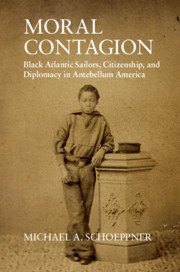
BOOK: Michael A. SCHOEPPNER, Moral Contagion : Black Atlantic Sailors, Citizenship, and Diplomacy in Antebellum America (Cambridge: Cambridge University Press, 2018). ISBN 9781108469999, £ 42.99


(Source: CUP)

Cambridge University Press is publishing a book dealing i.a. with the 19th century “Negro Seamen Acts”.  

ABOUT THE BOOK

Between 1822 and 1857, eight Southern states barred the ingress of all free black maritime workers. According to lawmakers, they carried a 'moral contagion' of abolitionism and black autonomy that could be transmitted to local slaves. Those seamen who arrived in Southern ports in violation of the laws faced incarceration, corporal punishment, an incipient form of convict leasing, and even punitive enslavement. The sailors, their captains, abolitionists, and British diplomatic agents protested this treatment. They wrote letters, published tracts, cajoled elected officials, pleaded with Southern officials, and litigated in state and federal courts. By deploying a progressive and sweeping notion of national citizenship - one that guaranteed a number of rights against state regulation - they exposed the ambiguity and potential power of national citizenship as a legal category. Ultimately, the Fourteenth Amendment recognized the robust understanding of citizenship championed by Antebellum free people of color, by people afflicted with 'moral contagion'.

ABOUT THE AUTHOR

Michael A. Schoeppner, University of Maine, Farmington
Michael A. Schoeppner is Assistant Professor of History at the University of Maine, Farmington.

TABLE OF CONTENTS

Introduction
1. The Atlantic's dangerous undercurrents
2. Containing a moral contagion, 1822–9
3. The contagion spreads, 1829–33
4. Confronting a pandemic, 1834–42
5. 'Foreign' emissaries and rights discourse, 1842–7
6. Sacrificing black citizenship, 1848–59
7. From the decks to the jails to assembly halls: black sailors, their communities, and the fight for black citizenship
Epilogue.

More information here

04 January 2019

JOURNAL: Law and History Review XXXVI (2018), No. 4 (Nov)

(image source: Twitter)

In This Issue In This Issue (Gautham Rao)

The Failure of Feminism? Rape Law Reform in the Republic of Ireland, 1980–2017 (Ciara Molloy)

Déjà Vu and the Gendered Origins of the Practice of Immigration Law: The Immigrants’ Protective League, 1907–40 (Felice Batlan)

“The Reasonable (Wo)man”: Physicians, Freedom of Contract, and Women's Rights, 1870–1930 (Lauren Macivor Thompson)

The Quality of Being French versus the Quality of Being Jewish: Defining the Israelite in French Courts in Algeria and the Metropole (Simon Rabinovitch)

No-Fault Divorce Reform in the 1950s: The Lost History of the “Greatest Project” of the National Association of Women Lawyers (Laura Oren)

Space, Law, and Justice in Leibniz: Leibniz as a Theorist of Spatial Justice (Ekaterina Yahyaoui Krivenko)

Civilizational Exceptions: Ottoman Law and Governance in Late Ottoman Palestine (Ahmad Amara)

Corporate Democracy: How Corporations Justified Their Right to Speak in 1970s Boston (Nikolas Bowie)

Using the Past and Bridging the Gap: Premodern Islamic Legal Texts in New Media (Mahmood Kooria)

In Defense of Progressive Legal Historiography In Defense of Progressive Legal Historiography (Laura Kalman)

Book reviews:
  • Matthew Lockwood, The Conquest of Death: Violence and the Birth of the Modern English State, New Haven: Yale University Press, 2017. Pp. ix, 404. $85.00 (ISBN: 978-0-300-21706-3)(Sara M. Butler)
  • Xavier Prévost, Jacques Cujas (1522-1590): Jurisconsulte humaniste (Travaux d'Humanisme et Renaissance, 541), Genève: Droz, 2015. Pp. xvi, 590. $122.76 paper (ISBN 978-2-600-01814-2). (Wim Decock)
  • Ditlev Tamm and Helle Vogt, eds., The Danish Medieval Laws: The Laws of Scania, Zealand and Jutland, London: Routledge, 2016. Pp. xiv, 349. $160.00 cloth (ISBN 978-1-138-95135-8); $54.95 ebook (ISBN 978-1-315-64637-4). (Jørn Øyrehagen Sunde)
  • Sergei Antonov, Bankrupts and Usurers of Imperial Russia: Debt, Property, and the Law in the Age of Dostoevsky and Tolstoy, Cambridge, MA: Harvard University Press, 2016. Pp. 386. $49.95 cloth (ISBN 9780674971486) (Catherine Evtuhov)
  • John O. Haley, Law's Political Foundations: Rivers, Rifles, Rice, and Religion, Cheltenham/Northampton, MA: Edward Elgar Publishing, 2016. Pp. viii, 256. $108.00 cloth (ISBN 9781785368493) (Jaakko Husa)
  • Paul Frymer, Building an American Empire: The Era of Territorial and Political Expansion, Princeton: Princeton University Press, 2017. Pp. 312. $35.00 cloth (ISBN 9780691166056). (Emilie Connolly)
  • Amalia D. Kessler, Inventing American Exceptionalism: The Origins of American Adversarial Legal Culture, 1800–1877, New Haven: Yale University Press, 2017. Pp. 464. $85.00 cloth (ISBN 9780300198072) (Nicholas R. Parrillo)
  • Cynthia Nicoletti, Secession on Trial: The Treason Prosecution of Jefferson Davis, New York: Cambridge University Press, 2017. Pp. 345. $99.99 cloth (ISBN 9781108415521); $29.99 paper (ISBN 9781108401531). (Jonathan W. White)
  • Laura Kalman, The Long Reach of the Sixties: LBJ, Nixon, and the Making of the Contemporary Supreme Court, New York: Oxford University Press, 2017. Pp. 488. $34.99 (ISBN-13: 978-0199958221). (Christopher W. Schmidt)
Read more on Cambridge Core.

BOOK: Paul CHAUVIN-HAMEAU, L’obligation militaire sous l’Ancien Régime, ed. Institut Universitaire Varenne (Paris: LGDJ, 2018). ISBN 978-2-37032-190-9, €45.00


(Source: LGDJ)

LGDJ has published a book on the obligation militaire during the Ancien Régime.

ABOUT THE BOOK

Cette thèse vise à analyser les fondements du devoir de risquer sa vie et de tuer pour l'État. Entre le XVIe et le XVIIIe siècle, ces deux volets consubstantiels de l'obligation militaire butent sur des critiques dont l'enjeu commun est, au fond, le rapport de l'individu au groupe et, plus précisément, le rapport du citoyen à l'État, mais aussi du chrétien à l'État et enfin de l'homme à l'État. Le monarque peut exiger l'accomplissement de l'obligation militaire de ses sujets en vertu de leur appartenance politique. Mais il ne peut prétendre exercer son pouvoir de manière inconditionnelle. À défaut de limites constitutionnelles, il existe alors des lois naturelles et divines qui encadrent le pouvoir coactif. Ces normes sont discutées par la doctrine mais aussi appliquées par le roi quand il légifère. L'ouvrage s'efforce de systématiser ce puissant travail argumentatif, d'en saisir les enjeux et les évolutions à travers l'étude des préambules des ordonnances royales et de la doctrine du droit politique. 

ABOUT THE AUTHOR

Juriste de formation (Université Paris II Panthéon-Assas), Paul CHAUVIN-HAMEAU s'est spécialisé en histoire du droit. Après avoir été doctorant contractuel à l'université Paris Sud-Saclay et A.T.E.R. à l'université Paris XIII Villetaneuse, il est aujourd'hui maître de conférences à l'université de Tours

More information here


03 January 2019

JOURNAL: Tijdschrift voor Rechtsgeschiedenis/Revue d'Histoire du Droit/Legal History Review LXXXVI (2018), Issue 3-4 (December)

(image source: Brill)

Mededeling van de Dagelijkse Redactie – Avis du Comité de Rédaction – Announcement of the Editorial Committee

Women in twelfth-century English lawsuits (Raoul C. van Caenegem)
Notwithstanding that the role of women in law courts could be expected to be modest for the Middle Ages, a perusal of lawsuits of the 12th century produced even a lesser proportion than expected.
Zum Anwendungsbereich des senatusconsultum Neronianum im Falle des Vindikationslegats fremder Sachen (Lisa Isola)
Das römische Vermächtnisrecht ist von zahlreichen Formalismen geprägt und öffnete sich erst nach und nach einer stärker materiellen Betrachtungsweise, die schließlich in der justinianischen Formfreiheit mündete. Das senatusconsultum Neronianum de legatis gilt dabei als erster Schritt einer Annäherung zwischen den einzelnen Legatstypen1, welche zunächst ganz unterschied­lichen Voraussetzungen unterlagen und damit in der Praxis offenbar erheb­liche Schwierigkeiten bereiteten. So war es nach ius civile insbesondere nicht ­möglich, Gegenstände mittels Vindikationslegat zu vermachen, die nicht im Eigentum des Erblassers standen; ein Beschaffungslegat in Form eines Damnationslegats hingegen war durchaus wirksam. Hier setzte die Bestimmung

Local traditions v. academic law: collateral rights on movables in Holland (c. 1300-c. 1700) (Dave De ruysscher & Ilya Kotlar)
In the County of Holland, in the sixteenth and seventeenth centuries the rules regarding security interests in movables changed fundamentally. Rules of doctrine came to be combined with rules found in local law, that is the bylaws of cities and regions. This went together with the re-interpreting of fragments of older bylaws. In 1631 Grotius’ Inleidinghe categorized the lien of the unpaid seller after delivery of the merchandise sold as entailing a reivindicatio. This new rule was adopted in cities in Holland, even though it ran counter the earlier approach that third-party effects of sales in this regard were very limited. Also, the new line of thought that holders with a legitimate title did not respond to pledgees pushed out older conceptions on tracing for some special pledges. In their legal writings Dutch authors after Grotius attempted to construe consistent solutions; in the legislative practice of cities, older rules could be preferred over new ones. Bylaws of cities, to which authors of Roman-Dutch doctrine referred as well, stipulated limits on tracing by unpaid sellers. All the mentioned developments were not determined by changes in the market, even though they could be incited by them. Legal change in Holland, even in the Golden Age of the seventeenth century, was due more to the embracing of academic ideas than to responsiveness to economic conditions.

Patent and innovation during the Industrial Revolution in England. Reflections on Josiah Wedgwood (1730-1795) (Deming Liu)
The article explores the role of patent or lack thereof in Josiah Wedgwood’s business. It first discusses the motive behind his opposition of extension of Richard Champion’s patent and then delves into his defence of his own patent in the dispute with the alleged infringer. It aims to show the incongruence of words and deeds of a tradesman with respect to patents; more importantly, it sets out to demonstrate that the claim of patent as an incentivising measure does not bear out as far as Wedgwood is concerned; rather, it is lack of patent protection that facilitates innovation in his pottery business.

Entrenchment Clauses in the History of Modern Constitutionalism (Michael Hein)
This article examines the origins, differentiation, and migration of constitutional entrenchment clauses from the beginning of modern constitutionalism until today. It is based on a broad understanding of ‘entrenchment clauses,’ covering all constitutional provisions that make amendments either to certain parts of a constitution or under certain circumstances more difficult to achieve than ‘normal’ amendments or even impossible, i.e., legally inadmissible. In particular, the article answers three questions: (1) When, and in which contexts, did the different types of constitutional entrenchment clauses emerge? (2) How have these types spread globally? (3) Which constitutional subjects do such clauses protect, and thus, which main functions do they aim to fulfill? The article is based on the new and unique Constitutional Entrenchment Clauses Dataset (CECD), which comprises 860 written national constitutions worldwide from 1776 until the end of 2015.

‘Strasbourg was something new, it was an adventure’. A history of the Belgian cases before the European Court of Human Rights in the 1960s, 1970s and 1980s (Laurens Lavrysen)
Abstract:
In recent years, a burgeoning literature has focused on the history of human rights in general and the history of the European Convention on Human Rights (ECHR) in particular. In order to understand how the ECHR gradually managed to gain authority in diverse national settings, it is necessary to complement transnational historical perspectives with studies of national reception histories. The present article approaches the history of the ECHR in Belgium by focusing on the history of the Belgian cases in Strasbourg, which have played an important role in contributing to the ‘discovery’ of the ECHR in the Belgian legal system. On the basis of interviews with actors involved in the early cases against Belgium, it was possible to determine their position in the Belgian legal landscape as well as their motivations and aspirations in going to Strasbourg. Moreover, these interviews allowed gaining insight into the circumstances out of which litigation against Belgium arose.

Book reviews:
  • Kille mist. Het Nederlandse notariaat en de erfenis van de oorlog, written by R. Schütz, 2016 (P.L. Nève)
Nécrologie In memoriam Johannes Antonius Eligius Kuijs, 1952-2018 (Jan Hallebeek)

(More on the Brill-website)

BLOG: Klaus RÖHL (Bochum) on interdisciplinary research in law (Rsozblog.de)

(image source: rsozblog)

First paragraph:
»Alle reden von Interdisziplinarität aber keiner tut es« (Veronika Fuest). Aber jedenfalls passen sich alle an, denn sie stehen unter dem Diktat der für die Wissenschaftsorganisation und Finanzierung zuständigen Instanzen, die bei praktisch allen Mittelanträgen, Akkreditierungen oder Evaluationen im Wissenschaftssystem Interdisziplinarität als Kriterium verwenden, vermutlich auch, weil dieses Kriterium einfacher zu handhaben ist als Qualität in der Sache.
(source: Rsozblog)

BOOK: Nicholas BARBER, Maria CAHILL, and Richard EKINS, eds., The Rise and Fall of the European Constitution. (London: Hart Publishing, 2018). ISBN 9781509910984, £60.00


(Source: Hart Publishing)

Hart Publishing is publishing a new book on the Draft European Constitution “with the benefit of hindsight”.

ABOUT THE BOOK

The Draft European Constitution was arguably both an attempt to constitutionalise the Union, re-framing that project in the language of the state, and an attempt to stretch the boundaries of constitutionalism itself, re-imagining that concept to accommodate the sui generis European Union. The (partial) failure of this project is the subject of this collection of essays. The collection brings together leading EU constitutional scholars to consider, with the benefit of hindsight, the purportedly constitutional character of the proposed Constitutional Treaty, the reasons for its rejection by voters in France and the Netherlands, the ongoing implications of this episode for the European project, and the lessons it teaches us about what constitutionalism really means.

ABOUT THE EDITORS

NW Barber
NW Barber is Associate Professor of Constitutional Law, University of Oxford.
Maria Cahill
Maria Cahill is Lecturer in Law at the University College Cork.
Richard Ekins
Richard Ekins is Associate Professor of Law, University of Oxford.

More information here

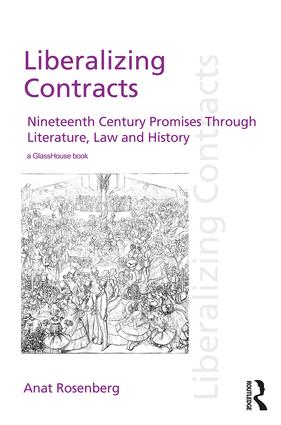
BOOK: Anat ROSENBERG, Liberalizing Contracts: Nineteenth Century Promises Through Literature, Law and History (London: Routledge, 2019). ISBN 9780367150839, £29.59


(Source: Routledge)

In 2017, Routledge published a book on 19th century liberal thought and the concept of contract in England. The paperback version has now been published.

ABOUT THE BOOK

In Liberalizing Contracts Anat Rosenberg examines nineteenth-century liberal thought in England, as developed through, and as it developed, the concept of contract, understood as the formal legal category of binding agreement, and the relations and human practices at which it gestured, most basically that of promise, most broadly the capitalist market order. She does so by placing canonical realist novels in conversation with legal-historical knowledge about Victorian contracts. Rosenberg argues that current understandings of the liberal effort in contracts need reconstructing from both ends of Henry Maine's famed aphorism, which described a historical progress "from status to contract." On the side of contract, historical accounts of its liberal content have been oscillating between atomism and social-collective approaches, missing out on forms of relationality in Victorian liberal conceptualizations of contracts which the book establishes in their complexity, richness, and wavering appeal. On the side of status, the expectation of a move "from status" has led to a split along the liberal/radical fault line among those assessing liberalism's historical commitment to promote mobility and equality. The split misses out on the possibility that liberalism functioned as a historical reinterpretation of statuses – particularly gender and class – rather than either an effort of their elimination or preservation. As Rosenberg shows, that reinterpretation effectively secured, yet also altered, gender and class hierarchies. There is no teleology to such an account.

ABOUT THE AUTHOR

Dr. Anat Rosenberg is an Assistant Professor (Lecturer) at the Radzyner Law School, The Interdisciplinary Center (IDC) Herzliya, Israel. She had been a visiting research fellow at Columbia Law School, and is currently a visiting scholar at the Faculty of History at the University of Cambridge, and a visiting fellow at the Institute of Advanced Legal Studies, the University of London. Her research brings together law, literature, sociology and cultural studies, to study the history of late modern capitalism.

TABLE OF CONTENTS

Introduction; 1. Contract’s Liberalism in Contracts Histories;   Part I: From Status   Foreword to Part I;   2.Credit and the Market: Vanity Fair and The Way We Live Now; 3. Contract and Abstraction(?): Agency in Ruth and Bleak House;   4. Contract and Freedom(?): Constrained Existence in Middlemarch and The Mayor of Casterbridge;   Part II: With Status   Foreword to Part II;   5. Status-to-Contract Reassessed: The Victorian Promise of Marriage;   6. Liberal Anguish: Wuthering Heights and the Structures of Liberal Thought;   Epilogue: History is Always in the Future

More information here


02 January 2019

JOURNAL: Grotiana XXXIX (2018), Issue 1 (December)

(image source: Brill)

An Unpublished Letter from Herbert of Cherbury to Grotius on the Expeditio in Ream Insulam: Commentary, Text, and Translation (Felix Waldmann)
Abstract:
The following article presents the text and translation of an unpublished letter to Grotius from Edward Herbert (1582?–1648), Lord Cherbury. The letter pertains to Cherbury’s The expedition to the Isle of Rhé or Expeditio in Ream Insulam – his manuscript account of the duke of Buckingham’s abortive siege of the Isle of Ré in July–October 1627.
Grotius, Dio Chrysostom and the ‘Invention’ of Customary ius gentium (Francesca Iurlarlo)
Abstract:
This article tackles the issue of whether and how Hugo Grotius conceives of custom as a formal source of the law of nations. The main claim of it is that not only custom plays a fundamental role in Grotius’s thought, but that his reflections mark a fundamental turning point for the history of customary international law. A crucial role in this process of re-conceptualization is played by Grotius’s reading of Dio Chrysostom, whose oration On custom provides him with an integrated account of custom as a ‘normative practice’ based on rhetorical judgment (as opposed to the Scholastic interpretation of custom as reiteration of voluntary acts). Consequently, I argue that Dio Chrysostom’s text helps Grotius to transpose the question of the normative legitimacy of custom from a moral to an interpretative level. To conclude, I will show that Grotius adopts two different rhetorical strategies to prove the existence of customary norms of ius gentium.
 States and Patrimonial Kingdoms: Hugo Grotius’s Account of Sovereign Entities in The Rights of War and Peace (Emile Simpson)
Abstract:
In this article I set out Hugo Grotius’s account of sovereign entities in the De Iure Belli ac Pacis (The Rights of War and Peace, 1625). In so doing, I seek to challenge a claim not uncommonly encountered in the recent historiography of the work, namely, that Grotius had no account of the state therein. In challenging that claim, I will make a further claim that while Grotius did have an account of the state, it was only one of two forms of sovereign entity, the other being the patrimonial kingdom. While this last claim is occasionally encountered in terms of a distinction between forms of government, I go further, on the basis that the distinction identifies a fundamental conceptual difference between free and unfree nations, which speaks not only to the form of government, but to the nature of the sovereign entity itself. Furthermore, it is my contention that through the patrimonial kingdom, Grotius was able to account for empire.
 A Reply to Grotius’s Critics. On Constitutional Law (Gustaaf van Nifterik)
Abstract:

It is not always easy to interpret Grotius’s constitutional theory that lies hidden within his book on the law of war and peace. After a very concise discussion of this constitutional framework, this study turns to various interpretations and conclusions by contemporary scholars that sit awkwardly within the theory. The interpretations of Richard Tuck, Peter Borschberg, Knud Haakonson, Frank Grunert, Deborah Baumgold, Marco Barducci, Daniel Lee and Gustaaf van Nifterik are discussed critically. 
An Introduction to the Smaller Bodies of Water in Hugo Grotius’s Legal Theory (Laurelin Middelkoop)
Abstract:
Around the same time as his writing of De iure belli ac pacis, Hugo Grotius wrote a short tract: Introduction to the jurisprudence of Holland. He was the first to offer a systematic account of the substantive law of Holland, with a specific focus on rights over laws. I propose that by drawing a comparison between the Introduction and his other major law treatises, the key elements and differences of his argument in Mare liberum become clearer. Secondly, it shows a different side of Grotius as a legal theorist, one concerned with smaller legal issues surrounding property relations in Holland, where potential conflicts stemming from water damage are particularly common and likely. By focusing on how Grotius handles categories of smaller bodies of water, in Introduction but also in ibp and De iure praedae, his understanding of what makes some water susceptible to ownership is drawn out.
 Book reviews:
  • The Historical Foundations of Grotius’ Analysis of Delict [Legal History Library 24], written by Joe Sampson (Eltjo Schrage)
  • Scriptural Authority and Biblical Criticism in the Dutch Golden Age: God’s Word Questioned, edited by Dirk van Miert, Henk J. M. Nellen, Piet Steenbakkers, and Jetze Touber (Nicholas Hardy)
  • Hugo Grotius and the Modern Theology of Freedom: Transcending Natural Rights, written by Jeremy Seth Geddert (Andrew Blom)
  • Hugo Grotius and the Century of Revolution 1613–1718: Transnational Reception in English Political Thought, written by Marco Barducci (Marco Barducci)
  • Criticism and Confession. The Bible in the Seventeenth Century Republic of Letters, written by Nicholas Hardy (Sarah Mortimer)
  • Necessity in International Law, written by Jens David Ohlin & Larry May (Ioannis D. Evrigenis)
Bibliography (Rens Steenhard)

More information with Brill.

CALL FOR PAPERS : Laypersons in Law - Social Science Perspectives on Legal Practices of Non-professionals (Berlin, 9-10 May 2019), DEADLINE: 15 January 2019


(Source: H/Soz/Kult)

Via H/Soz/Kult, we learned of a call for papers for a conference on laypersons in law, and which also welcomes legal historical contributions.

The Centre Marc Bloch and the Otto-von-Guericke University Magdeburg organize an international conference on legal practices of laypersons to be held in Berlin from 09 to 10 May 2019.

Lay judges and jury members in criminal trials; activists establishing so-called “people’s” or “citizen’s” tribunals, or proponents of alternative law - most of them are not legal experts with state-sanctioned competences. And yet, they all practice law, contribute to its production and development. In contrast, socio-legal research on law conceptualizes norms and acts mostly in the context of legal experts and legal institutions, including parliament, courts, tribunals and international organizations.

[…]

Read the full CfP here