Search

Showing posts with label Law and social sciences. Show all posts

28 June 2024

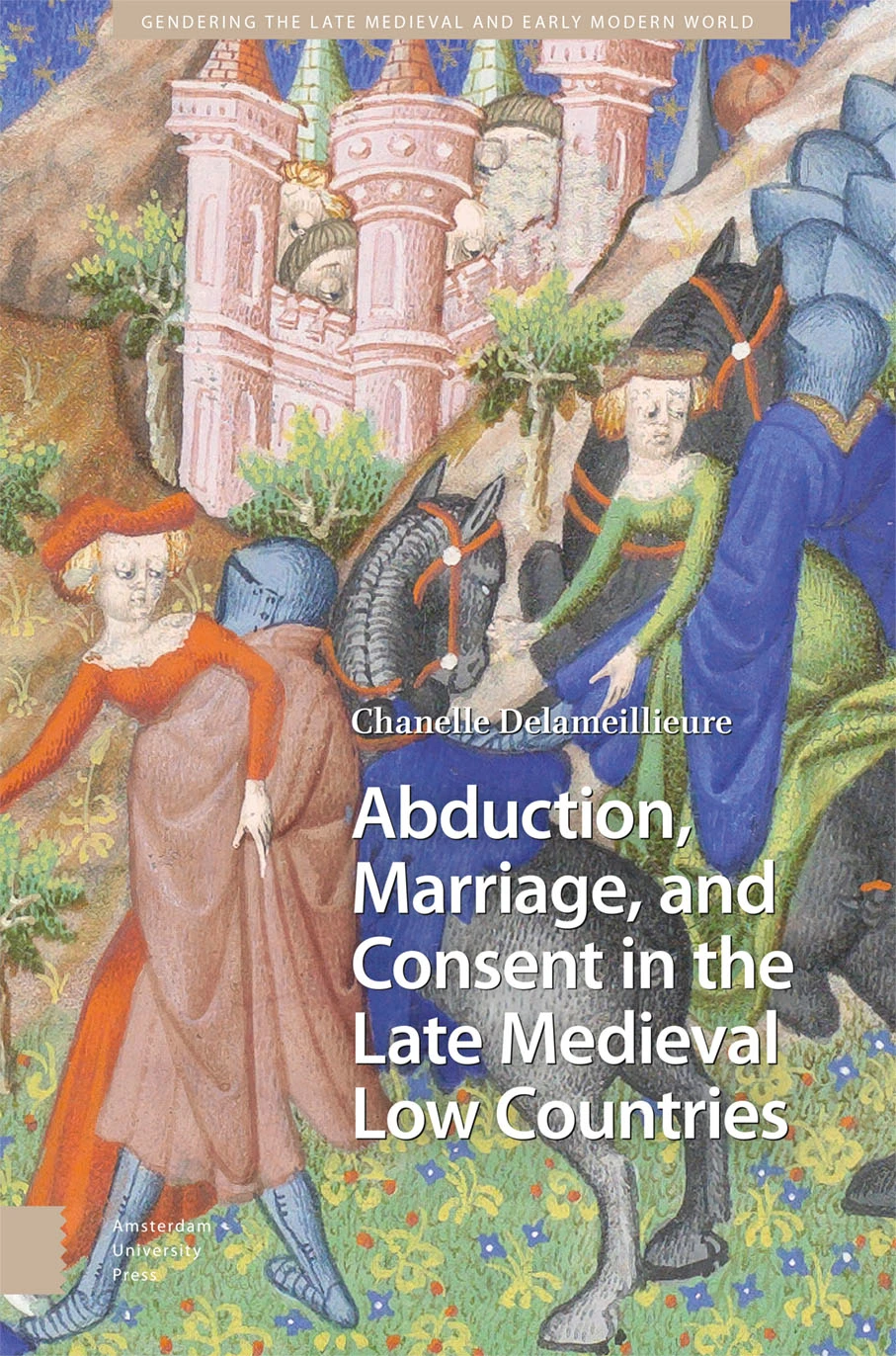
BOOK: Chanelle DELAMEILLIEURE, Abduction, Marriage, and Consent in the Late Medieval Low Countries (Amsterdam: Amsterdam University Press, 2024). ISBN: 9789463724074


ABOUT THE BOOK
The Middle Dutch term schaec referred to abduction with marital intent. This book explores this phenomenon to understand wider attitudes towards marriage-making in the fifteenth-century Low Countries. Whilst exchanging words of consent was all that was required legally, making marriage was a social process that evoked public concern and familial scrutiny. Abductions embodied contrasting evaluations of what mattered when selecting a spouse and resulted in polarized trials in which narratives on consent, coercion, and family strategy coincided and competed. Abduction, Marriage, and Consent draws from a wide range of legal records to assess how men, women, families, and authorities used, navigated, and dealt with abductions during this period. It contributes to debates on consent, family involvement, and women’s access to justice and demonstrates that abduction should be approached as a comprehensive social phenomenon, one that is crucial in the history of marriage and women’s social and legal status.

ABOUT THE AUTHOR
Chanelle Delameillieure researches late medieval gender and family history with a focus on marriage, sexuality and the social history of the law. She is a tenure track professor of medieval history at KU Leuven.

TABLE OF CONTENTS
Introduction
I. Perks and Perils of Being an Heiress
II. Abduction’s Who, How, and Why?
III. Consent in and out of the Courtroom
IV. What Authorities Did to Help
Conclusion

More information can be found here.

16 September 2019

BOOK: Bernadette MEYLER, Theaters of Pardoning (Ithaca: Cornell University Press, 2019). ISBN 978-1-5017-3933-0


Cornell University Press has published a new book on “theatres of pardoning”.

ABOUT THE BOOK

From Gerald Ford's preemptive pardon of Richard Nixon and Donald Trump's claims that as president he could pardon himself to the posthumous royal pardon of Alan Turing, the power of the pardon has a powerful hold on the political and cultural imagination. In Theaters of Pardoning, Bernadette Meyler traces the roots of contemporary understandings of pardoning to tragicomic "theaters of pardoning" in the drama and politics of seventeenth-century England. Shifts in how pardoning was represented on the stage and discussed in political tracts and in Parliament reflected the transition from a more monarchical and judgment-focused form of the concept to an increasingly parliamentary and legislative vision of sovereignty.

Meyler shows that on the English stage, individual pardons of revenge subtly transformed into more sweeping pardons of revolution, from Shakespeare's Measure for Measure, where a series of final pardons interrupts what might otherwise have been a cycle of revenge, to later works like John Ford's The Laws of Candy and Philip Massinger's The Bondman, in which the exercise of mercy prevents the overturn of the state itself. In the political arena, the pardon as a right of kingship evolved into a legal concept, culminating in the idea of a general amnesty, the "Act of Oblivion," for actions taken during the English Civil War. Reconceiving pardoning as law-giving effectively displaced sovereignty from king to legislature, a shift that continues to attract suspicion about the exercise of pardoning. Only by breaking the connection between pardoning and sovereignty that was cemented in seventeenth-century England, Meyler concludes, can we reinvigorate the pardon as a democratic practice.


17 January 2019

BOOK: Robert CARVAIS and Cédric GLINEUR, (eds.), L’Etat en scènes. Théâtres, opéras, salles de spectacles du XVIe au XIXe siècle. Aspects historiques, politiques et juridiques (Amiens: CEPRISCA, 2018). ISBN 979-10-97323-02-8, €39.00


(Source: Hi-D)

Via Hi-D, we learned of the publication of a new book which includes several legal historical contributions on the link between theatre, opera and other public spectacles and the legitimation of public power between the 16th-19th century.

ABOUT THE BOOK

« Le pouvoir entretient une relation particulière avec le monde des spectacles. Souvent les princes se sont mis en scène au travers de protocoles minutieux. Parfois, ils ont eux-mêmes fait l’objet de spectacles dans lesquels les acteurs leur ont attribués des rôles taillés sur mesure allant du drame au burlesque.

Cependant, les spectacles ne se jouent pas seulement pour la Cour, dans les résidences royales ou impériales. Dès le XVIe siècle, les princes comprennent l’utilité politique des pièces de théâtre, qui peuvent servir à montrer leur puissance et à assurer leur propagande. Ils saisissent l’intérêt social de ces divertissements, appréciés et recherchés au sein des couches les plus aisées de la population. Autour de trois thèmes – la construction des salles, leur fonctionnement et leur programmation -, sont ici réunies vingt-neuf contributions répondant à une recherche européenne, comparatiste et interdisciplinaire destinée à confronter la vision des juristes, des historiens, des politistes et des sociologues » (Extrait de la présentation de la 4e de couverture).

 ABOUT THE EDITORS

Cédric GLINEUR est professeur d’histoire du droit à l’Université de Picardie Jules
Verne et dirige le Centre de droit privé et de sciences criminelles d’Amiens. Ses travaux
portent sur l’histoire administrative aux périodes moderne et contemporaine.
Robert CARVAIS est directeur de recherche CNRS, Centre de théorie et analyse du
droit, Université Paris Nanterre. Ses travaux portent sur la confrontation de l’histoire du
droit avec l’histoire des sciences, des arts et des techniques.

The ToC can be found here

(Source : Hi-D)

02 January 2019

CALL FOR PAPERS : Laypersons in Law - Social Science Perspectives on Legal Practices of Non-professionals (Berlin, 9-10 May 2019), DEADLINE: 15 January 2019


(Source: H/Soz/Kult)

Via H/Soz/Kult, we learned of a call for papers for a conference on laypersons in law, and which also welcomes legal historical contributions.

The Centre Marc Bloch and the Otto-von-Guericke University Magdeburg organize an international conference on legal practices of laypersons to be held in Berlin from 09 to 10 May 2019.

Lay judges and jury members in criminal trials; activists establishing so-called “people’s” or “citizen’s” tribunals, or proponents of alternative law - most of them are not legal experts with state-sanctioned competences. And yet, they all practice law, contribute to its production and development. In contrast, socio-legal research on law conceptualizes norms and acts mostly in the context of legal experts and legal institutions, including parliament, courts, tribunals and international organizations.

[…]

Read the full CfP here